
 2,
2,- 1IPGP, Université Paris Cité, Paris, France (mallet@ipgp.fr)
- 2IPGP, Université Paris Cité, Paris, France (limare@ipgp.fr)
- 3Collège de France, PSL Research University, Paris, France (Alessandro.Morbidelli@oca.eu)
The early differentiation of planetesimals is recorded by iron meteorites. Planetesimal thermal evolution models combined with constraints from Hf–W isotopic core formation ages and inferred core sizes, provide insights into the initial formation conditions of both non-carbonaceous (NC) and carbonaceous (CC) parent bodies (1Kruijer2020), 2Spitzer2021). Most thermal evolution models have focused on ice-free planetesimals (3Kruijer2014, 4Neumann2012, 5Neumann2018, 6Kaminski2020), or have modelled the effect of water in an inconsistent manner (2Spitzer2021), leaving the physical mechanisms that enable ice-rich planetesimals to undergo differentiation poorly understood. However, the role of ice may significantly affect both heat transport and energy budgets. This leads us to investigate under which conditions ice-bearing planetesimals can undergo efficient heating and differentiation despite the presence of ice.
In this study, we investigate the thermal evolution, core formation times and core sizes of planetesimals using a one-dimensional numerical model. The model solves the heat conduction equation with an implicit finite-volume scheme that includes temperature and pressure-dependent thermal properties of ice, latent heat effects associated with ice sublimation, porosity evolution through cold compaction and sintering, and the onset of silicate convection that takes place at the rheological temperature transition (RTT), when the matrix disaggregate, allowing metal-silicate segregation. We did not take into account the eventual metal and silicate melt migration before the RTT. Because core growth is continuous, the modelled Hf-W core formation time represent an integrated, volume-weighted differentiation age rather than an instantaneous core formation event. We explore a range of initial ice mass fractions and accretion times, assuming instantaneous accretion of a 40 km radius body (7Morbidelli2022) and a chondritic composition (8Jarosewich1990).
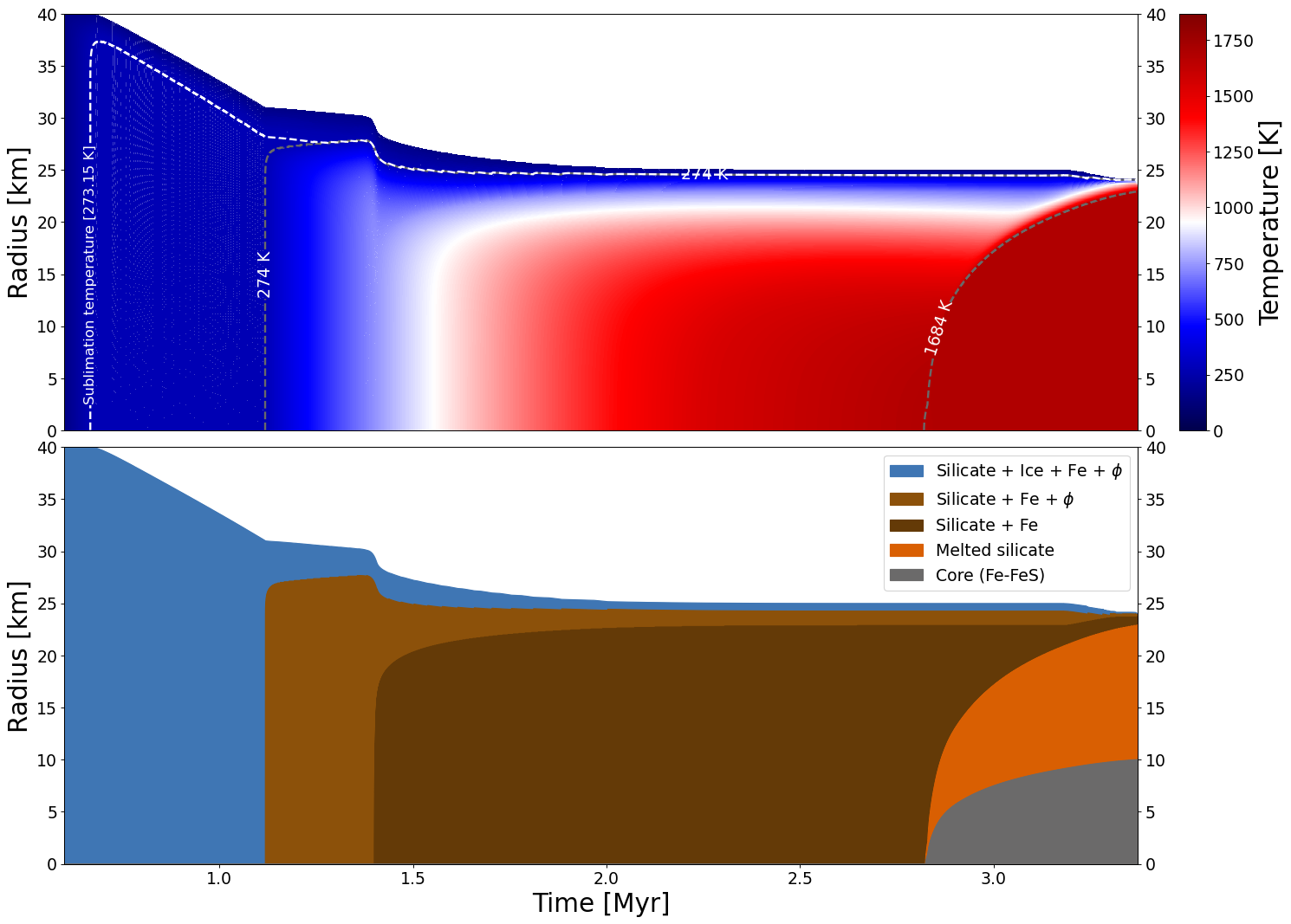
Figure 1: Top panel: Time evolution of the internal temperature of a planetesimal with an initial radius of 40 km formed at 0.6 Myr after CAI with an initial ice mass fraction 31 wt%. Dashed lines represents isotherms. Bottom panel: Corresponding structural evolution of the body.
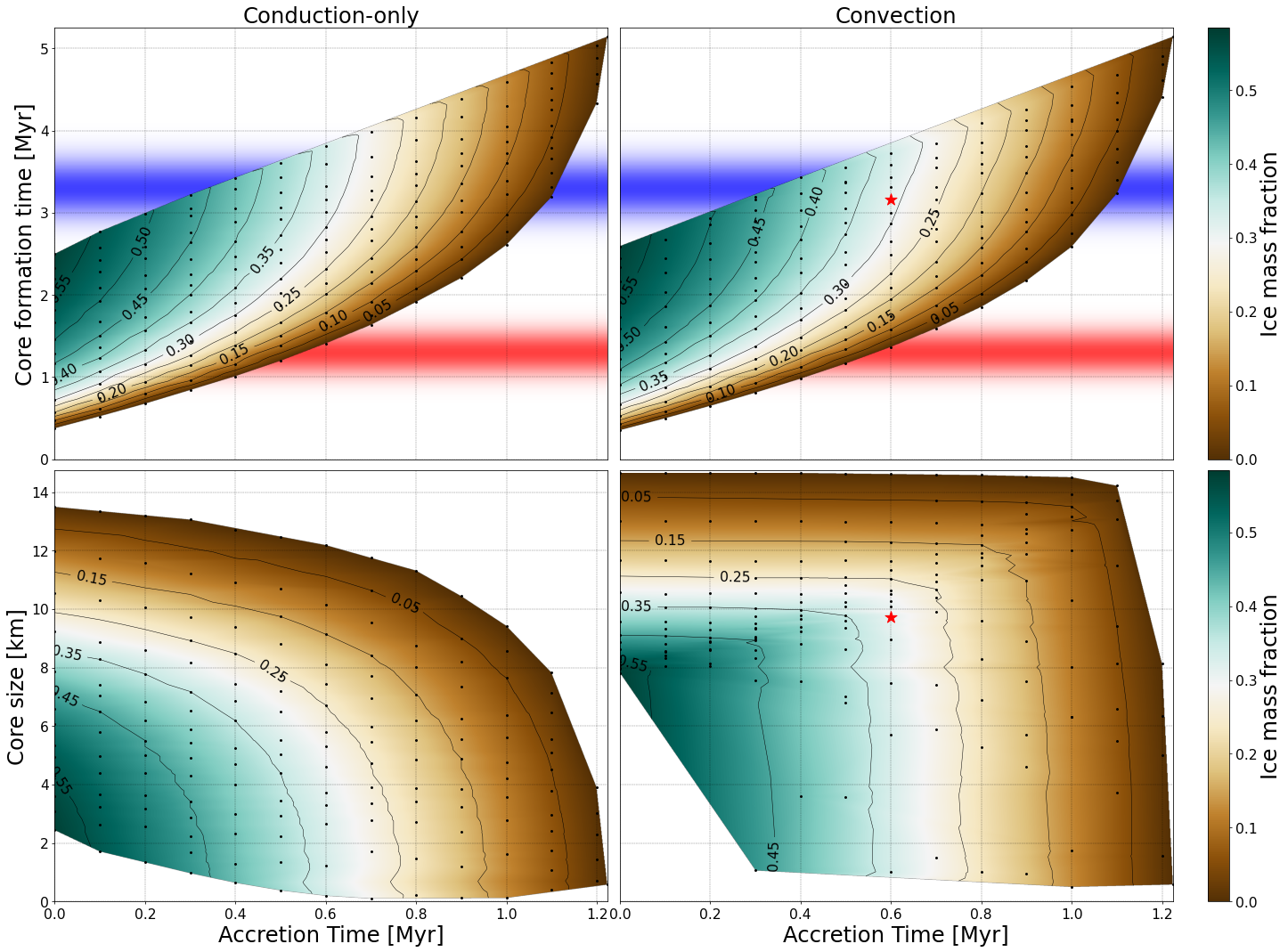
Fgure 2: Top panels: Modelled Hf-W core formation time as a function of accretion time and ice mass fraction. Bottom panels: Core size as a function of accretion time and ice mass fraction. Left panels: Simulations performed under conduction-only assumption. Right panels: Simulations performed accounting for silicate convection. Black dots represent individual simulations. The colormap represents the interpolated ice mass fraction. The red star represent the simulation result shown in figure 1. Red and blue shaded areas represent the mean ages of the volatile-rich NC and CC iron groups, respectively, as reported in 2Spitzer2021.
Our results show that ice mass fraction is the primary control on thermal evolution. Increasing the initial ice content reduces total content of rocky material that contain the radiogenic heat sources and simultaneously introduce an energy sink through ice sublimation. Ice also strongly affects thermal conductivity, which at low temperatures can exceed that of the rocky matrix by up to a factor of two, thereby enhancing conductive heat transport toward the surface. As a result, ice-rich bodies are more difficult to heat, narrowing the time-range allowing differentiation or even preventing core formation depending on initial conditions.
We also find that the radial structure of thermal conductivity has a major impact on thermal evolution. Since thermal conductivity is directly linked to porosity, the two-stage porosity evolution (cold compaction followed by sintering) plays a key role in regulating heat transport. Denser and sintered regions exhibit significantly higher conductivity, enhancing conductive heat transfer whereas low-conductivity layers act as insulating barriers that thermally decouple the interior from the surface.
The onset of silicate convection introduces a new heat transport regime within the planetesimal. Once triggered, convection rapidly redistribute internal heat and can lead to widespread melting. This convective regime is achieved once the rheological temperature transition is reached, thereby controlling the onset of convection and, consequently, the timing of core formation. Although this transition temperature depends on composition, it varies in a narrow range and therefore exerts only a limited influence on differentiation ages. The onset of convection results in the rapid formation of a metallic core throughout the body. In contrast, conduction-only models predict a gradual decrease in core size with increasing ice mass fraction and accretion time.
References:
1 TS. Kruijer, T. Kleine and L.E. Borg. The great isotopic dichotomy of the early Solar System. Nature Astronomy. 2020
2 F. Spitzer, C. Burkhardt, F. Nimmo and T. Kleine. Nucleosynthetic Pt isotope anomalies and the Hf-W chronology of core formation in inner and outer solar system planetesimals. Earth and Planetary Science Letters. 2021
3 TS. Kruijer, M. Touboul, M. Fischer-Gödde, KR. Bermingham, RJ Walker and T. Kleine. Protracted core formation and rapid accretion of protoplanets. Science. 2014
4 W. Neumann, D. Breuer and T. Spohn. Differentiation and core formation in accreting planetesimals. Astronomy & Astrophysics. 2012
5 W. Neumann, TS. Kruijer, D. Breuer and T. Kleine. Multistage Core Formation in Planetesimals Revealed by Numerical Modeling and Hf-W Chronometry of Iron Meteorites. Journal of Geophysical Research: Planets. 2018.
6 E. Kaminski, A. Limare, B. Kenda and M. Chaussidon. Early accretion of planetesimals unraveled by the thermal evolution of the parent bodies of magmatic iron meteorites. Earth and Planetary Science Letters. 2020
7 A. Morbidelli, K. Baillie, K. Batygin, S. Charnoz, T. Guillot, D. Rubie and T. Kleine. Contemporary formation of early Solar System planetesimals at two distinct radial locations. Nature Astronomy. 2022.
8 E. Jarosewich. Chemical analyses of meteorites: A compilation of stony and iron meteorite analyses. Meteoritics. 1990.
How to cite: Mallet, L., Limare, A., and Morbidelli, A.: Coupled effects of ice, porosity, and convection on core formation of iron meteorites parent bodies, Europlanet Science Congress 2026, The Hague, The Netherlands, 7–11 Sep 2026, EPSC2026-520, https://doi.org/10.5194/epsc2026-520, 2026.


