
 1,2,2,3,3,4
- 1Institute for Space Astrophysics and Planetology, Planetology, Roma, Italy (marjorie.galinier@inaf.it)
- 2School of Physics and Astronomy, University of Leicester, University Road, Leicester, LE1 7RH, UK
- 3Université Côte d’Azur, CNRS–Lagrange, Observatoire de la Côte d’Azur, 96 Boulevard de l’Observatoire, Nice, 06304, France
- 4INAF – Osservatorio Astronomico di Roma., Via Frascati 33, Rome, I-00078 Monte Porzio Catone, Italy
Erg Chech 002 is known as the ‘oldest andesite of the Solar System’ thought to have formed in the primitive crust of an early accreted and differentiated planetesimal in the beginning of the Solar System history [1]. Because of its unique spectral features, among which the presence of a small band around 650 nm, it was not found to match any known asteroid spectral type know in the literature [1]. Exploiting the Gaia Data Release 3 (DR3) dataset of visible reflectance spectra of asteroids [2], we found 142 asteroids as potential analogues of laboratory and modeled space-weathered spectra of Erg Chech 002 in a previous study [3]. However, the search for potential analogues of EC 002 using visible-range spectral data is challenging because of the similarity between the spectrum of andesitic and basaltic bodies in this range. Thus, these asteroids remained to be confirmed as analogues of the meteorites by observations in the near-infrared wavelength range, as this range contains diagnostic spectral features representative of specific mineralogies and allowing to distinguish basaltic from andesitic bodies.
As a follow up, we acquired new near-infrared observations with NASA’s IRTF of 20 of the main belt asteroids found as potential analogues of the meteorite [4]. We merged their near-infrared spectra with their visible Gaia DR3 spectra, and we classified the asteroids as a first insight of their composition. Among the observed asteroids, we obtained 16 V-types, one S-complex object, and one A-type. To complete our study, we included the literature spectra of asteroids 10537, 14390 and 7472, that were found to show peculiar spectral signatures (among which a small band around 650 nm), and are hypothesized to be fragments of differentiated planetesimals [5,6,7]. We analyzed the band centers and band area ratios of the observed and literature asteroids, since these diagnostic spectral features are directly related to the mineral composition of the asteroids and were found to be insensitive to space weathering [8]. The comparison of these diagnostic spectral features with those of Erg Chech 002, displayed in Fig.1, showed that none of the observed asteroids constitutes a good analogue for the meteorite. Instead, asteroids 10537 and 14390 emerge as potential matches to Erg Chech 002, and asteroid 7472 may match with a more olivine-rich sample of the meteorite. These asteroids could therefore belong to a new spectral class of andesitic bodies, and objects exhibiting similar spectral features in the main belt should be further studied, in order to better constrain the differentiation processes that took place in the early Solar System.
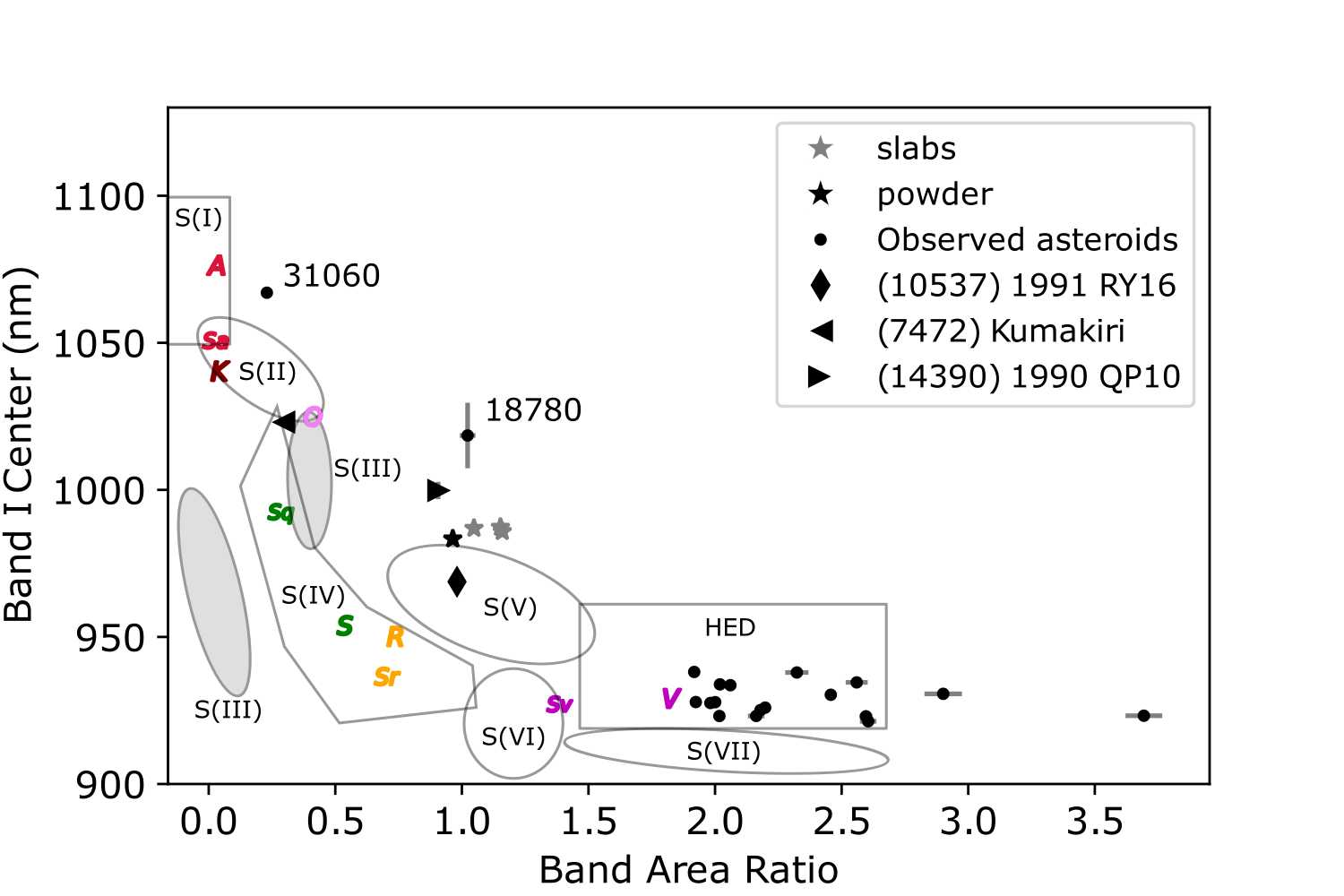
Fig.1: Band I Centre (BIC) with respect to BII/BI band area ratio (BAR) of Erg Chech 002 (stars), observed asteroids (dots), taxonomic end-members of DeMeo et al. (2009) taxonomy (colored letters), and literature asteroids 10537 (diamond), 7472 and 14390 (triangles). Light grey: mineralogical subdivisions defined in [8].
[1] Barrat, J.-A., Chaussidon, M., Yamaguchi, A., Beck, P., Villeneuve, J., Byrne, D.J., Broadley, M.W., Marty, B., Proc. Natl. Acad. Sci. 2021, 118.
[2] Gaia Collaboration, Galluccio, L., Astronomy & Astrophysics 2023, 674.
[3] Galinier, M., Delbo, M., Avdellidou, C., Galluccio, L., Marrocchi, Y., Astronomy & Astrophysics 2023, 671.
[4] M. Galinier, C. Avdellidou, M. Delbo, L. Galluccio., Icarus 2026, 453.
[5] Duffard, R., Roig, F., 2009. Planetary and Space Science 57 (2), 229–234.
[6] Moskovitz, N.A., Lawrence, S., Jedicke, R., Willman, M., Haghighipour, N., Bus, S.J., Gaidos, E., The Astrophysical Journal Letters 2008, 682.
[7] Leith, T.B., Moskovitz, N.A., Mayne, R.G., DeMeo, F.E., Takir, D., Burt, B.J., Binzel, R.P., Pefkou, D., Icarus 2017, 295, 61–73.
[8] Gaffey, M.J., Mineralogy of asteroids, in: AIP Conf. Proc., Eds. Telles, E., Dupke, R., Lazzaro, D., AIP Publishing, 2011, Rio de Janeiro; pages: 129-169.
Acknowledgements: MG and MD acknowledge financial support from CNES and the Action Specifique Gaia. MD is Leverhulme Visiting Professor at the University of Leicester with financial support from the Leverhulme Trust (UK). MD, CA, and LG acknowledge financial support from the ANR ORIGINS (ANR-18-CE31-0014). MG, CA and MD were Visiting Astronomers at the Infrared Telescope Facility, which is operated by the University of Hawaii under contract 80HQTR19D0030 with the National Aeronautics and Space Administration. This work has made use of data from the European Space Agency (ESA) mission Gaia, processed by the Gaia Data Processing and Analysis Consortium (DPAC). Funding for the DPAC has been provided by national institutions, in particular the institutions participating in the Gaia Multilateral Agreement.
How to cite: Galinier, M., Avdellidou, C., Delbo, M., and Galluccio, L.: Near-infrared spectroscopy search for analogues of andesitic meteorite Erg Chech 002 in the Main Belt, Europlanet Science Congress 2026, The Hague, The Netherlands, 7–11 Sep 2026, EPSC2026-523, https://doi.org/10.5194/epsc2026-523, 2026.


