
 3,4,5,6,7,8,9,
- 1DLR Institute of Space Research, Berlin, Germany (jean-baptiste.vincent@dlr.de)
- 2Department of Systems Innovation, School of Engineering, The University of Tokyo, Tokyo, Japan
- 3Observatoire de la Côte d’Azur, CNRS, Laboratoire Lagrange, Université Côte d’Azur, Nice, France
- 4European Space Astronomy Centre, European Space Agency, Villanueva de la Cañada, Madrid, Spain
- 5University of Grenoble, Grenoble, France
- 6Royal Observatory of Belgium, Brussels, Belgium
- 7Institut Supérieur de l’Aéronautique et de l’Espace (ISAE-SUPAERO), Université de Toulouse, Toulouse, France
- 8Dipartimento di Ingegneria Industriale, University of Bologna, Forlì, Italy
- 9Astronomical Observatory of Padova, INAF, Padova, Italy
- 10Department of Mechatronics, Optics and Engineering Informatics, Budapest University of Technology and Economics, Budapest, Hungary
- 11European Space Operations Center, Darmstadt, Germany
The Asteroid Framing Cameras (Vincent+2026) onboard ESA's Hera spacecraft (Michel+2026) are two identical panchromatic cameras with a field of view of 5.5 x 5.5 degree and an angular resolution of 93.7 micro-radians per pixel. Only one camera will be used at any time: nominally AFC1, with AFC2 serving as a redundancy instrument. Hereafter we use the acronym AFC to refer to the active camera.
The AFC design requirements were set to ensure a global mapping of both asteroids in the Didymos system down to a spatial scale of 0.5 meter per pixel, with 10 cm per pixel in selected regions of interest. The data is used for navigation and morphological characterization of the mission's targets. Figures 1 and 2 provide a summary of the expected distances and spatial scale, as well as sub-spacecraft latitude and phase angle.
By building a comprehensive visual characterisation of two Near-Earth Asteroids, the AFC contributes to Hera's Planetary Defense goal: to acquire the knowledge necessary for the deflection of a potentially hazardous object, when the time comes.
After Hera reaches the asteroids, the AFC baseline plan is to acquire one image every 15 min, within the operational constraints of the mission (typically 15h of observations followed by 8 hours of data transmission, with 1h margin, per day). This cadence guarantees sufficient redundancy and overlap between consecutive images to ensure a complete coverage of the surface of both asteroids. The outcome will be a new morphological map of Didymos and Dimorphos, documenting the changes induced by the DART impact in 2023 (see Barnouin+2024 for the pre-impact map).
The relatively rapid imaging is key to a precise measure of the rotational and orbital state of Dimorphos around Didymos. Analysis of fixed surface landmarks contributes to the Dimorphos mass determination, by measuring the subtle "wobble" motion it induces on the primary asteroid. High coverage of all regions will provide the multiple views of the surface necessary for shape reconstruction. The daily monitoring also enables detection of surface changes which may occur while Hera is orbiting the system.
In addition to this monitoring sequence, other activities are planned to support specific scientific objectives. AFC will for instance look for possible debris and satellites while approaching the system, and monitor the asteroids' limb for eventual dust ejection, as previously encountered by the OSIRIS-REX mission (Hergenrother+2019). Images are planned at multiple phase angles to establish a phase function of the asteroid surfaces and of dust in the system, if any. We will also dedicate observations to imaging the asteroids around zero phase angle in order to obtain a reliable measure of the albedo and photometric effects such as shadow-hiding and coherent backscattering.
AFC is also observing in synergy with other instruments, providing high resolution context images to the data acquired by Hyperscout (spectro-imager), TIRI (thermal imager) and PALT (laser altimeter), thus contributing to maximize the output of ESA's first Planetary Defense mission.
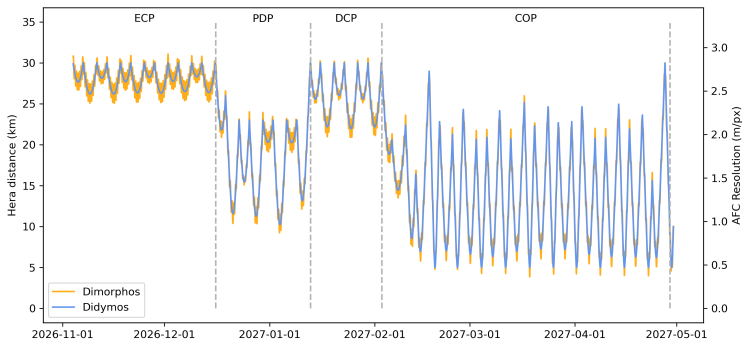
Figure 1: Planned trajectory for the first four phases of the mission after arrival at Didymos, ECP: Early Characterization Phase, PDP: Payload Deployment Phase, DCP: Detailed Characterization Phase, COP: Close Operations Phase. All dates are preliminary and may change during cruise
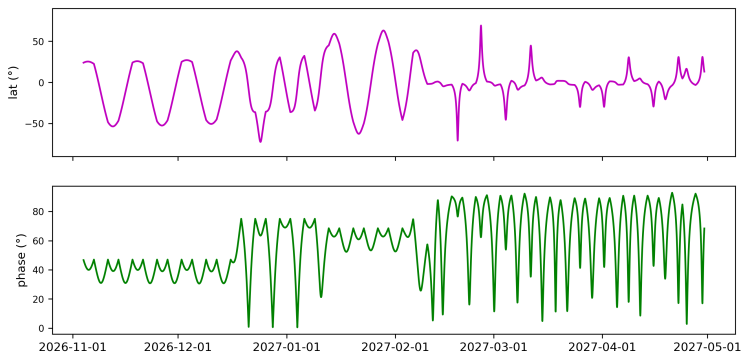
Figure 2: Sub-spacecraft latitude and phase angle on Didymos/Dimorphos in the first four phases of the mission after arrival at Didymos. All dates are preliminary and may change during cruise
How to cite: Vincent, J.-B., Sugita, S., Kueppers, M., Michel, P., Herique, A., Karatekin, Ö., Murdoch, N., Tortora, P., Pajola, M., Preusker, F., Kovács, G., and Guerbuez, C.: The Asteroid Framing Cameras on board ESA's Hera mission: planned activities in the asteroid phase, Europlanet Science Congress 2026, The Hague, The Netherlands, 7–11 Sep 2026, EPSC2026-527, https://doi.org/10.5194/epsc2026-527, 2026.


