EPSC Abstracts
Vol. 19, EPSC2026-529, 2026, updated on 02 Jul 2026
https://doi.org/10.5194/epsc2026-529
Europlanet Science Congress 2026
© Author(s) 2026. This work is distributed under the Creative Commons Attribution 4.0 License.

Centralizing Lunar Regolith Properties: An Open-Source Database for Geomechanical Data
 1,1,2
1,1,2- 1Institut Supérieur de l'Aéronautique et de l'Espace (ISAE-SUPAERO), Université de Toulouse, Toulouse, France
- 2Van der Waals-Zeeman Institute, Institute of Physics, University of Amsterdam, Amsterdam, The Netherlands
Lunar regolith is a complex material that has repeatedly challenged surface operations during lunar missions [1,2]. As humanity prepares to return to the Moon, understanding the mechanical properties of its surface is crucial for the validation of exploration technologies [3,4]. In-situ measurements from crewed and robotic missions, remote sensing, and laboratory analyses of returned samples have provided a wealth of information about lunar regolith. However, these data are often spread across various sources, can be difficult to access and are not always digitized.
To address this lack of accessibility, we have developed the Lunar Regolith Database [5] (https://lunar-regolith-database.streamlit.app): an open-source repository centralizing data on the physical and geomechanical properties of lunar soil, and some common regolith simulants. This dataset was manually extracted from a wide range of sources, including original mission reports, subsequent data interpretations, and recent mission publications. The database compiles key geotechnical parameters, such as the angle of internal friction, cohesion, bulk density, and bearing capacity, along with the specific test methods and locations for each measured value. Additionally, the tool features dedicated sections cataloging returned samples, their particle size distributions, and the broader context of the missions that collected them. In an effort towards greater reproducibility, it also incorporates complementary contextual information when available, including depth profiles, local gravitational acceleration, and the range of normal stresses applied in Mohr-Coulomb analyses. Finally, a dedicated user interface enables data retrieval, filtering, and comparative plotting. Users can dynamically tailor the displayed data to their specific research needs through a multi-parameter filter panel and export customized tables directly for further analysis.
We illustrate practical applications of the tool through representative use cases, including a comparison of regolith mechanical properties measured in-situ and on Earth (Fig. 1), where we observe that in-situ lunar data exhibits higher internal friction angles and often lower cohesion compared to measurements performed on returned samples. Such comparative analyses reveal critical discrepancies between terrestrial testing environments and actual lunar surface conditions, highlighting the need for a centralized dataset to serve as a reliable and accessible reference. Beyond facilitating fundamental studies in planetary science, this database has direct relevance for rover mobility analysis, lander design, ISRU system planning, and lunar construction activities. Developed in an agile mindset, the Lunar Regolith Database is intended to be used and improved by the planetary science and planetary exploration communities.
Figure 1: Comparison of the bulk cohesion and internal friction angle of lunar regolith measured in-situ, on Earth and using remote sensing techniques.
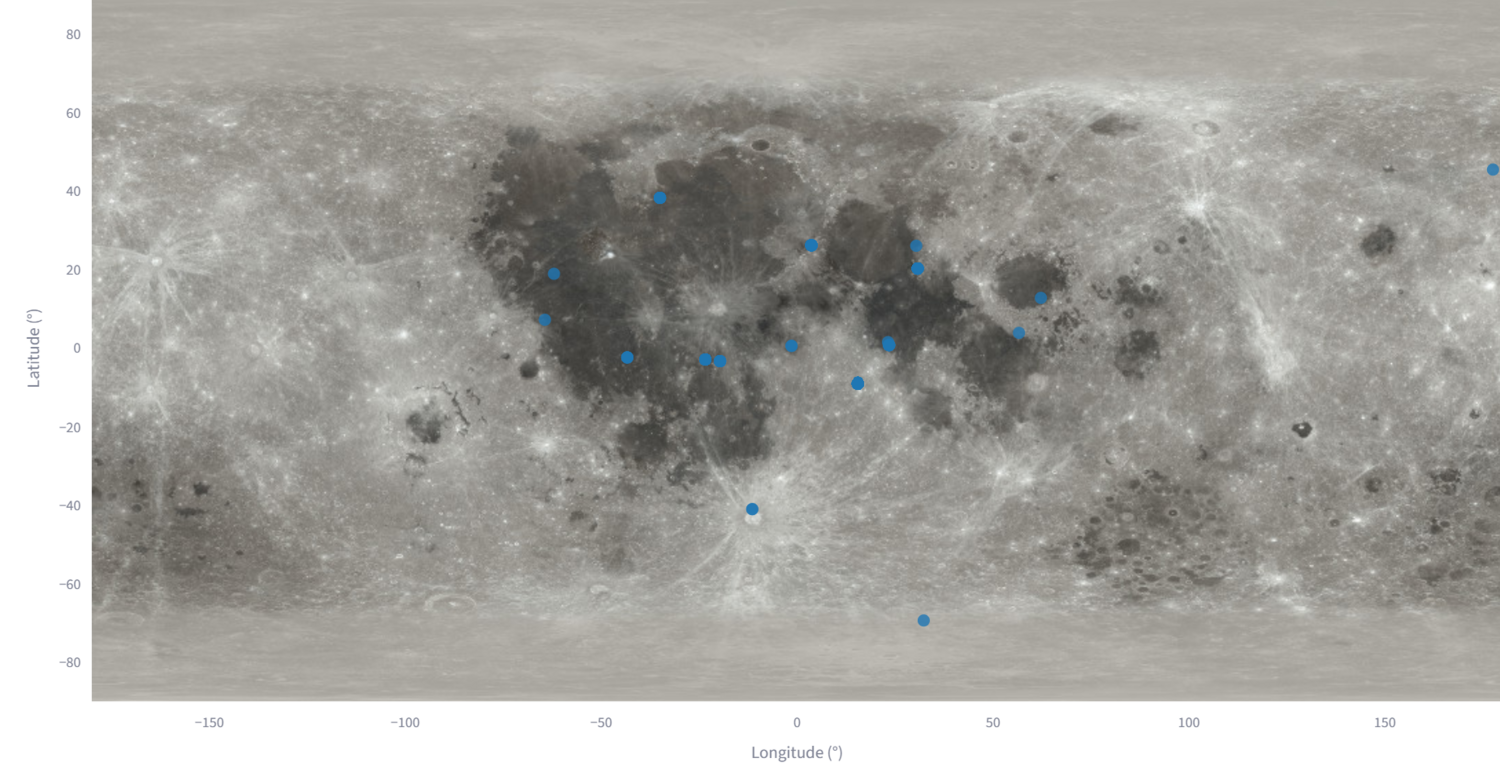
Figure 2: Representation of the different missions on the Moon as seen in the Lunar Regolith Database
This work is supported by the European Research Council GRAVITE project (grant N° 1087060), the French National Centre for Space Studies (CNES) in the context of the HERA space mission, and by the CNES fellowship 24-357 and APR N° 10678 (2025). This publication is part of the project Influence of gravity on granular flows with fileN° 21898 of the research programme VENI which is (partly) financed by the Dutch Research Council (NWO) under the grant 10.61686/DBYVT15219.
[1]G. Heiken, D. Vaniman, B. M. French, Lunar sourcebook: a user’s guide to the moon. Cambridge New York Port Chester: Cambridge university press, 1991.
[2]. Gromov, Physical and Mechanical Properties of Lunar and Planetary Soils, Earth, Moon, and Planets, vol. 80, pp. 51–72, 1998.
[3]Y. Lin, W. Yang, H. Zhang, et al. Return to the Moon: New perspectives on lunar exploration, Science Bulletin, vol. 69, pp. 2136–2148, 2024.
[4]. Noble, B. Bailey, J. Grossman, et al. Implementation Plan for a NASA Integrated Lunar Science Strategy in the Artemis Era, 2024.
[5] . Gasteiner, N. Murdoch, and O. D’Angelo, An Open Database of Lunar Regolith and Simulants Properties, invited contribution for the Journal for Numerical and Analytical Methods in Geomechanics [preprint: ArXiv: 2602.03829], 2026.
How to cite: Gasteiner, L., Murdoch, N., and D'Angelo, O.: Centralizing Lunar Regolith Properties: An Open-Source Database for Geomechanical Data, Europlanet Science Congress 2026, The Hague, The Netherlands, 7–11 Sep 2026, EPSC2026-529, https://doi.org/10.5194/epsc2026-529, 2026.


