
 1,2,3,5,6,1,2,1,
- 1Institut für Planetologie, University of Münster, Münster, Germany
- 2Institute of Space Research, German Aerospace Center, Berlin, Germany
- 3Institute for Mineralogy, University of Münster, Münster, Germany
- 4Leibniz Institute for Evolution and Biodiversity Science, Museum für Naturkunde, Berlin, Germany
- 5Space Operations and Astronaut Training, German Aerospace Center, Cologne, Germany
- 6Institute of Geophysics and Extraterrestrial Physics, Technische Universität Braunschweig, Braunschweig, Germany
Introduction
Asteroid parent bodies likely formed as porous aggregates whose internal structure evolved through thermal processing and progressive consolidation. One process considered important for the evolution of many ordinary chondrites and highly thermally altered carbonaceous chondrites is sintering. This process leads to material transfer within the body and to the formation of competent necks between individual grains, enhancing macroscopic properties such as thermal conductivity and mechanical strength (Neumann et al., 2014; Gail et al., 2015; Henke et al., 2016; Sakurai et al., 2025).
In this context, we perform laboratory experiments on sintered sphere packings with varying sinter degree and volume filling factor, measuring their thermal conductivity and tensile strength. A comparison with a numerical model developed in parallel (Agrawal et al., EPSC 2026), as well as with various analytical approaches, is intended to improve our understanding of the relationship between microscopic grain contacts and macroscopic properties. In particular, this comparison will help to identify the capabilities and limitations of existing models.
Laboratory experiments
For this study, we used soda-lime glass beads to produce a total of 12 samples with systematically varied sinter degree (expressed as mean sinter neck radius), 8 samples with reduced volume filling factors, and one reference sample of poured glass beads without sintering.
For the samples with varied sinter degree, glass beads were poured into a crucible and sintered in a furnace for 24 hours at temperatures of 635 °C, 640 °C, and 650 °C. Increasing temperature not only promoted the growth of sinter necks, but also induced global sample shrinkage, leading to an increase in volume filling factor from slightly to strongly sintered states.
For the samples with reduced volume filling factor, glass beads were mixed with sodium carbonate salt grains in mass ratios of 3:1 and 5:1. After sintering, the salt was removed by washing under running water, leaving behind a more porous sintered glass bead network. Since the presence of salt strongly affects the sintering behaviour, the resulting sinter degree could not be controlled easily, and therefore both volume filling factor and sinter state vary between samples.
Thermal conductivity measurements were performed under vacuum conditions (pressure below 10-4 mbar) at room temperature using a transient hot disk sensor. The sensor is placed between two sample disks and acts as both heater and thermometer. From the applied heat input and the resulting temperature evolution of the disk, the thermal conductivity of the samples is derived (Gustafsson, 1990; Gustavsson et al., 1994; Bohac et al., 2000).
Tensile strength measurements will be conducted by gluing the samples to a sample holder on opposite sides and applying a controlled tensile load until failure, while recording the applied force and the cross-sectional area at the fracture plane (Blum et al., 2006).
Microscopic parameters such as sinter neck size distributions, global volume filling factors, volume filling factor gradients, and coordination numbers are determined or will be determined using secondary electron microscopy (SEM) and micro-computed tomography (µCT).
The results of the thermal conductivity measurements (Fig. 1) show good agreement with the model by Arakawa et al. (2019), who propose a linear dependence on the sphere contact radius (mean neck radius in this case) and an approximately quadratic dependence on the volume filling factor. Despite the fact that the samples do not contain uniform sinter neck sizes, but rather a polydisperse distribution, and although the model was originally developed for weakly bound van der Waals contacts rather than strongly sintered sphere packings, it reproduces the experimental data reasonably well.
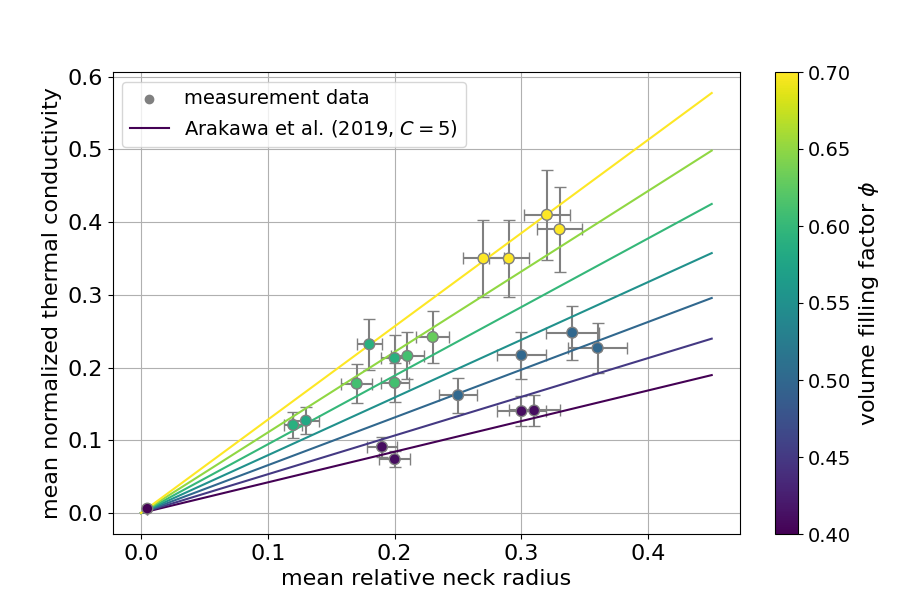
Figure 1: Thermal conductivity of sintered glass-bead samples, normalized to the glass material conductivity, as function of the mean relative sinter neck size and the global volume filling factor. The relative neck radius refers to the ratio of the neck radius to the sphere radius. The thermal model from Arakawa et al (2019) is plotted for various volume filling factors as a function of the mean sinter neck size for comparison. For this model, a coordination number of is currently assumed, but will soon be verified using µCT scans of the samples.
Next steps
As a next step, the tensile strength of the sintered glass bead samples will be measured and correlated with their thermal conductivity and microstructure. Combined, these measurements should improve our understanding of how grain-scale properties control the thermal and mechanical behaviour of asteroid material and help to relate remote sensing observations to laboratory analyses of returned samples.
References
Arakawa et al. (2019): Thermal conductivity and coordination number of compressed dust aggregates. Icarus, Vol. 324 (2019). https://doi.org/10.1016/j.icarus.2019.01.022
Blum et al. (2006): The Physics of Protoplanetesimal Dust Agglomerates. I. Mechanical Properties and Relations to Primitive Bodies in the Solar System. The Astrophysical Journal, Vol. 652 (2006). https://doi.org/10.1086/508017
Bohac et al. (2000): Parameter estimations for measurements of thermal transport properties with the hot disk thermal constants analyzer. Rev. Sci. Instrum., Vol. 71 (2000). https://doi.org/10.1063/1.1150635
Gail et al. (2015): Thermal evolution and sintering of chondritic planetesimals II. Improved treatment of the compaction process*. A&A, Vol. 576 (2015). https://doi.org/10.1051/0004-6361/201424278
Gustafsson (1990): Transient plane source techniques for thermal conductivity and thermal diffusivity measurements of solid materials. Rev. Sci. Instrum., Vol. 62 (1990). https://doi.org/10.1063/1.1142087
Gustavsson et al. (1994): Thermal conductivity, thermal diffusivity, and specific heat of thin samples from transient measurements with hot disk sensors. Rev. Sci. Instrum., Vol. 65 (1994). https://doi.org/10.1063/1.1145178
Henke et al. (2016): Thermal evolution and sintering of chondritic planetesimals III. Modelling the heat conductivity of porous chondrite material. A&A, Vol. 589 (2016).
https://doi.org/10.1051/0004-6361/201527687
Neumann et al. (2014): Modelling of compaction in planetesimals*. A&A, Vol. 567 (2014). https://doi.org/10.1051/0004-6361/201423648
Sakurai et al. (2025): Experimental study on thermal and mechanical properties of sintered glass materials: Implication for physical properties of primordial porous materials in the solar system. Icarus, Vol. 441 (2025). https://doi.org/10.1016/j.icarus.2025.116729
How to cite: Goldmann, M., Agrawal, B., Jennings, L. A., Greshake, A., Biele, J., Blum, J., Güttler, C., Grott, M., Klemme, S., Knollenberg, J., Patzek, M., and Gundlach, B.: Laboratory experiments on thermal and mechanical properties of sintered glass beads, Europlanet Science Congress 2026, The Hague, The Netherlands, 7–11 Sep 2026, EPSC2026-570, https://doi.org/10.5194/epsc2026-570, 2026.


