
 1,1,3
1,1,3- 1University of Amsterdam, Anton Pannekoek Instituut voor Sterrenkunde, Amsterdam, Netherlands (l.e.hanson@uva.nl)
- 2Laboratoire Environnements et Atmosphères Terrestres et Planétaires, Université Reims Champagne Ardenne, France
- 3Institut de Planétologie et d’Astrophysique de Grenoble, Univ. Grenoble Alpes, CNRS, Grenoble F-38000, France
Introduction.
Titan’s atmosphere is a compelling laboratory in which to study organic photochemistry and haze formation in a reduced environment [1]. Starting with the photolysis of the primordial methane and nitrogen, the neutral and charged photochemistry produces a wide range of organic compounds, which eventually aggregate to produce Titan’s ubiquitous refractory haze [2, 3]. Although molecular abundance measurements are mostly limited to species with six or fewer carbon atoms [4], there is also compelling evidence of polycyclic aromatic hydrocarbons (PAHs) in Titan’s upper atmosphere [3, 5, 6]. However, the largest molecules currently included in models of Titan’s photochemistry are substituted benzene species [7]. In this work we give an overview the most promising neutral pathways for forming naphthalene (C10H8), the simplest PAH, and share preliminary results from including these species in an existing model of Titan photochemistry [8, 9].
Background.
Photochemical models. To decipher Titan’s complex atmospheric chemistry, several groups have assembled photochemical models with networks of hundreds or thousands of neutral and charged reactions, photolysis of major species, haze formation, and condensation [8, 7, 10]. While small molecules with few carbon atoms can be simulated with relatively simple chemical networks, the number of possible isomers for a given stoichiometric formula grows exponentially with the number of carbon atoms. Because of this, photochemistry models have mostly focused on simulating the lowest-energy isomers. Recently, there has been a renewed effort to improve the small-molecule photochemistry by accounting for isomers of three- and four-carbon species [9]. We build on this work to extend the chemical network to larger aromatic species.
PAH chemistry. The chemistry of PAHs is of great interest in fields ranging from combustion chemistry [e.g., 11, 12] to interstellar chemistry [e.g., 13], but most of the work on PAH formation and growth has focused on high-temperature conditions [e.g., 11]. Significant effort has been dedicated to determining empirical methods of estimating chemical bahavior of large PAHs in interstellar conditions [e.g., 14], but the chemistry driving the formation of small PAHs is less generalizable and remains an active area of research [e.g., 13]. Similar methods of simulating molecular growth have been used in models of Titan’s photochemistry, but they have been focused on particle formation rather than molecular growth [2]. Recent work in theoretical and experimental chemistry has revealed several potential pathways for forming naphthalene in low-temperature conditions relevant to Titan [e.g., 11, 12], though these reactions are highly dependent on the availability of specific isomers of the reactants. Given the recent advances in Titan isomer chemistry, it is now possible to explicitly simulate the gas-phase formation of naphthalene.
Preliminary findings.
Naphthalene formation. We have assembled a preliminary chemical network that produces the naphthalene skeleton via neutral gas-phase reactions (see figure). Many of these pathways involve multiple reactions, sometimes producing non-naphthalene C10H8 isomers as intermediate steps. Thus, we find it is critical to explicitly account for different isomers when modeling naphthalene formation.
Naphthalene sinks. We have identified no neutral chemical reactions that destroy the naphthalene skeleton, but addition reactions with small radicals like C2H and CN are expected to be rapid. Photolysis of naphthalene also appears ineffective at destroying the naphthalene structure (only ~1% at 193 nm) [15], though to our knowledge there are no experimental branching ratios available. Thus, the naphthalene skeleton can only be destroyed at high altitudes where far UV radiation is most intense.
More information required. Although we have assembled a simple network for naphthalene formation, a lack of published data means that many of the inputs to the photochemical model must be estimated. Theoretical or experimental rates are needed for many reactions, and there is little information available regarding rates and products of reactions of large species with abundant small radicals such as H, CH3, C2H, and CN, all of which react rapidly with less abundant species in Titan’s atmosphere. There is a need for UV absorption cross-sections and photolysis branching ratios for most of the species included in the figure. Finally, there is a need for more study into ion-molecule pathways to PAH formation, which may dominate in Titan’s ionosphere [7].
Outlook.
With an understanding of the chemistry producing the smallest PAHs, it will be possible to begin to bridge the gap between small molecules, which are modeled explicitly, and large PAHs that can be modeled empirically. Models that can simulate PAH formation will be useful to interpret the infrared PAH-related emission features [5, 6], measurements of ionospheric composition and haze [e.g., 3], and the coming measurements from Dragonfly of the haze composition at the surface.
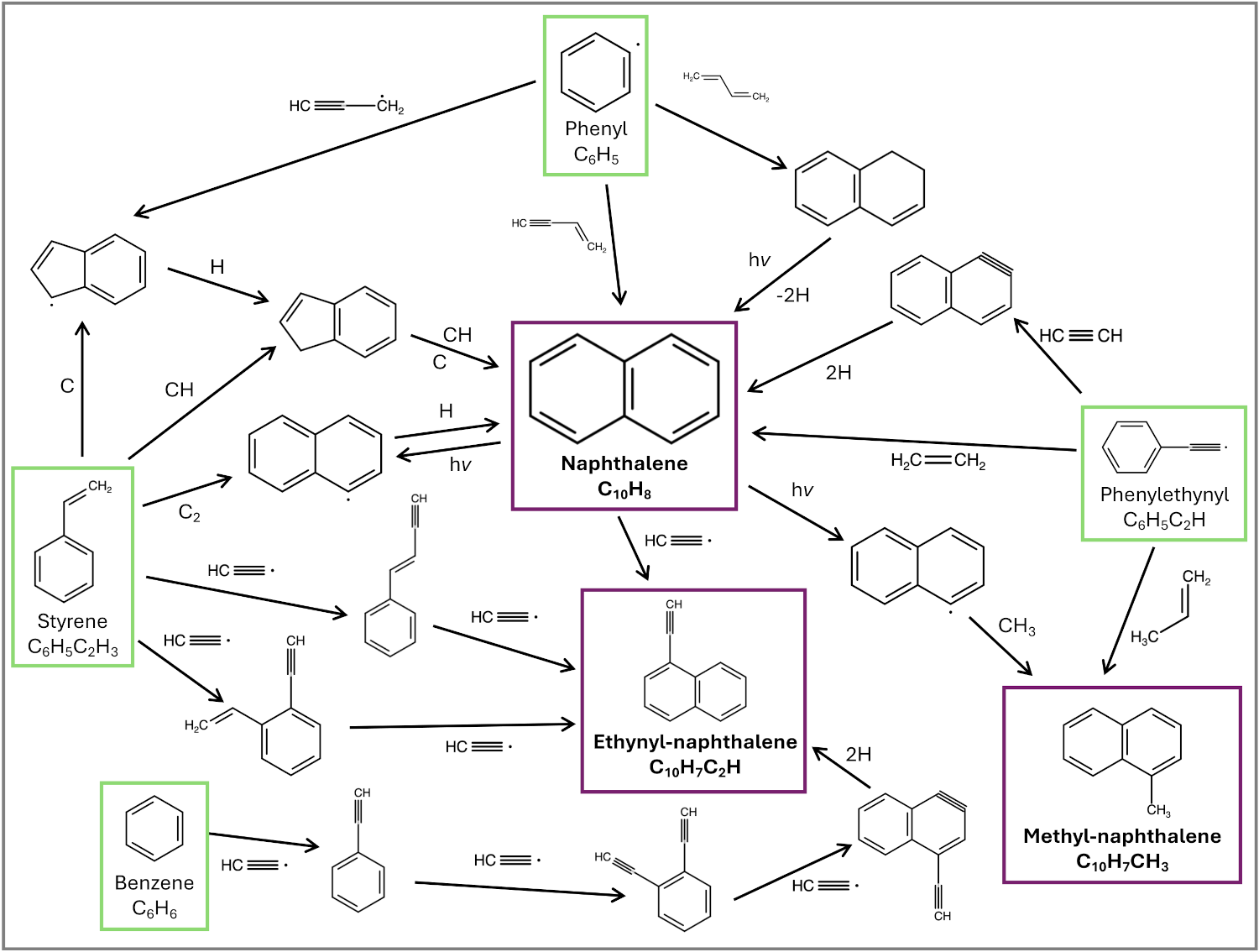
Figure. A preliminary low-temperature chemical network for forming the naphthalene skeleton (purple boxes) from precursor species (green boxes) via neutral radical-molecule reactions. Some of these reactions are slow but included for completeness. Most of these reactions also produce many non-PAH products which are not included in this schematic.
References.
[1] Coustenis 2021. The atmosphere of Titan. Oxford Research Encyclopedias. [2] Lavvas et al., 2011, ApJ 728, 80. Lavvas et al., 2013, PNAS 110, 2729–2734. [3] Haythornthwaite, R.P., et al., 2021. Planet. Sci. J. 2, 26. [4] Nixon, 2024, Earth Space Chem. 8, 406–456. [5] López-Puertas, M., et al., 2013, ApJ 770, 132. [6] Stikkelbroek, 2025, Thesis, Univ. Amsterdam. Stikkelbroek et al. 2025, EPSC-DPS, 1444. [7] Loison, J.C., et al., 2019, Icarus 329, 55–71. [8] Vuitton, V., et al., 2019, Icarus 324, 120–197. [9] Lavvas et al., 2025, EPSC-DPS 220. [10] Willacy et al., 2022, ApJ 933, 230. [11] Mebel et al., 2017, J. Phys. Chem. A 121, 901–926. [12] Yang et al., 2025, ACS Central Sci. 11, 322–330. [13] Tielens, 2026, ACS Earth Space Chem. 10, 942–968. [14] Tielens, 2008, Ann. Rev. Astron. Astrophys. 46, 289–337. [15] Dyakov et al., 2005, J. Phys. Chem. A 109, 8774–8784.
How to cite: Hanson, L., Candian, A., Lavvas, P., and Vuitton, V.: Polycyclic Aromatic Hydrocarbons in Titan’s atmosphere, Europlanet Science Congress 2026, The Hague, The Netherlands, 7–11 Sep 2026, EPSC2026-574, https://doi.org/10.5194/epsc2026-574, 2026.


