
 1,
1,- 1Planetary Remote Sensing Laboratory, The Hong Kong Polytechnic University, Hong Kong SAR (shane-xing.wang@polyu.edu.hk)
- 2Department of Earth, Environmental and Planetary Sciences, Brown University, Providence, RI, USA.
- 3Key Laboratory of Lunar and Deep Space Exploration, National Astronomical Observatories, Chinese Academy of Sciences, Beijing, China.
The South Pole-Aitken (SPA) basin on the lunar farside is the largest, oldest, and deepest confirmed impact structure on the Moon [1], making it a key archive of early lunar evolution and basin-scale impact processes. Here, we revisit the internal structure of SPA and the origin of its distinctive crescent-shaped thorium (Th) enhancement. We argue that this Th pattern is the evolved surface expression of an incompatible-trace-element (ITE)-rich impact melt sheet formed during the SPA-forming event and later modified by large impacts and volcanic resurfacing. This framework has renewed relevance following the return of Chang’E-6 (CE-6) samples from the Apollo basin within SPA.
Although SPA has been substantially degraded over time, its size strongly suggests that it originally formed as a multiring basin [2]. Two large topographic ellipses previously identified within SPA show a semi-minor-axis ratio close to the characteristic √2 spacing between adjacent rings in large multiring basins [3,4] (Fig. 1). If these ellipses represent the two outermost SPA rings, analogous to the Cordillera and Outer Rook rings of Orientale, then the intervening “Outer Terrace” may be interpreted as a mega-terrace produced by collapse of the rim-crest region during late-stage basin modification [5-7]. This interpretation is supported by the composition of the Outer Terrace, which is broadly feldspathic, similar to the surrounding farside highlands, and generally poor in Th. Its spatial correspondence with the Heterogeneous Annulus defined from spectral observations further strengthens this view [5,6,8].
A different geological regime emerges inward of the Outer Terrace. The region between the inner topographic ellipse and an inferred peak-ring ellipse, estimated from ring-spacing relationships, broadly coincides with the Mg-pyroxene-rich annulus and shows distinctly higher Th abundances [4,5,8] (Fig. 1). Further toward the basin center, the inferred peak-ring region encloses the central topographic depression and areas of relatively thin crust. Most of this inner region exhibits Th concentrations above 3 ppm, with the notable exception of the SPA Central Compositional Anomaly (SPACA) [5,8]. The size of the inferred peak-ring region is also consistent with earlier estimates for the extent of the SPA impact melt sheet [9].
We interpret the broad Th enrichment in the SPA interior as a signature of impact melt differentiation. Numerical and petrological studies suggest that the SPA-forming impact generated a large and deep melt sheet, whose subsequent differentiation produced an upper residual layer enriched in ITEs, including Th [10,11]. Such a layer provides a natural explanation for the elevated Th concentrations observed across much of the basin interior. The localized Th minimum in SPACA may represent a later modification of this original geochemical pattern. As suggested in our previous work, SPACA may correspond to an extensive cryptomare region, where volcanic resurfacing could have buried or diluted the Th-rich signature of the underlying impact melt sheet [5].
Indeed, the present crescent-shaped Th distribution as a whole appears to record a long history of post-impact modification [12] (Fig. 2). Following formation of the SPA melt sheet, several large early impacts in the northwestern basin interior, such as Von Kármán M, Von Kármán, and Leibnitz, would have excavated and redistributed Th-rich melt-sheet materials beyond the original melt-sheet boundary. Later large impacts, including Apollo and Poincaré, occurred near the inferred outer portion of the inner basin and may have removed or diluted parts of this Th-rich layer, producing local decreases in surface Th abundance. Prolonged mare and cryptomare volcanism in central SPA, especially within SPACA, further obscured the primary geochemical signature. Finally, younger craters such as Birkeland and Oresme V likely re-excavated redistributed Th-rich materials, forming the two prominent Th hotspots now observed in northwestern SPA [12].
This basin-scale framework provides important context for interpreting CE-6 samples from the southern mare plain of the Apollo basin. Laboratory analyses indicate that the landing-site mare deposits are dominated by low-Ti basalts emplaced at ~2.8 Ga, consistent with earlier remote-sensing interpretations [13–15]. However, Apollo is not simply a volcanic setting within SPA. As the largest impact basin in the northeastern SPA interior, it formed across compositionally distinct structural domains of the older SPA basin [6]. Its southwestern interior exposes Mg-rich noritic materials in areas of extremely thin crust, whereas its northeastern portion is more feldspathic [6]. These Mg-rich lithologies, likely excavated from deeper crustal levels during the Apollo-forming event (Fig. 3), have also been identified among CE-6 returned materials [16]. The CE-6 sample collection may therefore record not only local mare volcanism, but also the deeper crustal architecture and excavation history of SPA.
References:
[1] Spudis, P. D. et al. (1994) Science, 266(5192), 1848–1851. [2] Baker, D. M. et al. (2012) JGRP, 117(E12). [3] Garrick-Bethell, I. & Zuber, M. T. (2009) Icarus, 204(2), 399–408. [4] Pike, R. J. and Spudis, P. D. (1987) Earth Moon Planet, 39, 129–194. [5] Wang, X. et al. (2024) JGRP, 129(5), e2023JE008176. [6] Wang, X. et al. (2024) AJ, 168(6), 247. [7] Head, J. W. (2010) GRL, 37(2). [8] Moriarty, D. P. and Pieters, C. M. (2018) JGRP, 123(3), 729–747. [9] Potter, R. W. et al. (2012) Icarus, 220(2), 730–743. [10] Vaughan, W. M. and Head, J. W. (2014) PSS, 91, 101–106. [11] Hurwitz, D. M. & Kring, D. A. (2014) JGRP, 119(6), 1110–1133. [12] Wang et al. (2025) 55th LPSC, Abstract #1121. [13] Cui, Z. et al. (2024) Science, 386(6728), 1395–1399. [14] Zhang, Q. W. et al. Nature, 643(8071), 356–360. [15] Qian, Y. et al. (2024) EPSL, 637, 118737. [16] Li, C. et al. (2024) NSR, 11(11), nwae328.
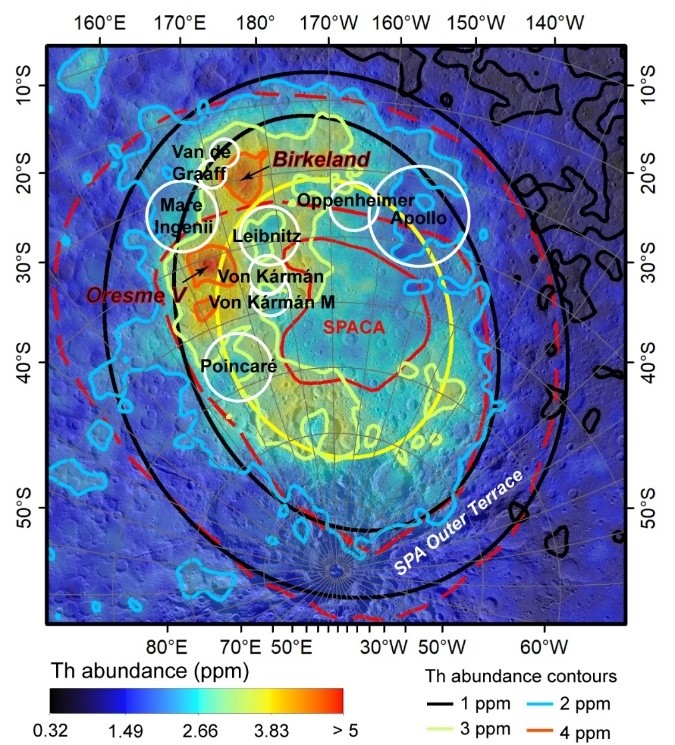
Fig. 1. Th distribution in and around the SPA basin obtained by Lunar Prospector. The solid black lines are the topographic ellipses [3]. The solid yellow line indicates the possible location of the SPA peak ring based on the ring spacing relationship [5, 6]. The red dashed lines outline the compositional zones defined by [8].
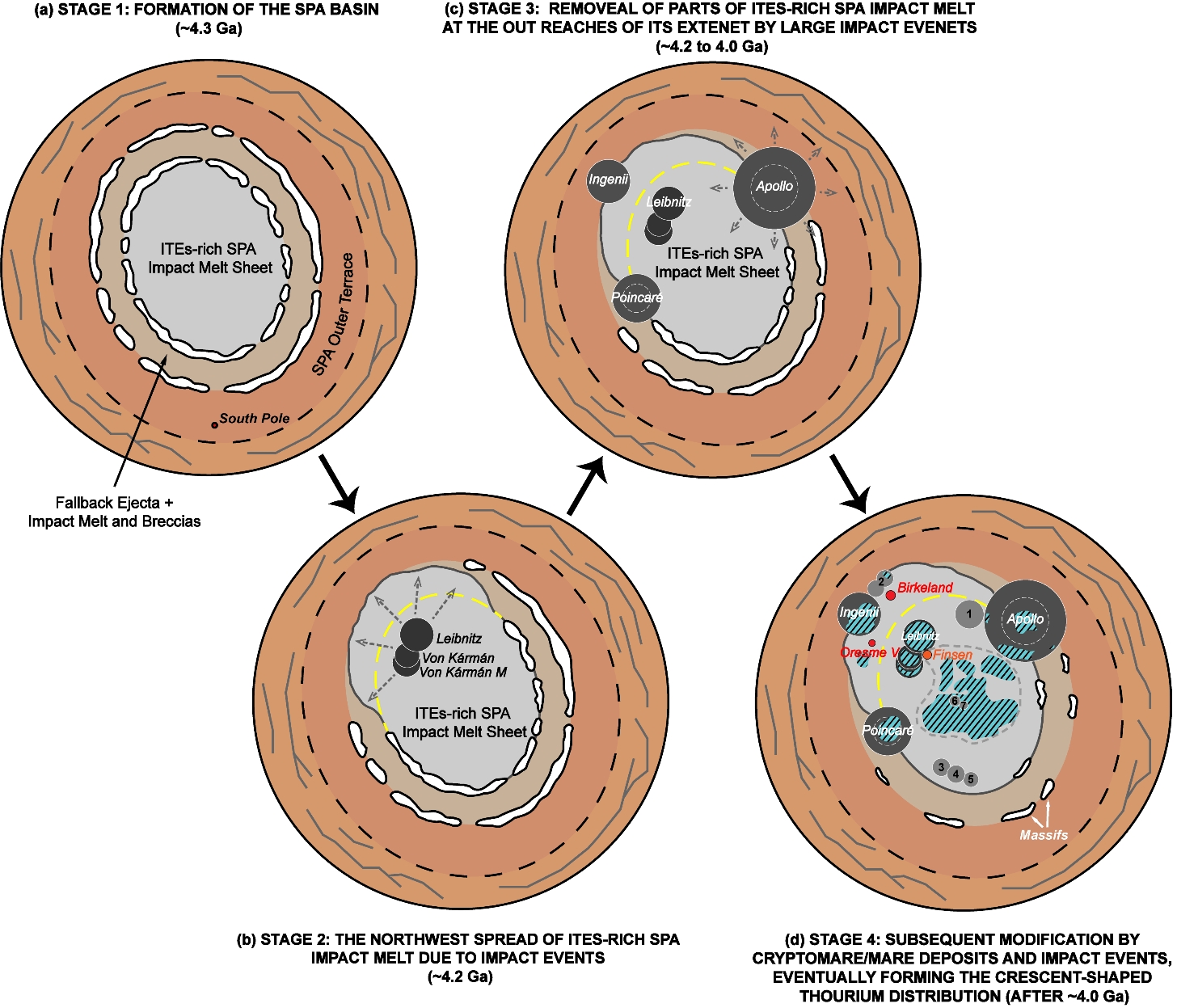
Fig. 2. Schematic diagram of the evolution of the crescent-shaped Th distribution within the SPA basin. In (d), 1-Oppenheimer, 2-Van de Graaff, 3-Minnaert, 4-Antoniadi, 5-Numero, 6-Bose, 7-Bhabha.
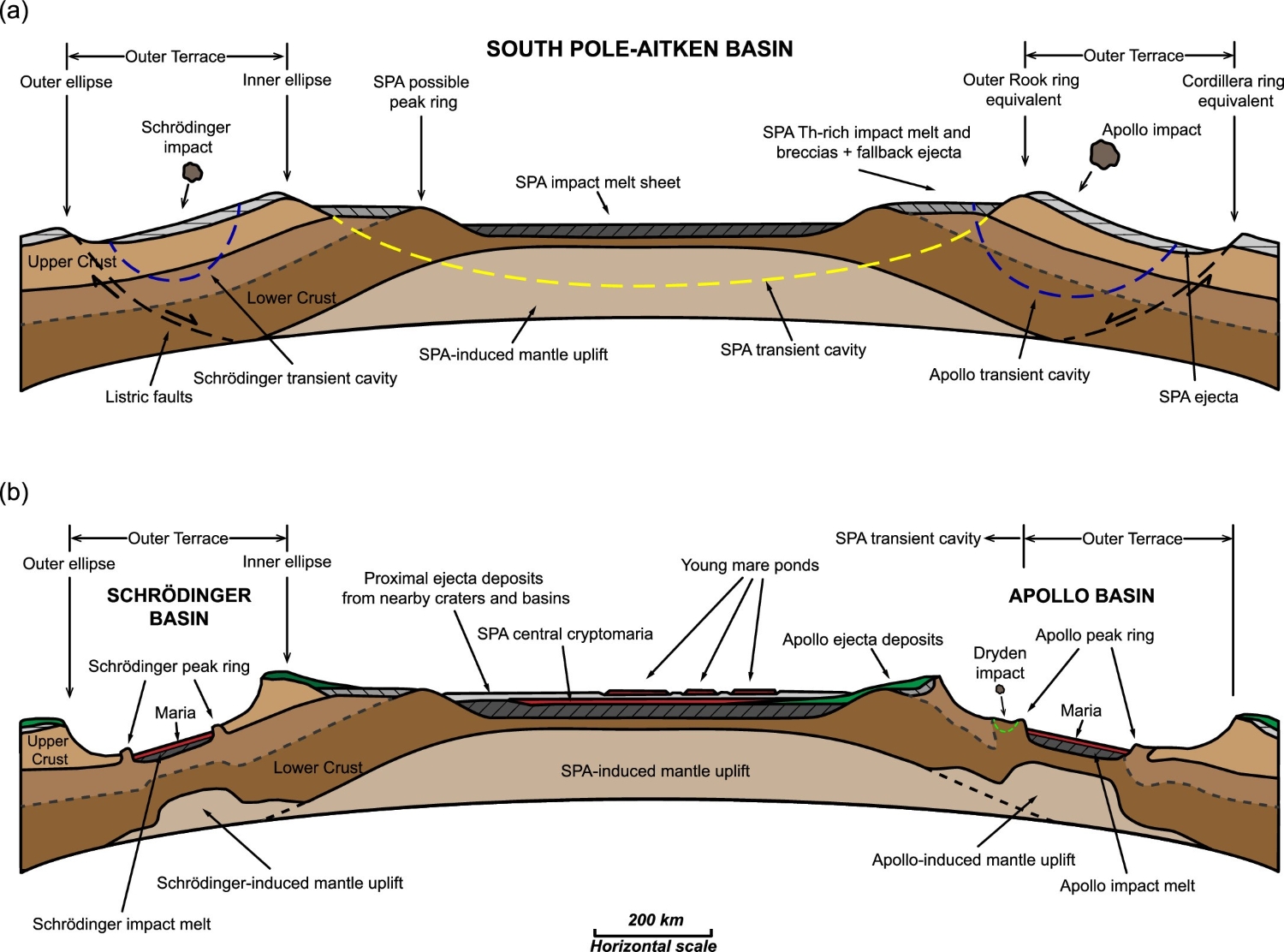
Fig. 3. Schematic cross-sectional diagrams of SPA basin structure, (a) pre- and (b) post-Apollo/Schrödinger events.
How to cite: Wang, X., Head III, J. W., Wu, B., and Liu, J.: The South Pole-Aitken Basin Interior, Thorium Distribution, and Implications for Chang’E-6 Samples, Europlanet Science Congress 2026, The Hague, The Netherlands, 7–11 Sep 2026, EPSC2026-624, https://doi.org/10.5194/epsc2026-624, 2026.


