
 2,2,
2,2,- 1Natural History Museum, London, United Kingdom of Great Britain – England, Scotland, Wales
- 2University of Oxford, Planetary Physics, United Kingdom of Great Britain – England, Scotland, Wales (emelia.branagan-harris@nhm.ac.uk)
Introduction: Phobos’ formation remains uncertain, with two main hypotheses: accretion of debris following a high-energy impact between Mars and an asteroid [1] or capture of a primitive asteroid [2]. To solve this, JAXA’s Martian Moons eXploration (MMX) mission aims to return samples from Phobos by 2031 [3]. The characterisation of these samples will determine the origin of Phobos.
Current observations of Phobos are limited to remote measurements that are interpreted without direct mineralogical ground-truth. In this study, we have characterised the infrared (IR) reflectance spectra and mineralogy of meteorites considered good analogues for materials likely to be present on the surface of Phobos. These measurements provide a link between remote sensing data and physical sample analysis by building a spectral-mineralogical reference catalogue using powdered meteorites. This catalogue will help interpret the initial remote observations (prior to landing on Phobos’ surface) of the upcoming MMX mission, inform sampling site choices, and then help evaluate the later returned sample spectra to ultimately constrain the origin of Phobos. In addition, the mineralogical-spectral correlations can be referred to for future spectral calibration across other small bodies in the Solar System.
Methods: We have characterised the mineralogy and spectral properties of six CM (Mighei-like) carbonaceous chondrites, Tarda (C2-ung), the CO (Ornans-like) chondrite Kainsaz, CRs (Renazzo-like) NWA 801 and 1567, a range of shock darkened ordinary chondrites (mostly falls) including L4-6 and H5-6, four ureilites, Martian meteorites Nakhla and Tissint (shergottite), and a Tagish Lake (C2-ung) based simulant created by the University of Tokyo, known as UTPS-TB [5].
We performed FTIR and XRD measurements on the same powder (~50 mg, grain size <40 μm) to reduce variability in the results from differences in grain size and potential sample heterogeneity. This ensures that the mineralogy determined by XRD can be directly correlated with the spectral features. Such a controlled, internally consistent dataset allows us to isolate the effects of mineralogy on the spectra [e.g. 6], which are critical parameters when interpreting remote spectra from Phobos.
Diffuse reflectance spectra (1.6 - 25 μm) of powders were collected using a Bruker VERTEX 70V FTIR spectrometer under vacuum. Spectra were calibrated at the start of each measurement day and between measurements of samples using a gold standard.
XRD patterns were collected using an INEL X-ray diffractometer with a position-sensitive detector. Each sample was measured for 16 hours to achieve good signal-to-noise. Measurements of well-characterised standard minerals were collected for 30 minutes and compared with meteorite patterns to identify minerals and quantify their abundance in the sample [e.g. 7].
Results & Discussion:
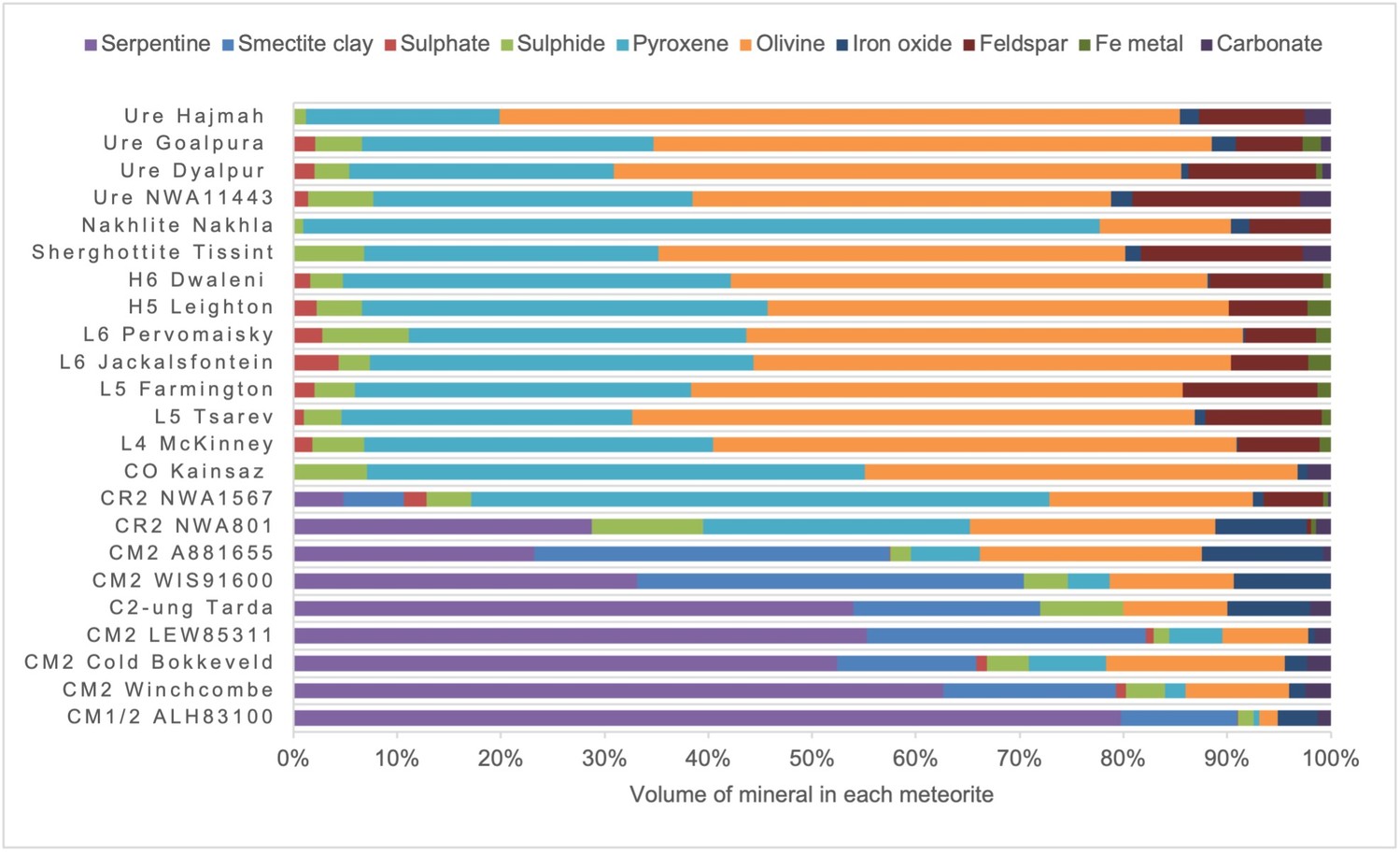
Figure 1: PSD-XRD modal mineralogy in volume % for Phobos-analogue meteorites.
Figure 1 shows the modal mineralogy of the Phobos analogues, presenting a range of aqueous and thermal alteration, with significant variation in composition between the classification groups. The carbonaceous chondrites studied (except CO Kainsaz) all have phyllosilicate minerals, varying from 10 to 92 vol.%. In contrast, the Martian meteorites’ composition are almost entirely anhydrous silicates; Nakhla’s composition was 77 vol.% pyroxene and 10 vol.% olivine, and Tissint was composed of 45 vol.% olivine and 28 vol.% pyroxene.
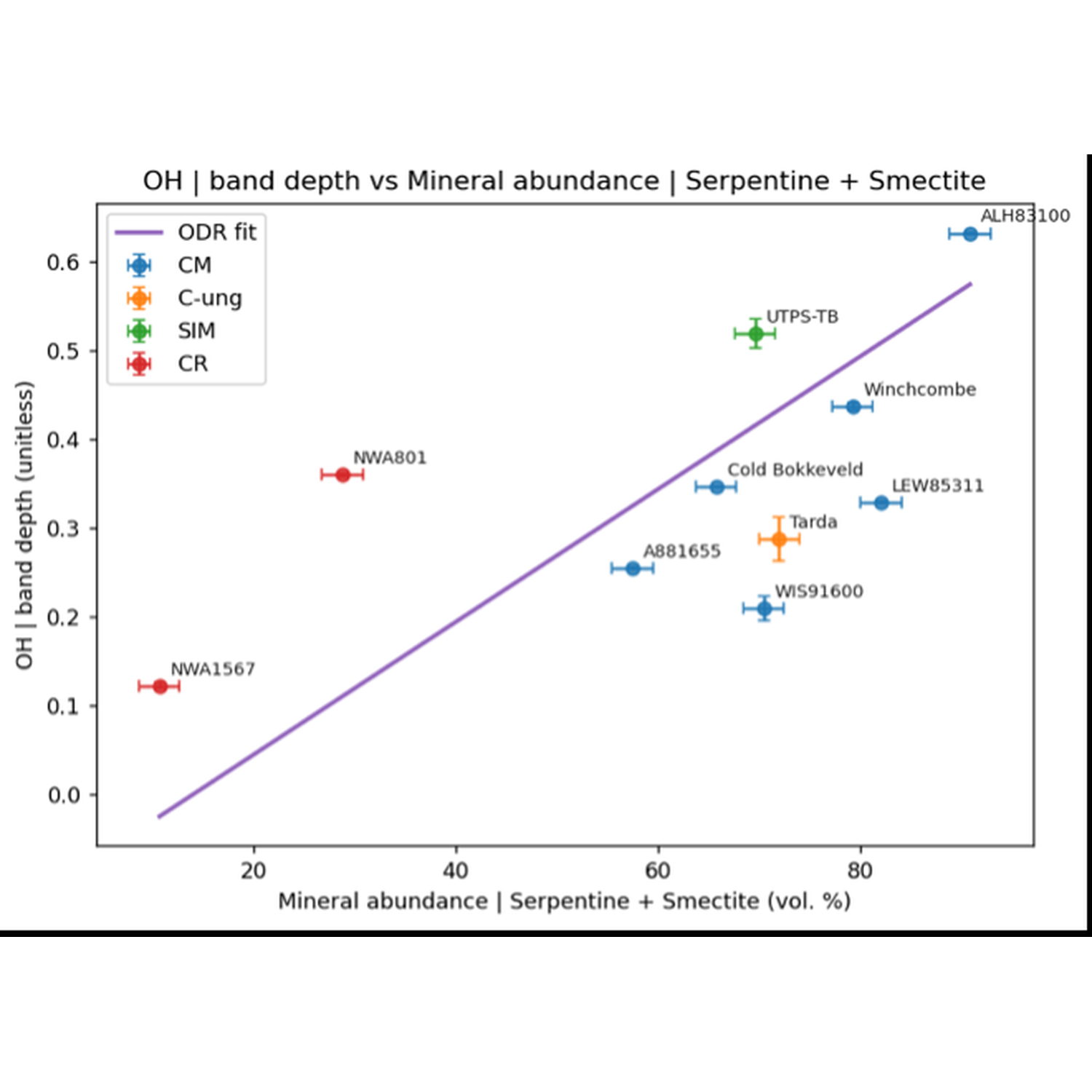
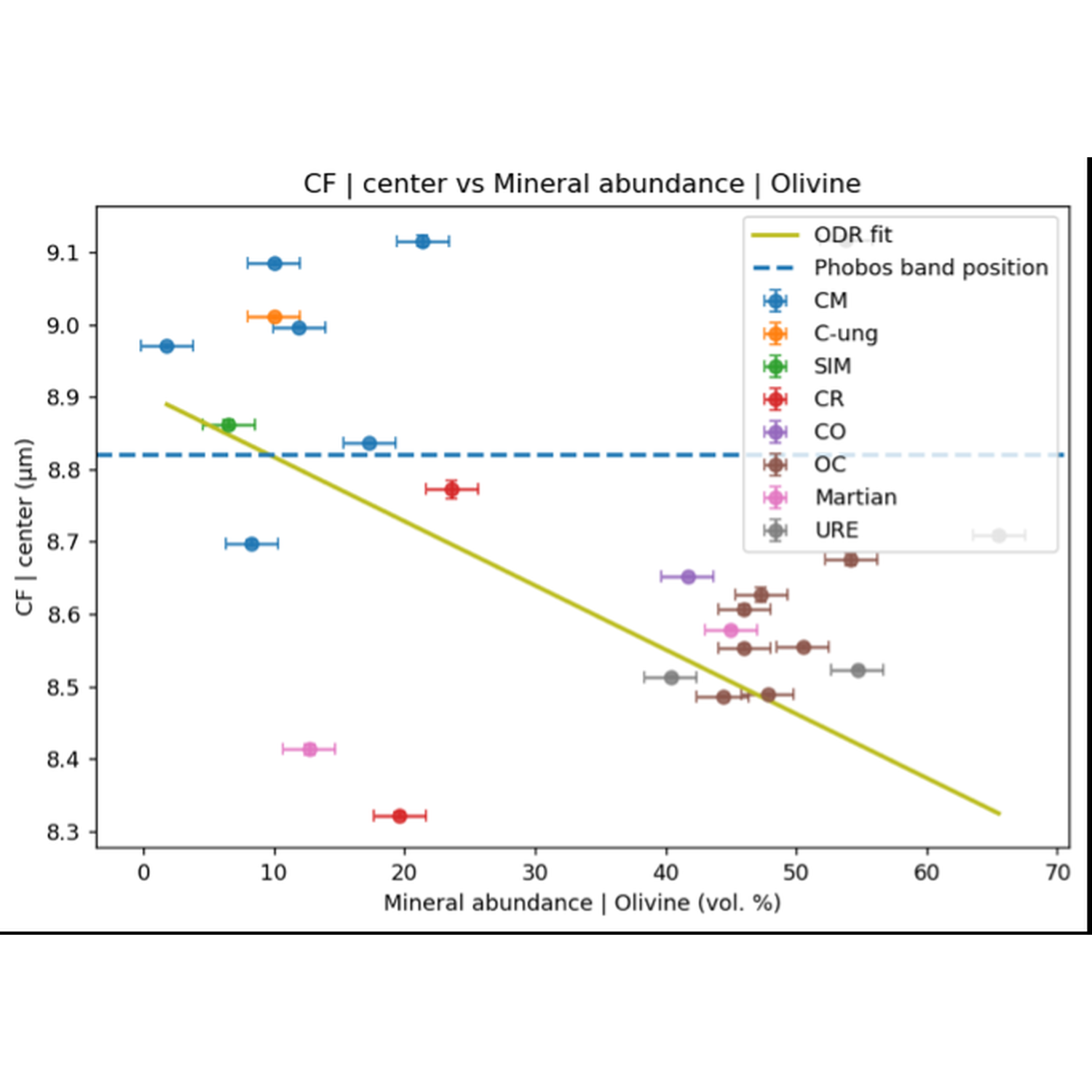
Figure 2: Comparison of spectral features with mineralogy determined by XRD . (a) OH feature band depth vs volume of phyllosilicates serpentine and smectite (combined). (b) CF centre position vs volume of olivine, with Phobos’s CF centre position (8.82 microns) as determined by [8].
We find a positive correlation between the 3-micron band depth and abundance of phyllosilicates. As the 3-micron feature is present due to the stretching of OH (which phyllosilicates contain), the depth of the feature is proportional to the abundance of phyllosilicate. MMX’s MIRS instrument will operate in the region where the 3-micron feature is present [9]. So far, a possible 3-micron feature has been observed in Phobos’s spectrum, but the MMX instrument will be searching for it as aqueous alteration could indicate a captured primitive asteroid origin.
The CF feature is a key region of study as the miniRAD radiometer on MMX’s rover will investigate the position of the feature as a first order mineralogical characterisation [10]. The position of the feature varies in relation to the meteorites’ mineral composition; in the case of Figure 2b the centre of the CF has a negative correlation with the mineral abundance of olivine as samples with lover olivine abundances (like carbonaceous chondrites) contain more phyllosilicates which have CFs at shorter wavelengths. The remotely observed position of the CF (8.82 microns) is plotted and falls closely to the CF of carbonaceous chondrite samples, implying that Phobos’ composition is close to that of the primitive carbonaceous.
Based on this data it may be possible to infer the abundance of phyllosilicate from the band depth of the 3-mircon feature, especially when used in combination with the CF position. Increasing aqueous alteration leads to more phyllosilicate and less olivine abundance. The 3-micron band depth and CF position combined could therefore be a powerful tool for interpreting the surface mineralogy of Phobos.
Conclusion: Carbonaceous chondrites are the closest spectral match to Phobos from the samples studied according to the position of their CF. These results support the interpretation that Phobos is composed of primitive material, likely of outer solar system origin, which favour a capture scenario over a collisional formation from Martian ejecta, and further demonstrates the importance of the MMX mission sample return for solving the mystery of their origin definitively.
References: [1] R. Citron et al. (2015) Icarus 252:334-338. [2] M. Pajola et al. (2013) The Astrophysical Journal 777:127. [3] K. Kuramoto et al. (2022) Earth, Planets and Space 74:12. [4] K. D. Pang et al. (1978) Science 199(4324):64-66. [5] H. Miyamoto et al. (2021) Earth, Planets and Space 73:1-17. [6] H. C. Bates et al. (2023) Meteoritics & Planetary Science 1-23. [7] G. Cressey et al. (1996) Powder Diffraction 11:35-39. [8] Wargnier et. al (2024) Icarus 421 116216. [9] M. Barucci et al. (2025) Progress in Earth and Planetary Science 12:69. [10] J. Knollenberg et al. (2025) Progress in Earth and Planetary Science 12:53.
How to cite: Branagan-Harris, E., Bates, H., Shirley, K., King, A., Bowles, N., and Russell, S.: Spectral–Mineralogical Correlations in Meteorite and Simulant Analogues: Implications for the Composition and Origin of Phobos, Europlanet Science Congress 2026, The Hague, The Netherlands, 7–11 Sep 2026, EPSC2026-650, https://doi.org/10.5194/epsc2026-650, 2026.


