
 2,
2,- 1Institute of Geodesy and Geoinformation Science, Technische Universität Berlin, Berlin, Germany (ziese@tu-berlin.de)
- 2Institute of Space Research, German Aerospace Center (DLR), Berlin, Germany
- 3RISE Project, National Astronomical Observatory of Japan, Ōshū, Japan
- 4SOKENDAI (The Graduate University for Advanced Studies), Shonan Village, Hayama, Japan
Introduction
Continuous astrometric observations of the Martian satellites are essential for refining their ephemerides. Of particular value are the so-called mutual event observations, that is, images showing not only one of the moons but also a second reference object. When the ephemeris of that object is well known, its measured position in the frame can be used to correct the spacecraft’s pointing, thereby enabling more accurate determinations of the moon’s location. Alternatively, the pointing-independent angular separation between the two objects can be extracted.
Mars Express/SRC images
In earlier studies we have processed SRC frames that show Phobos or Deimos and the Jupiter system or Saturn, as well as images in which both Martian moons appear simultaneously [1]. In addition, we have analysed HERA/AFC observations of Deimos with Mars in the background that were acquired during HERA's Mars fly-by in March 2025 [2].
Here, we report on the analysis of images that depict either of the moons and one or several stars (Figure 1). We also evaluate images showing one of the moons and the Jovian system (Figure 2) in the background. Because of their great distance, the Galilean satellites appear as point-like sources. Consequently they look indistinguishable from stars, and we process these images using almost the same methodology. The SRC images are affected by a complex point spread function (PSF) owing to which stars as well as the Galilean moons appear as triangular objects with diffuse edges (Figure 1).
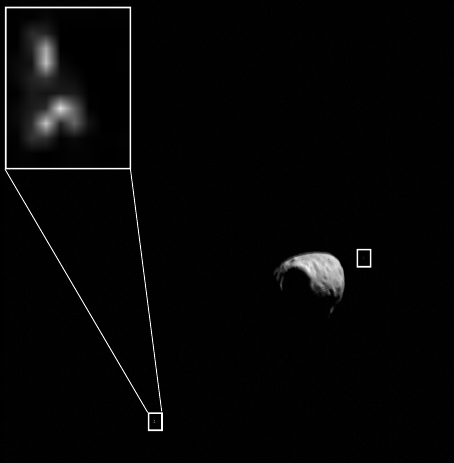
Fig 1: Phobos with stars in the background (Orbit 12563 [ESA/DLR/FU Berlin]). Due to the rather complex point spread function SRC images show stars as triangular objects with diffuse edges.
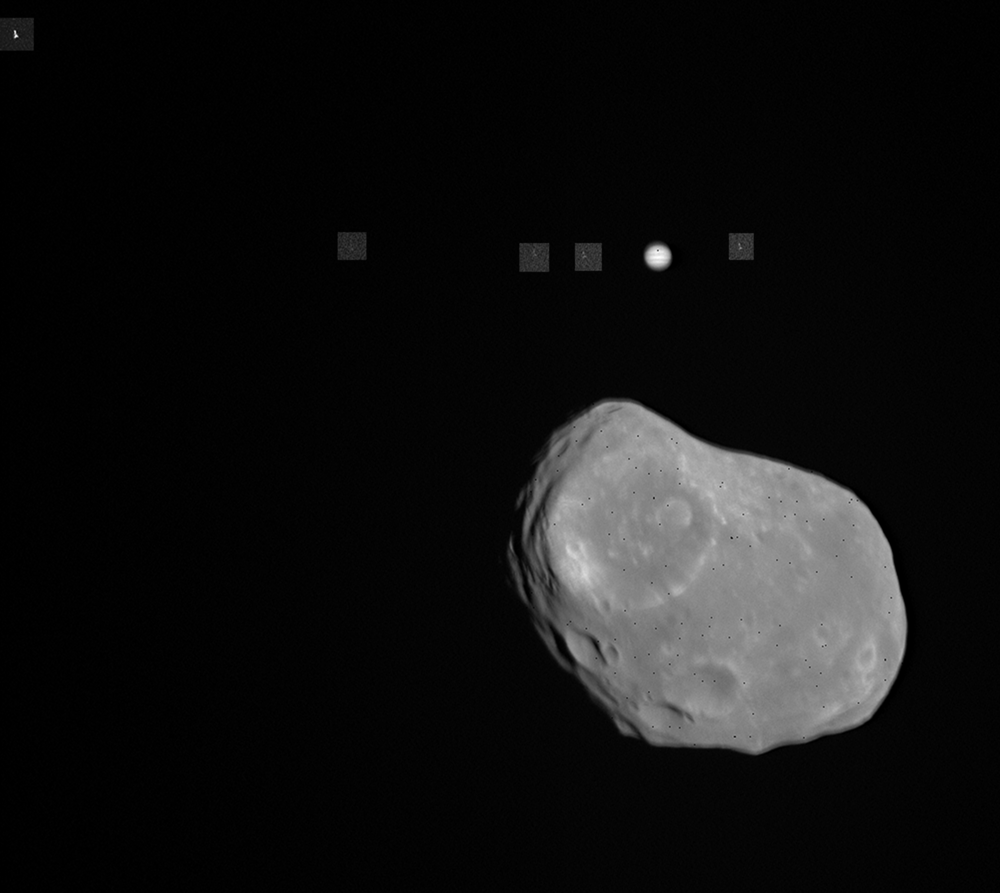
Fig 2.: Mutual event observation of Phobos and Jupiter with the Galilean satellites (Orbit 12515, [ESA/DLR/FU Berlin]). In addition a star was observed.
Methods: The measurement consists of determining the image coordinates of each body’s centre of figure (COF). For Phobos and Deimos we generate a synthetic image with the NAIF SPICE toolkit, incorporating the moons’ ephemerides, shape and rotation models, the Mars Express trajectory, and the SRC’s nominal pointing and camera parameters. The surface reflectance is modeled using the parameter-free Akimov disk function. Because the COF is known a priori in the simulated image, its pixel location in the observation can be determined with sub-pixel accuracy once a satisfactory match between the observation and the simulation is achieved [1].
As mentioned above, the SRC images are characterised by a complex PSF that renders stars as triangular objects with diffuse edges. Instead of generating a full synthetic image, we employ the PSF model presented in [3] to detect both stars and the Galilean moons and to extract their precise positions. The identified stars are cross‑matched with the Gaia catalogue [4, 5].
MMX/TENGOO
While MMX moves about Phobos in a quasi-satellite orbit, the TENGOO camera will have the chance to capture mutual event images of Deimos against a stellar background. Here we consider the epoch from 1 July 2028 to 30 September 2028. The observing windows for mutual events are spread throughout the epoch, with multiple opportunities sometimes occurring on a single day. Because downlink bandwidth is limited, not every opportunity can be exploited. Consequently, one must prioritize those instances that offer the most favorable observing conditions - i.e., the ones that will yield the highest-quality astrometric measurements of Deimos. These are related to
-
Apparent size: Deimos should occupy as many pixels as possible; we therefore prefer images in which the satellite spans ≥ 70 pixels.
-
Illumination geometry: A phase angle ≤ 90° is preferred to ensure adequate illumination without excessive shadowing.
Moreover, observations should be well-distributed in Deimos’ mean anomaly so that the entire orbit around Mars is sampled. Figure 3 illustrates the mean anomaly, the phase angle and the apparant size of Deimos for the mutual event opportunities.
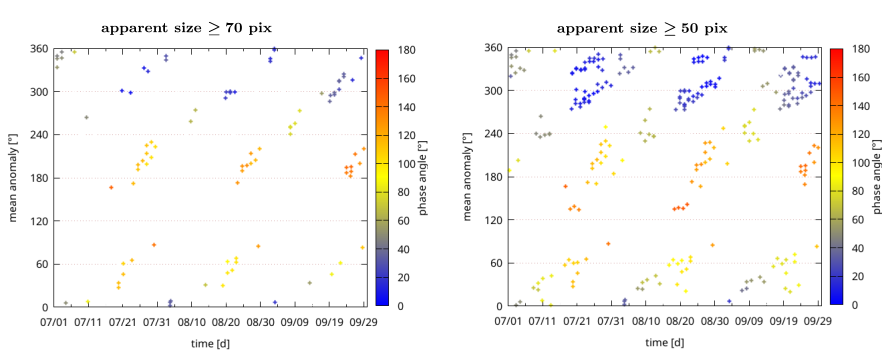
Fig. 3: Mean anomaly, phase angle and apparent size of Deimos for the mutual event opportunities spanning 1 July 2028 - 30 September 2028.
Covering the entire set of six 60° anomaly sectors can be achieved only if we include observations with phase angles ≤ 115°. When we impose the requirement that Deimos occupies an apparent size larger than 70 pixels and restrict the phase angle to ≤ 90°, no viable windows remain for anomaly values between 60° and 240°. If we relax the size constraint to a minimum of 50 pixels while still limiting the phase angle to ≤ 90°, the only remaining gap lies between 120° and 180° anomaly. Additionally, the only opportunities that fall within the 60°–90° anomaly range occur in September 2028.
Summary
We described the reduction of mutual events observations by Mars Express/SRC. The new observations complement the previous data set and enable maintaining the ephemerides of the Martian satellites. In addition, we outlined MMX/TENGOO imaging opportunities that could record Deimos together with background stars.
References:
[1] Ziese, R., Willner, K. (2018). A&A, 614, A15.
[2] Ziese, R., Willner, K., Vincent, J.-B., and Oberst, J. (2025). EPSC-DPS Joint Meeting 2025, EPSC-DPS2025-1965.
[3] Duxbury, T. et. al. (2011). HRSC Team Meeting 2011. Technical Note.
[4] Gaia Collaboration, T. Prusti, J.H.J. de Bruijne, et al. (2016). A&A 595, A1.
[5] Gaia Collaboration, A. Vallenari, A. G. A. Brown, et al. (2023). A&A 674, A1.
Acknowledgements:
This project is supported by the Deutsche Forschungsgemeinschaft (DFG), research grant number 528586639. It also relies on work done in an earlier project, suppported by DFG, grant number OB 1 24/1 4-1.
How to cite: Ziese, R., Willner, K., Matz, K.-D., Matsumoto, K., and Oberst, J.: Mutual event observations of the Martian moons with Mars Express/HRSC and MMX/TENGOO, Europlanet Science Congress 2026, The Hague, The Netherlands, 7–11 Sep 2026, EPSC2026-670, https://doi.org/10.5194/epsc2026-670, 2026.


