

- Institute of Astronomy, Geophysics and Atmospheric Sciences University of São Paulo, São Paulo, Brazil (sylvio@iag.usp.br)
Tidal torques influence the rotation of close-in exoplanets in a well-known way: they drive the rotation of the exoplanets to a synchronous stationary state where the planetary rotational and orbital periods are equal. This happens because of the proximity of these planets to the host star. So, not only are the tides more intense, but the stronger stellar radiation prevents the planets from maintaining an atmosphere, whether primary or secondary. However, if the planets are not too close to the host star, a dense secondary atmosphere can be formed, and thermal tides can deform this atmosphere in such a way that the gravitational attraction of the host star may create an additional torque as important as the torque due to the gravitational tide. This happens in Venus and may happen in any planet in the habitable zone of a star whose mass approaches the mass of the Sun. It is worth recalling that the study of the rotation of Venus with a new version of the creep tide theory (Folonier et al. 2025; Ferraz-Mello, 2026) shows that, in the absence of an atmospheric accelerating torque, the planet's current retrograde rotation is reversed, becoming direct in a few million years. This result indicates that the retrograde rotation of Venus cannot be simply due to a random catastrophic event, such as a collision with another body (e.g., a retrograde moon) or to eventual chaotic transitions associated with large obliquities.
What happens with Venus is simpler and may also be found among the internal exoplanets of other planetary systems. Our knowledge of Venus' rotation may be used to define what to expect for the rotation of Earth-like exoplanets in or near the habitable zone of stars with masses approaching the solar mass. Indeed, we know that the retrograde rotation of Venus is maintained by accelerating torques due to the atmospheric thermal tides, which offset the braking torques due to the gravitational tides (Ingersoll and Dobrovolskis, 1978).
The mathematical analysis of the equations describing the effects of the two torques shows that the phase space of these equations exhibits a feature common to many first-order differential equations: a pitchfork bifurcation (Ferraz-Mello, 2026). Without an atmosphere, the equation presents the well-known stable synchronous attractor: the gravitational tides tend to synchronize the planet’s rotational and orbital motions. With an atmosphere, an accelerating torque is added, and if the atmosphere is dense enough, the composition of the two torques may lead to different attractors. With the conditions observed on Venus, the synchronous stationary solution becomes unstable. The former stable attractor bifurcates into two asynchronous branches: one supersynchronous and one subsynchronous. Besides, the subsynchronous branch may reach negative rotation values.
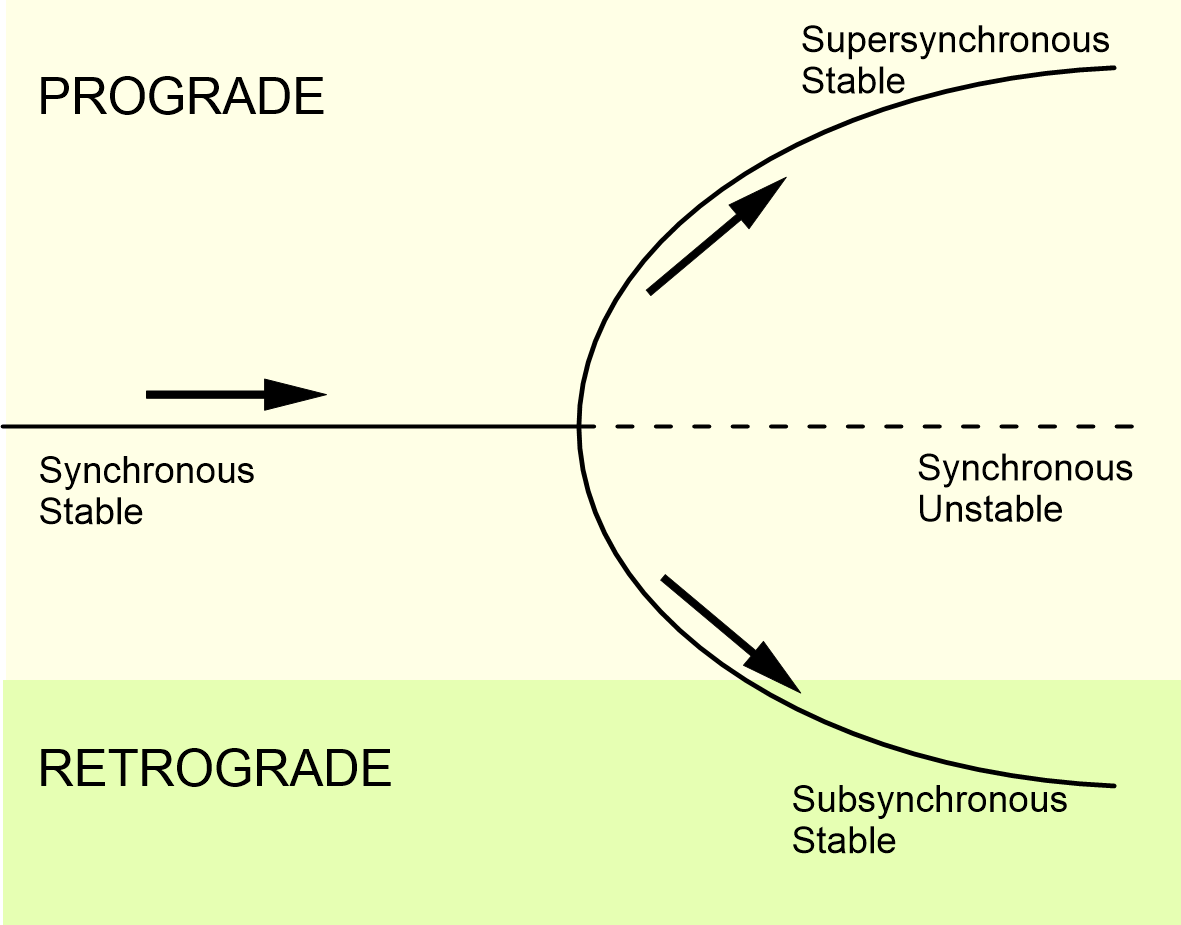
Therefore, the slow formation of a dense atmosphere on an exo-Earth initially devoid of a significant one may lead its rotation to cross the bifurcation that makes possible the rotation to become retrograde. The planet must remain without a significant atmosphere for several million years to allow the rotation to become synchronized before the bifurcation is reached. Then, with almost equal probabilities, it evolves towards one of two asynchronous attractors. The evolution towards a retrograde rotation does not necessarily happen. It is necessary that, after the bifurcation, evolution goes along the subsynchronous branch and that the atmosphere becomes dense enough to transform the subsynchronous, but still direct, rotation into a retrograde one. The conclusion comes from a simplified model, but it is very robust and also present in studies with more complex models (Correia and Laskar, 2003). Its simplicity suggests that many Earth-like exoplanets in or near the habitable zone of solar-type stars may exhibit retrograde rotation. Like Venus!
References
Correia, A.C. and Laskar, J., Icarus, 163, 24-45 (2003)
Ferraz-Mello, S., Astron. J. 171: 206 (2026).
Folonier, H. A., Ferraz-Mello, S., and Silva, R.A., Celest. Mech. Dynam. Astron. 137: 15 (2025).
Ingersoll, A.P. and Dobrovolskis, A.R., 1978, Nature, 275, 37-38 (1978).
Support: FAPESP, CNPq
How to cite: Ferraz-Mello, S.: Rotational synchronization and desynchronization of terrestrial planets in the habitable zone of solar-type stars., Europlanet Science Congress 2026, The Hague, The Netherlands, 7–11 Sep 2026, EPSC2026-678, https://doi.org/10.5194/epsc2026-678, 2026.


