
 ,,
,,- Department of Earth, Atmospheric, and Planetary Sciences, Purdue University, West Lafayette, IN, USA (hmanelsk@purdue.edu)
Introduction: As the scientific community plans for future in-situ exploration of the Moon, new instruments are being developed to meet its numerous objectives. Studying the chemical composition of the lunar crust remains an important focus. For example, searching for mantle exposures, KREEP-rich material, and volatile inventories are subjects of investigations outlined in the Artemis III Science Definition Team Report [1]. Laser Induced Breakdown Spectroscopy (LIBS) is a spaceflight-proven technique for rapidly quantifying chemical elements in geologic samples that is well suited for each of these objectives [2]. In LIBS, a pulsed laser is fired at a geologic target. A plasma then forms that cools, emitting light with energy specific to the elements present.
LIBS imaging is an emerging technique that has been applied in terrestrial geology and biology. Rather than sparse rasters, LIBS imaging involves creating dense scans (50-200 microns between points). In this way, a mm- or cm-scale image is created with each pixel composed of a LIBS spectrum. LIBS imaging has the ability to reveal chemical heterogeneity at the scale of individual grains in geologic targets - particularly valuable for studying coarsely crystalline igneous and brecciated lunar rocks. LIBS’s ability to quantify light elements gives it a significant advantage over X-ray fluorescence mapping, which is generally limited to elements heavier than Na (Z=11) [2,3].
This abstract describes a major element calibration with a flight-relevant lunar LIBS setup and applies it to chemically map a lunar feldspathic breccia, effectively simulating an in-situ analysis by a lander or rover on the Moon. A ~1.4 x 2.5 cm polished slab of the lunar meteorite Laâyoune 002 was purchased for this work. Laâyoune 002 was found in Western Sahara in 2022 and has been classified as a low weathering grade lunar feldspathic breccia [4].
LIBS Calibration: The goal of a LIBS calibration is to derive elemental compositions from raw spectra. First, 96 pressed pellets (26 mineral standards and 70 mixtures) with known chemical compositions were shot with LIBS in a lunar vacuum chamber (<10-4 mbar). These standards spanned a range of chemical compositions and matrices, including anorthosite, norite, basalt, ilmenite, pyroxene, and olivine. These spectra were input into different regression models commonly applied to LIBS calibrations. The optimal model for each major element (Si, Fe, Mg, Al, Ti, Ca, K, and Na) was trained using a 5-fold cross-validation scheme implemented with scikit-learn. Models for each element were compared based on their Root Mean Square Error of Prediction (RMSEP) and performance over different matrices, with the best performing model for each element reported (Table 1). Limits of detection (LOD) of each element were found statistically by using the slope of the calibration line and the standard deviation of the background signal (LOD2, as described in Lasue et al. [5]).
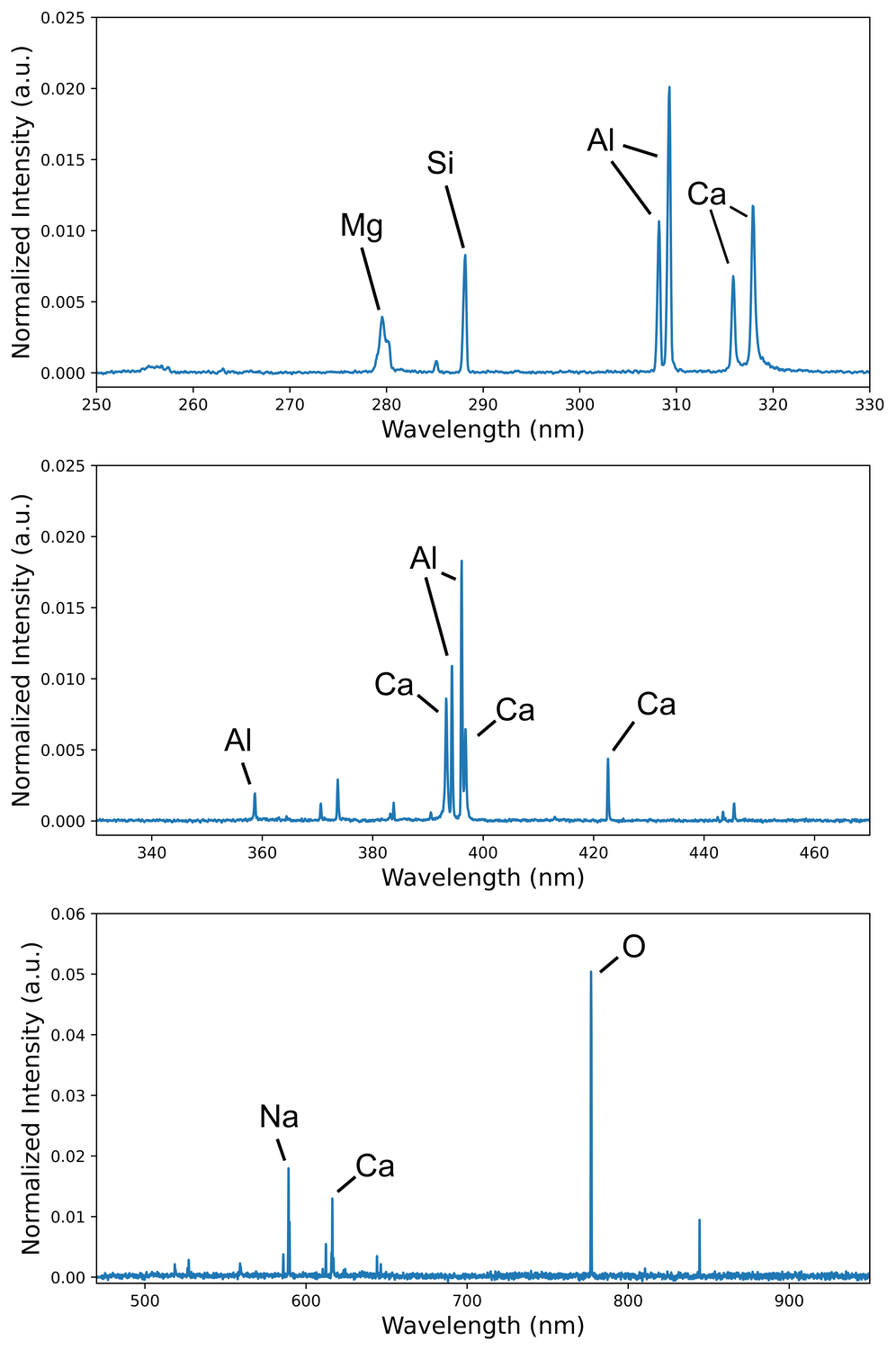
Figure 1. LIBS spectrum of an anorthosite pellet taken in vacuum conditions, with element lines annotated.
Table 1. RMSEP and LOD for all major elements
|
Element |
RMSEP (wt.%) |
LOD (wt.%) |
|
SiO2 |
3.98 |
4.8 |
|
MgO |
0.80 |
0.24 |
|
FeOT |
1.89 |
0.46 |
|
Al2O3 |
2.62 |
0.38 |
|
CaO |
1.49 |
0.12 |
|
Na2O |
0.43 |
0.24 |
|
K2O |
0.53 |
1.07 |
|
TiO2 |
1.79 |
0.22 |
LIBS Mapping: After LIBS spectra of pressed pellets were collected for test and training data, the Laâyoune 002 slab was placed in the lunar vacuum chamber and mounted on a Zaber XY stage. LIBS observations were then made, spaced in a 40x40 grid, with individual points spaced 150 microns apart. The median composition of all analyses is summarized in Table 2.
Table 2. Global median elemental composition of the scanned area.
|
Element |
Median (wt.%) |
|
SiO2 |
47.80 |
|
MgO |
1.61 |
|
FeOT |
4.63 |
|
Al2O3 |
28.93 |
|
CaO |
13.76 |
|
Na2O |
1.41 |
|
K2O |
0.37 |
|
TiO2 |
0.17 |
|
Total |
98.57 |
The high Al2O3 and CaO content of the scanned area (28.93 and 13.76 wt.%, respectively) suggests the Laâyoune 002 sample is dominated by Ca-rich plagioclase (anorthite) with minor olivine and orthopyroxene, which is consistent with other feldspathic lunar meteorites. The average derived normative plagioclase abundance is 86-89%, suggesting a strongly feldspathic lithology. Clast boundaries are clearly visible in elemental data (Fig. 2), demonstrating strong chemical heterogeneity at the sub-millimeter scale, and this variability is reflected in bimodal distributions of some major elements. The light-toned ~4x1 mm clast near the center of the scan, expected to be plagioclase-rich based on reflectance spectra, shows enhanced Al2O3 (~35 wt.%), CaO (~16 wt.%), SiO2 (~49 wt.%) and depleted FeOT (~2.5 wt.%).
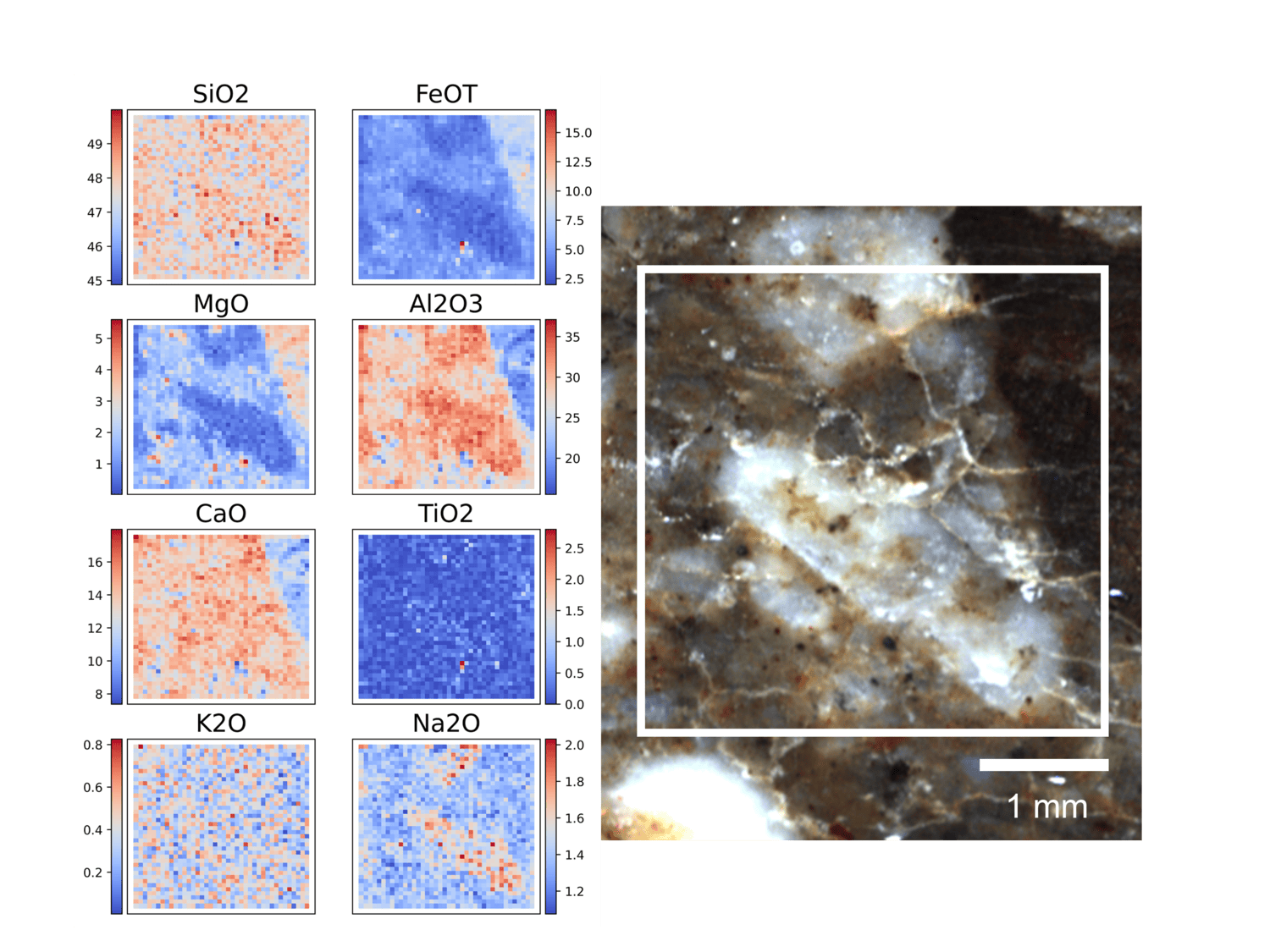
Figure 2. LIBS-derived elemental heatmaps (left) and a true color image of the Laâyoune 002 slab, with a white box indicating the scanned region (right).
Discussion: In this work, LIBS mapping with planetary samples was demonstrated for the first time. A custom elemental calibration was developed, showing that a spaceflight-relevant LIBS setup can distinguish major rock-forming minerals under lunar environmental conditions. Elemental scans of a polished slab of Laâyoune 002 confirmed its composition is consistent with a feldspathic breccia dominated by anorthite and low-calcium pyroxene (<5 wt.% FeOT, >25 wt.% Al2O3, and <1 wt.% TiO2 in Table 2). No spatially coherent zones with significant FeOT and MgO enrichment were observed, indicating that the mapped region does not contain clasts derived from mare basalts or lower crust mafic material. Given the lack of mare-derived, alkali-, or KREEP-rich clasts, it is possible Laâyoune 002 was ejected from deep within the lunar highlands, but LIBS scans over a much larger area on the sample would be required to make this claim with confidence.
References: [1] Artemis III Science Definition Team (2022) NASA, 186 pp. [2] Cremers D. A. and Radziemski L. J. (2013) John Wiley & Sons, Ltd. [3] Rapin W. et al. (2017) Spectrochimica Acta Part B: Atomic Spectroscopy. [4] Gattacceca et al. (2023) Meteoritics & Planetary Science, pp. 901-904. [5] Lasue et al. (2012) JGR: Planets, 117, E1.
How to cite: Manelski, H., Bedford, C., Lee, D. J., Wiens, R., Gillis, J., Vannier, H., Klidaras, A., Jolliff, B., Ollila, A., Clegg, S., Rapin, W., and Fraeman, A.: Chemical Mapping of a Lunar Meteorite Using LIBS: Implications for Future In-Situ Exploration, Europlanet Science Congress 2026, The Hague, The Netherlands, 7–11 Sep 2026, EPSC2026-68, https://doi.org/10.5194/epsc2026-68, 2026.


