
 2,2
2,2- 1Institut d’Astrophysique Spatiale, CNRS/Paris-Saclay University, France
- 2School of Physics and Astronomy, University of Leicester, Leicester, UK
- 3LIRA, Observatoire de Paris, Université PSL, Sorbonne Université, Université Paris Cité, CY Cergy Paris Université, CNRS, 92190 Meudon, France
Introduction. The icy satellites of Jupiter preserve a record of the physical and chemical interactions occurring between internal geologic activity, surface evolution, and the intense radiative environment imposed by Jupiter’s magnetosphere (e.g., [1, 2]). Understanding the composition and physical state of their surfaces is therefore essential not only to reconstruct their geological history, but also to investigate the coupling processes linking surface, subsurface, exosphere and the Jovian magnetosphere. In preparation for the arrival of the JUICE and Europa Clipper missions in the Jovian system, we present a spectroscopic analysis of Ganymede’s surface based on the merging of multiple visible-to-infrared hyperspectral datasets acquired from both ground-based observatories (VLT/MUSE, SPHERE, SINFONI) and space instrumentation (JWST/NIRSpec). By combining these datasets, we produce reflectance spectra spanning 0.5–5.3 µm over representative regions of Ganymede’s surface, enabling the simultaneous investigation of visible spectral slopes, water-ice absorption bands, Fresnel peaks, and infrared signatures of non-icy compounds.
Data and Methods. The observations were projected and photometrically corrected using an Oren–Nayar rough Lambertian model [3] before cross-calibration and spectral merging. The resulting dataset covers approximately 13% of Ganymede’s surface (both leading and trailing) at spatial resolutions ranging from 25 to 300 km/px. Spectral cubes are finally combined to the lowest resolution equivalent pixel to maintain consistency across the entire spectrum.
Spectral features. Spectral parameter maps reveal strong correlations between absorption features distributed across different wavelength ranges, demonstrating the scientific value of broadband spectral analyses. In particular, the combined analysis of the 1.03, 1.3, 1.5, 2, and 3 µm H2O bands, together with the 1.65 µm crystalline-ice feature and the Fresnel peaks near 3.1 µm, reveals major spatial variations in ice grain size and crystallinity across the surface.
Our results indicate that coarse-grained crystalline ice dominates the ancient grooved and dark terrains, whereas fine-grained ice is preferentially associated with recent crater ejecta and polar regions. These trends likely reflect the competition between thermal recrystallization and irradiation-driven amorphization caused by charged particles trapped within Jupiter’s magnetosphere. The weakening or disappearance of the 1.65 µm band and Fresnel peaks in dark trailing-hemisphere terrains further suggests enhanced radiation damage and accumulation of amorphous ice in these regions. Additional spectral features associated with radiolytic species such as H2O2 and O2 also display strong spatial correlations with the geometry of Ganymede’s magnetic field and plasma bombardment patterns. Those results are in line with previous studies on individual datasets (e.g., [4-7]).
Spectral modeling. To further constrain surface composition, we performed spectral modeling using three complementary approaches: areal (linear), intimate (nonlinear Hapke-based), and multiscale mixtures (an original and hybrid approach between areal and intimate mixtures). The combined spectral range allows simultaneous modeling of grain-size effects, continuum variations, water-ice crystallinity, and non-icy contaminants (Fig. 1). All models require mixtures dominated by water ice associated with sulfur-bearing phases, including sulfuric acid hydrates and polyhydrated magnesium sulfates. Older terrains appear enriched in Mg-sulfates, possibly linked to endogenous material, whereas younger and more irradiated terrains are preferentially enriched in sulfuric acid hydrates produced by radiolytic processing. Chloride salts remain poorly constrained in all models and are detected only at low abundance.
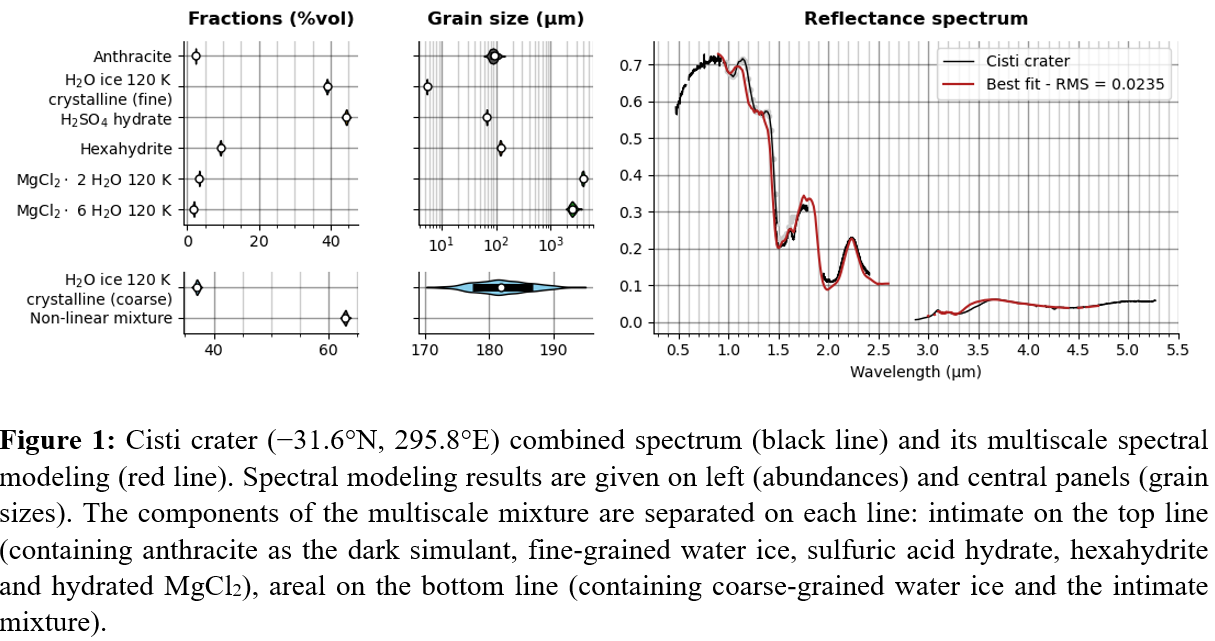
Lessons Learned. One of the most important outcomes of this study concerns the darkening agent responsible for the low albedo of Ganymede’s ancient terrains. Previous studies relying on linear mixing models suggested that dark material could represent a major fraction of the surface [6]. Our results show instead that intimate and multiscale mixtures reproduce the observations with much lower abundances of dark material (typically 1–10%), demonstrating that the inferred abundance strongly depends on the adopted radiative transfer formalism and grain-scale physics. This result has major implications for the interpretation of spectral observations of icy worlds, as it highlights the degeneracy between composition, grain size, and mixing geometry.
Beyond Ganymede itself, this work demonstrates the scientific potential of broadband visible-to-infrared spectral fusion for the exploration of icy satellites throughout the Jovian system to better constrain the physical processes that are expected to occur on the icy Moons under different irradiation and geological conditions. In particular, the ability to combine spectral diagnostics across the 0.5–5.5 µm range will be essential to disentangle the effects of composition and texture, identify minor compounds, and characterize the coupling between surface composition, geological activity, and exogenic processing on the Galilean moons. The methodology developed in this study also provides a direct framework for the future interpretation of MAJIS/JUICE and MISE/Europa Clipper observations [8,9].
Finally, our study highlights a critical limitation for future spectroscopic investigations: the lack of optical constants measured over extended spectral ranges and under cryogenic conditions representative of icy moon surfaces. The interpretation of forthcoming orbital datasets will therefore require a coordinated effort in laboratory spectroscopy to expand spectral libraries for hydrated salts, sulfur-bearing species, irradiated compounds, amorphous water ice, silicates, and candidate darkening agents. Such efforts will be essential to fully exploit the unprecedented spectral and spatial capabilities of JUICE and Europa Clipper and to achieve a comparative understanding of the icy worlds of the Jovian system.
References: [1] Pappalardo et al., 1998. Nature; [2] Schenk et al., 2001, Nature; [3] Oren & Nayar, 1995, Int J Comput Vis; [4] King et al., 2025, JGR: Planets; [5] King & Fletcher., 2022, JGR: Planets; [6] Ligier et al., 2019, Icarus; [7] Bockelée-Morvan et al., 2024, A&A; [8] Poulet et al., 2024, SSR; [9] Blainey et al., 2025, SSR
How to cite: Royer, C., Poulet, F., King, O., Bockelée-Morvan, D., and Fletcher, L.: Ganymede’s Surface Composition from 0.5 to 5.3 µm using combined VLT and JWSTdatasets and the resulting lessons learned, Europlanet Science Congress 2026, The Hague, The Netherlands, 7–11 Sep 2026, EPSC2026-768, https://doi.org/10.5194/epsc2026-768, 2026.


