
 2,4,4,4,
- 1Centro de Astrobiología (CAB), CSIC-INTA, Torrejón de Ardoz, Madrid, Spain
- 2University of Alcalá (UAH), Madrid, Spain
- 3The University of Tokyo (UoT), Tokyo, Japan
- 4National Institute for Aerospace Technology (INTA), Torrejón de Ardoz, Spain
Abstract
Samples returned from the C-type asteroid Ryugu by the Hayabusa2 mission offer a unique window into pristine carbonaceous material from the early Solar System. Here we report results from two Raman-based investigations of Ryugu fragments A0542 (0.5 mg) and A0552 (0.7 mg).
First, using Raman spectroscopy performed after applying organic extraction to the samples for mass spectrometry analysis, we were able to identify the mineralogy more clearly i.e. we identified not only dolomite, magnetite, and pyrrhotite, easily detected by Raman spectroscopy, but also phyllosilicate-related phases, hydroxyapatite Ca5(PO4)3(OH) and eskolaite (Cr₂O₃), which have been identified for the first time by Raman spectroscopy in Ryugu samples. Most importantly, we have detected for the first time in Ryugu the sulfide mineral erdite (NaFeS₂·2H₂O), which provides new constraints on aqueous alteration and sulfur geochemistry in primitive carbonaceous bodies.
In addition, Principal Component Analysis (PCA) applied to a Raman spectral database including Ryugu and a suite of meteoriotes allowed us to explore the spectral and compositional relationships between Ryugu and other primitive Solar System materials.
Introduction
Samples returned from the C-type asteroid Ryugu by the Hayabusa2 mission provide a unique opportunity to investigate pristine carbonaceous material from the early Solar System [1]. Our team received two Ryugu fragments, A0542 (0.5 mg) and A0552 (0.7 mg), through JAXA’s 4th Ryugu sample announcement of opportunity. This study addresses two complementary scientific objectives: (i) detailed mineralogical characterisation of Ryugu by Raman spectroscopy under reduced-fluorescence conditions enabled by an organic extraction step; and (ii) application of multivariate data analysis to Raman spectral databases.
Raman spectroscopic analysis of carbonaceous chondrites is commonly hindered by intense fluorescence that can obscure diagnostic spectral features beyond the D and G bands of organic matter [2]. By exploiting the organic extraction step required for high-resolution mass spectrometry (HRMS), we significantly reduced fluorescence interference and expanded the detectable mineral inventory of Ryugu samples.
On the other hand, we used multivariate techniques applied to Raman spectroscopy analysis. Multivariate statistical techniques, and in particular Principal Component Analysis (PCA) [3], offer a powerful tool to reduce the dimensionality of datasets while preserving the variance that distinguishes samples of different origin or composition. Here we apply PCA and k-means clustering to a comprehensive Raman spectral database that includes Ryugu samples alongside carbonaceous chondrites, with the aim of identifying the spectral relationships between Ryugu and other primitive carbonaceous bodies, particularly the CM chondrites Aguas Zarcas and Kolang, and establishing a validated spectral classification framework for primitive carbonaceous materials.
Materials and Methods
Two Ryugu fragments were used for these analyses. The smaller fragment, A0542 (0.5 mg), was analyzed without any prior treatment: Raman spectra were acquired directly and used for the multivariate PCA database. The larger fragment, A0552 (0.7 mg), was subjected to organic extraction for high-resolution mass spectrometry (HRMS), and micro-Raman measurements were subsequently performed on the residual material after this extraction step.
Micro-Raman measurements were performed on Ryugu particles from sample A0542, measured directly in the JAXA capsule after removal of the sapphire window. All measurements were carried out using a Renishaw inVia Qontor system (532 nm, 1800 l/mm grating, 50× objective).
For multivariate analysis, 100 Raman spectra per sample were acquired under identical conditions from Ryugu, Aguas Zarcas (CM2), Kolang (CM1/2), NWA 14792 (CR2), Los Vientos 123 (CO3), El Médano 485 (CO3), Paposo 087 (L6) and Zagami martian meteorite. All spectra were pre-processed uniformly: clipping to 100–1800 cm⁻¹, cosmic-ray removal, baseline subtraction, and z-score normalization. PCA and k-means clustering were then applied to reduce spectral dimensionality and identify grouping patterns and compositional relationships among primitive carbonaceous materials, particularly between Ryugu asteroids and the meteorites.
Results and Discussion
The results of the microRaman analysis show, in addition to confirming previously reported phases such as dolomite, magnetite, and pyrrhotite, the identification of phyllosilicate-related phases, hydroxyapatite, and eskolaite (Cr₂O₃). Most significantly, we report the first identification by Raman spectroscopy of erdite (NaFeS₂·2H₂O) in Ryugu samples, whose presence provides new constraints on aqueous alteration processes and sulfur geochemistry in primitive carbonaceous bodies (Figure 1D). It is worth noting that neither eskolaite nor erdite were detected during previous SEM investigations in these samples [4], which demonstrates the high interest of this methodological approach.
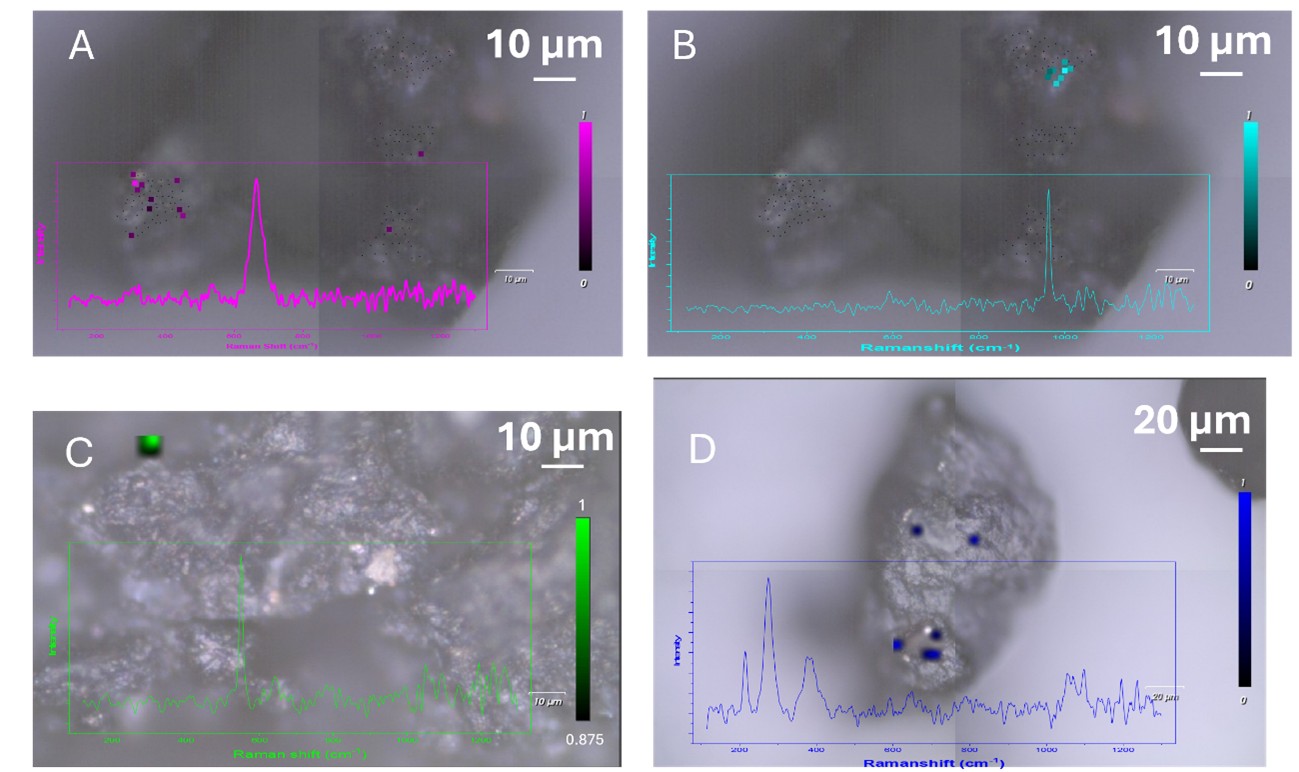
Figure 1. Raman spectra corresponding to different mineral phases identified for the first time by Raman spectroscopy in Ryugu sample: (A) phyllosilicate-related phase (B) hydroxyapatite,, (C) eskolaite, (D) erdite.
PCA applied to the spectral database reveals clear compositional relationships among the primitive carbonaceous materials studied. Ryugu clusters most closely with the CM chondrites Aguas Zarcas and Kolang, consistent with their shared aqueous alteration histories and carbonaceous compositions. This chemometric approach provides a robust framework for characterising the spectral affinities of Ryugu with other primitive Solar System materials.
Conclusions
Performing Raman spectroscopy after organic extraction significantly enhances mineral detection in Ryugu samples by suppressing fluorescence, leading to the first identification of erdite in Ryugu and providing new constraints on aqueous alteration and sulfur chemistry on the parent body. PCA of a comprehensive Raman spectral database reveals clear compositional affinities between Ryugu and the CM carbonaceous chondrites Aguas Zarcas and Kolang, establishing Raman spectral signatures as a robust tool for characterising the relationships among primitive carbonaceous bodies in the Solar System.
References
[1] Watanabe, S. et al. (2019). Hayabusa2 arrives at the carbonaceous asteroid 162173 Ryugu. Science, 364, 268–272.
[2] Bonal et al., 2024 — The thermal history of Ryugu based on Raman characterization of Hayabusa2 samples, Icarus 408:115826.
[3] Wold, S., Esbensen, K., & Geladi, P. (1987). Principal component analysis. Chemometrics and Intelligent Laboratory Systems, 2(1–3), 37–52.
[4] Sánchez-España et al. (2025) Sulfides and phyllosilicates of the Ryugu asteroid: mineral controls of S- and N-sp
How to cite: J. Bonales, L., Menor-Salván, C., Blanco, C., Prieto-Ballesteros, O., Cho, Y., Sánchez-España, J., G. Moral, A., de Dios-Cubillas, A., Fernández-Sampedro1, M., P. Canora, C., Benito-Parejo, M., and Rodriguez-Prieto, J. A.: Raman Spectroscopy of Ryugu: Mineralogy and Multivariate Analysis, Europlanet Science Congress 2026, The Hague, The Netherlands, 7–11 Sep 2026, EPSC2026-785, https://doi.org/10.5194/epsc2026-785, 2026.


