
 1,1,1,
- 1STEM, Open University, Milton Keynes, United Kingdom (rachael.hamp@open.ac.uk)
- 2Department of Chemistry, UCL, London
- 3Diamond Light Source, Harwell Campus, Oxford
Icy worlds hosting subsurface oceans, such as Europa and Enceladus, are leading candidates in the search for habitable environments beyond Earth. Identifying cryovolcanic regions on the surface of icy worlds, where ocean-derived fluids are delivered to the surface, is critical for probing ocean chemistry and therefore assessing their potential habitability. Characterising these surface ocean deposits is a key objective of both European Space Agency’s JUICE and NASA’s Europa Clipper missions [1]. However, the mechanisms that transport ocean material to the surface, and the extent to which emplacement processes modify composition and structure of ocean material are poorly constrained.
NaCl is a major component that has been identified in the cryovolcanic plumes at Saturn’s moon Enceladus [2] and on the surface of Jupiter’s moon Europa [3]. For more than 150 years, the NaCl-H2O phase diagram has only comprised of two known crystalline salt phases: NaCl (halite) and NaCl·2H2O (hydrohalite). Our recent work has discovered a novel metastable NaCl dihydrate formed through rapid freezing at rates comparable to cryovolcanic emplacement [4]. This metastable hydrate is stable below ~190 K, indicating that it can form and persist on the surfaces of icy worlds. This discovery provides the first evidence that ocean derived material on icy worlds may form previously unrecognised mineral phases under cryovolcanic conditions.
In this study, we assessed the compositional and structural signatures produced by variations in cooling rate and brine concentration. Raman spectroscopy, along with X-ray and neutron diffraction, was used to determine the mineralogical composition of NaCl-H2O ices formed over a range of cooling rates and concentrations. To investigate the effect of cooling rate on structure, we employed cryoSEM analysis. The aim of this study was to determine whether unique compositional and/or structural signature exist within NaCl-H2O assemblage as a function of cooling rate. Detection of these signatures would therefore provide insight into the thermal history experiences by the material.
Here, we present four distinct NaCl-H2O assemblages, comprising of hydrohalite, metastable hydrate and amorphous phases, that form along unique thermal pathways controlled by the initial brine concentration and cooling rate. Our study also shows that these NaCl-H2O assemblages produce distinct near-infrared spectral signatures detectable by upcoming orbital missions, highlighting the potential for this thermal proxy to be tested. CryoSEM analysis reveals that cooling rate also strongly influenced the structural morphology. Slower cooling rates produced thicker salt-bearing channels containing ordered microscale structure, whereas faster cooling rates produced thinner salt-bearing channels lacking microscale structure (Figure 1).
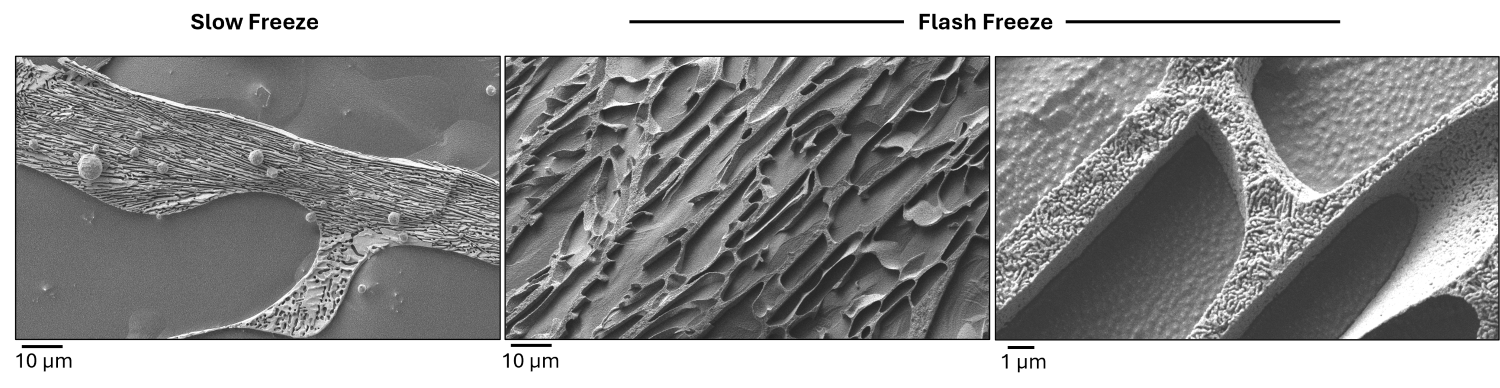
Figure 1: CryoSEM images of a 2 mol kg-1 NaCl-H2O solution frozen at different cooling rates. The slow frozen image (left) shows a large salt thick salt channel with ordered microscale texture. In comparison, the flash frozen image (middle) at the same scale shows much thinner and widely distributed salt channels. The right-hand image shows no order microscale texture in the flash frozen sample.
Cryo-imaging also revealed that there are no observable changes to sample structural morphology during heating, even when heated to beyond the known metastable-stable phase transition at ~190 K. This demonstrates that the structure formed during initial cooling is preserved during the transition to the thermodynamically stable phase. Consequently, material on the surface of icy worlds that initially contained metastable phases that have since decomposed to the thermodynamically stable forms could still be identified on the basis of their structural characteristics. These results demonstrate that both phase assemblages and morphologies can record brine cooling rates on icy worlds, providing a means to reconstruct geological history of ocean-derived surface material. The identification of metastable phases on the surface of icy worlds, which form at the fastest cooling rates, would provide evidence for rapidly frozen ocean deposits and could help identify high priority targets for analysis for upcoming missions.
References: [1] Hendrix, A. R. et al. Astrobiology 19, 1–27 (2019) [2] Postberg et al., Nature (2009), 459, 1098–1101 [3] Trumbo et al., Science Advances, 5 (2019) [4] Hamp et al., J. Phys. Chem. Lett, 15, 50, 12301-12308 (2024)
How to cite: Hamp, R., Fox-Powell, M., Fawdon, P., Salzmann, C., Hogan, J., Beaumont, M., Perera, L., and Thompson, S.: Cooling history recorded in the structure and mineralogical composition of surface NaCl-H2O on icy worlds, Europlanet Science Congress 2026, The Hague, The Netherlands, 7–11 Sep 2026, EPSC2026-826, https://doi.org/10.5194/epsc2026-826, 2026.


