

- Sandia National Labs, Albuquerque, United States of America (esilbe@sandia.gov)
Near-Earth asteroids that penetrate the atmosphere deposit energy along their flight path, generating shock waves that decay into infrasound, sub-audible acoustic waves below 20 Hz that propagate efficiently over hundreds to thousands of kilometers with minimal attenuation. Infrasound is frequently among the few geophysical observables captured from bolide events at regional to global distances. Infrasound signal periods can be used to recover the blast radius and, through it, the energy deposited per unit path length (the source function) along the trajectory, a quantity that informs impact-hazard assessments, bolide flux calibrations, and post-event characterization for planetary defense. However, the weak-shock models used in this source-function recovery have not previously been benchmarked against a hypersonic source with independently known parameters, leaving a poorly quantified systematic uncertainty in source-function estimates derived from natural impactors.
The OSIRIS-REx Sample Return Capsule (SRC) reentry on 24 September 2023 offers an opportunity to reduce this uncertainty. The SRC is a rigid, effectively non-ablating hemisphere whose geometry, trajectory, and velocity at each emission point are constrained from mission data and ray tracing, reducing source-side ambiguity associated with ablation and fragmentation that complicates natural meteoroid analyses. Infrasound was recorded at 39 ground stations deployed in Nevada and Utah, each sampling a different emission point along the trajectory at source altitudes of 44 to 62 km, providing a controlled, multi-station calibration dataset for weak-shock theory applied to a hypervelocity atmospheric source (Fig. 1).
Six blast-radius (R0) formulations and three weak-shock transition coefficients (C) were evaluated through systematic forward and inverse modeling. The Sakurai (1965) formulation achieves the lowest period residual (9% median absolute error) with near-zero bias, while the Mach-diameter approximation commonly used in bolide studies appears to overestimate the blast radius by a factor of approximately 3.4 for this non-ablating source (Fig. 2). The signal period is found to be a more operationally practical observable for constraining the source function than peak overpressure, which remains sensitive to propagation-model assumptions at these distances. A monotonic residual trend with source altitude suggests that constant-normalization blast-radius formulations may not fully capture the variation in energy coupling across the range of entry conditions sampled, an uncertainty that would map directly into source-function estimates for natural impactors.
These results contribute toward a calibrated performance baseline for infrasound-based source-function recovery from hypervelocity atmospheric sources and help quantify systematic uncertainties relevant to planetary-defense applications.
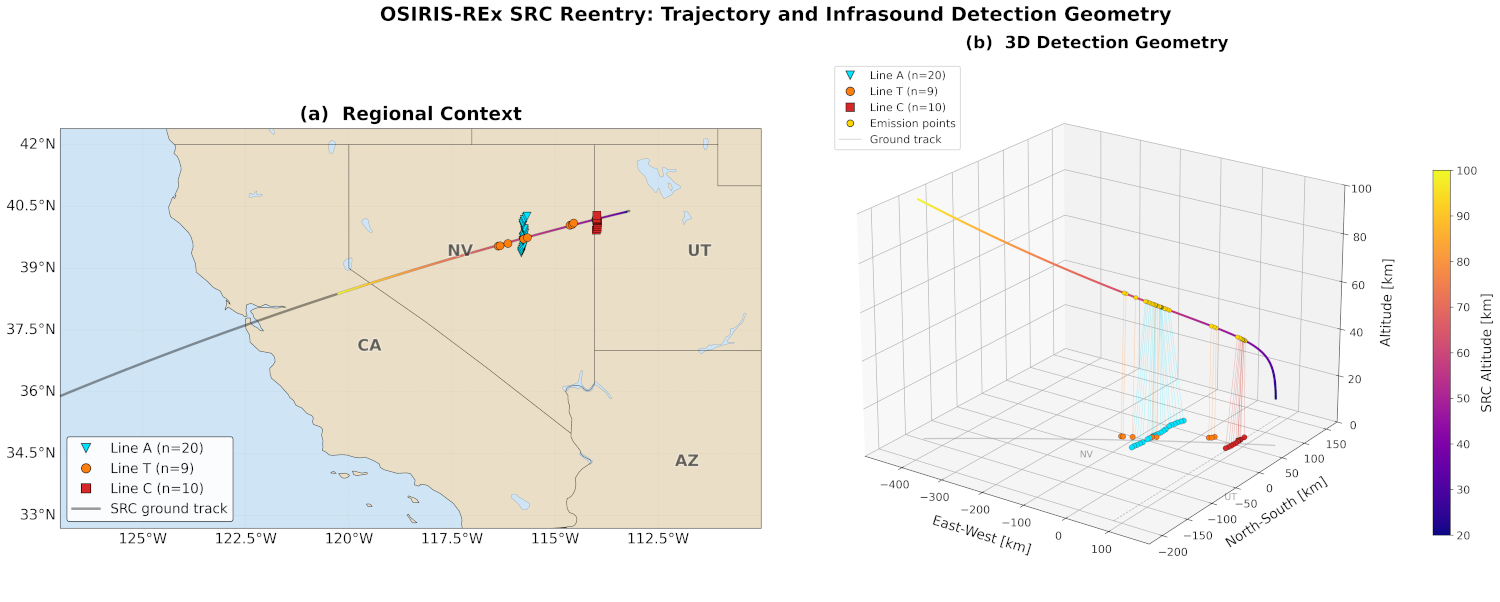
Figure 1: OSIRIS-REx SRC reentry trajectory and infrasound detection geometry. (a) Regional context map showing the projected SRC ground track and the 39 single-sensor infrasound stations deployed across three lines (A, T, C) in Nevada and Utah. (b) Three-dimensional view of the source-to-receiver geometry, with ray paths connecting ground stations to their raytracing-derived emission points (gold markers) along the trajectory at altitudes of 44 to 62 km.
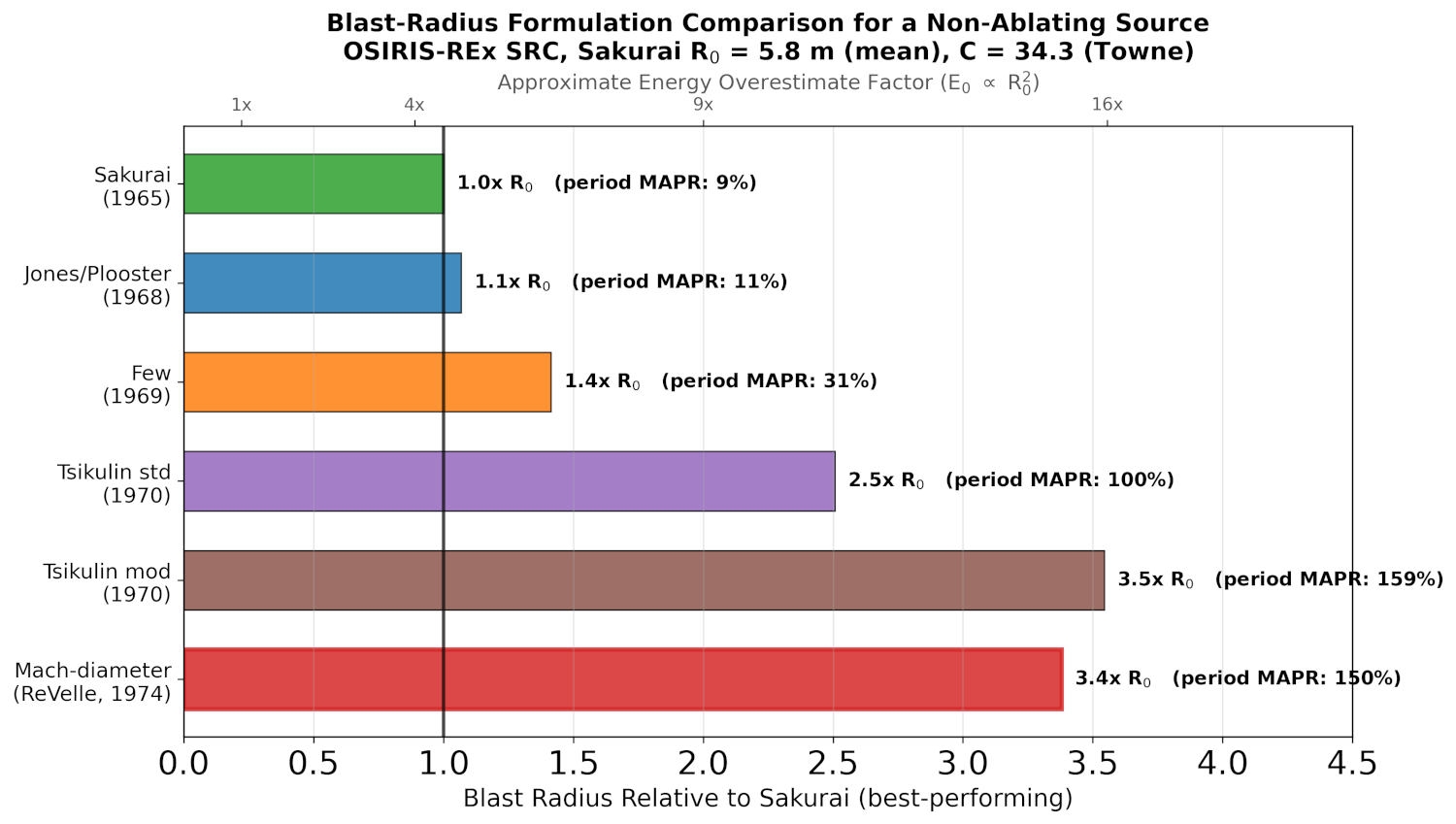
Figure 2: Blast-radius overestimate factor for each of the six tested R₀ formulations, expressed relative to the Sakurai (1965) formulation (the best-performing for this non-ablating source). Each bar is annotated with the corresponding forward-model period median absolute percentage residual (MAPR) at C = 34.3. The top axis shows the approximate energy-per-unit-path-length overestimate.
SNL is managed and operated by NTESS under DOE NNSA contract DE-NA0003525. Cleared for release.
How to cite: Silber, E.: Calibrating Infrasound-Based Energy Estimation for Atmospheric Impactors Using the OSIRIS-REx Reentry Benchmark, Europlanet Science Congress 2026, The Hague, The Netherlands, 7–11 Sep 2026, EPSC2026-86, https://doi.org/10.5194/epsc2026-86, 2026.


