
 1,1,3,5,1,1,
- 1DLR, Institute of Space Research (WR), Berlin, Germany (susanne.schroeder@dlr.de)
- 2Department of Earth and Planetary Science, The University of Tokyo, Tokyo, Japan
- 3Centro de Astrobiologia (CAB-INTA-CSIC), Torrejón de Ardoz, Spain
- 4German Aerospace Center (DLR), Microgravity User Support Center, Cologne, Germany
- 5Instituto National de Técnica Aerospacial (INTA), Torrejón de Ardoz, Spain
- 6ISAS/JAXA, Kanagawa, Japan
- 7Institut für Planetologie, Universität Münster, Münster, Germany
Introduction: JAXA’s Martian Moon eXploration (MMX) mission is dedicated to study the two Martian moons Phobos and Deimos with the goal on shedding light on their origin and evolutionary history [1,2]. For in-situ mineralogical analysis on the martian moon Phobos with the MMX IDEFIX rover [3], a highly compact Raman spectrometer [4] was developed under the lead of DLR with contributions from international partners: Instituto Nacional de Tecnica Aerospacial (INTA), University of Valladolid (UVa), JAXA and University of Tokyo. MMX will be launched in fall 2026, arrive in the Mars system in summer 2027 and the IDEFIX rover will be released to the surface of Phobos between late 2028 and early 2029 for a surface operations phase of 100 (Earth) days [5]. Orbital observations with the main MMX spacecraft and in-situ science on Phobos with the IDEFIX rover are going to be complemented by returning surface samples (>10 g) from Phobos to Earth, which shall arrive in 2031.
The RAX Raman spectrometer: By characterizing in-situ the mineral composition of Phobos’ surface, the RAman spectrometer for MMX (RAX) directly contributes to the top-level goals of the MMX mission. Different mineral phases can be associated with different formation scenarios (e.g. captured asteroid or major impact) and to surface alteration processes on Phobos. Next to providing ground truth, the mineralogical information obtained with RAX can also support sampling decisions with the main spacecraft and be compared with data obtained from the returned samples and in-situ data from the surface of Mars.
RAX is located on the underside of the 24 kg rover and is characterized by its extremely compact design, a mass of only 1.5 kg and a volume of about 1 dm³. It contains a spectrometer with a miniaturized and highly sensitive optical assembly. The optical design of RAX was driven by A.) the tight constraints of volume and mass available on the small MMX rover and B.) optimizing the collection and detection capabilities of the Raman signal from a sample at several centimeters distance below the rover’s body. Raman excitation (continuous wave with λ = 532 nm) is achieved through a separate laser module based on the Raman Laser Spectrometer (RLS) laser developed for the ExoMars mission’s Rosalind Franklin rover [6]. To focus the laser onto Phobos’ surface beneath the rover, the spectrometer is equipped with an opto-mechanical autofocus subsystem that allows fine-tuning of the focus position at a working distance of approximately 8 cm, within a range of 13 mm and to an accuracy of 50 µm. Raman measurements on Phobos will be done during Phobos night. The rover’s locomotion system is needed for the main height adjustment: the rover will gradually lower its height until the RAX instrument is within its working range. After autofocusing, dark spectra (without the laser) and Raman spectra will be measured from a footprint of 50 µm from what is exposed in the RAX field-of-view beneath the rover.
To demonstrate the functionality of the RAX instrument after launch and to monitor its performance, a Verification Target (VT) is part of the payload. The VT is a pellet made of deuterated polyethylene terephthalate (PET) specifically developed for this mission [7]. The VT is placed in the field of view of the RAX instrument and can be measured during the cruise and while in orbit until the rover separates from the MMX spacecraft for landing on Phobos in late 2028.
Status: The flight model of the IDEFIX rover was delivered to JAXA/MELCO and integrated into the main spacecraft for qualification and functional testing. Operational sequences, e.g. defining the interaction between locomotion and science instruments, are currently being prepared and tested [8]. RAX checkout activities are being prepared and tested for the MMX cruise phase after launch. RAX surface measurements are being prepared with laboratory studies with the RAX development model in a vacuum chamber at low temperatures, see Fig. 1 B and [9], and in combination with the rover’s locomotion system using the MMX IDEFIX rover model Prototypix in the testbed of DLR in Oberpfaffenhofen [10].
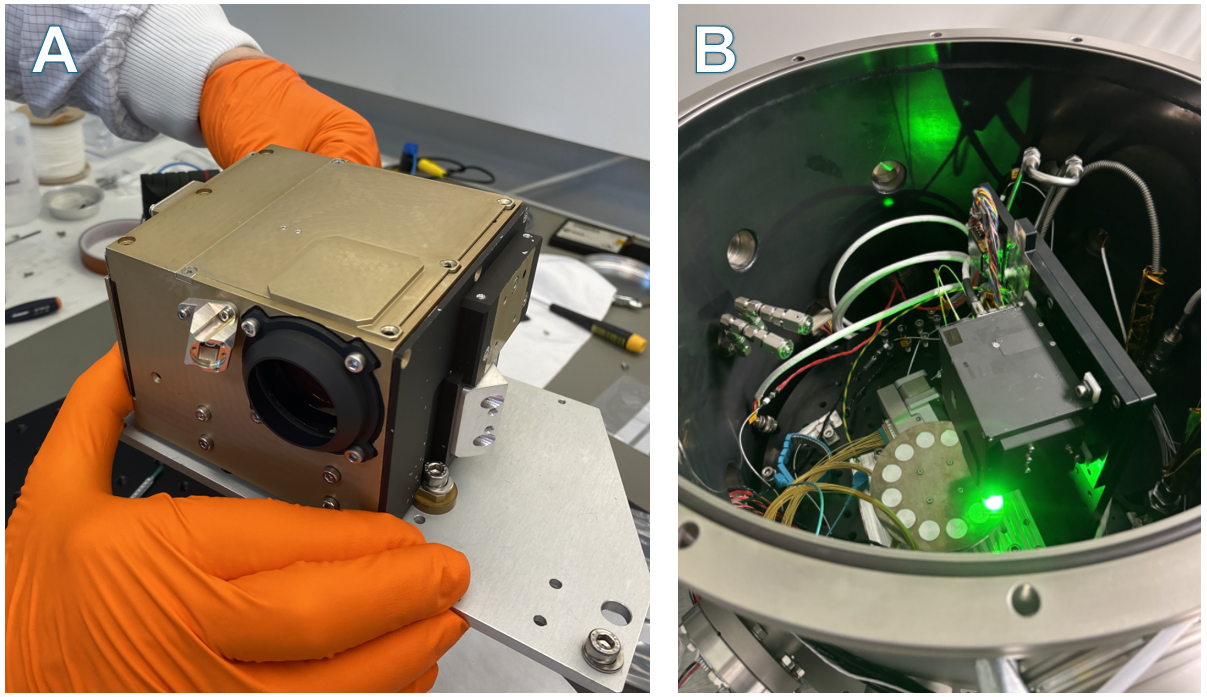
Figure 1 A: RAX flight model. B: RAX development model in vacuum chamber for reference measurements.
References:
[1] T. Usui, K. Bajo, W. Fujiya et al., Space Sci. Rev. 2020, 216, 49.
[2] Y. Kawakatsu, K. Kuramoto, T. Usui et al., Acta Astronaut. 2023, 202, 715.
[3] S. Ulamec, P. Michel, M. Grott et al., Acta Astronaut. 2023, 210, 95.
[4] T. Hagelschuer, U. Böttger, M. Buder et al., Internat. Astronautical Congress (IAC): 18-22 September, 2022, Proceed. 2022, IAC-22-A3.4A.8.
[5] S. Ulamec, P. Michel, N. Murdoch et al., PEPS 2025, 12, 97.
[6] F. Rull, S. Maurice, I. Hutchinson et al., Astrobiology 2017, 17, 627.
[7] A. G. Moral, J. Mora, O. Prieto-Ballesteros et al., J. Raman Spectrosc. 2023, 54, 1268.
[8] C. Krause, C. Delmas, D. Arrat et al., SpaceOps 2025, ID #29.
[9] N. Krybus, F. Seel, S. Schröder et al., EPSC-DPS 2025, ID #1669.
[10] F. Buse, L. Burkhard, N. Borgsmüller et al., iSpaRo 2025,454-460.
How to cite: Schröder, S., Cho, Y., Hübers, H.-W., Prieto-Ballesteros, O., Buder, M., Bunduki, Y., Dietz, E., Hagelschuer, T., Krause, C., Krybus, N., Moral Inza, A. G., Peter, G., Rammelkamp, K., Säuberlich, T., Seel, F., Ulamec, S., Usui, T., and Weber, I.: The RAX Raman Spectrometer on the MMX IDEFIX Rover for in-situ Mineralogical Analysis on Phobos , Europlanet Science Congress 2026, The Hague, The Netherlands, 6–11 Sep 2026, EPSC2026-872, https://doi.org/10.5194/epsc2026-872, 2026.


