
 1,3,
1,3,- 1Aix Marseille Université, Institut Fresnel, Marseille Cedex 20, France (christelle.eyraud@fresnel.fr)
- 2Computing Sciences, Tampere University (TAU), P.O. Box 692, 33101, Tampere, Finland
- 3Univ. Grenoble Alpes, CNRS, CNES, IPAG, Grenoble, France
The internal structure of asteroids remains poorly understood and is based entirely on inferences drawn from remote-sensing observations of their surfaces and theoretical modelling. Electromagnetic waves from space-based radars represent the most advanced method for characterising the internal structure of asteroids and comets [Herique2018]. In particular, the ESA-HERA mission, launched in October 2024 and equipped with a radar system called JuRa, will encounter the binary S-type asteroid 65803 Didymos in the coming months [Michel2022]. The main body of Didymos has a diameter of approximately 800 m, and Dimorphos, the asteroid’s small moon, has a diameter of approximately 160 m. Given the center frequency of the JuRa radar, the diameter of the main body corresponds to 160 λ in free space, and that of the small moon to 32 λ in free space.
Imaging the interiors of these asteroids requires specific advances in both measurement techniques and imaging algorithms. As far as imaging procedures are concerned, these difficulties are mainly due to the large size of these structures relative to the wavelength, as well as their significant contrast in terms of permittivity and their high level of electromagnetic scattering.
This work focuses on a method based on frequency-domain diffraction tomography aimed at obtaining an image of the interior of these asteroids exploiting the observation equation (Eq.(1)) which relates the scattered field to the induced current [Dufaure2023]. The procedure has been optimised to take full account of polarisation and to reconstruct all components of the induced current vector (Eq.(2)).


For each frequency, a 3D image of the target is obtained, and the images from all frequencies are then combined to produce the final image. This imaging technique enables structural imaging of the interior of asteroids with relatively low memory requirements, even if the target is large.
To test this imaging procedure, we used the microwave analogy, making use of the scale invariance rule in Maxwell’s equations, which involves reducing the size of the analogue and the wavelength by the same factor, whilst keeping the permittivity constant [Vaillon2014]. We have designed and produced 3D-printed scale models of the asteroid 25143 Itokawa [SorsaMD202] and the moon Dimorphos [Pajola2026]. The microwave scattering properties of these analogues were measured in an anechoic chamber using the MIMOSA equipment at the Fresnel Institute [Geffrin2025] (Figure 1). The configuration was chosen as quasi-monostatic to be similar to those used by the JuRa radar on the HERA mission and by the radar to be carried on board the Ramses mission to (99942) Apophis. Imaging results obtained from different analogues of asteroids will be presented and analyzed.
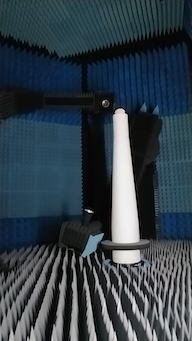
Figure 1. Measurement of the microwave scattering of an analogue with MIMOSA setup of the Institut Fresnel, Marseille
References
[1] A. Herique and al. Direct observations of asteroid interior and regolith structure: Science measurement requirements, Advances in Space Research, 2018.
[2] P. Michel and al. The esa hera mission: Detailed characterization of the dart impact outcome and of the binary asteroid(65803) didymos, The Planetary Science Journal, 2022.
[3] A. Dufaure, C. Eyraud, L.-I. Sorsa, Y. O. Yusuf, S. Pursiainen, and J.-M. Geffrin. Imaging of the internal structure of an asteroid analogue from quasi-monostatic microwave measurement data - i. the frequency domain approach, Astronomy and Astrophysics, 674(A72), 2023.
[4] R. Vaillon and J.-M. Geffrin. Recent advances in microwave analog to light scattering experiments, Journal of Quantitative Spectroscopy and Radiative Transfer, 146, 2014.
[5] Liisa-Ida Sorsa, Christelle Eyraud, Alain H´ erique, Mika Takala, Sampsa Pursiainen, and Jean-Michel Geffrin, Complex-structured 3d-printed wireframes as asteroid analogues for tomographic microwave radar measurements, Materials and Design, 198, 2021.
[6] Topi Pajala, Christelle Eyraud, Alain H´ erique, Jean-Michel Geffrin, and Sampsa Pursiainen, Rubble pile asteroid radar analogue model for dimorphos — the asteroid moon of 65803 didymos, Acta Astronautica, 2026.
[7] J. M. Geffrin and al. Mimosa: a new setup for scattering and diffraction measurements, 2025 IEEE Conference on Antenna Measurements and Applications (CAMA) (pp. 1-3), 2025.
How to cite: Eyraud, C., Pajala, T., Berquin, Y., Henry, G., Pursiainen, S., Hérique, A., and Geffrin, J.-M.: Structural imaging of asteroid analogues from lab-Measurements considering the polarization, Europlanet Science Congress 2026, The Hague, The Netherlands, 7–11 Sep 2026, EPSC2026-906, https://doi.org/10.5194/epsc2026-906, 2026.


