
 1,4,
1,4,- 1University of Bayreuth, BGI, Bayreuth, Germany (katherine.dale@uni-bayreuth.de)
- 2HUN-REN Research Centre for Astronomy and Earth Sciences (CSFK), Konkoly Observatory, Budapest, Hungary
- 3MTA Centre of Excellence, Budapest, Hungary
- 4Kapteyn Astronomical Institute, Rijksuniversiteit Groningen, Groningen, The Netherlands
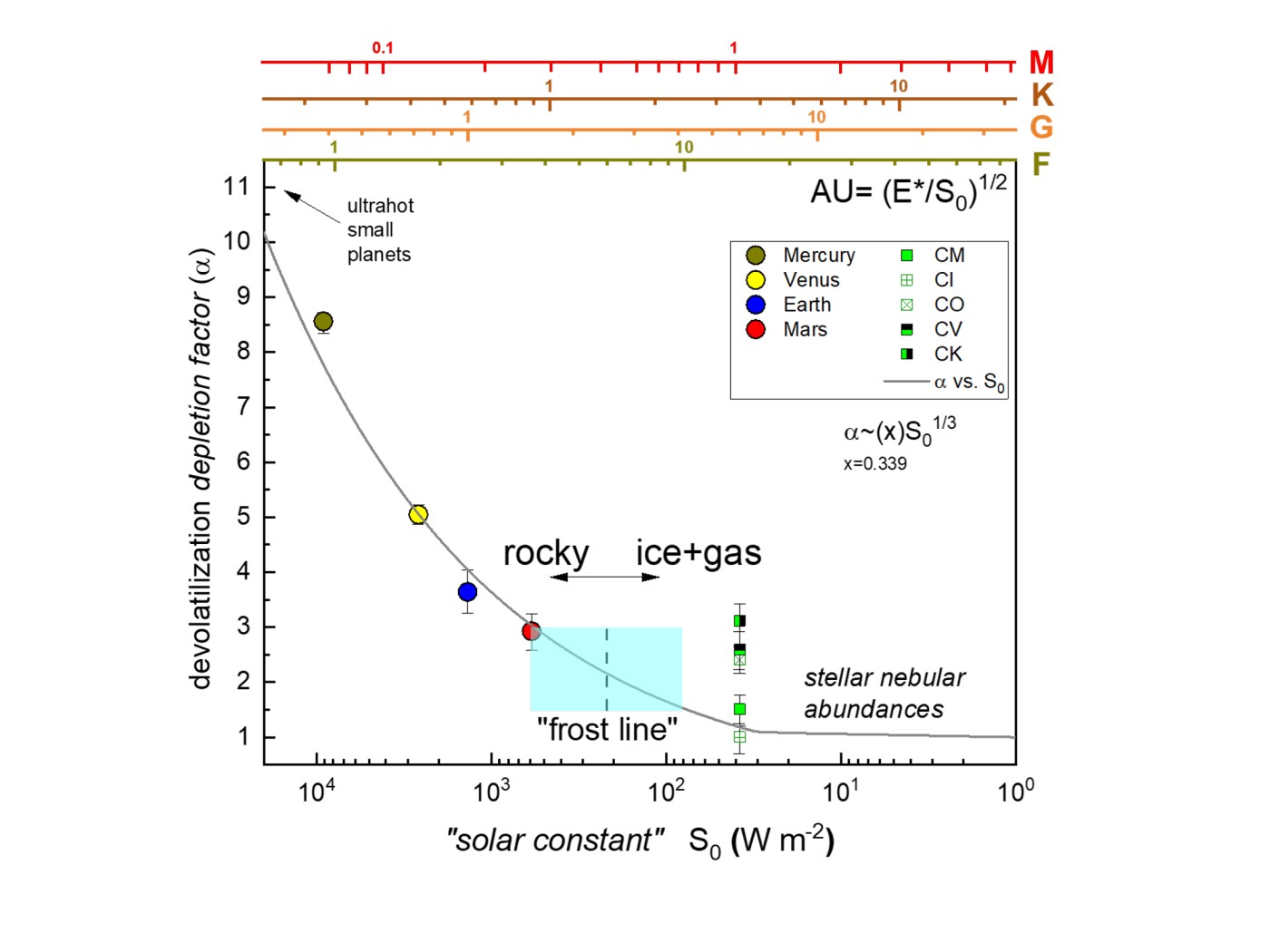
There are eight planets in the Solar System, each unique in many ways but all sharing one similarity: they are formed from the same material as the Sun they orbit. As such, the variation between the 6286 exoplanets (NASA, 2026) that have been discovered orbiting a variety of different stars cannot be examined by looking at our Solar System alone. However, it can give us some clues. The Earth is depleted in more volatile elements, elements with relatively low condensation temperatures, relative to Solar values (e.g. Yoshizaki and McDonough 2021; Palme and O’Neill 2014; Halliday and Porcelli 2001). Similarly, measurements of Martian material show that Mars is also depleted in these volatile elements, but to a lesser degree than the Earth is (e.g. Yoshizaki and McDonough 2020; Sossi and Fegley 2018). Compositional models of Venus and Mercury also suggest a volatile depletion, this time greater than the Earth’s. These volatile depletion trends can be modelled in a variety of different ways. We adopt the model of Wang et al. 2019, a slope in log space, gradient α, which describes volatile depletion relative to Solar abundances as a function of condensation temperature. We use this α to quantify the bulk abundance of elements in rocky exoplanets. Previously, Mojzsis et al. 2023 speculated that this α was related to the solar constant (the amount of energy received by an object at a given distance from its star, S<sub>0<sub> such that α = S<sub>0<sub><sup>1/ 3<sup> . We further support this relationship and apply it to exoplanet systems, as it has been suggested that this process of devolatilisation applies to the formation of all rocky planets (Wang et al. 2019). This allows us to explore the possible variation in exoplanet compositions around M-dwarf stars, a spectral class of star previously unexplored when modelling exoplanet compositions (e.g. Spaargaren et al. 2025, 2023). Additionally, we are able to predict the compositions of known exoplanets using this method, potentially aiding interpretations of atmospheric data and assessments of habitability.
The basis for the composition of exoplanets should first be the composition of the star that they orbit (Bonsor et al. 2021; Doyle et al. 2019). Spaargaren et al. 2025, 2023 used the composition of FGK stars in the Solar neighbourhood found in the Hypatia and GALAH catalogues to model the compositions of rocky exoplanets around their stars. We take this one step further, using the devolatilisation trends at different semi-major axes from different stellar abundances, as shown in Figure 1. For example, a planet at 1 AU around an F star should have a volatile depletion trends similar to those of Mercury: highly depleted in volatile elements and refractory rich. At 1 AU around an M-dwarf, a planet should exhibit depletion trends similar to CC meteorites relative to their stellar abundances. Such planets are likely volatile-rich, potentially retaining near-stellar abundances of the most volatile elements. Unlike previous studies, we are able to probe into the composition of rocky exoplanets around these M-dwarfs, a population of stars that make up the majority of the Solar neighbourhood and host a variety of small rocky planets. This has never been done before as elemental abundances are difficult to observe in M-dwarfs, unlike FGK stars. It is important to examine the exoplanets around M-dwarfs, however, as rocky exoplanets are easy to observe around these types of stars. In order to discern M-dwarf abundances, we use observations combined with the galactic chemical evolution (GCE) models of Trueman et al. 2026, which allow us to quantify the abundances of a variety of different elements found in M-dwarfs. Thus, we combine stellar abundance measurements with devolatilisation trends to predict bulk rocky planet compositions as a function of spectral class and orbital distance. This will aid us making and interpreting exoplanet observations as well as leading to insights in atmospheric formation, tectonic regimes, mineralogy and habitability.
References
NASA, et al., 2026, NASA (2026). URL: https://science.nasa.gov/exoplanets/ (visited on 11/05/2026).
Trueman, T. C. L. et al., 2026, Manuscript under review.
Spaargaren, Rob J. et al., Nov. 2025, In: A&A.
Mojzsis, Stephen et al., May 2023, In: EGU General Assembly Conference Abstracts.
Spaargaren, Rob J. et al., May 2023, In: The Astrophysical Journal.
Bonsor, Amy et al., May 2021, In: Monthly Notices of the Royal Astronomical Society
Yoshizaki, Takashi and McDonough, William F., May 2021, In: Chemie der Erde / Geochemistry.
Yoshizaki, Takashi and McDonough, William F., Mar. 2020, In:
Geochimica et Cosmochimica Acta.
Doyle, Alexandra E. et al., Oct. 2019, In: Science.
Wang, Haiyang S. et al., Aug. 2019, In: Icarus.
Sossi, Paolo A. and Fegley Jr., Bruce, Nov. 2018, In: Reviews in Mineralogy and Geochemistry.
Palme, H. and O’Neill, H.St.C, 2014, In: Treatise on Geochemistry (Second Edition). Ed. by Heinrich D. Holland and Karl K. Turekian.
Halliday, A. N. and Porcelli, D., Nov. 2001, In: Earth and Planetary Science Letters.
Figure 1: Adapted from Mojzsis et al. 2023, the relationship between α, the level of volatile depletion, and S<sub>0<sub>, the energy received by a planet at a given distance from the Sun. Top bars indicate equivalent orbital distances for planets receiving the same stellar flux around stars of different spectral classes.
How to cite: Dale, K. I., Mojzsis, S. J., Spaargaren, R. J., and Trueman, T. C. L.: Using Volatile Depletion Trends to Predict Exoplanet Compositions, Europlanet Science Congress 2026, The Hague, The Netherlands, 7–11 Sep 2026, EPSC2026-932, https://doi.org/10.5194/epsc2026-932, 2026.


