
 1,2,2,3,
- 1University of Bern, Space Research & Planetary Sciences, Bern, Switzerland (alizee.amslermoulanier@unibe.ch)
- 2Aix-Marseille Université, CNRS, CNES, Institut Origines, LAM, Marseille, France
- 3Earth-Life Science Institute (ELSI), Tokyo Institute of Technology, Meguro, Tokyo 152-8550, Japan
- 4Solar System Science and Exploration Division, Southwest Research Institute, 1301 Walnut St, Ste 400, Boulder, CO, USA
The Galilean moon Europa will be intensively explored in a few years by two upcoming space missions: JUICE and Europa Clipper. This icy moon, whose surface is covered by a thick ice shell, has attracted considerable attention because of its potential habitability and the likely presence of a subsurface liquid-water ocean. Despite the detection of potentially endogenic compounds on its surface such as salts or trapped volatiles (e.g. McCord et al. 2002, Fisher et al. 2015, Villanueva et al. 2023, Trumbo and Brown 2023…) the evolution and the current composition of such a subsurface ocean remain poorly constrained.
The evolution of Europa’s subsurface ocean was likely shaped by a combination of physical and chemical processes. In particular, interactions between the rocky mantle and the overlying water ocean may have strongly influenced the volatile inventory of the hydrosphere, as well as its pH and salinity. In addition, if Europa’s surface temperature remained sufficiently high shortly after accretion, equilibrium with a primordial atmosphere could also have modified the volatile distribution within the early ocean.
In the context of upcoming missions exploring the Galilean system, this study aims to establish links between future observations potentially probing Europa’s ocean composition and the moon’s formation and evolutionary history. Specifically, assuming Europa’s hydrosphere formed from the delivery of ice-rich planetesimals and solids, we investigate how the primordial volatile inventory evolved during the early stages of accretion by modeling the chemical evolution of its hydrosphere.
As Europa accumulates mass through accretion of surrounding material and bombardment by impactors, the surface temperature is calculated from a combination of impact heating and thermal input from the circumjovian disk (Bennacer et al. 2025). At each time step, we compute the composition of the primordial atmosphere and ocean, considering:
- The liquid-vapor equilibrium at the atmosphere-ocean interface
- The water-rock interactions occurring at the ocean-rocky mantle interface
- The influence of the rocks remaining in suspension in the ocean as Europa accretes material
Chemical equilibria associated with water-rock interactions are calculated using PHREEQ-C (Parkhurst and Appelo, 2013), while atmosphere-ocean exchange is modelled following the framework of Amsler Moulanier et al. (2025). The transport of species throughout the water column is modelled as well, using the diffusion transport scheme available in PHREEQ-C.
Our results provide an overview of how Europa’s accreted volatile inventory in the hydrosphere was influenced by the processes occurring during its early evolution. In particular, we highlight the key role of water-rock interactions in controlling the composition of the primordial atmosphere, the chemical evolution of the ocean, as well as its pH and salinity. In the context of the upcoming JUICE and Europa Clipper missions, this work provides various evolutionary pathways for Europa’s ocean composition, depending on the conditions of accretion, the initial volatile inventory and the composition of the rocky mantle. Comparing these results to future measurements potentially indicative of today’s ocean composition, we may better constrain and understand Europa’s evolution and formation conditions.
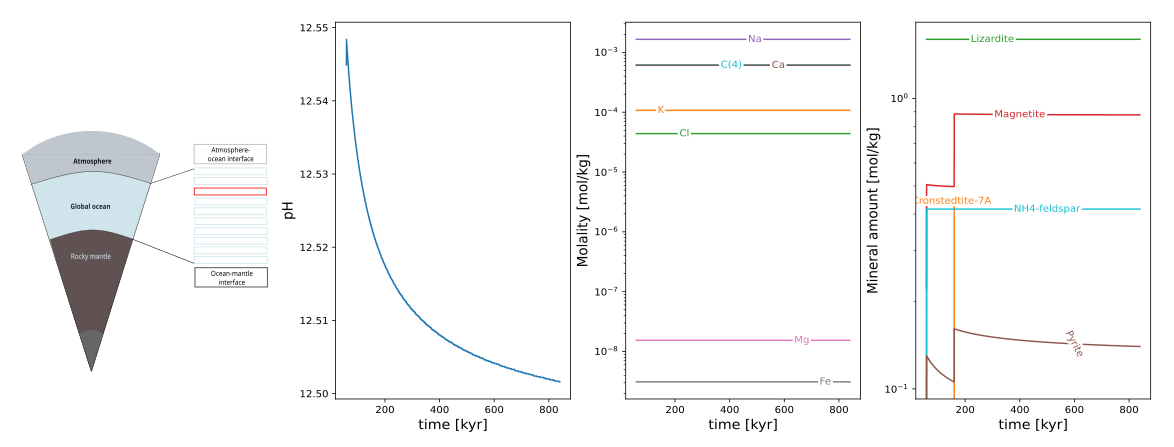
Figure 1 : Evolution of pH (left panel), species abundances (middle panel) and precipitated minerals (right panel) in one of the ocean’s layer during Europa’s accretion process (assuming a slow accretion in a warm CPD). During the modelling process, the ocean is divided in n layers, with here n=10. The results shown in this plot are for the modelled ocean layer highlighted in red on the left-hand side of the figure.
Acknowledgement:
The authors acknowledge the financial support of the SNSF under SNSF starting grant 218336.
References:
- McCord, B. T. et al. , J. Geophys. Res., 107(E1), doi:10.1029/2000JE001453, 2002.
- P. D. Fischer et al 2015 AJ 150 164
- G. L. Villanueva et al., Endogenous CO2 ice mixture on the surface of Europa and no detection of plume activity.Science381,1305-1308(2023).DOI:10.1126/science.adg4270
- Samantha K. Trumbo, Michael E. Brown, The distribution of CO2 on Europa indicates an internal source of carbon.Science381,1308-1311(2023).DOI:10.1126/science.adg4155
- Alizée Amsler Moulanier et al 2025 Planet. Sci. J. 6 1
- Yannis Bennacer et al 2025 Planet. Sci. J. 6 138
- Parkhurst, D.L., and Appelo, C., 2013, Description of input and examples for PHREEQC version 3: A computer program for speciation, batch-reaction, one-dimensional transport, and inverse geochemical calculations: U.S. Geological Survey Techniques and Methods 6-A43, xx, 497 p., https://doi.org/10.3133/tm6A43.
How to cite: Amsler Moulanier, A., Sekine, Y., Bennacer, Y., Kadoya, S., Mousis, O., and Vorburger, A.: On the composition of Europa’s early hydrosphere during accretion., Europlanet Science Congress 2026, The Hague, The Netherlands, 7–11 Sep 2026, EPSC2026-950, https://doi.org/10.5194/epsc2026-950, 2026.


