
 1,1,2,3,1,3,1
- 1LIRA - CNRS, Planeto, Meudon, France (robin.sultana@obspm.fr)
- 2Institute of Space and Astronautical Science, Japan Aerospace Exploration Agency, Sagamihara, Kanagawa 2525210, Japan,
- 3Laboratoire Atmosphère Observations Spatiales, Université Versailles St-Quentin/Université Paris-Saclay, Guyancourt, France
In October 2026, the Martian Moons eXploration (MMX) mission [1] will depart for the Martian system. Its primary objective is to unveil the origins of Phobos and Deimos, distinguishing between two possible scenarios: either the moons were captured asteroids or they formed from the debris of a giant impact on Mars.
Onboard MMX, the MMX InfraRed Spectrometer (MIRS) [2] will map the surfaces of Phobos and Deimos in the 0.9–3.6 µm range to search for weak spectral signatures of hydrated minerals (at 2.7 µm) or organics (at 3.3–3.4 µm), which would indicate an asteroidal origin. Thanks to its high signal-to-noise ratio and continuous spectral coverage, MIRS will fill the gaps in existing data from CRISM, OMEGA, and PFS. Previous analyses of CRISM data have revealed a weak signature of hydrated minerals around 2.7 µm [3] leading to an asteroidal capture, but the instrument’s limitations prevent definitive conclusions.
To prepare for the MMX mission and calibrate its instruments, spectral analogues for the surface of Phobos have been developed, namely OPPS [4] and UTPS-TB [5]. Although these analogues reproduce the spectral properties of Phobos, they are based on the asteroidal capture scenario (D-type asteroid for OPPS and Tagish Lake C2 chondrite for UTPS-TB) and incorporate organic materials and hydrated minerals.
In this work, we are developing a new simulant to test the post-impact scenario. The objective is to reproduce the near-infrared (NIR) spectral properties (reflectance level and spectral slope) of Phobos without incorporating any materials (such as organics or hydrated minerals) that would have been likely decomposed or evaporated by the impact [6].
To develop this simulant, we used a Hawaï lava tube basalt grinded in an Retsch PM100 planetary grinder and sieved the resulted powders into several categories (<50 µm, 50-100 µm, 100-300 µm). The choice of lava tube basalt was motivated as a proxy for a rapid melting and solidification, which minimizes the presence of large mineral grains and try to preserve mostly amorphous material, thus reducing potential absorption features from silicates (olivine, pyroxenes) [7]. As a darkening agent, we added up to 50 vol% magnetite.
The mixtures were then measured in the visible (VIS), near-infrared (NIR) and mid-infrared (MIR) using a Bruker Invenio-R FTIR coupled with the BOROMIR goniometer available at LIRA spectroscopy facility. To enable direct comparison with CRISM observations of Phobos from October 23, 2007 [8], we performed measurements replicating the observation geometry. We set the goniometer to match the geometry at the central region of the Phobos disk in the CRISM data, with an illumination angle of 30° and an emergence angle of 15°.
Figure 1 shows the spectral measurements of our samples compared to CRISM data under similar geometry. With the 50–50 vol% mixture, we obtained a red slope devoid of any spectral bands between 1.4 and 4 µm, although a weak adsorbed water feature around 2.8 µm is visible due to laboratory humidity. The slope and reflectance level of this mixture are consistent with those of Phobos’ red unit and almost perfectly overlap the observations. For similar geometry of observation for OPPS and UTPS-TB (incidence at 30° emergence at 20°), their spectra are much brighter despite sharing similar red slopes.
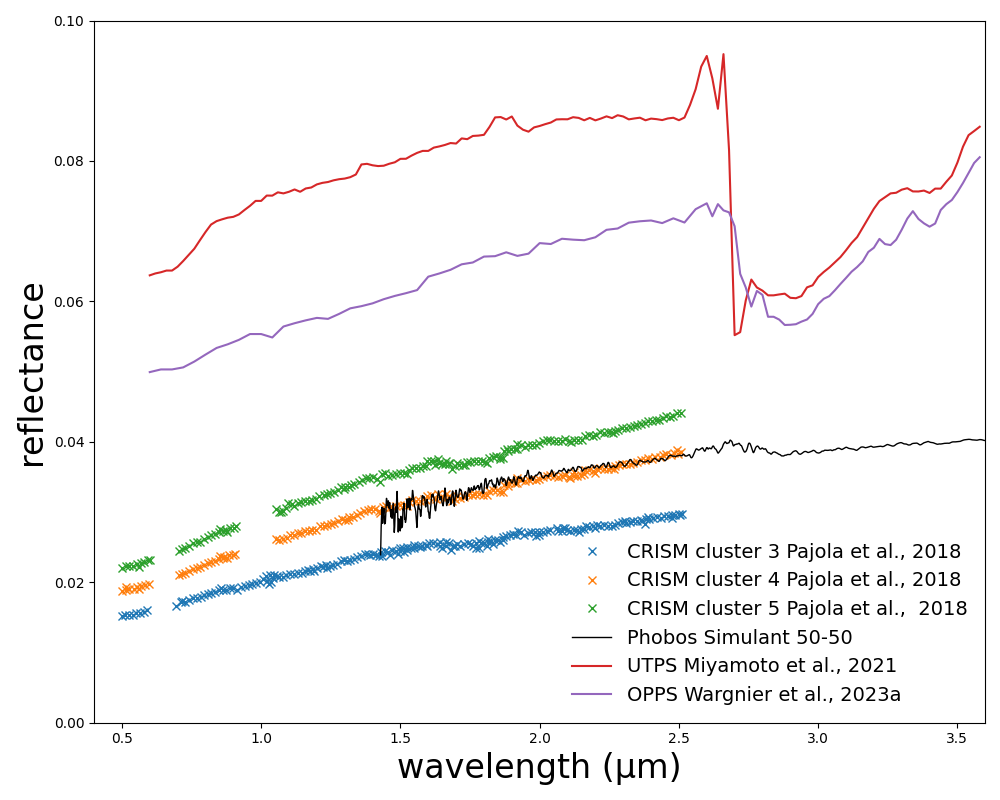
Figure 1: Spectra of Phobos from CRISM data, OPPS, UTPS, and this works simulant.
This preliminary work therefore demonstrates the possibility of reconciling the post-impact scenario with the spectral properties observed on Phobos.
As an improvement for this post-impact simulant, we are aiming at melting basalt around 1700K and cool the lava quickly under a reducing atmosphere as an extension to the work of [9].
We hope to produce a dark glass to reduce the amount of darkening component in the simulant and increase the amount of amorphous material to reduce the bands around 1 µm. The ongoing laboratory experiments and results will be presented and discussed
[1] Kuramoto et al., 2022, Earth, Planets and Space, 10.1186/s40623-021-01545-7
[2] Barucci et al., 2021, Earth, Planets and Space, 10.1186/s40623-021-01423-2
[3] Fraeman et al., 2014, Icarus, 10.1016/j.icarus.2013.11.021
[4] Wargnier et al., 2023a, Monthly Notices of the Royal Astronomical Society, 10.1093/mnras/stad2132
[5] Miyamoto et., 2021, Earth Planets and Space, 10.1186/s40623-021-01406-3
[6] Craddock, 2011, Icarus, 10.1016/j.icarus.2010.10.023
[7] Pisello et al., 2022, Icarus, 10.1016/j.icarus.2021.114801.
[8] Pajola et al., 2018, Planetary and Space Science, 10.1016/j.pss.2018.02.016
[9] Moroz et al., 2009, Icarus, 10.1016/j.icarus.2009.02.007
How to cite: Sultana, R., Hedjal, C., Yumoto, K., Chaudesaygues, C., Millan, M., Fornasier, S., Gautier, T., and Barucci, A.: Testing experimentally the post-impact formation scenario of the areolian moons: development of a new Phobos spectral simulant, Europlanet Science Congress 2026, The Hague, The Netherlands, 7–11 Sep 2026, EPSC2026-963, https://doi.org/10.5194/epsc2026-963, 2026.


