
 1,
1,- 1University of Bern, Physics Institute, Space Research and Planetary Sciences, Bern, Switzerland (oliver.schib@unibe.ch)
- 2University of Zurich, Department of Astrophysics, Zurich, Switzerland
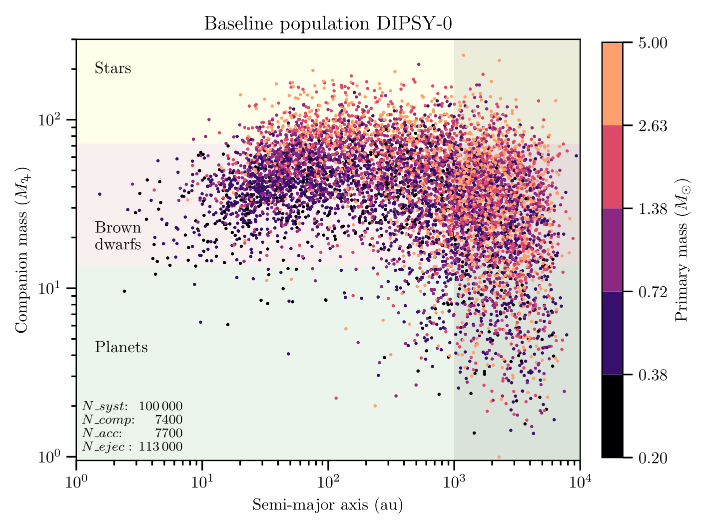
Disc instability remains a leading formation pathway for a subset of observed giant planets. In particular, it naturally accounts for giant planets at wide separations, around M-type stars, and in very young systems. Despite this, many aspects of the mechanism remain poorly understood, and the resulting planetary population is still uncertain. We have developed a comprehensive model that follows the formation and evolution of a star–disc system from the collapse of a molecular cloud core through disc dispersal and beyond. The model incorporates the possibility of disc fragmentation as well as the subsequent evolution of any resulting fragments. We apply this framework to conduct a population synthesis within the disc-instability paradigm (DIPSY). We present the results of the baseline population and discuss the emerging distribution of companions around different stellar types. Our findings indicate that, although fragmentation—i.e., the formation of gravitationally bound clumps within the disc, a necessary step for planet formation via disc instability—occurs in only a minority of systems, it often produces at least one companion when it does occur. The resulting population (Figure) spans a wide mass range, from planetary to stellar companions. These outcomes provide new insights for both theoretical studies of planet formation (e.g., hydrodynamic simulations) and future observational searches for companions. Overall, DIPSY advances our understanding of planet formation independently of any particular formation pathway.
How to cite: Schib, O., Mordasini, C., Emsenhuber, A., and Helled, R.: DIPSY: A new Disc Instability Population SYnthesis, Europlanet Science Congress 2026, The Hague, The Netherlands, 7–11 Sep 2026, EPSC2026-979, https://doi.org/10.5194/epsc2026-979, 2026.


