
 1,4,4,8
- 1Institut für Planetologie, Universtität Münster, Münster, Germany (markus.patzek@uni-muenster.de)
- 2Institute of Geochemistry and Petrology, ETH Zürich, Zurich, Switzerland
- 3Univ Brest, CNRS, Ifremer, IRD, LEMAR, Institut Universitaire Europèen de la Mer (IUEM), Place Nicolas Copernic, Plouzané, France
- 4University of Vienna, Faculty of Physics, Isotope Physics, Vienna, Austria
- 5Department of Geosciences, University of Arizona, Tucson, Arizona, USA
- 6German Fireball Network, Augsburg, Germany
- 7VKTA - Strahlenschutz, Analytik & Entsorgung Rossendorf e. V., Dresden, Germany
- 8Geowissenschaftliches Zentrum, Universität Göttingen, Göttingen, Germany.
- 9HUN-REN Institute for Nuclear Research, Debrecen, Hungary
- 10Institut für Mineralogie, University of Münster, Corrensstr. 24, 48149 Münster, Germany.
Introduction: The Blaubeuren meteorite was discovered in 1989 in southern Germany by a homeowner digging a cable trench in his garden, though it remained unrecognized as a meteorite until 2020. It is an H4-5 ordinary chondrite breccia weighing over 30 kg and the largest recovered stony meteorite in Germany [1]. 14C-10Be dating revealed a terrestrial age of 9.2 ± 0.3 ka. Repeated search campaigns by private meteorite hunters led to a newly recognized specimen in a forest close to the city of Schelklingen, ~3 km from the find location of the Blaubeuren meteorite.
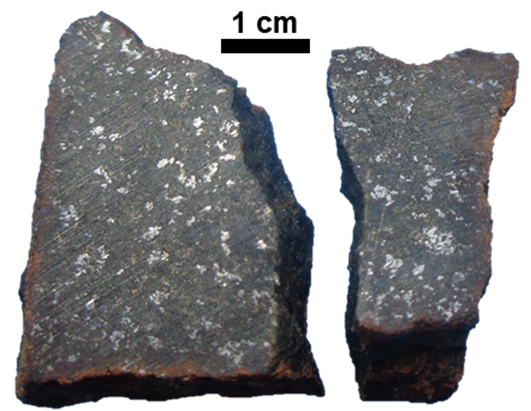
Figure 1: Cut face of the new specimen. The metal grains are remarkably unweathered.
Results: To verify a potential relationship to Blaubeuren, the new specimen has been studied using various techniques (optical and electron microscopy, bulk chemical, radionuclide [14C, 26Al, 41Ca] and noble gas analyses). It is an only moderately weathered single stone with a mass of ~17 g showing remnants of weathered fusion crust. Its O isotopic composition places it in the field of H chondrites. Petrographic study shows a rock with chondrules and chondrule relics (Figure 2) and an only slightly weathered interior (W1/2) [2]. The rock is unbrecciated at the thin section scale. Olivine grains show mosaicism indicating a shock degree of C-S4 [3]. The mean composition of olivine is Fa18.4±0.3 and the low-Ca pyroxenes have a mean composition of Fs16.1±0.3. The terrestrial age of the specimen has been determined by 14C-dating and found to be 9.4±1.3 ka. Preliminary noble gas data give gas retention ages of ~3.1 Ga and ~3.7 Ga for 4He and 40Ar, respectively, and cosmogenic 3He, 21Ne, and 38Ar concentrations 2–4× lower than measured for Blaubeuren. Cosmogenic radionuclides (26Al/27Al and 41Ca/40Ca) of the Schelklingen specimen are comparable to those of Blaubeuren [1] pointing to similar recent exposure conditions.
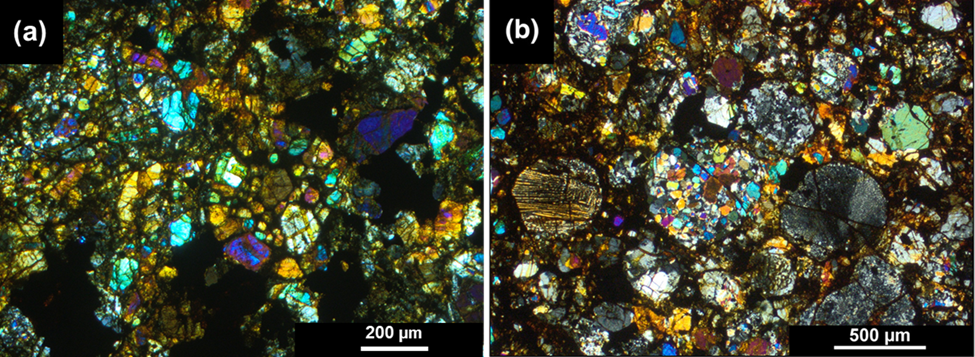
Figure 2: (a) Cross-polarized photograph of an area in the new specimen from close to Schelklingen with a chondrule and more metamorphosed material. (b) Cross-polarized photograph of an area in the Blaubeuren meteorite showing various types of chondrules and relics thereof.
Discussion: A comparison of the newly found specimen found close to Schelklingen with Blaubeuren shows a very similar mineralogy. Major differences compared to the Blaubeuren meteorite are that the newly found specimen shows (1) a significantly lower degree of terrestrial weathering, (2) a higher shock degree (C-S4 versus C-S2 for Blaubeuren), and (3) lower cosmogenic noble gas concentrations. The significantly fresher appearance of the new specimen may be attributed to different alteration conditions on the different locations (forest slope vs. soil inside a valley for Blaubeuren). This could have resulted in lower soil moisture and therefore favorable preservation of the Schelklingen specimen as the type and extent of terrestrial alteration depends on various aspects [4]. Differences in the shock degree can easily be explained by heterogeneity at the sample size studied because shock effects can vary from clast to clast at the cm-scale [5]. Thus, C-S4 shocked clasts may well be present elsewhere in the main mass of Blaubeuren. The differences in the cosmogenic noble gas concentrations of Blaubeuren and the new specimen may indicate they originated from strongly different depths within a large meteoroid (i.e., >120 cm radius). This, however, is not consistent with the similar cosmogenic radionuclide data obtained for both meteorites. Instead, this could suggest a more complex exposure history, (1) either on the parent body with Blaubeuren having experienced pre-exposure close to the surface or (2) that the meteoroid was a rubble pile consisting of individual fragments that experienced individual exposure histories. We consider it extremely unlikely that Blaubeuren and the new Schelklingen specimen originate from different meteoroids, which impacted Earth roughly at the same time and same place: Although. H ordinary chondrites represent the second most abundant class of meteorite falls [6,7], finding two meteorites from separate fall events within ~3 km seems statistically not favorable.
Conclusion: The new Schelklingen specimen and the Blaubeuren meteorite may be part of the same strewn field and therefore of the same meteoroid with a complex exposure history impacting Earth about 9 ka ago. Their differences in the shock degree and weathering may be explained by sample heterogeneity (as typical for breccias) at the cm-scale and different alteration conditions during the ~9 ka of terrestrial weathering.
References: [1] Bischoff, A. et al. (2022) Meteoritics & Planetary Science 57:136-153. [2] Wlotzka, F. (1993). A weathering scale for the ordinary chondrites. Meteoritics, vol. 28, no. 3, volume 28, page 460-460, 28. [3] Stöffler, D., Hamann, C., & Metzler, K. (2018). Shock metamorphism of planetary silicate rocks and sediments: Proposal for an updated classification system. Meteoritics & Planetary Science, 53(1), 5-49. [4] Bland, P. A., et al. (2006). Meteorites and the early solar system II, 1, 853-867. [5] Sharp, T. G., & DeCarli, P. S. (2006). Meteorites and the early solar system II, 943, 653-677. [6] Kouvatsis, I., & Hofmann, B. A. (2020). Meteoritics & Planetary Science, 55(1), 67-76. [7] The Meteorite Bulletin Database, 2026; https://www.lpi.usra.edu/meteor/
How to cite: Patzek, M., Paliwal, D., Krietsch, D., Barrat, J. A., Merchel, S., Jull, A. J. T., Heinlein, D., Degering, D., DiRocco, T., Marchhart, O., Martschini, M., Wieser, A., Molnár, M., Busemann, H., Berndt, J., Bischoff, A., and Pack, A.: The Blaubeuren Meteorite and its new Sibling: New Find in Close Vicinity Suggests a Complex Exposure History, Europlanet Science Congress 2026, The Hague, The Netherlands, 7–11 Sep 2026, EPSC2026-981, https://doi.org/10.5194/epsc2026-981, 2026.


