
 1,1,2,1,1,1,1,3,1,1,1,1
- 1INAF - IAPS, Rome, Italy
- 2Department of Physics, University of Rome Tor Vergata, Rome, Italy
- 3INAF - OAPd, Padua, Italy.
Introduction
On the Moon, increasing evidence of water ice in Permanent Shadowed Regions [1-3] (PSRs) and day-night surface-exosphere hydration variability [4], is asking for a description of the delivery scenario [5]. Here, we present preliminary results from our Smoothed Particle Hydrodynamics model for volatile emissions, to monitor the evolution of a plume originating from the impact of a cometary-like object over the Moon’s surface, an event that could significantly contribute to the exogenic delivery of lunar water ice [6], in particular within PSRs.
Methods
We follow the dynamical and thermal evolution of the vaporized ejecta resulting from the impact by means of the Smoothed Particle Hydrodynamics (SPH) method [7]. This particle-based mesh-free approach integrates hydrodynamic equations and provides the evolution of velocity, density, and energy. Our model, successfully used to simulate Enceladus’ plumes [8], describes the collisional regime of fluid flow, often neglected in ejecta simulations on the Moon [9]. We consider phase transitions between water vapor and icy-grains, their viscous interaction, solar radiation effect, thermal conduction with boundaries, Moon’s gravity and tidal interaction with Earth.
Initial conditions. We use scaling relationships [10-11] to relate crater, ejecta, target, and impactor properties. We assume a top-surface lunar density of 1100 kg/m3 [12] and a cometary-like impactor with density of 500 kg/m3, size ~1.5 km, velocity of ~15 km/s [13] and an ice of 20% of the comet mass. The ejecta thermal energy fraction is taken from literature [14] and produces ice sublimation.
Boundary conditions. Our boundaries are the Moon’s surface and a 5 km radius PSR, modeled as a hemispherical crater centered on the south pole. We consider that the PSR rim touches the rim of the impact crater (20 km radius). For the thermal interaction, the Moon’s surface temperature is taken from the DIVINER data [15]. The PSR is assumed to have a temperature profile linearly decreasing with depth setting Tfloor = 50 K and Trim = 100 K, consistent with a cold-trap [16].
Results.
We simulate 10 h of evolution of the post-impact plume, using 106 particles. After ~1 h, the vapor is globally spread throughout the Moon, producing a transient exosphere. Ice accumulates on the shadowed side and poles and reaches ~20% of the initial amount of material after 10 h. The plume is dominated by vapor which gradually exceeds Hill limit, yielding a loss of ~60% after 10 h of evolution, as shown in Figure 1.
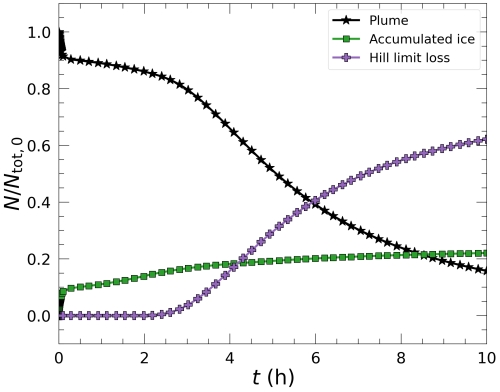
Figure 1: Temporal evolution of the particle fraction forming the plume (black stars, dominated by water vapor), accumulated on the surface (green squares), and lost from the Hill limit (purple plus markers).
The surface accumulation of ice is higher at the south pole, where the impact occurs, and gradually extends toward the north pole. The surface density gives insights into the material collected by PSRs and cold-traps located at different distances from the impact point. In particular, we obtain that vapor lingers in the area of the simulated cold-trap only at early times. Shadows and interaction with cold walls favor deposition into ice, which after 100 s reaches a stable fraction of 2 x 10⁻⁴ of the initial water amount (Figure 2).
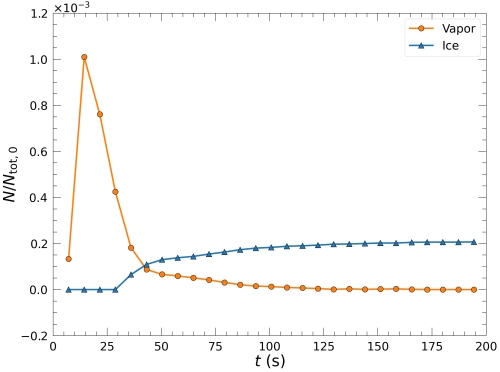
Figure 2: Temporal evolution of the fraction of vapor and ice within the polar PSR.
According to our model and initial conditions, the ice retained within the PSR is lower than the vapor entering the area, indicating a partial local condensation. The adopted PSR temperatures keep the accumulated ice stable against sublimation on long timescales, producing a reservoir of ~2.8 x 10⁸ kg. This value is consistent with observational estimates within PSR, which range from 107 to 109 kg [17], compatible with the hypothesis that polar impacts of hydrated objects could have been a fundamental water delivery mechanism for the present-day lunar ice.
Perspectives
We plan to explore ice accumulation dependence on impact point–PSR and estimate the exosphere contribution over a longer time. Furthermore, we consider assessing the importance of long-time processes, such as impact gardening, regolith mixing, ice exposure/burial and volatile redistribution in PSRs, on ice deposits preservation. We plan to improve initial conditions performing impact simulation and using Eulerian methods [18] to characterize the thermal behavior of the PSR and volatile stability. Moreover, we can consider the presence of dust [19], that can alter early phases. This would further support lunar science, missions and exploration. In addition, this study is applicable to other objects, such as Mercury. More generally, our model provides a numerical tool to characterize volatile emissions on various targets, including vapor-ice-dust mixture releases, triggered by drilling activities [19], planned for ExoMars and Prospect missions, or cometary activity [20].
References
[1] Li et al. 2018, PNAS, 115, 8907.
[2] Sanin et al. 2017, Icarus, 283, 20.
[3] Ohtake et al. 2024, ApJ, 963, 124.
[4] Livengood et al. 2025, Icarus, 255, 100.
[5] Thiemens et al. 2024, PNAS, 121, 52.
[6] Lucey et al. 2022, Geochemistry, 82, 125858.
[7] Monaghan 2005, Rep. Prog. Phys. 68, 1703.
[8] Teodori et al. 2026, Icarus, 443, 116765.
[9] Stewart et al. 2011, Icarus, 215, 1.
[10] Housen et al. 1983, J. Geophys. Res. 88, 2485.
[11] Housen & Holsapple 2011, Icarus, 211, 856.
[12] Hayne et al. 2017, J. Geophys. Res. Planets 122, 2371.
[13] Ivanov et al. 2001, SSR, 96, 87.
[14] O’Keefe & Ahrens 1982, JGR: Solid Earth, 87, 6668.
[15] Hurley et al. 2015, Icarus, 155, 159.
[16] Formisano et al. 2025, MNRAS, 543, 4187.
[17] Brown et al. 2022, Icarus, 377, 114874.
[18] Formisano et al. 2024, PSS, 251, 105969.
[19] Maggioni et al. 2026, PSS, 272, 106244.
[20] G. Rinaldi et al. 2025, EPSC-DPS2025-1556.
Acknowledgments
This work is supported by INAF Theory Grant “Thermophysical modeling of Permanently Shadowed Regions (PSRs) on Moon and Mercury”, INAF MiniGrant “PLUMES - Planetary fractures Lagrangian simUlations for Multi-component EmissionS”, and ISSI within the project “Thermophysical Characterization of Ice-Rich Areas on the Surface of Specific Planetary Bodies: Conditions for the Formation of a Transient Exosphere”.
How to cite: Teodori, M., Maggioni, L., Magni, G., Formisano, M., De Sanctis, M. C., Altieri, F., D'Aversa, E., Ciarniello, M., Bertoli, S., Filacchione, G., Raponi, A., Capaccioni, F., and Frigeri, A.: Investigating the contribution to lunar ware ice delivered by cometary impacts through Smoothed Particle Hydrodynamics, Europlanet Science Congress 2026, The Hague, The Netherlands, 7–11 Sep 2026, EPSC2026-996, https://doi.org/10.5194/epsc2026-996, 2026.


