ODAC8 | Developing Community and Identity for Projects and Organisations

ODAC8

Developing Community and Identity for Projects and Organisations
Co-organized by MITM
Convener: Thibaut Roger | Co-conveners: Callum Piper, Nimisha Verma, Gemma Domènech Rams
Orals THU4
| Thu, 10 Sep, 16:00–17:30 (CEST)|Room Earth (Tango 1)
Posters TUE-POS
| Attendance Tue, 08 Sep, 18:00–19:30 (CEST) | Display Tue, 08 Sep, 08:30–19:30|Foyer 3, F3.74
Thu, 16:00
Tue, 18:00
Every modern scientist will, at one time or another, face the challenge of growing a community around their project, and give it an identity easily recognisable by the said-community. Whether a small research group or an international organisation, building proactive community may be the key to unlocking greater collaboration and scientific achievement.

In this session, we will explore key tools for community-building. We welcome contributions from all occupations and backgrounds in planetary science. Early-career scientists are especially encouraged to attend - the sooner we learn these skills, the more time we have to use them.

What should you expect from this session? And how can you contribute?

- Building identity: branding, visual identity (e.g., logo, motto, etc.) online, as well as at events and in the media: how do you make your brand recognisable?
- Social media presence, exchange tools and websites: how do you grow your online community?
- Community-building tips and tricks: what works and what doesn't?
- Networking and lobbying for your community: how can you find key stakeholders to support your project?
- Diversity and inclusion: how do we ensure our projects benefit from diverse participation, while circumventing inter-cultural tensions?
- Involving the public in research: how can your community-building effort can benefit from Citizen Science and Pro-Amateur collaborations?

Orals: Thu, 10 Sep, 16:00–17:30 | Room Earth (Tango 1)

Chairpersons: Callum Piper, Thibaut Roger, Nimisha Verma
Building national networks
16:00–16:12
|
EPSC2026-1370
|
On-site presentation
Lena Noack, Heike Rauer, Bastian Gundlach, and Carsten Güttler

At EPSC 2024 held in Berlin, Germany, the idea was born to bring the German Planetary Sciences community together in a new Society, to make activities in the field of planetary research more visible within Germany and beyond, to promote scientific exchange, and to strengthen cooperation between researchers, institutions and companies. In May 2025 in Münster, the German Society for Planetary Research (Deutsche Gesellschaft für Planeten­forschung, DGP, https://www.planet-dgp.de/) was then founded.

The society was introduced at an international level at EPSC-DPS 2025 in Helsinki, Finland, at a splinter meeting with about 60 participants. Since the new DGP Society and the EuroPlanet Germany Hub share many common goals, the German community (i.e. either German-speaking or working in a German institution) decided at the EPSC-DPS splinter meeting to join forces under the main umbrella of the new society.

The early-career community within Germany also created their independent subnetwork with the DGP, and following the EPEC name convention, are called "DGPEC". They organize early-career activities at the annual meetings of the DGP and at EPSC, as well as virtual get-togethers throughout the year, and present individual early-career members and their current research projects to the community as part of the monthly DGP newsletter.

The First Annual Meeting of the DGP & Europlanet Germany Hub was organized this year in March 16-18 at Freie Universität Berlin and attracted more than 200 participants and 131 scientific abstracts.

Here we will present the current status of setting up the society and links to EuroPlanet, as well as current and planned community activities.

How to cite: Noack, L., Rauer, H., Gundlach, B., and Güttler, C.: Connecting the German Planetary Community with EuroPlanet via the newly founded German Society for Planetary Research (DGP), Europlanet Science Congress 2026, The Hague, The Netherlands, 7–11 Sep 2026, EPSC2026-1370, https://doi.org/10.5194/epsc2026-1370, 2026.

16:12–16:24
|
EPSC2026-1364
|
On-site presentation
Alejandro Cardesín-Moinelo, Paula Benavidez, Pedro Machado, Ricardo Hueso Alonso, Julia de León, David Morate, Noemí Pinilla Alonso, Andres Catalán, Maarten Roos, João Dias, Joaquín Álvaro, Laura M. Parro, Jorge Hernandez Bernal, Andoni Moral Inza, Susana Fernandez, and Rene Duffard

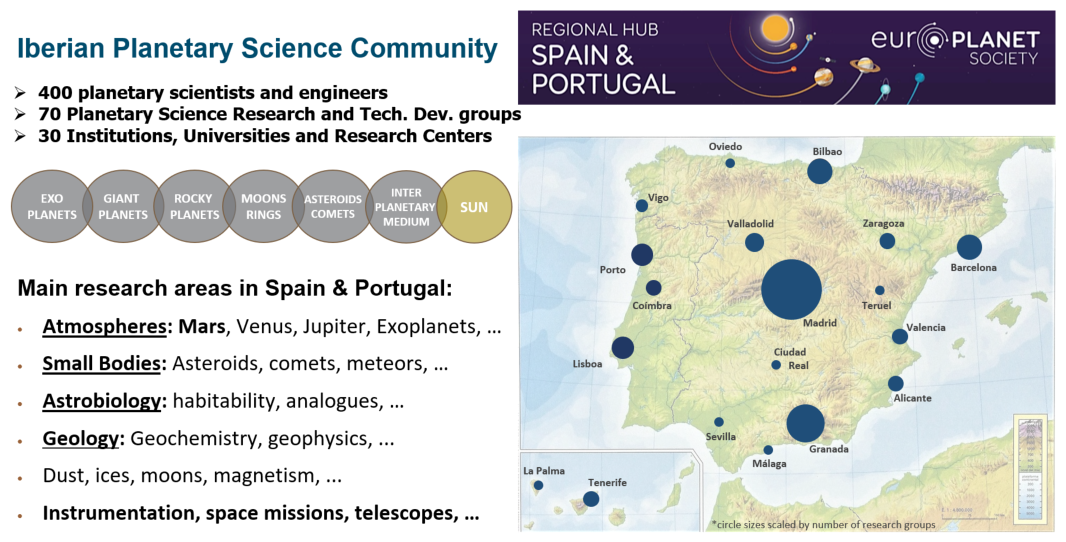
Europlanet Iberia is the Iberian node of the Europlanet Society. Its main objective is to support the Spanish and Portuguese planetary science community, promoting the collaboration between all scientific and technology development institutions and research groups, reinforcing the participation of Iberian scientists and engineers in national and international space research programmes, and support the new generation of early career students, as well as promoting the collaboration with the amateur community via pro-am collaborations ensuring the visibility towards the public.

The Iberian Planetary Science Community has over >400 members, planetary researchers and engineers, distributed accross >70 research groups in >30 institutions.

We promote open discussions on the status of Planetary Sciences in the Iberian Peninsula, with a special focus on opportunities for scientific, technological and industrial collaboration at an international level, especially in Ibero-America.

The main activities of the Iberian hub in past years have been focused on networking of the planetary science community, promoting synergy between scientists and industry, reinforcing international collaboration, supporting the new generation of early-career researchers, collaborating with amateur astronomers and organizing public outreach activities, enhancing the accessibility and visibility of our community to achieve a greater impact on society.

Summary of activities:

  • Biennial Congress on Planetary Sciences and Solar System Exploration (CPESS). Involving 200 participants from planetary groups of the main public research institutions and space technology development centres, including strong presence of the Space Industry and representatives from the State Research Agency and Spanish Space Agency.
  • Biennial planetary meetings at the Scientific Meetings of the Spanish Astronomy Society (SEA). We organize public debates, promote the participation of planetary researchers in a dedicated planetary session and ensure the visibility of all solar system science within the wider astronomical community.
  • Annual Awards for Student Theses and Amateur contributions: Europlanet Iberia organizes the annual awards in support of the new generation of planetary scientists, engineers and amateur observers in Spain and Portugal
    • Europlanet Iberia “Abraham Zacut” & "Pedro Nunes” Awards for best PhD and Master's Thesis
    • Europlanet Iberia Amateur Astronomy Award, for the best amateur contribution in solar system astronomy and exoplanets
  • Support to Funding Calls: Europlanet Iberia has supported research, outreach and education projects via the Europlanet funding calls, resulting in many successful projects to maximize the impact and visibility of planetary science and technology.
  • Iberoamerican collaboration: Europlanet Iberia collaborates with the IberoAmerican Space Agency Network, the Organization of Iberoamerican States (OEI) and the Spanish Aerospace Platform, for the organization of regular online webinars on space science, technology, policy, diversity, outreach and education addressed to the Iberoamerican community in Spanish and Portuguese language: "Técnicas para Observar Asteroides" and “Infraestructura planetaria y exploración espacial”, “Desafío Marte” and more.

How to cite: Cardesín-Moinelo, A., Benavidez, P., Machado, P., Hueso Alonso, R., de León, J., Morate, D., Pinilla Alonso, N., Catalán, A., Roos, M., Dias, J., Álvaro, J., Parro, L. M., Hernandez Bernal, J., Moral Inza, A., Fernandez, S., and Duffard, R.: Europlanet Iberia: Planetary Science Community Building in the Spain & Portugal Regional Hub, Europlanet Science Congress 2026, The Hague, The Netherlands, 7–11 Sep 2026, EPSC2026-1364, https://doi.org/10.5194/epsc2026-1364, 2026.

16:24–16:36
|
EPSC2026-1233
|
On-site presentation
Thibaut Roger

For the last 12 years, the Swiss planetary science community has come together to form the NCCR PlanetS – a national collaboration of 4 universities all working on the topic, and representing over 80 Millions euros of funding from the universities and the Swiss National Science Foundation. In those twelve years, I’ve had many roles within this network – scientist, communication and outreach specialist, and report coordinator, giving me a great overview of the effort to grow a community together.

As the NCCR PlanetS is coming to an end, and as the community is coming together to create the Swiss Institute for Planetary Sciences (SIPS), it is the ideal time to reflect on the community building measures we implemented in the scientific and communication domains and assess their efficiency. I will also discuss what I would do differently if we would start again, or what additional initiatives I would implement nowadays to foster the genuine sense of belonging for its members.

How to cite: Roger, T.: Twelve Years, One Community: Reflections on Building Research Networks, Europlanet Science Congress 2026, The Hague, The Netherlands, 7–11 Sep 2026, EPSC2026-1233, https://doi.org/10.5194/epsc2026-1233, 2026.

Going international
16:36–16:48
|
EPSC2026-1227
|
On-site presentation
Anita Heward, Callum Piper, and Stavro Ivanovski

Europlanet is a distributed research infrastructure and membership organisation that supports the planetary science and exploration communities. It offers a suite of services, developed and optimised over 20 years, including research visits to facilities and field sites, access to telescopes, mentoring and professional development programmes, bursaries, prizes, and small-scale funding schemes. Its annual meeting, the Europlanet Science Congress (EPSC), is currently the largest international meeting on planetary science, attracting over 1200 participants each year that include researchers, industry representatives, policy-makers, amateur astronomers, outreach providers and teachers. Membership of Europlanet includes individuals and organisations spread over five continents, and from a cross-cutting range of scientific disciplines, languages and cultures.

Since its foundation in 2005, Europlanet has received 28 million Euros in funding through a series of grants from the European Commission (EC). However, the EC funding landscape has been changing in recent years, and the Europlanet 2024 Research Infrastructure (RI) project that ran from 2020-2024 was one of the last opportunities to secure RI funds for a specific topic, such as planetary science. Europlanet started sustainability planning in 2013, initially with the establishment of a consortium of institutions linked by a Memorandum of Understanding (MoU), followed by the inauguration of a society of individual members in 2018.

In February 2023, Europlanet established a non-profit Association International Sans But Lucratif (AISBL) based in Brussels, Belgium, to provide it with an independent legal structure. In December 2024, a new category of organisational membership was added. Europlanet now operates as a fully self-sustaining organisation funded through revenue from EPSC and members’ subscriptions. Core activities are run through a paid Executive Office, with most community programmes implemented by voluntary committees and working groups, including the Europlanet Early Careers (EPEC) Network, Regional Hubs, Diversity Committee, Outreach Working Group and the bodies responsible for the organisation of EPSC (the Executive Committee, Local Organising Committee, Virtual Organising Committee, and Scientific Organising Committee, as well as the session conveners).

To date, organisational membership has been driven largely by institutions wishing to include facilities in the Europlanet distributed Research and Technology Infrastructure (RTI). The number and diversity of RTI facilities offered by Europlanet’s member organisations continues to grow rapidly, and the current collection covers a wide range of experimental set-ups and disciplines. Europlanet’s flagship Transnational Access (TA) programme is designed to allow researchers from anywhere in the world, and at all career stages, to access the RTI facilities to carry out short research projects, and to foster international collaborations. The programme supports the travel and local accommodation costs of the participating researchers, as well as providing a contribution to the operating costs of the facilities. The first TA call in 2026 included 25 facilities hosted by ten organisations, with a second call with additional facilities anticipated to open in September 2026. The TA programme builds on the very successful practices initiated through EC-funding; however, Europlanet is now working towards a broader role of connecting users from both the industrial and academic sectors with planetary-relevant RTI facilities through additional programmes (e.g., commercial access, negotiated rates, or voucher systems).

With minimal centralised resources, supporting a global and highly distributed network of planetary scientists and institutions can be a challenge. In practice, this means that Europlanet must be able to deploy a proactive and collaborative community that is primed and willing to share information and resources, which in turn needs to be underpinned by the efficient and coordinated flow of information and feedback. Over several years, Europlanet has developed a comprehensive communications, dissemination and training programme that supplements standard tools and platforms (website, newsletters, webinars, social media, Discord community, etc) with more community-focused initiatives, such as the interactive online Teams Days (to better cross-network the various committees and working groups), Facility Days (to bring together facility operators, users and suppliers), and the Planetary Geological Mapping Winter School (to support and grow the international planetary mapping community).

The rapid organisational changes over recent years have required some fundamental shifts in mindset and strategy with respect to how Europlanet is presented to the community. This includes the consolidation of branding and the development of industry-focused descriptions of services. The ongoing evaluation of Europlanet activities across a range of impact areas (scientific, technological, training & education, social & societal, and economic) has helped provide a robust framework for defining and prioritising which activities should be supported with the more constrained funds available beyond the EC grants.

In this talk, we will present an overview of how we have gone about developing and implementing a sustainable programme to consolidate and build Europlanet’s community and distributed infrastructure. We will discuss the main challenges and lessons learned in transitioning to a non-profit business model that can operate independently of grants, as well as future opportunities with EC-funding for collaborations and access programmes across the Physical Sciences and Engineering domain.

How to cite: Heward, A., Piper, C., and Ivanovski, S.:  Europlanet – Building a Sustainable Community and Infrastructure to Support Planetary Science and Exploration, Europlanet Science Congress 2026, The Hague, The Netherlands, 7–11 Sep 2026, EPSC2026-1227, https://doi.org/10.5194/epsc2026-1227, 2026.

16:48–17:00
|
EPSC2026-1373
|
ECP
|
On-site presentation
Nimisha Verma and Thomas R. O'Sullivan

The Europlanet Early Career network (EPEC) was established as a platform to give early career researchers and professionals – including bachelors, masters, and doctoral students, in addition to any individual who completed their last degree up to 7 years prior – access to a community with activities and events catered to their needs. What began as an idea during EPSC 2014 in Lisbon, with short courses focused on early careers, formally took shape as EPEC under Europlanet in 2018. Over the years, EPEC has established itself as an integral part of the Europlanet community and the wider planetary science and astronomy landscape in Europe and beyond.

Over the last decade, EPEC has created various events and activities spanning the whole year such as EPEC Annual Week, inspiring stories of the month, EPEC@EPSC, podcasts, and more. The EPEC Annual Week has consistently attracted around 30-50 early career individuals over the years, whilst EPEC@EPSC experiences participation from around 80 early careers across its activities. Beyond the numbers, these events and activities have led to long-lasting connections - friendships, professional opportunities (e.g. internships), PhD opportunities, collaborations through conversations, and social interactions. For many who have volunteered and organised within EPEC, it has also been a space to develop skills that go beyond science – event management, public engagement, science communication, networking, and leadership.

With this work, we bring together years of experience to showcase the impact of EPEC on the early career community, shared both by organisers and participants. As EPEC enters its second decade, we hope this reflection serves not only as a celebration of what has been built and what we have learned over the years, but as an invitation for the community to carry it forward.

How to cite: Verma, N. and O'Sullivan, T. R.: The Europlanet Early Career (EPEC) Network and its Impact on the Planetary Science Community Over the Years., Europlanet Science Congress 2026, The Hague, The Netherlands, 7–11 Sep 2026, EPSC2026-1373, https://doi.org/10.5194/epsc2026-1373, 2026.

Developing mission consortia
17:00–17:12
|
EPSC2026-1375
From Fragmentation to Federation: Lessons from EUROPLANET and the Jupiter Exploration Community
Michel Blanc
17:12–17:24
|
EPSC2026-1379
|
On-site presentation
Ines Belgacem, Olivier Witasse, Claire Vallat, Joana S. Oliveira, Nicolas Altobelli, Angela Dietz, Azul Pinochet-Barros, Nicole Shearer, Jans Henke, Ricardo Hueso, and Benoit Seignovert

The JUpiter ICy Moons Explorer (JUICE), ESA’s first large-class Cosmic Vision mission, was launched on 14 April 2023 and is en route to Jupiter, where it will arrive in July 2031. Over four years, the mission will explore the Jupiter system, performing Jupiter observations, flybys of the Galilean icy moons and an orbital phase around Ganymede. JUICE will investigate the icy moons’ potential habitability, focusing on their subsurface liquid oceans, and will study Jupiter as an archetype of giant planet systems. It will also address magnetospheric interactions, tidal evolution, and additional targets such as Io, minor inner moons and rings and irregular moons.

Such a large and inspiring planetary mission attracts a lot of attention in the scientific community, the general public, media and various stakeholders. It is therefore important to communicate about the mission progresses and deliver data and results to these different communities in the most appropriate ways, depending on the phase of the mission (study, development, launch campaign, cruise, science phase, post-operation and legacy).

This presentation will cover the project’s communication strategy and will highlight some concrete engagement activities. Examples to bring the general public along include the drawing contest for the Ariane 5 fairing, the launch campaign and its outreach components, activities surrounding the gravity-assist flybys, general image releases including the observation campaign of the interstellar object 3I/ATLAS or data sonification efforts.

Engaging the rest of the science community is also a big part of our communication effort. This includes, for example, regular Europlanet webinars and open calls for scientific participation. We will also explore collaborations with amateur astronomers’ networks in ground-based observations of Jupiter and stellar occultations of its moons (e.g. Kallichore), and look ahead to the rich scientific opportunities of the nominal mission phase.

The presentation will actively seek feedback from the Europlanet community on how to increase the mission’s accessibility to the public and strengthen scientific engagement for those already involved and potential newcomers.


How to cite: Belgacem, I., Witasse, O., Vallat, C., Oliveira, J. S., Altobelli, N., Dietz, A., Pinochet-Barros, A., Shearer, N., Henke, J., Hueso, R., and Seignovert, B.: How to get engaged with the ESA JUICE mission?, Europlanet Science Congress 2026, The Hague, The Netherlands, 7–11 Sep 2026, EPSC2026-1379, https://doi.org/10.5194/epsc2026-1379, 2026.

17:24–17:25
17:25–17:30

Posters: Tue, 8 Sep, 18:00–19:30 | Foyer 3

Display time: Tue, 8 Sep, 08:30–19:30
Chairpersons: Callum Piper, Thibaut Roger, Nimisha Verma
F3.74
|
EPSC2026-658
|
On-site presentation
Kristina Lopez, Eric Palmer, and Mike Drum

For the past 5 years, the PDS has made a substantial effort to improve community outreach and relations using conference outreach presence. Through a combination of approachable, friendly staff, and fun innovative outreach activities, we have achieved this goal and become an organization people look forward to interacting with at community events. Now that this goal has been achieved, we turned our attention to how we can harness this new community engagement to improve the FAIR-ness of the PDS archives.

At EPSC 2025, we piloted an interactive outreach activity designed to collect structured information about researchers’ data practices and foster dialogue on metadata, archival standards, and search behaviors. The PDS Small Bodies Node (SBN) is using this to inform the development of a new discipline  dictionary focused on search/findability.


Participants completed a digital form to “Describe Your Data,” selecting scientific disciplines, targets, missions, techniques, and software relevant to their work. Responses were converted into custom stickers to be placed on a wearable badge with the header “My Data Is:” (Fig 1.), creating a thematic experience that encouraged networking and scientific exchange. The form balanced curated options for standardization with free-text input to capture underrepresented domains, generating a feedback loop for improving metadata assumptions and vocabularies.


The activity achieved substantial engagement: 422 participants contributed 2,349 items, representing 25% of the 1,659 in-person attendees. Figure 2 and Tables 1-4 show examples of the data collected.  These results demonstrate the effectiveness of interactive outreach for gathering actionable insights, strengthening PDS standards, and promoting FAIR principles.


The structured responses collected during this activity provides the initial inputs for enhancing PDS search capabilities. By identifying how scientists describe their data through disciplines, targets, and techniques, we can refine controlled vocabularies, improve metadata indexing, and support higher-level data search in terms that our users use, rather than just relying on observational metadata. This directly advances interoperability across PDS nodes and external archives, enabling users to transition seamlessly between observational and derived data products. These insights will inform future API enhancements and ontology-driven search strategies, ensuring that PDS remains a leader in FAIR-compliant data discovery. We present lessons learned for community-driven metadata development and strategies for scaling this model to other conferences, including LPSC, ACM, and again at EPSC 2026.

How to cite: Lopez, K., Palmer, E., and Drum, M.: Turning Outreach into Infrastructure: Community-Driven Inputs to Improve Data Discovery, Europlanet Science Congress 2026, The Hague, The Netherlands, 7–11 Sep 2026, EPSC2026-658, https://doi.org/10.5194/epsc2026-658, 2026.