
 1,
1,- 1University of Granada, Signal Theory, Telematics and Communications, Granada, Spain (gsus@go.ugr.es)
- 2Instituto Volcanológico de Canarias: INVOLCAN, Tenerife, Spain (involcan@involcan.org)
- 3University of Granada, Signal Theory, Telematics and Communications, Granada, Spain (equally contributing)
Distributed Acoustic Sensing (DAS) provides several benefits over conventional seismic station sensing. DAS offers long spatial coverage at high resolution: approximately every 10 meters of a kilometric optical fiber can act as a seismic sensor. Furthermore, the elements necessary for DAS sensing require very little maintenance. This sort of sensing generates large volumes of data with high spatial correlation, bringing opportunities for more precise exploratory analysis, monitoring and knowledge generation; as well as new data analysis challenges.
In previous works [1], we have studied the data collected by conventional seismic stations in the Canary Islands, Spain; including data from the volcanic eruption of La Palma of 2021 (see Fig. 1). These studies employed data fusion techniques as well as Multivariate Statistic (MS) methods like oMEDA [2] and PCA-MSPC [3] to understand the combined data of several spatially distributed stations. This approach let us develop an interpretable real time monitoring system able to not only detect anomalies, but also trace them to their source in the original data, locating them in time and space
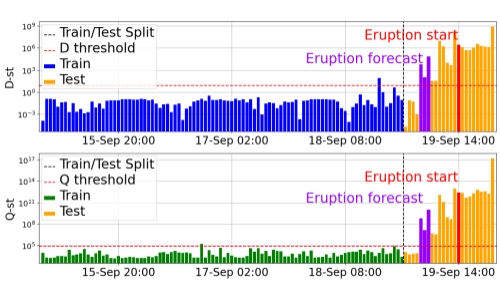
This archipelago also bears a submarine DAS fibre infrastructure deployed between the islands of La Palma and Tenerife (see Fig. 2). In this contribution, we expand the MS framework developed for seismic station data to a DAS data framework.
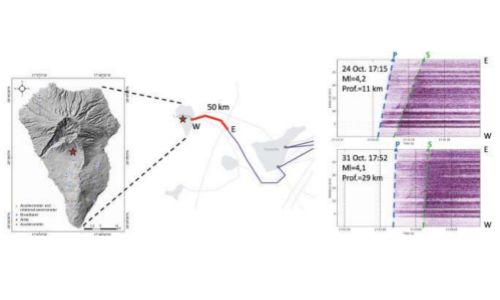
The development of this framework has the potential to significantly increase the risk monitoring capabilities of DAS infrastructures in areas with high seismic and volcanic activity, which can be instrumental for public safety during times of crisis. Thanks to the interpretability provided by MS methods, specialists would be able to assess the anomalies detected by a monitoring system, distinguishing real threats from false alarms. This approach leaves the agency and decision making to the specialists, who don’t need to trust a warning system blindly.
As a result of this work, we will generate an expertise in understanding DAS data structures for seismic data, its particular challenges, related to data size, spatial correlation and computational challenges in real time applications. Results are compared to those of conventional seismometers analyzed in previous works.
[1] García Sánchez, J., García, L., D'Auria, L., Fernández-Carabantes, J., Benítez Ortúzar, C., Camacho, J. Volcanic eruption forecast using PCA. IEEE International Geoscience and Remote Sensing Symposium 2025, Brisbane (Australia), 2025.
[2] Camacho, J. Observation-based missing data methods for exploratory data analysis to unveil the connection between observations and variables in latent subspace models. Journal of Chemometrics, 2011, 25 (11) : 592 - 600.
[3] Fuentes-García, N.M., Maciá-Fernández, G., Camacho, J. Evaluation of diagnosis methods in PCA-based Multivariate Statistical Process Control. Chemometrics and Intelligent Laboratory Systems, 2018, 172 : 194 - 210.
This work is part of project Multi-scale Spatio-Temporal Analysis of Research Data (MuSTARD,https://codas.ugr.es/mustard/en/), supported by grant no. PID2023-1523010B-IOO funded by the Agencia Estatal de Investigación in Spain, call no. MICIU/AEI/10.13039/501100011033, and by the European Regional Development Fund.
How to cite: García Sánchez, J., Benítez, C., D'Auria, L., García, L., and Camacho, J.: Multivariate Statistical analysis of DAS seismic data, Galileo conference: Fibre Optic Sensing in Geosciences, Aussois, France, 31 Aug–4 Sep 2026, GC14-FibreOptic-12, https://doi.org/10.5194/egusphere-gc14-fibreoptic-12, 2026.


