

- Karlsruhe Institute of Technology, Karlsruhe, Germany (jannick.fischer@kit.edu)
As reviewed by Fischer et al. 2025, the spatial distribution of severe convective storms across Europe is heavily influenced by mountain ranges. Most reports of severe weather, especially those of hail, cluster around the Alps or downwind of smaller mountain ranges. There are several possible explanations for this: (1) orographic lifting processes leading to more frequent convection initiation (CI) over mountains, which then become severe when moving from the mountains to the plains, (2) the ingredients for severe stroms are enhanced near mountains, specifically low-level moisture and vertical wind shear, (3) reports cluster near population centers, which are often in the foothills of mountain ranges.
To disentangle these factors, this study uses a toy model to create storm tracks with severe reports across Europe. To isolate the role of orographic CI, storm tracks are only started over the most prominent mountain ridges (Fig. 1) consistent with Manzato et al. 2022. Based on the typical thunderstorm evolution and movement in each region, artificial severe weather reports then produced along the tracks. In other words, the toy model assumes that the ingredients for severe weather are uniform and that population density has no impact on reports, thus only assessing the role of CI. The resulting toy model report distribution is then compared with the actual distribution of hail reports in the European Severe Weather Database to quantify the spatial correlation and differences. The correlation between populations density and severe report density will be similarly assessed. These results will provide a first estimate whether orographic CI, ingredient enhancement, or population density are driving the spatial distribution of severe weather in different regions of Europe.
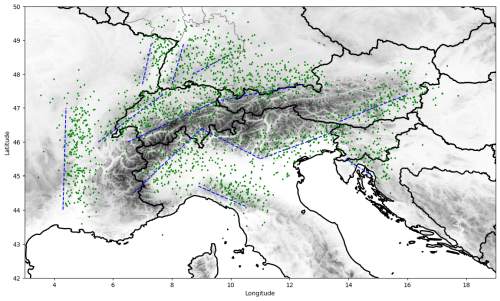
Fig. 1: Example of the toy model hail reports (green triangles) resulting from tracks initiated over European mountain ridges (blue lines)
Fischer, J., Groenemeijer, P., Holzer, A., Feldmann, M., Schröer, K., Battaglioli, F., Schielicke, L., Púčik, T., Gatzen, C., Antonescu, B., and the TIM Partners: Invited perspectives: Thunderstorm Intensification from Mountains to Plains, EGUsphere, accepted, https://doi.org/10.5194/egusphere-2024-2798, 2025.
Manzato, A., Serafin, S., Miglietta, M. M., Kirshbaum, D., and Schulz, W.: A Pan-Alpine Climatology of Lightning and Convective Initiation, Monthly Weather Review, 150, 2213–2230, https://doi.org/10.1175/MWR-D-21-0149.1, 2022.
How to cite: Fischer, J.: Why are European severe storms most frequent near mountains?, 12th European Conference on Severe Storms, Utrecht, The Netherlands, 17–21 Nov 2025, ECSS2025-203, https://doi.org/10.5194/ecss2025-203, 2025.


