
 1,2,1,2,4,5,6,6,4,8
- 1Department of Earth Sciences, University of Western Ontario, London, Canada
- 2Institute for Earth and Space Exploration, University of Western Ontario, London, Canada
- 3Geomatics and Cartographic Research Centre, Carleton University, Ottawa, Canada
- 4DLR Institut für Weltraumforschung, Berlin, Germany
- 5The Open University, Milton Keynes, UK
- 6Natural History Museum, London, UK
- 7Imperial College London, London, UK
- 8INAF-Astronomical Observatory of Padova, Italy
Oxia Planum is the chosen landing site for the European Space Agency’s ExoMars Rosalind Franklin rover mission for its evidence of multi-episodic sustained aqueous activity and astrobiological potential[1,2]. Previous works have aimed to characterise various mineralogical and morphological units present in Oxia Planum. Two distinct clay-bearing units have been identified based on spectral and morphological variations: an orange and a blue unit [2,3]. The blue unit stratigraphically overlies the orange unit, and while they are similar texturally, they exhibit some subtle textural as well as spectral differences from one another.Compositionally, the orange unit is associated with the strongest clay signatures, while the blue unit appears to be consistent with a clay signature mixed with a mafic component[2,3]. Several hypotheses have been proposed to explain their formation, including pedogenesis, groundwater alteration, and subaqueous sedimentation of either authigenic or clastic nature[3]. However, these scenarios need to be further constrained and may also need to be further expanded to include clay formation under less warm and wet conditions on early Mars [4]. Impact craters serve as windows into the subsurface by excavating, uplifting, and exposing materials that may not be visible at the surface. In this study, we use impact craters to investigate local and regional variations in the stratigraphy of Oxia Planum.
Methods: We characterized the colour/spectral characteristics of exposed layers within a ~1.5- and a ~2.1-km crater and compared them with units on the basin floor (stars in Fig. 1). Here we use DS-corrected [8-10] multispectral data from the 3-band High Resolution Imaging Science Experiment (HiRISE) (50-60 cm/px) [11], the 4-band Colour and Stereo Surface Imaging System (CaSSIS) (4 m/px) [12], and the hyperspectral Compact Reconnaissance Imaging Spectrometer for Mars (CRISM) (20 m/px) [13]. CRISM is no longer operational, and the data is limited, while CaSSIS and HiRISE effectively extend the detailed spectral information from CRISM across the region. By identifying specific mineral phases with CRISM and then spectrally resampling them to CaSSIS and HiRISE, we establish a method to extensively map mineralogical units.
Representative orange and blue unit CRISM spectra (FRTs 9A16 & 810D) were collected from sites 1,3 and 4 (Fig. 1) and resampled to the responses of CaSSIS for direct comparisons with image-derived CaSSIS and HiRISE spectra [14,15].
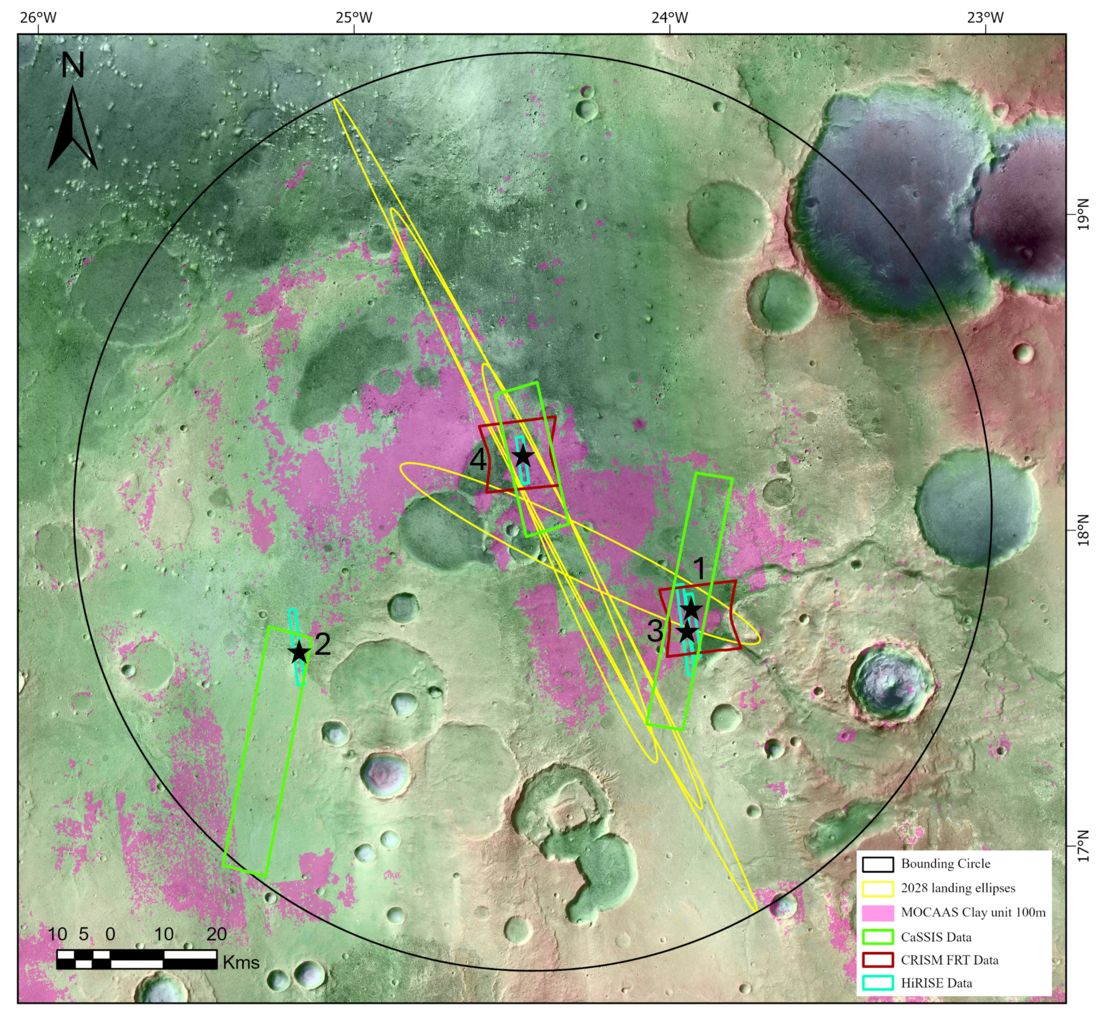
Fig. 1. HRSC-MOLA overlain on CTX and with a spectral map of clay detections in magenta[16]. The latest 2028 landing ellipses (yellow) and bounding circle (black) are shown. Black stars indicate the locations of craters (1 & 2) and basin floor (3 & 4) for spectral analysis.
Results and Discussion: Previous mapping [5], reveals as many as 7 orange and 5 blue layers to date (location 2) (Fig. 2). Crater rim formation is a complicated process with the possibility of an overturned strata. However, any overturned flap would be limited to the uppermost section of the crater wall.
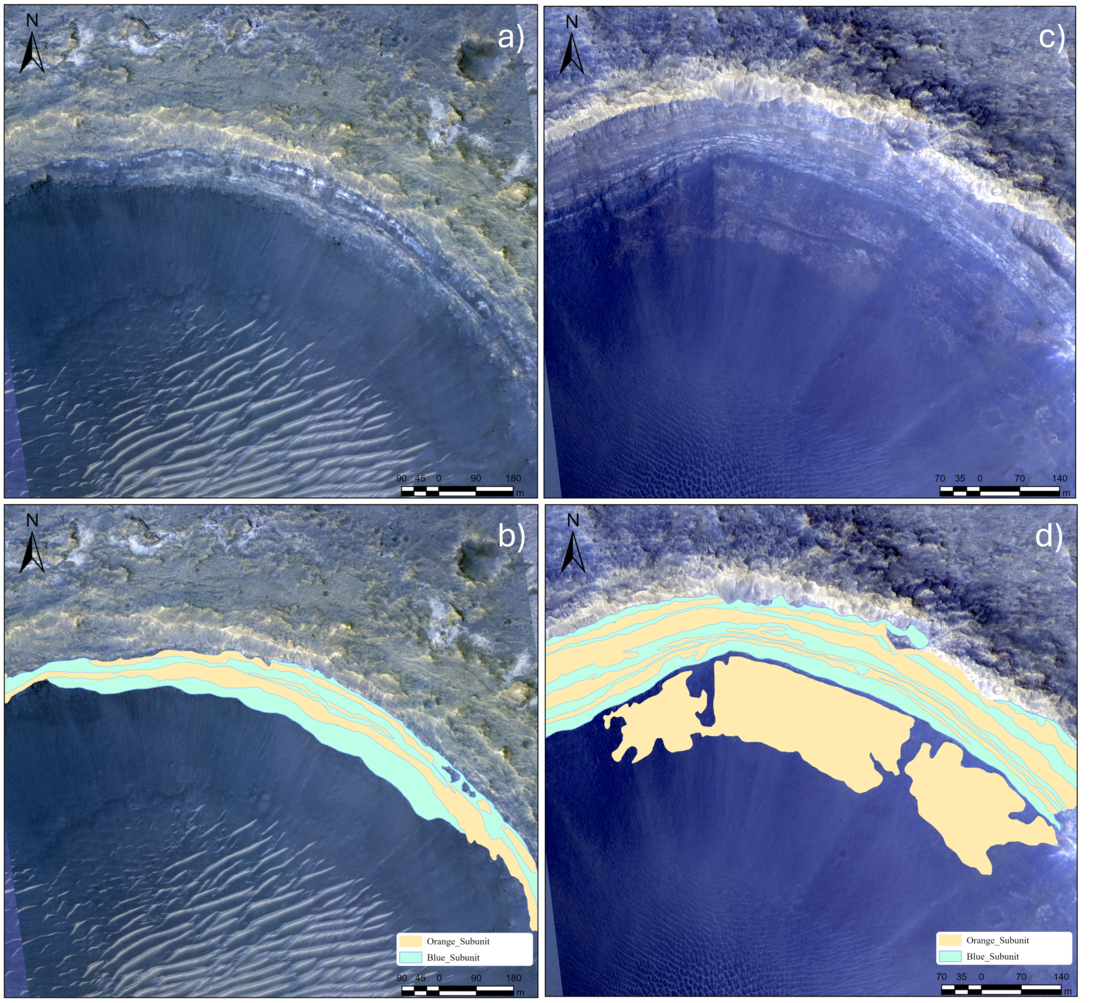
Fig. 2 Crater wall exposures. (a), (b) HiRISE IRB ESP_073652_1980 location #1 with mapped units; (c), (d) HiRISE IRB ESP_077041_1980 location #2 with mapped units.
The presence of multiple alternating layers raises questions about their origin—whether they represent the same or different units—and how these materials have evolved over time. Our spectral results show overall consistency in spectral shape between the three datasets, despite differences in their spectral and spatial resolution.
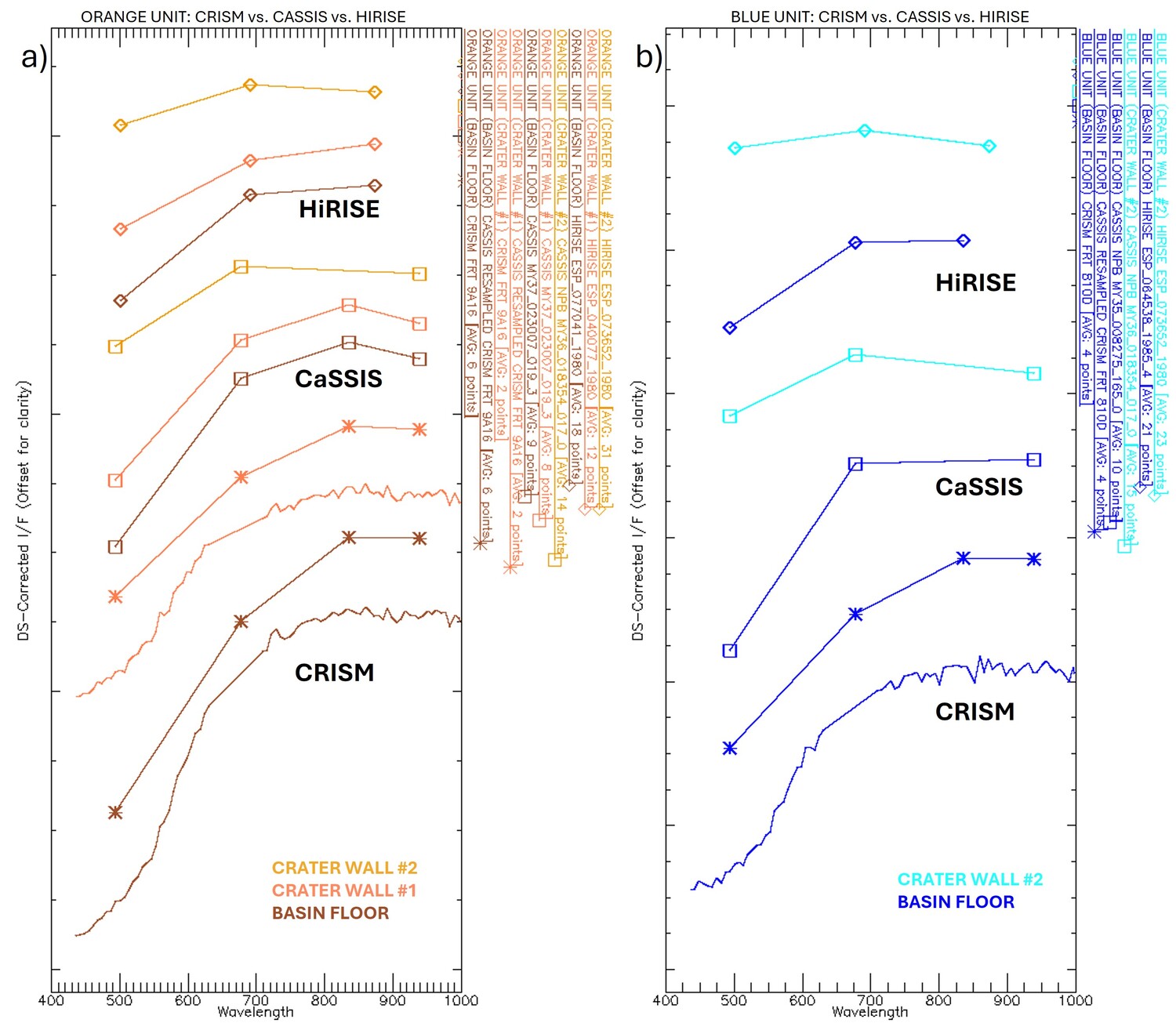
Fig. 3. Comparisons of DS-corrected CRISM (solid lines), CRISM resampled to CaSSIS (asterisk), CaSSIS (squares), and HiRISE (diamonds) spectra of the (a) orange unit and (b) blue unit from crater walls #1 and #2 and basin floor #3 and #4.
We compared the orange and blue units present in the basin floor (#3 & #4) and the crater walls (#1 & #2). The spectra show generally consistent nature of the units in the VNIR wavelengths. Contrary to the reported olivine component in the blue unit, the 810D spectra do not show any significant deflections towards the IR (#4; Fig. 3) [3]. Similarly, the blue unit lacks an IR deflection at ~950 nm in CaSSIS and HiRISE. It has a striking similarity with the orange unit which warrants further investigation. Due to the coarse resolution and limited coverage of CRISM, we could not extract a representative spectrum for the blue unit from the crater walls.
Well-exposed craters at lower elevations expose thicker units than ones at higher elevations (Fig. 3). These observations provide further constraints on the origin of the clays and favour a formation by erosion-transport-deposition sourced from the adjacent Noachian highlands, transported through valley systems, and eventually deposited in Oxia Planum [5].
We observe multiple alternating orange and blue units in craters across the Oxia Planum regionthat vary in number and thickness as a function of the location and local elevation [5,6], which differs from previous reports of one blue unit atop a singular orange one [2,3,7]. By further establishing a correlation between the number and thickness of these units as a function of location and elevation, we intend to reconstruct the clay-associated stratigraphy of Oxia. This would provide further insights into the provenance and origin of the clay units of the Oxia basin and the surrounding region.
References: [1] Vago J. L. et al. (2017) Astrobiology, 17 (6-7), 471-510. [2] Quantin-Nataf C. et al. (2021) Astrobiology, 21(3), 345-366. [3] Mandon L. et al. (2020) Astrobiology, 21(4), 464-480. [4] Tornabene L. L. et al. (2013) JGR: Planets, 118, 994–1012. [5] Srivastava et al. (2024) Xth Mars, 3233. [6] Srivastava et al. (2025) 56th LPSC, 1798. [7] Parkes – Bowen A. et al. (2022) PSS, 214. [8] Tornabene L. L. et al. (2018) Space Sci. Rev., 214. [9] Rangarajan V. G. et al. (2023) Icarus, 115849. [10] Tornabene L. L. et al. (2023) LPSC 54, p.2727. [11] McEwen A. S. et al. (2007) JGR: Planets, 112(E5), E05S02. [12] Thomas N. et al. (2017) Space Sci Rev, 212. [13] Murchie S. et al. (2007) JGR, 112, E05S03. [14] Tornabene L. L. et al. (2024) Xth Mars, 3318. [15] Tornabene et al. (2025) EPSC. [16] Carter et al. (2023) Icarus, 115164.
How to cite: Srivastava, A., Tornabene, L., Osinski, G., Caudill, C., Rangarajan, V. G., Fawdon, P., McNeil, J., Grindrod, P., Hauber, E., Davis, J., and Pajola, M.: Multi-scale Spectral Characterization of Clay-Rich Crater Walls in Oxia Planum, EPSC-DPS Joint Meeting 2025, Helsinki, Finland, 7–12 Sep 2025, EPSC-DPS2025-1001, https://doi.org/10.5194/epsc-dps2025-1001, 2025.


