
 1,2,
1,2,- 1Department of Astronomy, University of Virginia, Charlottesville, VA, USA (av4n@virginia.edu)
- 2Planetary Science Institute, Tucson, AZ, USA
- 3Department of Astronomy and Cornell Center for Astrophysics and Planetary Science, Cornell University, Ithaca, NY
- 4South African Astronomical Observatory, Sutherland, South Africa
We report the results of a campaign to observe the opposition effect of several trans-Neptunian objects (TNOs) and Centaurs from several ground-based telescopes. Our target list included TNOs (225088) Gonggong and (275809) 2001 QY297 and Centaurs (10199) Chariklo and (52872) Okyrhoe, among others, and our observations were obtained primarily at the Astrophysical Research Consortium's 3.5-m telescope at Apache Point Observatory and the South African Astronomical Observatory's 74-inch telescope.
The opposition effect, or opposition surge, is the non-linear increase in reflectance seen as an airless planetary body nears opposition and the solar phase (Sun-Target-Observer) angle decreases to zero. The smallest solar phase angles are attainable at node crossings as the Earth transits the solar disk as viewed from the object. In this configuration, a solar system body is at "true" opposition and when combined with observations at larger phase angles, the resulting measurement can be related to the collisional history and physical properties of the surface. The minimum solar phase angle at which a TNO or Centaur can be observed is defined by the angular radius of the Sun seen from the body. Thus, we exploit the large heliocentric distances at which TNOs reside to probe deeper into the opposition effect by accessing smaller solar phase angles than can be observed for objects inward of 30 au.
The opposition effect is the product of two mechanisms: interparticle shadow hiding and a constructive interference phenomenon know as coherent backscatter. The shadow hiding opposition effect (SHOE) is most pronounced at phase angles less than 20º [1] and is related to regolith grain size distribution, grain transparency, and surface porosity [2]. The coherent backscatter opposition effect (CBOE) occurs when photons traveling in the regolith along identical but reversed paths interfere constructively to increase the reflectance by up to a factor of two at phase angles less than 2º [3,4]. Both the SHOE and the CBOE are characterized by an amplitude and an angular width. While the SHOE acts only on singly scattered light, the CBOE affects both singly and multiply scattered photons [5,6]. Due to the role of multiple scattering in the CBOE, high albedo surfaces should exhibit strong opposition effects. Nevertheless, many low albedo surfaces, including those on TNOs and Centaurs [e.g. 7,8], exhibit strong CBOE, most likely contributed by multiple internal scattering from minute inclusions and mechanical imperfections within individual, architecturally complex regolith grains. The angular width of the CBOE is directly related to regolith maturity: surfaces with broad opposition effects are more mature than those whose CBOE angular widths are narrower [9] (Fig. 1). Characterization of the angular width and amplitude of the SHOE and CBOE enables the investigation and comparison of the surface properties and evolution of TNOs and Centaurs.
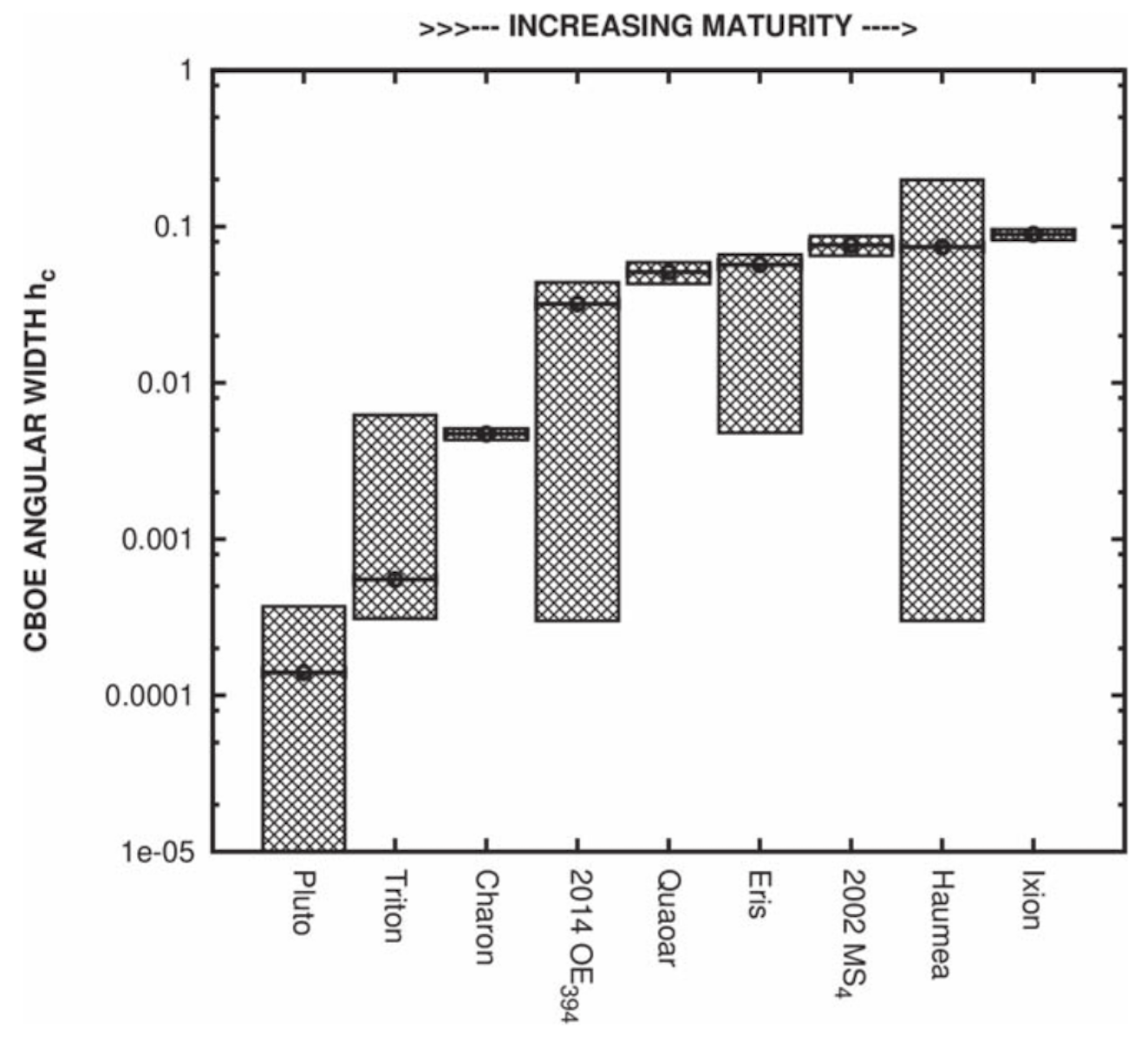
Fig. 1: From [8], CBOE angular width (in radians) for several large TNOs and dwarf planets as a function of surface maturity. Surfaces with larger CBOE widths (e.g. Ixion and Houmea) are more mature than those with smaller CBOE angular widths (e.g. Pluto and Triton).
Authors acknowledge support from NASA grant 80NSSC21K0433.
[1] Helfenstein, P. et al. (1988) Icarus 74, 231. [2] Hapke, B. (1986) Icarus 67, 264. [3] Shkuratov, Y. G. (1988) Kinemat. Phys. Neb. Tel. 4, 33. [4] Muinonen, K. (1990) Ph. D. Thesis, Helsinki University, Helsinki. [5] Hapke, B. (2002) Icarus 157, 523. [6] Hapke, B. et al. (2009) Icarus 199, 210. [7] Verbiscer, A. J. et al. (2019) ApJ 158, 123. [8] Verbiscer, A. J. et al. (2022) PSJ 3, 95. [9] Hapke, B. (2021) Icarus 354, 114105.
How to cite: Verbiscer, A., Benecchi, S., Sickafoose, A., Helfenstein, P., Lynn, J., and Worters, H.: Physical Surface Properties of Trans-Neptunian Objects and Centaurs Derived from Observations of the Opposition Effect, EPSC-DPS Joint Meeting 2025, Helsinki, Finland, 7–12 Sep 2025, EPSC-DPS2025-1006, https://doi.org/10.5194/epsc-dps2025-1006, 2025.


