
 ,,,
,,,- Group of Orbital Dynamics & Planetology, São Paulo State University (UNESP), School of Engineering and Science, Guratingueta, Brazil (lb.braga@unesp.br)
NASA's Lucy mission aims to investigate Jupiter trojan asteroids, considered primordial remnants of the Solar System's formation. The probe will visit targets at the L4 and L5 Lagrangian points, including the asteroid (11351) Leucus (Levison et al., 2021).
Leucus is a peculiar asteroid characterized by an extremely slow rotation (~446 hours), elongated shape, and low surface gravity, making it especially relevant for studies of surface dynamics in microgravity environments.
In this work, we give a detailed analysis of the surface dynamics of Leucus based on the 3-D polyhedral shape model with 574 vertices and 1,144 faces available in the literature (Durech & Hanus, 2023).
We calculate dynamical characteristics, such as geometric height, surface tilt, geopotential surface, surface acceleration, escape speed, slopes, and the number, location, and stability of equilibrium points. We adopt a density of 1.0 g/cm3 (Marchis et al., 2006) and a rotational period of 446 h (Mottola et al., 2020; Buie et al., 2021).
Our results show that the surface tilt across Leucus does not exceed 40 degrees. The minimum geopotential locations are in the poles (Fig. 1), corresponding to the areas over Leucus's surface with maximum surface acceleration (Fig. 2). Also, the maximum escape speed values are in the poles of the asteroid Leucus.
The analysis of the slopes allows us to infer possible regions of material accumulation or migration, which is important for understanding the morphological evolution of the asteroid Leucus. Most of the slopes over the surface of Leucus are less than 30 degrees, and particles are probably accumulating in some regions along its surface (Fig. 3).
We found 5 equilibrium points around Leucus, of which 3 are linearly stable (L2, L4, and L5) regarding its density and rotational period (Fig. 4). The equilibrium point locations are far away from the surface of asteroid Leucus, due its slow rotational period.
So, the dynamic environment around Leucus may eventually trap particles in the Roche lobe, allowing the formation of rings and small satellites.
We believe that the detailed study of the surface dynamics of asteroid Leucus could provide insights for mission planning and expand our understanding of the evolution of Trojan asteroids.
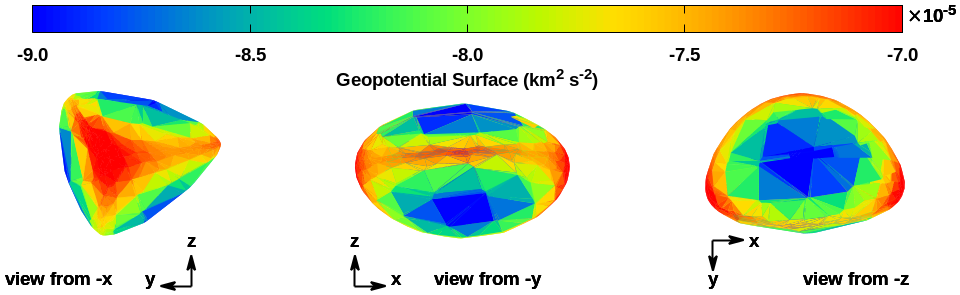
Fig. 1: Geopotential computed across Leucus's surface. The color box indicates the geopotential values in km2/s².
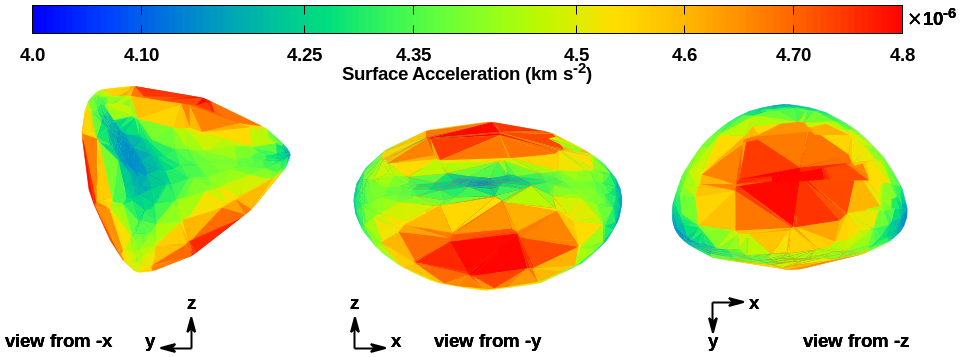
Fig. 2: Surface acceleration calculated over Leucus's surface. The color box denotes the surface acceleration values in km/s².
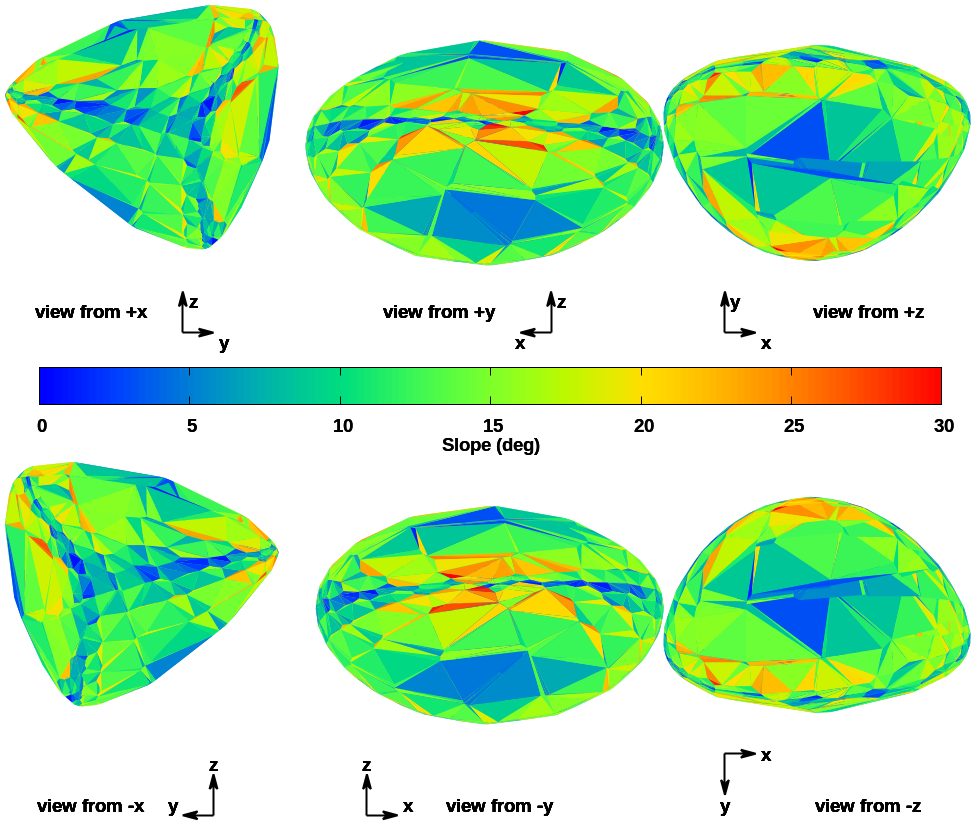
Fig. 3: Slopes computed across the surface of asteroid Leucus. The color bar code indicates the slope values in degrees.

Fig. 4: The number, location, and stability of equilibrium points around asteroid Leucus. The green dots represent linearly stable equilibrium points, while the red crosses are unstable.
How to cite: Braga, L., Amarante, A., Monteiro, F., Martins, M., Rocha, N., and Ferraz, A.: The Dynamics About Lucy Target Asteroid (11351) Leucus: A Very Slow Rotator, EPSC-DPS Joint Meeting 2025, Helsinki, Finland, 7–12 Sep 2025, EPSC-DPS2025-1009, https://doi.org/10.5194/epsc-dps2025-1009, 2025.


