
 1,1,
1,1,- 1Astronomical Observatory Institute, Faculty of Physics and Astronomy, Adam Mickiewicz University, Słoneczna 36, 60-286 Poznań, Poland. (julia.perla@amu.edu.pl)
- *A full list of authors appears at the end of the abstract
Context:
Stellar occultation databases gather many high-quality, multichord results of occultation phenomena (Herald et al. 2024, SODIS). This data is a great foundation for determining physical properties of asteroids, such as size and shape (Herald et al. 2020). In order to determine an asteroid size, it is possible to fit a sphere, ellipsoid, or spin and shape model to chords from a stellar occultation campaign (Durech et al. 2011, Herald et al. 2020). As is known from multiple space missions, asteroid shapes are mostly irregular. Therefore, the most accurate method for determining asteroid sizes is through the fitting of complex shape models, rather than ellipsoids. Accurate diameters in turn allow, for instance, better density constraints (Carry 2012).
Aims:
There is a significant number of asteroids with valuable stellar occultation data, but no shape model. The primary reason for the absence of a spin and shape model is typically an insufficient amount of photometric data. Therefore, we conducted an observing campaign to collect rotational lighcurves in additional apparitions of these targets.
Methods:
Asteroids were modelled using the convex inversion method (Kaasalainen, Torppa 2001, Kaasalainen et al. 2001) and then scaled with rich stellar occultation data (Durech et al. 2011).
Results:
We modelled spins and shapes of a few main belt asteroids. This permitted the precise determination of the asteroid diameters, narrowing the range of diameters determined by the infrared studies. Moreover, for some targets we resolved the mirror-pole ambiguity.
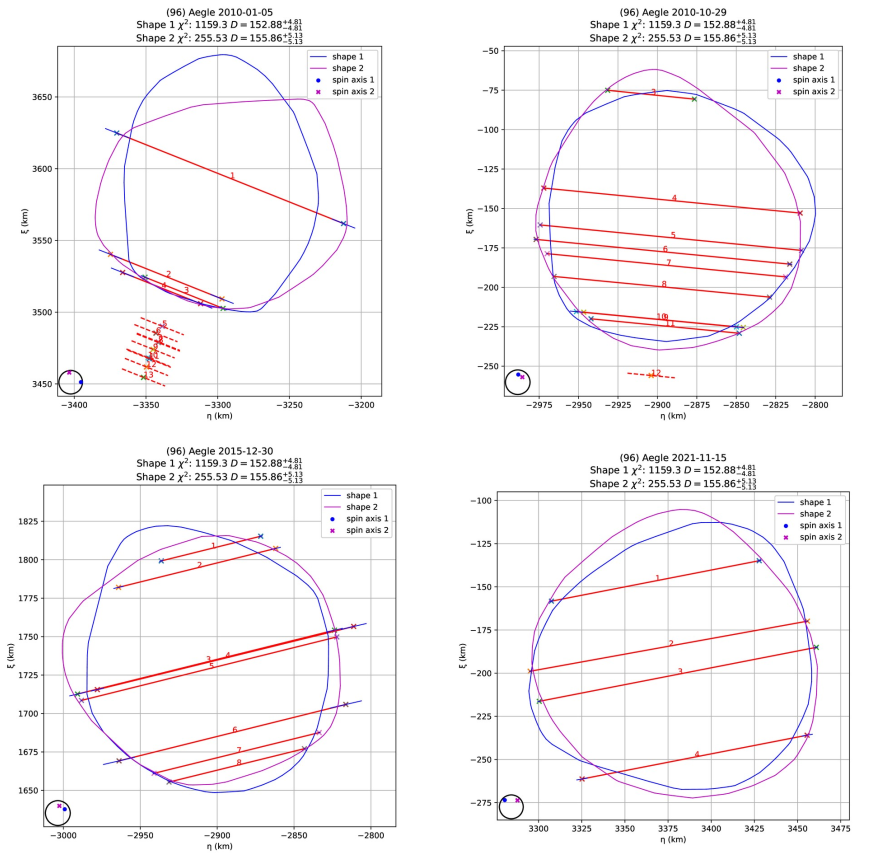
Figure 1: Sample result: shape model of asteroid (96) Aegle fitted to stellar occultations. Red solid lines indicate positive chords (where the occultation was observed), while red dashed lines represent negative chords (where no occultation was detected). The two spin and shape solutions are distinguished by color. The symbol in the lower left corner indicates the model spin axis orientation: the "x" marks the spin-axis vector pointing into the plane (away from the observer), and the "•" marks the vector pointing out of the plane (toward the observer). In this case, Shape 2 provides a better fit to the occultation data. The estimated equivalent volume diameter is (156 ± 5) km.
References:
Herald D., et al. 2024. Asteroid Occultations V4.0. NASA Planetary Data System
Stellar Occultation Data Input System (SODIS), https://sodis.iota-es.de
Durech, J., Kaasalainen, M., Herald, D., et al. 2011, Icarus, 214, 652
Herald, D., Gault, D., Anderson, R., et al. 2020, MNRAS, 499, 4570
Carry B. 2012. Planet. Space Sci., 73, 98
Kaasalainen, M. & Torppa, J. 2001, Icarus, 153, 24
Kaasalainen, M., Torppa, J., & Muinonen, K. 2001, Icarus, 153, 37
Josep Bosch, Adrian Jones, Mario Morales Aimar, Michał Żejmo, Magdalena Szkudlarek
How to cite: Perła, J., Marciniak, A., Choukroun, A., Podlewska-Gaca, E., and Najda, K. and the team of observers: Asteroid Shape Modelling Driven by Archival Stellar Occultation Data, EPSC-DPS Joint Meeting 2025, Helsinki, Finland, 7–12 Sep 2025, EPSC-DPS2025-101, https://doi.org/10.5194/epsc-dps2025-101, 2025.


