SB6 | Surface and interiors of small bodies, meteorite parent bodies, and icy moons: thermal properties, evolution, and structure

SB6

Surface and interiors of small bodies, meteorite parent bodies, and icy moons: thermal properties, evolution, and structure
Convener: Wladimir Neumann | Co-conveners: Jürgen Blum, Marco Delbo, Cécile Deligny, Wataru Fujiya, Xian Shi
Orals WED-OB5
| Wed, 10 Sep, 15:00–16:00 (EEST)
 
Room Jupiter (Hall A)
Orals WED-OB6
| Wed, 10 Sep, 16:30–18:30 (EEST)
 
Room Jupiter (Hall A)
Orals THU-OB2
| Thu, 11 Sep, 09:30–10:30 (EEST)
 
Room Jupiter (Hall A)
Orals THU-OB3
| Thu, 11 Sep, 11:00–12:24 (EEST)
 
Room Jupiter (Hall A)
Posters TUE-POS
| Attendance Tue, 09 Sep, 18:00–19:30 (EEST) | Display Tue, 09 Sep, 08:30–19:30
 
Finlandia Hall foyer, F150–179
Wed, 15:00
Wed, 16:30
Thu, 09:30
Thu, 11:00
Tue, 18:00
The asteroids in particular and the asteroid-comet-dwarf planet continuum in general bear the signature of the birth of the solar system. Their observed properties allow for testing theories regarding the evolution of the solar system's planetary objects and of their prospective development. Additional important insights into this exciting field of research are provided by the laboratory investigations of the samples delivered to the Earth in the form of meteorites and by sophisticated numerical models.
The session will gather researchers of different communities for a better understanding of the evolution and properties of small bodies, ranging from planetesimals or cometesimals to icy moons, and including meteorite parent bodies. It will address recent progresses made on physical and chemical properties of these objects, their interrelations and their evolutionary paths by observational, experimental, and theoretical approaches.
We welcome contributions on the studies of the processes on and the evolution of specific parent bodies of meteorites, investigations across the continuum of small bodies, including comets and icy moons, ranging from local and short-term to global and long-term processes, studies of the surface dynamics on small bodies, studies of exogenous and endogenous driving forces of the processes involved, as well as statistical and numerical impact models for small bodies observed closely within recent space missions (e.g., AIDA, Hayabusa2, Lucy, New Horizons, OSIRIS-REx).

Session assets

Orals WED-OB5: Wed, 10 Sep, 15:00–16:00 | Room Jupiter (Hall A)

Chairpersons: Wladimir Neumann, Jürgen Blum, Marco Delbo
Observations and Data Analysis
15:00–15:12
|
EPSC-DPS2025-346
|
On-site presentation
Olivier Barnouin, Erica Jawin, and Zhang Yun

Recently, data from the OSIRIS-REx mission revealed evidence of layering, where fine-grained material on Bennu could be located at depth, not far below the asteroid’s surface (Bierhaus et al., 2023). If present and distributed globally, this fine-grained material could be more cohesive than the coarser and typically unconsolidated surface material, and would provide a relative stronger substrate at depth. Several lines of evidence indicate that Bennu’s interior should possess such strength, including but not limited to its non-circular equatorial ridge (Barnouin et al., 2019), the presence of surface lineaments (Barnouin et al., 2019; Jawin et al., 2022), and the widespread evidence of surface mass movement (Barnouin et al., 2022; Jawin et al., 2020; Tang et al., 2023; Walsh et al., 2019). Understanding properties including cohesion, particle size distribution, and structure is key to interpreting an asteroid’s geologic history. One manifestation of our uncertainty in asteroid surface properties is a mismatch in the crater-derived surface ages of NEAs such as Bennu and Ryugu, which are orders of magnitude younger than the proposed age of the breakup of their parent bodies. 

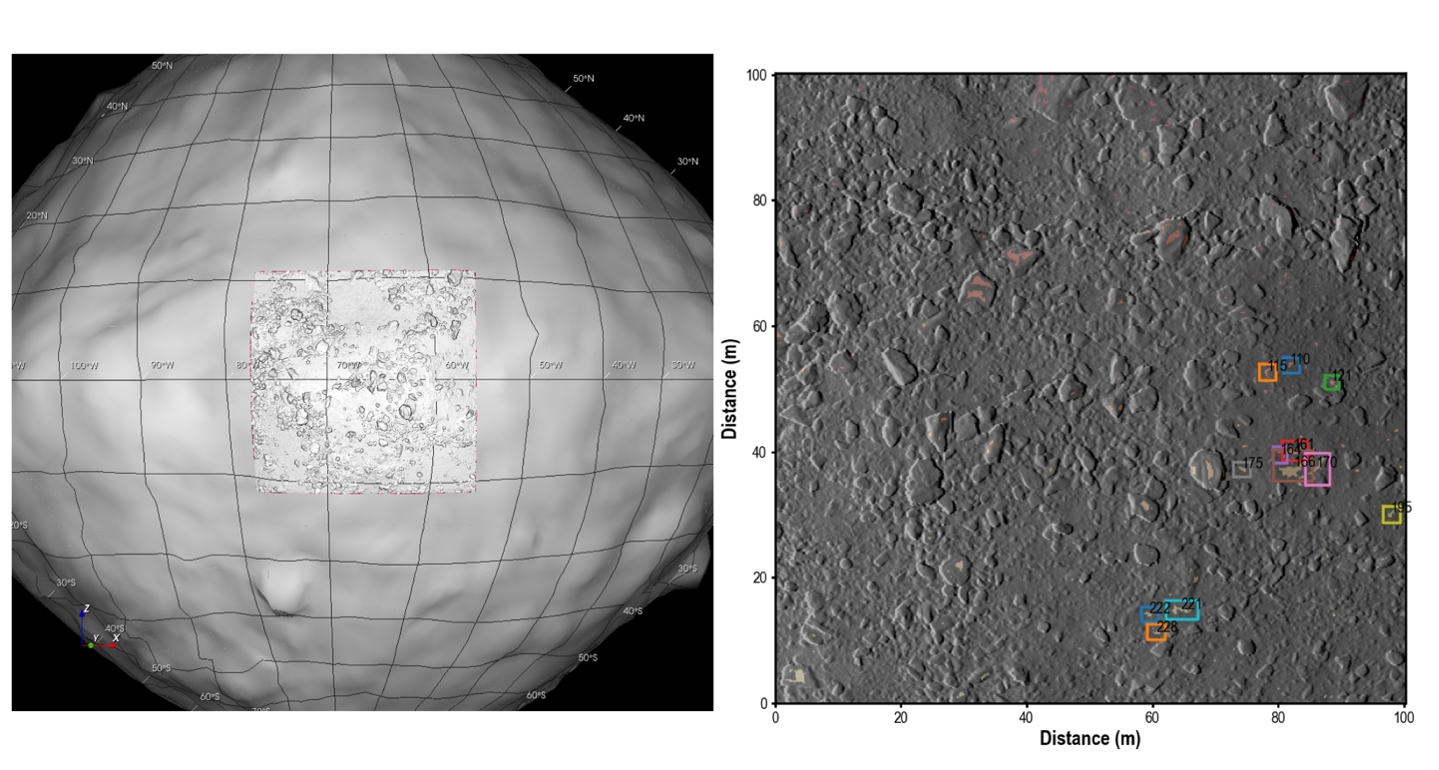
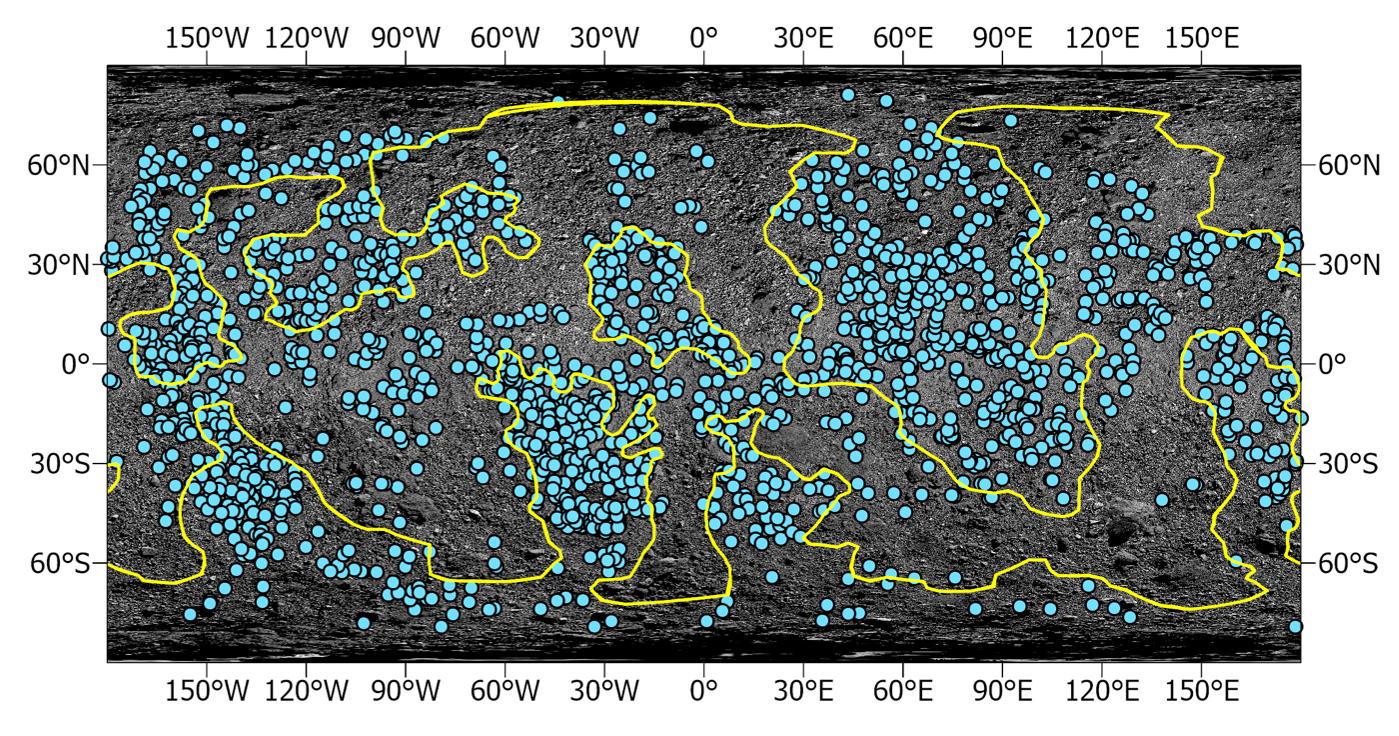
Figure 1. Global image mosaic showing smooth regions larger than ~1 m (circles) compared to global geologic units (yellow outline). Smooth regions are concentrated in the Smooth Unit (regions including the north and south poles), although smooth exposures are also present in the Rugged Unit (covering most of the equatorial zone).

Here, we begin to explore in detail the spatial distribution and physical attributes of the exposed subsurface, fine-grained layer. Our approach is to systematically identify smooth areas across the asteroid, where the more cohesive fines might exist, with the ultimate objective to test the hypothesis of the presence of this fine-grained subsurface layer, in part by establishing the stratigraphic height of any exposed fine-grained material.


Identifying smooth areas:

We visually identify smooth regions in a global image mosaic generated from the Detailed Survey phase of the mission with a pixel scale of ~5 cm (Bennett et al., 2021) (Fig. 1). This initial mapping identified relatively smooth-textured areas regardless of objective roughness or geologic setting (i.e., not restricted to impact craters). Additional analyses will survey the polar regions, define spatial extents of smooth exposures, merge overlapping regions, remove any regions smaller than our minimum diameter of 5 m, and will identify regions for subsequent SFD analyses.


We also identify and map smooth regions on a global set of 20 cm digital terrain models (DTM) that were generated using OLA data collected during the prime mission. As available in the Small Body Mapping Tool, these 20 cm DTMs include the variation of surface tilts across the surface of Bennu, within a 1-m diameter region, centered on each one of the DTM’s facet. The tilt variation is determined by taking the root mean square of variation of each facets tilt relative to the mean tilt of 1 m region. Surfaces that have a greater tilt variation are typically rougher than regions that do not. To find the smoothest areas, we filter this tilt variation < 4 deg. We also filter out boulder tops, many of which are very smooth (Fig. 2). The remaining regions are tracked by location, elevation, radius, and so on.

Fig. 2 Twenty-cm DTM located on Bennu (left), with smooth regions identified (right) as colored patches. Boxed regions were ultimately considered in this analysis. Other patches are usually boulder tops, which are often smooth.

Numerical assessments

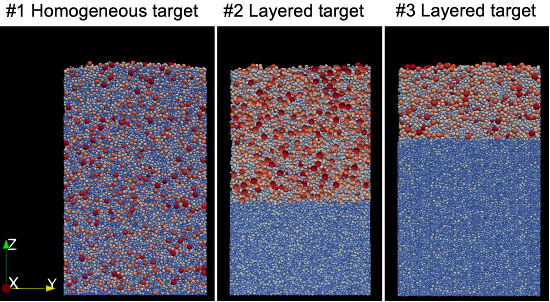
To complement our systematic mapping efforts, we have also undertaken a suite of numerical investigations that make use of the Soft-Sphere Discrete Element Model code PKDGRAV. We hypothesize that a near-surface layer of fine-grained material, owing to its stronger cohesion, could facilitate mobilization of the overlying coarse regolith, thereby enhancing surface mass movement compared to an unlayered target. If this hypothesis is correct, then the geotechnical properties of the granular material should depend on: (1) particle SFD, (2) particle size range, and (3) confining pressure. To systematically study how these factors interact and influence the mechanical behavior of Bennu’s surface and near-surface regolith, we perform triaxial compression tests using PKDGRAV.  We further conduct landslide simulations using granular beds with various surface and subsurface structures (Fig. 3) to assess their surface mobility. These efforts consider Bennu gravitational conditions.

Fig. 3 Examples of subsurface structures used in the numerical simulations for testing surface mobility. Particles are color-coded by their radii.

Current status of findings:

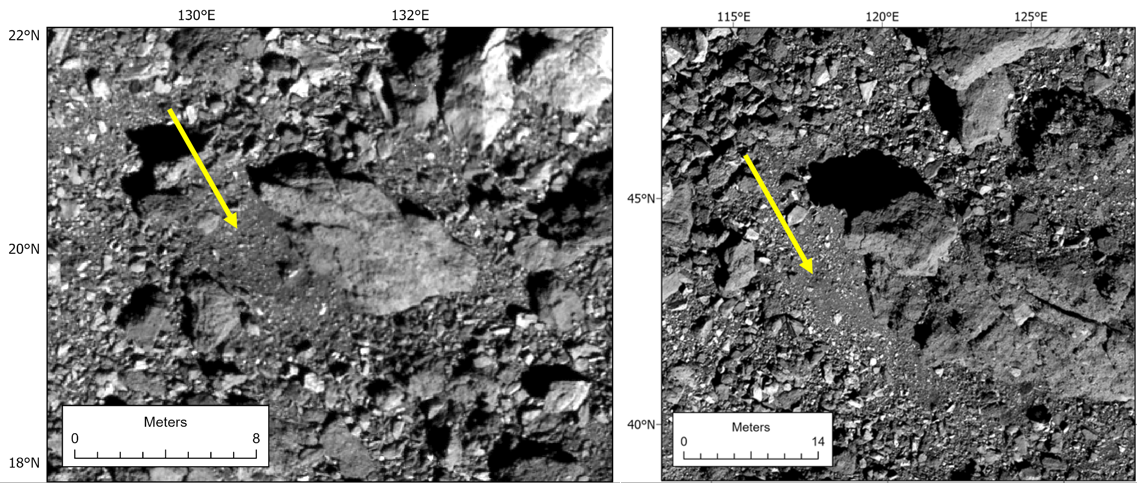
Our initial spatial trends suggest that smooth exposures are more prevalent in the Smooth Geologic unit (compared to the Rugged unit), although smooth regions are also found in the Rugged unit that may be associated with the movement of large boulders via impacts and/or mass movement (Fig. 1). We also find that smooth areas are often, but not always, associated with small fresh (red) craters. Many of the smoothest regions also exist between boulders, including the largest boulders (>20-30 m diameter) which have previously been associated with recent mass movement activity (Daly et al., 2020; Jawin et al., 2020). Some of the most interesting smooth regions are found down-slope of a larger boulder, where coarse surface material appears to have slid away, exposing the fines (Fig. 4?). Our ongoing numerical investigation will provide a better understanding for what near-surface conditions were needed to achieve these observations.


Figure 4. Examples of smooth regions downslope of large boulders on Bennu. 

References:

Barnouin, O.S., et al., 2019. Nature Geoscience 12, 247–252. https://doi.org/10.1038/s41561-019-0330-x

Barnouin, O.S., et al., 2022. Journal of Geophysical Research: Planets 127, e2021JE006927. https://doi.org/10.1029/2021JE006927

Bennett, C.A., et al., 2021.  Icarus 357, 113690. https://doi.org/10.1016/j.icarus.2020.113690.

Bierhaus, E.B., et al., 2023. Icarus 115736. https://doi.org/10.1016/j.icarus.2023.115736

Jawin, E.R., et al., 2022. Icarus 381, 114992. https://doi.org/10.1016/j.icarus.2022.114992

Jawin, E.R., et al., 2020. J Geophys Res-Planet 125. https://doi.org/10.1029/2020JE006475

Tang, Y., et al., 2023. Icarus 115463. https://doi.org/10.1016/j.icarus.2023.115463

Walsh, K.J., et al., 2019.  Nature Geoscience 12, 242–246. https://doi.org/10.1038/s41561-019-0326-6

How to cite: Barnouin, O., Jawin, E., and Yun, Z.: Characterizing a near-surface, fine-grained layer on Bennu. , EPSC-DPS Joint Meeting 2025, Helsinki, Finland, 7–13 Sep 2025, EPSC-DPS2025-346, https://doi.org/10.5194/epsc-dps2025-346, 2025.

15:12–15:24
|
EPSC-DPS2025-60
|
On-site presentation
Michaël Marsset, Josef Hanuš, Thomas Mueller, Pierre Vernazza, Miroslav Brož, and Christina Thomas

We recently proposed that the Massalia asteroid family is the source of the most common meteorites found on Earth: the ordinary L chondrites (Marsset, Vernazza, Brož et al. 2024, Nature). This hypothesis is supported by several lines of evidence:
(1) spectral similarities between Massalia family members and L chondrites;
(2) the family’s steep size-frequency distribution, extending down to the detection limit of current all-sky surveys, indicating a large population of small fragments;
(3) the orbital clustering of L-chondrite-like Near-Earth Objects (NEOs) near the family and the 3:1 mean-motion resonance with Jupiter;
(4) the presence of a zodiacal dust band intersecting the family, suggesting ongoing dust production that feeds the inner Solar System;
(5) the dynamical and collisional ages of the family, which we found to be consistent with the argon isotope ages measured in L chondrites;
and (6) the reconstructed pre-atmospheric orbits of L chondrites, pointing to a low-inclination source in the inner asteroid belt.

In our initial study, we made several testable predictions for future large-scale surveys (e.g., LSST) and targeted observations to further validate our finding. One such prediction was the existence of a large impact crater on (20) Massalia itself. Here, we present high-resolution adaptive optics (AO) images of Massalia obtained with VLT/SPHERE to test this prediction. By combining these multi-epoch AO observations covering a full rotation with optical light curves , we determined the asteroid’s spin orientation and derived a detailed shape model. Additionally, we analyzed an extensive set of thermal measurements to estimate (20) Massalia’s thermal inertia and surface roughness. We will discuss these results in the context of the proposed link between the Massalia family and L chondrites.

How to cite: Marsset, M., Hanuš, J., Mueller, T., Vernazza, P., Brož, M., and Thomas, C.: Searching for the Cradle of L Chondrites on (20) Massalia's Surface, EPSC-DPS Joint Meeting 2025, Helsinki, Finland, 7–13 Sep 2025, EPSC-DPS2025-60, https://doi.org/10.5194/epsc-dps2025-60, 2025.

15:24–15:36
|
EPSC-DPS2025-1549
|
On-site presentation
Chrysa Avdellidou, Ullas Bhat, Kieran Bujdoso, Marco Delbo, Michael Marsset, and Pierre Vernazza

In the classical theory of planetesimal differentiation, a body would form an iron-rich core, an olivine-dominated mantle, and a pyroxene-rich basaltic crust [1]. The detection of differentiated bodies in the current asteroid main belt will allow us to get insights and study the very initial phases of planetesimal accretion. So far, the only striking proof of a differentiated planetesimal is asteroid (4) Vesta and its family that resulted from the impact formation of two large basins Rheasilvia and Veneneia [2]. Asteroid (22) Kalliope is the densest known asteroid with =4.4±0.46 g.cm-3 [3] indicating a metal-rich composition. The low radar albedo (0.18±0.05 [4]), however, points towards a lower metal content on the surface but the presence of very high density indicates a differentiated metal-rich interior.  (22) Kalliope has recently been shown to be the parent body of an asteroid family in the outer main belt consisting of 302 members [5]. Therefore, studying the physical properties of the Kalliope family members we can get insights into the internal structure of the original planetesimal. In this work we studied the physical properties of the Kalliope family. Thirty seven Kalliope family members have visible reflectance spectra from Gaia DR3 and 22 of which were observed at NASA IRTF obtaining their near-infrared spectra. Following the methodology of our previous work on the Athor asteroid family [6], Gaia and IRTF spectra were combined with the available visible SDSS data. The final combined spectra were classified in the Bus-DeMeo taxonomy [7]. Using the reflectance spectra of Kalliope family members as well as their geometric visible albedos we matched them with meteorites that are included in the RELAB and PSF meteorite lab spectra databases.  We discovered that the Kalliope family is the first family that consists of metallic fragments, confirming the differentiated nature of the original planetesimal [8].

References: [1] Elkins-Tanton, L. and Weiss, B. (2017), Planetesimals, Cambridge University Press. [2] Marchi S. et al. (2021) Science 336, Issue 6082, 690. [3] Ferraris M. et al. (2022) A&A, 622, A71. [4] Shepard M. K., et al. (2015) Icarus, 245, 38. [5] Brož M. et al. (2022) A&A, 664, A69. [6] Avdellidou C. et al. (2022) A&A, 665, L9. [7] DeMeo F. E. et al. (2009) Icarus, 202, 160. [8] Avdellidou C. et al. (2025) MNRAS.

How to cite: Avdellidou, C., Bhat, U., Bujdoso, K., Delbo, M., Marsset, M., and Vernazza, P.: Kalliope sings rock and metal., EPSC-DPS Joint Meeting 2025, Helsinki, Finland, 7–13 Sep 2025, EPSC-DPS2025-1549, https://doi.org/10.5194/epsc-dps2025-1549, 2025.

15:36–15:48
|
EPSC-DPS2025-1464
|
ECP
|
On-site presentation
Miguel R. Alarcon, Javier Licandro, and Miquel Serra-Ricart

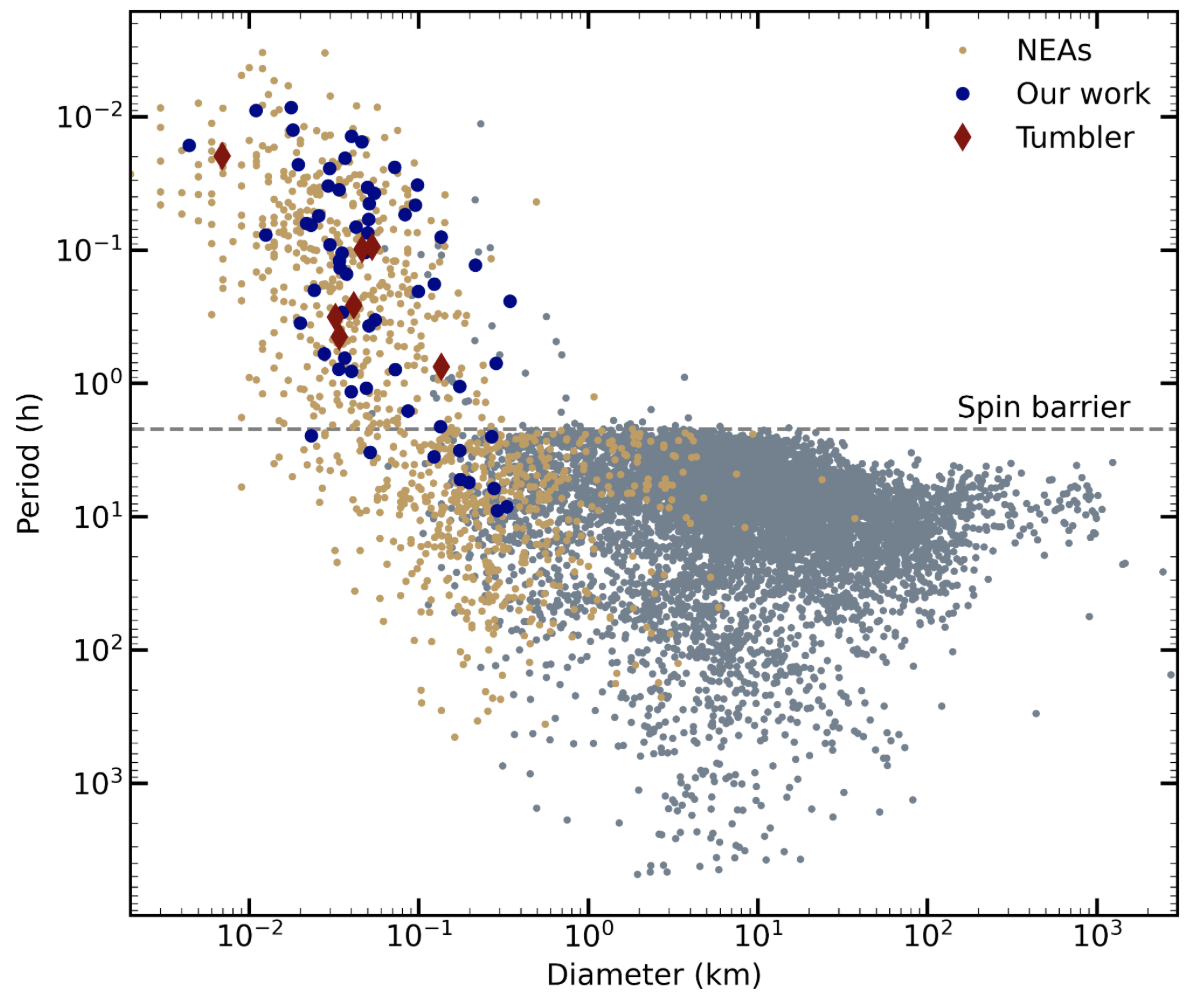
Near-Earth asteroids (NEAs) offer unique laboratories for probing the internal structure and cohesion of small bodies. Although most asteroids spin more slowly than the so‑called “cohesionless spin barrier” (a ∼2.2 h rotation period above which a rubble pile would disrupt), a growing handful of NEAs exhibit much shorter periods, calling into question our understanding of their mechanical strength and aggregate structure.

Measuring sub‑barrier spin rates is challenging: wide‑field surveys rarely provide the continuous, high‑cadence photometry needed to resolve rapid light‑curve variations over several hours. Dedicated follow‑up with robotic telescopes is therefore essential to capture the dense temporal sampling required to detect and characterize fast rotators.

Here we report on an ongoing survey targeting NEAs with absolute magnitude H > 22.5, carried out with four new robotic instruments at Teide Observatory, Tenerife: two 0.8 m telescopes (TTT‑1/2), a 1 m wide‑field telescope (TST; 4.1 deg² FOV), and a 2 m telescope (TTT‑3). All are equipped with high‑sensitivity sCMOS cameras optimized for rapid, low‑noise photometry. For the 2 m telescope, individual observing blocks are constrained to under 40 minutes, whereas on the 0.8 m telescopes we employ two‑hour blocks to secure adequate temporal coverage of fast rotators.

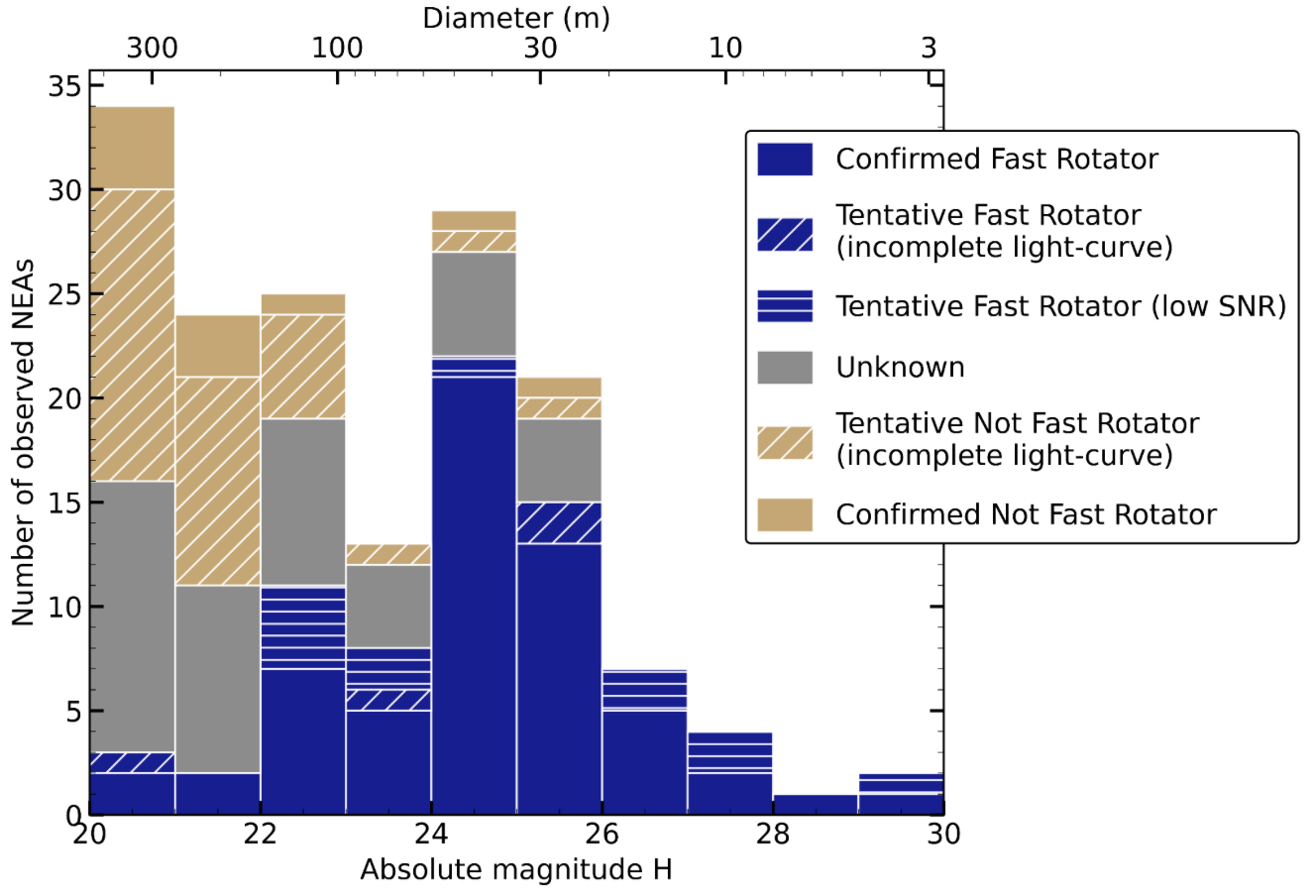
To date we have observed over seventy NEAs within days of discovery, identifying more than 55 previously unreported fast rotators. Preliminary statistics indicate that 91 % of our sample with H > 24 rotate faster than the spin barrier, and every one of fourteen targets with H > 26 exhibits sub‑barrier spin periods—several completing a full rotation in under a minute. We also report at least five new non‑principal‑axis (tumbling) rotators, a substantial increase over the thirteen known to date. These results underscore both the prevalence of rapid spin states among the smallest NEAs and the power of dedicated, high‑cadence follow‑up in expanding our knowledge of their physical properties.

Figure 1. Number of small NEAs observed versus absolute magnitude, color‑coded by spin rate relative to the 2.2 h cohesionless spin barrier: fast rotators in blue and slower rotators in gold. Short observing blocks (< 2 h per target) reduce our capacity to determine to low‑amplitude, not-fast‑spinning objects.


Figure 2. Published rotation periods versus diameter for asteroids (LCDB, U > 2), with Near‑Earth Asteroids highlighted in gold. Our new measurements appear in blue, with non‑principal‑axis (tumbling) rotators in red.

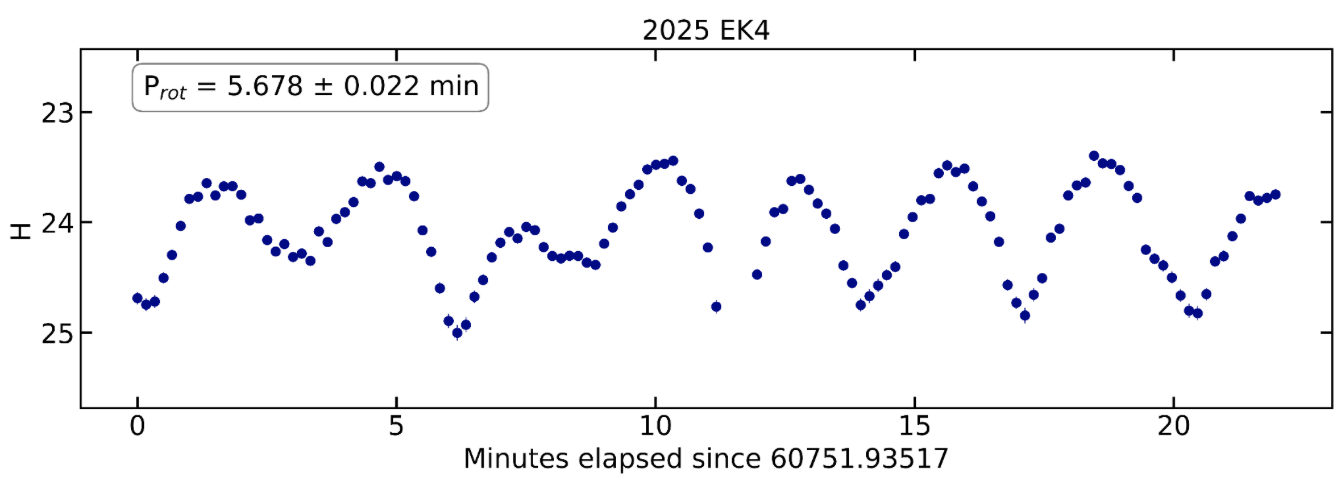
Figure 3. Lightcurve of 2025 EKover less than 25 minutes. This is one of the NEAs illustrating rapid, non‑principal‑axis rotation.

How to cite: R. Alarcon, M., Licandro, J., and Serra-Ricart, M.: Prevalence of Fast Rotators Among Small Near‑Earth Asteroids: An Ongoing Survey from the Two‑Meter Twin Telescope facility, EPSC-DPS Joint Meeting 2025, Helsinki, Finland, 7–13 Sep 2025, EPSC-DPS2025-1464, https://doi.org/10.5194/epsc-dps2025-1464, 2025.

15:48–16:00
|
EPSC-DPS2025-1271
|
ECP
|
On-site presentation
Max Mahlke, Michaël Marsset, Maxime Devogèle, Donia Baklouti, Pierre Beck, Lydie Bonal, Rosario Brunetto, Cateline Lantz, and Paolo Tanga

Introduction: L-type asteroids represent a rare taxonomic class that is spectrally similar to CO and CV carbonaceous chondrites [1]. Their spectra often suggest highabundances of refractory materials like calcium-aluminium-rich inclusions (CAIs), implying their parent bodies were among the earliest chondrites to form in the Solar System [2]. CO and CV chondrites in turn contain the highest vol% of refractory inclusions in the meteorite collection and are predominantly of petrographic type 3, with varying degrees of thermal metamorphsim [3]. Understanding the distribution and spectral characteristics of L-types is thus crucial for deciphering early Solar System composition and evolution. However, their rarity and spectral ambiguity with other classes have hindered comprehensive characterisation [4, 5]. Our study aimed to identify new L-types within known associated asteroid families, provide detailed UV-VisNIR spectral characterisation using VLT/XSHOOTER [6], assess the spectral diversity within the class, and investigate links to chondritic meteorites.

Methods: We obtained high-quality UV-VisNIR (0.30µm to 2.48µm) reflectance spectra of nine asteroids belonging to five families previously associated with L-types (Aquitania, Brangäne, Henan, Tirela, Watsonia [7, 8, 9]) using VLT/XSHOOTER. We classified them using different taxonomies [10, 11, 12] and compared them quantitatively with laboratory reflectance spectra of ordinary, CO, and CV chondrites [13, 14].

Results: Our observations successfully identified five new L-type asteroids, expanding the sample of this class with VisNIR wavelength coverage by ~30%. The remaining targets were classified as S-types. The new L-type spectra confirm the considerable spectral diversity previously noted for this population [12], often falling taxonomically between or on the edges of established classes (e.g., L, M, S) depending on the classification system and spectral features considered.

Combining our new data with existing VisNIR spectra of L-types and related "Barbarian" asteroids (polarimetrically defined and likely compositionally linked), we investigated the overall spectral distribution of this population. A potential bimodal distribution emerged, separating the L-type/Barbarian asteroids into two groups, tentatively named LL and LM. As illustrated by the mean spectra and albedos (see Figure 1), these groups primarily differ in their 2µm absorption band depth and geometric albedo: the LL group exhibits generally higher albedos and a more pronounced 2µm feature, while the LM group shows lower albedos and weaker spectral features, resembling M-type asteroids in overall shape but presenting subtle features. Notably, members from the same dynamical families (e.g., Aquitania, Brangäne) are found in both the LL and LM groups.

A similar analysis of laboratory spectra of CO and CV chondrites revealed analogous spectral diversity. CO chondrites, in particular, displayed a similar bimodal separation in spectral features and albedo (denoted here as “COr” and “COp” groups), mirroring the LL/LM asteroid split (Figure 1). CV chondrites also showed significant spectral variation across their subclasses (CVRed, CVOxA, CVOxB [15]), correlating feature strength with albedo. Comparisons suggest that the LL asteroids share spectral characteristics (stronger features, higher albedo) with COr and CVOxA chondrites, while the LM asteroids align better with the lower albedo, weaker-featured COp, CVRed, and CVOxB chondrites, once expected space weathering effects (primarily reddening) are considered [16, 17].

Figure 1: Reflectance spectra and albedo of CO-CV classes and subgroups and the two identified L-type populations. Shown are the mean values and the standard deviation in all wavelengths bins and the albedo distribution. The spectra are vertically offset for comparability.

Conclusions: The expanded census and detailed characterisation of L-type asteroids reveal a spectrally diverse population, likely sampling ancient parent bodies related to CO and CV chondrites. The observed spectral bimodality (LL/LM), mirrored in laboratory data for CO and CV chondrites, strongly suggests significant heterogeneity within the parent bodies of multiple asteroid families. This heterogeneity may stem from differing degrees of thermal metamorphism across the original planetesimals. The presence of members from the same dynamical family in both spectral groups further supports the concept of compositionally heterogeneous, yet related, L-type parent bodies.

The distinct UV-visible slope of L-types compared to S-types promises L-type identification in future Gaia data releases (e.g., DR4, mid 2026). The recently launched SPHEREx mission, providing near-infrared spectra, will be crucial for robustly testing the proposed bimodality, refining mineralogical interpretations, and fully characterising the distribution and nature of these enigmatic Solar System relics.

References:

[1] Burbine, T. H. et al., 1992, Meteoritics, 27, 424

[2] Sunshine, J. M. et al., 2008, Science, 320, 514

[3] Scott, E. R. D. & Krot, A. N. 2014, in Meteorites and Cosmochemical Processes, ed. A. M. Davis, Vol. 1, 65–137

[4] Devogèle, M. et al., 2018, Icarus, 304, 31

[5] Mahlke, M. et al., 2023, A&A, 676, A94

[6] Vernet, J. et al., 2011, Astronomy & Astrophysics, 536, A105

[7] Brož, M. et al., 2013, A&A, 551, A117

[8] Vinogradova, T. A. 2019, Monthly Notices of the Royal Astronomical Society

[9] Balossi, R. et al., 2024, Astronomy & Astrophysics, 688, A221

[10] Tholen, D. J. 1984, PhD thesis, University of Arizona, Tucson

[11] DeMeo, F. E. et al., 2009, Icarus, 202, 160

[12] Mahlke, M. et al., 2022, A&A, 665,A26

[13] Eschrig, J. et al., 2021, Icarus, 354, 114034

[14] Eschrig, J. et al., 2022, Icarus, 381 115012

[15] Bonal, L. et al., 2016, Geochim. Cosmochim. Acta, 189, 312

[16] Lantz, C. et al. 2017, Icarus, 285, 43

[17] Mahlke, M. et al. 2024, Analogues of enigmatic L-types: The effect of space weathering on CV, CO, CK, and CL chondrites, EPSC 2024

Acknowledgements: The authors acknowledge important contributions by A. Aleón-Toppani to this work. This work was supported by the Programme National de Planétologie (PNP) of CNRS-INSU co-funded by CNES.

How to cite: Mahlke, M., Marsset, M., Devogèle, M., Baklouti, D., Beck, P., Bonal, L., Brunetto, R., Lantz, C., and Tanga, P.: In Barbarian territory: Spectral bimodality in L-type asteroids and their link to CO-CV chondrites, EPSC-DPS Joint Meeting 2025, Helsinki, Finland, 7–13 Sep 2025, EPSC-DPS2025-1271, https://doi.org/10.5194/epsc-dps2025-1271, 2025.

Orals WED-OB6: Wed, 10 Sep, 16:30–18:30 | Room Jupiter (Hall A)

Chairpersons: Cécile Deligny, Wataru Fujiya, Xian Shi
Observation and Data Analysis (continued)
16:30–16:42
|
EPSC-DPS2025-1824
|
ECP
|
On-site presentation
Anicia Arredondo, Aaron Deleon, Tracy Becker, and Maggie McAdam

The FORCAST instrument on the Stratospheric Observatory for Infrared Astronomy (SOFIA) regularly obtained mid-infrared data of large asteroids as calibrators for other observations. This previously unused dataset represents a long-baseline series of photometric and spectroscopic observations that can be used to investigate how thermal and compositional properties may change over time. We present multi-filter photometry and spectroscopy in the wavelength range 5-38 μm of (1) Ceres which was observed on seventeen nights between 2015-2022. These nights correlate to different portions of Ceres’ orbit (Figure 1). While there are no data near perihelion, the full data set covers a wide spread of Ceres’ orbit.  

Figure 1. Location of Ceres along its orbital path (grey line) around the Sun (yellow star) for each of our observations (colored markers). Perihelion is marked with a black cross.

We performed aperture photometry on the imaging data, which consisted of between six and twelve different filters per night. We fit the Near-Earth Asteroid Thermal Model (NEATM) to the extracted photometric points to derive the beaming parameter (η), which is a proxy for thermal properties. We find that η does not change with Ceres’ point in its orbit or with the sub-observer longitude of the observation; however, we find a general increase in η over the time scale of our observations (Figure 2). The cause of this increase is likely instrumental, as it is also seen in a similar study of (4) Vesta. 

Figure 2. We do not find a correlation between η and point in orbit or sub-observer longitude, indicating that there are no significant rotational or seasonal thermal effects on Ceres. We do see a correlation between η and julian date, which is likely an instrumental artifact.  

Spectra between 17.6-37.1 μm were obtained on all nights, and additional spectra between 4.9-13.7 μm were obtained on three nights. The average spectrum (Figure 3) shows a broad feature near 20 μm due to phyllosilicates. We did not find any significant differences in the size or shape of this feature on any of the nights, indicating that it does not vary rotationally or seasonally. Ceres' lack of rotational and seasonal changes enables it to be a good calibrator for other astronomical observations, as expected. 

Figure 3. Average spectrum of  Ceres from all seventeen nights of data. 

How to cite: Arredondo, A., Deleon, A., Becker, T., and McAdam, M.: Long-term MIR photometry and spectroscopy of (1) Ceres from SOFIA, EPSC-DPS Joint Meeting 2025, Helsinki, Finland, 7–13 Sep 2025, EPSC-DPS2025-1824, https://doi.org/10.5194/epsc-dps2025-1824, 2025.

16:42–16:54
|
EPSC-DPS2025-523
|
On-site presentation
Oriel Humes and Cristina Thomas

Main belt asteroid 203 Pompeja shows evidence of spectral variability in the visible and near-infrared (VNIR). During most epochs, Pompeja’s spectrum resembles a typical X-type asteroid [1, 2]. However, during its 2021 apparition, steeply red sloped spectra were observed in the VNIR, invoking comparisons to the ultra-red VR and RR TNOs and leading to the suggestion that Pompeja may have migrated from the TNO region to the Main Belt [3]. An uneven distribution of ultra-red material across its surface may contribute to Pompeja’s observed spectral variability.


In order to assess the extent of ultra-red material across Pompeja’s surface, in October 2024, we observed this asteroid using the Las Cumbres Observatory global telescope network [4], obtaining grizy photometry over nearly its entire 24 hour rotational period. The observing geometry relative to the earth and Sun during this epoch was close to equatorial, providing nearly-complete longitudinal coverage of Pompeja at low and mid-latitudes. We present the results of this observing campaign and discuss their implications for the abundance and distribution of ultra-red material on Pompeja in light of current models of its shape and rotational pole orientation [5]. We derive upper limits on the abundance of ultra-red material at equatorial and mid-latitudes, discuss the implications of our observations on the origin of Pompeja, and evaluate future observational prospects.


[1] Hasegawa, S., DeMeo, F. E., Marsset, M., et al. 2022 ApJL, 939, L9, doi: 10.3847/2041-8213/ac92e4

[2] Humes, O. A., Thomas, C. A., & McGraw, L. E. 2024, PSJ, 5, 80, doi: 10.3847/PSJ/ad2e99

[3] Hasegawa, S., Marsset, M., DeMeo, F. E., et al. 2021 ApJL, 916, L6, doi: 10.3847/2041-8213/ac0f05

[4] Brown, T. M., Baliber, N. et al. 2013 PASP, 125, 931, 1031-1055, doi: 10.1086/673168

[5] Humes, O. A., Hanuš, J. 2024 PSJ, 5, 271, doi: 10.3847/PSJ/ad8f3a

How to cite: Humes, O. and Thomas, C.: 24 hours on Pompeja: time-resolved spectrophotometry of an unusual Main Belt asteroid, EPSC-DPS Joint Meeting 2025, Helsinki, Finland, 7–13 Sep 2025, EPSC-DPS2025-523, https://doi.org/10.5194/epsc-dps2025-523, 2025.

16:54–17:06
|
EPSC-DPS2025-2054
|
ECP
|
On-site presentation
Haeun Kim, Mjung-Jin Kim, Hee-Jae Lee, Youngmin JeongAhn, Hong-Kyu Moon, Young-Jun Choi, and Yonggi Kim

Binary asteroids provide a unique opportunity to study the key physical and dynamic properties of small solar system bodies. Unlike single bodies, binaries allow us to estimate component masses and orbital parameters based on mutual orbital dynamics. This provides constraints on system architecture and formation mechanisms. These systems are particularly valuable for testing evolutionary scenarios in which a rapidly rotating progenitor undergoes rotational fission, followed by binary reaccumulation of the fragments into a bound system.
Among the known formation pathways, YORP-induced rotational fission is expected to operate more efficiently for small asteroids near the Sun, whereas collisional formation dominates larger bodies. Theoretical time-scale comparisons suggest that these two mechanisms become equally effective at around 6 km in diameter (Jacobson et al. 2014), which closely matches the size of (7344) Summerfield (D = 6.25 km; NEOWISE). The asteroid’s rotation period of ~2.6 hours (Pray et al., 2017, CBET 4412) is slightly above the spin barrier (~2.2 hours), which is consistent with a history of rotational acceleration. Although a collisional origin cannot be ruled out, the mass ratio of ~0.18 is consistent with the observed limit for binaries formed by rotational fission (q < 0.2; Pravec et al. 2010). Near this threshold, fission events may be especially violent, allowing for slightly slower rotation than the critical value.
(7344) Summerfield lies near the critical boundaries where rotational fission might just be able to form a binary system, making a good candidate to evaluate this mechanism. To investigate this possibility, we conducted a photometric study of (7344) Summerfield, a confirmed main-belt binary chosen for its previously reported periodic brightness variations and potential mutual events, high visibility, and favorable photometric amplitude under our observing conditions.
We conducted observations using the 1.8 m Bohyunsan Optical Astronomy Observatory (BOAO), the 0.6 m Sobaeksan Optical Astronomy Observatory (SOAO), and the 1.0 m Lemmonsan Optical Astronomy Observatory (LOAO) from February to April 2025. We employed R-band time-series photometry for this study. This multi-site approach improved the system’s temporal resolution and phase coverage across its rotation.
Initial analysis reveals a rotation period of approximately 2.59 hours, with mutual events manifesting as characteristic brightness dips. We measured an eclipse depth of 0.04 magnitudes (~3.7% brightness decrease), corresponding to a radius ratio of ~0.19 between the two components. These values are consistent with those reported independently by Pray et al. (2017, CBET 4412), which further supports the binary nature of the system.
Assuming that (7344) Summerfield is an S-type asteroid, we use a bulk density of 2700 kg/m^3, which is typical for this class (Carry 2012), and we assume that both components are spherical. We then estimate the component masses as ~3.5 × 10¹⁴ kg for the primary and ~2.4 × 10¹² kg for the secondary. Using the orbital period of P=17.41 hr from CBET 4412 and applying Kepler’s third law, we estimate the system’s semi-major axis to be approximately 13 km. This value is consistent with the ~11 km estimate reported in the Asteroids with Satellites Database (Johnston’s Archive), considering large uncertainties in shape and bulk density. We measured a lightcurve amplitude of 0.177 magnitudes for the primary. Assuming a prolate shape (a ≥ b ≃ c), and applying the relation a/b = 10^(0.4A) (Binzel et al. 1989), we calculate an elongation ratio of a/b ≈ 1.18, which indicates that the primary has a low degree of elongation. This shape is characteristic of primaries formed via rotational fission, which evolve toward a top-shape due to reaccumulation and spin-driven relaxation.
Studying additional binary systems near the critical thresholds for rotational fission, such as (7344) Summerfield, through systematic photometric surveys would enable a statistical characterization of their properties. This approach could significantly advance our understanding of how rotational fission contributes to the formation and dynamical evolution of binary asteroids in the main belt.

How to cite: Kim, H., Kim, M.-J., Lee, H.-J., JeongAhn, Y., Moon, H.-K., Choi, Y.-J., and Kim, Y.: Time-Series Photometry of Main-Belt Binary Asteroids: A Case Study of (7344) Summerfield, EPSC-DPS Joint Meeting 2025, Helsinki, Finland, 7–13 Sep 2025, EPSC-DPS2025-2054, https://doi.org/10.5194/epsc-dps2025-2054, 2025.

Surface Properties
17:06–17:18
|
EPSC-DPS2025-1810
|
ECP
|
On-site presentation
Kumar Gaurav and Ishan Sharma


Introduction
Small planetary bodies, such as asteroids, have surfaces covered with loose granular material known as regolith. This regolith can flow under disturbances from impacts, tidal interactions, or spin variations caused by thermal torques. The complex gravity field, irregular shape, and potentially three-dimensional rotation of these bodies affect how the regolith flows across the surface. 

We propose a framework to investigate regolith dynamics on small planetary bodies, such as asteroids, over long timescales, focusing on their impact on the body's spin and shape evolution. We begin by examining the idealized case of axisymmetric regolith motion, followed by a generalization to the more complex non-axisymmetric scenario.

Methodology

We assume that the regolith movement is triggered by impact events that induce seismic shaking on the asteroid's surface. To simulate the stochastic history of these collisions, we employ the size frequency distribution of the main asteroid belt. While the majority of the collision energy contributes to crater formation, a smaller portion is transmitted as seismic waves. We propose that regolith flow initiates when seismic waves produce stress levels that surpass the material’s cohesion and hydrostatic compression. Once movement begins, we assume the regolith remains fluidized as long as seismic shaking continues on the asteroid. Our regolith flow model incorporates a rotating frame to account for the asteroid's spin, curvilinear coordinates to capture complex topography, and  mass loss from the surface.

Asteroids typically have irregular shapes, yet top shapes are in plenty. Top shapes can be thought of as minor deviations from a sphere. With this inspiration, we envision the central body to be a sphere with shallow topographical features on its surface that evolves after each landslide. We finally augment the landslide model with the Monte-Carlo collisional history of an asteroid and stochastic thermal/YORP (Yarkovsky–O'Keefe–Radzievskii–Paddack) torque. 

Axisymmetric motion

Regolith motion is neither global nor symmetrical. However, the current section assumes axisymmetric nature of regolith motion to reduce the complexity of the mathematical equations involved.
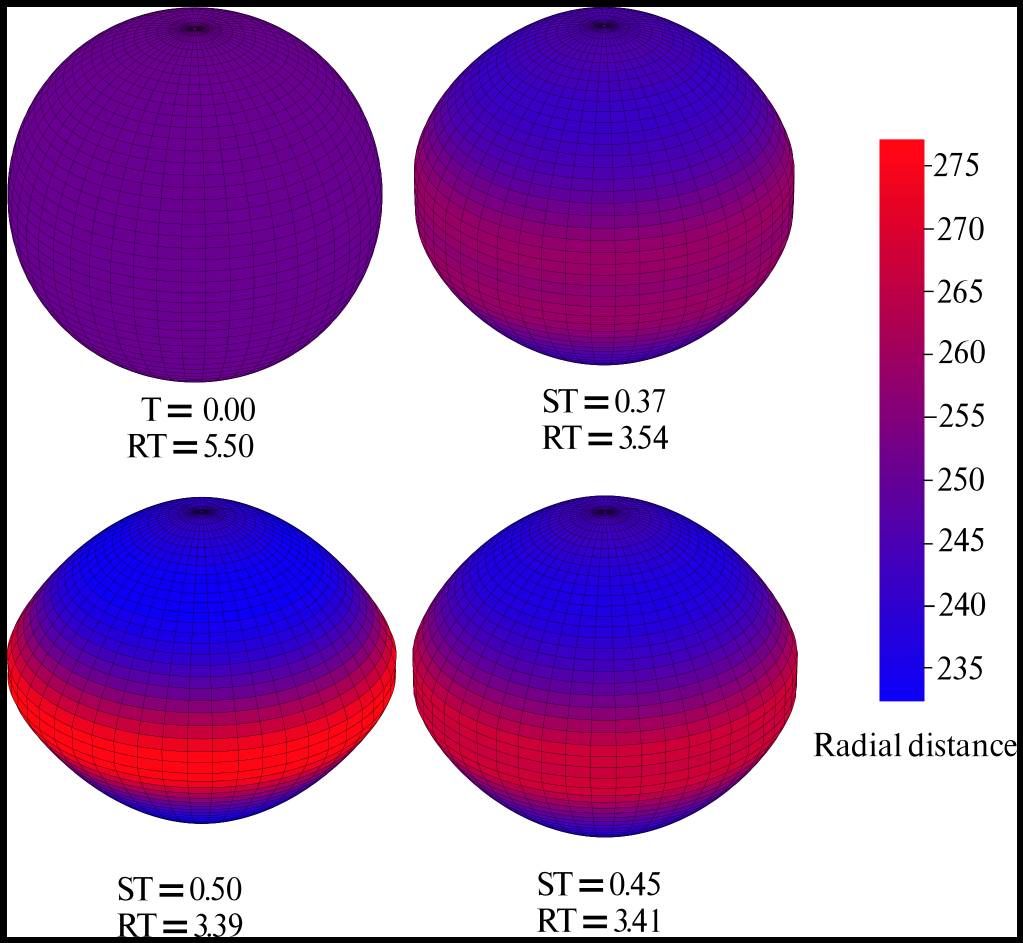
Figure 1 illustrates the shape evolution of an initially spherical asteroid. Under the influence of a spin-increasing YORP torque, impact-induced landslides drive gradual surface reshaping, causing the asteroid to slowly transform into a top-like shape.

Figure 1: The evolution of shape of an initially spherical asteroid. ST is the simulation time and RT is the rotational time period. Radial distance is the distance of the point from the center of the sphere.

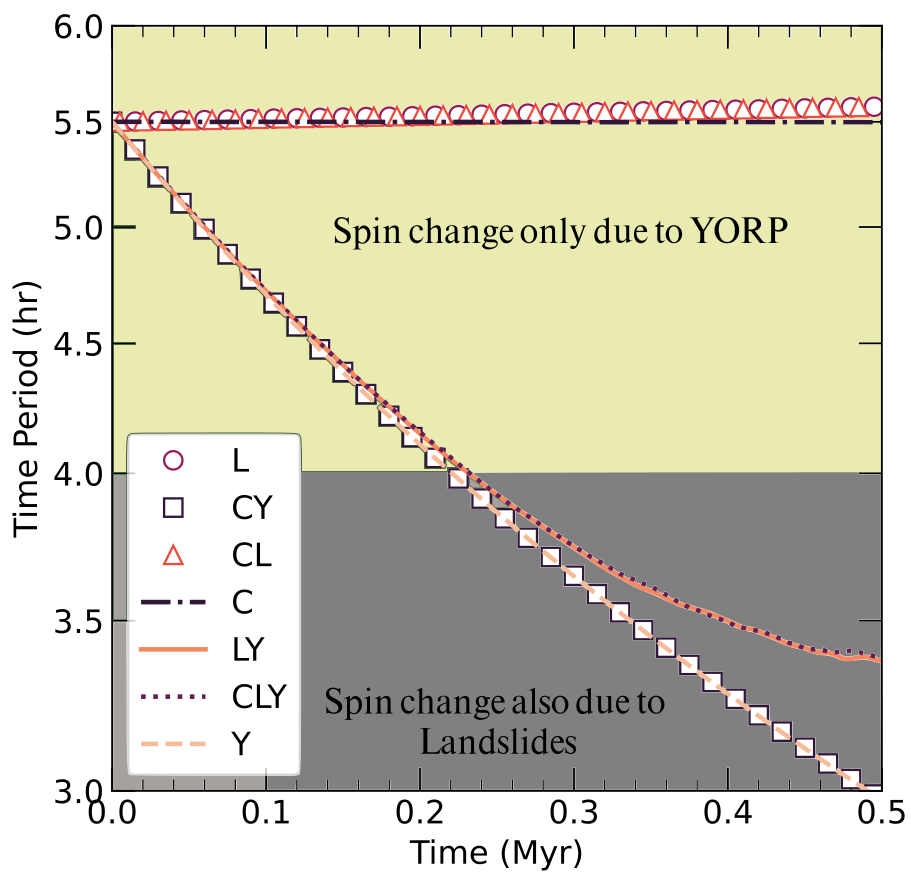
The effects on spin change due to various active processes are shown in Fig. 2. shows the spin change when different processes were considered such as  collision (C), YORP torque (Y) and surface landslides (L). We found that the impact induced landslides can contribute to spin change only at high rotation rates (or small rotation periods).

Figure 2: Spin evolution resulting from collisions (C), YORP torque (Y), and surface landslides (L), with all possible combinations of these processes illustrated

Non-axisymmetric landslides

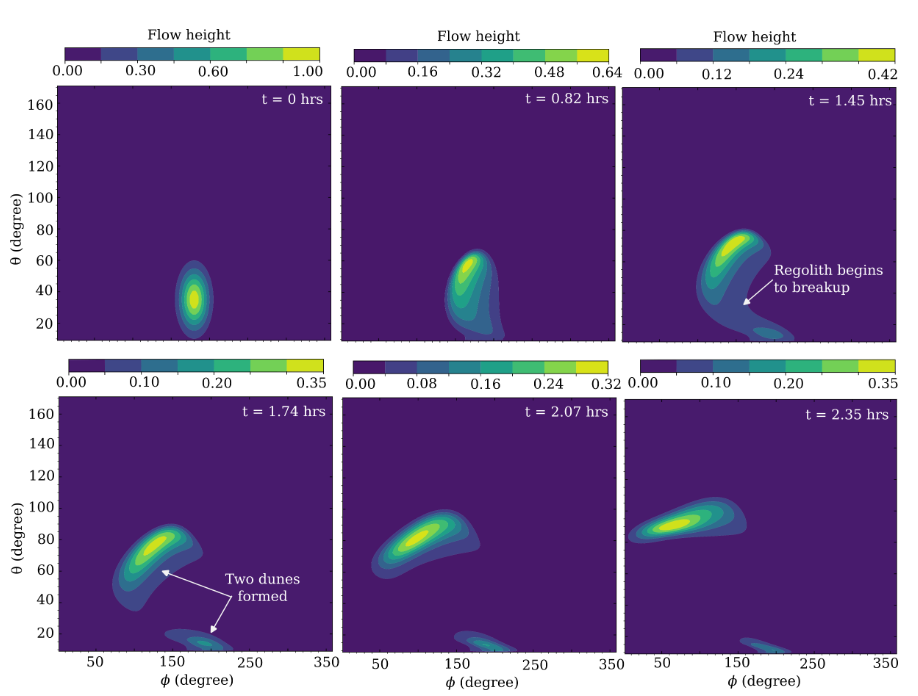
Non-axisymmetric regional scale landslides represent a more realistic scenario. On a fast rotating asteroid, the Coriolis force will dominate the regolith migration. To illustrate this, the slumping of an idealized Gaussian dune on a frictionless spherical asteroid is shown in Fig. 3. In the absence of rotation the dune should slump gradually and its peak remains at the same spot, as gravity is normal to the surface. However, due to rotation, the centrifugal force moves the peak towards the equator while the Coriolis force moves it westward. As the dune reaches the equator, it slows down and begins spreading in the azimuthal direction.

Figure 3: The slumping of a Gaussian dune on a frictionless spherical asteroid. θ is the meridional direction and Φ is the azimuthal direction.

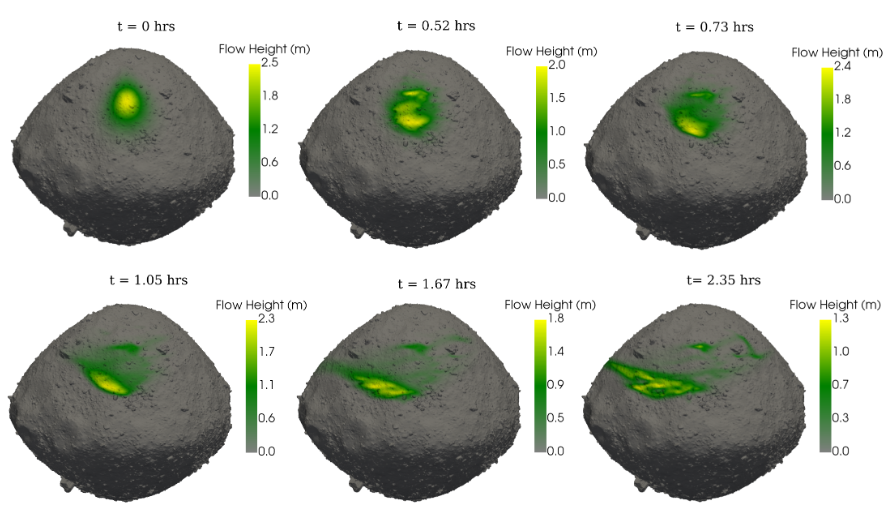
Finally, we simulate dune slumping on a Bennu-shaped asteroid rotating with a short period of 3.4 hours, as shown in Figure 4. Our results show that the regolith does not reach the equator. The prominent equatorial bulge of Bennu acts as a barrier, hindering the material’s movement toward the equator. At such high rotation rates, some of the material begins to lift off the surface and enter orbit

Figure 4: The slumping of a dune on a Bennu-shaped body.

Conclusion

We introduce a framework for analyzing regolith motion on asteroid surfaces, incorporating various active processes affecting the body. We demonstrate its application in an idealized scenario involving axisymmetric regolith flow and find that such motion becomes prominent at high rotation rates, significantly influencing the spin and shape of small planetary bodies. The framework is then extended to model dune slumping in non-axisymmetric cases, including asteroids with shapes similar to Bennu.


How to cite: Gaurav, K. and Sharma, I.: Regolith dynamics and long term surface evolution on asteroids, EPSC-DPS Joint Meeting 2025, Helsinki, Finland, 7–13 Sep 2025, EPSC-DPS2025-1810, https://doi.org/10.5194/epsc-dps2025-1810, 2025.

17:18–17:30
|
EPSC-DPS2025-266
|
ECP
|
On-site presentation
Nóra Takács, Csaba Kiss, Róbert Szakáts, Emese Plachy, Csilla E. Kalup, Gyula M. Szabó, László Molnár, Krisztián Sárneczky, Róbert Szabó, Attila Bódi, and András Pál

The rotational characteristics of small bodies in the Solar System serve as critical constraints on their internal structure, composition, and collisional evolution[1,2]. The break-up rotation rate of asteroids defines an upper bound on their bulk density or necessary cohesion if they are to remain gravitationally bound. While most medium-sized Hilda and Jovian Trojan asteroids exhibit relatively slow rotation, recent observations with the Transiting Exoplanet Survey Satellite (TESS) reveal a handful of exceptions that stretch the boundaries.
We present the discovery and analysis of the three fastest-spinning Hilda asteroids and the three fastest-spinning Jovian Trojans identified. These findings provide new constraints on the bulk densities and required cohesion for structural integrity in these populations.

Our analysis is based on TESS photometric light curves processed using refined techniques for asteroid photometry, including adaptive aperture photometry and correction for systematics and background contamination[3]. For all targets, rotation periods were confirmed using Lomb-Scargle periodograms and Fourier series fits, with additional validation from Zwicky Transient Facility (ZTF) data when available. Physical parameters were derived assuming triaxial ellipsoid shapes, with estimates of cohesion based on the Drucker–Prager failure criterion.

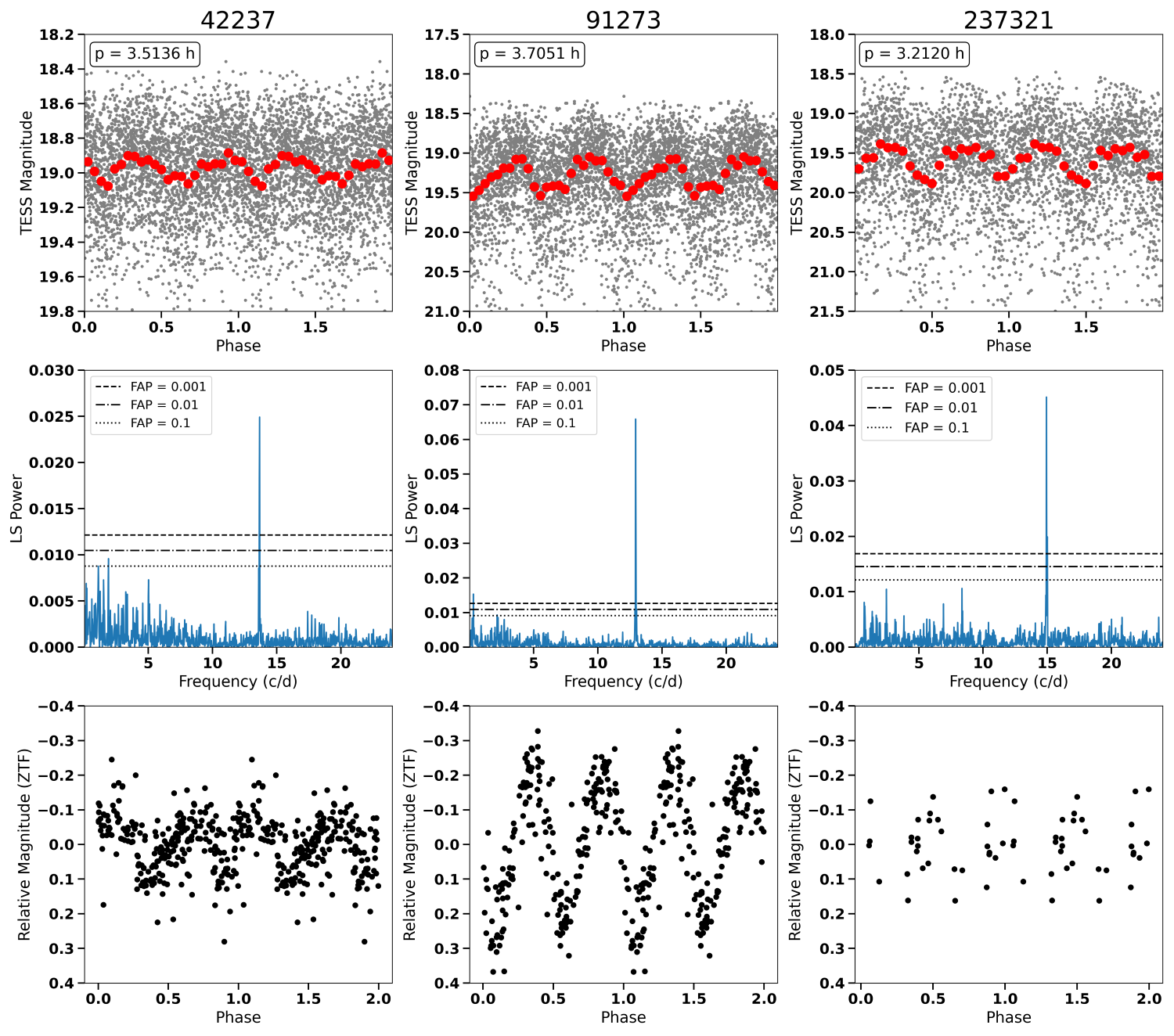
Among Hildas, we identified three asteroids — (42237), (91273), and (237321) — with rotation periods in the 3.2–3.7 hour range, well below the previously established ~5-hour threshold for this population. Two additional fast rotators from the K2 mission were reanalysed using TESS data. These objects exhibit light curve amplitudes between 0.2 and 0.5 mag and diameters ranging from 7 to 19 km. The implied densities, assuming a strengthless structure, span 1.1–1.9 g/cm³. For the largest asteroid in the sample, cohesion of ~1–3 kPa is required for densities below 1.5 g/cm³.


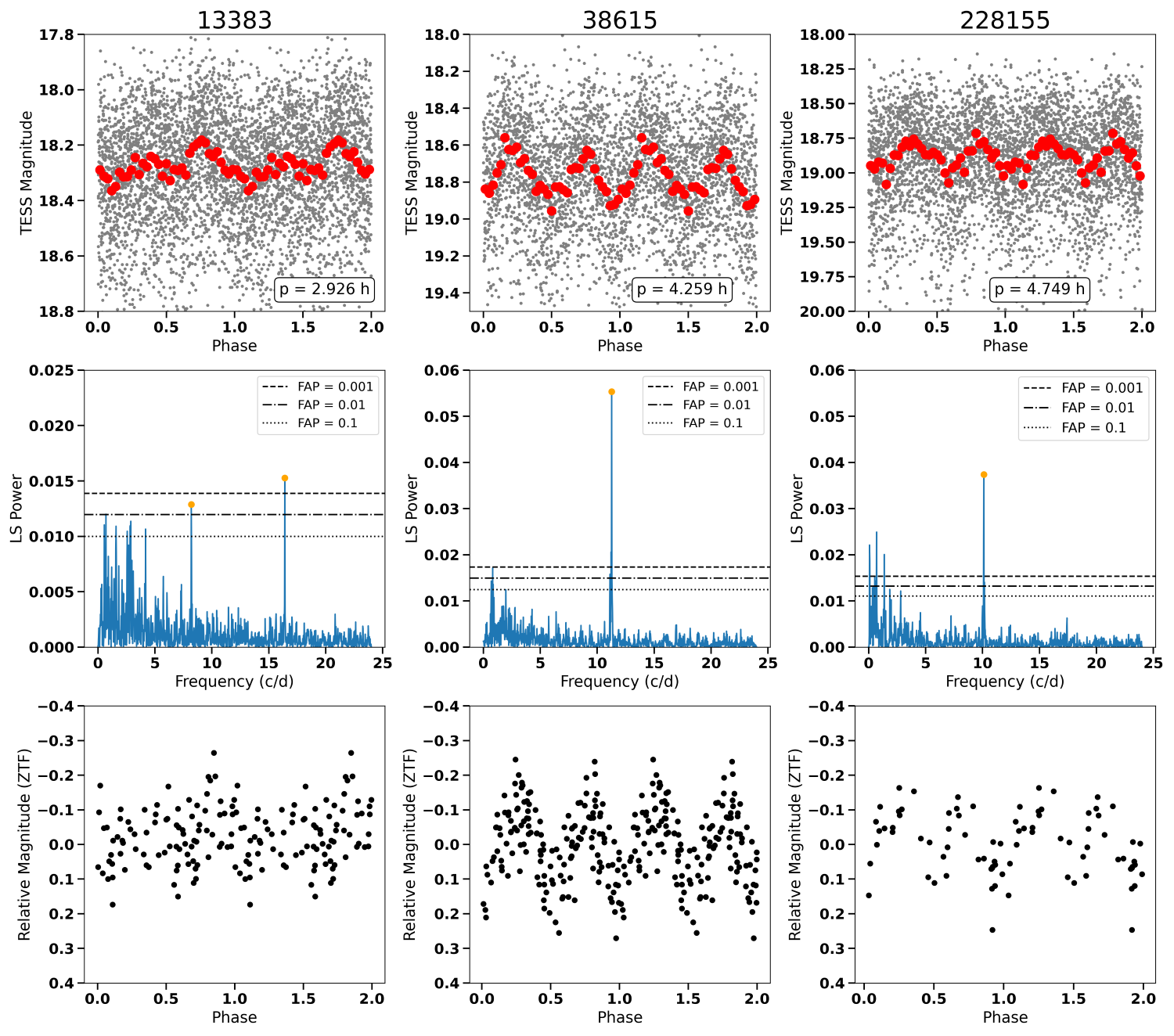
Figure 1. Folded TESS light curves and corresponding rotational frequency spectra for the three fast-rotating Hilda asteroids on the left three panels and the three fast-rotating Jovian Trojan asteroids on the right three panels. Top panels: phase-folded light curves using the derived rotation periods, with observations binned into 24, 26, and 22 bins for (42237), (91273), and (237321), respectively and with 36 phase bins in the case of (13383), (38615), and (228155). Middle panels: Lomb-Scargle power spectra with dashed lines indicating false alarm probability levels. Bottom panels: independent light curves from ZTF, folded with the same rotation periods for comparison.

For Jovian Trojans, we report fast rotation in three ~15–24 km bodies: (13383), (38615), and (228155), with periods of 2.926, 4.259, and 4.749 hours, respectively[4]. Notably, (13383) rotates significantly faster than the nominal ~5-hour breakup limit for Trojans, requiring a density of ~1.6 g/cm³ or cohesion exceeding several kPa. The other two Trojans imply lower critical densities (~0.7–0.8 g/cm³), consistent with the traditionally assumed porous, icy rubble-pile structures.

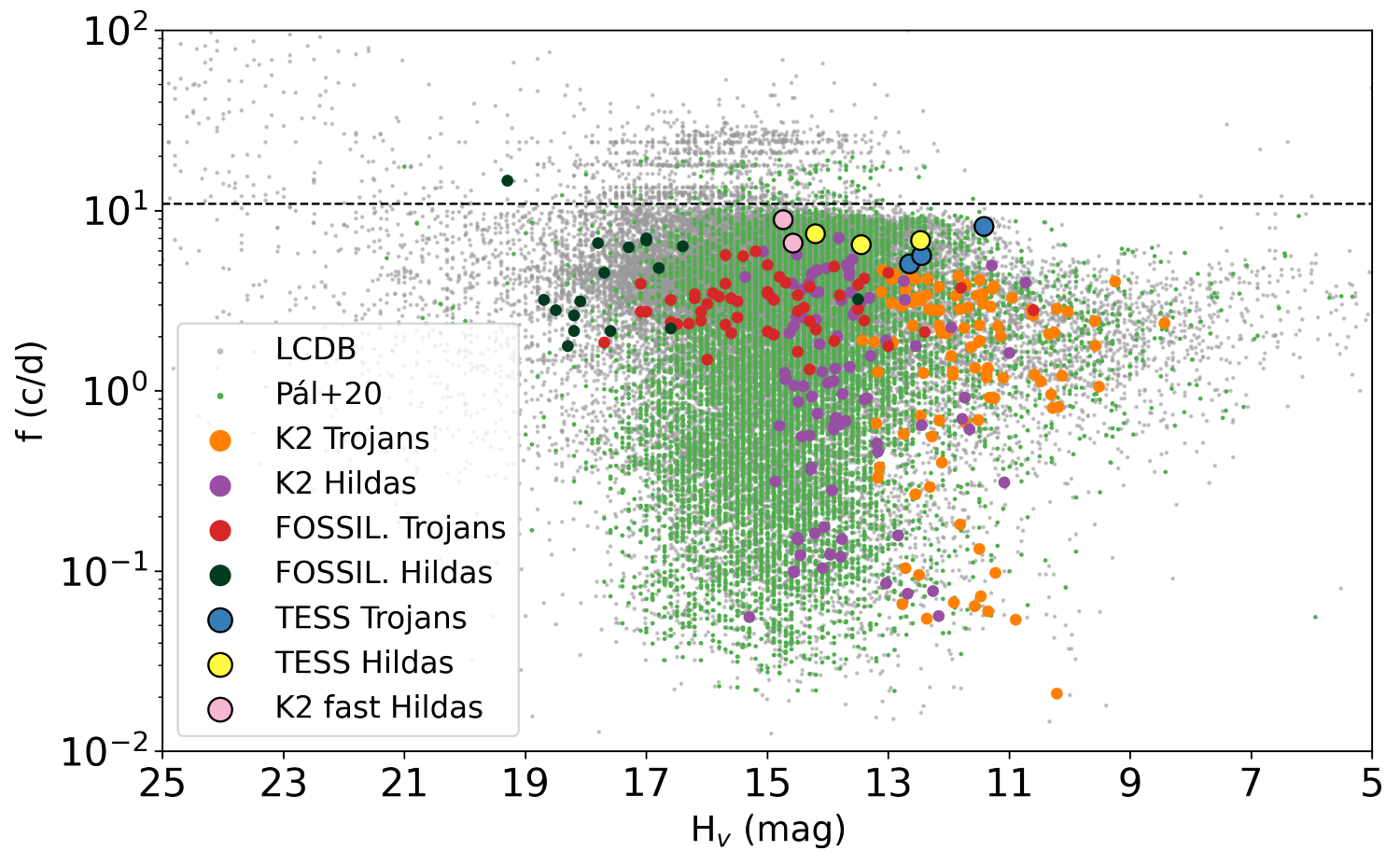
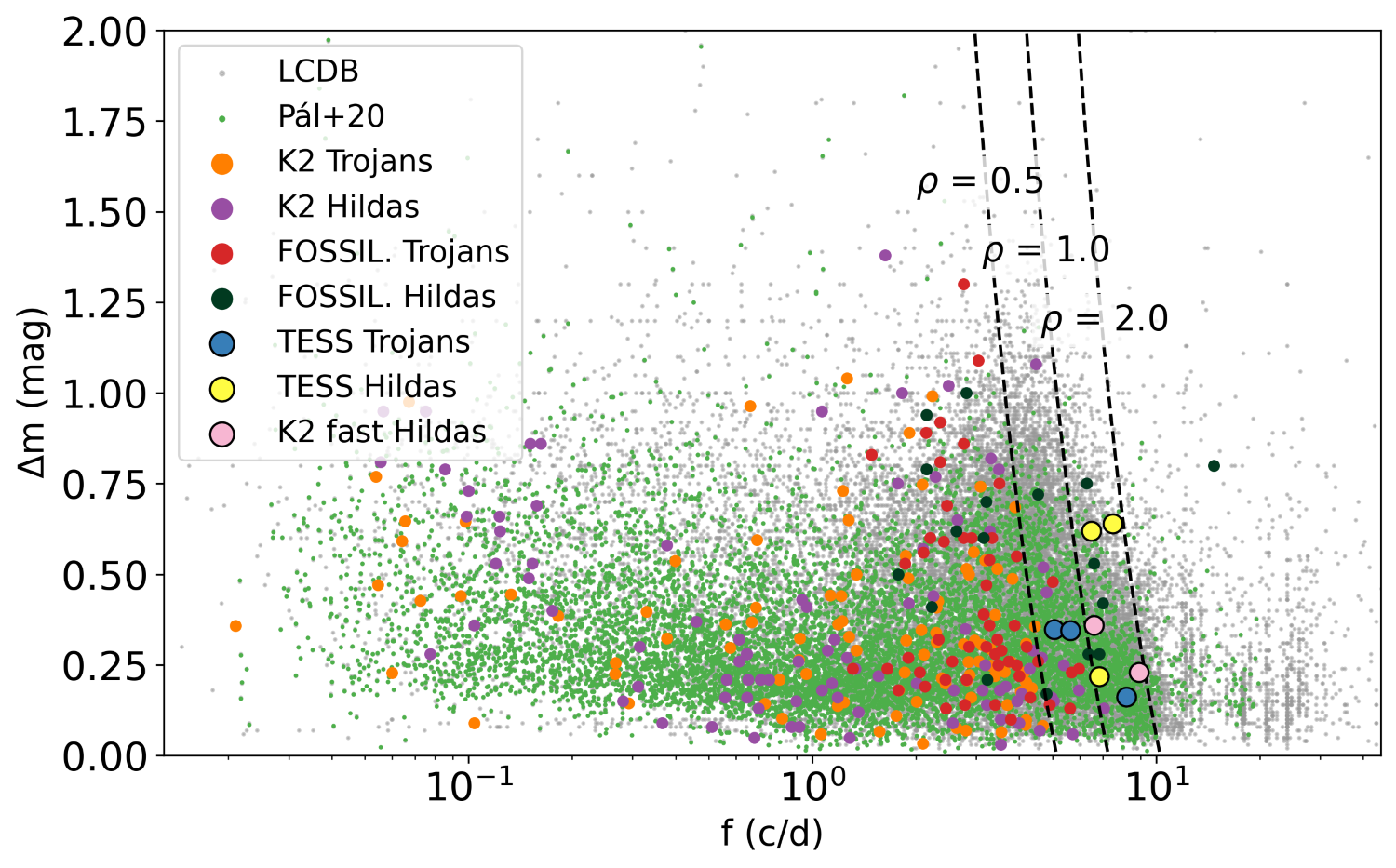
The obtained rotation periods and the derived densities are presented in Fig. 1, together with data from large databases, including Jovian Trojans and Hildas from the K2 mission, and the FOSSIL survey.

Figure 2. Rotational properties of inner Solar System asteroids. The top panel shows rotational frequency versus absolute magnitude, with the dashed horizontal line indicating the traditional rotational breakup limit corresponding to a 2.2 hours of period. The bottom panel plots light curve amplitude against rotational frequency, with dashed curves representing lines of constant critical density. Colored points denote asteroids from various observational surveys. The three Hilda asteroids are shown as large yellow symbols, the fast-spinning Jovian Trojans are highlighted in blue and pink symbols represent two previously known fast-rotating Hildas from the K2 mission.

The occurrence of fast rotators among Hildas (~1\%) is notably higher than among Jovian Trojans, possibly reflecting a higher fraction of denser C-type asteroids within the Hilda population. A two-component Maxwellian distribution model incorporating a fast-rotating C-type subpopulation among Hildas supports this interpretation. In contrast, most Jovian Trojans are D-types with lower densities and porosities that preclude such fast spins without significant internal strength.

The extreme spin rate of (13383), paired with its relatively high albedo (~0.11), may indicate a collisional spin-up event that exposed bright material at the surface. This, along with its elevated density requirement, challenges the notion that all Jovian Trojans are loosely bound, low-density remnants of the outer Solar System.

Our results expand the known rotational parameter space of both Hilda and Jovian Trojan asteroid populations. These fast-spinning objects provide rare insights into the material properties and evolutionary histories of small Solar System bodies beyond the main belt. Continued TESS monitoring and complementary surveys (e.g., ZTF, LSST) will be essential for building statistically meaningful samples of fast rotators in resonant populations.

References:

[1] Mottola, S., Britt, D. T., Brown, M. E., et al. 2024, Space Sci. Rev., 220, 17

[2] Vokrouhlický, D., Nesvorný, D., Brož, M., et al. 2025, arXiv e-prints, arXiv:2503.04403

[3] Takács N., Kiss C., Szakáts R., Pál A., 2025, PASP, 137, 044401

[4] Kiss, C., Takács, N., Kalup, C. E., et al. 2025, A\&A, 694, L17


How to cite: Takács, N., Kiss, C., Szakáts, R., Plachy, E., Kalup, C. E., Szabó, G. M., Molnár, L., Sárneczky, K., Szabó, R., Bódi, A., and Pál, A.: Probing Internal Structure Through Extremes: The Fastest Rotators Among Hilda and Jovian Trojan Asteroids, EPSC-DPS Joint Meeting 2025, Helsinki, Finland, 7–13 Sep 2025, EPSC-DPS2025-266, https://doi.org/10.5194/epsc-dps2025-266, 2025.

17:30–17:42
|
EPSC-DPS2025-123
|
On-site presentation
Antoine Choukroun, Anna Marciniak, Josef Durech, and Julia Perła

Context

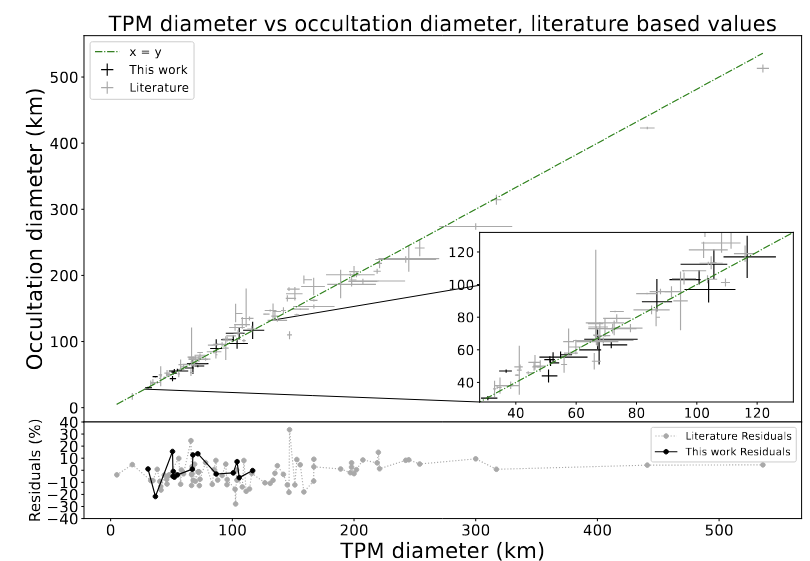
Reliable asteroid diameters underpin accurate studies on other topics like determination of the density. Traditional diameter estimates—often based on simplistic spherical models or/and on data of lower quality, can differ by tens of percent in the literature, propagating into density uncertainties exceeding 90%. On the other hand, the convex inversion thermophysical model (CITPM) (see Durech et al. 2017) is an advanced thermophysical model that simultaneously fits lightcurves and thermal-infrared data enabling precise size determination.

Aim

We aim to demonstrate that CITPM alone can yield main-belt asteroid diameters with precision comparable to multichord stellar occultations. Our goal is to determine diameters of fifteen slowly rotating, low-amplitude asteroids using CITPM, and to validate these results against occultation-based values (see our poster from Marciniak et al. for full details on occultations).

Methods

Starting from dense, multi-apparition lightcurves, we derive convex 3D shape and spin models via lightcurve inversion (see Kaasalainen, Torppa 2001, Kaasalainen et al. 2001). These models feed directly into CITPM, which optimizes shape parameters together with thermal inertia, albedo, surface roughness and diameter by fitting both visible and infrared datasets. We then compare our CITPM diameters to diameters determined by occultations (see Marciniak et al. poster) and to literature values, quantifying agreement and demonstrating CITPM standalone accuracy.

Results


For all fifteen targets, CITPM-derived diameters agree with occultation-based values to within 5%. Overall, CITPM residuals relative to occultations are smaller than those found in the literature, underscoring the advantage of simultaneous lightcurve–thermal fitting. Moreover, CITPM rely solely on photometry and thermal-IR measurements. This validates CITPM as a powerful, widely applicable tool for future large-scale asteroid size surveys. All results from this work can be found in Choukroun et al. (accepted for publication in Astronomy & Astrophysics).

Figure 1: Representation of diameters from TPMs on the x-axis and diameters from occultations on the y-axis. Grey points correspond to values from the literature, while black points represent values from this work. The green line corresponds to y = x.

Acknowledgement

This work was supported by the grant 2020/39/O/ST9/00713 funded by National Science Centre, Poland.

References

Choukroun, A., Marciniak, A., Durech, J., et al., accepted to A&A
Durech, J., Delbo., M., Carry, B., Hanuš, J., & Alí-Lagoa, V. 2017, A&A, 604, A27
Kaasalainen, M. & Torppa, J. 2001, Icarus, 153, 24
Kaasalainen, M., Torppa, J., & Muinonen, K. 2001, Icarus, 153, 37


How to cite: Choukroun, A., Marciniak, A., Durech, J., and Perła, J.: Asteroid sizes determined with thermophysical model, EPSC-DPS Joint Meeting 2025, Helsinki, Finland, 7–13 Sep 2025, EPSC-DPS2025-123, https://doi.org/10.5194/epsc-dps2025-123, 2025.

17:42–17:54
|
EPSC-DPS2025-197
|
On-site presentation
Yuri Skorov, Sergey Krasilnikov, Yiingqi Xin, Bo Wu, and Jürgen Blum

The temporary exposure of volatiles on comet 67P/Churyumov-Gerasimenko, driven by sublimation-induced erosion, has been extensively discussed in previous studies. Bright spots observed on the surface have been attributed to the appearance of water ice [1, 2, 3]. These ice exposures, or bright features, were detected in optical OSIRIS/NavCam images through time-series analysis, appearing as high-albedo spots in several geomorphological regions. Temperature and spectral analyses of data from the VIRTIS-M instrument further confirmed the presence of water ice. Subsequent research [4] revealed a broad spatial distribution of these bright features. Notably, surface exposure of volatiles is not unique to 67P but has also been observed on other comets, such as 9P/Tempel 1 [5].

The formation of these bright spots on the surface of 67P may be the result of sublimation-driven erosion, likely involving subsurface volatiles. Mapping studies [4] and our own findings suggest a concentration of bright spots in the equatorial region, with a slight shift towards the southern hemisphere. These spots are predominantly located in rugged terrains with consolidated material. Additionally, the locations of faint jet outbursts and previously detected jets near the perihelion may be associated with some of these bright spots.

Albedo variation, a key parameter for detecting bright spots, was analyzed using the single-scattering albedo derived from the radiance factor and illumination data from OSIRIS images. By applying the algorithm from [6] and the Hapke reflectance model, we were able to extract albedo variations, revealing local discrepancies between the target features and the surrounding surface. Time-series analysis of the OSIRIS dataset confirmed the presence of numerous bright spots, supporting the hypothesis that these features result from sublimation-driven erosion, although the underlying physical processes may vary.

In our study, we focus on the microphysical processes that could lead to temporary increases in surface brightness. We introduce a novel heat transfer model for the near-surface layer, grounded in the medium’s microphysical properties [7]. This model consistently accounts for various heat transfer mechanisms, the permeability of the crust to gas flow, and other relevant factors. For the first time, we propose an evolving layer model that predicts the 'oscillating' behavior of the crust, where phases of accumulation (thickening) and discharge alternate repetitively.

In addition to the above model, we also examine the evolutionary model [8], which investigates the erosion of a heterogeneous layer composed of small ice particles and dust. This model introduces a unique approach to describing the evolution of such a mixture, providing estimates for both the removal of dust particles—while preserving exposed ice regions—and the formation of a temporary dry crust.

The computational experiments performed in our study allow for a comparison between the lifetime of bright spots and observational data. This provides us with quantitative constraints on the microscopic properties of the near-surface material.

References: [1] Pommerol A et al. (2015) A&A, 583, A25. [2] Barucci M. A. et al. (2016) A&A, 595, A102. [3] Filacchione G. et al. (2016a) Nature, 592, 7586, 268-372. [4] Deshapriya J. D.P. et al. (2018) A&A, 613, A36. [5] Sunshine J. M. et al. (2006) Science, 311, 5766, 1453-1455. [6] Davidsson B. J. R. et al. (2022) MNRAS, 516, 4, 5125-5142. [7] Xin Y. et al. (2025), A&A, 693, A123. [8] Schuckart , C. and J. Blum (2025) A&A, DOI: https://doi.org/10.1051/0004-6361/202553750

How to cite: Skorov, Y., Krasilnikov, S., Xin, Y., Wu, B., and Blum, J.: Albedo Variations and Bright Spot Formation on Comet 67P: Microphysical Scenarios, EPSC-DPS Joint Meeting 2025, Helsinki, Finland, 7–13 Sep 2025, EPSC-DPS2025-197, https://doi.org/10.5194/epsc-dps2025-197, 2025.

17:54–18:06
|
EPSC-DPS2025-546
|
On-site presentation
Duncan Lyster, Carly Howett, John Spencer, Joshua Emery, Benjamin Byron, Philip Christensen, Victoria Hamilton, and The Lucy Team

Introduction: The Lucy mission's first asteroid flyby provided a unique and unexpected opportunity to study a binary asteroid system up close. Originally expected to encounter a single target, Dinkinesh, the discovery of its small, tidally locked moon, Selam, introduced additional opportunity and complexity to the interpreting flyby observations [1]. We present thermal modelling of the binary system, quantifying how the presence of Selam influenced radiance measurements and indicating its possible impact on thermal inertia estimates. Thermal inertia (TI) offers insight into surface properties such as grain size and regolith structure. Determining the TI of Dinkinesh adds to our understanding of small S-type asteroids and enables comparison within a binary, potentially revealing differences driven by tidal effects or surface evolution.

Methods: We modelled the flyby geometry and instrument measurements using the new TESBY (Thermal Emissions Spectrometer flyBY) module of TEMPEST (the Thermophysical Equilibrium Model for Planetary Environment Surface Temperatures) [2] to simulate the thermal radiance of both bodies and assess their combined effect on interpretation of data from the Lucy Thermal Emission Spectrometer (L’TES) instrument [3].

The Thermal Model: Dinkinesh and its satellite, Selam, were modelled in TEMPEST. A stereo-photogrammetric shape model is available for the primary target – Dinkinesh [4], with ~2 m lateral and ~0.5 m vertical resolution, covering ~60% of the surface. This shape model was downsampled to a dimensionally accurate model with 1266 facets with a resolution of ~35 m. A sphere of representative diameter (230 m [1]) was used for the satellite Selam.

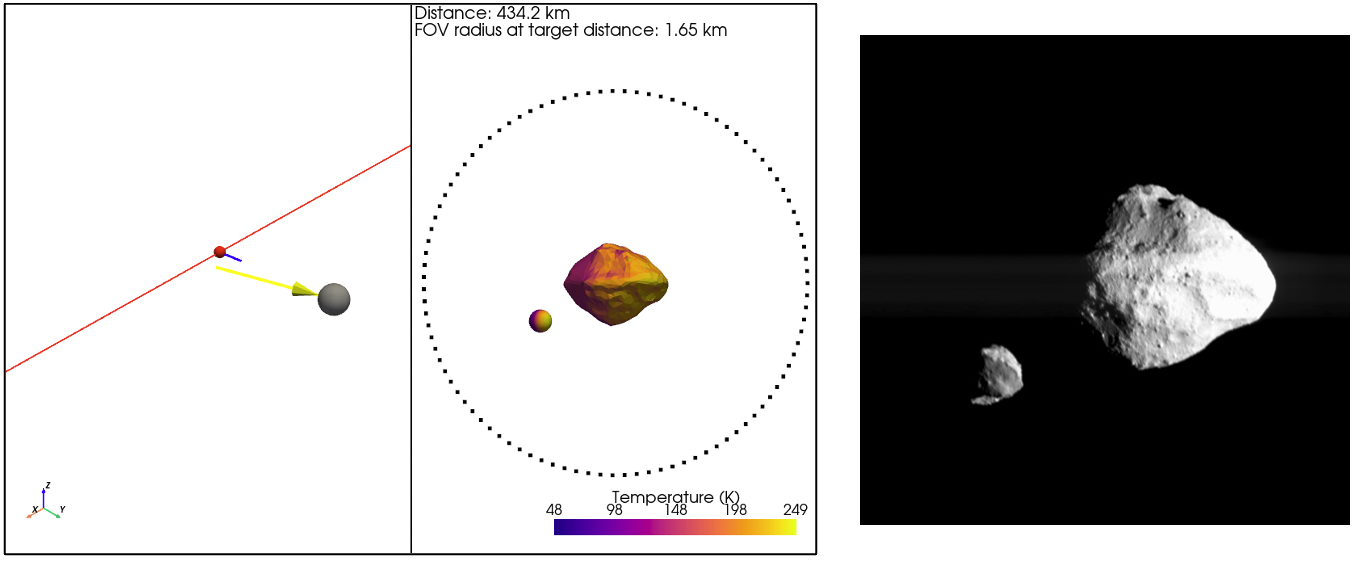
Figure 1: TESBY visualization of flyby. Global view of the flyby trajectory (left), and the FOV of the instrument (centre), with corresponding L’LORRI image for comparison [1] taken 0.54 minutes before closest approach (right). Input is the TEMPEST [5] result for the shape model of Dinkinesh, and representative diameter sphere for Selam. Parameters used: solar distance = 2.19 AU, rotation periods = 3.74 hours (Dinkinesh) and 52.7 hours (Selam) [1] thermal inertia (provisional) = 40 J m-2 s-1/2 K-1, geometric albedo = 0.27

Flyby geometry: Building on the TEMPEST framework, the TESBY module is given the geometry information for the flyby and the thermal data from TEMPEST. Based on the 7.3 mrad Field-of-View (FOV) of the L’TES instrument [3] TESBY produces simulated radiance measurements by computing a weighted sum of blackbody curves from each visible facet, based on its temperature, projected area, and emission angle. Matching these modelled radiances to the instrument data allows us to fit for the thermal inertia of the asteroid. A complicating factor in this study is that the sensitivity of L’TES is not uniform across its FOV, including this effect in the model is the subject of ongoing work.

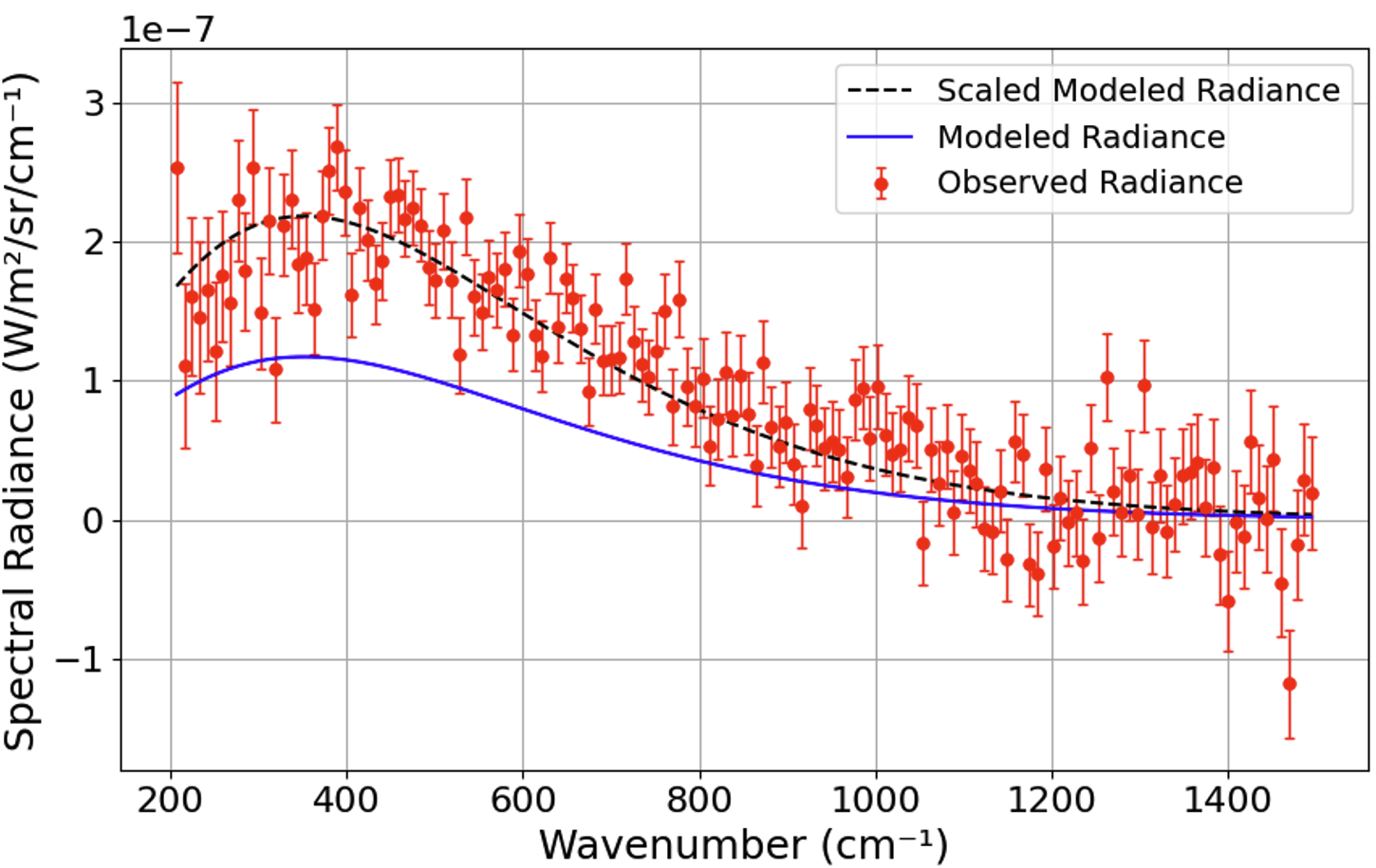
Figure 2: Preliminary modelled radiance results (blue line) compared to L’TES observation (red) using the same model settings as Fig. 1. Scaled radiances (dotted line) are also provided (see main text for more information).

Results: An example of the currently predicted model radiance is given by Figure 2. As it shows, there is a notable offset between the predicted and observed radiances. Accounting for the position of the targets in the L’TES FOV is expected to resolve the observed discrepancy in absolute radiance levels. However, as the scaled model shows, the predicted radiances are able to capture the shape of the L’TES radiance.

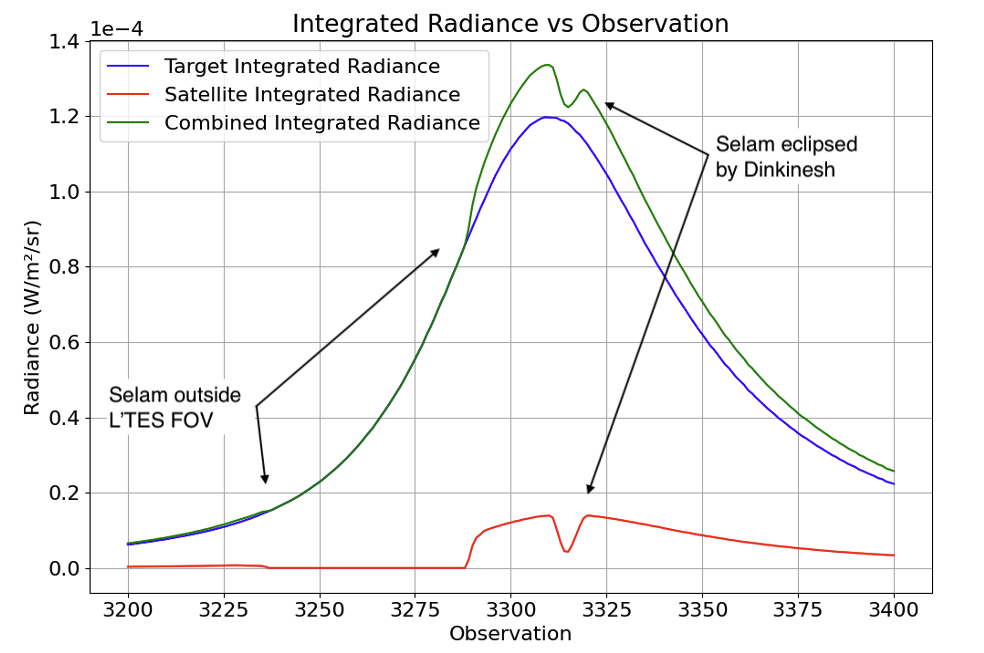
We find that due to the slower rotation rate of Selam, the maximum surface temperatures on the satellite can be as much as 25 K higher than those on Dinkinesh (Fig. 1), meaning that despite the small size (lobe diameter of only 230 m, compared with 790 m for Dinkinesh [1]), the contribution to measured radiance is significant. This effect is highlighted by investigation of the integrated radiances of the targets throughout the flyby (Fig. 3), where the entry and exit of Selam within the FOV is visible, as well as the dip in integrated radiance while Selam is partially eclipsed by Dinkinesh. Our results demonstrate the importance of considering the full system in flyby analysis, informing techniques for similar encounters in the future. This work highlights how the thermal signature of even a small secondary body can significantly impact observations, shaping our understanding of asteroid surface properties and thermal environments.

Continued analysis will focus on the use of TEMPEST/TESBY to constrain the thermal inertia of this binary asteroid from L’TES flyby observations.


Figure 3: Variation in integrated wavelength for Dinkinesh (target, blue), Selam (satellite, red) and combined effect (green). Radiances were integrated over the 200–1500 cm⁻¹ spectral range. The results show that despite its small size, Selam makes a significant difference to the spectral radiance, particularly at shorter wavelengths. The dip in combined spectral radiance at observations 3315-3320 is due to Selam being eclipsed by Dinkinesh.

The thermal model code is open source and available at: github.com/duncanLyster/TEMPEST/

Acknowledgement: This work was made possible by support from the UK Science and Technology Facilities Council.  

References:

[1] Levison, H.F., Marchi, S., Noll, K.S. et al. A contact binary satellite of the asteroid (152830) Dinkinesh. Nature 629, 1015–1020 (2024).

[2] Lyster, D., Howett, C., & Penn, J. (2024). Predicting surface temperatures on airless bodies: An open-source Python tool. EPSC Abstracts, 18, EPSC2024-1121.

[3] Christensen, P. R., et al. The Lucy Thermal Emission Spectrometer (L’TES) Instrument, Space Sci. Rev. (2023)

[4] Preusker, F. et al. (2024). Shape Model of Asteroid (152830) Dinkinesh from Photogrammetric Analysis of Lucy’s Frame Camera L’LORRI. 55th Lunar and Planetary Science Conference, Abstract #1903.

[5] Lyster, D., Howett, C., & Penn, J. (2025). TEMPEST: A Modular Thermophysical Model for Airless Bodies with Support for Surface Roughness and Non-Periodic Heating. Submitted to EPSC Abstracts, 2025

How to cite: Lyster, D., Howett, C., Spencer, J., Emery, J., Byron, B., Christensen, P., Hamilton, V., and Lucy Team, T.: Thermal Modelling of the Flyby of Binary Main Belt Asteroid (152830) Dinkinesh by NASA’s Lucy Mission, EPSC-DPS Joint Meeting 2025, Helsinki, Finland, 7–13 Sep 2025, EPSC-DPS2025-546, https://doi.org/10.5194/epsc-dps2025-546, 2025.

18:06–18:18
|
EPSC-DPS2025-274
|
ECP
|
On-site presentation
Lakshika Palamakumbure and Tomáš Kohout

Introduction: Near-Earth asteroids (NEAs) like Itokawa and Eros provide invaluable insights into the collisional and surface evolution of the inner solar system. These bodies, classified as S-type asteroids, are particularly abundant in the inner asteroid belt and are believed to retain signatures of collisional events that have shaped their surfaces over time. Once exposed, these surfaces undergo space weathering (SW), a gradual alteration process caused primarily by solar wind irradiation and micrometeorite bombardment. Since the progression of SW is time-dependent, it offers a means of estimating the surface exposure age of an asteroid following a resurfacing event. Determining the SW age of NEAs like Itokawa and Eros can thus provide critical constraints on their geologic history, regolith dynamics, and collisional evolution.

Aim: This study aims to estimate the surface exposure ages of Itokawa and Eros by analyzing their reflectance spectra using a machine learning approach that captures the spectral alterations due to SW.

Methods: We employed an ensemble machine learning model, trained on laboratory reflectance spectra of irradiated silicate samples. These samples, comprising olivine, pyroxene, olivine-pyroxene mixtures, and chondritic meteorites, simulate the mineralogy typically found on S-type asteroid surfaces. Spectral data were sourced from the Reflectance Experiment Laboratory (RELAB), published literature, and direct contributions from authors.

The model’s inputs included reflectance spectra and corresponding SW conditions (micrometeorite impact dose and solar wind flux), while the output was the exposure time at 1 AU. Itokawa's surface-resolved spectral data were acquired by the Near Infrared Spectrometer (NIRS) aboard the Hayabusa spacecraft (Abe et al. 2011). Eros data were obtained by the Near-Infrared Spectrometer (NIS) on the NEAR Shoemaker spacecraft (Warren et al. 1997). All asteroid data were retrieved from the NASA Planetary Data System (PDS). The spectra were interpolated from 820–2080 nm range at 20 nm intervals for Itokawa and 820–2360 nm, at 20 nm intervals for Eros, as required by the model. The model predictions were subsequently corrected for heliocentric distance to reflect actual surface ages.

Results: The surface age estimates for Itokawa range from approximately 2 × 103 to 2 × 109 years (Fig 1). Both solar wind irradiation and micrometeorite impacts contributed to surface alteration, though solar wind effects were found to be more dominant. In contrast, Eros shows evidence of much older surfaces, with estimated surface ages ranging from 4 × 10⁸ to 2 × 10⁹ years (Fig 2), largely driven by micrometeorite impacts. However, the spectral resolution of the Eros dataset was notably lower than that of Itokawa, introducing greater uncertainty in the model’s predictions for Eros.

Discussion and conclusion: The relatively young surface ages of Itokawa (2.8 × 10years) align well with findings from the Hayabusa sample return mission, and other studies, which revealed that the dominating SW agent is solar wind irradiation (Hiroi et al. 2006, Matsumoto et al. 2016, Keller et al. 2016, Burges et al. 2021, Sunho et al. 2022). This supports the hypothesis that Itokawa has undergone frequent resurfacing events, possibly due to regolith migration (Miyamoto eta al. 2007), tidal resurfacing (Binzel et al. 2010), or by seismic shaking (Tsuchiyama et al. 2011). However, our study also reveals that certain regions of Itokawa (e.g., Arcoona) exhibit mature surface ages, dominated by micrometeorite impacts, reaching up to 2 × 10⁹ years, suggesting localized areas of minimal resurfacing and long-term exposure. The mature surface ages for Eros, consistent with previous spectral studies and surface morphology analyses, suggest a mature surface (Mahlke et al. 2022, Korda et al. 2023). Eros appears to lack significant recent resurfacing activity, allowing prolonged micrometeorite bombardment to dominate its SW history. Relatively younger ages can be observed in crater regions. This may be due to the material movement on the crater slope (Mantz et al. 2004) or it may reflect the cratering event age.

The contrasting surface ages and dominant SW processes between Itokawa and Eros underscore the role of asteroid size, orbital dynamics, and regolith properties in governing SW rates. While smaller asteroids like Itokawa are dynamically active and frequently refreshed, larger bodies like Eros tend to preserve ancient surface features. Additionally, Itokawa’s contact binary origin may contribute to more recent reshaping events, which could explain the presence of localized areas with younger surface ages. Our results demonstrate the utility of machine learning in decoding the complex interplay between spectral alteration and exposure history.


Fig 1. Predicted surface age for asteroid Itokawa.


Fig 2. Predicted surface age for asteroid Eros.


Abe et al. 2011 Data set information

Binzel et al. 2010 DOI 10.1038/nature08709

Burges et al. 2021 DOI 10.1111/maps.13692

Hiroi et al. 2006 DOI 10.1038/nature05073

Keller et al. 2016 https://ntrs.nasa.gov/citations/20160002375

Korda et al. 2023 DOI 10.1051/0004-6361/202346290

Mahlke et al. 2022 DOI 10.1051/0004-6361/202243587

Matsumoto et al.2016 DOI 10.1016/j.icarus.2015.05.001

Miyamoto eta al. 2007 DOI 10.1126/science.1134390

Sunho et al. 2022 DOI 10.1051/0004-6361/202244326

Tsuchiyama et al. 2011 DOI 10.1126/science.1207794

Warren et al. 1997 DOI 10.1023/A:1005015719887

How to cite: Palamakumbure, L. and Kohout, T.: Surface age of the asteroids Itokawa and Eros by machine learning., EPSC-DPS Joint Meeting 2025, Helsinki, Finland, 7–13 Sep 2025, EPSC-DPS2025-274, https://doi.org/10.5194/epsc-dps2025-274, 2025.

18:18–18:30
|
EPSC-DPS2025-1479
|
ECP
|
On-site presentation
Duncan Lyster, Carly Howett, and Joseph Penn

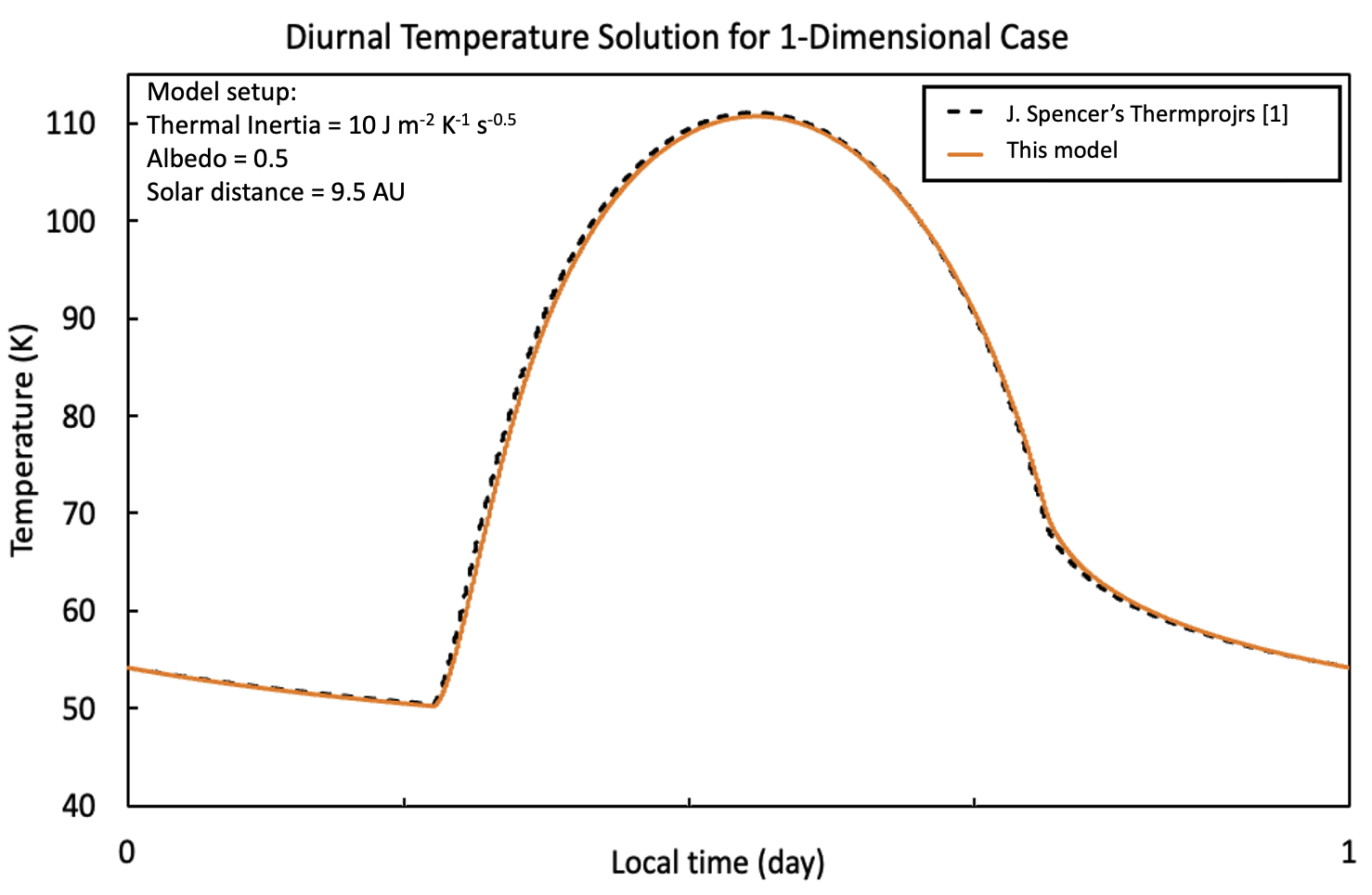
Introduction: Understanding surface temperatures on airless planetary bodies is crucial for interpreting thermal observations and constraining surface properties. We present TEMPEST (Thermal Evolution Model for Planetary Environment Surface Temperatures), a modular, open-source Python model that simulates diurnal and non-periodic thermal evolution on irregular bodies. Unlike traditional 1D periodic solvers, TEMPEST handles transient heating events such as eclipses, non-synchronous rotations such as tumbling asteroids, and seasonal variations. Key capabilities include surface roughness modelling via hemispherical craters, multiple thermal conduction schemes, and modular scattering using lookup tables (LUTs). TEMPEST has been used to analyse data from the Lucy mission and has been validated against the well-established Spencer 1D thermal model, thermprojrs [1].

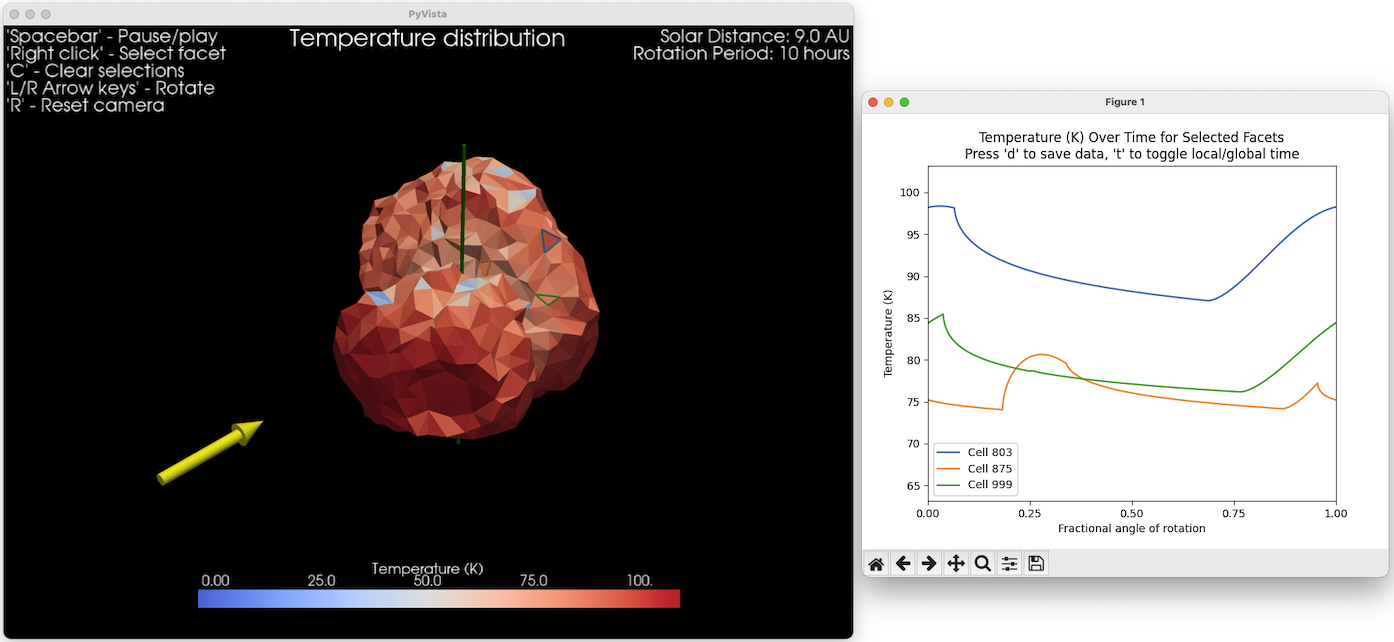
Figure 1: TEMPEST allows the user to select a facet to view any of its time varying properties including insolation, temperature and radiance. The diurnal temperature curves (right) are those of the corresponding outlined facets selected by the user in the interactive pane (left).

Methods: TEMPEST calculates surface temperatures by solving a surface energy balance that includes solar flux, thermal emission, vertical heat conduction, and (optionally) radiative self-heating. Figure 1 shows the user interface once the model has completed a run. Key components include:

  • Thermal solvers: Includes a standard 1D periodic conduction scheme influenced by the widely used thermprojrs [1] and a non-equilibrium solver, designed for better performance and stability in non-periodic cases.
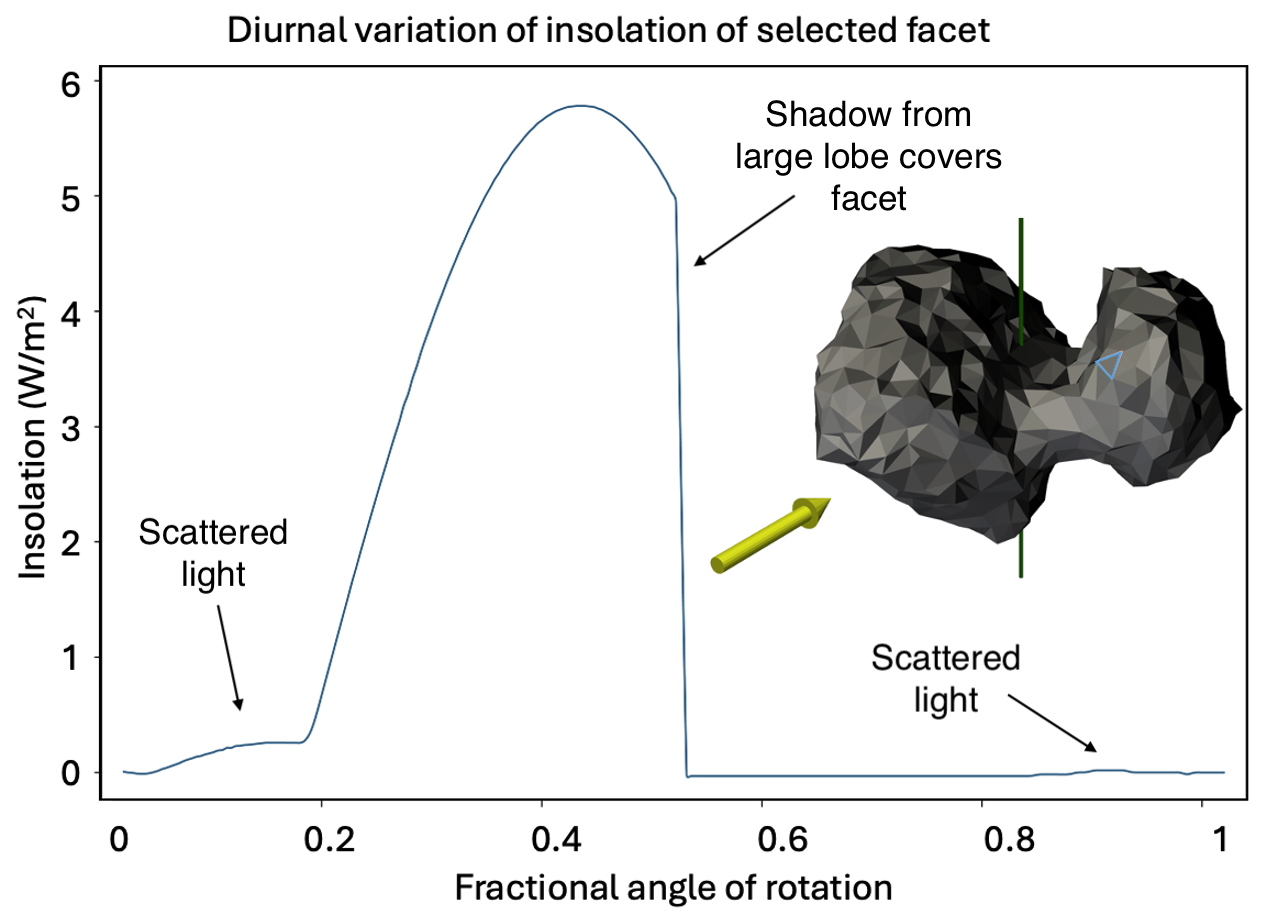
  • Scattering treatments: Utilises precomputed LUTs for various scattering laws (e.g., Lambertian, Lommel-Seeliger). This structure allows users to incorporate empirical bi-directional reflectance function (BRDF) data (e.g., from goniometer measurements of lunar regolith) or test the impact of different scattering assumptions, which can be particularly important for investigating the temperature of shadowed regions, as shown in Figure 2. The modularity also facilitates user modification for specific research needs.
  • Surface roughness: Implemented via hemispherical sub-facet craters with adjustable rim angle to match roughness with a specified RMS slope angle.
  • Non-periodic and time-dependent conditions: Supports time-dependent boundary conditions, including periodic scenarios such as eclipses and seasonal variations due to orbital eccentricity, as well as non-periodic cases including tumbling rotation, endogenic heating, and, or other user-defined transient heating scenarios.

Designed for efficient parallel execution, the model runs effectively on multi-core personal computers and can efficiently simulate shape models with tens of thousands of facets. It has also been deployed on high-performance computing clusters for larger-scale models on the order of 1 million facets. Input configuration files are simple and flexible, allowing integration into larger analysis pipelines.

Figure 2: An example insolation curve from a 1666 facet model of the bilobate comet 67P. The effects of scattered light can be seen either side of the main peak, this is particularly important for permanently shadowed regions. The selected facet is shown with a blue outline; sunlight direction is shown with a yellow arrow.

Results: We validated TEMPEST by comparing temperature time series with Spencer’s 1D model thermprojrs [1] under idealised conditions, showing consistent results – see Figure 3. Applied to high-resolution shape models of 67P/Churyumov-Gerasimenko and 101955 Bennu, the model produces detailed temperature maps that reflect the significant influence of self-shadowing and local geometry, quantifying, for example, the temperature reduction in shadowed craters. Non-periodic simulations have been run to explore rotational transitions and eclipse effects, enabling new modes of comparison with observational datasets. The modular scattering and roughness components offer a powerful way to assess how sub-resolution scale parameters impact apparent thermal inertia and surface radiative behaviour. TEMPEST is already being used to interpret thermal data from recent missions, including Lucy, and can be adapted for upcoming datasets from targets like those of Comet Interceptor and Europa Clipper.

Figure 3: TEMPEST shows good agreement with ‘industry standard’ thermophysical models in 1 dimension.

TEMPEST is open-source and available at:

github.com/duncanLyster/TEMPEST/

Acknowledgement: This work was made possible by support from the UK Science and Technology Facilities Council. 

References:

[1] Spencer, J.R., Lebofsky, L.A., and Sykes, M.V., 1989. Systematic biases in radiometric diameter determinations. Icarus, 78(2), pp.337-354.

[2] Lyster, D., Howett, C., & Penn, J. (2024). Predicting surface temperatures on airless bodies: An open-source Python tool. EPSC Abstracts, 18, EPSC2024-1121.

[3] Lyster, D.G., Howett, C.J.A., Spencer, J.R., Emery, J.P., Byron, B., et al. (2025). Thermal Modelling of the Flyby of Binary Main Belt Asteroid (152830) Dinkinesh by NASA’s Lucy Mission. Submitted to EPSC Abstracts, 2025.

How to cite: Lyster, D., Howett, C., and Penn, J.: TEMPEST: A Modular Thermophysical Model for Airless Bodies with Support for Surface Roughness and Non-Periodic Heating, EPSC-DPS Joint Meeting 2025, Helsinki, Finland, 7–13 Sep 2025, EPSC-DPS2025-1479, https://doi.org/10.5194/epsc-dps2025-1479, 2025.

Orals THU-OB2: Thu, 11 Sep, 09:30–10:30 | Room Jupiter (Hall A)

Chairpersons: Wladimir Neumann, Jürgen Blum, Marco Delbo
N-Body Models and Rotation
09:30–09:42
|
EPSC-DPS2025-1040
|
On-site presentation
Dusan Marceta, Bojan Novakovic, and Marko Gavrilovic

Context

Recently, several asteroids with super-fast rotation rates, ranging from just 10 seconds to a few minutes, have been observed to exhibit significant drift in their semi-major axes, potentially caused by the Yarkovsky effect. Standard analytical models of the Yarkovsky effect suggest that these objects must possess extremely low thermal inertia to produce such strong orbital drift under rapid rotations. However, such low thermal inertia implies specific structural characteristics, such as a fine regolith layer and/or a highly porous internal structure, both of which are challenging to sustain under the intense inertial stresses caused by their extreme rotational rates.

The strong Yarkovsky effect observed under extremely fast rotation can seem counterintuitive. Since existing analytical models of the Yarkovsky effect rely on various assumptions, their applicability to cases of extremely fast rotation, where some of these assumptions may no longer hold, becomes questionable. We aim to evaluate the validity of the analytical models in such scenarios and to determine whether the observed drift in the semi-major axis of rapidly rotating asteroids can be explained by the Yarkovsky effect.

Methods and Model Validation

To test the analytical model’s validity under fast spins, we developed an open-source numerical model of the Yarkovsky effect, tailored to address cases of super-fast rotation. Given that extremely low thermal inertia effectively forms an insulating surface layer, where thermal wave penetration depths can be on the order of microns, the model is designed to deliver high-resolution calculations in both depth and time. This allows for precise modeling of steep spatial and temporal temperature gradients on and beneath the asteroid's surface, which is essential for accurately computing the Yarkovsky drift in scenarios involving super-fast rotation.

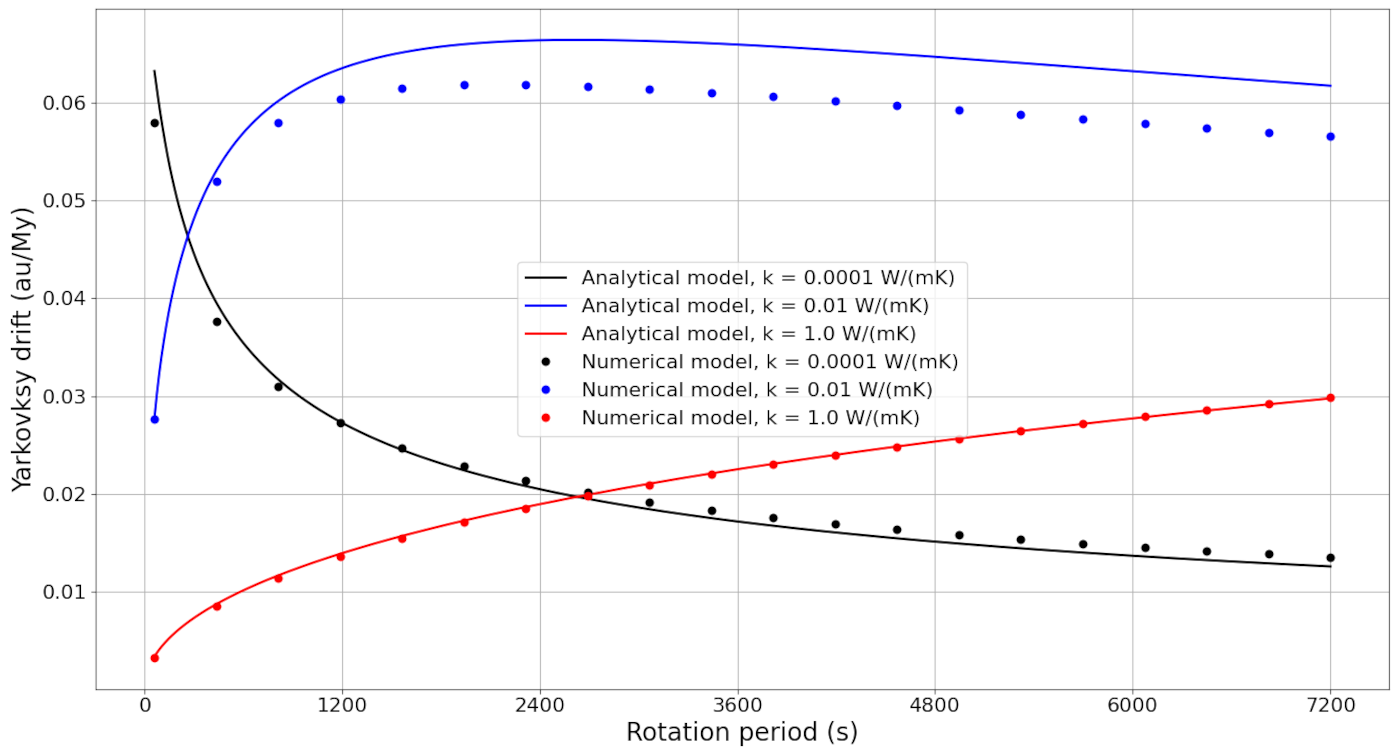
Figure 1 presents a comparison of the Yarkovsky drift computed using our numerical model and a standard analytical model for a fictitious asteroid on a circular orbit (R = 10 m, ρ = 1000 kg/m3, Cp = 1000 J/(kgK), a = 1 au), considering three values of thermal conductivity k and rotation periods ranging from 10 seconds to 2 hours. A comparison between our numerical model and the analytical model shows very good agreement, confirming that the observed semi-major axis drift can be attributed to extremely low thermal inertia.

Figure 1: Comparison of Yarkovsky drift computed using the numerical and standard analytical model (Vokrouhlický 1998, 1999)

Results

As an illustrative example, we present the thermal characteristics of the super-fast rotating near-Earth asteroid 2016 GE1, for which a rotation period of approximately 34 seconds has been measured. 

The analysis assumes the following nominal parameters: a= 2.06 au, e = 0.52, D = 14 m, ρ = 2500 kg/m3, Cp = 1000 J/(kg K), and a spin axis orthogonal to the orbital plane. JPL reports a relatively large semi-major axis drift of da/dt = 0.058 au/My.

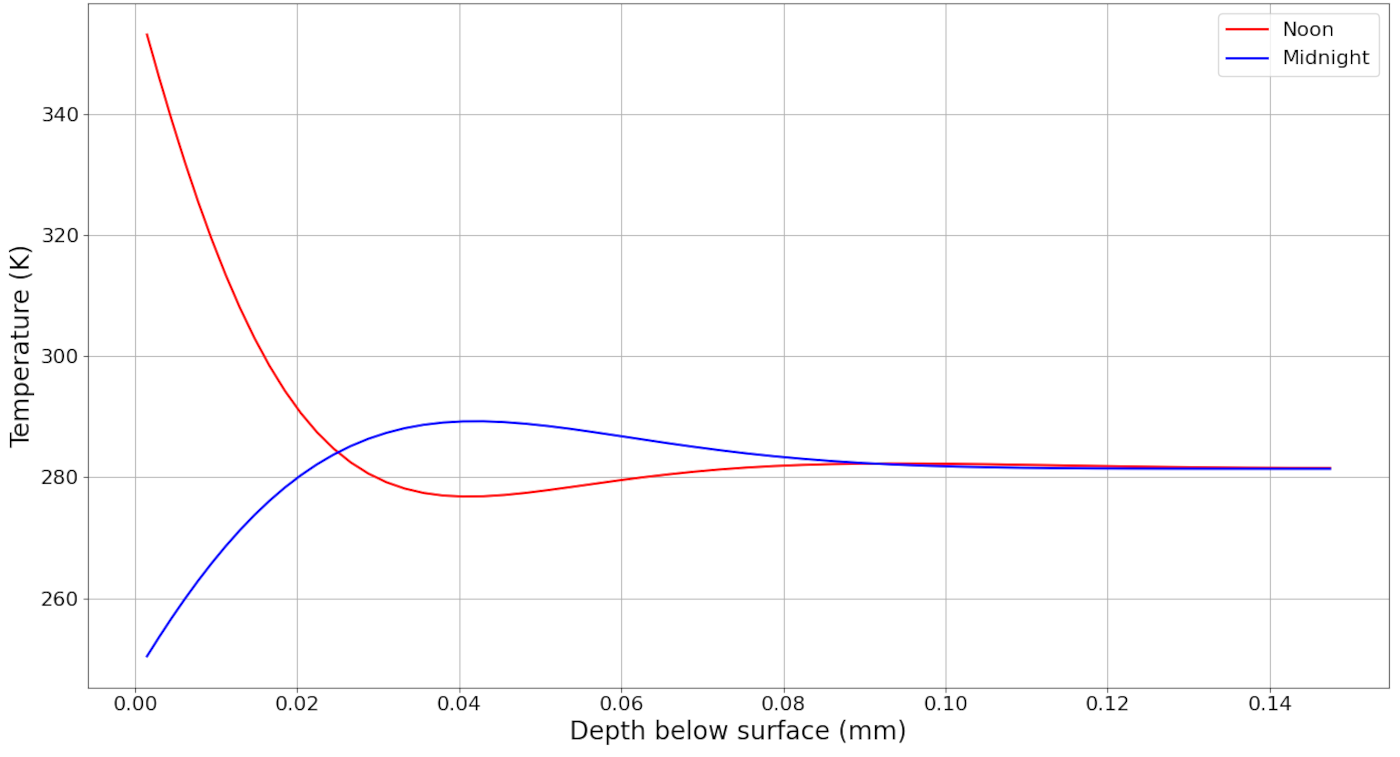
Figure 2 illustrates the resulting extreme temperature gradient with depth, showing variations of several tens of degrees within a fraction of a millimeter beneath the surface.

Figure 2: Temperature variation with depth beneath the surface of asteroid 2016 GE1

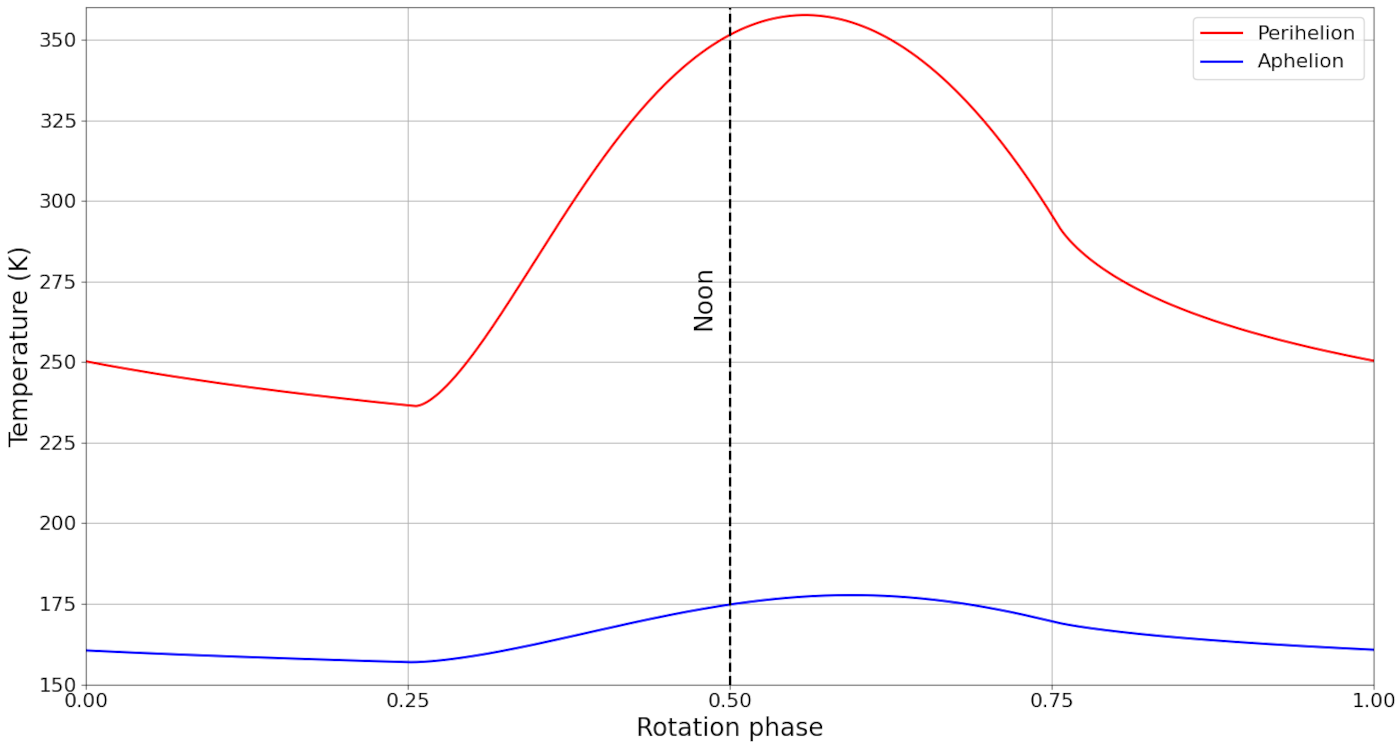
As a consequence of the steep subsurface temperature gradients, we observe a pronounced diurnal temperature variation, despite the extremely rapid rotation. Figure 3 shows the diurnal temperature cycle at the equator, both at perihelion and aphelion. 

Figure 3: Diurnal temperature variation at the equator of 2016 GE1

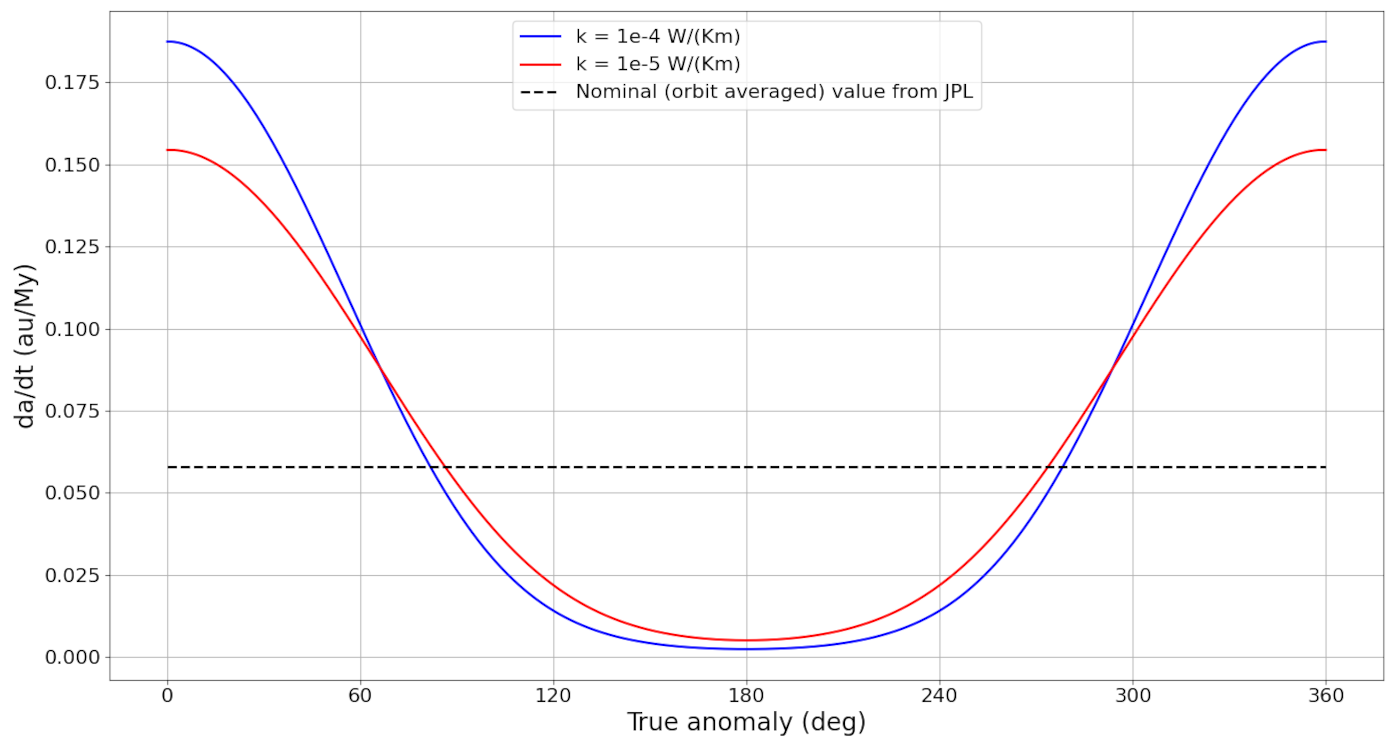
A significant difference is evident between these two orbital positions, resulting in the Yarkovsky drift being predominantly generated near perihelion, as illustrated in Figure 4, which shows that the drift near perihelion is an order of magnitude greater than at aphelion. Given that low thermal conductivity plays a crucial role in the Yarkovsky drift of super-fast rotators, this highlights the importance of modeling the thermal properties of asteroids as a function of heliocentric distance in order to obtain realistic estimates of the drift.

Figure 4: Dependence of the Yarkovsky drift on orbital position for a highly eccentric orbit of 2016 GE1

The developed model demonstrates that a significant Yarkovsky drift can be sustained even in cases of extremely rapid rotations. This finding potentially implies that specific structural characteristics, such as a fine regolith layer and/or a highly porous internal structure, can persist despite the intense inertial stresses caused by extreme rotational rates.

References:

Vokrouhlický , D. 1998.Diurnal Yarkovsky effect as a source of mobility of meter-sized asteroidal fragments. I. Linear theory. Astronomy and Astrophysics 335, 1093–1100.

Vokrouhlický, D. 1999. A complete linear model for the Yarkovsky thermal force on spherical asteroid fragments. Astronomy and Astrophysics 344, 362–366.

Acknowledgements: This research was supported by  The Science Fund of the Republic of Serbia through Project No. 7453 Demystifying enigmatic visitors of the near-Earth region (ENIGMA)

How to cite: Marceta, D., Novakovic, B., and Gavrilovic, M.: Numerical Modelling of the Yarkovsky Effect for Super-Fast Rotating Asteroids, EPSC-DPS Joint Meeting 2025, Helsinki, Finland, 7–13 Sep 2025, EPSC-DPS2025-1040, https://doi.org/10.5194/epsc-dps2025-1040, 2025.

09:42–09:54
|
EPSC-DPS2025-1387
|
ECP
|
On-site presentation
Wen-Yue Dai, Bin Cheng, Yukun Huang, Yifei Jiao, Wen-Han Zhou, Kun-Yi Ren, Harrison Agrusa, Seth Jacobson, Eiichiro Kokubo, Sébastien Charnoz, Yang Yu, Hexi Baoyin, and Junfeng Li

Introduction

Near-Earth asteroids and small main-belt asteroids (MBAs) with diameters between 200 m and 20 km are thought to be rubble piles. Most of their satellites are believed to be born from rotational mass shedding of the primary body, where the spin-up of a primary asteroid triggers mass shedding, creating a transient debris disk that finally re-accumulates to form satellite(s). In this scenario, a prolate satellite in a compact orbit is expected from theoretical predictions (Walsh et al, 2008). However, recent space missions have revealed a remarkable diversity of binary configurations. One striking anomaly is the (152830) Dinkinesh system, which hosts a contact-binary satellite named Selam in a wide orbit (Levison et al, 2025). In addition, several asteroids in this size range have been found to have more than one satellite. These findings reveal a diversity in the orbital architecture, satellite shape, and the number of satellite(s) when multiple asteroid systems are considered.

Existing models in the literature (Jacobson & Scheeres, 2011; Madeira et al, 2023) prefer to reconstruct this diversity through a single mass shedding event, but recent simulations (Agrusa et al, 2024) suggest that the actual picture of satellite formation is quite different, and the morphological properties of Selam have still not been convincingly reproduced. In this work, by considering multiple mass shedding and thus multi-generation of satellites, we propose a unified and self-consistent framework capable of covering all aspects of this configuration diversity.

Results

Through gravitational N-body simulations, we find that if multiple episodes of mass shedding and multi-generations of satellites are considered, the pre-existing satellite can strongly influence the subsequent satellite formation. Taking into account the orbital migration of the pre-existing satellite, this leads the system evolution after a subsequent mass shedding to different pathways, where the observed diversity in binary asteroid configurations can be naturally produced. Furthermore, a dynamical atlas of binary asteroid evolution is presented.

We suggest that the Selam-like contact binary satellite is more likely to originate from two separate mass shedding events and the subsequent inter-satellite collision, in which satellite migration also plays an important role. This also suggests a new formation mode for contact binary asteroids like Itokawa. We also find that ~ 44% of known binaries are located in the parameter ranges corresponding to multi-satellite histories, suggesting that the mechanisms shown in this work are prevalent in the evolution of binaries. Consequently, Selam-like satellites may be not rare, and satellites with even stranger shapes such as a contact triple, may also be found in the future.

This work has been supported by the National Natural Science Foundation of China grant No. 12372047.

References

Walsh, D. C. Richardson, P. Michel, Rotational breakup as the origin of small binary asteroids. Nature 454 (7201), 188–191 (2008).

Levison, et al., A contact binary satellite of the asteroid (152830) Dinkinesh. Nature 629 (8014), 1015–1020 (2024).

Jacobson, S. A. & Scheeres, D. J. Dynamics of Rotationally Fissioned Asteroids: Source of Observed Small Asteroid Systems. Icarus 214, 161–178 (2011).

Madeira, G., Charnoz, S. & Hyodo, R. Dynamical Origin of Dimorphos from Fast Spinning Didymos. Icarus 394, 115428 (2023).

Agrusa, H. F. et al. Direct N-body Simulations of Satellite Formation around Small Asteroids: Insights from DART’s Encounter with the Didymos System. The Planetary Science Journal 5, 54 (2024).

How to cite: Dai, W.-Y., Cheng, B., Huang, Y., Jiao, Y., Zhou, W.-H., Ren, K.-Y., Agrusa, H., Jacobson, S., Kokubo, E., Charnoz, S., Yu, Y., Baoyin, H., and Li, J.: Diverse configurations of binary asteroids explained by multi-generation satellites, EPSC-DPS Joint Meeting 2025, Helsinki, Finland, 7–13 Sep 2025, EPSC-DPS2025-1387, https://doi.org/10.5194/epsc-dps2025-1387, 2025.

09:54–10:06
|
EPSC-DPS2025-803
|
On-site presentation
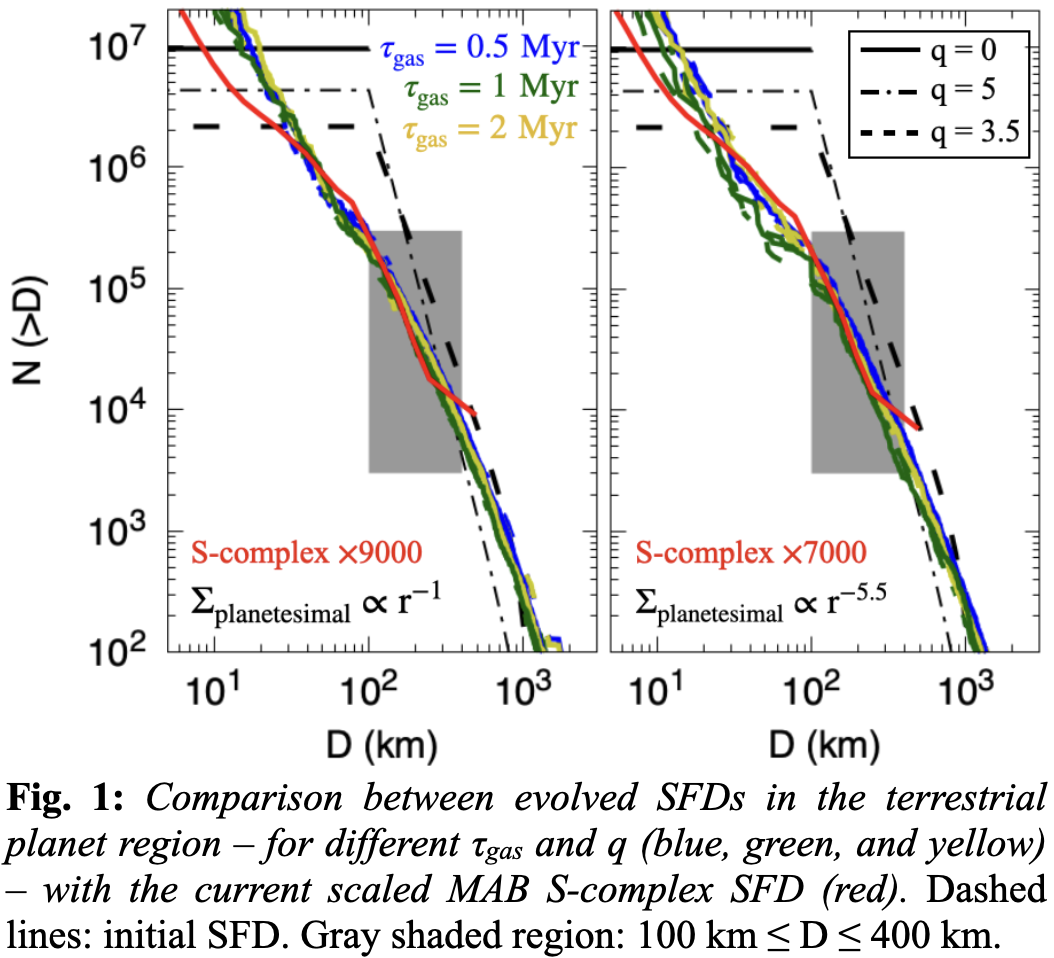
Rogerio Deienno, Andre Izidoro, David Nesvorny, William Bottke, Fernando Roig, and Simone Marchi

Introduction: The main asteroid belt (MAB) is known for having a very small total mass (5x10⁻⁴ Earth masses) and for being primarily composed of S- and C-complex bodies [1]. Isotopic measurements on meteorites suggest C-complex bodies, many which are water/volatile-rich, are likely to have originated exterior to Jupiter’s orbit, whereas S-complex bodies, most which are water/volatile-poor, come from within it [2].

The MAB’s low mass and taxonomical mixing can potentially be explained if the MAB was either originally empty [2] or never had much mass [3]. In this case, the currently observed MAB would result from limited implantation of S- and C-complex asteroids that were scattered from their source regions [2].  This proposition is in agreement with models suggesting that the solar system building blocks formed in concentric rings at various radial distances around the Sun [4] (models which were partly motivated by cosmochemical constraints [5]). This would naturally form a primordial MAB depleted in or devoid of mass [3].

What remains to be explored is whether the size-frequency distribution (SFD) of the MAB could potentially be explained by the implantation of S- and C-complex asteroids. The power law slope (q) for MAB’s SFD for objects 100 km ≤ D ≤ 400 km in diameter is probably unchanged over solar system history [6]. Thus, the implanted asteroids in this size range should have a slope comparable to the MAB’s current slope. Here we focus on the implantation from S-complex asteroids originating in the terrestrial planet region.

Methods:  We conducted terrestrial planet formation simulations starting from planetesimal-sized objects that were tracked over 5 Myr within the solar nebula [7]. We assumed the gas disk exponentially dispersed over timescales τgas of 0.5, 1, and 2 Myr. We gave our initial planetesimal population a cumulative SFD following N(>D)∝ D-q, with q = 0 (D = 100 km), 3.5, and 5 (100 km ≤ D ≤ 1,000 km). The total mass was 2.5 Earth masses. Planetesimals were radially distributed according to Σ ∝ r-x with x = 1 and 5.5 in the semi-major axis range 0.7 au ≤ a ≤ 1.5 au [4].

The evolution of the planetesimals’ SFD was tracked with the code LIPAD [8] during their accretion phase; some eventually grow to become planetary embryos. Given that S-complex planetesimals are only expected to be implanted in the MAB after the solar nebula has dispersed [2], we compared our evolved SFD at the end of the simulation with that from S-complex asteroids in the current MAB [6, 9].

Results: A compilation of our results is shown in Fig. 1. A large concentration of mass is needed near 1 au to form terrestrial planets and reproduce their orbits [4], so collisional evolution there is intense. As a result, our SFDs, regardless of x, q and τgas, rapidly reaches collisional equilibrium. In this state, the slope of our evolved SFDs broadly match that of the current MAB SFD in the range 100 km < D < 400 km.

Conclusions:  Assuming that the evolved SFDs stay in collisional equilibrium after gas disk dispersal, and that implantation in the MAB is size-independent, we conclude that S-complex asteroids may indeed be objects that formed in the terrestrial planet region, i.e., within 1.5 au. That includes asteroid (4) Vesta [3].

Additionally, we find that implantation efficiency  is likely to be <10-3. Higher efficiencies would potentially overpopulate the MAB with S-complex objects larger than asteroid (4) Vesta [3].

References: [1] DeMeo & Carry (2014) Nature, 505, 629. [2] Raymond & Izidoro (2017) Sci Adv, 3. [3] Deienno et al. (2024) PSJ 5, 5, 110. [4] Izidoro et al. (2022) Nat Ast, 6, 357. [5] Kruijer T. S., et al., (2020), Nat Ast, 4, 32. [6] Bottke et al. (2005) Icarus, 175, 111. [7] Weiss et al. (2021) Sci Adv, 7. [8] Levison et al. (2012) AJ, 144, 119. [9] Delbo et al. (2017) Sci, 357, 1026.

How to cite: Deienno, R., Izidoro, A., Nesvorny, D., Bottke, W., Roig, F., and Marchi, S.: Size-Frequency Distribution of S-complex Implanted Asteroids., EPSC-DPS Joint Meeting 2025, Helsinki, Finland, 7–13 Sep 2025, EPSC-DPS2025-803, https://doi.org/10.5194/epsc-dps2025-803, 2025.

Laboratory Work
10:06–10:18
|
EPSC-DPS2025-44
|
On-site presentation
Bin Liu, Qin Zhou, Haiying Li, Jianjun Liu, Yan Geng, and Chunlai Li

Introduction: The surface particle size and distribution characteristics of celestial bodies (e.g., the Moon, asteroids) play a crucial role in landing, roving, sampling missions, and in the interpretation of hyperspectral data [1-3]. Existing methods mainly rely on thermal inertia derived from remote sensing data, but often show discrepancies compared with high-resolution imaging results [4]. Thermal Infrared (TIR) spectroscopy is sensitive to particle size, influencing diagnostic spectral features such as the Christiansen Feature (CF), Reststrahlen Bands (RB), and Transparency Features (TF) [5-6]. By analyzing a large number of laboratory TIR spectra of silicate minerals and their mixtures, we identified a strong correlation between particle size and the spectral slope near the long-wavenumber side of the CF. Based on this relationship, a new model is proposed to estimate grain sizes (30–300 µm) of silicate-dominated surfaces, achieving correlation coefficients (R²) greater than 0.9 for most mineral types. This new approach provides an alternative for particle size estimation, with practical implications for spectral interpretation and surface sampling of the S-type asteroids.

Data and methods: Three common silicate minerals (olivine, pyroxene, and feldspar) and the binary mixtures of pyroxene and feldspar were prepared as analogs to lunar and S-type asteroid regolith. Each sample was ground and sieved into seven grain size ranges (Table 1). Thermal infrared spectra were measured using a Bruker 80v FTIR spectrometer with an integrating sphere under ambient conditions. Reflectance data were converted to emissivity using Kirchhoff’s law (E = 1 − R), and all spectra were normalized. The CF position for each sample was determined by polynomial fitting following the method of Donaldson Hanna et al. (2012). This data set provides the basis for building and validating a particle size estimation model.

We focus on the spectral slope near the CF position, which is highly sensitive to grain size variations. To ensure consistency and avoid interference from spectral absorptions, the reference point at 1500 cm-1 was selected on the long-wavenumber side of the CF. The spectral slope (K) was then calculated using the difference in emissivity values between the CF position and 1500 cm-1, normalized by their wavenumber interval. This approach captures a consistent trend: as particle size decreases, the spectral slope becomes steeper (Figure 1).

Results and discussion: The relationship between spectral slope and particle size was quantified across a wide range of mineral samples. As particle size decreases, the slope near the CF position becomes steeper, forming a consistent trend across all tested mineral types. Exponential fitting between slope (K-value) and grain size showed strong correlation (R2 > 0.9) (Figure 2), especially for olivine and pyroxene-feldspar mixtures (Table 2). This trend is attributed to increased volume scattering in finer grains, which enhances spectral contrast and shifts CF positions toward longer wavelengths.

To evaluate the model's performance, we applied it to spectral data from Apollo soils and terrestrial rock samples(Figure 3). The predicted particle sizes showed a systematic overestimation (Figure 4). This discrepancy is mainly attributed to surface weathering and compositional complexity in natural samples, which reduce spectral contrast and shift the CF positions. A correction function was thus developed to adjust the predicted sizes, improving model accuracy across typical lunar regolith compositions. After calibration, the model demonstrates optimal applicability for silicate-dominated regolith with grain sizes below 300 μm.

This study proposes a new method to estimate particle sizes of silicate-rich regolith using thermal infrared spectral slopes near the Christiansen Feature. The model shows strong correlation in the 30–300 μm range and is validated with both laboratory and returned lunar samples. A correction function improves accuracy by accounting for spectral deviations in natural materials. Future work will focus on integrating additional factors such as porosity, surface roughness, and space weathering to enhance model robustness for more diverse planetary surfaces.

References: [1] Yue et al. 2020, Journal of Deep Space Exploration, 7, 371. [2] Poulet et al. 2007, Journal of Geophysical Research: Planets, 112. [3] Shirley & Glotch, 2019, Journal of Geophysical Research: Planets, 124, 970. [4] DellaGiustina et al. 2019, Nature Astronomy, 3, 341. [5] Logan & Hunt 1970, Journal of Geophysical Research, 75, 6539. [6] Logan et al., 1973, Journal of Geophysical Research, 78, 4983.

Table 1: Description of Samples

Sample Types

Specific Mineral Composition

Particle Size Range

Minerals

Olivine

(1) 30-54μm; (2) 54-76μm; (3) 76-100μm; (4) 100-150μm;(5) 150-200μm; (6) 200-300μm; (7) 300-450μm

Mixed sample 1

10wt% augite +

90wt% labradorite

(1) 30-54μm; (2) 54-76μm; (3) 76-100μm; (4) 100-150μm;(5) 150-200μm; (6) 200-300μm; (7) 300-450μm

Mixed sample 2

30wt% augite +

70wt% labradorite

(1) 30-54μm; (2) 54-76μm; (3) 76-100μm; (4) 100-150μm;(5) 150-200μm; (6) 200-300μm; (7) 300-450μm

Mixed sample 3

50wt% augite +

50wt% labradorite

(1) 30-54μm; (2) 54-76μm; (3) 76-100μm; (4) 100-150μm;(5) 150-200μm; (6) 200-300μm; (7) 300-450μm

Table 2: The coefficients of the exponential function fitting for each sample.

Sample

a

b

c

R2

Olivine

-8.71×10⁻⁴

-7.11×10⁻³

-5.82×10⁻⁵

0.99

10wt% augite + 90wt% labradorite

-9.33×10⁻⁴

-1.59×10⁻²

-2.66×10⁻⁵

0.97

30wt% augite + 70wt%labradorite

-9.05×10⁻⁴

-1.53×10⁻²

-3.84×10⁻⁵

0.94

50wt% augite + 50wt% labradorite

-8.56×10⁻⁴

-1.32×10⁻²

-2.34×10⁻⁵

0.95

All mixed samples

-8.95×10⁻⁴

-1.48×10⁻²

-3.02×10⁻⁵

0.95

Figure 1: The thermal infrared spectra of minerals and mixtures with different particle sizes,  measured at room temperature and in the Earth’s atmospheric environment. (a) Olivine, (b) the mixture with 10wt% augite and  90wt% labradorite (c) the mixture with 30wt% augite and 70wt% labradorite (d) the mixture with 50wt%  augite and 50wt% labradorite.

Figure. 2: Exponential function fit of the relationship between the particle sizes and the K-values.

Figure. 3: The Thermal Infrared Spectra of Test Samples ((a) Lunar Olivine; (b) Mare Basalt; (c) Gabbro; (d) Anorthositic Gabbro; (e) Apollo 15101319; (f) Apollo 6122041)

Figure. 4: Comparison between predicted and ground-truth particle sizes across test samples. A linear regression method is used to fit the correction formula, see the black dashed line in the figure. The correlation coefficients (R2) is 0.79, and the RMSE of the fitting is 33.62µm.

How to cite: Liu, B., Zhou, Q., Li, H., Liu, J., Geng, Y., and Li, C.: A new method to predict particle sizes of S-type asteroid surfaces based on the laboratory thermal-infrared data., EPSC-DPS Joint Meeting 2025, Helsinki, Finland, 7–13 Sep 2025, EPSC-DPS2025-44, https://doi.org/10.5194/epsc-dps2025-44, 2025.

10:18–10:30
|
EPSC-DPS2025-588
|
ECP
|
On-site presentation
Nicol Latsia, Johan Borg, Erika Kaufmann, Georgios Tsirvoulis, Heikki Suhonen, Mikael Granvik, and Axel Hagermann

Thermal fatigue on asteroids is driven by diurnal and/or annual surface temperature variations, with its efficiency depending on the heliocentric distance, the rotation period, and the thermal and optical properties of the asteroid’s surface. Earlier studies [1,2] suggest that thermal fatigue remains effective over thousands, or even millions, of temperature cycles, contributing to the gradual breakdown of surface rocks. Other studies are somewhat more inconclusive [3]. The detailed timing and progression of crack propagation during repeated thermal cycling remain insufficiently understood. In fracture mechanics, the Kaiser effect, well known from studies on terrestrial rocks, suggests that fracturing on materials ceases unless the stress applied exceeds previous levels [3]. In the context of thermal fatigue, differences in the thermal expansion coefficients of individual minerals under changing temperatures can generate varying internal stresses within the rock.

In this study, we investigate the time-resolved development of cracks induced by thermal stresses in meteorites, acting as analogues for asteroid material, to better understand the role of thermal fatigue in regolith production. We have subjected different petrographic types of meteorites to 100 thermal cycles of ΔT=190 K. The meteorites used are CM2 Aguas Zarcas, CV3 Allende, LL5 Chelyabinsk, L5 Sayh al Uhaymir, L3 Aba Panu, and H3-5 Oum Dreyga. Acoustic emission monitoring is used to detect and temporally resolve microcracking events, while X-ray μCT scanning is applied to visualise the spatial distribution of pre-existing and propagating fractures at the start and end of each thermal cycling experiment. A comparison of XCT scans before and after the thermal cycling will reveal the extent and progression of fracture development.


[1] Delbo M. et al. 2014. Nature 508(7495) 233-236. [2] Molaro J.L. et al. 2015. JGR Planets 120(2) 255-277. [3] Patzek M et al. 2024. JGR Planets, 129(1). [4] Kaiser J. 1950. A study of acoustic phenomena in tensile heat (PhD Thesis).

How to cite: Latsia, N., Borg, J., Kaufmann, E., Tsirvoulis, G., Suhonen, H., Granvik, M., and Hagermann, A.: Temporal evolution of fracturing in chondrites induced by thermal cycling, EPSC-DPS Joint Meeting 2025, Helsinki, Finland, 7–13 Sep 2025, EPSC-DPS2025-588, https://doi.org/10.5194/epsc-dps2025-588, 2025.

Orals THU-OB3: Thu, 11 Sep, 11:00–12:30 | Room Jupiter (Hall A)

Chairpersons: Cécile Deligny, Wataru Fujiya, Xian Shi
Laboratory Work (continued)
11:00–11:12
|
EPSC-DPS2025-271
|
On-site presentation
Leonard Schirner, Georgios Tsirvoulis, Mikael Granvik, Athanasia Toliou, and Jooyeon Geem

The posterchild of near-Sun asteroids, 3200 Phaeton, exemplifies the poorly understood mechanisms driving their activity during perihelion passages. We study the nature of the activity of near-Sun asteroids by simulating their environment using a vacuum chamber and a high-power solar simulator (Tsirvoulis et al., 2022). Here we report on experiments with a CM carbonaceous chondrite simulant (Britt et al. 2019), because it appears to be the closest match for the fresh material on Phaeton, that is, the material that has not lost its volatiles due to recent perihelion passages (MacLennan & Granvik 2024, Schrader et al. 2025). 

In a set of roughly 50 experiments, we subjected CM regolith simulant to conditions experienced at heliocentric distances of 0.1–0.2 au. We conducted the experiments for two different grain sizes based on estimates from infrared observations (MacLennan et al. 2022): large grains with sizes between 1000 and 355 µm and small grains with sizes below 355 µm. The experiments were recorded, and the resulting videos were evaluated by comparing each frame to the next. We use two different image difference metrics: the mean square error (MSE), and the structural similarity index measure (SSIM; Wang et al, 2004), both of which quantify changes in images. Applying these metrics to the entire sequence of frames provides us with an objective way to evaluate the change in the sample over time, that is, measure the level of activity.  

We observe explosive events and jumping particles that can result in the complete sample moving away from the experiment region at the highest irradiances considered, that is, distances closest to the Sun. In our experiments roughly 3 grams of material are evaporated in about 100 seconds on a 2 by 2 cm area. If we assume this happens on the surface of a 1 km radius asteroid we get a mass loss of about 9000 kilograms per second, which is comparable to values of up to 2000 kilograms per second as measured by Knight et al. (2016) for comet 322P. 

There appears to be an activity breakpoint between 0.13 and 0.15 au, where above that distance no significant activity can be detected in our experiments. This coincides with the perihelion distance of Phaeton of 0.14 au and could potentially explain why Phaeton’s activity is only observed in the days surrounding its perihelion passage: the temperature threshold might only be reached at its perihelion.  

We found evidence that the observed activity is driven by outgassing of pyrite grains, contained in the CM simulant. The repeated outgassing of iron sulfides has been proposed by Suttle et al. (2024) to explain how repeated activity can be possible over long timescales. Furthermore, there are spectral links between Phaeton and the CY group of meteorites (MacLennan & Granvik 2024). These meteorites are known to have sulfide contents of up to 20% (King et al, 2015), which could imply that Phaeton indeed contains substantial amounts of sulfides. 

In our experiments, large grains show stronger levels of activity than small grains. However, this might not be due to grain size but to sulfide content: there seem to be more pyrite grains in the larger grains leading to stronger activity. On the other hand, stronger levels of activity could also be due to the way we measure activity: if a larger particle moves, more pixels in the video change, leading to higher activity measured by the software. If, however, the grain size actively influences the level of activity, this may have implications for the near-Sun asteroid population: asteroids with fine grained surfaces could survive longer in the extreme near-Sun environment.  

As a key finding, we identify an activation threshold near 0.14 au for CM material, above which no significant activity can be observed. Interestingly this threshold broadly coincides with Phaeton’s perihelion distance. The observed destruction could lead to a mass loss of up to 9000 kg per second, which aligns with observations of up to 2000 kg per second by Knight et al. (2015) for comet 322P.  

Furthermore, we find evidence that the observed activity could be driven by outgassing of iron sulfides in the material, which has been previously studied on a smaller scale by Suttle et al. (2024). We speculate that the observed mechanism can, in the more extreme radiation environments closer to the Sun, lead to the destruction of entire asteroids (Granvik et al. 2016). 


References: 

Georgios Tsirvoulis, Mikael Granvik, Athanasia Toliou: SHINeS: Space and High-Irradiance Near-Sun Simulator, Planetary and Space Science, 2022. 

https://doi.org/10.1016/j.pss.2022.105490. 

Britt, D.T., et al. (2019), Simulated asteroid materials based on carbonaceous chondrite mineralogies. Meteorit Planet Sci, 54: 2067-2082. 

 https://doi.org/10.1111/maps.13345 

MacLennan, E., Granvik, M. Thermal decomposition as the activity driver of near-Earth asteroid (3200) Phaethon. Nat Astron 8, 60–68 (2024).  

https://doi.org/10.1038/s41550-023-02091-w 

Devin L. Schrader et al., Geochimica et Cosmochimica Acta, 2025. 

https://doi.org/10.1016/j.gca.2024.12.021. 

Knight, Matthew M. and Fitzsimmons, Alan and Kelley, Michael S. P. and Snodgrass, Colin: COMET 322P/SOHO 1: An asteroid with the smallest perihelion distance? The Astrophysical Journal Letters, 2015. 

https://dx.doi.org/10.3847/2041-8205/823/1/L6 

Suttle, M.D., Olbrich, L.F., Bays, C.L. et al. Rapid heating rates define the volatile emission and regolith composition of (3200) Phaethon. Nat Commun 15, 7178 (2024). 

https://doi.org/10.1038/s41467-024-51054-w 

A.J. King, P.F. Schofield, K.T. Howard, S.S. Russell, Modal mineralogy of CI and CI-like chondrites by X-ray diffraction, Geochimica et Cosmochimica Acta, 2015. 

https://doi.org/10.1016/j.gca.2015.05.038. 

Granvik, M., Morbidelli, A., Jedicke, R. et al. Super-catastrophic disruption of asteroids at small perihelion distances. Nature 530, 303–306 (2016).  

https://doi.org/10.1038/nature16934 

How to cite: Schirner, L., Tsirvoulis, G., Granvik, M., Toliou, A., and Geem, J.: Activity of fresh Phaethon-like regolith close to the Sun , EPSC-DPS Joint Meeting 2025, Helsinki, Finland, 7–13 Sep 2025, EPSC-DPS2025-271, https://doi.org/10.5194/epsc-dps2025-271, 2025.

Internal Structure and Evolution
11:12–11:24
|
EPSC-DPS2025-1654
|
ECP
|
On-site presentation
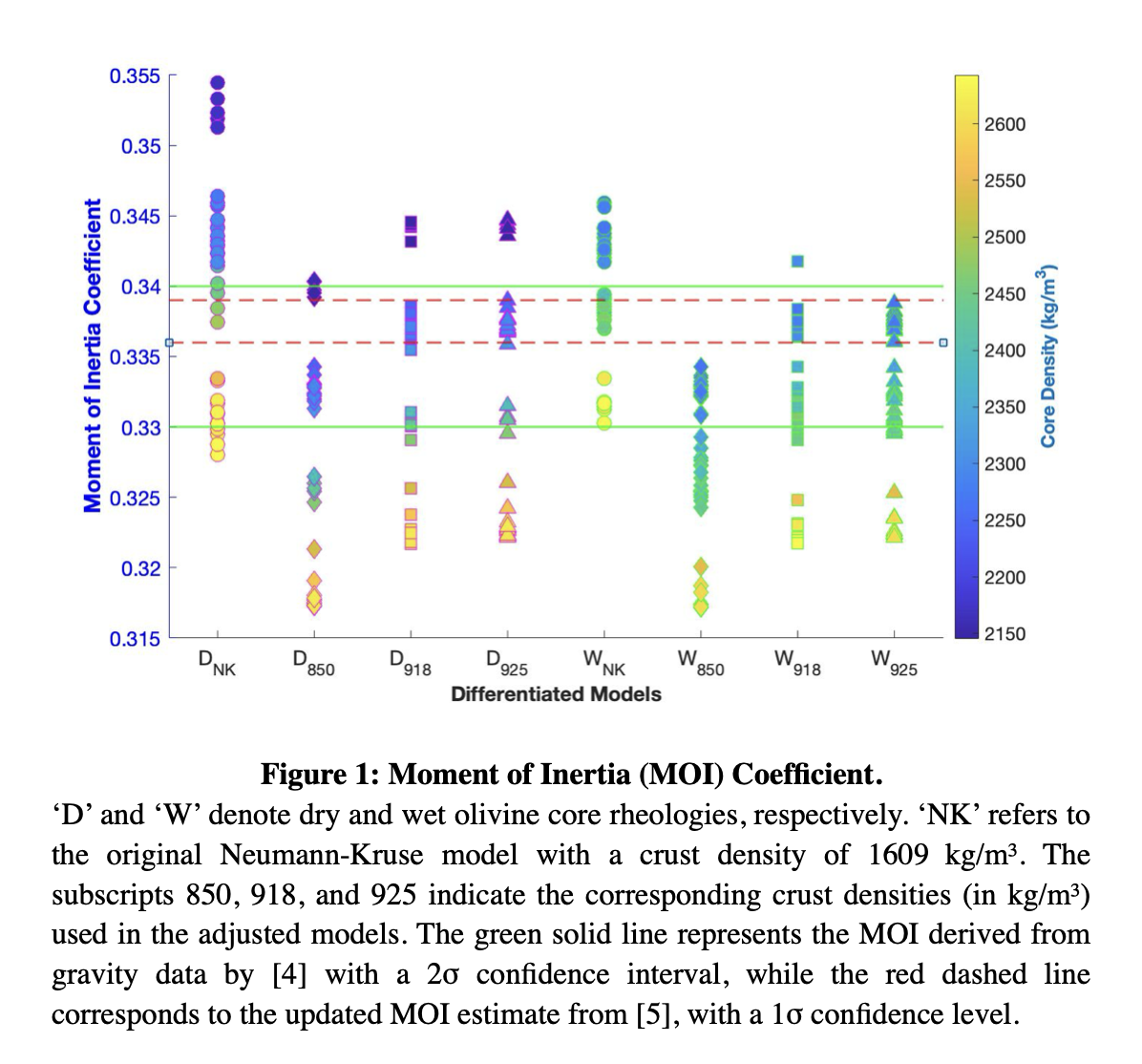
Delaram Darivasi, Jürgen Oberst, and Wladimir Neumann

Introduction

Enceladus, Saturn’s sixth-largest moon with a radius of 252.0 ± 0.2 km [1], was visited by NASA’s Cassini spacecraft in 2005. During close flybys, Cassini used backlighting techniques to detect plumes erupting from the South Polar Terrain (SPT) [2], identifying Enceladus as the source of fine icy particles that replenish Saturn’s E ring [3]. These observations suggest the presence of a subsurface liquid water ocean [2].

With a density of 1608 ± 5 kg/m³ and an icy surface [2], Enceladus appears to have an ice-rich bulk composition. Its moment of inertia (MOI) coefficient, initially estimated at 0.33–0.34 [4] and later refined to 0.336–0.339 [5], indicates a differentiated interior, likely composed of a rocky core beneath an H₂O mantle [6].
In this study, we investigate a range of internal structure models and their corresponding MOI values to determine which configurations are most consistent with the spacecraft-derived MOI constraints.


Methodology

This study builds upon the internal structure models developed by [6] (called henceforth "Neumann-Kruse models"), which explored Enceladus’ thermal and differentiation evolution driven by radiogenic heating and tidal dissipation. Their models considered three rheologies for the rocky core: wet olivine, dry olivine, and antigorite. The resulting internal structures featured a differentiated body with a core radius of ~185–205 km, a porous core layer of ~2–80 km, a subsurface ocean of ~10–27 km, and an ice-rock crust of ~30–40 km. Notably, the crust was assumed to be undifferentiated, composed of a mixture of ice and rock.

In this study, we refine these models by introducing rock subduction from the crust to the core, leading to core enlargement and a corresponding change in crust density. We evaluate three crust densities: 850 kg/m³ [1], 918 kg/m³, and 925 kg/m³ [7,8]. We calculated the MOI for nearly 500 internal structure models, including both the original and adjusted cases, to assess their compatibility with spacecraft-derived values.


Results


Figure 1 presents the calculated MOI coefficients for the differentiated Neumann-Kruse models and the adjusted models incorporating a differentiated crust with densities of 850 kg/m³ [1], 918 kg/m³, and 925 kg/m³ [7,8], for both dry and wet olivine core rheologies.

Models with a crust density of 850 kg/m³ show no agreement with the MOI range derived from gravity data [5]. Similarly, models with an undifferentiated crust (1609 kg/m³) yield the lowest agreement, approximately 5% for dry olivine and 18% for wet olivine.

In contrast, models with crust densities of 918 and 925 kg/m³ show significantly better alignment. For dry olivine, both densities yield about 39.5% agreement with the observed MOI. For wet olivine, the model with a crust density of 925 kg/m³ provides the highest overall agreement. In general, wet olivine models exhibit better consistency with the observed MOI range than dry olivine models.

A key observation is that wet olivine models require higher core densities to match the observed MOI, whereas dry olivine models align better with lower core densities. Accepted dry olivine models typically have a porous outer core thickness ranging from ~3 to 73 km, with 55% of these models having a porous layer thinner than 5 km. For wet olivine, the range is ~2 to 80 km, and only 41% of accepted models feature a porous outer core under 5 km. This indicates that wet olivine rheology generally requires a thicker porous outer core than dry olivine.


Conclusions

Our study builds upon the differentiated internal structure models proposed by [6], initially based on a rock-ice crust model. We further refined these models by incorporating a differentiated crust with varying densities. Our analysis indicates that most models, with a crust density of 925 kg/m³, align with the MOI range of [0.336–0.339] [5]. This trend persists regardless of whether the core rheology is dry or wet olivine. As expected, lower crust densities result in lower average MOI coefficients. In contrast, antigorite rheology predicts a higher MOI than the observed range, suggesting inconsistency with gravity data. Overall, our models support compatibility with spacecraft-derived constraints.

Acknowledgment

This work was supported by the Berlin University Alliance (BUA), by the Deutsche Forschungsgemeinschaft (DFG), and by the International Space Science Institute (ISSI) in Bern and Beijing, through ISSI/ISSI-BJ International Team project “Timing and Processes of Planetesimal Formation and Evolution”. 

References

[1] P.C. Thomas. et al., Icarus 264, 37 (2016).

[2] C.C. Porco. et al., Science 311, 1393 (2006).

[3] F. Spahn. et al., Science 311, 1416 (2006).

[4] L. Iess. et al., Science 344, 78 (2014).

[5] R. S. Park et al., J. Geophys. Res. Planets 129 (2024).

[6] W. Neumann and A. Kruse, The Astrophysical Journal 882, 47 (2019).

[7] W.B. McKinnon, Geophysical Research Letters 42, 2137 (2015).

[8] D.J. Hemingway and T. Mittal, Icarus 332, 111 (2019).

How to cite: Darivasi, D., Oberst, J., and Neumann, W.:  Insights into Enceladus’ Interior: Structural Modeling from Moment of Inertia, EPSC-DPS Joint Meeting 2025, Helsinki, Finland, 7–13 Sep 2025, EPSC-DPS2025-1654, https://doi.org/10.5194/epsc-dps2025-1654, 2025.

11:24–11:36
|
EPSC-DPS2025-437
|
On-site presentation
Michael M. Sori

Introduction:

Extensive evidence from the Dawn mission shows that dwarf planet Ceres had liquid brines in the subsurface in the past and probably the present, a finding with potential astrobiological significance [1].  Especially compelling evidence is found at Occator Crater, where the young, bright faculae have been shown to be the products of endogenic, salty water interacting with the surface [e.g., 2–6].  It is unclear whether these brines today exist regionally underneath Occator or globally in a subsurface layer that one could call an “ocean”. Because traditional observations used to detect subsurface oceans (e.g., libration, magnetic induction) are not plausibly applicable to a body like Ceres without a giant planet or large moon, more indirect methods must be used to test the extent of subsurface liquid water.

Here, I argue that the combination of surface features, inferences on Ceres’ interior structure, and results from thermal evolution models are most parsimonious with subsurface liquid brines concentrated in a region under Occator Crater but not present in the form of a present-day global ocean.  The key observation is that Occator is at low latitude and the region of greatest crustal thickness, both factors that favor brines at the bottom of the icy crust.

Methods:

 I use the finite element method (FEM) software COMSOL to quantify heat transfer in 3D and calculate the present-day temperature distribution within Ceres. The goal of the models is to determine if and where temperatures that permit liquid brine stability are reached. A similar approach with analytical equations has been previously used in 1D to show the feasibility of brines [7], and a 3D FEM approach is a sensible next step given Ceres’ surface temperature and interior structure.  Because Ceres’ surface is so close to its melting point (within 100 K in some locations) and its crustal thickness can exceed 10% the planetary radius, effects like surface temperature variations, crustal thickness variations [8], lateral heat conduction, planetary curvature, and ice’s temperature-dependent conductivity are all non-negligible.  I quantify these effects in the models.

I model Ceres’ crust in COMSOL in 3D. The outer boundary is set at the annual-average surface temperature, which varies with latitude, and the inner boundary has a heat flux applied from the deep interior.  The crust is a mix of ice, rock, and possibly clathrates and porosity [9], where the thermal conductivity is volumetrically weighted by each component.  I run hundreds of simulations, varying the crust’s composition and the heat flow.  At the end of each simulation, I note where, if anywhere, the base of the crust exceeds 273 K (melting point of pure H2O) or 220 K (the eutectic temperature of plausible chloride-ice mixtures [10]). Figure 1 shows the model conceptually.

Results and Discussion:

Sample results from a simulation along different longitudes are shown in Figure 2, and results from many simulations are summarized in Figure 3. Many models consistent with Dawn data [e.g., 8] and thermal evolution models [e.g., 10] lead to temperatures at the base of the crust that exceed 220 K beneath the region around Occator Crater, but not globally. For example, the model shown in Figure 2 yields a basal crustal temperature of 231 K underneath Occator’s region but only 119 K underneath the south pole. The models show that reaching >220 K globally is very challenging and would require extensive clathrates, which have been suggested [9] but may be implausible on the basis of evolution models [11], or unrealistically high heat flows from the deeper interior.

Brines existing regionally on Ceres but not everywhere provides a natural explanation for why Occator’s faculae are so extensive, but other large, young craters have smaller faculae [12] or no bright faculae at all. Occator’s faculae are sourced from both impact melt and pre-existing subsurface water [3], but perhaps other faculae, like the smaller and less bright faculae in young Haulani Crater [13], result from the impact process alone without requiring endogenic brines.  This process would not explain the presence of faculae at Ahuna Mons [14], which could instead be locally sourced from the deeper interior rather than the base of the crust [15].

Conclusions:

The combination of Ceres’ surface features (Occator’s bright faculae), interior structure (thick crust in Occator’s region), and thermal evolution (models imply only a few mW/m2 today) suggest that liquid brines exist today regionally in the subsurface under Occator, but not globally. This interpretation is consistent with a global ocean in the past, as the regional brine sea would represent a late stage of an ancient, freezing ocean [16].  Therefore, facula materials in Occator are still interpreted to be the products of an ocean world in this framework, and represent an excellent and accessible target for future spacecraft exploration [17].

References: [1] Castillo-Rogez et al.(2020), Astrobiology. [2] De Sanctis et al.(2016), Nature 536. [3] Scully et al.(2020), Nature Comms. [4] Bowling et al.(2019), Icarus 320. [5] De Sanctis et al.(2020), Nature Astron. [6] Nathues et al.(2020), Nature Astron. [7] Raymond et al.(2020), Nature Astron. 4. [8] Ermakov et al.(2017), JGR Planets 122. [9] Fu et al.(2017), EPSL 476. [10] Castillo-Rogez et al.(2019), GRL 46. [11] Castillo-Rogez et al.(2018), Meteorit. Planet. Sci. 53. [12] O’Brien et al.(2024), PSJ 5. [13] Krohn et al.(2018), Icarus 316. [14] Zambon et al.(2017), GRL 44. [15] Ruesch et al.(2019), Nature Geosci. 12. [16] Pamerleau et al.(2024), Nature Astron. [17] Castillo-Rogez et al.(2022), PSJ 3.

Figure 1. Conceptual diagram of our simulations, with a latitudinally variable surface temperature and heat flow Q applied to the base of the crust.

Figure 2. Example model temperature outputs along 220ºE (A–A’) and 60ºE (B–B’) for a crust with 50% ice, 30% clathrate, 10% silicate rock, and 10% porosity.

Figure 3. Results from a suite of models showing the predicted temperature at the bottom of the crust underneath Occator (solid lines) and the south pole (dashed lines) for different crustal compositions and heat flows applied from the deeper interior.

How to cite: Sori, M. M.: Ceres’ surface features, interior structure, and thermal evolution suggest a subsurface regional sea rather than a global ocean, EPSC-DPS Joint Meeting 2025, Helsinki, Finland, 7–13 Sep 2025, EPSC-DPS2025-437, https://doi.org/10.5194/epsc-dps2025-437, 2025.

11:36–11:48
|
EPSC-DPS2025-839
|
On-site presentation
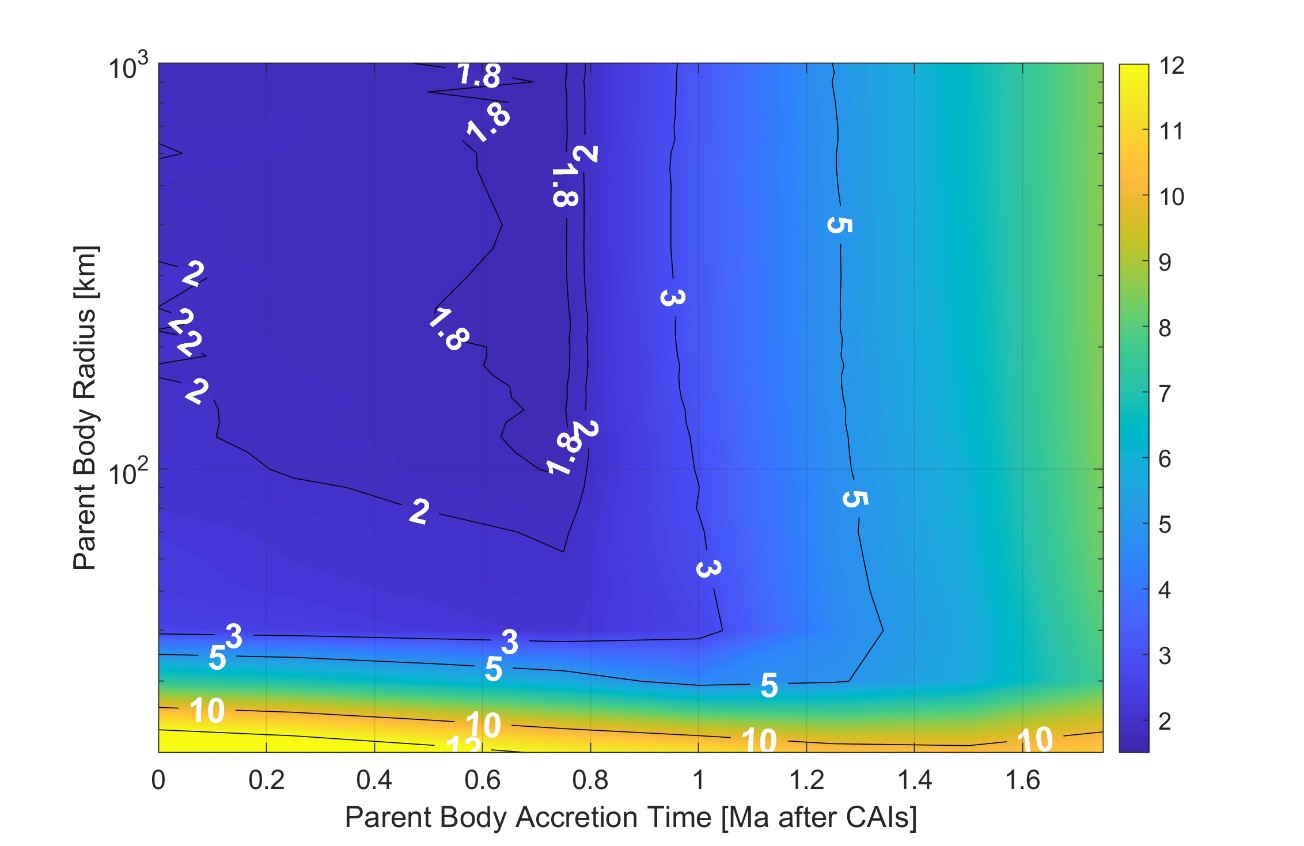
Wladimir Neumann, Audrey Bouvier, Philip Reger, and Mario Trieloff

Introduction

Angrites are differentiated rocky meteorites that are distinct form other achondrites in their oxygen isotopic compositions and originate from a planetary object that formed in the inner solar system. Crystallization ages of up to ≈4.564 Ga make the angrites the oldest igneous rocks of the solar system and their material indicates heating of the parent body to high temperatures sufficient for melting and differentiation. This implies an early parent body accretion relative to the formation of Ca-Al-rich inclusions (CAIs) and possibly a big size. Quenched angrites cooled rapidly on the surface, while plutonic angrites cooled in the interior of the crust or mantle. While asteroids with diameters of up to 60 km can be related to angrites based on their reflectance spectra[1-4], the parent body could not be identified in the present solar system, implying its destruction in the past. An upper bound on the size for this object is provided by the size of Mars[5]. In particular, Mercury has been discussed as the source of the angrites[6-9]. Here, we combine thermo-chronological data with thermal evolution modeling to constrain the accretion time and size of the angrite parent body.


Data and methods

The thermo-chronological data, such as cooling ages and closure temperatures, can be combined with thermal evolution models and help constraining not only the accretion time and internal evolution, but also the size of the parent body[10]. We combine new[11] and literature data (long-lived and short-lived chronometers in mineral phases, such as Pb-Pb, Al-Mg, Mn-Cr, Hf-W, and U-Pb phosphate ages) with numerical modeling to derive constrains on the angrite parent body. The ages and corresponding closure temperatures result in 31 data points for 13 meteorites in total, of which 12 data points are from 5 quenched angrites (Sahara 99555, NWA 1670, NWA 10463, NWA 2999, NWA 6291) and 19 data points from 8 plutonic angrites (D´Orbigny, Angra Dos Reis, Asuka 881371, NWA 1296, NWA 4590, NWA 4801, LEW 86010, NWA 8535). We considered two cases: (a) data for both quenched and plutonic angrites, and (b) data for plutonic angrites only. We calculated thermal evolution models for planetesimals of varying accretion times and sizes and fitted temperature evolution curves at different depths to the data with an RMS procedure[10,12-14]. The best-fit parent bodies and best-fit depths for the meteorites within a parent body were identified.


Results and Conclusions

A fit is considered to be acceptable if the fit quality χ2 is limited by the difference between the number of data points N and number of the optimized parameters p: χ2 < N-p. Here, assuming that different meteorites originate from different depths, p is the number of these fitted depths plus the number of the global parent body properties fitted (radius and accretion time). This means χ2 < 14 or χ< 3.7 for case (a) (omitting two outliers – Angra Dos Reis U-Pb phosphate and NWA 4801 U-Pb phosphate) and χ2 < 8 or χ< 2.8 for case (b). In both cases, we could identify planetesimals that satisfy this condition. The overall fit quality as a function of the planetesimal radius and accretion time takes minimum values of χ< 1.8 (see Fig. 1 for case (a)) for an accretion close to 0.6 – 0.8 Ma after CAIs and a radius of at least 100 km. However, no upper bound on the radius could be constrained.

Figure 1: The fit quality χas a function of planetesimal accretion time t0 (abscissa) and radius R (ordinate). Best fits of χ< 1.8 are obtained for t0 of 0.6 to 0.8 Ma and R > 100 km.

Figure 2 shows thermal evolution curves at the fit depths of the meteorites for a representative planetesimal with R = 200 km and t0 = 0.75 Ma. NWA 8535 is fitted at the highest depth of 19 km relative to other meteorites (2.7 km – 9.5 km). The cooling rates calculated between the temperature maxima and the lowest closure temperature (600 K for U-Pb in phosphates) are inversely proportional to the fit depths, with the highest value of ≈80 K/Ma for NWA 1679 fitted at ≈2.3 km, decreasing to ≈50 K/Ma for LEW 86010 and Angra Dos Reis both fitted at ≈9.5 km, and with the lowest being ≈10 K/Ma for NWA 8535 fitted at ≈19 km.

Omitting quenched angrites, but including the outliers and fitting them at separate depths assuming extrusion from a deeper interior to shallower depths (case (b)) leads to a better fit quality. However, the depth range and the cooling rates remain similar. In particular, the late NWA 8535 U-Pb phosphate age requires very slow cooling of the deeper crust or upper mantle of ≈10 K/Ma and, thus, favors a big parent body with a radius of > 100 km.

Our results constrain the accretion time of the angrite parent body to a narrow time interval of 0.6 Ma to 0.8 Ma after CAIs and confirm that it was one of the larger asteroids, if it was an asteroid at all. However, the fit quality improves with an increasing radius and, thus, allows for a planet-size parent body.


Figure 2: Thermal evolution curves at the fit depths of the meteorites for case (a) and a representative planetesimal with R = 200 km and t0 = 0.75 Ma.


[1] Burbine et al. (2001) 32nd LPSC, 1857.

[2] Burbine et al. (2006) MAPS 41, 1139-1145.

[3] Rivkin et al. (2007) Icarus 192, 434-441.

[4] Rider-Stokes et al. (2025) Icarus 429, 116429.

[5] Baghdadi et al. (2013) MAPS 48, 1873-1893.

[6] Irving et al. (2005), Eos, 86, P51A-0898.

[7] Kuehner and Irving (2006). 38th LPSC, 1344.

[8] Ruzicka and Hutson (2006) MAPS 41, Proceedings of 69th MetSoc Annual Meeting, 5080.

[9] Blewett and Burbine (2007) 38th LPSC, 1203.

[10] Neumann et al. (2018) Icarus 311, 146-169.

[11] Bouvier et al. (2024) 86th MetSoc Annual Meeting (LPI Contrib. 3036), 6210.

[12] Neumann W. et al. (2023) PSJ 4, 196.

[13] Neumann et al. (2024) SciRep 14, 14017.

[14] Ma M. et al. (2022) GPL 23, 33-37.

How to cite: Neumann, W., Bouvier, A., Reger, P., and Trieloff, M.: Formation Time, Thermal Evolution, and Size of the Angrite Parent Body, EPSC-DPS Joint Meeting 2025, Helsinki, Finland, 7–13 Sep 2025, EPSC-DPS2025-839, https://doi.org/10.5194/epsc-dps2025-839, 2025.

Collisions
11:48–12:00
|
EPSC-DPS2025-1404
|
ECP
|
On-site presentation
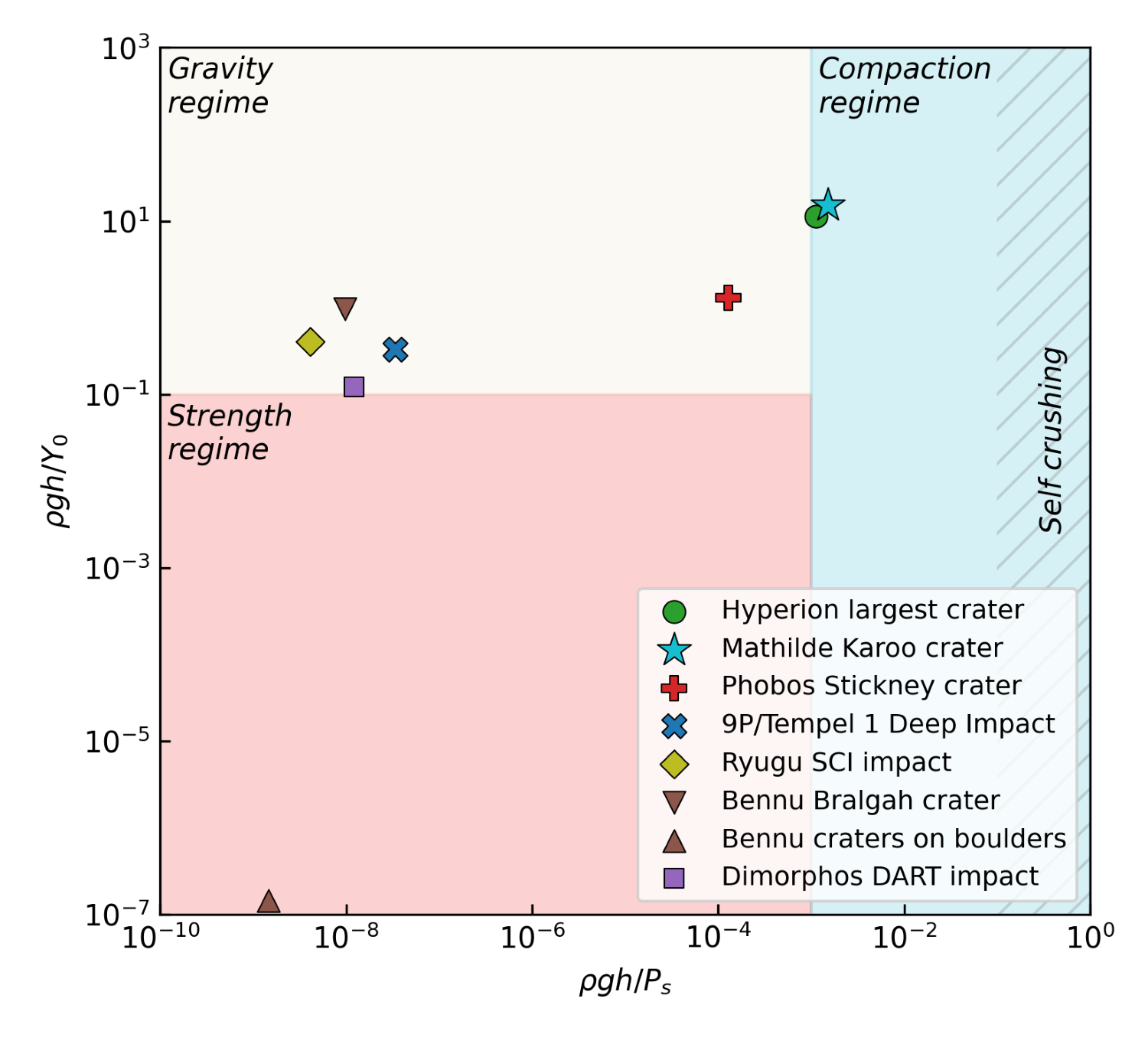
Yifei Jiao, Bin Cheng, Wen-Yue Dai, Erik Asphaug, Martin Jutzi, Sabina Raducan, Xiaoran Yan, Yang Yu, and Hexi Baoyin

The dark carbonaceous asteroids, comprising over 75% of the main belt population (~50% by mass), are thought to contain the most primitive materials from the early solar system. However, the lack of direct interior measurements has greatly limited our understanding of the formation and evolution of this category. One such primitive asteroid, the 53-km Mathilde, characterized by its well-preserved giant craters, has remained a puzzle since the NEAR spacecraft's first glimpse in 1997 [1]. Recent missions to Ryugu and Bennu [2,3] have provided valuable insights into the composition and structural properties of km-size rubble piles, which are debris aggregates of primitive asteroids, offering a unique opportunity to re-examine the interior of their parent bodies--the large primitive objects like Mathilde.

Here we show that large primitive asteroids could possess a cohesive and porous interior, by reconstructing the formation of giant craters on Mathilde with hydrodynamics simulations. Our results suggest a cohesion of ~10 kPa, an internal friction coefficient of 1.0, and a crush strength of 10 to 100 MPa, in which case the giant craters on Mathilde are formed in a compaction dominated regime (Fig. 1). Most low-albedo asteroids 40–100 km diameter may possess similar interiors and similar giant craters; this will be tested by the Lucy and MBR Explorer missions. Based on these simulations, and to explain the hydration diversity and exogenic contamination observed among Ryugu and Bennu, we propose that ~85% of the small carbonaceous asteroids could have originated from the catastrophic and super-catastrophic disruptions of large primitive asteroids like Mathilde, with giant cratering events supplying the rest. Conversely, small basaltic asteroids are more likely to originate from less energetic events thus containing less exogenic.

References

[1] J. Veverka, et al., Science 278 (5346), 2109–2114 (1997).

[2] S. Watanabe, et al., Science 364 (6437), 268–272 (2019). 350.

[3] O. Barnouin, et al., Nature Geoscience 12 (4), 247–252 (2019).352. 

Fig.1 Giant craters on Mathilde appear to be in a transition between gravity-regime and self crushing.

How to cite: Jiao, Y., Cheng, B., Dai, W.-Y., Asphaug, E., Jutzi, M., Raducan, S., Yan, X., Yu, Y., and Baoyin, H.: Giant Craters on Asteroid Mathilde Revealing a Cohesive Porous Interior of C-type Parent Bodies, EPSC-DPS Joint Meeting 2025, Helsinki, Finland, 7–13 Sep 2025, EPSC-DPS2025-1404, https://doi.org/10.5194/epsc-dps2025-1404, 2025.

12:00–12:12
|
EPSC-DPS2025-486
|
ECP
|
On-site presentation
Roberto Balossi and Paolo Tanga

Asteroid families are groups of asteroids sharing similar orbits and surface properties resulting from the disruption of a parent body. Asteroid families can be identified as overdensities in the phase space of the proper elements [1] or from their spectral properties [2]. The latter method assumes that families are homogeneous in composition. However, according to the theories of the Solar System’s evolution and the presence of metallic and basaltic asteroids in the Belt, there should have been differentiated planetesimals, some of which should have undergone fragmentation. Therefore, there should be asteroid families characterized by an inhomogeneous composition. Still, such structures have never been observed, or at least not in a sufficient quantity compared to the number of predicted differentiated objects [3]. This implies that there could be a mechanism that intervenes in the first phases after the formation of an asteroid family acting on the surface compositions of its members, homogenizing them.

We investigate the possible role of collisions internal to a family, among its members, occurring in the first thousand years after the disruption of a differentiated parent body. Fragments with different compositions coming from different regions within the parent body (i.e, core, mantle, crust) would collide, leading to a gradual compositional mixing.

This mechanism could be efficient at the beginning of the evolution of the family, before the randomization of the anomalies and orbital nodes. In such conditions, the usual statistical approaches cannot be used [5], and numerical simulations are required to test this hypothesis. The fragments are assigned to an ejection velocity field [4] and integrated over time under gravitational and non-gravitational perturbations. Collisions are recorded during the simulation and are then converted into collisional probabilities [5], from which the results can be generalized into size distributions approximating real families. Figure 1 reports the collision probability numerically determined in a system of 25,000 particles, each with a radius of 5 km, integrated up to the randomization of the true anomalies. In this regime, the collision probability aligns with that predicted by the statistical approach [5].

Various methods can be implemented to estimate the degree of mutual surface contamination within the family. One approach involves assigning each fragment a specific mineralogical composition based on its original location within the parent body. The compositions would then evolve as a result of collisions. Since the surface composition of asteroids is not directly observable, it cannot be directly compared with real data. Instead, reflectance spectra linked to the mineralogical compositions can be derived using empirical models such as those developed by Hapke [6] and Cloutis [7].
An alternative method is to assign to each fragment a meteorite spectrum representing its initial region within the parent body. The final spectrum for each fragment would be computed as a weighted linear combination of the initial spectra, where the weights reflect the number and nature of collisions the fragment has undergone.
Other alternative methods could be explored as well.

The spectra of the family members can finally be compared with spectroscopic observations, such as Gaia DR3 data, which have proven effective in identifying asteroid families without additional data [2] [8]. This comparison will be crucial to assess whether intrafamilial collisions significantly contribute to homogenization, offering insights into the distribution and abundance of differentiated planetesimals in the early Solar System.

In this contribution, we present the first results obtained from this ongoing investigation, most notably the collision probabilities at the very beginning of the evolution of the families after their breakup. We also test their evolution towards the results presented in [5] for later stages, and show a preliminary evaluation of the degree of intra-family spectral contamination after the breakup of a completely differentiated asteroid.

Figure 1: The collision probability determined for a system of 25,000 particles, each with a radius of 5 km, integrated up to the randomization of the true anomalies.


References

[1] Zappalà, V., Cellino, A., Farinella, P., Knežević, Z. (1990), Asteroid Families. I - Identification by Hierarchical Clustering and Reliability Assessment, AJ, 100, 2030–2046.
[2] Balossi, R., Tanga, P., Sergeyev, A., Cellino, A., Spoto, F. (2024), Gaia DR3 asteroid reflectance spectra: L-type families, memberships, and ages, A&A, 688, A221.
[3] Burbine, T. H., DeMeo, F. E., Rivkin, A. S., Reddy, V. (2017). Evidence for Differentiation among Asteroid Families. In L. T. Elkins-Tanton & B. P. Weiss (Eds.), Planetesimals (pp. 298–320). Cambridge University Press.
[4] Paolicchi, P., Verlicchi, A., Cellino, A. (1996), An Improved Semi-Empirical Model of Catastrophic Impact Processes. I: Theory and Laboratory Experiments, Icarus, 121, 1.
[5] Dell’Oro, A., Paolicchi, P., A., Cellino, A., Zappala, V. (2002), Collisional Rates within Newly Formed Asteroid Families, Icarus, 156, 1.
[6] Hapke, B. (1981), Bidirectional reflectance spectroscopy: 1. Theory, JGR, 86(B4), 3039-3054.
[7] Cloutis, E. A., Gaffey, M. J., Jackowski, T. L., Reed, K. L. (1986), Calibrations of phase abundance, composition, and particle size distribution for olivine-orthopyroxene mixtures from reflectance spectra, JGR, 91(B11), 11641-11653
[8] Balossi, R., Tanga, P., Delbo, M., Cellino, A., (in prep.), An ancient L-type family associated to (460) Scania in the Middle Main Belt as revealed by Gaia DR3 spectra. Manuscript in preparation

How to cite: Balossi, R. and Tanga, P.: Post-impact self-gardening: a poorly known mechanism with consequences on the properties of asteroid surfaces, EPSC-DPS Joint Meeting 2025, Helsinki, Finland, 7–13 Sep 2025, EPSC-DPS2025-486, https://doi.org/10.5194/epsc-dps2025-486, 2025.

12:12–12:24
|
EPSC-DPS2025-402
|
On-site presentation
Kevin Walsh, Ronald-Louis Ballouz, Harrison Agrusa, Josef Hanus, Martin Jutzi, and Patrick Michel

A subset of large asteroids (Diameter larger than 100km) are found to be in multi-asteroid systems: asteroids with one or more satellites. The formation of these large multi-asteroid systems is generally thought to occur through impacts into the parent body [e.g., Durda et al. 2004]. The specifics of the impact process that could achieve this has been confounded by a lack of satellites found amongst the largest remnants of very large asteroid families. These asteroids are known to have suffered catastrophic impacts, yet rarely have satellites. Meanwhile, the asteroids that do have satellites are almost always rotating rapidly and are elongated.


Here, through combined modeling of impacts with smoothed particle hydrodynamics, reaccumulation with discrete element methods and long term satellite stability with N-body modeling, we find a direct pathway to satellite formation in sub-catastrophic impacts. Targets with rapid pre-impact rotation, or that suffer highly oblique impacts, can be distorted into an elongated shape immediately after the impact event. The distorted shape of the rotating body provides a means to launch some debris onto initial trajectories distinct from simple ballistic trajecotires that would otherwise be doomed to re-impact. The debris most commonly launched into stable orbits around the parent body is sourced from its longest-axis and relatively shallow depths (10-20km below the surface of a 50-km-radius object). Thus, the specific energy of a collision does not control satellite formation, as sub-catastrophic impacts are sufficiently energetic to generate ejecta that dynamically evolve to stable orbits in relatively short timescales. Catastrophic or super-catastrophic collisions are not guaranteed to result in the formation of satellites around the parent body. These characteristics of disruption-level asteroid collisions explains the observed lack of a correlation between the presence of satellites around large main belt asteroids and the presence of a family.


The figure shows a modeled impact and reaccumulation after the handoff to pkdgrav at times. The particles are colored by their instantaneous orbit relative to the largest remnant in the system, where the shades of red show particles with an orbit pericenter smaller than the primary radius and blue have pericenter larger than the largest remnant radius. A cluster of blue particles is found at later times amidst the tail of debris and are the source of debris that reach temporary orbits that are not immediately re-impacting the primary. This case was for a 13km impactor hitting a 100km target that was initially rotating with a 10hr at 5km/s at and angle 60 degrees. The largest remnant has a period of 6.75hrs and a short over long axis ratio of 0.69.

How to cite: Walsh, K., Ballouz, R.-L., Agrusa, H., Hanus, J., Jutzi, M., and Michel, P.: Satellite formation around the largest asteroids, EPSC-DPS Joint Meeting 2025, Helsinki, Finland, 7–13 Sep 2025, EPSC-DPS2025-402, https://doi.org/10.5194/epsc-dps2025-402, 2025.

Discussion

Posters: Tue, 9 Sep, 18:00–19:30 | Finlandia Hall foyer

Display time: Tue, 9 Sep, 08:30–19:30
Chairpersons: Wladimir Neumann, Cécile Deligny, Jürgen Blum
F150
|
EPSC-DPS2025-2032
|
On-site presentation
Julia Cartwright and Gareth Douglas

Many meteorites in our inventories are crystalline and formed through magmatic activity, showing features similar to terrestrial gabbros, cumulates, pyroxenites and basalts. However, unlike terrestrial basalts, which often contain ubiquitous vesicles resulting from volatile loss and near-surface exsolution of water-rich fluids in ascending magmas, vesicles in asteroidally-derived meteorites are exceptionally rare, with only a few eucrites and angrites (~5) showing vesicular textures [1-3]. The ability for vesicles to form on small airless bodies is ultimately limited by the asteroid size and lack of atmosphere [1], where magma fragmentation and gas escape would occur instead [4]. While the simplest explanation for the occurrence of vesicles in a meteorite is as a lava flow [5], this would require substantially thick flows >>100 m [4], which are unlikely based on our knowledge of most asteroids, including the largest differentiated asteroid Vesta (diameter ~525 km). Instead, previous research has suggested that vesicles could be formed and preserved in a dyke(s) trapped at ~5 km depth that was subsequently excavated from Vesta by substantial impact [1]. Additionally, the carrier gas of the vesicles is thought to be CO or a mix of CO:CO2 [1,6]. Ultimately, the study of vesicles in asteroidal meteorites can help determine formation depth, volatiles in magmatic systems, and the nature of crust formation [1].

A recently recovered and little studied meteorite, Jikharra 001, classified as a eucritic melt breccia, may provide key information about magmatic activity on asteroids, particularly for Vesta, the likely parent body to the HED meteorites [7]. Jikharra 001 is fairly heterogenous with at least two lithologies previously reported [8]. We have acquired a sample on loan from a collection of Jikharra 001 material that shows a highly unusual vesicular texture with evidence of gradation in a fine-grained lithology, as well as potential xenoliths/enclaves from another lithology that is coarse-grained. Preliminary data acquired in a pilot study using the Zeiss Xradia micro Computerised Tomography (CT) based in the School of Engineering, University of Leicester (UoL) shows the complexity of the sample (Figs 1-2). Fig. 1B shows a labelled diagram of a CT-slice through part of Jikharra 001, highlighting an angular coarse-grained clast alongside the dominant fine-grained matrix that shows increasing vesicle size with distance from the coarser-grained lithology. Investigating this further, we have started to calculate the vesicle volumes, and can further identify the apparent gradient (Fig. 2). Our initial observations are indicative of flow, volatile dynamic activity, with evidence of brecciation and rapid cooling. The observation of a gradient may also provide a way-up structure, possibly indicating the direction of the asteroid surface in relation to the sample. We are investigating these findings further, with a view to modelling the nature of Jikharra 001, and potential formation history.

References: [1] McCoy T. J. et al., (2006) EPSL 246:102-108. [2] Warren P. W. (2003) 66th Metsoc (abs.# 5297). [3] Mittlefehldt D. W., Killgore M., and Lee M. T., (2002) MAPS 37:345-369. [4] Wilson L. & Keil K. (1997) MAPS 32:813-823. [5] Mittlefehldt D. W., et al. (1998) in Planetary Materials, Min. Soc. Am. 36:4.1-4.195. [6] Wilkening L. L. and Anders E., (1975) GCA 39:1205-1210. [7] Mittlefehldt D. W. (2015) Chemie der Erde, 75:2:155-183. [8] Wang Z., Tian W., Wang W-RZ., (2023) LPSC (abs.# 1017).

Fig.1: A) Jikharra 001 on the sampling stage within the Zeiss Xradia. B) CT-image of Jikharra 001 region highlighting the main features observed.

Fig.2: Mesh map of vesicles (‘pores’) in Jikharra 001 shown in relative positions. Colour scale bar represents volume, ranging from dark purple (0 mm3) to yellow (3.5 mm3). CT-scan slice shown for reference at the bottom of the combined image.

How to cite: Cartwright, J. and Douglas, G.: Investigating Rare Vesiculated Meteorite Jikharra 001, EPSC-DPS Joint Meeting 2025, Helsinki, Finland, 7–13 Sep 2025, EPSC-DPS2025-2032, https://doi.org/10.5194/epsc-dps2025-2032, 2025.

F151
|
EPSC-DPS2025-55
|
On-site presentation
Anna Marciniak, Josef Durech, Antoine Choukroun, and Julia Perła and the Two teams of observers

Context                                                                                                                                    
Asteroid sizes, even for large objects are surprisingly poorly determined. As the MP3C database (https://mp3c.oca.eu/) shows, many objects in the range of a few tens of km to 100 km have diameter determinations differing by more than 30% in various studies. This influences density determinations and compositional studies, among others.                                                            

     On the other hand, there exist techniques capable of determining asteroid diameters with very good precision. Fitting 3D asteroid shape models to multichord stellar occultations is one of them (Durech et al. 2011, Herald et al 2020).                                                                       
                                                                                                                             
Aims
In order to improve diameter values for a dozen or so large and medium-sized main belt asteroids we conducted two photometric campaigns: one for rotational lightcurves over multiple apparitions and the other for stellar occultations by these objects.                                                         
                                                                                           
Methods
We performed lightcurve inversion (Kaasalainen, Torppa 2001, Kaasalainen et al. 2001) for the target asteroids obtaining their spins and 3D shapes. Next, we created their on-sky silhouettes for the moments of well-observed stellar occultations and fitted them to the occultation chords (Durech et al. 2011). We tested ten versions of each shape model, with various level of stretch along the spin axis to check the influence of shape model uncertainty on the resulting diameter. 

                                                                  
Results
Obtained volume-equivalent diameters have very small uncertainties, at the level of a few percent on average, reaching no more than 10% for targets with the poorest covered occultations. In many cases we managed to resolve the mirror-pole ambiguity (see Fig. 1). Moreover, diameters determined this way have been independently confirmed by applying the Convex Inversion Thermophysical Model (Durech et al. 2017), see the contribution by Choukroun et al. in this meeting. Results from both techniques can be found in the paper by Choukroun et al., accepted to "Astronomy & Astrophysics".


Fig. 1: Sample result: shape model of asteroid (541) Deborah fitted to three stellar occultations (Choukroun et al., accepted to A&A). Preferred spin and shape solution is shown on the fundamental plane with the solid contour, while the rejected one with dashed contour. Straight lines are chords based on occultation timings. Grey segments denote timing uncertainties, while the red segment represents the distance covered by the asteroid shadow in a given time. The diameter of sphere with the equivalent volume for the preferred model is 57 ± 2 km.

Acknowledgement
This work was supported by the National Science Centre, Poland, through grant no. 2020/39/O/ST9/00713.                                     
                                                                                                                                          
References                                                                                                                                 
Choukroun, A., Marciniak, A., Durech, J., et al., accepted to A&A
Durech, J., Delbo., M., Carry, B., Hanuš, J., & Alí-Lagoa, V. 2017, A&A, 604, A27
Durech, J., Kaasalainen, M., Herald, D., et al. 2011, Icarus, 214, 652
Herald, D., Gault, D., Anderson, R., et al. 2020, MNRAS, 499, 4570
Kaasalainen, M. & Torppa, J. 2001, Icarus, 153, 24
Kaasalainen, M., Torppa, J., & Muinonen, K. 2001, Icarus, 153, 37

How to cite: Marciniak, A., Durech, J., Choukroun, A., and Perła, J. and the Two teams of observers: Asteroid sizes determined with stellar occultations, EPSC-DPS Joint Meeting 2025, Helsinki, Finland, 7–13 Sep 2025, EPSC-DPS2025-55, https://doi.org/10.5194/epsc-dps2025-55, 2025.

F152
|
EPSC-DPS2025-101
|
ECP
|
On-site presentation
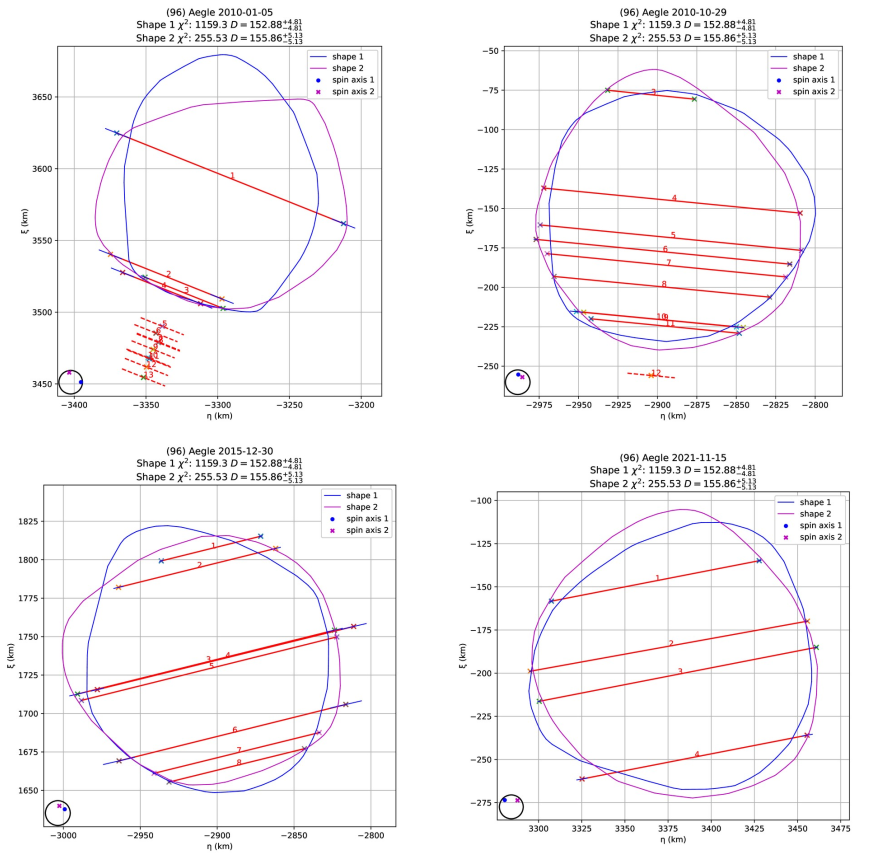
Julia Perła, Anna Marciniak, Antoine Choukroun, Edyta Podlewska-Gaca, and Kacper Najda and the team of observers

Context:
Stellar occultation databases gather many high-quality, multichord results of occultation phenomena (Herald et al. 2024, SODIS). This data is a great foundation for determining physical properties of asteroids, such as size and shape (Herald et al. 2020). In order to determine an asteroid size, it is possible to fit a sphere, ellipsoid, or spin and shape model to chords from a stellar occultation campaign (Durech et al. 2011, Herald et al. 2020). As is known from multiple space missions, asteroid shapes are mostly irregular. Therefore, the most accurate method for determining asteroid sizes is through the fitting of complex shape models, rather than ellipsoids. Accurate diameters in turn allow, for instance, better density constraints (Carry 2012).

Aims:
There is a significant number of asteroids with valuable stellar occultation data, but no shape model. The primary reason for the absence of a spin and shape model is typically an insufficient amount of photometric data. Therefore, we conducted an observing campaign to collect rotational lighcurves in additional apparitions of these targets.

Methods:
Asteroids were modelled using the convex inversion method (Kaasalainen, Torppa 2001, Kaasalainen et al. 2001) and then scaled with rich stellar occultation data (Durech et al. 2011).

Results:
We modelled spins and shapes of a few main belt asteroids. This permitted the precise determination of the asteroid diameters, narrowing the range of diameters determined by the infrared studies. Moreover, for some targets we resolved the mirror-pole ambiguity.

Figure 1: Sample result: shape model of asteroid (96) Aegle fitted to stellar occultations. Red solid lines indicate positive chords (where the occultation was observed), while red dashed lines represent negative chords (where no occultation was detected). The two spin and shape solutions are distinguished by color. The symbol in the lower left corner indicates the model spin axis orientation: the "x" marks the spin-axis vector pointing into the plane (away from the observer), and the "•" marks the vector pointing out of the plane (toward the observer). In this case, Shape 2 provides a better fit to the occultation data. The estimated equivalent volume diameter is (156 ± 5) km.

References:
Herald D., et al. 2024. Asteroid Occultations V4.0. NASA Planetary Data System
Stellar Occultation Data Input System (SODIS), https://sodis.iota-es.de
Durech, J., Kaasalainen, M., Herald, D., et al. 2011, Icarus, 214, 652
Herald, D., Gault, D., Anderson, R., et al. 2020, MNRAS, 499, 4570
Carry B. 2012. Planet. Space Sci., 73, 98
Kaasalainen, M. & Torppa, J. 2001, Icarus, 153, 24
Kaasalainen, M., Torppa, J., & Muinonen, K. 2001, Icarus, 153, 37

How to cite: Perła, J., Marciniak, A., Choukroun, A., Podlewska-Gaca, E., and Najda, K. and the team of observers: Asteroid Shape Modelling Driven by Archival Stellar Occultation Data, EPSC-DPS Joint Meeting 2025, Helsinki, Finland, 7–13 Sep 2025, EPSC-DPS2025-101, https://doi.org/10.5194/epsc-dps2025-101, 2025.

F153
|
EPSC-DPS2025-134
|
ECP
|
On-site presentation
Bianca Ranieri, Andrea Raponi, Maria Cristina De Sanctis, and Monica Pondrelli

Introduction

Ceres provides key insights into volatile-rich body evolution. Dawn showed Ceres' impact-modified surface involves subsurface volatiles. Recent craters reveal the shallow subsurface and ongoing geological activity. Oxo crater, a small (~9 km diameter) and geologically young feature (~1-10 Myr old; Combe et al., 2016; Nathues et al., 2017) located in Ceres' northern hemisphere (42.20°N, 359.75°E), is notable for its prominent exposures of water ice on its southern crater wall.

We integrate spectral/geological analyses to characterize ice properties (thermal state, grain size, abundance, distribution) and constrain its origin and role in recent surface evolution.

Data and Methods

  • Spectral Analysis: We used Dawn VIR data (1.0–4.2 µm; De Sanctis et al., 2011), covering diagnostic water ice and carbonate absorption features. Pixels in/around Oxo crater were classified into four compositional types based on 2.0 µm ice and 4.0 µm carbonate absorption strengths: 1A (water ice and carbonates present), 1B (water ice present, carbonates weak), 1C (carbonates present, water ice absent), and 1D (Ceres’ average surface composition).

  • Radiative Transfer Modeling: To quantify ice unit (1A, 1B) properties, we modeled spectra via Hapke theory (Hapke, 2012) using ice optical constants (Mastrapa et al., 2009) from 50-150 K. Areal mixing models (using 1C/1D and ice endmembers) yielded ice T, granulometry, and abundance. A linear correction addressed residual continuum slopes.
  • Geological Mapping: Geomorphological mapping used Dawn FC images in QGIS, aided by a high-resolution DEM produced via ISIS stereo. This involved identifying and delineating structural (fractures), surface textures and features such as crater walls, taluses slump blocks, flow-like features, and the distribution of high-albedo materials potentially associated with ice deposits.

Results

  • Spectral Modeling: Our analysis indicates that areal mixing models provide better fits for VIR spectra of ice-bearing units compared to intimate mixing models in accordance with previous studies (Combe et al., 2016, 2019; Raponi et al., 2016;). The best-fit parameters for the two ice-bearing classes under areal mixing are:
    • Class 1A: effective ice temperature of T ≈ 110 K,  grain size of ~125 µm, and ice abundance of ~1.4%.
    • Class 1B: also T ≈ 110 K, but a distinct grain size of ~105 µm and ice abundance of ~2.0%.
  • Geological Analysis: Preliminary mapping reveals complex wall structures with evidence of slumping and terracing, particularly on the pole-facing slopes where ice exposures are concentrated. The spatial distribution of the spectrally classified units (1A, 1B, 1C, 1D) is being actively correlated with these mapped geomorphic features.

Discussion

The derived effective temperature of ~110 K for water ice in both dominant spectral classes (1A and 1B) is noteworthy. This temperature is significantly lower than Ceres' average daytime surface temperature (Combe et al., 2016; Formisano et al., 2019) but may reflect diurnal temperatures in pixel-scale micro-shadowed regions. The distinction between Class 1A and 1B, primarily in grain size, suggests potential differences in formation mechanism, exposure age, or subsequent surface processing (preferential sublimation, regolith mixing).

The slightly higher abundance and smaller grain size of Class 1B might indicate relatively fresher or purer ice exposures compared to Class 1A, where ice and carbonates appear more co-located. Additionally the presence and distribution of Class 1C pixels are also significant. This observation could represent several scenarios: areas where water ice, perhaps initially associated with carbonates as in Class 1A, has subsequently sublimated away, leaving a carbonate-enriched lag deposit; locations where carbonates were emplaced via a distinct process (impact-related, endogenic activity) not directly linked to the currently observed primary ice exposures; or surfaces where ice might persist below VIR's detection limits. Understanding the origin of these carbonate-rich, ice-poor areas, together with ice rich areas, is key to interpreting the evolution of volatile exposures and the driving mechanism for geology within Oxo.

The geological mapping aims to determine if these different spectral units (1A, 1B, and 1C) correlate spatially with morphological features. Are slumps predominantly associated with a particular ice type (1A vs 1B), suggesting a causal link between ice properties (abundance, perhaps influencing mechanical strength) and mass wasting? Furthermore, analyzing the spatial relationship between the ice-bearing units (1A, 1B) and the carbonate-dominant units (1C) can provide constraints on transport mechanisms, relative emplacement timing, and the longevity of exposed ice. Integrating spectral data with geomorphology constrains Oxo's evolution and how near-surface materials modify Ceres' craters, informing volatile-rich small body surface dynamics.

Conclusions

Our integrated analysis of VIR spectroscopy and geological mapping reveals distinct compositional units, including populations of water ice, within the young Oxo crater on Ceres. Characterized by an effective temperature of ~110 K but differing grain sizes, abundances, and significant variations in association with carbonates, these surface materials likely reflect complex emplacement and modification histories. Ongoing work correlating these spectral units with detailed geomorphological mapping will further understanding about the role of water ice and associated non-ice components in controlling surface evolution and mass wasting processes on Ceres. This study highlights the synergy between spectral modeling and geological investigation in deciphering the activity and evolution of volatile-rich small bodies.

Bibliography

  • Combe J.-P. et al. (2016), Science, 353, aaf3010.

  • Combe J.-P. et al. (2019), Icarus, 318, 22.

  • De Sanctis M. C. et al. (2011), Space Sci. Rev., 163, 329.

  • Formisano M. et al. (2019), J. Geophys. Res. Planets, 124, 2.

  • Hapke B. (2012), Cambridge Univ. Press.

  • Mastrapa R. M. et al. (2009), Astrophys. J., 701, 1347.

  • Nathues A. et al. (2017), Astron. J., 154, 84.

  • Raponi A. et al. (2016), AAS/DPS Meet. Abstr., 48, #48.

How to cite: Ranieri, B., Raponi, A., De Sanctis, M. C., and Pondrelli, M.: Thermal State and Physical Properties of Water Ice in Ceres' Oxo Crater: Implications for Surface geomorphology and Evolution, EPSC-DPS Joint Meeting 2025, Helsinki, Finland, 7–13 Sep 2025, EPSC-DPS2025-134, https://doi.org/10.5194/epsc-dps2025-134, 2025.

F154
|
EPSC-DPS2025-235
|
On-site presentation
Hikaru Kubota, Shigeru Takahashi, Takahiro Iino, Hideo Sagawa, and Takashi Tsukagoshi

Although Pluto and its moon Charon may have undergone a process of co-evolution, their surfaces exhibit distinct characteristics in that Pluto is predominantly covered with nitrogen and methane ice, while Charon contains a greater abundance of water ice. Their albedo, surface emissivity, and thermal inertia—which all influence surface temperature—also differ significantly [Grundy et al., 2016, Science 351, 6279; Lellouch et al., 2016, A&A 588, A2]. Further investigation of the individual surface properties of Pluto and Charon will provide deeper insights into the evolutionary history of the Pluto system.

Separating Charon from Pluto (by an angular separation of ~0.9 arcseconds) has long been a challenge in observational studies. Most past ground-based and space-based observations (except for the New Horizons spacecraft) have lacked the spatial resolution to separate the two bodies, and the data have typically been analyzed as the combined Pluto system. However, radio interferometry in the submillimeter and millimeter wavelength ranges offers a solution to this problem. High spatial resolution observations of Pluto and Charon have previously been conducted with the Submillimeter Array (SMA) and Karl G. Jansky Very Large Array (VLA). In addition, the Atacama Large Millimeter/submillimeter Array (ALMA) enables us to achieve even higher spatial resolution. Furthermore, these long-wavelength observations are capable of probing thermal emissions from a few centimeters to several tens of centimeters beneath the surface.

In this study, we analyzed continuum emission images of Pluto and Charon at a wavelength of 1.2 mm, obtained from the ALMA Science Archive (Project code: 2016.1.01100.S), which was reported preliminarily in the conference presentations [Butler et al., 2019, Pluto System After New Horizons 2019 (LPI Contrib. No. 2133)]. The observations had been carried out on September 27 and October 14, 2017. Using the Second Levels Quality Assurance (QA2) data, we found that observations achieved a spatial resolution of approximately 0.025 arcseconds—sufficient to resolve Pluto, whose apparent diameter is about 0.1 arcseconds. Thus, as expected, Pluto and Charon are clearly separated in the images. The disk-averaged brightness temperatures, averaged over three data sets, were measured as 22.9 ± 2.9 K for Pluto and 25.3 ± 3.0 K for Charon. These values are nearly 10 K lower than those reported in previous studies, which suggests a potential calibration error in the archived ALMA images.

We calculated the spatial distribution of thermal emission at 1.2 mm using a three-dimensional polygonal surface model for both Pluto and Charon. This model solves one-dimensional heat diffusion equation, each location on Pluto’s and Charon’s disks, from their orbital and rotational motions. Due to Pluto’s long orbital period and the significant tilts of its orbital plane (~17°) and rotational axis (~120°), latitudes above 60° experience polar days lasting more than one Earth year. By representing the surface as a mesh of polygons, it becomes possible to efficiently determine the areas illuminated by the Sun and those visible to the observer. This modeling approach also allows for straightforward application of the heat diffusion equation on a per-polygon basis, making it well suited for comparison with high-spatial-resolution thermal emission data, such as those provided by ALMA. While previous studies treated Pluto's albedo as uniformly 0.46 [Lellouch et al., 2016, A&A 588, A2] and Charon's albedo as uniformly 0.25 [Lellouch et al., 2011, Icarus 214, 701], we assigned spatially varying Pluto and Charon albedo values to each surface polygon based on latitude and longitude using New Horizons images [Buratti et al., 2017, Icarus 287, 207]. In this presentation, we report spectral emissivities derived from the ALMA measurements.

How to cite: Kubota, H., Takahashi, S., Iino, T., Sagawa, H., and Tsukagoshi, T.: Spectral emissivity of Pluto and Charon at millimeter wavelength inferred from spatially resolved observations of ALMA, EPSC-DPS Joint Meeting 2025, Helsinki, Finland, 7–13 Sep 2025, EPSC-DPS2025-235, https://doi.org/10.5194/epsc-dps2025-235, 2025.

F155
|
EPSC-DPS2025-312
|
On-site presentation
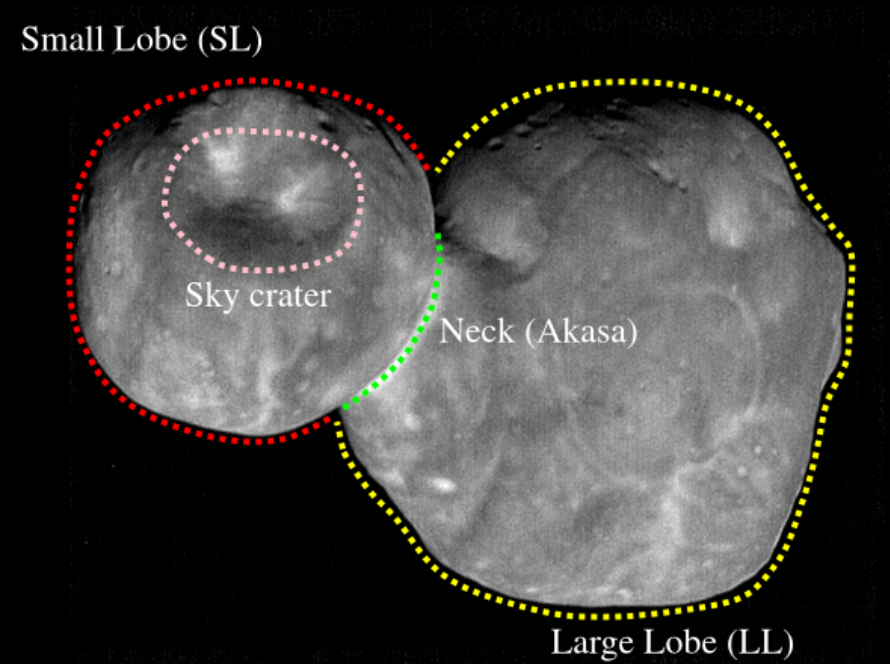
Rai Machado, Othon Winter, Rafael Sfair, André Amarante, and Fernando Azevedo

The New Horizons probe approached (486958) Arrokoth in January 2019, producing remarkable information about a trans-Neptunian object. The first images revealed a "snowman" shape with notable pits and craters on the surface, composed of a small lobe and a large lobe attached by a narrow neck. Thus, the elongated bilobate shape was classified as a contact binary (Fig. 1). 

Fig. 1. (486958) Arrokoth surface. The red dashed line encompasses the Small Lobe (SL), and the yellow one, the Large Lobe (LL). The pink dashed line indicates the Sky crater on the SL. The green dashed line is noticed at the neck (also called Akasa). Adapted from: NASA/Johns Hopkins University Applied Physics Laboratory/Southwest Research Institute/ESA.

Several studies have been conducted to analyze Arrokoth’s near environment and surface characteristics. However, its internal structure remains an open question, with aspects yet to be explored. Meyer and Scheeres (2024) studied the cohesive strength of Arrokoth and other contact binaries, fitting two ellipsoids to represent the bodies. Kim et al. (2024) investigated the cohesive strength regime of Arrokoth under the assumption that the Sky crater-forming event occurred after the formation of its bilobate shape. Geomorphological analysis from the mission images revealed structural feature differences between the two lobes, indicating the possibility that each lobe has distinct physical properties. Thus, this study aims to analyze its internal structure by considering a range of density values in each lobe and a constant spin period, assuming that all pits and craters were formed before the contact-binary attachment. Keane et al. (2022), considering a possible density range of 155–600 g/cm3, determined an optimal homogeneous bulk density of 235 g/cm3 for Arrokoth. In this work, we use the Finite Element Method to investigate static stress propagation in an elastic-plastic body under self-gravitational and centrifugal forces. The self-gravitational forces at each lobe were computed considering the density range proposed by Keane et al. (2022) (Fig. 2).

Fig. 2. Schematic representation of the densities in Arrokoth’s lobes under the xy plane view. We split the two lobes simply considering a division in x = -3900, y = z = 0. When it was assumed heterogeneous bulk density d1 ≠ d2, whilst on the homogeneous bulk density d1 = d2.

Our analysis was performed using the irregular shape of the object, creating a mesh with 34,575 elements and 51,674 nodes. Hooke’s law behavior was assumed to compute the stress-strain relationship in the elastic state. In the plastic state, we employed the Drucker–Prager criterion. In both elastic and plastic states, we assume icy parameters (i.e., Young’s modulus, Poisson’s ratio, and friction angle) to represent the object’s material properties. From the analysis, the minimum cohesion required to maintain the object’s structural integrity was defined. The results showed a tendency for failure propagation around the neck of the object, caused in most cases by compressive stress. We also identified the lowest cohesion when each lobe had different density values. Finally, we generated a global cohesion map for each assumed density (Fig. 3) and identified potential failure regions on the Arrokoth shape structure.

Fig. 3. Arrokoth cohesion map. The x-axis represents the density of the small lobe, while the y-axis represents the density of the large lobe. The color bar indicates the minimum cohesion required for the object.

Acknowledgements
This study was financed by CAPES, International Cooperation Project number 3266, FAPESP - Proc. 2022/01678-0 and CNPq - Proc. 316991/2023-6.

References
KEANE, James T. et al. The geophysical environment of (486958) Arrokoth—A small Kuiper belt object explored by New Horizons. Journal of Geophysical Research: Planets, v. 127, n. 6, p. e2021JE007068, 2022.
KIM, Yaeji; HIRABAYASHI, Masatoshi; BAUER, James. Numerical Investigation of the Cohesive Strength Regime of the Bilobated Arrokoth after the Sky-crater-forming Impact Event. The Planetary Science Journal, v. 5, n. 11, p. 241, 2024.
MEYER, Alex J.; SCHEERES, Daniel J. The strength and shapes of contact binary objects. The Astrophysical Journal Letters, v. 963, n. 1, p. L14, 2024.

How to cite: Machado, R., Winter, O., Sfair, R., Amarante, A., and Azevedo, F.: On the cohesion of the TNO Arrokoth across different density ranges, EPSC-DPS Joint Meeting 2025, Helsinki, Finland, 7–13 Sep 2025, EPSC-DPS2025-312, https://doi.org/10.5194/epsc-dps2025-312, 2025.

F156
|
EPSC-DPS2025-503
|
On-site presentation
Dagmara Oszkiewicz, MIlagros Colazo, Patrycja Poznaniak, Alvaro Alvarez-Candal, Benoit Carry, Wiktoria Stefanowska, and Aleksandra Wenda

The asteroid phase coloring effect manifests as variations in spectral slopes, color indices, albedo, and absorption band depths as a function of phase angle. To date, the effect has been observed in a limited number of asteroids through spacecraft and ground-based observations, though laboratory meteorite measurements, and sparse photometric survey data (e.g., ATLAS, SDSS).

In this study, we evaluate the detectability and reliability of phase coloring detection using sparse photometric data from several large-scale surveys (ATLAS, ZTF, SDSS, LSST, Euclid, and VISTA). We simulate survey spectral slopes based on laboratory meteorite spectra and survey-specific filter sets to estimate the expected magnitude of the coloring effect for various meteorite types and surveys.

By simulating uncertainties in color indices and phase curve parameters, we define detection thresholds for the expected slope variations. Our analysis shows that detecting phase coloring requires stringent constraints on both color uncertainties and phase curve fits. Using actual survey data, we assess whether reliable detections of phase coloring are currently achievable, and for which subset of observed asteroids. These results provide a quantitative framework for interpreting the subtle coloring effect and for optimizing future observational strategies.

How to cite: Oszkiewicz, D., Colazo, M., Poznaniak, P., Alvarez-Candal, A., Carry, B., Stefanowska, W., and Wenda, A.: Phase coloring of asteroids: Detection limits for survey photometry, EPSC-DPS Joint Meeting 2025, Helsinki, Finland, 7–13 Sep 2025, EPSC-DPS2025-503, https://doi.org/10.5194/epsc-dps2025-503, 2025.

F157
|
EPSC-DPS2025-750
|
ECP
|
On-site presentation
Ziyu Liu, Shunjing Zhao, Xian Shi, Daniel Hestroffer, and Man-To Hui

Photocentre displacement is a well-known effect in optical observations of extended celestial bodies such as asteroids. It shows a shift in the observed position with respect to the actual centre of mass. This shift is linked to the physical properties of asteroids, such as surface composition, shape and size [1][2].

Similarly, in millimeter/sub-millimeter observations, the derived position of the target is usually the thermal centre, i.e.position of the peak flux density  which may differ from the barycentre (the center of mass) due to the high resolution of the instrument. These differences can be of the order of a few milli-arcseconds. In a recent study on Kalliope-Linus, a main-belt binary asteroid system, a discrepancy was found between the separation of Kalliope and Linus obtained from ALMA data and that predicted by the ephemeris [3]. In this study, we aim to investigate this difference by considering the offset between the thermal centre and the centre of mass.

For each ALMA observation, we simulate the temperature distribution of Kalliope at different depths with a one-dimensional numerical thermophysical model [4]. By translating subsurface temperatures to thermal flux density, we could estimate the thermal center of Kalliope in each observation as well as its offset to barycenter. The estimates are then used to calibrate the observations for comparison with the ephemeris. In addition, it is possible to update the mutual orbit of the Kalliope system using this revised data.

[1] L. Lindegren, “Meridian observations of planets with a photoelectric multislit micrometer.,”, vol. 57, no. 1-2, pp. 55–72, May 1977

[2] D. Hestroffer, “Photocentre displacement of minor planets: analysis of HIPPARCOS astrometry,”, vol. 336, pp. 776–781, Aug. 1998.

[3] Katherine de Kleer et al 2024, Surface properties of the Kalliope-Linus system from ALMA and VLA data

[4] Shunjing Zhao et al 2024, Deep operator neural network applied to efficient computation of asteroid surface temperature and the Yarkovsky effect

How to cite: Liu, Z., Zhao, S., Shi, X., Hestroffer, D., and Hui, M.-T.: Analysis of thermalcentre-barycentre offsets and application to ALMA observations, EPSC-DPS Joint Meeting 2025, Helsinki, Finland, 7–13 Sep 2025, EPSC-DPS2025-750, https://doi.org/10.5194/epsc-dps2025-750, 2025.

F158
|
EPSC-DPS2025-1020
|
Virtual presentation
Alvaro Alvarez-Candal, Juan Luis Rizos, Milagros Colazo, René Duffard, David Morate, Valerio Carruba, Julio I.B. Camargo, and Andrés Gómez

Phase curves of small bodies are useful tools to obtain their absolute magnitudes and phase
coefficients. The former relates to the object’s apparent brightness, while the latter relates to how
the light interacts with the surface. Data from multi-wavelength photometric surveys, which usually
serendipitously observe small bodies, are becoming the cornerstone of large statistical studies of the
Solar System. Nevertheless, to our knowledge, all studies have been carried out in visible wavelengths.
Aims. We aim to provide the first catalog of absolute magnitudes in near-infrared filters (Y, J, H, and K).
We will also study the applicability of the HG*12 model to these data and compare it with a simple
linear model.

In this work, we compute the absolute magnitudes using two photometric models: the HG*12 and the
linear model. We use a combination of Bayesian inference and Monte Carlo sorting to compute the
probability distributions of the absolute magnitudes and corresponding phase coefficients. We use the
combination of four near-infrared photometric catalogs to create our input database.
We produced the first catalog of near-infrared magnitudes, obtaining absolute magnitudes for > 10,000
objects (with at least one absolute magnitude measured) and about 180 objects with the four absolute
magnitudes. We confirmed that a linear model that fits the phase curves produces accurate results. We
also detect a phase coloring effect in the near-infrared, as detected in visible wavelengths for asteroids
and trans-Neptunian objects.

How to cite: Alvarez-Candal, A., Rizos, J. L., Colazo, M., Duffard, R., Morate, D., Carruba, V., Camargo, J. I. B., and Gómez, A.: Near Infrared Absolute Magnitudes of Asteroids, EPSC-DPS Joint Meeting 2025, Helsinki, Finland, 7–13 Sep 2025, EPSC-DPS2025-1020, https://doi.org/10.5194/epsc-dps2025-1020, 2025.

F159
|
EPSC-DPS2025-1161
|
ECP
|
On-site presentation
Xiang Tang, Xian Shi, Bin Cheng, Xiaoran Yan, Jianchun Shi, and Man-To Hui

Boulder displacement on comets, including the migration of rocks up to tens of meters and relocation of decimeter- to meter-scale debris, are critical processes in reshaping the nucleus as well as redistributing volatile materials. During its over-two-year rendezvous with comet 67P/Churyumov–Gerasimenko (hereafter 67P), European Space Agency’s Rosetta spacecraft revealed a wide range of boulder activities. Decimeter- to meter-scale chunks were detected in the near-nucleus coma, with many ultimately falling back onto the comet's surface [1,2,3]. Boulder migration was also observed directly on the nucleus, like falling and bouncing of chunks from cliffs [4,5]. Different scenarios have been proposed for the destabilization of cometary boulders, such as occurrence of an outburst underneath the boulder, seismic vibrations from nearby active sources [6,7], acceleration by the surrounding asymmetric gas field [3], and 'rocket force' caused by volatile activity within the boulder [8].

The most striking boulder displacement event occurred in the Khonsu region of 67P's southern hemisphere, where a ~30 m boulder was found to have moved ~140 m during the perihelion passage [6]. Recently, via a systematic search through imaging data obtained by Rosetta's OSIRIS camera system, we successfully narrowed the time of this event to within 14 hours on October 3, 2015 [8]. Observations also show numerous changes in the boulder's surrounding area, as well as localized night-time dust activities coinciding with the displacement [8]. These new observational constraints enable synthetic analysis on the boulder's triggeringmechanism in the context of its thermal history and dynamical environment.

In this work, we present latest findings in investigating the unique event of Khonsu boulder. Leveraging the Discrete Element Method (DEM), we investigate the destabilization of the boulder under various conditions. Drawing from methodologies previously applied to asteroid surface evolution [e.g.,9, 10], we model 67P's nucleus surface as a granular medium, with physical properties constrained by Rosetta's in-situ observation data including those derived from Philae's landing dynamics [11,12,13]. Our simulations incorporate realistic topography, mechanical and thermal properties to assess the susceptibility of boulders of different scales to destabilizing forces. Preliminary results suggest the critical role of the comet's seismic efficiency in governing the mobility of large surface blocks, comparable to the impact-induced seismic shaking dynamics on asteroids [14,15]. These findings provide new insights into the physical conditions required to trigger major boulder displacements on comets, with direct implications for understanding surface evolution and volatile redistribution across small Solar System bodies.


References

1. Agarwal, J. et al. Evidence of sub-surface energy storage in comet 67P from the outburst of 2016 July 03. Monthly Notices of the Royal Astronomical Society 469, s606–s625 (2017).

2. Pfeifer, M., Agarwal, J. & Schröter, M. On the trail of a comet’s tail: A particle tracking algorithm for comet 67P/Churyumov-Gerasimenko. A&A 659, A171 (2022).

3. Shi, X. et al. Diurnal Ejection of Boulder Clusters on Comet 67P Lasting beyond 3 au. ApJL 961, L16 (2024).

4. Pajola, M. et al. The pebbles/boulders size distributions on Sais: Rosetta’s final landing site on comet 67P/Churyumov–Gerasimenko. Monthly Notices of the Royal Astronomical Society 469, S636–S645 (2017).

5. Vincent, J.-B. et al. Bouncing boulders on comet 67P. in vol. 13 EPSC-DPS2019-502 (2019).

6. El-Maarry, M. R. et al. Surface changes on comet 67P/Churyumov-Gerasimenko suggest a more active past. Science 355, 1392–1395 (2017).

7. Hasselmann, P. H. et al. Pronounced morphological changes in a southern active zone on comet 67P/Churyumov-Gerasimenko. A&A 630, A8 (2019).

8. Tang, X., Shi, X. & El-Maarry, M. R. Boulder Migration in the Khonsu Region of Comet 67P/Churyumov–Gerasimenko. ApJ 979, 91 (2025).

9. Richardson, D. C., Walsh, K. J., Murdoch, N. & Michel, P. Numerical simulations of granular dynamics: I. Hard-sphere discrete element method and tests. Icarus 212, 427–437 (2011).

10. Cheng, B. et al. Reconstructing the formation history of top-shaped asteroids from the surface boulder distribution. Nat Astron 5, 134–138 (2020).

1 Biele, J. et al. The landing(s) of Philae and inferences about comet surface mechanical properties. Science (2015).

12. Wu, X., Küppers, M., Grieger, B. & Shang, H. Characterization of the Agilkia region through discrete-element simulation of Philae’s rebound. A&A 630, A14 (2019).

13. O’Rourke, L. et al. The Philae lander reveals low-strength primitive ice inside cometary boulders. Nature 586, 697–701 (2020).

14. Miyamoto, H. et al. Regolith Migration and Sorting on Asteroid Itokawa. Science 316, 1011–1014 (2007).

15. Richardson, J. E., Steckloff, J. K. & Minton, D. A. Impact-produced seismic shaking and regolith growth on asteroids 433 Eros, 2867 Šteins, and 25143 Itokawa. Icarus 347, 113811 (2020).

How to cite: Tang, X., Shi, X., Cheng, B., Yan, X., Shi, J., and Hui, M.-T.: Boulder Mobility on Comets: Insights from Rosetta Observations and Numerical Modelling, EPSC-DPS Joint Meeting 2025, Helsinki, Finland, 7–13 Sep 2025, EPSC-DPS2025-1161, https://doi.org/10.5194/epsc-dps2025-1161, 2025.

F160
|
EPSC-DPS2025-1334
|
On-site presentation
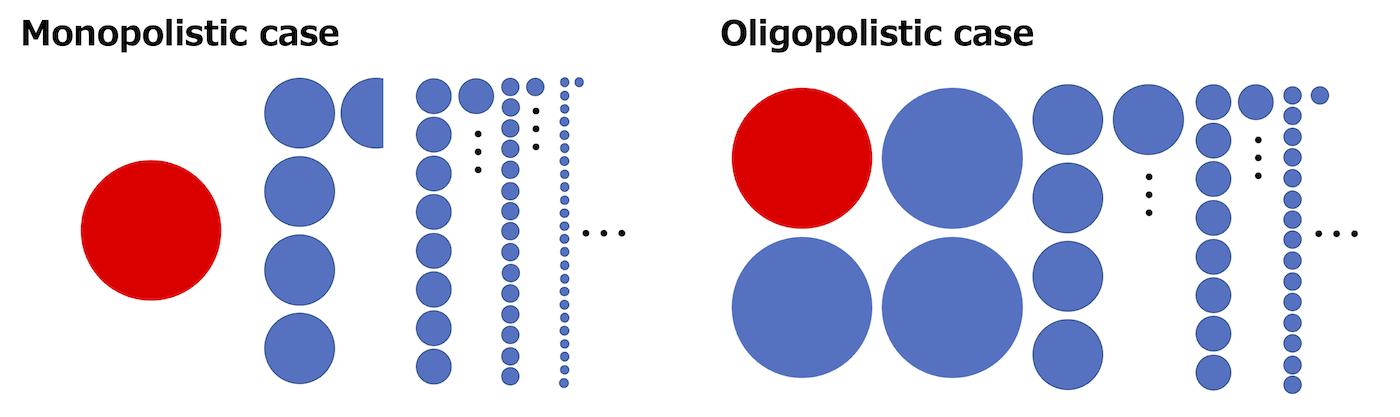
Naru Hirata

The existence of rubble pile asteroids, such as Itokawa, Ryugu, and Bennu, is widely recognized. Despite sharing a common formation process, aggregation of fragments produced by the disruption of a parent body, these asteroids exhibit considerable morphological diversity. For example, Ryugu has a spinning top-like shape, with a triaxial ratio of b/a = 0.96 and c/a = 0.87 [1]. In contrast, the overall triaxial ratio of Itokawa is b/a = 0.55 and c/a = 0.39 [2, 3]. Even when divided into "head" and "body" regions, the body retains an elongated form with a triaxial ratio of b/a = 0.63 and c/a = 0.53 [4]. Recent spacecraft observations of other asteroids with possible rubble pile structures have also revealed that each asteroid possesses a unique shape and displays a wide range of axial ratios.

The diversity in asteroid shapes is further supported by light curve observations obtained from both ground-based and space-based telescopes. Statistical analyses of light curves for main belt asteroids indicate that bodies with diameters less than 10 kilometers, which are likely to have rubble pile structures based on their collisional lifetimes, exhibit axial ratios b/a ranging approximately from 1.0 to 0.4, with a peak near b/a = 0.6 [5].

The objective of this study is to clarify, through rigid body simulations, the range of possible asteroid shapes that can be formed through realistic rubble pile accumulation processes. Fragments resulting from impact disruption of a parent body are modeled as rigid bodies, and their random accumulation is simulated to evaluate the resulting final shapes.

In this study, the rubble pile accumulation process is modeled using Chrono, an open source physics simulation engine. Chrono is designed for multi-physics applications, offering a comprehensive suite of tools for simulating the dynamics of rigid bodies, soft bodies, and fluids under a variety of conditions [6]. Ferrari and Tanga (2020; 2022) have applied Chrono to the modeling of rubble pile asteroid accumulation [7-8].

The axial ratio of the collisional fragments is set to 2:√2:1, which corresponds to typical shapes observed in laboratory impact experiments and is also consistent with the morphology of boulders found on asteroid surfaces. Each simulation includes several hundred to approximately one thousand fragments, prepared according to a size-frequency distribution (SFD) that follows a power law. The standard power law index is set to –2.5. Additional SFDs with indices of –2.25 (representing fewer small fragments) and –2.75 (representing more small fragments) are also examined. Two scenarios for the distribution of the largest fragments are considered: a Monopolistic case with a single largest fragment, and an Oligopolistic case with four largest fragments of equal maximum size (Fig. 1). In total, six distinct SFD configurations are investigated.

Fig. 1. Size-frequency distribution cases in this study.

Simulations are initialized by placing the largest fragment first, followed by the sequential addition of the remaining fragments in random order (Fig. 2). In most runs, the initial fragment is not rotating. However, for the case with a power law index of –2.5, additional simulations are performed in which the initial fragment is assigned spin rates equal to one and two times the critical spin limit.

Fig. 2. Example of a rubble-pile formed from a monopolistic case run.

The results are presented in Fig. 3. These plots show the distributions of axial ratios for rubble pile asteroids formed through the simulations. Each plot includes the mean axial ratios for each simulation run, along with the observed axial ratios of asteroids investigated by spacecraft and the initial axial ratio of the fragments. Above each scatter plot, a histogram of the b/a is shown, along with a reference histogram axial ratios estimates for main belt asteroids smaller than 10 km in diameter, derived from telescope observations.

Figure 3. Distributions of axial ratios of rubble-pile asteroids formed by the simulation.

In all simulation cases, a large number of rubble pile asteroids were formed with axial ratios similar to those of top-shaped bodies such as Ryugu and Bennu. However, asteroids with highly elongated shapes, like Itokawa, were rarely produced. Only in one instance—a case with a power law index of - 2.25 and a fragment distribution dominated by a few large bodies—was a rubble pile asteroid formed with an axial ratio comparable to that of the body region of Itokawa.

These results indicate that within the range of parameters explored in this study, the formation of elongated rubble pile asteroids observed by spacecraft and inferred from telescope data is unlikely. In general, fragments arriving in the later stages of the accumulation process tend to settle in regions of low gravitational potential on the rubble pile surface. This effect likely leads to the formation of more spheroidal shapes, as observed in the simulations.

Itokawa is considered to be a rubble pile asteroid with high confidence, based on its high macroporosity. Therefore, in future work, it is necessary to expand the parameter space of the simulations in order to explore more realistic scenarios under which elongated rubble pile asteroids, such as Itokawa and others, could form.

How to cite: Hirata, N.: Rigid-Body Simulations of Rubble Pile Accumulation: Implications for Asteroid Shape Diversity, EPSC-DPS Joint Meeting 2025, Helsinki, Finland, 7–13 Sep 2025, EPSC-DPS2025-1334, https://doi.org/10.5194/epsc-dps2025-1334, 2025.

F161
|
EPSC-DPS2025-1522
|
ECP
|
On-site presentation
Rawdha Albeshr, Bijay Guha, Claus Gebhardt, and Neha Gupta

Thermal stress arises within materials due to expansion or contraction caused by temperature variations. On airless planetary bodies, such stresses play a critical role in the breakdown of surface materials subjected to repeated heating and cooling cycles. Previous analytical studies have shown that thermal stress amplitude and phase lag are influenced by an object's spin rate, size, thermal inertia, and material properties, particularly in the context of S-type asteroids. Ravaji et al. (2019) developed a one-dimensional heat diffusion and thermal stress model to evaluate subsurface temperature and stress profiles for rocks of varying sizes. Building on this framework, the present study extends the analysis by incorporating parameters such as rotation period, heliocentric distance, albedo, thermal inertia, density, and thermal expansion coefficient to evaluate both macroscopic and microscopic thermal stresses in airless bodies.

This work focuses on quantifying the magnitude and phase of thermal stress, along with the temperature profiles from the surface to subsurface layers, for the seven target asteroids of the Emirates Mission to the Asteroid Belt (EMA): 10253 Westerwald, 623 Chimaera, 13294 Rockox, 88055, 23871, 59980, and 269 Justitia (Parker et al., 2024). In addition to thermal characterization, the study also aims to perform dynamic characterization and potential family classification using Hierarchical Clustering Methods, as well as trajectory simulations based on data from the JPL Horizons ephemeris service and the Minor Planet Center database. 

Acknowledgments: The authors would like to acknowledge support by National Space Science and Technology Center (NSSTC), UAE University.

References:

[1] Parker, J. S., Al Hameli, F. S., Knittel, J., Pilinski, E., Baskar, S., Imler, P., & Almashjari, M. H. Proximity operations strategy for the Emirates mission to explore the asteroid belt (EMA).

[2] Ravaji, B., Alí‐Lagoa, V., Delbo, M., & Wilkerson, J. W. (2019). Unraveling the mechanics of thermal stress weathering: Rate‐effects, size‐effects, and scaling laws. Journal of Geophysical Research: Planets, 124(12), 3304-3328.

How to cite: Albeshr, R., Guha, B., Gebhardt, C., and Gupta, N.: Orbital and Thermal Characterization of Target Asteroids for the Emirates Mission to the Asteroid Belt, EPSC-DPS Joint Meeting 2025, Helsinki, Finland, 7–13 Sep 2025, EPSC-DPS2025-1522, https://doi.org/10.5194/epsc-dps2025-1522, 2025.

F163
|
EPSC-DPS2025-1578
|
On-site presentation
Xiaoran Yan
Introduction
Small bodies in the Solar System (asteroids, comets, etc.) are covered by layers of regolith whose distribution and evolution record their collisional histories. Hypervelocity impacts not only produce new ejecta but also drive seismic shaking that can mobilize or erase existing regolith. For example, detailed analysis of regolith particles from Itokawa (Hayabusa) shows that meteoroid impacts formed much of the regolith, and subsequent seismic-induced grain motion steadily abrades and sorts these grains [1]. Likewise, high-resolution imaging of asteroid Eros revealed a paucity of small craters and evidence of downslope regolith flows that are well explained by impact-driven seismic shaking [2]. Laboratory experiments on granular media reinforce these ideas: even low-velocity impacts cause measurable surface grain motion that decays with distance from the crater, indicating that impacts of all sizes can induce regolith displacement [3]. Recent modeling of Eros's surface confirms that large impacts (e.g. the Shoemaker crater) excite global resurfacing because Eros's interior is highly dissipative [4]. 
 
Observational evidence underscores that regolith can be globally "refreshed" on short timescales. In situ measurements show that Itokawa's regolith has cosmogenic exposure ages < 10 Myr, much younger than the ~75 Myr age of the body itself [1], implying recent widespread resurfacing. Similarly, Bennu (OSIRIS-REx) exhibits ubiquitous mass-movement features: boulder flows and deposits (e.g. in Bralgah Crater) attest to ongoing regolith transport under impacts and spin-induced processes [5]. These studies highlight how even small bodies can rapidly reshuffle their surface. In contrast, highly spinning objects like 2016 HO3 (Kamoʻoalewa) challenge regolith stability: modeling shows that only very fine (mm–cm) grains can remain attached (with cohesion <0.2 Pa), and any disturbed regolith tends to slide and bounce until escaping [6]. Thus, a critical open question is how impact energy, material strength, and body shape govern where regolith is eroded, transported, or retained on small bodies.
 
Methods
To address this, we develop a unified theoretical and numerical framework to model regolith “refresh” driven by impacts. Our approach combines analytical scaling with high-resolution, mesh-free simulations. We use the Material Point Method (MPM) to obtain the stress wave propagation subject to impacts. MPM naturally handles large deformations and discontinuous flows without a fixed mesh, making it well-suited for simulating ejecta and landslides [7]. We will first consider idealized spherical bodies, constructing models with tunable bulk strength, gravity, and cohesion. For each simulation, a hypervelocity impact is applied (varying energy/impactor size and incidence) and the regolith response is tracked. We quantify three outcomes: (1) Escape of material into space, (2) Migration of particles (e.g. downslope transport or ballistically redeposited material), and (3) Stability (areas where regolith remains largely undisturbed). Key parameters include impact energy, target and regolith cohesion, grain size, and rotation rate.
 
Discussions
Conceptually, our model predicts how different impact regimes refresh small-body surfaces. On spherical rubble piles, we expect a critical impact energy above which most surface regolith is globally disturbed or lost (leading to a “fresh” surface and erasure of small craters). Below this threshold, impacts produce localized disturbances: for a rotating body, material tends to migrate toward low-potential regions (e.g. equator) while leaving poles relatively unchanged. Incorporating cohesion, we anticipate that cohesive regolith will resist motion up to higher impact energies, creating a dependence of surface maturity on grain binding forces.
 
By linking hypervelocity impacts to the spatial pattern of regolith erosion and deposition, it will help interpret the contrasting surface ages and properties observed on asteroids and meteorite parent bodies (e.g. Itokawa, Ryugu, Bennu). Ultimately, understanding the regolith "refresh" process is essential for using crater records to date surfaces and for predicting sample maturity for future missions.
 
References
[1] Tsuchiyama, A. et al. (2011) Sci. 333(6046).
[2] Richardson, JE. et al. (2004) Sci. 306(5701).
[3] Neiderbach, M. et al. (2023) Icar. 390.
[4] Ballouz, RL. et al. (2025) Nat Astron. 9.
[5] Tang, Y. et al. (2023) Icar. 395.
[6] Li, X. et al. (2021) Icar. 357.
[7] Yan, X. et al. (2024) EPSC2024-1111.

How to cite: Yan, X.: Impact-Induced Regolith Renewal on Small Bodies, EPSC-DPS Joint Meeting 2025, Helsinki, Finland, 7–13 Sep 2025, EPSC-DPS2025-1578, https://doi.org/10.5194/epsc-dps2025-1578, 2025.

F164
|
EPSC-DPS2025-1591
|
ECP
|
On-site presentation
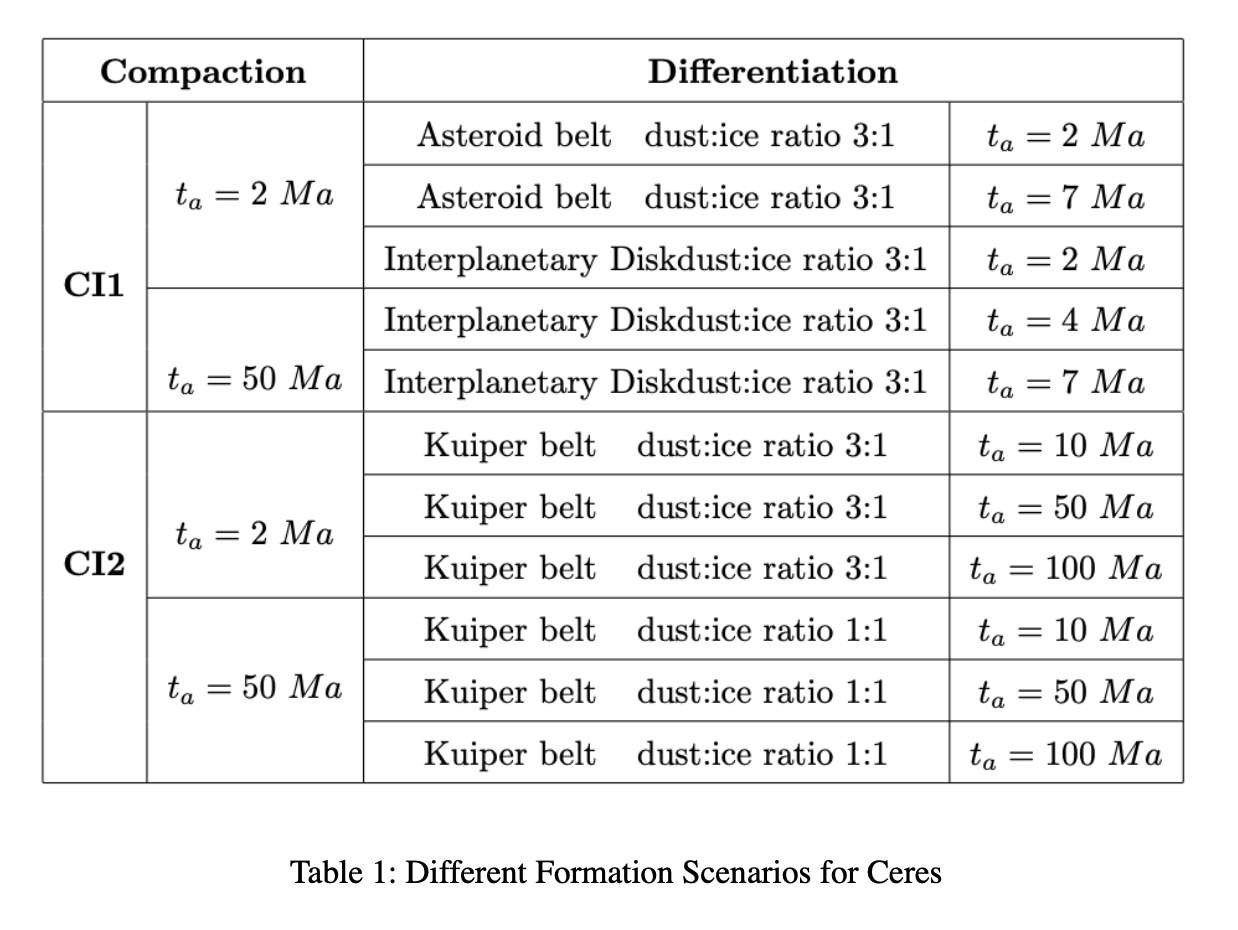
Delaram Darivasi, Jürgen Oberst, and Neumann Wladimir

Introduction:

Ceres, the largest body in the asteroid belt, became the first dwarf planet orbited by a spacecraft when NASA’s Dawn mission arrived in 2015. Located at 2.767 AU from the Sun and rotating every ~9.07 hours [1], recent gravity data suggest Ceres retains a fossil equatorial bulge, hinting at a faster past rotation, possibly despun by 6.5%, potentially resulting from the loss of a satellite or a major impact event [2,3,4]. 


Methodology:

We build on internal structure models from [5], exploring various formation and accretion scenarios (Table 1) to examine how Ceres’ interior evolution influences its angular velocity and energy state. Our primary focus is a scenario where Ceres accreted over 10 Ma in the Kuiper Belt with a 3:1 dust-to-ice ratio, then migrated to the asteroid belt ~600 Ma after CAI formation, completing the migration within 1 Ma. We analyze how this formation pathway affects the evolution of its MOI, angular velocity, kinetic energy, and potential energy, including an analytical approximation of the latter. The resulting normalized MOI is compared with the spacecraft-derived range of 0.345–0.375 [4] to assess the plausibility of this scenario.


Results:

MOI

Figure 1 illustrates how Ceres’s thermal and internal evolution influenced its MOI. In the 3:1 rock-to-ice composition scenario, early radiogenic heating was dominated by the rock component, primarily driven by short-lived isotopes. However, due to the prolonged accretion timescale of 10 Ma, most of the short-lived isotopes had decayed by the end of accretion. Consequently, internal heating was sustained mainly by long-lived isotopes. Formation in the cold Kuiper Belt further suppressed internal temperatures, limiting early differentiation. As a result, Ceres likely developed only a partially dehydrated silicate core, with substantial amounts of ice and porosity preserved in its interior. Despite this subdued internal evolution, the degree of differentiation and compaction was sufficient to reduce the MOI to ~0.369, which falls well within the observed range of 0.345–0.375. These results support are in line with the Kuiper Belt origin for Ceres, consistent with current geophysical constraints.


Angular Velocity

Figure 2 illustrates that the most significant angular velocity increase occurs in the Kuiper Belt formation scenario. As Ceres migrates from ~40–50 AU to ~2.7 AU, possibly associated with theLate Heavy Bombardment or the Nice Model, rising environmental temperatures cause internal restructuring, including ice sublimation and porosity collapse. Two spikes in angular velocity are evident in Figure 2: the first likely due to a differentiation in the cold Kuiper Belt (~50 K), drivenprimarily by radioactive isotopes, and the second resulting from restructuring in the warmer asteroid belt (~170 K), which caused mass redistribution, lowering the MOI and increasing angular velocity by ~45% to conserve angular momentum—significantly higher than the ~6% despin previously proposed by [4], who assumed a static internal structure.


Kinetic Energy

Figure 3 shows corresponding increases in kinetic energy during phases of angular velocity change. The sharp rises in KE coincide with internal differentiation events, highlighting the linkbetween structural evolution and rotational dynamics. These findings emphasize that rising temperatures during migration triggered the mechanical collapse of porous ice-rock mixtures and differentiation, releasing energy as Ceres adjusted to a new equilibrium state.


Gravitational Potential Energy

As shown in Figure 4, Ceres’ gravitational potential energy increases during accretion as mass accumulates and self-gravity strengthens. After accretion, fluctuations in potential energy reflect mass redistribution resulting from porosity reduction and internal differentiation. Earlyheating was significantly driven by the decay of short-lived nuclides, though this effect diminished rapidly, with long-lived isotopes sustaining a slower thermal evolution thereafter. Distinct steps in the potential energy curve correspond to major structural changes, particularly during the transition from Kuiper Belt to asteroid belt conditions.


Conclusion:

This study investigates how internal structure, thermal evolution, and migration history influence the rotational dynamics and energy budget of Ceres. Focusing on a Kuiper Belt formation scenario followed by inward migration, we find that the computed MOI values are consistent withcurrent gravity and shape data [4], supporting the plausibility of this origin. Notably, we show that Ceres’ angular velocity could have increased by ~45% due to internal restructuring driven by thermal changes and subsequent evolution, significantly higher than previous estimates [4].These findings highlight internal evolution and environmental transitions as key drivers of planetary spin states and energy distributions.

[1] M.A. Chamberlain et al., Icarus 188, 451 (2007).

[2] X. Mao and W.B. McKinnon, LPSC 47, 1637 (2016).

[3] X. Mao and W.B. McKinnon, LPSC 48, 2744 (2017).

[4] X. Mao and W.B. McKinnon, Icarus 299, 430 (2018).

[5] W. Neumann et al., A&A 633, A117 (2020).

How to cite: Darivasi, D., Oberst, J., and Wladimir, N.: Internal Structure and Dynamical Evolution of Ceres, EPSC-DPS Joint Meeting 2025, Helsinki, Finland, 7–13 Sep 2025, EPSC-DPS2025-1591, https://doi.org/10.5194/epsc-dps2025-1591, 2025.

F165
|
EPSC-DPS2025-1650
|
ECP
|
On-site presentation
Ranjan Sarkar, Nathues Andreas, Martin Hoffmann, and Maélie Coutelier

(1) Ceres is a relict ocean world in the inner Solar System, located in the middle asteroid belt at ~2.8 AU (Russell et al., 2016). Ceres has attracted the attention of the scientific community for several reasons—but the primary being the huge amount of water it contains. Remnants of recent endogenic activities (e.g. cryovolcanism) on its surface suggests that the water might still be in a liquid state, as evidenced  by large-area mudflows, pitted terrains, and the bright faculae material, likely originating from extrusions of brine (Nathues et al., 2016, 2017; De Sanctis et al., 2020; Scully et al., 2021; J. Castillo-Rogez et al., 2022). However, the distribution of liquid water within Ceres depends on the degree of differentiation the body underwent—a question that is not yet fully resolved. For example, it is not clear whether Ceres underwent a differentiation that segregated the water in a global ‘mantle’ layer or multiple discrete brine reservoirs, or if this water is pervasive across its volume (J. C. Castillo-Rogez et al., 2019; J. Castillo-Rogez, 2020; Neumann et al., 2020; Daswani & Castillo-Rogez, 2022; Nathues et al., 2022; Ruesch et al., 2019).

The recent discovery of a “yellow bright material” (yBM) at Consus crater has revealed that ammoniated phyllosilicates are produced by endogenous activities, as carbonaceous chondritic (CM/CI) materials can contain significant amounts of NH4+ (Nathues et al., 2024). However, yBM is only one of many spectrally anomalous color units that differ from the global average Ceres spectrum. Other anomalous color units appear both bright and dark, and occur in a variety of geological settings. In the absence of atmospheric processes, igneous and tectonic activity, and extensive space weathering beyond the top few centimetres, these units are also possibly of endogenous origin. Therefore, systematically identifying all regions on Ceres that differ from the average spectrum, and grouping them spectrally and spatially is essential to shed further light on the evolution of Ceres. Such a study can help us gain deeper insights into the state of Ceres’ differentiation and its phase state of water. In a differentiated (or partially differentiated) Ceres, spectral anomalies should show systematic depth dependencies (i.e., a layered structure) of exposed materials, with regional variations related to localized brine pockets. On the other hand, in an undifferentiated Ceres, the liquid is distributed throughout the interior in pore spaces and therefore, the spectral anomalies should display stochastic patterns. Moreover, correlating spectral features with crater ages could reveal changes in the water state and endogenic processes over geological time. In addition, spatial distribution patterns such as clustering at specific latitudes or longitudes, or in and around impact craters, or a random distribution can provide further geological insights into the origin of these spectrally anomalous sites.

With this objective, we are developing an automated pipeline to systematically identify and characterize spectrally anomalous sites across Ceres' surface using NASA Dawn's Framing Camera (FC) data (Sierks et al., 2011). Our pipeline uses an autoencoder to detect FC pixels that are spectrally different from the global average surface spectrum of Ceres, followed by morphological clustering and hierarchical clustering to group the sites based on spectral similarity. This approach allows us to identify and classify all major spectral units, including yBM sites and other yet undetected anomalous regions on Ceres.

References

Castillo-Rogez, J. (2020, May). Future exploration of Ceres as an ocean world. Nature Astronomy. Nature Research. https://doi.org/10.1038/s41550-020-1181-5

Castillo-Rogez, J., Neveu, M., Vinogradoff, V., Miller, K. E., Sori, M. M., Tosi, F., et al. (2022). Science Drivers for the Future Exploration of Ceres: From Solar System Evolution to Ocean World Science. The Planetary Science Journal, 3(3), 64. https://doi.org/10.3847/PSJ/ac502b

Castillo-Rogez, J. C., Hesse, M. A., Formisano, M., Sizemore, H., Bland, M., Ermakov, A. I., & Fu, R. R. (2019). Conditions for the Long-Term Preservation of a Deep Brine Reservoir in Ceres. Geophysical Research Letters, 46(4), 1963–1972. https://doi.org/10.1029/2018GL081473

Daswani, M. M., & Castillo-Rogez, J. C. (2022). Porosity-filling Metamorphic Brines Explain Ceres’s Low Mantle Density. The Planetary Science Journal, 3(1), 21. https://doi.org/10.3847/PSJ/ac4509

De Sanctis, M. C., Mitri, G., Castillo-Rogez, J., House, C. H., Marchi, S., Raymond, C. A., & Sekine, Y. (2020). Relict Ocean Worlds: Ceres. Space Science Reviews, 216(4), 60. https://doi.org/10.1007/s11214-020-00683-w

Nathues, A., Hoffmann, M., Platz, T., Thangjam, G. S., Cloutis, E. A., Reddy, V., et al. (2016). FC colour images of dwarf planet Ceres reveal a complicated geological history. Planetary and Space Science, 134, 122–127. https://doi.org/10.1016/J.PSS.2016.10.017

Nathues, A., Platz, T., Thangjam, G., Hoffmann, M., Mengel, K., Cloutis, E. A., et al. (2017). Evolution of Occator Crater on (1) Ceres. The Astronomical Journal, 153(3), 112. https://doi.org/10.3847/1538-3881/153/3/112

Nathues, A., Hoffmann, M., Schmedemann, N., Sarkar, R., Thangjam, G., Mengel, K., et al. (2022). Brine residues and organics in the Urvara basin on Ceres. Nature Communications, 13(1). https://doi.org/10.1038/s41467-022-28570-8

Nathues, A., Hoffmann, M., Sarkar, R., Singh, P., Hernandez, J., Pasckert, J., et al. (2024). Consus Crater on Ceres: Ammonium-Enriched Brines in Exchange With Phyllosilicates? Journal of Geophysical Research: Planets, 129(9), e2023JE008150.

Neumann, W., Jaumann, R., Castillo-Rogez, J., Raymond, C. A., & Russell, C. T. (2020). Ceres’ partial differentiation: undifferentiated crust mixing with a water-rich mantle. Astronomy & Astrophysics, 633, A117. https://doi.org/10.1051/0004-6361/201936607

Ruesch, O., Genova, A., Neumann, W., Quick, L. C., Castillo-Rogez, J. C., Raymond, C. A., et al. (2019). Slurry extrusion on Ceres from a convective mud-bearing mantle. Nature Geoscience, 12(7), 505–509. https://doi.org/10.1038/s41561-019-0378-7

Russell, C. T., Raymond, C. A., Ammannito, E., Buczkowski, D. L., Sanctis, M. C. D., Hiesinger, H., et al. (2016). Dawn arrives at ceres: Exploration of a small, volatile-rich world. Science, 353(6303), 1008–1010. https://doi.org/10.1126/science.aaf4219

Scully, J. E. C., Baker, S. R., Castillo-Rogez, J. C., & Buczkowski, D. L. (2021). The In Situ Exploration of a Relict Ocean World: An Assessment of Potential Landing and Sampling Sites for a Future Mission to the Surface of Ceres. The Planetary Science Journal, 2(3), 94. https://doi.org/10.3847/PSJ/abee28

Sierks, H., Keller, H. U., Jaumann, R., Michalik, H., Behnke, T., Bubenhagen, F., et al. (2011). The Dawn framing camera. Space Science Reviews, 163(1–4), 263–327. https://doi.org/10.1007/S11214-011-9745-4/METRICS


How to cite: Sarkar, R., Andreas, N., Hoffmann, M., and Coutelier, M.: Probing Ceres' Internal Structure Using Spectral Anomalies: A Machine Learning Approach, EPSC-DPS Joint Meeting 2025, Helsinki, Finland, 7–13 Sep 2025, EPSC-DPS2025-1650, https://doi.org/10.5194/epsc-dps2025-1650, 2025.

F166
|
EPSC-DPS2025-1839
|
ECP
|
On-site presentation
Comparison of surface geology of sub-kilometric to several kilometers size asteroids
(withdrawn after no-show)
Laura M. Parro, Adriano Campo Bagatin, and Stephen Schwartz
F167
|
EPSC-DPS2025-1966
|
ECP
|
On-site presentation
Sonasha Auer Wilkins, Jürgen Oberst, Alexander Stark, Hauke Hussmann, Andreas Benedikter, and Wladimir Neumann

Enceladus, a small icy moon orbiting Saturn, has become a key focus in the search for extraterrestrial life within our Solar System. Composed primarily of water ice, rock and other icy volatiles, Enceladus is part of a class of icy moons believed to harbor global oceans of liquid water underneath their crusts. With the presence of liquid water, the detection of life essential elements such as carbon, hydrogen, nitrogen, oxygen, phosphor and sulfur [1] (CHNOPS elements), and evidence of ongoing geothermal activity between the ocean and the rocky core of Enceladus [2], the moon meets the basic requirements for the existence of life and has therefore become a prime candidate for astrobiological research. To this end, the German Space Agency at DLR has launched the Enceladus Explorer (EnEx) initiative, a collaborative research project with the goal of studying Enceladus’ geophysical characteristics and searching for biosignatures by sampling the moon’s liquid subsurface water. As part of this initiative, the EnEx-RaTNOS (Radar Transponder based Navigation and Orbit Determination by Satellite) project aims to achieve precise orbit determination using radar transponders placed on Enceladus’ surface [3].

The determination of stable orbits is a fundamental prerequisite for precise orbit determination and is also of high importance for topographic mapping and measuring surface deformationhrough synthetic aperture radar (SAR) imaging, as proposed in above mentioned EnEx [4] [5]. A satellite orbiting Enceladus should have a low altitude, low eccentricity and a high inclination to provide global coverage with a focus on the south polar region. However, orbits with such properties around planetary satellites are notoriously unstable, with the planet’s gravitational perturbations causing the orbiting vehicle to impact the moon within short time periods [6]. The acquisition of SAR measurements imposes additional constraints on a satellite orbit [7]. For repeat-pass SAR, the SAR image acquisition is performed over two or more time instances by a single receiver, requiring a periodic orbit in which the ground track between an initial and a repeating orbit is parallel and repeats in a body-fixed reference frame. The distance between two consecutive ground tracks is constrained by the critical baseline B, which is in the range of several hundred meters for ka-band (26-40 GHz) and several kilometers for P-band (around 300 MHz) frequencies [8]. Short repeat periods are preferable due to the risk of decorrelation caused by surface changes occurring in the time interval between two image acquisitions.

This study focuses on determining stable and periodic orbits around Enceladus which fulfill the previously outlined requirements and includes a comparative evaluation of the orbit integration tools provided by the TU Delft Astrodynamics Toolbox (Tudat) and the DLR’s Particle Integrator (pInt), in order to verify the similarity of propagation results produced by both integration tools. Building on prior research by Benedikter et al. (2022) [8], a grid-search method is implemented with the goal of identifying combinations of initial values within a defined parameter space for semi-major axis, inclination and eccentricity which lead to stable and long-term repeating orbits around Enceladus. In contrast to Benedikter et al. (2022), the orbit integration is achieved using the integration method of Tudat rather than pInt and uses the more recent non-spherical gravity terms of Enceladus published by Park et al. (2024) [9]. In addition to the higher gravity terms of Enceladus, Saturn’s higher gravity terms are included as perturbing factors acting on the orbiting satellite.

In order to determine likely candidates for periodic orbits, the grid-search method looks for orbits that minimize the angle between the initial orbital state vector and the state vectors within a time window after an estimated repeat period. Results of the grid-search method show range of possible solutions for periodic orbits around Enceladus which are further analyzed for long-term stability and optimized towards higher inclinations. Three example orbits, K1′, K2′ and K3′, with short repeat periods of 1.2, 2.5 and 3.8 days and mean inclinations of 56.4, 52.5 and 57.8 degrees respectively are discussed in detail and compared to the orbits with similar repeat periods identified by Benedikter et al. (2022). The K3′ orbit shows the best long-term periodicity, with no visible differences between the orbit after 80 days and the orbit after 200 days. The identified orbits are promising candidates for stable and repeating satellite trajectories as required for the EnEx mission concept and can be used as a foundation for further analysis. Results from this study will be demonstrated and discussed at the conference.

References
[1] Weiming Xu et al. Enough sulfur and iron for potential life make enceladus’s ocean fully habitable. The Astrophysical Journal Letters, 980(1):L10, February 2025.
[2] Ligia F. Coelho and Zita Martins. The geochemistry of icy moons, pages 207–216. Elsevier, 2021.
[3] J. Oberst and M. Vossiek. Gesamtvorhabensbeschreibung EnEx-RaTNOS Radartransponder basierte Navigation und Orbitbestimmung von Satelliten. Technical report, 6 2023.
[4] Mark Simons et al. Crustal deformation derived from repeat-pass Interferometric SAR at Enceladus – why and how? In AAS/Division for Planetary Sciences Meeting Abstracts #55, volume 55 of AAS/Division for Planetary Sciences Meeting Abstracts, page 210.07, October 2023.
[5] Andreas Benedikter et al. Performance analysis of a repeat-pass insar mission for deformation and topography mapping of Saturn’s moon Enceladus. In IGARSS 2023 - 2023 IEEE International Geoscience and Remote Sensing Symposium, pages 4177–4180. IEEE, July 2023.
[6] Ryan P. Russell and Martin Lara. On the design of an enceladus science orbit. Acta Astronautica, 65(1–2):27–39, July 2009.
[7] Paul A. Rosen et al. Repeat pass insar at enceladus- a geophysics mission concept to understand dynamics and habitability. In EUSAR 2024; 15th European Conference on Synthetic Aperture Radar, pages 1318–1323, 2024.
[8] Andreas Benedikter et al. Periodic orbits for interferometric and tomographic radar imaging of Saturn’s moon Enceladus. Acta Astronautica, 191:326–345, February 2022.
[9] R. S. Park et al. The global shape, gravity field, and libration of Enceladus. Journal of Geophysical Research: Planets, 129(1), January 2024.

How to cite: Auer Wilkins, S., Oberst, J., Stark, A., Hussmann, H., Benedikter, A., and Neumann, W.: Search for Stable Orbits around Saturn’s Moon Enceladus using Numerical Modeling, EPSC-DPS Joint Meeting 2025, Helsinki, Finland, 7–13 Sep 2025, EPSC-DPS2025-1966, https://doi.org/10.5194/epsc-dps2025-1966, 2025.

F168
|
EPSC-DPS2025-2069
|
On-site presentation
Sarah Sonnett, Eva Lilly, and Tommy Grav

Collisions, gravitational forces, and non-gravitational forces like YORP and Yarkovsky drift are three major processes that shape planetary systems.  Due to their small sizes and lack of atmospheric weathering, asteroids are the most well-preserved tracers of these forces.  The Main belt between Mars and Jupiter is the most numerous asteroid population known and houses dozens of identified collisional families of varying ages and compositions, fossilizing evidence of these evolutionary processes at diverse time stamps and under different compositional contexts.  Fundamental Main belt asteroid (MBA) properties like shape and size-frequency distribution (SFDs) are key constraints on solar system evolutionary models, yet these properties for the Main belt’s constituent subpopulations remain either unknown or inadequately constrained due to biases in the surveys upon which they are based.    

Our project aims to constrain shape and spin pole distributions, model survey efficiencies, and construct debiased SFDs for prominent collisional families in the Main belt and for dynamically distinct regions of non-family (i.e., “background”) MBAs.  By comparing debiased SFDs of old versus young families of similar composition, we can ascertain how quickly and in what ways continuous evolutionary forces are reshaping small body populations.  We can also help understand how impact physics differ between different types of material by comparing debiased SFDs and shape distributions of carbonaceous families to more siliceous families.  The shape and spin pole distributions determined here are used to assess how quickly ongoing collisional grinding softens asteroid dimensions and how efficiently YORP realigns rotation axes.  At the completion of this study, we will also improve the mass budget estimate of the Main belt using our debiased SFDs to better constrain dynamical and collisional depletion and accumulation models. 

We implement the LEADER software (Nortunen et al. 2017) to constrain pole latitude and a:b axis ratio distributions for our dynamical subpopulations using archived 12-micron asteroid photometry taken during the NEOWISE space mission’s cryogenic phase.  The NEOWISE dataset is uniquely well suited for debiasing due to far fewer observational biases, a regular survey cadence, and well understood and stable survey sensitivities.  We will use this information to measure detection efficiency functions over multiple trials and across several parameters down to diameters of a few kilometers, then apply them to the observed subpopulations to determine debiased SFDs that (uniquely, in our understanding) take into account empirical asteroid shape properties.  In this presentation, we report the preliminary findings of our debiased MBA SFD project. 

How to cite: Sonnett, S., Lilly, E., and Grav, T.: Exploring Dynamical and Evolutionary Processes via Debiased Main Belt Asteroid Size-Frequency Distributions, EPSC-DPS Joint Meeting 2025, Helsinki, Finland, 7–13 Sep 2025, EPSC-DPS2025-2069, https://doi.org/10.5194/epsc-dps2025-2069, 2025.

F169
|
EPSC-DPS2025-1200
|
On-site presentation
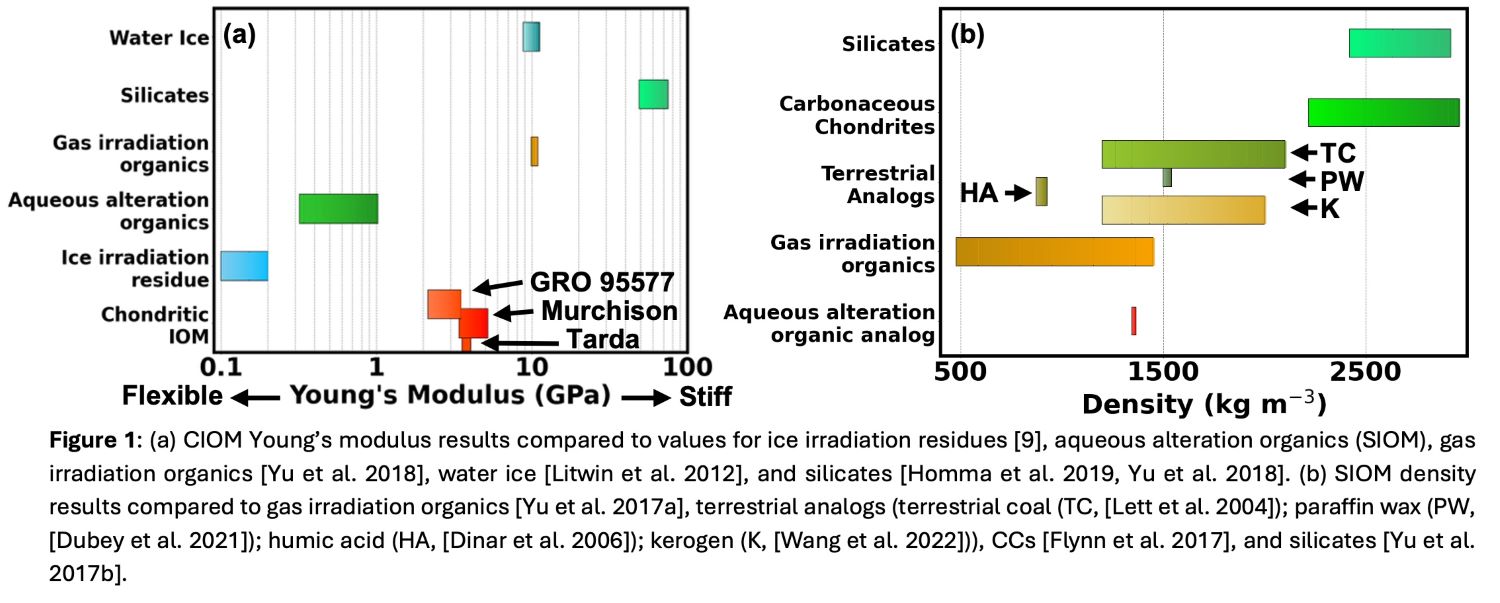
Eric Austin, Xinting Yu, Adis Husić, Dionysis Foustoukos, Kelly Miller, Conel Alexander, Alan Whittington, Julie Castillo-Rogez, Ricardo Vega, Chris Glein, and Ngoc Truong

Introduction: Organic molecules are ubiquitous as primitive Solar System building blocks and are also central to astrobiology, yet their origins and evolution remain debated. These organics likely play crucial, yet poorly constrained, roles in fundamental planetary processes during the formation and evolution of planetary systems. Models of planet formation struggle to explain the rapid aggregation of dust into planetesimals, facing collisional barriers where silicate grains tend to fragment rather than stick [Birnstiel (2024)]. The presence of organic matter in chondrites and comets has fostered the hypothesis that organic matter may coat these grains, enhancing their sticking efficiency [Homma et al. (2019)]. However, current attempts to quantify this effect remain theoretical, relying on values for analogs such as terrestrial coal to represent parameters for organics present within the interstellar medium (ISM) or protosolar nebula (PSN) [Homma et al. (2019)]. Meanwhile, understanding the thermal evolution and potential habitability of icy moons and dwarf planets hinges on modeling their internal structure and heat sources, primarily tidal dissipation [Bagheri et al. (2022)]. Observations suggest that these bodies contain significant amounts of low-density refractory material, likely primitive organic matter, mixed with rock and ice [Reynard and Sotin (2023)]. The amount and the mechanical/viscoelastic properties of this organic fraction would critically influence tidal heating efficiency and internal dynamics. Accurately modeling planetesimal aggregation and icy world evolution thus requires direct measurements of the physical properties of relevant Solar System organics. Insoluble Organic Matter (IOM), the dominant organic component in chondrites, represents a key material whose origin (interstellar, nebular, parent-body) is complex [Alexander et al. (2017)]. This study utilizes nanoindentation and helium pycnometry to characterize two fundamental physical properties (Young's modulus, Y​; grain density, 𝜌) of chondritic IOM (CIOM) and synthetic analogs, aiming to provide crucial data for planet formation and icy body models while simultaneously shedding new light on the complex origins and processing history of IOM. 

Methods: We measured Young's modulus using dynamic nanoindentation [Oliver and Pharr (2004)] (KLA iMicro) on CIOM extracted from three carbonaceous chondrites (CCs): Murchison (CM2), Tarda (C2), and Grosvenor Mountains (GRO) 95577 (CR1) [Cody et al. (2002)]. These represent materials with varying degrees of parent body aqueous alteration. Using nanoindentation and helium pycnometry (Anton Paar Ultrapyc 3000), we also measured the Young's modulus and density of synthetic IOM (SIOM) synthesized hydrothermally via dextrose carbonization [Foustoukos et al. (2021)]. Young’s modulus measurements were compared to synthetic organic analogs representing key formation/processing pathways: (1) Ice irradiation residues [Piani et al. (2017)]; (2) Aqueous alteration organics (SIOM); and (3) Gas irradiation organics (Titan tholin analogs, [Yu et al. (2018)]). Density measurements were compared to terrestrial organic analogs typically used in planetary modelling. CIOM (and SIOM following density measurements) samples were embedded in epoxy, polished (Pace Technologies NANO-2000S), and indented under N2Y​ was determined by the instrument’s software from load-displacement curves, averaging data from depths > 500 nm. 

Results: Significant differences in mechanical stiffness were observed (Figure 1a). Synthetic analogs showed distinct moduli linked to formation pathways: stiffness increased in the order Ice Irradiation Residues < Aqueous Alteration Organics < Gas Irradiation Organics. CIOM from Murchison, Tarda, and GRO 95577 exhibited intermediate stiffness (Y ~ 2-6 GPa), about an order of magnitude stiffer than ice irradiation residues (Y ~ 0.1 GPa). Their moduli fell between those of aqueous alteration analogs (SIOM measured at 0.69 ± 0.4 GPa) and gas irradiation analogs (~ 10 GPa). Notably, CIOM from GRO 95577, the most primitive sample [Alexander et al. (2010)], was mechanically softer than Murchison and Tarda IOM, suggesting that the aqueous alteration of the parent body may stiffen the structure of IOM. Moreover, measurements for both CIOM and SIOM indicate the material is more flexible (lower Y) than water ice (~ 10 GPa) and silicates (> 50 GPa). Density measurements of SIOM (Figure 1b) align with values for terrestrial coal and kerogen currently used in planetary modeling.

Discussion: The intermediate stiffness of CIOM, significantly different from highly flexible ice residues but generally softer than stiff gas irradiation products, points towards a complex, multi-stage history. Based on our data, we favor a model involving the formation of precursors, likely in cold environments (consistent with isotopes), followed by subsequent processing (e.g., aqueous alteration, gas-phase reactions/irradiation), gradually creating stiffer macromolecules. Further experimentation investigating the effects of aqueously altering ice and gas irradiation organics, as well as measuring the Young’s modulus of other CC petrological types aside from those analyzed thus far (CM2, C2-ung, CR1), is necessary to confidently substantiate whether aqueous alteration affects the stiffnes of the material.

Our Young’s modulus measurements confirm that IOM is significantly more flexible than silicates. This increased elasticity, along with the density measurements, results in an enhanced sticking efficiency during dust collisions, likely promoting aggregation and assisting in overcoming fragmentation barriers, thereby potentially accelerating planetesimal growth compared to silicate-only models.

Our finding that IOM has a significantly lower Young's modulus than rock implies higher shear compliance. Therefore, an organic-rich component within an icy moon's interior (consistent with low bulk densities) would deform more readily under tidal forces, potentially leading to significantly enhanced tidal dissipation and internal heating than purely rock-ice models. This impacts internal structure, thermal history, and habitability potential of many astrobiological targets in the outer solar system.

Conclusions: Mechanical properties provide a novel diagnostic tool for deciphering IOM's complex history. Our nanoindentation results on CIOM and analogs support a multi-stage origin involving the processing of precursors in cold environments via ice irradiation, followed by gradual stiffening through processes involving aqueous alteration and/or gas irradiation. Moreover, the mechanical characteristics of SIOM and CIOM have intriguing implications, suggesting organics play key roles in facilitating planetesimal formation through enhanced aggregation and influencing the thermal evolution and habitability of icy worlds via enhanced tidal dissipation.

How to cite: Austin, E., Yu, X., Husić, A., Foustoukos, D., Miller, K., Alexander, C., Whittington, A., Castillo-Rogez, J., Vega, R., Glein, C., and Truong, N.:  Mechanical Properties of Insoluble Organic Matter and Implications for Its Evolution and Influence on Planetary Processes. , EPSC-DPS Joint Meeting 2025, Helsinki, Finland, 7–13 Sep 2025, EPSC-DPS2025-1200, https://doi.org/10.5194/epsc-dps2025-1200, 2025.

F170
|
EPSC-DPS2025-367
|
ECP
|
Virtual presentation
Time-series asteroid photometry with TESS
(withdrawn)
Amy Tuson, Jorge Martínez-Palomera, Christina Hedges, Brian Powell, and Jessie Dotson
F171
|
EPSC-DPS2025-1349
|
On-site presentation
Róbert Szakáts, Csaba Kiss, and Thomas Müller

Aside from a limited number of dedicated observations of solar system small bodies (Müller et al. 2018), asteroids have randomly been captured in many PACS and SPIRE maps with the Herschel Space Observatory, which operated from 2009 to 2013. Given the still limited number of infrared measurements of asteroids, these incidental detections offer valuable data for modeling asteroid thermal emission and deriving their fundamental physical properties.

In our work, we first searched for serendipitously observed asteroids in measurements taken with the PACS instrument aboard the Herschel Space Observatory. The workflow began by retrieving all available Level 2 scan map observations in FITS format from the Herschel Science Archive (HSA) for each OBSID.

Next, using the ephemd program (Pál et al. 2018), we identified small Solar System bodies that could have potentially been visible in each map at the time it was taken—that is, during the instrument's scan of the corresponding sky area. We considered the start, mid, and end times of each observation to determine whether a potential asteroid entered or exited the field of view during the scan. Predicted positions were then translated into pixel coordinates and checked against the map coverage. If at least one of the three predicted positions fell within the map boundaries, we treated it as a positive detection; otherwise, the object was excluded from further analysis.

This initial selection was followed by a filtering step based on detectability. For each candidate asteroid, we ran a NEATM model and retained only those with an optimistic predicted flux density above 100 mJy at 70 μm. This threshold reflects a practical detection limit, as fainter sources would not be reliably observable.

For the photometry, the asteroid’s precise position was determined using the "fine time" of the scan. As a consistency check, we compared our final candidate list with the one presented by Racero et al. (2022), and found good agreement with their Table B.1. Minor discrepancies were mostly due to our algorithm excluding targets located too close to the map edges to allow for reliable photometry.

At each predicted position, we performed centroid fitting followed by aperture photometry in the Herschel Interactive Processing Environment (HIPE). To estimate the photometric uncertainty, we placed six additional apertures of the same size around the target aperture to sample the background. The standard deviation of these background measurements was used as the one-sigma error estimate (Klaas et al. 2018). Since we applied multiple apertures per source, we subsequently selected the most suitable one for each target.

This process yielded 364 new flux density measurements for 144 unique asteroids. We are currently categorizing these asteroids into five groups based on the availability of shape models and thermal data. The categories are as follows:

1) Mission targets and well-studied objects – These include well-known asteroids such as (1) Ceres and (20) Massalia. For these, we will compare our serendipitous fluxes with predictions based on published model solutions.

2) Objects with shape models and a sufficient number of multi-mission thermal measurements – For these asteroids, we will perform detailed thermophysical modeling to derive high-quality size and albedo estimates, and to constrain thermal inertia and surface roughness.

3) Objects with shape models but limited or no thermal measurements – In these cases, we will utilize the available spin and shape models and generate radiometric solutions using all combined thermal data.

4) Objects without shape models but with sufficient thermal measurements – Here, simple spherical models will be applied. If the spin axis and rotation period are unknown, we will use the NEATM model to derive size-albedo solutions, either by combining all thermal data or analyzing different datasets separately to identify potential shape effects.

5) Objects lacking both shape models and significant thermal measurements – For these asteroids, we will derive basic size and albedo estimates from the available data. If necessary, we will consult the WISE catalog to supplement the thermal measurements.

In our presentation, we show the thermal emission model results from categories 4 and 5.

The resulting flux density values will be made available through the SBNAF Infrared Database (Szakáts et al. 2020).

We plan to publish the full results in an upcoming paper (Szakáts et al. 2025, in prep).

References:
Müller, T. G., Marciniak, A., Kiss, Cs., et al. 2018, Advances in Space Research, 62, 2326

Pál, A., Molnár, L., & Kiss, C. 2018, PASP, 130, 114503

Racero, E., Giordano, F., Carry, B., et al. 2022, A&A, 659, A38

Klaas, U., Balog, Z., Nielbock, M., et al. 2018, A&A, 613, A40

Szakáts, R., Müller, T., Alí-Lagoa, V., et al. 2020, A&A, 635, A54

How to cite: Szakáts, R., Kiss, C., and Müller, T.: Photometry of serendipitously observed asteroids with Herschel/PACS, EPSC-DPS Joint Meeting 2025, Helsinki, Finland, 7–13 Sep 2025, EPSC-DPS2025-1349, https://doi.org/10.5194/epsc-dps2025-1349, 2025.

F172
|
EPSC-DPS2025-532
|
ECP
|
On-site presentation
Milagros Colazo, Dagmara Oszkiewicz, Alvaro Alvarez-Candal, Patrycja Poźniak, Przemysław Bartczak, and Edyta Podlewska-Gaca
We present phase curves for over 300,000 asteroids using the ATLAS Solar System Catalog V2 (SSCAT-2), covering 301,272 objects in the orange filter and 280,953 in cyan. For 3,345 (orange) and 492 (cyan) asteroids, phase curve parameters were obtained with uncertainties below 15%. Our model, which accounts only for the apparition effect, shows strong consistency with more complex methods but requires significantly less computational time.
 
Using cross-matched taxonomy and robust two-dimensional Kolmogorov–Smirnov tests, we found that phase curve parameters (G1, G2) vary significantly with wavelength across nearly all taxonomic classes, except A-types. When comparing between filters, statistically significant differences were observed in the G1–G2 distributions, indicating wavelength-dependent behavior. Our analysis suggests that while phase coloring behaviors are observed without a clear preference for reddening or bluening at phase angles below 5°, reddening predominates in the 10°–30° range. However, these conclusions are based on extrapolated trends, and the associated uncertainties, particularly at low phase angles, remain significant.
 
Our catalog-independent algorithms are adaptable to new datasets, including future LSST data. This work opens new pathways for large-scale photometric surface analysis using efficient, scalable tools.

How to cite: Colazo, M., Oszkiewicz, D., Alvarez-Candal, A., Poźniak, P., Bartczak, P., and Podlewska-Gaca, E.: Asteroid phase curves and phase coloring effect using the ATLAS survey data, EPSC-DPS Joint Meeting 2025, Helsinki, Finland, 7–13 Sep 2025, EPSC-DPS2025-532, https://doi.org/10.5194/epsc-dps2025-532, 2025.

F173
|
EPSC-DPS2025-684
|
ECP
|
On-site presentation
Paul Simon, Pierre Vernazza, Laurent Jorda, and Miroslav Brož

Since 2000, numerous missions have been targeting near-earth asteroids, either by flyby or by orbiting, with a significant number scheduled over the coming years. Identifying the source families of these objects is essential to contextualize the scientific results of these missions.

This talk will focus on S-type objects only:

-  Eros (433), the first NEA visited by a probe, NASA's mission NEAR Shoemaker. It entered orbit in February 2000. 
- Toutatis (4179), visited in December 2012 by CNSA's Chang'e 2 probe.
- Didymos (65803), the target of NASA's DART mission and scheduled to be visited by ESA's HERA mission by the end of 2026.
- Torifume (98943), a high-speed flyby target for the extended mission of JAXA's Hayabusa2.
- Apophis (99942), a designated target of NASA's OSIRIS-APEX mission and ESA's proposed RAMSES mission.

This presentation proposes an approach that combines a mineralogical and an orbital dynamical modelling to constrain it.
Visible and near-infrared spectra are used to compare each asteroid's surface composition with H, L and LL chondrite meteorites. This comparison follows the methodology of Marsset et al. 2024 [1], applying a space-weathering correction using the de-reddening function from  Brunetto 2006 [2] and finding the best match through chi-squared minimisation.

For Didymos, we reduced and analysed mid-infrared spectrum obtained with JWST/MIRI (Cycle 1, Program 1245, PI: A. Thomas)  (Rivkin et al. 2023 [3]) and compared the asteroid's emissivity with laboratory reflectance spectra of meteorites with varying porosities (Vernazza et al. 2012 [4]). 

On the dynamical side, numerical tools from Brož (2024a [5]  ; 2024b [6]) are used.  They implement a forward dynamical model that simulates the long-term orbital evolution of source family asteroids. By comparing the current orbital parameters of the target asteroid with those of the modeled population, the probability of a family origin can be estimated.

By integrating both compositional and dynamical constraints, this approach aims to more accurately identify the likely source families of these mission targets.


References:

[1] M. Marsset, et al 2024, The Massalia asteroid family as the origin of ordinary L chondrites. Nature, 634(8034):561–565, 2024.

[2] R. Brunetto et al. 2006, Modeling asteroid surfaces from observations and irradiation experiments: The case of 832 Karin. Icarus, 184(2):327–337, 2006.

[3] A. S. Rivkin et al. 2023, Near to Mid-infrared Spectroscopy of (65803) Didymos as Observed by JWST: Characterization Observations Supporting the Double Asteroid Redirection Test. The Planetary Science Journal, 4(11):214, nov 2023.

[4] Vernazza et al. 2012 High surface porosity as the origin of emissivity features in asteroid spectra. Icarus 221(2):1162–1172, 2012.

[5] Brož et al. 2024a, Source regions of carbonaceous meteorites and near-Earth objects. A & A, 689:A183, 2024.

[6] Brož et al. 2024b,Young asteroid families as the primary source of meteorites. Nature, 634(8034):566–571, Oct 2024.

How to cite: Simon, P., Vernazza, P., Jorda, L., and Brož, M.: Constraining the source family of mission-targeted S-type Near-Earth Asteroids, EPSC-DPS Joint Meeting 2025, Helsinki, Finland, 7–13 Sep 2025, EPSC-DPS2025-684, https://doi.org/10.5194/epsc-dps2025-684, 2025.

F174
|
EPSC-DPS2025-1564
|
ECP
|
On-site presentation
Petr Fatka, Petr Pravec, Peter Scheirich, Kamil Hornoch, Peter Kušnirák, and Hana Kučáková

Introduction

Understanding the physical and dynamical properties of asteroids is essential for planetary defense strategies and for the successful planning of spacecraft missions to small Solar System bodies. This study reports on our recent work (Fatka et al. 2025) modeling the spins and shapes of Near-Earth Asteroids (NEAs) and our ongoing study of  the spin evolution of main-belt asteroid pairs.

In Fatka et al. (2025), we analyzed dense photometric data for 18 NEAs obtained within the framework of the NEOROCKS project (Near-Earth Object Rapid Observation, Characterization, and Key Simulations; Dotto et al. 2021). From these, we successfully derived or constrained spin and shape models for 11 asteroids. A particularly noteworthy of the modeled NEAs  is (98943) 2001 CC21 (Torifune) that will be visited by JAXA's Hayabusa2#  extended mission in 2026 (Hirabayashi et al. 2021).

In parallel, we are conducting photometric observations and subsequent spin and shape modeling for 8 main-belt asteroid pairs. These are gravitationally unbound systems believed to have formed through recent break-up events (Pravec et al. 2019). Our goal is to investigate the evolution of their spin vectors and test hypotheses about their formation mechanisms.

Table 1. Successfully modeled NEAs (Fatka et al. 2025).

(5189) 1990 UQ

(6569) Ondaatje

(7025) 1993 QA

(8566) 1996 EN

(66251) 1999 GJ2

(86450) 2000 CK33

(98943) Torifune

(137199) 1999 KX4

(276786) 2004 KD1

(495615) 2015 PQ291

(512245) 2016 AU8


Methodology

To determine an asteroid’s shape and spin axis, we first need to know how fast it spins—its sidereal rotation period. This can be tricky when observations are spread out over many years or the asteroid spins quickly, leading to several possible solutions (called period aliases).

We used a widely accepted method called lightcurve inversion, implemented in software developed by Josef Ďurech and based on Kaasalainen & Torppa (2001) and Kaasalainen et al. (2001). 

To improve accuracy, we combined our detailed photometric data with additional observations from the ATLAS survey. While these sparse data don’t help with modeling shape, they do help resolve ambiguities in the spin period. In most unclear cases, this combination led us to a unique and reliable solution.

In some instances, even when multiple periods seemed possible, the resulting models still pointed to similar spin axes and shapes—though this wasn’t always true. We also found that asteroids with large brightness variations and observations from multiple apparitions were more likely to produce reliable models.

Finally, we note that such modeling tends to favor certain types of asteroids, introducing potential biases in the broader statistics of asteroid properties. Users of these models should keep these biases in mind when interpreting the results.

Case Study: (98943) Torifune

Asteroid (98943) Torifune, the planned 2026 fly-by target of the Hayabusa2# mission, is one of our best-modeled objects. Our data, spanning from 2002 to 2023, produced a sidereal rotation period of 5.021522 ± 0.000003 hours, in agreement with the independent result of 5.021516 ± 0.000106 hours by Popescu et al. (2025). Our nominal solution for its  spin axis is (λ, β) = (259°, +84°) with an 8° uncertainty radius, also in agreement with the Popescu et al. (2025) estimate of (λ, β) = (301, +89-6+1). Our derived convex shape model is presented in Fig. 1.

We are currently updating this model by joining or data with the data from Popescu et al. (2025), the latest ATLAS catalog, and additional unpublished observations. This refined model will be important for planning the s/c fly-by and maximizing the scientific return of the event. We plan further observations of (98943) in its upcoming apparition in October-December 2025 to further improve  its model.

Figure. 1. Convex shape model of the asteroid (98943) Trorifune. Left: view along the x-axis (the longest axis) from the asteroid’s equatorial plane. Middle: view along the  -axis from the asteroid’s equatorial plane. Right: view along the z-axis (rotational axis). Fatka et al. (2025). 

Asteroid Pairs and Spin Axis Evolution

In a parallel effort, we are studying 8 asteroid pairs—recently separated, gravitationally unbound systems. We obtained dense lightcurves for both components of each pair, allowing us to derive or refine their spin axis orientations and shape models.

Using N-body backward orbital integrations, we estimated the separation ages of each pair (e.g., Pravec et al. 2019). By evolving the current spin axis directions backward in time to the point of separation, we can assess whether the spin vectors were aligned at that moment.

One hypothesis for pair formation is that a gently separating proto-binary system—a temporarily bound pair formed by a rotational fission (e.g., Scheeres 2007, Pravec et al. 2010, 2019)—would result in aligned spin axes. Our models are designed to test this prediction. This study may provide new insights into their formation and the broader processes that shape asteroid dynamics in the Solar System.

Table 2. Selected asteroid pairs.

(2110) Moore-Sitterly - (44612) 1999 RP27

(4905) Hiromi - (7813) Anderserikson

(6070) Rheinland - (54827) Kurpfalz

(9068) 1993 OD - (455327) 2002 OP28

(18777) Hobson - (57738) 2001 UZ160

(54041) 2000 GQ113 - (220143) 2002 TO134

(56232) 1999 JM31 - (115978) 2003 WQ56

(60744) 2000 GB93 - (218099) 2002 MH3

(69142) 2003 FL115 - (127502) 2002 TP59

(80218) 1999VO 123 - (213471) 2002 ES90

Acknowledgements

This work has been supported by the Grant Agency of the Czech Republic, Grant 23-04946S, and by the "Praemium Academiae" award from the Academy of Sciences of the Czech Republic, grant AP2401.

References 

Dotto et al., 7th IAA Planetary Defense Conference, 221 (2021)

Fatka et al., A&A, 695, id.A139 (2025)

Hirabayashi et al.,  Adv. Space Res., 68 (2021)

Kaasalainen & Torppa Icarus, 153, 24 (2001)

Kaasalainen et al., Icarus, 153, 37 (2001)

Pravec et al. Nature 466, 1085 (2010)

Pravec et al. Icarus, 333, 429 (2019)

Popescu et al. PSJ 6, 2, id.42 (2025)

Scheers Icarus 189, 370 (2007)

Tonry et al., PASP, 130, 064505 (2018)

How to cite: Fatka, P., Pravec, P., Scheirich, P., Hornoch, K., Kušnirák, P., and Kučáková, H.: Spins and Shapes of 11 Near-Earth Asteroids and 8 Main-Belt Asteroid Pairs with Evolving Spin Axes, EPSC-DPS Joint Meeting 2025, Helsinki, Finland, 7–13 Sep 2025, EPSC-DPS2025-1564, https://doi.org/10.5194/epsc-dps2025-1564, 2025.

F175
|
EPSC-DPS2025-668
|
On-site presentation
Apostolos Christou, Nikolaos Georgakarakos, Andrew Marshall-Lee, Alice Humpage, Matija Cuk, and Aldo Dell'Oro
As the nearest stable repository of asteroids to both the Earth and the Sun, the Mars Trojans (MTs) represent a unique natural laboratory to study the outcomes of small asteroid evolution over Gyrs [1]. Their small sizes notwithstanding, MTs exhibit some unique features: a strong asymmetry favouring L5 vs L4 residents [2,3]; a family of L5 asteroids that are likely products of YORP-induced rotational spin-up and breakup [4,5] from (5261) Eureka; and the olivine-dominated composition of this family [6,7], one of only two known to exist [8].
 
Ongoing asteroids surveys continue to discover new members of this population and the upcoming Rubin Legacy Survey of Space and Time (LSST; [9]) will likely increase their number several-fold. In anticipation of the LSST discoveries, we take a fresh look at MTs using a larger sample of asteroids than was available in earlier works. Details of our study can be found in [10]. Our statistical analysis of the new sample reveals the existence of two additional clusters of three (3) asteroids apiece with >95% statistical confidence. One of the clusters is embedded within the Eureka family and is probably the result of ongoing cascade disruption among family asteroids [11]. The second group is characterised by a high libration amplitude, not easy to reconcile with YORP fission from Eureka and its family. We argue instead that this group represents impact ejecta from a collision that occurred during the ~1 Gyr age of this family. This is the first positive evidence that collisions play a role in the Gyr evolution of these small asteroids, alongside solar-thermal effects.
 
References
[1] Christou, A.A., Borisov, G. et al (2020) Icarus, 335, 113370. doi:10.1016/j.icarus.2019.07.004
[2] Christou, A.A. (2013) Icarus 224, 144. doi: 10.1016/j.icarus.2013.02.013
[3] de la Fuente Marcos, C. & de la Fuente Marcos, R. (2013) MNRAS 432, 31. doi:10.3847/1538-4365/abd93d
[4] Cuk, M., Christou, A.A., Hamilton, D.P. (2015) Icarus 252, 339. doi: 10.1016/j.icarus.2015.02.009
[5] Christou, A.A., Borisov, G.B. et al (2017) Icarus 293, 243. doi:10.1016/j.icarus.2017.03.003
[6] Borisov, G.B., Christou, A.A. et al (2017) MNRAS 466, 489. doi:10.1093/mnras/stw3075
[7] Polishook, D., Jacobson, S.A. et al (2017) NatAs 1, 0179. doi:10.1016/j.icarus.2005.07.012
[8] Galinier, M., Delbo, M. et al (2024) A&A 683, L3. doi: 10.1051/0004-6361/20234905
[9] Jones, R.L., Juric, M. et al (2016) In: Asteroids: New observations, new models, Proc. IAU Symp. 318, 282. doi: 10.1017/S1743921315008510
[10] Christou, A.A., Georgakarakos, N. et al (2025) A&A, in press. doi: https://doi.org/10.1051/0004-6361/202553804
[11] Fatka, P., Pravec, P., Vokrouhlický, D. (2020) Icarus 338, 113554. doi: 10.1016/j.icarus.2019.113554

How to cite: Christou, A., Georgakarakos, N., Marshall-Lee, A., Humpage, A., Cuk, M., and Dell'Oro, A.: Evidence for cascade disruption and for collisions among the Martian Trojans, EPSC-DPS Joint Meeting 2025, Helsinki, Finland, 7–13 Sep 2025, EPSC-DPS2025-668, https://doi.org/10.5194/epsc-dps2025-668, 2025.

F176
|
EPSC-DPS2025-1402
|
ECP
|
On-site presentation
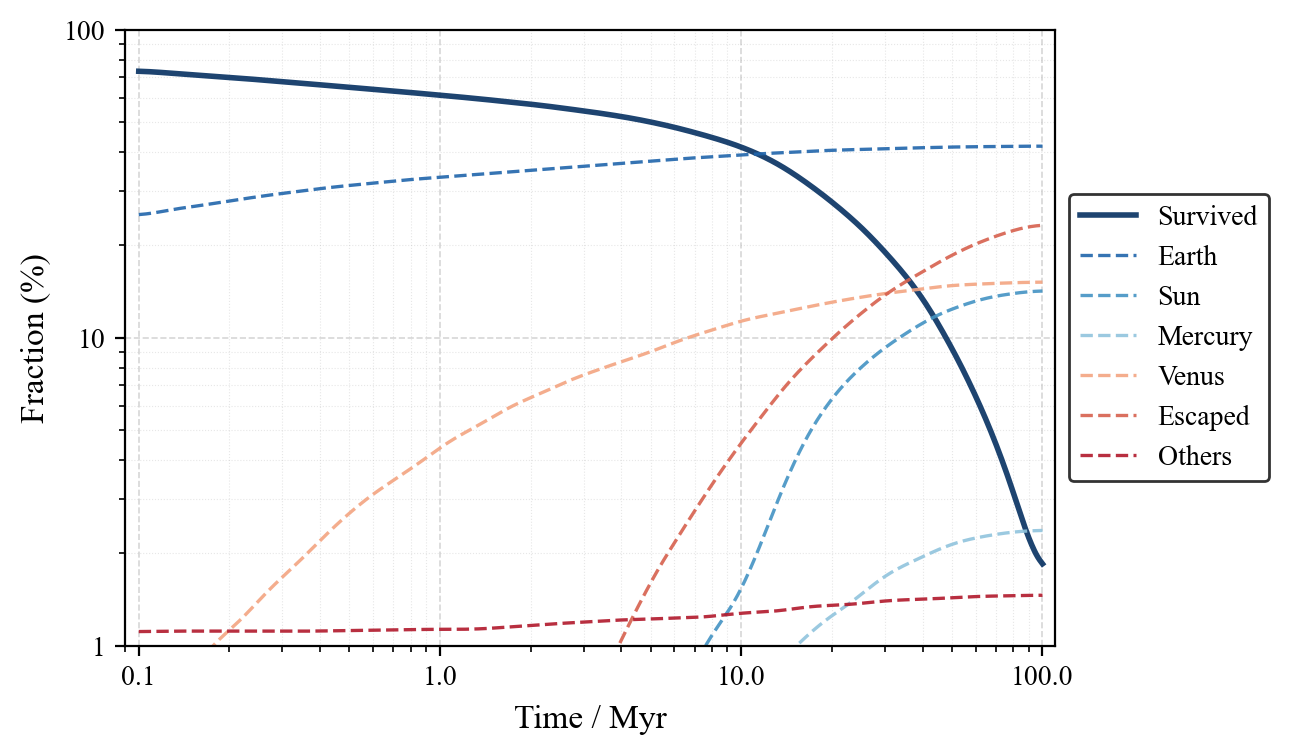
Yixuan Wu, Yifei Jiao, Yukun Huang, Bin Cheng, Wen-Yue Dai, Hexi Baoyin, and Junfeng Li

1. Introduction

Near-Earth asteroids (NEAs) have been thought to originate from the main asteroid belt between Mars and Jupiter. However, recent research has revealed the existence of a unique family of NEA originating from lunar impact ejecta. For example, the asteroid 2016 HO3 (Jiao et al, 2024), which is the target of China's Tianwen-2 mission, and the recently discovered asteroid 2024 PT5 (Kareta et al, 2025) may belong to this category of lunar-originated asteroids. Despite these discoveries, there is still a lack of systematic understanding of the population, size distribution, and dynamical characteristics of such lunar-originated asteroids.

In this work, we combine the lunar impact history and N-body simulations incorporating the Yarkovsky effect to systematically investigate the orbital evolution of D > 5 m lunar ejecta on a timescale of ~ 100 Myr. We focus on Earth flyby events of these lunar-originated asteroids and their orbital characteristics. Considering the current observational capabilities of optical survey telescopes, we have also assessed the detectability of potential lunar-originated asteroids.

Fig. 1 Dynamical fates of all the lunar ejecta

2. Results

Through N-body simulations involving 20,000 particles ejected from the Moon for a time range of 100 Myr, we find that 41.9% of the particles eventually hit the Earth and only 1.6% can survive (Fig. 1). In particular, 24.8% of the particles hit the Earth within the first 0.1 Myr, which is consistent with the previous study (Castro-Cisneros et al, 2025). Combining the lunar impact history and cratering simulations, it is estimated that there are approximately 700,000 lunar-originated asteroids (> 5 m) still surviving, which is ≲ 1% of the NEA population. Furthermore, we find that there can be approximately 23 Earth flyby events (distance < 0.05 AU encounters) per year for such asteroids.

Among these Earth flyby events, we are most interested in those that can be detected by roving telescopes. For the "wide and shallow" survey strategy (e.g., ATLAS), by counting flybys where the asteroid's apparent V-band magnitude is < 20, we find an average of 2.3 such observing opportunities annually. These results indicate a significant potential for the discovery and subsequent verification of lunar-originated asteroids >5m in diameter.

In addition, we also find that the frequency of temporary capture events similar to that observed for 2024 PT5 is about once per century on average. This suggests that while 1 m sized asteroids may form a steady state population of Earth's minimoons (Jedicke et al, 2025), it is uncommon to find lunar-originated D > 5 m asteroids serving as minimoons.

References

Jiao, Y., Cheng, B., Huang, Y., Asphaug, E., Gladman, B., Malhotra, R., ... & Baoyin, H. (2024). Asteroid Kamo ‘oalewa’s journey from the lunar Giordano Bruno crater to Earth 1: 1 resonance. Nature Astronomy, 8(7), 819-826.

Kareta, T., Fuentes-Muñoz, O., Moskovitz, N., Farnocchia, D., & Sharkey, B. N. (2025). On the Lunar Origin of Near-Earth Asteroid 2024 PT5. The Astrophysical Journal Letters, 979(1), L8.

Castro-Cisneros, J. D., Malhotra, R., & Rosengren, A. J. (2025). Lunar impact ejecta flux on the Earth. Icarus, 116606.

Jedicke, R., Alessi, E. M., Wiedner, N., Ghosal, M., Bierhaus, E. B., & Granvik, M. (2025). The steady state population of Earth’s minimoons of lunar provenance. Icarus, 116587.

How to cite: Wu, Y., Jiao, Y., Huang, Y., Cheng, B., Dai, W.-Y., Baoyin, H., and Li, J.: Hunt for Lunar-Originated Asteroid Population from Earth Flybys, EPSC-DPS Joint Meeting 2025, Helsinki, Finland, 7–13 Sep 2025, EPSC-DPS2025-1402, https://doi.org/10.5194/epsc-dps2025-1402, 2025.

F177
|
EPSC-DPS2025-69
|
On-site presentation
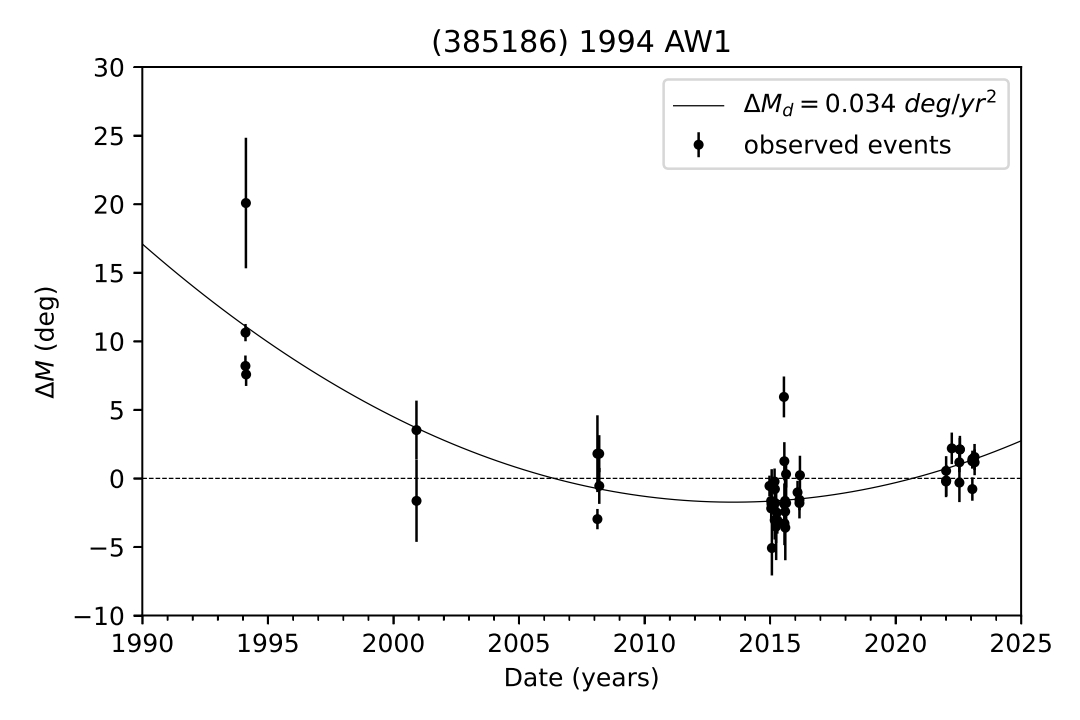
Peter Scheirich, Petr Pravec, Wen-Han Zhou, Marin Ferrais, Daniel Scheeres, Jay McMahon, Kamil Hornoch, Peter Kušnirák, Hana Kučáková, Petr Fatka, Tim Lister, Edward Gomez, Joseph Chatelain, Sarah Greenstreet, and Emmanuel Jehin

Using thorough photometric observations taken from 1994 to 2024, we derived physical and dynamical properties of two binary near-Earth asteroids (175706) 1996 FG3 and (385186) 1994 AW1.

For 1996 FG3, we obtained a unique solution with a quadratic drift of the mean anomaly of the satellite of 0.018 ± 0.040 deg/yr2 (all quoted uncertainties correspond to 3 σ), i.e., consistent with zero.  This means that the drift of the semimajor axis of the mutual orbit is also consistent with zero, specifically, it is −0.026 ± 0.06 cm/yr. The zero drift for this system was already observed by Scheirich et al. (2015), but our new data constrain it with less uncertainty.

For 1994 AW1, we determined that the quadratic drift of the mean anomaly is 0.034 ± 0.021 deg/yr2, implying a small, but non-zero inward drift in semimajor axis of −0.063 ± 0.05 cm/yr.

The zero drift of 1996 FG3 suggests that the system is in a state of stable equilibrium between the BYORP effect (Jacobson & Scheeres, 2011), binary Yarkovsky effect (Zhou, 2024) and mutual tides.

The inward drift of 1994 AW1 indicates that either BYORP or the binary Yarkovsky effect must be acting on the system, as this cannot be attributed to tidal expansion. The small value of the drift with a near-zero 3σ uncertainty suggests that if the BYORP is causing the drift, the system is very close to the tidal-BYORP equilibrium.

We will present the implications for the two systems dynamics and the BYORP and binary Yarkovsky effects.

Figure: Time evolution of the mean anomaly difference ΔM  with respect to the reference solution of 1994 AW1 with no drift in mean anomaly. Black symbols correspond to lightcurve mutual events covered by the observed data. Vertical error bars represent estimated 1σ uncertainties of the event times, expressed in the mean anomaly. A quadratic fit to the data points, represented by the black curve, gives the quadratic term of 0.034 deg/yr2. The plot was constructed as follows. We generated a synthetic lightcurve using a model with mean anomaly drift fixed at zero. Then, for each light-curve event separately, we fitted the mean anomaly of the model in order to obtain the best match between its synthetic lightcurve and the observed data. ΔM  is the difference between the mean anomaly of the original model and the fitted one. 

Acknowledgments

The work by the authors from [1] was supported by the Grant Agency of the Czech Republic, Grant 23-04946S.

References

Scheirich, P., et al., 2015. Icarus 245, 56–63.

Jacobson, S.A., Scheeres, D.J., 2011. The Astrophysical Journal Letters 736, L19.

Zhou, W.H., 2024. A&A 692, L2.

How to cite: Scheirich, P., Pravec, P., Zhou, W.-H., Ferrais, M., Scheeres, D., McMahon, J., Hornoch, K., Kušnirák, P., Kučáková, H., Fatka, P., Lister, T., Gomez, E., Chatelain, J., Greenstreet, S., and Jehin, E.: Minor orbital drifts in binary near-Earth asteroids (175706) 1996 FG3 and (385186) 1994 AW1: Implications for their orbital dynamics, EPSC-DPS Joint Meeting 2025, Helsinki, Finland, 7–13 Sep 2025, EPSC-DPS2025-69, https://doi.org/10.5194/epsc-dps2025-69, 2025.

F178
|
EPSC-DPS2025-1399
|
ECP
|
On-site presentation
Mikko Pöntinen, Mikael Granvik, Achille Nucita, Simone Sacquegna, Antonio Franco, Benoit Carry, and Belén Yu Irureta-Goyena Chang

Introduction

The European Space Agency's Euclid space telescope provides a unique opportunity for Solar System science due to its capabilities in both visible and near-infrared wavelengths, thanks to the visible imager (VIS) and the near-infrared spectrophotometer (NISP). During a week-long Phase Diversity Calibration (PDC) campaign in December 2023, Euclid observed regions along the ecliptic plane, offering a special dataset for asteroid detection and characterization. The campaign's observation strategy was designed to follow the apparent motion of most asteroids to increase the probability of obtaining multiple observations of the same objects. These observations represent Euclid's first deliberate sampling of Solar System objects and serve as a testbed for the Wide Survey. We present results from our analysis of these observations, demonstrating Euclid's potential for asteroid science.


Background

Studying asteroids provides insights into the formation and evolution of our Solar System. Asteroids' compositional and dynamical distribution helps us understand planetary migration and other processes that have shaped the Solar System over 4.5 billion years.

While many asteroids show relatively similar reflectance spectra in visual wavelengths, they differ significantly in NIR (DeMeo et al. 2009). NIR data for asteroids remains relatively scarce, with the largest catalog containing only about 35,000 objects (Popescu et al. 2016). Unlike surveys such as Gaia and LSST (visual only) or VISTA and UKIDSS (NIR only), Euclid covers both spectral regions with a single telescope. During its 6.5-year Wide Survey, Euclid is expected to observe up to 150,000 Solar System objects (Carry 2018), even though it primarily targets regions away from the ecliptic plane where asteroid densities are lower.


Methods

The ecliptic campaign consisted of approximately 150 observations covering an area of ~18 square degrees between one degree on either side of the ecliptic plane. We developed a pipeline capable of processing Level 1 (raw) VIS data, which will be essential for timely analysis and potential follow-up observations during the Wide Survey.

Our data processing pipeline begins with preprocessing, adapted from Nucita et al. (2025), including standard reduction steps (such as bias and flat corrections), cosmic ray removal, and astrometric and photometric calibration. For streak detection, we utilize the StreakDet software (Virtanen et al. 2016) to identify asteroid streaks in single exposures, using parameters optimized for Euclid VIS images (Pöntinen et al. 2020). We then employ an algorithm to link streaks across Euclid's four dithered exposures per field, significantly reducing false positives. We carry out PSF photometry via StreakDet, aperture photometry via TRIPPy (Fraser et al. 2016), and trailed photometry (Devogèle et al. 2024). Finally, we use the OpenOrb software (Granvik et al. 2009) to link objects between fields and generate probability density functions for orbital elements.


Results

Our pipeline detected over 43,000 individual asteroid streaks across the observed fields. Cross-matching with the SkyBot database (Berthier et al. 2006) revealed that approximately 53% of these streaks correspond to 2,334 known asteroids, with an average of 10 streaks per object. The remaining 47% of streaks originate from previously unknown objects, suggesting the discovery of roughly 2,000 new asteroids in this dataset. The false positive rate of our pipeline is estimated to be less than 1%.

Most detected objects belong to the Main Asteroid Belt, with additional detections including near-Earth asteroids, Mars-crossers, and objects in the Cybele and Hilda populations. Most detected asteroids have apparent magnitudes between 22 and 25. We also detected an unknown comet or active asteroid in seven fields. This object, with an apparent magnitude of 20-21, displays a clearly visible tail in all observations. Orbital fitting suggests the object is moving away from the Sun, with a distance of approximately 2-4 AU from Euclid at the time of observation.

While the short observational arcs (typically 1-7 hours) limit the precision of orbital solutions from Euclid data alone, we estimated orbital distributions for the objects. Asteroids observed across multiple fields over periods up to 27 hours yielded significantly improved orbital constraints.

Additionally, this extensive collection of real asteroid streaks is valuable for retraining the deep learning-based asteroid detection pipeline developed by Pöntinen et al. (2023), which, when tested with simulated data, could reach shorter and fainter streaks than StreakDet, potentially increasing the number of detected objects by up to 50%.


Conclusions

The Euclid ecliptic plane observations have demonstrated the telescope's capability for asteroid science, and it has served as a proving ground for the Wide Survey. Furthermore, it highlights the usefulness of Euclid’s ecliptic campaigns: by pointing the telescope toward the ecliptic plane, we observed approximately ten times more asteroids during one week than would be expected from a comparable period of the Wide Survey, which focuses away from the ecliptic plane.

While our analysis of VIS data is well-advanced, work on NISP data calibration and analysis continues. The combination of VIS and NISP data provides valuable insights into asteroid compositions, helping address key questions about Solar System formation and evolution. The PDC campaign has confirmed Euclid's potential as a significant contributor to small-body science, complementing other current and upcoming surveys through its fairly unique observational capabilities.


References

Berthier, J., Vachier, F., Thuillot, W., et al. 2006, in Astronomical Society of the Pacific Conference Series, Vol. 351, Astronomical Data Analysis Software and Systems XV, ed. C. Gabriel, C. Arviset, D. Ponz, & S. Enrique, 367

Carry, B. 2018, A&A, 609, A113

DeMeo, F. E., Binzel, R. P., Slivan, S. M., & Bus, S. J. 2009, Icarus, 202, 160

Devogèle, M., Buzzi, L., Micheli, M., et al. 2024. A&A, 689, A211. 

Fraser, W., Alexandersen, M., Schwamb, M. E., et al. 2016, AJ, 151, 158

Granvik, M., Virtanen, J., Oszkiewicz, D., & Muinonen, K. 2009, Meteoritics & Planetary Science, 44, 1853

Nucita, A. A., Conversi, L., Verdier, A., et al. 2025, A&A 694: A116.

Popescu, M., Licandro, J., Morate, D., et al. 2016, A&A, 591, A115

Pöntinen, M., Granvik, M., Nucita, A. A., et al. 2020, A&A, 644, A35

Pöntinen, M., Granvik, M., Nucita, A. A., et al. 2023, A&A, 679, A135

Virtanen, J., Poikonen, J., Säntti, T., et al. 2016, ASR, 57, 1607

How to cite: Pöntinen, M., Granvik, M., Nucita, A., Sacquegna, S., Franco, A., Carry, B., and Irureta-Goyena Chang, B. Y.: Asteroid Science with ESA Euclid: Results from the Ecliptic PDC Campaign, EPSC-DPS Joint Meeting 2025, Helsinki, Finland, 7–13 Sep 2025, EPSC-DPS2025-1399, https://doi.org/10.5194/epsc-dps2025-1399, 2025.

F179
|
EPSC-DPS2025-1631
|
Virtual presentation
Edoardo Rognini, Angelo Zinzi, Andrea Chessa, Veronica Camplone, Marianna Angrisani, and Monia Vadrucci
Introduction. The characterization of the surface material of airless bodies is important for the comprehension of the geology and evolution, and also for mission decisions as the selection of the sample site. The thermophysical properties affect the surface temperature curve, that is the temperature as function of time; the thermal inertia, defined by (kρc)1/2 (where k is the thermal conductivity,  the density and c the specific heat), is the key parameter that controls the maximum daytime temperature and the time at wich the maximum occurs. The comparison between observed and calculated temperature of an airless body allows the retrieval of thermophysical properties of the object. Furthermore, the thermal inertia causes an asimmetric thermal emission and non gravitational perturbation on orbital parameters called Yarkovsky  effect; a proper evaluation of  this is required in order to calculate the impact risk of a potentially hazardous object.
 
Methods. We developed a thermophysical model for the calculation of surface temperature as function of thermal inertia and emissivity [1, 2, 3]. The code numerically solves the 1D heat equation taking into account the solar illumination given by orbital and topographic conditions. We have included in our thermophysical model the effects of the particle size distribution, using the results of Ryan et al. (2020) [4]; numerical simulations by these authors indicate that the thermal conductivity of a polydisperse soil is approximated by the thermal conductivity of a monodisperse soil with a particle diameter equal to Sauter mean D32, that is the diameter of a particle with the same volume-to-area ratio. Corrections for non-isothermality of the particles are also included.
The temperatures can be projected on the target shape model with the MATISSE tool [5].
 
Results and future work. The code is beeing checked on Ryugu with the data provided by the TIR instrument onboard the Hyabusa 2 mission [6] of JAXA, and some theoretical lunar temperatures have been checked with the measurements of the DIVINER instrument of NASA's Lunar Reconnaissance Orbiter [7]. The comparison theoretical-observed temperature for Ryugu also will allow to properly modelize the rubble-pile asteroids. We want to apply our model for 99942 Apophis, that will safely pass close to Earth on April 13, 2029.
 
References.
[1] Rognini, E., et al. (2019), Journal of Geophysical Research: Planets, 125
[2] Rognini, E., et al. (2022), Planetary and Space Science, 212
[3] Capria, M. T., et al. (2014), Journal of Geophysical Research, 41, 1438-1443
[4] Ryan, A., et al. (2020), Journal of Geophysical Research, 125
[5] Zinzi, A., et al. (2016), Astronomy and Computing, 15
[6] Okada, T., et al. (2017), Space Sci. Rev., 208
[7] Paige, D. A., et al. (2010), Space Sci. Rev., 150
 
 Figure 1: Occator's thermal map calculated with the model, image created with MATISSE (Multi-purpose Advanced Tool Instrument for the Solar System Exploration, https://tools.ssdc.asi.it/matisse.jsp, Zinzi et al. 2016)

How to cite: Rognini, E., Zinzi, A., Chessa, A., Camplone, V., Angrisani, M., and Vadrucci, M.: A thermophysical model for airless bodies and evaluation of impact risk, EPSC-DPS Joint Meeting 2025, Helsinki, Finland, 7–13 Sep 2025, EPSC-DPS2025-1631, https://doi.org/10.5194/epsc-dps2025-1631, 2025.