
 1,10,11,
- 1Geosciences Environnemet Toulouse, Université de Toulouse, CNRS & IRD, 14, Avenue Edouard Belin, 31 400 Toulouse, France.
- 2Hassan II University Casablanca, Faculty of Sciences Ain Chock, GAIA Laboratory, BP 5366 Maarif, 20000 Casablanca, Morocco.
- 3University Cadi Ayyad, Marrakech, Morocco.
- 4Atlas Dark Sky Foundation, Marrakech, Morocco.
- 5GEOPS—Géosciences Paris Sud, Université Paris-Sud, CNRS, Université Paris-Saclay, Rue du Belvédère, Bâtiment 504-509, 91405 Orsay, France.
- 6Agence Sénégalaise d’Etudes Spatiale, Dakar, Sénégal.
- 7Association Sénégalaise pour la Promotion de l’Astronomie, Dakar, Sénégal.
- 8Université Numérique Cheikh Hamidou Kane, Diamniadio, Sénégal.
- 9Faculty of Sciences of Tunis. Tunis El Manar University.
- 10Laboratoire des Sciences de la Matière, de l'Environnement et l’Énergie Solaire (LASMES)/UFR-SSMT, Université Félix Houphouët-Boigny, Abidjan, Côte d'Ivoire.
- 11Association Ivoirienne d’Astronomie, Abidjan, Côte d’Ivoire.
- 12Haikintana, Antananarivo, Madagascar.
- 13Laboratoire Temp Espace, Observatoire de Paris, PSL Research University, CNRS UMR 8028, Sorbonne Université, Université de Lille, 77 av. Denfert-Rochereau, 75014 Paris, France.
- 14Université Cheikh Anta Diop, Dakar, Sénégal.
- 15Université des Sciences et de la Technologie Houari Boumediene, Algiers, Algeria.
- *A full list of authors appears at the end of the abstract
At a time when space technologies are emerging as a strategic lever for development, African countries are taking decisive steps forward, such as the construction and launch of nanosatellites, the creation of national space agencies, and the recent inauguration of the African Space Agency (AfSA). The organization of the Marché Africain des Solutions Spatiales (MASS) in Abidjan in 2025 affirms that “Africa's future is also in space” and illustrates the continent's ambition to position itself as a key player in the global space industry and research. The development of a dynamic ecosystem conducive to the integration of space technologies into public policies and private initiatives is also accompanied by public institutional initiatives, such as the construction of research infrastructures in the field of astronomy and space sciences [1]. Applied or fundamental space research has also shown itself to be a unique tool for scientific diplomacy, with collaborations that survive political crises and wars. The results of this research, which touches on our origins and the origins of planets and life, fascinate, enthrall and bring people together. They help build trust between academics, politicians and the public.
Within the context, the African Initiative for Planetary and Space Sciences (AFIPS, https://africapss.org) is a network of researchers that was initiated informally in 2017 [2,3]. It now brings together 23 African institutions (research centers, universities or associations) in 12 countries (Algeria, Burkina Faso, Chad, Ethiopia, Ivory Coast, Ghana, Mauritania, Morocco, Senegal and Tunisia), and 8 laboratories in France, and also involves international collaborators in Europe and America. It receives since 2024 regular funding from the French National Research Institute for Sustainable Development and the Centre National de la Recherche Scientifique. In this dynamic context of recent and multiple initiatives in the field of the Sciences of the Universe (SU) across the continent, the specificity of this network is to focus on areas of the Sciences of the Universe with strong synergies with the geosciences and environmental sciences [4]. The network's activities are divided into four areas: 1) Remote sensing and geological mapping of planetary surfaces, comparative planetology with emphasis on planetary analogues in Africa, 2) Meteorites and impact science, 3) Space physics, space weather, 4) Astronomical observations of the Earth's neighborhood, from space debris to asteroids. These high-profile activities, illustrated in Fig. 1, are a source of inspiration for Africa's young people, helping to foster scientific vocations and contribute to the Sustainable Development Goals by building the capacity of young people to take part in science and technology, in particular for the use of Earth observation data in Africa [5]. The network also aims to protect and enhance the geo-heritage of the African continent, such as meteorites and impact structures. For instance, a new collection of tektites (ivorites) is now curated at the Université Félix Houphouët-Boigny in Côte d’Ivoire, the Bosumtwi impact crater in Ghana is now listed as one of the IUGS Geological Heritage Sites, and the project of dark sky reserve at the National Park of the Toubkal shall protect the environment and the quality of the sky around the Observatory of Oukaimeden in Morocco. Some of the most recent achievements involving partnerships with AFIPS include:
- The training of master and doctoral students (5 masters, 8 doctoral theses defended and 5 ones in progress).
- 3 sucessful occultation campaign in Senegal, involving an ambitious deployment of 10 - 20 telescopes in the country to get critical data in preparation for asteroid flybys by NASA New Horizon and Lucy spacecrafts.
- Deployment of a network of meteor-monitoring cameras (Morocco, Senegal, Burkina Faso, Tunisia) in collaboration with the FRIPON/France network, installation of a robotic telescope in Madagascar (training school already planed in July 2015 in Madagascar).
- Organization of the 4th AfAS Congress in Marrakech in April 2024 (https://afas24.ouca.site/sponsors)
- Several research achievements at the Oukaimeden observatory on space weather, satellite and space debris tracking
- Contributions to associative or institutional initiatives on the African continent such as the ATTARIK Foundation in Morocco (2019), the Mauritanian Astronomy Association (2021), the Ivorian Astronomy Association (2020), and the Senegalese Space Studies Agency (2023). The AFIPS network is also active in the elaboration of international research projects: in 2025, a new project focusing on planetary mapping, planetary analogues, impacts craters and meteorites was submitted to PHC Maghreb focusing the strengthening the collaborations between Morocco, Tunisia and France.
- Organization or participation in outreach events: Numerous events and exhibitions organized by the ATTARIK foundation in Morocco, AstroTour Ivoire (2023), Space Bus Senegal (2025), Festival d'Astronomie de Madagascar (2023, 2024, and 2025); Editing of the magazine “Astronomie Afrique” (https://lastronomieafrique.com/), the first French-language astronomy magazine for Africa elaborated in partnership between SAF (France) and ASPA (Senegal).
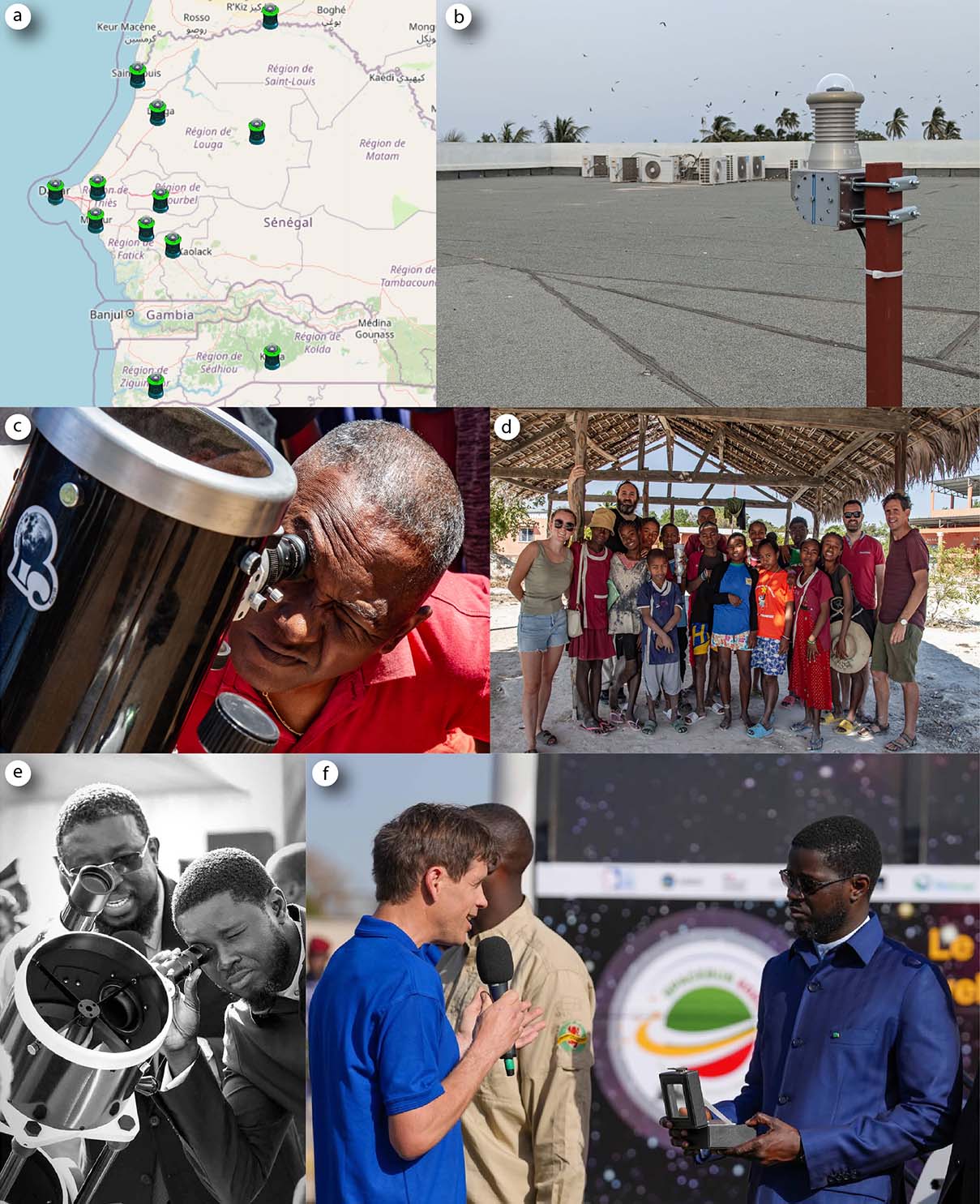
Fig. 1 – Illustration of some of the activities involving AFIPS members. a) Map of the network of cameras for monitoring meteors in Senegal (network Asamaan); b) Asamaan camera on the roof of one ENO (“Espace Numérique Ouvert”) of the Université Numérique Cheikh Hamidou Kane (UNCHK); c) Observation of the Sun during the Astronomy Festival of Madagascar; d) Schoolchildren from the Ecole de monde in Besely (Madagascar) during the preparation of the play “Un astéroïde nommé Besely”, written and directed by Jean-Philippe Uzan; e) and f) Opening ceremony of Space Bus Senegal, with the Senegalese President observing the Moon at a telescope, and receiving a meteorite a gift from the participants to the Space Bus.
Bibliographic references
[1] Pović, M. et al. Development in astronomy and space science in Africa. Nat. Astron. 2, 507–510 (2018).
[2] Baratoux, D. et al. The State of Planetary and Space Sciences in Africa. Eos (2017) doi:10.1029/2017EO075833.
[3] Baratoux, D. et al. Africa Initiative for Planetary and Space Sciences. Eos (2017) doi:10.1029/2017EO075935.
[4] Mustard, J. F. From planets to crops and back: Remote sensing makes sense: Planetary Remote Sensing. J. Geophys. Res. Planets 122, 794–797 (2017).
[5] Ifejika Speranza, C. et al. Enhancing the Uptake of Earth Observation Products and Services in Africa Through a Multi-level Transdisciplinary Approach. Surv. Geophys. (2022) doi:10.1007/s10712-022-09724-1.
Prudence Ayivi Doh Koffi Addor David Baratoux Zouhair Benkhaldoun Sylvain Bouley Moulley Charaf Chabou Hasnaa Chennaoui-Aoudjehane Jamila Chouqar François Colas Mayssa Daldoul Kassamba Abdel Aziz Diaby Sylvain Douté Mayssa El Yazidi Meriem El Yajouri Ines Ezzine Gayane Faye Absa Gasama Mourad Gachoui Maram Kaire Sie Zacharie Kam Marie Korsaga Cheikh Amadou Bamba Niang Elycheikh Ould Mohamed Naviee Ndeye Marame Ngom Andoniaina Rajaonarivelo Mializo Razanakoto Charles Takalana Marian Selorm Sapah Asma Steinhausser Olivier Obrou Hamed Pourkhorsandi Frederic Pitout Mirjana Povic Yoann Quesnel Charles Ratsifaritana Ratiba Sahoui Pétanki Soro Feyda Srarfi
How to cite: Baratoux, D., Chennaoui-Aoudjehane, H., Benkhaldoun, Z., Bouley, S., Kaire, M., Gasama, A., Srarfi, F., Diaby, K. A. A., Marc Harris Fortune, Y., Rajaonarivelo, A., Razanakoto, M., Colas, F., Sylla, S., and Sahoui, R. and the AFIPS Team: AFIPS – A network of African planetary scientists , EPSC-DPS Joint Meeting 2025, Helsinki, Finland, 7–12 Sep 2025, EPSC-DPS2025-1018, https://doi.org/10.5194/epsc-dps2025-1018, 2025.


