
 6,3,11,
- 1Trottier Space Institute, McGill University, 3550 rue University, Montréal, H3A 2A7, QC, Canada
- 2Department of Physics, McGill University, 3600 rue University, Montréal, H3A 2T8, QC, Canada
- 3Observatoire Astronomique, l’Université de Genève, Chemin Pegasi 51b, Versoix, Geneva, Switzerland
- 4Institut Trottier de Recherche sur les Exoplanètes and Département de Physique, Université de Montréal, 1375 Avenue Thérèse-Lavoie-Roux, Montréal, H2V 0B3, QC, Canada
- 5Department of Earth & Planetary Sciences, McGill University, 3450 rue University, Montréal, H3A 0E8, QC, Canada.
- 6Institut Trottier de Recherche sur les Exoplanètes, Université de Montréal, 1375 Avenue Thérèse-Lavoie-Roux, Montréal, H2V 0B3, QC, Canada.
- 7Department of Astronomy & Astrophysics, University of Chicago, 5640 South Ellis Avenue, Chicago, 60637, IL, USA.
- 8Department of Physics & Astronomy, Johns Hopkins University, 3400 N. Charles Street, Baltimore, 21218, MD, USA.
- 9NRC Herzberg Astronomy and Astrophysics, 5071 West Saanich Rd, Victoria, V9E 2E7, BC, Canada.
- 11Carl Sagan Institute, Cornell University, 302 Space Science Building, Ithaca, 14850, NY, USA.
- 12Department of Astronomy and Carl Sagan Institute, Cornell University, Ithaca, 14850, NY, USA.
- 13Department of Physics and Astronomy, Bishops University, 2600 Rue College, Sherbrooke, J1M 1Z7, QC, Canada.
- *A full list of authors appears at the end of the abstract
The detection of metastable helium in exoplanet atmospheres has opened a new observational window into hydrodynamic escape processes and planetary evolution. Leveraging the unprecedented sensitivity of the James Webb Space Telescope (JWST), we present time-resolved NIRISS-SOSS spectroscopy of the warm Neptune WASP-107b, revealing a continuous and significant helium absorption feature centered on the 10833 Å triplet.
We detect strong helium absorption not only during the transit but also in the pre- and post-transit phases, with a peak significance of 36σ at mid-transit and 17σ during pre-transit. The helium absorption begins approximately 1.5 hours before planetary ingress and extends over 10 planetary radii, far beyond the Roche lobe, indicating the presence of a large, escaping thermosphere. In Figure 1, we present the light curve at the helium triplet, clearly showing the extended nature of the absorption beyond the optical transit.
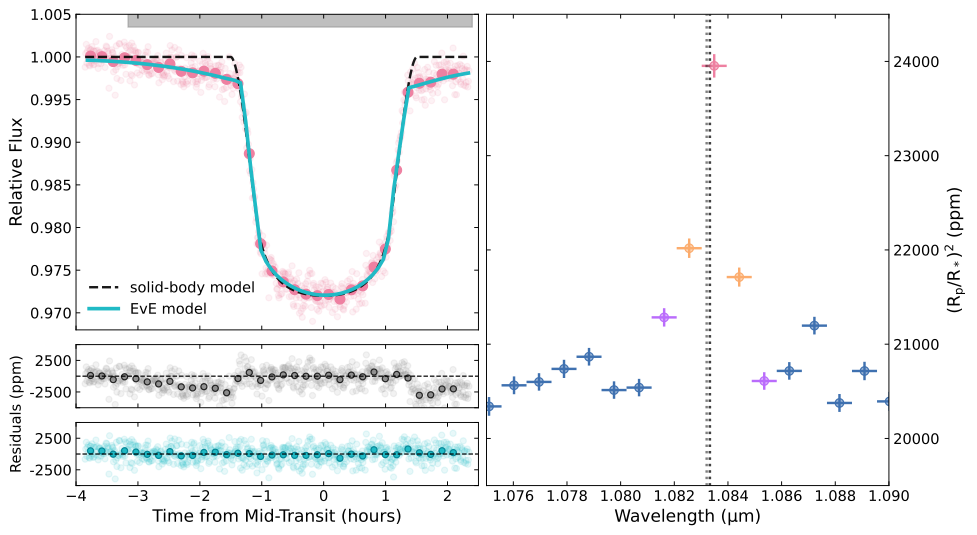
Figure 1: Left: Light curve near the metastable helium feature (pixel corresponding to λ: 1.0830216 – 1.0839538 μm), overlaid with the best-fit solid-body model light curve (black) and the best-fit EvE model (turquoise), along with their corresponding residuals below. The binned data are highlighted for clarity. Pre-transit and post-transit absorption is evident. The out-of-transit excess absorption is particularly apparent in the middle panel, which shows the residuals from the solid-body model fit. The shaded gray region indicates the coverage of past ground-based observations of the target. Right: Transmission spectrum at instrument resolution around the metastable helium lines. Although the lines are not fully resolved (indicated by black dotted lines), the excess absorption is clearly visible.
To interpret this signature, we developed an ellipsoidal outflow model of the thermosphere using our Evaporating Exoplanets (EvE) framework, which successfully reproduces the observed helium light curve (Figure 2). This model constrains the geometry of the escaping atmosphere and supports a broad, extended outflow consistent with hydrodynamic escape driven by stellar irradiation and tidal forces.
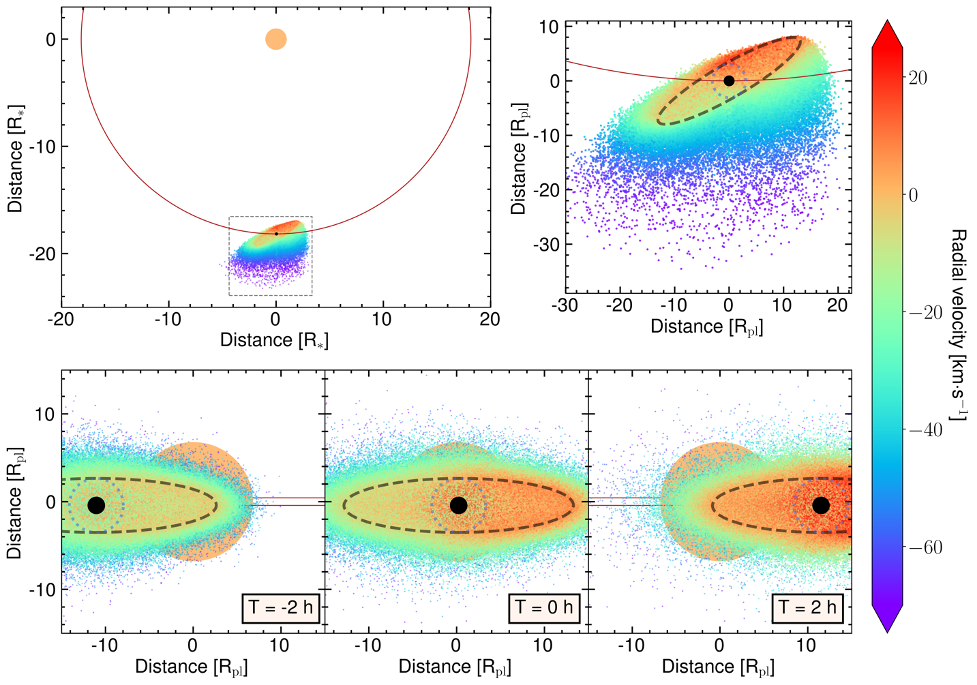
Figure 2: View of the escaping metastable helium in our best-fit model. The red line denotes the planetary orbit, the blue dotted line shows the projection of the Roche lobe, and the black dashed line indicates the boundary of the confined outflow, from which escaping atoms are launched over the 3D surface. The thermospheric profile is generated with a mass-loss of ∼ 1012 g/s, a temperature of 7000 K and a H/He ratio of 0.90. The associated metastable helium mass-loss is ∼ 9 · 105 g/s. Top: Views of the system from above at mid-transit. The right panel is a zoom in over the square black region indicated in the left panel. Bottom: Views of the system along the line-of-sight at mid-transit, and 2 hours before/after.
Importantly, at the NIRISS/SOSS resolution (R ~ 700), a degeneracy exists between the line shape and depth of the helium absorption signal, which cannot be fully resolved without high-resolution spectroscopy. Previous studies of metastable helium in this system relied on stellar reference spectra obtained during the pre- or post-transit phases, likely biasing their light curves and spectral interpretations. This underscores the importance of coordinating JWST observations with high-resolution ground-based spectroscopy to capture both the broad phase curve and the resolved line profile, enabling a more complete understanding of helium escape.
In addition to helium, we detect water absorption in the transmission spectrum (log₁₀[H₂O] = –2.5 ± 0.6), along with a significant short-wavelength slope attributed to unocculted stellar spots (5.2σ), rather than high-altitude hazes. We also place a 2σ upper limit on potassium abundance (log₁₀[K] < –4.86), consistent with a super-solar O/H metallicity. The inferred mass-loss rate of ~1–10 Earth masses per Gyr and high metallicity suggest that WASP-107b formed beyond the snowline and migrated inward recently. Ongoing tidal dissipation, due to the planet’s mildly eccentric orbit, likely contributes to atmospheric inflation and enhanced escape.
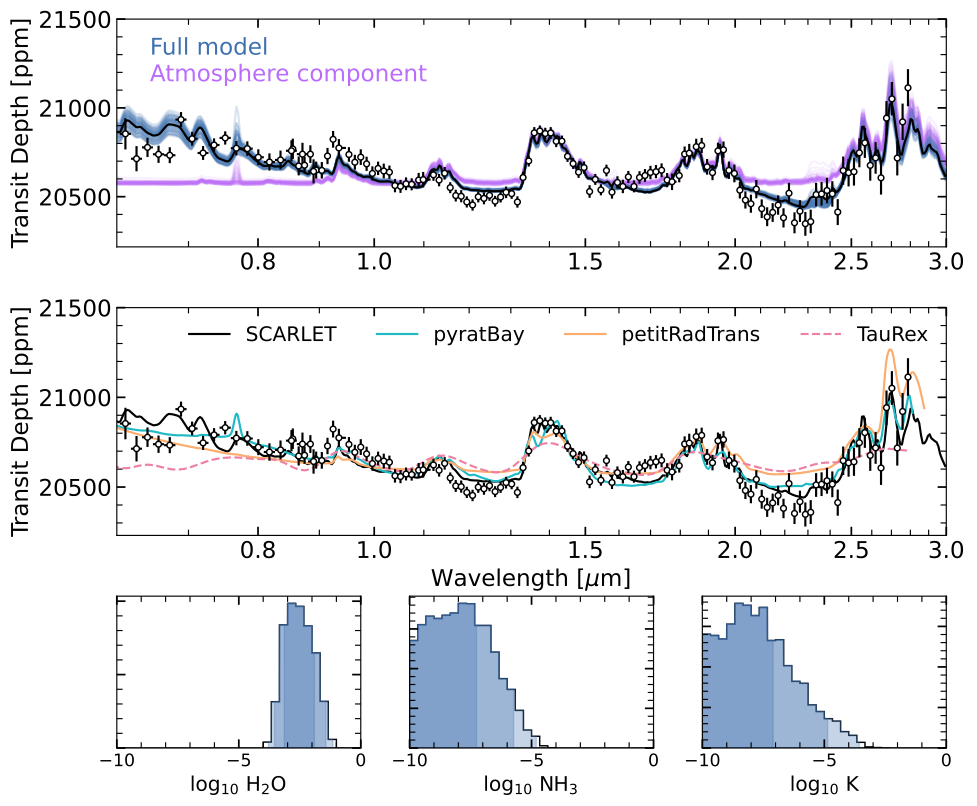
Figure 3: Results of free retrieval performed on the JWST /NIRISS SOSS transmission spectrum of WASP-107 b with SCARLET, TauREx, petitRADTRANS and Pyrat Bay. Top panel: Sample spectra from the posterior distributions of the SCARLET free retrievals (joint fit of planetary atmosphere and stellar contamination). The full models are shown in blue, and the atmosphere contribution is shown in purple for each sample. The best-fit SCARLET model is shown in black. The fitted NIRISS/SOSS transmission spectrum is overlaid (black points) and shifted by the best-fitting offset from the SCARLET retrieval (156 ppm). Middle panel: Best-fit spectra retrieved with SCARLET (black), TauREx (dashed pink), Pyrat Bay (blue) and petitRADTRANS (orange). Bottom panels: Posterior distributions on the H2O, NH3 and K volume mixing ratios from the SCARLET retrievals. The shaded areas indicate the 1, 2, and 3σ confidence intervals. For K and NH3, where only upper limits are obtained, we show the 1, 2, and 3σ upper limits.
This study highlights the transformative potential of JWST in characterizing exoplanetary mass loss and atmospheric dynamics. Our findings provide new insight into the coupling between stellar environments and planetary atmospheres, and establish WASP-107b as a cornerstone system for future atmospheric escape and formation studies.
Jake Taylor (14), Jake D. Turner (12)
How to cite: Krishnamurthy, V., Carteret, Y., Piaulet-Ghorayeb, C., Splinter, J., Doshi, D., Radica, M., Coulombe, L.-P., Allart, R., Bourrier, V., B. Cowan, N., Lafrenière, D., Albert, L., Dang, L., Jayawardhana, R., Johnstone, D., Kaltenegger, L., B. Langeveld, A., Pelletier, S., F. Rowe, J., and Roy, P.-A. and the NEAT Team: Continuous helium absorption from leading and trailing tails of WASP-107 b, EPSC-DPS Joint Meeting 2025, Helsinki, Finland, 7–12 Sep 2025, EPSC-DPS2025-1024, https://doi.org/10.5194/epsc-dps2025-1024, 2025.


