EXOA0 | General Session of EXOA

EXOA0

General Session of EXOA
Conveners: John Lee Grenfell, Séverine Robert, Brian Jackson, Francisco J. Pozuelos, Hannah Jang-Condell
Orals THU-OB5
| Thu, 11 Sep, 15:00–15:51 (EEST)
 
Room Jupiter (Hall A)
Orals FRI-OB4
| Fri, 12 Sep, 14:00–16:00 (EEST)
 
Room Saturn (Hall B)
Posters MON-POS
| Attendance Mon, 08 Sep, 18:00–19:30 (EEST) | Display Mon, 08 Sep, 08:30–19:30
 
Finlandia Hall foyer, F195–203
Thu, 15:00
Fri, 14:00
Mon, 18:00
The objective of the General Session is to accommodate abstracts from a program group that do not align with the themes of any existing sessions within the same program group. Please note that all submitted abstracts may be reallocated to a different session at the discretion of the respective session chairs.

Session assets

Orals THU-OB5: Thu, 11 Sep, 15:00–16:00 | Room Jupiter (Hall A)

Chairperson: Brian Jackson
Small Bodies, Terrestrial Planets, and Planet Formation
15:00–15:12
|
EPSC-DPS2025-50
|
ECP
|
On-site presentation
Caroline Brachmann, Lena Noack, Frank Sohl, and Fabrice Gaillard

Secondary atmospheres on rocky planets primarily form through volcanic degassing after the solidification of a global magma ocean. A key parameter controlling the nature of volcanic degassing and the resulting atmospheric composition is the oxygen fugacity (fO₂) of the melt. Oxygen fugacity strongly influences both the solubility of volatile species and their speciation into reduced or oxidized gases, which in turn critically impacts the atmospheric pressure and composition.

In geodynamical modeling, it is common practice to assume a fixed oxygen fugacity for an entire planet and to keep it constant throughout the modeled time period. However, this is a significant simplification. The oxygen fugacity of a planet's interior and surface can evolve over time due to various processes, such as atmospheric escape and photochemical reactions.

Here, we focus on the effect of volatile degassing in the CHOS (carbon-hydrogen-oxygen-sulfur) system on the oxygen fugacity of ascending magma, and how accounting for this feedback modifies the composition of the gases released, compared to models that neglect it. We present a basic model that simulates melt generation in a planet’s mantle, incorporating initial oxygen fugacity, volatile content, pressure, and temperature as functions of mantle properties and melting depth. The model tracks melt ascent, bubble formation, and gas composition, taking into account volatile solubility and equilibrium gas-melt reactions. We further examine how equilibrium reactions within gas bubbles alter the melt’s oxygen fugacity by either consuming or releasing oxygen.

Building on the results presented in Brachmann et al. (2025), we couple this melt degassing model with atmospheric evolution, including processes such as atmospheric chemistry, water condensation, and hydrogen escape, to study the long-term effects (up to 1 Gyr) of changing oxygen fugacity on planetary atmospheres.

Our results indicate that degassing of reduced species such as H₂ and CO can oxidize the melt, while sulfur degassing as SO₂ tends to reduce it. Consequently, the oxygen fugacity of the melt evolves significantly during degassing, depending on its volatile inventory. As shown in Figure 1, the redox state of the melt tends to converge towards more intermediate values after degassing, reducing the variation seen in the initial conditions.

When coupling this process with our planetary atmosphere model (Brachmann et al., 2025), we find that redox changes due to magma degassing can profoundly influence atmospheric composition, especially for planets with initially reduced mantles (IW to IW–6). Instead of maintaining reduced atmospheres dominated by species like NH₃, CH₄, and H₂O, such planets may develop more oxidized atmospheres with higher CO₂ and H₂O abundances. Because CO₂ and H₂O have higher molecular weights and are more efficient greenhouse gases compared to their reduced counterparts, these changes could lead to significantly higher atmospheric pressures and surface temperatures, with major implications for planetary climate and habitability.

Figure 1: change in oxygen fugacity during melt ascent and degassing depending on initial oxygen fugacity and water content. We tested 6 cases with 3 different initial oxygen fugacities (IW +0, IW + 2 and IW + 4) and varied water content (0.07 wt % and 0.4 wt%). Sulfur was set at 0.1 wt% and CO2 at 0.05 wt%.

How to cite: Brachmann, C., Noack, L., Sohl, F., and Gaillard, F.: Redox Evolution During Magma Degassing and Its Impact on Planetary Atmospheres, EPSC-DPS Joint Meeting 2025, Helsinki, Finland, 7–13 Sep 2025, EPSC-DPS2025-50, https://doi.org/10.5194/epsc-dps2025-50, 2025.

15:12–15:24
|
EPSC-DPS2025-1296
|
On-site presentation
Margaret Pan and Re'em Sari

While investigating whether planetesimals might form via gravitational instability of a thin layer of solids at the midplane of a gas-dominated protoplanetary disk, Sekiya (1998) performed the first analytic investigation into Kelvin-Helmholtz stable density profiles of well-coupled dust in such a disk. He found that for given gas disk parameters, marginally stable profiles exist only up to a maximum dust surface density ∑d,crit. We derive a natural extension of his profile solutions to larger dust surface densities. In these new profiles, additional dust mass above ∑d,crit accumulates at the midplane, where orbital velocities are already Keplerian and where the dust’s effect on the vertical velocity profile is least destabilizing: the fraction of the dust at the midplane increases and the total height of the dust layer decreases as the dust surface density increases.

The new profiles suggest that for disks enriched by a factor of several over typical ISM metallicities -- for example disks whose gas has begun to dissipate as they approach the ends of their lifetimes -- solids at the midplane may concentrate enough to undergo gravitational instability before Kelvin-Helmholtz disruption of the dust density profile. Using physical parameters typical of observed disks, we characterize planetesimal populations that might form in this way.

How to cite: Pan, M. and Sari, R.: Forming planetesimals via gravitational instability in maximally-settled protoplanetary disks , EPSC-DPS Joint Meeting 2025, Helsinki, Finland, 7–13 Sep 2025, EPSC-DPS2025-1296, https://doi.org/10.5194/epsc-dps2025-1296, 2025.

15:24–15:36
|
EPSC-DPS2025-1770
|
ECP
|
On-site presentation
Lucy Taylor, Simon Lock, Zoë Leinhardt, David Grant, and Hannah Wakeford

Introduction

Giant impacts are a crucial stage of planet formation, capable of altering the properties of planets and the structure of planetary systems [Raymond et al., 2018]. As such, garnering a better understanding of the dynamics of these incredibly violet and energetic events is essential to the study of planetary formation pathways. Unfortunately, the observational constraints we have on the outcomes of giant impacts are the marks left in the present-day properties of planetary systems, such as the chemistry of the Earth-Moon system or the density of exoplanets. This is a limited data set with degeneracies between the initial conditions, processes and final outcomes. However, we have recently entered a new frontier in the study of giant impacts. Recent observations of an infrared excess followed by a visible transit of the star ASASSN-21qj are thought to be the result of an exoplanetary collision [Kenworthy et al., 2023]: the infrared excess could be the result of direct emission from the substantially inflated post-impact body. To leverage this powerful new constraint on the dynamics of giant impacts, we need to be able to relate observed data to models of giant impacts. However, large sections of post-impact bodies are optically thick and observed emission likely comes from the very edge of the post-impact structure where material density is very low. Due to computational expense, it is not currently possible to conduct giant impact simulations that resolve such low densities, inhibiting our ability to use astronomical observations to constrain impact processes.

We present a new method of processing the results of existing smoothed particle hydrodynamics (SPH) impact simulations to emulate the true physical properties of outer regions of post-impact body candidates to compare to astronomical observations.

Going Beyond the Density Floor

We simulate giant impacts using SWIFT [Schaller et al., 2024]. Simulated colliding planets are represented as collections of parcels of mass (particles); the number of particles used is referred to as the simulation’s resolution. Typically, higher-resolution simulations are considered more accurate, but are far more computationally expensive. The radius of these fixed-mass particles, proportional to a “smoothing length” (h),  evolves during the simulation and allows the code to interpolate properties such as the density at the central location of each particle, and calculate forces acting between particles. SWIFT iteratively solves Equation 1 to find a particle’s smoothing length [Price 2012]. However, for computational efficiency, SWIFT imposes an upper limit on how large SPH particles are allowed to become, or a “maximum smoothing length”. This truncation prevents these particles from recording sufficiently low densities at each of their locations and enforcing a lower density limit or “density floor”.

(Equation 1: n is number density, η is a smoothing parameter, x vectors are multi-dimensional locations and particle positions, W is a smoothing kernel described in [Dehnen & Aly 2012].)

Although the density floor is essential to increasing SWIFT’s computational efficiency, it presents an unfortunate problem in the analysis of optical thickness and the process of locating photic surfaces of simulated structures. Post-impact structures can span tens to hundreds of Earth radii, are substantially vaporised and heated, and likely optically thick to very low densities [Kenworthy et al., 2023]. However, high-resolution, well-smoothed simulations of computational feasibility typically have density floors above 10−5 kg m−3, forcing particles in the outer regions of simulated post-impact structures to store the same density values which could be several orders of magnitude higher than reality, and misrepresenting the simulation’s material record of thermodynamic properties.

To overcome this issue, we have implemented a post-processing pipeline which re-solves Equation 1 without enforcing efficiency-induced truncation, and so recovers the extremely low densities expected at the edge of this expansive vaporised structure (Figure 1). We then account for the effect of smoothing length truncation on the rest of the structure’s thermodynamic properties, and simultaneously untangle properties of multiple materials (e.g. forsterite from the impactor/ target mantles and iron from their cores) at different phases. Finally, we model the absorption of silicate vapour [Kraus et al., 2012] and condensates to locate the photic surface of the post-impact structure.

[Figure 1: A histogram showing original interpolated particle densities when smoothing lengths are truncated (green), vs. reprocessed interpolated particle densities (purple). Note the large spike in the original distribution of densities at approximately 10-3 kgm-3 – this is the density floor imposed by truncation. The original and processed distributions are near identical for higher density values where assigned smoothing lengths are accurate. For lower density values, particles originally at the density floor are assigned lower density values once their smoothing length has been recalculated.]

Conclusions

We find that giant impacts can easily produce bright, hot, chaotic objects with optically thick regions than span hundreds of Earth radii. The size of the photic surface varies with particle resolution, since it is essential that individual SPH particle masses are low enough to accurately model the relatively low-mass outer regions of post-impact structures. However, for collisions between two Earth-mass bodies we begin to see convergence in the shape of optically thick regions for resolutions above 106 particles.

[Figure 2: Extracting the optically thick region of a post-impact structure, viewed 23 hours after a simulated impact event perpendicularly to the collisional plane. (Black indicates optical thickness, teal optical thinness.) SPH particle locations are superimposed (white). The pipeline identifies that not all SPH particle locations are contained within the optically thick region. This post-impact structure is the result of a collision between two identical planetary objects 1R in radius and 0.9M in mass, each made up of 106.5 particles.]

We are now using this pipeline to relate giant impact simulations to the detectability of post-impact objects, both via direct detection and the transit method, for a variety of telescopes with different technical specifications. The scale of the optically thick regions of post-impact bodies, along with their associated flux values, suggest that a wide range of impacts may feasibly detectable, allowing powerful new constraints to be placed on planetary formation models.  

How to cite: Taylor, L., Lock, S., Leinhardt, Z., Grant, D., and Wakeford, H.: Analysing Optical Thickness in Simulated Giant Impacts to Determine Observational Signatures of Post-Impact Bodies, EPSC-DPS Joint Meeting 2025, Helsinki, Finland, 7–13 Sep 2025, EPSC-DPS2025-1770, https://doi.org/10.5194/epsc-dps2025-1770, 2025.

15:36–15:51
|
EPSC-DPS2025-124
|
ECP
|
On-site presentation
Prachi Vaijanath Chavan, Bin Yang, and Lucas Cieza

Introduction

In recent years, the discovery of more exoplanetary systems and interstellar objects has highlighted the growing synergy between exoplanetary science and planetary science. While exoplanetary science offers statistical insights into planetary architectures and formation scenarios, planetary science provides detailed physical models essential for the characterization of exoplanets [1]. Planet formation, whether in our Solar System or around other stars, is strongly influenced by the initial conditions of protoplanetary disks (PPDs)—including masses, sizes, surface densities, and temperature profiles [10]. In addition to that, the subsequent evolution of these PPDs is governed by processes such as radial drift, vertical mixing, and, in particular, grain growth [2].

One of the major challenges in planet formation is understanding how dust grains grow into millimeter- to centimeter-sized particles. Such large grains—found in comets—serve as local analogs to the solids observed in disks around young stars [3] and provide a unique opportunity to investigate early grain growth processes. However, studies of these particles, which also constitute the bulk of the total coma mass [4], remain largely unexplored. Large particles also contribute to the grain size distribution, which plays a critical role in estimating the total dust mass in PPDs. Accurate dust mass estimates are essential to evaluate the potential to form planetesimals, rocky planets, and giant planet cores [5]. However, the current dust mass estimates are highly uncertain and insufficient to explain the observed high incidence of massive exoplanets [6,7].

These challenges—uncertainties in PPD dust masses and limited characterization of large particles—can be addressed through multi-frequency analysis of dust in both protoplanetary disks and comets. Although numerous studies have individually investigated dust properties in each of these environments, comparative analyses integrating exoplanetary and planetary science remain understudied. Such interdisciplinary comparisons of dust properties have the potential to significantly improve our understanding of the processes governing the evolution of planetary systems.

Observations and Methods

As part of the ODISEA project (Ophiuchus DIsk Survey Employing ALMA) [8], we combined the archival ALMA observations across Band 3 (100 GHz), Band 4 (140 GHz), Band 6 (230 GHz), Band 7 (350 GHz), and Band 8 (410 GHz). This multi-frequency approach allows us to constrain dust temperatures, surface densities, and grain size distributions as a function of radius [9]. This is in contrast to the single-frequency approach, which requires assuming a single temperature and optically thin emission. Our method is based on the radiative transfer equation under the plane-parallel slab approximation, which is given by:

Iν = Bν (Td) [1 - exp (-τ0 (ν/ν0) β)]

where Bν(Td) is the Planck function, Td is the dust temperature, τ0 is the optical depth of dust at frequency ν0, and β is the dust opacity spectral index. This framework, therefore, enables more robust dust mass estimates by integrating over the surface density profile.

To extend this analysis to the solar system context, we apply a similar multi-frequency approach to study the dust properties in comets. Using a similar set of ALMA bands, we target the distribution of dust and the presence of large grains in the comae of the exceptionally bright Oort Cloud comets, C/2023 A3 and C/2017 K2. These long-period comets are among the least thermally processed bodies in the Solar System and are also known to be dust-rich, making them one of the best-preserved reservoirs of primitive material from the solar nebula. Our observations aim to constrain the dust mass-loss rate and model the spectral energy distribution (SED) to derive the grain size distribution and dust structure. Additionally, we obtained mid-infrared observations of comet A3 with VLT’s VISIR instrument to investigate the long-standing contradiction of detecting crystalline silicates, formed at high temperatures, in comets that originated in cold environments.

I will present the analysis of dust continuum from both A3 and K2 based on our ALMA observations, alongside key results of their composition from mid-infrared spectral fitting using dust models. In parallel, I will present the statistical results on dust surface density, maximum grain size, and dust temperature profiles in PPDs, emphasizing the comparison between dust masses derived from single- versus multi-frequency analyses. This represents the first comprehensive multi-frequency study of a large sample of 44 Class I and Class II disks, corresponding to the early stages of PPD evolution, within a single molecular cloud. Finally, I will discuss how integrating findings from both cometary and disk environments through consistent multi-frequency analysis helps bridge a critical knowledge gap in our understanding of grain growth, the role of large particles, and the evolution of dust properties across different stages of planetary system formation.

References

[1] Kane, S. R., et al. 2021, JGRE, 126, e06643
[2] Simon, J.B., et al. 2022, arXiv e-prints, 2212.04509
[3] Mannings, V., & Emerson, J. P. 1994, MNRAS, 267, 361
[4] Jewitt D., et al. 1992, Icarus, 100, 187
[5] Drazkowska, J., et al. 2023, PPVII, 717
[6] Greaves, J. S., & Rice, W. K. M. 2010, MNRAS, 407, 1981
[7] Manara, C. F., et al. 2018, A&A, 618, L3
[8] Cieza, L. A., et al. 2019, MNRAS, 482, 698
[9] Sierra, A., et al. 2021, ApJ, 257, 14
[10] Williams, J. P., & Cieza, L. A. 2011, ARAA, 49, 67.

How to cite: Chavan, P. V., Yang, B., and Cieza, L.: From Disks to Comets: A Multi-frequency Study of Dust from Ophiuchus Molecular Cloud to the Oort Cloud, EPSC-DPS Joint Meeting 2025, Helsinki, Finland, 7–13 Sep 2025, EPSC-DPS2025-124, https://doi.org/10.5194/epsc-dps2025-124, 2025.

Orals FRI-OB4: Fri, 12 Sep, 14:00–16:00 | Room Saturn (Hall B)

Chairperson: Hannah Jang-Condell
Giant Planets
14:00–14:12
|
EPSC-DPS2025-376
|
ECP
|
On-site presentation
Anna Ruth Taylor, Tommi Koskinen, Chenliang Huang, Anthony Arfaux, and Panayotis Lavvas

Understanding atmospheric escape from hot Jupiters and sub-Neptunes is critical for constraining exoplanet evolution, demographics, and star-planet interactions. Observations of escaping atmospheres increasingly probe excited states of hydrogen and helium, including the He I 1083 nm triplet and H I Balmer lines. These features provide sensitive diagnostics of mass loss, thermal structure, and non-LTE level populations but have at times proven difficult to interpret. We present results from a full-atmosphere model framework that connects a multi-species thermosphere-ionosphere escape code with a 1D lower atmosphere model. For HD 209458b and HD 189733b, we show that reproducing the modest He I and H α transit depths observed alongside large UV transit depths requires relatively low mass loss rates, efficient diffusive separation, and stellar-driven variability. We incorporate updated rate coefficients and high-resolution cross-sections to predict He I absorption under varying stellar activity conditions more accurately. We extend this framework to sub-Neptunes and present predictive modeling for GJ 1214b, a warm, low-density planet with evidence for a high-metallicity, possibly water-rich atmosphere. Water-dominated thermospheres have distinct thermal structures and radiative properties, leading to reduced scale heights and potentially suppressed mass loss. These models demonstrate the importance of self-consistent, multi-layer models of atmospheric escape and underscore the need for simultaneous UV, optical, and infrared observations to disentangle the complex interplay between composition, heating, and dynamics in escaping exoplanet atmospheres.

How to cite: Taylor, A. R., Koskinen, T., Huang, C., Arfaux, A., and Lavvas, P.: Exploring atmospheric escape from hot-Jupiters and water-rich sub-Neptunes with full-atmosphere models, EPSC-DPS Joint Meeting 2025, Helsinki, Finland, 7–13 Sep 2025, EPSC-DPS2025-376, https://doi.org/10.5194/epsc-dps2025-376, 2025.

14:12–14:24
|
EPSC-DPS2025-1024
|
On-site presentation
Vigneshwaran Krishnamurthy, Yann Carteret, Caroline Piaulet-Ghorayeb, Jared Splinter, Dhvani Doshi, Michael Radica, Louis-Philippe Coulombe, Romain Allart, Vincent Bourrier, Nicolas B. Cowan, David Lafrenière, Loïc Albert, Lisa Dang, Ray Jayawardhana, Doug Johnstone, Lisa Kaltenegger, Adam B. Langeveld, Stefan Pelletier, Jason F. Rowe, and Pierre-Alexis Roy and the NEAT Team

The detection of metastable helium in exoplanet atmospheres has opened a new observational window into hydrodynamic escape processes and planetary evolution. Leveraging the unprecedented sensitivity of the James Webb Space Telescope (JWST), we present time-resolved NIRISS-SOSS spectroscopy of the warm Neptune WASP-107b, revealing a continuous and significant helium absorption feature centered on the 10833 Å triplet.

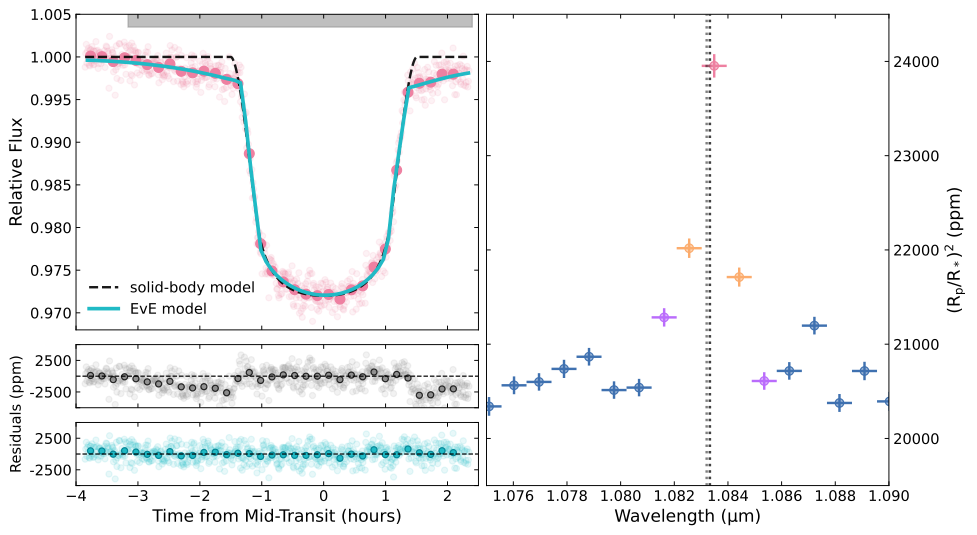
We detect strong helium absorption not only during the transit but also in the pre- and post-transit phases, with a peak significance of 36σ at mid-transit and 17σ during pre-transit. The helium absorption begins approximately 1.5 hours before planetary ingress and extends over 10 planetary radii, far beyond the Roche lobe, indicating the presence of a large, escaping thermosphere. In Figure 1, we present the light curve at the helium triplet, clearly showing the extended nature of the absorption beyond the optical transit.

Figure 1: Left: Light curve near the metastable helium feature (pixel corresponding to λ: 1.0830216 – 1.0839538 μm), overlaid with the best-fit solid-body model light curve (black) and the best-fit EvE model (turquoise), along with their corresponding residuals below. The binned data are highlighted for clarity. Pre-transit and post-transit absorption is evident. The out-of-transit excess absorption is particularly apparent in the middle panel, which shows the residuals from the solid-body model fit. The shaded gray region indicates the coverage of past ground-based observations of the target. Right: Transmission spectrum at instrument resolution around the metastable helium lines. Although the lines are not fully resolved (indicated by black dotted lines), the excess absorption is clearly visible.

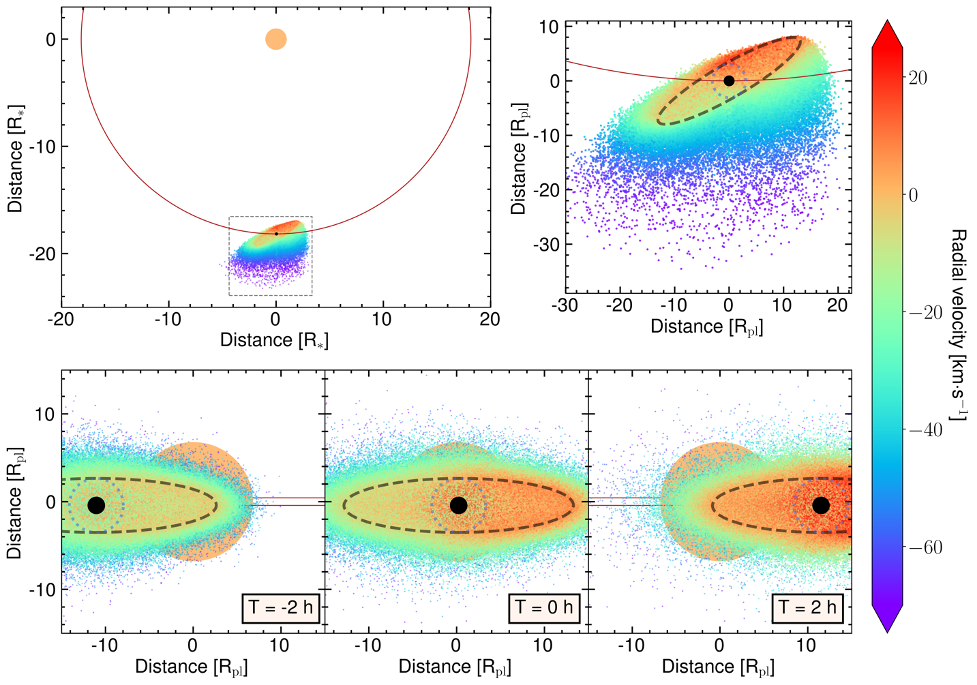
To interpret this signature, we developed an ellipsoidal outflow model of the thermosphere using our Evaporating Exoplanets (EvE) framework, which successfully reproduces the observed helium light curve (Figure 2). This model constrains the geometry of the escaping atmosphere and supports a broad, extended outflow consistent with hydrodynamic escape driven by stellar irradiation and tidal forces.

Figure 2: View of the escaping metastable helium in our best-fit model. The red line denotes the planetary orbit, the blue dotted line shows the projection of the Roche lobe, and the black dashed line indicates the boundary of the confined outflow, from which escaping atoms are launched over the 3D surface. The thermospheric profile is generated with a mass-loss of ∼ 1012 g/s, a temperature of 7000 K and a H/He ratio of 0.90. The associated metastable helium mass-loss is ∼ 9 · 105 g/s. Top: Views of the system from above at mid-transit. The right panel is a zoom in over the square black region indicated in the left panel. Bottom: Views of the system along the line-of-sight at mid-transit, and 2 hours before/after.

Importantly, at the NIRISS/SOSS resolution (R ~ 700), a degeneracy exists between the line shape and depth of the helium absorption signal, which cannot be fully resolved without high-resolution spectroscopy. Previous studies of metastable helium in this system relied on stellar reference spectra obtained during the pre- or post-transit phases, likely biasing their light curves and spectral interpretations. This underscores the importance of coordinating JWST observations with high-resolution ground-based spectroscopy to capture both the broad phase curve and the resolved line profile, enabling a more complete understanding of helium escape.

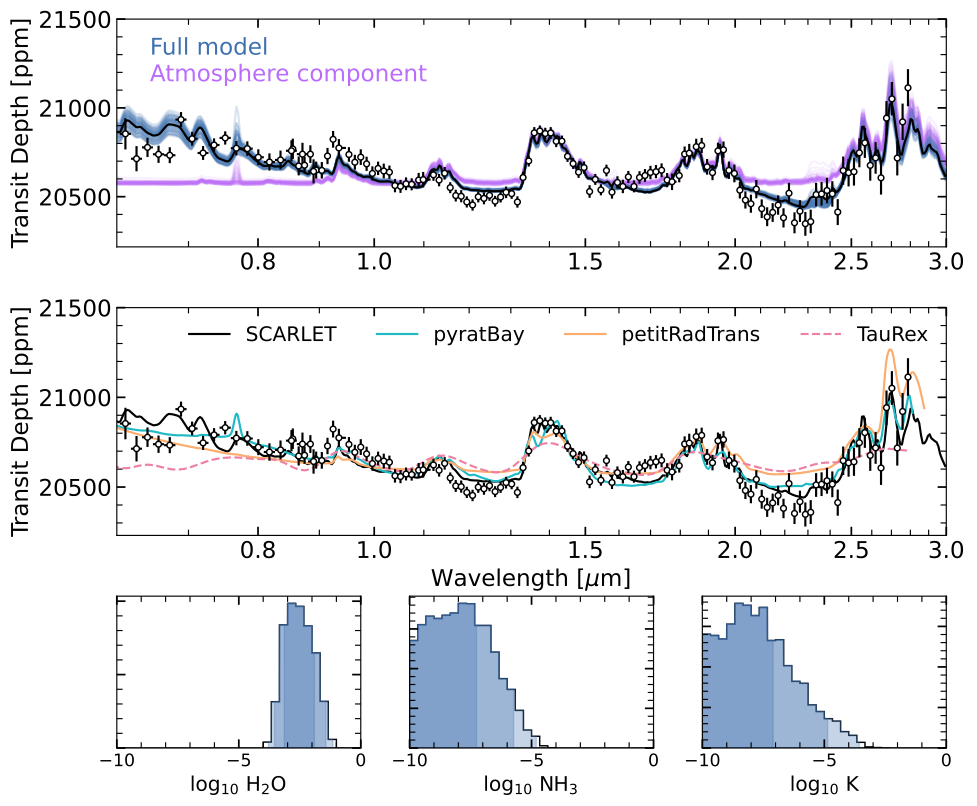
In addition to helium, we detect water absorption in the transmission spectrum (log₁₀[H₂O] = –2.5 ± 0.6), along with a significant short-wavelength slope attributed to unocculted stellar spots (5.2σ), rather than high-altitude hazes. We also place a 2σ upper limit on potassium abundance (log₁₀[K] < –4.86), consistent with a super-solar O/H metallicity. The inferred mass-loss rate of ~1–10 Earth masses per Gyr and high metallicity suggest that WASP-107b formed beyond the snowline and migrated inward recently. Ongoing tidal dissipation, due to the planet’s mildly eccentric orbit, likely contributes to atmospheric inflation and enhanced escape.

Figure 3: Results of free retrieval performed on the JWST /NIRISS SOSS transmission spectrum of WASP-107 b with SCARLET, TauREx, petitRADTRANS and Pyrat Bay. Top panel: Sample spectra from the posterior distributions of the SCARLET free retrievals (joint fit of planetary atmosphere and stellar contamination). The full models are shown in blue, and the atmosphere contribution is shown in purple for each sample. The best-fit SCARLET model is shown in black. The fitted NIRISS/SOSS transmission spectrum is overlaid (black points) and shifted by the best-fitting offset from the SCARLET retrieval (156 ppm). Middle panel: Best-fit spectra retrieved with SCARLET (black), TauREx (dashed pink), Pyrat Bay (blue) and petitRADTRANS (orange). Bottom panels: Posterior distributions on the H2O, NH3 and K volume mixing ratios from the SCARLET retrievals. The shaded areas indicate the 1, 2, and 3σ confidence intervals. For K and NH3, where only upper limits are obtained, we show the 1, 2, and 3σ upper limits.

This study highlights the transformative potential of JWST in characterizing exoplanetary mass loss and atmospheric dynamics. Our findings provide new insight into the coupling between stellar environments and planetary atmospheres, and establish WASP-107b as a cornerstone system for future atmospheric escape and formation studies.

How to cite: Krishnamurthy, V., Carteret, Y., Piaulet-Ghorayeb, C., Splinter, J., Doshi, D., Radica, M., Coulombe, L.-P., Allart, R., Bourrier, V., B. Cowan, N., Lafrenière, D., Albert, L., Dang, L., Jayawardhana, R., Johnstone, D., Kaltenegger, L., B. Langeveld, A., Pelletier, S., F. Rowe, J., and Roy, P.-A. and the NEAT Team: Continuous helium absorption from leading and trailing tails of WASP-107 b, EPSC-DPS Joint Meeting 2025, Helsinki, Finland, 7–13 Sep 2025, EPSC-DPS2025-1024, https://doi.org/10.5194/epsc-dps2025-1024, 2025.

14:24–14:36
|
EPSC-DPS2025-1077
|
On-site presentation
Tristan Guillot and Steve Markham
Convection governs the structure, interior temperatures and cooling of planets. When condensation occurs, the release of latent heat can lead to a more efficient heat transport. This situation is natural for us, as it occurs in the Earth atmosphere with water condensation, which can lead to powerful storms and a temperature gradient close to a moist adiabat. But when condensing species are both abundant and heavier than the surrounding gas or fluid, the opposite may be true: The release of latent heat then keeps the abundance of the condensing species higher than in the surrounding environment, leading to an inhibition of convection. Furthermore, this inhibition occurs independently of the temperature gradient itself, leading to a potentially very significant superadiabaticity, controlled by other processes (radiation, conduction) available for heat transport and by condensate precipitation. 
 
This situation occurs with methane in the atmospheres of Uranus and Neptune. It may occur with water in Jupiter and Saturn and explain some of the structures seen with Juno and Cassini. In the deep interiors of these planets, the latent heat released by helium droplets when they phase separate from hydrogen also creates a powerful barrier to convection that could explain the dichotomy that is observed on their magnetic fields. In exoplanets, moist convection inhibition should prevail in a large variety of situations: In the atmospheres of metal-rich hydrogen-dominated exoplanets, especially temperate one in which abundant condensing species such as water are present. It should also affect the interior structures of super-Earths with magma oceans. 
 
The consequences should be a slower cooling and generally (but not always) higher interior temperatures. Moist convection inhibition affects the transport of heat and chemicals, and therefore the link that we can make between the atmosphere and interior from disequilibrium species. It affects the mass-radius-age relations and therefore the inferred bulk abundances of heavy elements in fluid planets. We will review the consequences and opportunities this represents in preparation of the PLATO mission. 

How to cite: Guillot, T. and Markham, S.:  Moist convection inhibition and its consequences for exoplanets , EPSC-DPS Joint Meeting 2025, Helsinki, Finland, 7–13 Sep 2025, EPSC-DPS2025-1077, https://doi.org/10.5194/epsc-dps2025-1077, 2025.

14:36–14:48
|
EPSC-DPS2025-907
|
ECP
|
Virtual presentation
Daniela Ernestová, Miroslav Brož, and Felix Sainsbury-Martinez

Hot Jupiters are highly irradiated Jupiter-sized planets in extremely close synchronous orbits around their host stars. Despite their size and proximity to the star, which makes them relatively easy to observe, direct observations of their atmospheres are difficult. Therefore, interpreting indirect observations is crucial to understanding their global atmospheric circulation. Here, we aim to test the hypothesis that systematically varying the rotation rate of hot Jupiters influences their atmospheric circulation and resulting phase curves. We used DYNAMICO (Dubos et al, 2015), a 3d General Circulation Model (GCM) that uses an energy-conserving Hamiltonian to solve fluid dynamics equations on a rotating sphere. To test our hypothesis, we modelled benchmark hot Jupiter HD209458b and then Kepler 5b, WASP103b, and WASP121b. We used PICASO (Robbins-Blanch et al., 2022), a 3d state-of-the-art radiative transfer code, to model the phase curves in JWST NIRCam filters for 3.6 μm and 4.5 μm wavelengths. We also used GGChem (Woitke et al., 2018) to check if chemical species can condense into clouds composed of quartz and forsterite, unlike clouds in the Solar System.

Our simulations show that the general atmospheric circulation can be divided into two circulation regimes: rotational and divergent. The rotational regime is characteristic of models with fast rotation rates (between one and 40 times the nominal rotation rate). These models exhibit rotationally dominated circulation, which produces a narrow and weak eastward jet. Its speed drops from 3km/s to 0.3km/s and its width decreases with increasing rotation rate. These weak jets transport less heat from the substellar point, and therefore the synthetic phase curves have a large amplitude (the ratio of the planetary to stellar flux is around 3 × 10⁻⁵) and little to no offset. On the other hand, the divergent regime is characteristic of slow rotators. There, the divergent (overturning) circulation dominates, so the temperature across the planet is more homogenised, therefore, the synthetic phase curves exhibit 3 times smaller amplitudes than in the rotational regime and large offsets (of the order of tens of degrees).

Our results for HD209458b suggest that differences in the shapes and offsets of the phase curve are most prominent in the 4.5 μm band. However, our model underestimates the amplitude of the phase curves by half (the synthetic value is around 5 × 10⁻⁴ compared to 1 × 10⁻³ for the observed one). Even though our model includes accounts for the complex interplay between a planet’s physical characteristics (size, mass, period, etc.) and its chemical composition (metallicity and opacity), it is still idealised. It is yet to be extended to high atmosphere (10−6 bar), with possible weak temperature inversion, longer radiative timescales and high-altitude clouds.


Dubos, T., Dubey, S., Tort, M., Mittal, R., Meurdesoif, Y. and Hourdin, F. DYNAMICO-1.0, an icosahedral hydrostatic dynamical core designed for consistency and versatility. 2015. Geoscientific Model Development. 8: 3131-3150.

Robbins-Blanch, N., Kataria, T., Batalha, N. and Adams, D. J. Cloudy and Cloud-free Thermal Phase Curves with PICASO: Applications to WASP-43b. 2022. The Astrophysical Journal. 930: 93-102. 

Woitke, P., Helling, Ch., Hunter, G. H., Millard, J. D., Turner,  G. E., Worters, M., Blecic, J., and Stock, J. W. Equilibrium chemistry down to 100 K. Impact of silicates and phyllosilicates on carbon/oxygen ratio. 2018. Astronomy & Astrophysics. 614.

How to cite: Ernestová, D., Brož, M., and Sainsbury-Martinez, F.: How rotation rate influences the phase curve of hot Jupiters: theory and observations, EPSC-DPS Joint Meeting 2025, Helsinki, Finland, 7–13 Sep 2025, EPSC-DPS2025-907, https://doi.org/10.5194/epsc-dps2025-907, 2025.

14:48–15:00
|
EPSC-DPS2025-1227
|
ECP
|
On-site presentation
Alexandra Lehtmets, Zuzana Balkoova, Heleri Ramler, Egle Väljamäe, Claudia Matt, and Mihkel Kama

The direct characterisation of exoplanetary atmospheres remains observationally challenging, especially for close-in gas giants around bright stars. However, recent theoretical work by Jermyn & Kama (2018) suggests an indirect pathway: highly irradiated hot Jupiters with evaporating atmospheres may transfer a fraction of their atmospheric material onto their host stars. This process, known as stellar photospheric contamination, could imprint the chemical composition of the exoplanet's upper atmosphere onto the stellar spectrum, offering a new means of atmospheric characterisation.

In this study, we explore the conditions under which such contamination may occur, focusing on star–planet systems involving F and A-type host stars. These stars, with their relatively thin convective zones and high ultraviolet output, are particularly susceptible to detectable enrichment from planetary material. Using a sample of well-characterised hot Jupiters orbiting F-type stars, we model the vertical pressure–temperature (P–T) profiles of their atmospheres, identifying species likely to escape and potentially accumulate on the stellar surface.

We then examine how the architecture of each system (e.g. orbital separation, planetary atmosphere evaporation rates) affects the efficiency and detectability of contamination. Our approach combines theoretical atmospheric structure modelling with current and archival spectral data to assess the feasibility of this technique using existing high-resolution spectrographs and to define instrumental requirements for future observations.

Our results demonstrate that photospheric contamination is a promising, underutilised method for tracing the chemical fingerprints of exoplanet atmospheres. This work opens new avenues for synergy between stellar spectroscopy and planetary atmospheric studies, offering a complementary tool to direct detection techniques.

How to cite: Lehtmets, A., Balkoova, Z., Ramler, H., Väljamäe, E., Matt, C., and Kama, M.: Stellar Photospheric Contamination as a Tool for Indirect Characterisation of Hot Jupiter Atmospheres, EPSC-DPS Joint Meeting 2025, Helsinki, Finland, 7–13 Sep 2025, EPSC-DPS2025-1227, https://doi.org/10.5194/epsc-dps2025-1227, 2025.

15:00–15:12
|
EPSC-DPS2025-1562
|
ECP
|
Virtual presentation
Planet-induced Modulation of Stellar Activity in an M-Dwarf: Insights into the Magnetism of a Benchmark Warm Neptune
(withdrawn)
Daniel Revilla, Pedro Amado, Rafael Luque, Patrick Schöfer, Antonino Francesco Lanza, Abraham Binnenfeld, José Antonio Caballero, Artie Hatzes, Gregory Henry, Sandra Jeffers, Simranpreet Kaur, Enric Pallé, Luis Peña, Miguel Pérez, Andreas Quirrenbach, Ansgar Reiners, Ignasi Ribas, Daniele Viganò, Maria Rosa Zapatero, and Shay Zucker
JWST, VLT, and Exoplanet Transits
15:12–15:24
|
EPSC-DPS2025-1623
|
On-site presentation
John Allen and Thaddeus Komacek

Introduction: Recent advances in observation with the JWST and high-resolution ground-based instruments have enabled the study of exoplanets to progress towards atmospheric characterisation, as opposed to merely detection. Hot and ultra-hot Jupiters remain among the best characterised and studied class of exoplanet, due to their large sizes and close orbits, however how the internal heating and resulting radius inflation of bloated ultra-hot Jupiters and related coupling to the internal magnetic field impacts their atmospheric circulation remains an open question. Moreover, the impact of atmospheric dynamics on observable properties can now be studied in detail. This study investigates the effect of varying both atmospheric drag and internal heat flux on the observable properties of WASP-76b, with comparisons made to JWST NIRSpec white-light phase curves. In addition, we perform a broader parameter sweep using the SPARC/MITgcm to investigate the influence of internal heating and inflated radii on the observable properties of hot and ultra-hot Jupiters.

Methods: A suite of general circulation models are run, which solve the primitive equations of meteorology coupled to non-grey correlated-k radiative transfer with the SPARC/MITgcm [1]. The effect of Lorentz forces is represented by changing a spatially constant drag timescale , and for WASP-76b we consider two different internal heat fluxes for comparison, across the range of predicted values for hot and ultra-hot Jupiters [2]. We then will perform a broader parameter sweep, exploring the space of inflated-radii hot and ultra-hot Jupiters by covering a range of irradiation levels from zero-albedo full-redistribution equilibrium temperatures of 1000 – 3200K, again using the SPARC/MITgcm. This parameter space is inclusive of most inflated gas-giant planets, excluding KELT-9b, and will allow us to study the impact of internal heating on atmospheric circulation, with interior heating and evolution modelled using MESA [3]. We then use the gCMCRT radiative transfer code [4] to post-process the GCM results to produce simulated phase curves.

Results: The key result from this study is shown in Figure 1, with simulated phase curves shown in comparison to Spitzer telescope data [5] at 3.6mm. We make the comparison to Spitzer data here as a placeholder for the comparison to JWST NIRSpec data, as the JWST data is not yet published. Figure 3 shows the impact of the interior heat flux on the internal temperature structure of WASP-76b. There is no observable difference between the interior heat flux scenarios. Figures 2 and 4 show characteristics of the atmospheric dynamics and temperature structure. Strong drag acts to suppress all winds throughout the atmosphere, as is expected, while intermediate drag removes the offset of the hot spot due to the suppression of the deep equatorial jet. There is a strong equatorial jet within the deep atmosphere, and the T-P profile implies that cloud species Al2O4 and Mg2SiO4 can form on the night-side and terminators of WASP-76b, and within its deep atmosphere.

Conclusions: Spitzer data is best matched by a strong () drag case. There is no potentially observable difference between the hot interior flux and cold interior flux. The comparisons of these simulated phase curve to JWST NIRSpec white-light phase curves will help further constrain drag in the ultra-hot regime, which will be a useful point of comparison to other ultra-hot Jupiters. Other ultra-hot Jupiters with Spitzer phase-curves (WASP-18b [6], WASP-103b [7], WASP-121b [8]) also show high dayside-nightside temperature differences. This may imply that the drag mechanisms are similar in each planet in the ultra-hot regime (~2000-2500 K). New JWST NIRSpec/G395H phase-curve data (JWST GO proposal 5268) will also constrain metallicity, breaking the drag/metallicity degeneracy. The similarity in deep-atmosphere temperature shown by Figure 3 motivates the need for a parameter sweep where the temperature at the bottom boundary is varied, as opposed to an interior heat flux, in order to speed up convergence. Likewise, the T-P profile in Figure 4 motivates the need for longer simulation runs, as the model has not reached equilibrium within the deep atmosphere.

References:

[1] Showman, A.P. et al. (2009), The Astrophysical Journal, 699(1), pp. 564–584.

[2] Thorngren, D. et al. (2019), ApJL (Vol. 884, Issue 1)

[3] Jermyn, A.S. et al. (2023), The Astrophysical Journal Supplement Series, 265, p. 15.

[4] Lee, E.K. et al. (2022), The Astrophysical Journal, 929(2), p. 180

[5] May, E.M. et al. (2021), The Astronomical Journal, 162(4), p. 158.

[6] Maxted, P.F. et al. (2012), Monthly Notices of the Royal Astronomical Society, 428(3), pp. 2645–2660

[7] Kreidberg, L. et al. (2018), The Astronomical Journal, 156(1), p. 17

[8] Davenport, B. et al. (2025),  Available at: https://arxiv.org/abs/2503.12521 (Accessed: 20 March 2025). 


How to cite: Allen, J. and Komacek, T.: Circulation models and JWST observations of inflated ultra-hot Jupiters, EPSC-DPS Joint Meeting 2025, Helsinki, Finland, 7–13 Sep 2025, EPSC-DPS2025-1623, https://doi.org/10.5194/epsc-dps2025-1623, 2025.

15:24–15:36
|
EPSC-DPS2025-319
|
On-site presentation
Maël Voyer, Quentin Changeat, and Pierre-Olivier Lagage

The study of the atmosphere of exoplanets orbiting white dwarfs is a largely unexplored field. With WD 0806-661 b, we present the first deep dive into the atmospheric physics and chemistry of a cold exoplanet around a white dwarf. We observed WD 0806-661 b using JWST's Mid-InfraRed Instrument Low-Resolution Spectrometer (MIRI-LRS), covering the wavelength range from 5 to 12 microns, and the Imager, providing us with 12.8, 15, 18 and 21 microns photometric measurements. We carried the data reduction of those datasets, tackling second-order effects to ensure a reliable retrieval analysis. Using the TauREx retrieval code, we inferred the pressure-temperature structure, atmospheric chemistry, mass, and radius of the planet. The spectrum of WD 0806-661 b is shaped by molecular absorption of water, ammonia, and methane, consistent with a cold Jupiter atmosphere, allowing us to retrieve their abundances. From the mixing ratio of water, ammonia and methane we derive C/O, C/N and N/O and the ratio of detected metals as proxy for metallicity. We also derive upper limits for the abundance of CO and CO, which were not detected by our retrieval models. While our interpretation of WD 0806-661 b's atmosphere is mostly consistent with our theoretical understanding, some results - such as the lack of evidence for water clouds, an apparent increase in the mixing ratio of ammonia at low pressure, or the retrieved mass at odds with the supposed age - remain surprising and require follow-up observational and theoretical studies to be confirmed.

How to cite: Voyer, M., Changeat, Q., and Lagage, P.-O.: MIRI-LRS Spectrum of a Cold Exoplanet around a White Dwarf !, EPSC-DPS Joint Meeting 2025, Helsinki, Finland, 7–13 Sep 2025, EPSC-DPS2025-319, https://doi.org/10.5194/epsc-dps2025-319, 2025.

15:36–15:48
|
EPSC-DPS2025-1584
|
ECP
|
On-site presentation
Juan Roy Perez, Santiago Pérez Hoyos, Naiara Barrado Izagirre, and Hao Chen Chen

Since the launch of the James Webb Space Telescope (JWST), big forward steps have been taken in the understanding of exoplanet atmospheric properties. Focusing on the first exoplanet observed with the telescope, WASP-39b, the huge spectral range covered by all its instruments with different spectral resolutions has provided the opportunity to detect many different chemical species. The high quality of the data has been useful even for detecting differences in the planet terminators (Espinoza et al., 2024) or for studying the properties of the atmospheric aerosols (Roy-Perez et al., 2025).

However, it is also important to keep in mind that the differences among the different data collected and their treatment can be relevant when inferring the planet properties. For example, Lueber et al. (2024) studied the differences on the retrieved atmospheric properties using the diverse instrument data acquired as reference. Davey et al. (2025), on the other hand, studied the effect of binning the spectroscopic observations.

In line with this reasoning we study the effect of using different reduction pipelines and calibrations for the same dataset when performing atmospheric retrievals. So far, different pipelines have been used to reduce the WASP-39b observations. For example, Rustamkulov et al. (2023) used four different pipelines to reduce the observed data, all in broad agreement. Due to the presence of a saturated region, the data have been reanalyzed to minimize the issue (Carter et al., 2024).

Figure 1: A comparison of six different reductions of the data from the WASP-39b transit observed during the ERS Program 1366.


Following the atmospheric description from Roy-Perez et al. (2025), we explored the effect of using different calibrations in the retrieval process. In order to compare results and quantify the relevance of the reduction process, we extended the analysis including different cloud extinction parameterizations. Three different cloud extinction models were considered: flat extinction, the Angstrom model, and the Mie parametrization using MOPSMAP.

As in our previous work, we obtain a strong evidence to include cloud extinction models other than a flat contribution for all data reduction. However, the retrieved atmospheric parameters in Figure 2 show that the results are even more dependent on data reduction than in the cloud parametrization.

Figure 2: Atmospheric parameter values retrieved when using the different presented data reductions and cloud parametrizations. As reference, some reference values from Faedi et al. (2011) are also plotted.


We find notable differences in the physical parameters of the planet, such as size or atmosphere extension, as well as in the stratospheric temperature. The chemical composition may also be affected, leading to significant differences in some cases. These results show the relevance of the data reduction and assess the importance of discussing atmospheric retrievals in the context of the assumed calibration procedure.


References

Carter, A. L., May, E. M., Espinoza, N., et al. 2024, Nature Astronomy, 8, 1008

Davey, J. J., Yip, K. H., Al-Refaie, A. F., & Waldmann, I. P. 2025, MNRAS, 536, 2618

Espinoza, N., Steinrueck, M. E., Kirk, J., et al. 2024, Nature, 632, 1017

Faedi, F., Barros, S. C. C., Anderson, D. R., et al. 2011, A&A, 531, A40

Lueber, A., Novais, A., Fisher, C., & Heng, K. 2024, A&A, 687, A110

Roy-Perez, J., Pérez-Hoyos, S., Barrado-Izagirre, N., & Chen-Chen, H. 2025, A&A, 694, A249

Rustamkulov, Z., Sing, D. K., Mukherjee, S., et al. 2023, Nature, 614, 659

How to cite: Roy Perez, J., Pérez Hoyos, S., Barrado Izagirre, N., and Chen Chen, H.: The effect of data reduction pipelines on WASP-39b atmospheric retrievals: a Bayesian analysis., EPSC-DPS Joint Meeting 2025, Helsinki, Finland, 7–13 Sep 2025, EPSC-DPS2025-1584, https://doi.org/10.5194/epsc-dps2025-1584, 2025.

15:48–16:00
|
EPSC-DPS2025-1379
|
ECP
|
On-site presentation
Thi My Hanh Tran, Maud Langlois, and Olivier Flasseur

HD 142527 is a well-studied Herbig Ae/Be star surrounded by a transitional disk with a large dust cavity, spiral structures, and a known accreting dwarf companion. Despite extensive observations, the system’s inner regions remain poorly understood, particularly regarding their influence on disk morphology and planet formation. Aiming to probe the inner region of HD 142527, we use new dedicated post-processing methods on high-contrast imaging data of VLT/SPHERE instruments at visible and near-infrared wavelengths in order to identify previously undetected companion(s) and/or structures and explore their potential role in shaping the disk’s morphology and evolution. We report on the discovery of new inner disk features. These new features could be dynamically linked to the companions, suggesting ongoing interactions that influence the disk’s structure. We will present our study of these inner features and their dynamical link with the known and additional companions in this system to better understand the system’s architecture and evolution.

How to cite: Tran, T. M. H., Langlois, M., and Flasseur, O.: Exploration of the inner region of the system HD 142527, EPSC-DPS Joint Meeting 2025, Helsinki, Finland, 7–13 Sep 2025, EPSC-DPS2025-1379, https://doi.org/10.5194/epsc-dps2025-1379, 2025.

Posters: Mon, 8 Sep, 18:00–19:30 | Finlandia Hall foyer

Display time: Mon, 8 Sep, 08:30–19:30
F195
|
EPSC-DPS2025-137
|
ECP
|
Virtual presentation
Andre O. Kovacs and Adriana Valio

The photospheric manifestations of stellar magnetic activity, such as starspots, introduce contaminations in exoplanet transit observations. For instance, occulted starspots cause 'bumps' in the transit lightcurve that can change the shape of the ingress and egress phases, potentially mimicking transit timing variations (TTVs), or cause apparent transit depth variations, when closer to mid-transit. Conversely, unnoculted starspots can cause the so called "Transit Light Source Effect" (TLSE), impacting the estimated transit depth and, consequently, introducing contaminations in the transmission spectra. Differently from the usual single band observations, where the differentiation between stellar contamination and the transit signal is challenging, simultaneous multiwavelength transit observations offers the advantage of being able to take advantage from the chromaticity dependency of the stellar contamination to help disentangle it from the transit of the exoplanet. Our target, CoRoT-2 b, is a hot Jupiter exoplanet orbiting a young and moderately active G-type star CoRoT-2, known for displaying starspot-crossing events in its lightcurves during transit observations. In this work we evaluate possible mitigation scenarios for the impacts of occulted starspots on the transit depth, from simultaneous multiwavelength transit observations. We employ the transit mapping method to probe for starspot-crossing events in simultaneous multiwavelength observations of transits of the exoplanet CoRoT-2 b obtained from archival observations from the CoRoT space mission, using its three colors (blue, green, and red) from the exoplanet channel. For the transits identified as clearly containing starspot-crossing events, we compare the transit depths obtained from ignoring, masking, or fitting the spot contaminations on the lightcurves.

How to cite: O. Kovacs, A. and Valio, A.: Correcting for the impact of starspot-crossing events on the exoplanet transit depth with multiwavelength transit observations of CoRoT-2 b, EPSC-DPS Joint Meeting 2025, Helsinki, Finland, 7–13 Sep 2025, EPSC-DPS2025-137, https://doi.org/10.5194/epsc-dps2025-137, 2025.

F196
|
EPSC-DPS2025-662
|
On-site presentation
Emily Sandford and Yamila Miguel

Observations of the Solar System giants, including Juno gravity data from Jupiter and ring seismology of Saturn, indicate that these planets likely have "dilute" or "diffuse" cores, with heavy element mass fraction decreasing gradually with radial distance from the center of the planet. These observations challenge simple layered models of planet interior structure, which have often been adopted in exoplanet and brown dwarf studies for conceptual and computational simplicity. Here, we investigate the effects of a dilute core structure on the evolution of a suite of giant planets, simulated with the 1D stellar evolution code MESA, with particular attention to the cooling rate and luminosity of these planets over time. Alongside, we present the open source modifications we made to MESA to make these simulations possible, including the implementation of an equation of state appropriate to planetary conditions. 

How to cite: Sandford, E. and Miguel, Y.: Evolution of giant planets with dilute cores in MESA, EPSC-DPS Joint Meeting 2025, Helsinki, Finland, 7–13 Sep 2025, EPSC-DPS2025-662, https://doi.org/10.5194/epsc-dps2025-662, 2025.

F197
|
EPSC-DPS2025-743
|
On-site presentation
Louis Siebenaler and Yamila Miguel

Mean opacities are essential tools for modeling the atmospheres, interiors, and thermal evolution of exoplanets. Although significant progress has been made in recent years in developing molecular line lists, many widely used mean opacity tables still rely on outdated data and are therefore subject to considerable uncertainties.

In this work, we present new Rosseland and Planck mean opacity tables relevant to the atmospheres of giant planets. These tables are based on state-of-the-art molecular line lists and include updated pressure broadening treatments. They extend to higher pressures than commonly used tables, making them particularly relevant for modeling planetary interiors and deep atmospheres. We compare our results to existing opacity tables and investigate their impact on key properties of planets. In addition, we assess the influence of solid grains on the opacities by performing calculations for various grain sizes.

How to cite: Siebenaler, L. and Miguel, Y.: Updated Mean Opacity Tables for Giant Planet Atmospheres, EPSC-DPS Joint Meeting 2025, Helsinki, Finland, 7–13 Sep 2025, EPSC-DPS2025-743, https://doi.org/10.5194/epsc-dps2025-743, 2025.

F198
|
EPSC-DPS2025-799
|
ECP
|
On-site presentation
Heleri Ramler, Sandipan Borthakur, Colin Folsom, and Alexandra Lehtmets

Early F- and A-type stars, with masses above 1.4 solar masses, are underrepresented in planet host studies, yet they offer a unique probe of intermediate-mass star–planet connections. We present a homogeneous spectroscopic and photometric analysis of 18 such stars from the Ariel Mission Candidate Sample. Their radiative envelopes preserve surface chemical signatures that may trace accretion or planet formation history. We explore correlations between stellar mass, metallicity, and the presence of giant planets, providing insights into the formation and evolution of planetary systems around early-type stars.

How to cite: Ramler, H., Borthakur, S., Folsom, C., and Lehtmets, A.: Hot Stars in the Ariel Mission Sample: Intermediate-Mass Star–Planet Correlations, EPSC-DPS Joint Meeting 2025, Helsinki, Finland, 7–13 Sep 2025, EPSC-DPS2025-799, https://doi.org/10.5194/epsc-dps2025-799, 2025.

F199
|
EPSC-DPS2025-1107
|
On-site presentation
Denise Stephens, Savanah Turner, Conner Scoresby, and Joshua Miller

Brown Dwarfs are easily accessible laboratories for studying the physics and chemistry of planetary atmospheres and refining the theoretical models we use for studying exoplanets.  We recently published a paper where we fit 1.0-2.5 micron spectra of 300 L and T dwarfs using the Sonora models and a subset of the Phoenix models. The intent of this study was to understand how cloud opacity and disequilibrium chemistry impact the spectral energy distribution for objects ranging from 2400 K down to 800 K. We found that clouds have a more significant impact on the near-infrared spectra than disequilibrium chemistry, and that the silicate clouds still influence the near-infrared spectrum through the late T-dwarfs.  We also identified a few families of objects with spectral features that deviate from the benchmark brown dwarfs used for spectral classification.  Further inspection into these families suggest that possible combinations of binarity, cloud clearing, and vertical mixing could be leading to the different spectral morphologies. I will present some of the results from our paper and follow-up work we are doing to extend this study to longer wavelengths, cooler temperatures, and possible application to exoplanet atmospheres.

How to cite: Stephens, D., Turner, S., Scoresby, C., and Miller, J.: A Survey of Model Fits to 300 L and T Dwarfs, EPSC-DPS Joint Meeting 2025, Helsinki, Finland, 7–13 Sep 2025, EPSC-DPS2025-1107, https://doi.org/10.5194/epsc-dps2025-1107, 2025.

F200
|
EPSC-DPS2025-1401
|
On-site presentation
Forming Super-Mercuries by Giant Impact
(withdrawn after no-show)
Zoë Leinhardt, Jingyao Dou, and Philip Carter
F201
|
EPSC-DPS2025-1460
|
On-site presentation
Sascha Grziwa, Hendrik Schmerling, and Martin Pätzold

Most confirmed planets known by date were detected in high resolution stellar light curves of the space missions CoRoT, Kepler, K2 and TESS. These light curves are searched for candidates by automatic detection pipelines because of the large data amount. Most detection methods make use of the periodicity of the transit in the light curve using Box leased square (BLS) algorithm or frequency analysis (e.g. FFT). These algorithms usually need three transits at least for a detection (light curves more than two times the length of the orbital period of the transit). Planets with only one transit visible in the light curve (single transits, mono transits) are usually not detected with these automatic pipelines. Single transits of binaries or large planets (Jupiter planets) are partially found by visual search or analysis of detections in multi-planet systems. Most of the planetary single transits of shallow depth (Neptune, Super-Earth planets) are still hidden in the archive data. Especially the relatively short light curves of K2 and TESS shall include many single transits of planets up to a period of 100 days not found yet.

In this SPP1992 project we developed a single transit detection pipeline using our existing wavelet based transient search algorithm SINGLETRANS. The available archive data of CoRoT, Kepler, K2 and TESS shall be searched for unknown single transits of especially small radius planets. Our pipeline will help to populate the area of planetary candidates with larger orbital periods. Detected single transits can be confirmed by ground-based follow-up (RV-measurements) or additional transit observation (e.g. CHEOPS). The additional number of detected candidates with larger orbital periods shall help to increase the diversity of exoplanets.
In the future early detections of single transits in light curves of the upcoming PLATO mission can help to priorities transit candidates and forecast the following transits.
Our tests show that SINGLETRANS is suitable to detect also periodic and ‘quasi periodic’ (strong TTV, circumbinary planets) transits.

How to cite: Grziwa, S., Schmerling, H., and Pätzold, M.: SINGLETRANS a new pipeline to detect mono transits in stellar light curves, EPSC-DPS Joint Meeting 2025, Helsinki, Finland, 7–13 Sep 2025, EPSC-DPS2025-1460, https://doi.org/10.5194/epsc-dps2025-1460, 2025.

F202
|
EPSC-DPS2025-1541
|
On-site presentation
Elin Stenmark, Luke Bouma, and Andrew Howard

Exactly when and how hot Jupiters arrive on their close-in orbits has been a mystery since their first discovery in 1995. The hot Jupiter age distribution may provide valuable insight as the arrival timescale for hot Jupiters differs across migration models. We define a brightness-limited sample of 349 hot Jupiters previously discovered by a range of space and ground-based surveys, and examine the rotation period distribution of the hot Jupiter host stars. We then use these stellar rotation periods as age indicators, since the spin-down rate of Sun-like stars has been calibrated by other work. We compute ages for 58 hot Jupiter systems from the literature using this approach, under the assumption of minimal star-planet tidal interaction. The resulting rotational age distribution suggests a paucity of hot Jupiters younger than 0.8 ± 0.1 Gyr, relative to the abundance of hot Jupiters at older ages. While this result is consistent with a late arrival from high-eccentricity migration, additional work is needed to assess the potential impact of both the Milky Way’s star formation history and completeness of the rotation period catalog on the observed hot Jupiter age distribution.

How to cite: Stenmark, E., Bouma, L., and Howard, A.: The Origin of Hot Jupiters Revealed Through Their Age Distribution, EPSC-DPS Joint Meeting 2025, Helsinki, Finland, 7–13 Sep 2025, EPSC-DPS2025-1541, https://doi.org/10.5194/epsc-dps2025-1541, 2025.

F203
|
EPSC-DPS2025-1693
|
ECP
|
On-site presentation
Max Johann Dobat, Andrés Asensio Ramos, Jeffrey Richards Kuhn, and Nicolas Lodieu

An important aspect of characterizing exoplanets is getting reliable information about structures on their surfaces. Resolving exoplanet surfaces might seem like an impossible challenge. Given that no resolved direct images of exoplanet surfaces exist, this skepticism is understandable. Terrestrial exoplanets are small, distant, and difficult to observe due to the stark contrast with their host stars.

The Small ExoLife Finder (SELF), a hybrid interferometric telescope currently under construction at Teide Observatory, Tenerife, is a dedicated instrument for direct imaging of exoplanets. It serves as a prototype for a much larger telescope, the ExoLife Finder (ELF). Both employ advanced optics and photonics, including lightweight mirrors and a novel approach to starlight suppression through destructive interference. With SELF, Jovian exoplanets will be observed, paving the way for ELF to target terrestrial ones.

Despite these promising prospects, obtaining resolved surface maps of exoplanets from the surveys of these telescopes remains non-trivial. Even the most sophisticated telescopes planned to date will not be able to directly resolve exoplanet surfaces. This task requires an alternative approach: reconstructing exoplanet surfaces from unresolved reflected light curves. Applying deep learning to this inverse problem and testing this spin-orbit tomography approach on Earth as an exoplanet shows the robustness of this method at recovering compact structures on exoplanets such as continents, even at moderate signal-to-noise (SNR) conditions.

Further characterizing, combining light curves across different wavelengths, even allows distinguishing between vegetated land, deserts, or ice. This would be an important contribution to the search for biosignatures. Going beyond natural features, this technique is also promising for discovering large-scale artificial structures, which is a highly interesting path to technosignature detection.

How to cite: Dobat, M. J., Asensio Ramos, A., Kuhn, J. R., and Lodieu, N.: Reconstructing exoplanet surfaces from unresolved light curves, EPSC-DPS Joint Meeting 2025, Helsinki, Finland, 7–13 Sep 2025, EPSC-DPS2025-1693, https://doi.org/10.5194/epsc-dps2025-1693, 2025.