
 1,2,3,4,5,6,1,7,1,2,7,8,
- 1Università degli Studi di Napoli "Parthenope", Napoli, Italy (alessandra.rotundi@uniparthenope.it)
- 2INAF-OAC, Osservatorio Astronomico di Capodimonte, Naples, Italy
- 3CNRS, Institut d’Astrophysique Spatiale, Université Paris-Saclay, Orsay, France
- 4Dipartimento di Scienze della Terra, Università di Pisa, Pisa, Italy
- 5CNR-IPCF, Istituto per i Processi Chimico-Fisici, Messina, Italy
- 6INAF- Astrophysical Observatory of Arcetri, Florence, Italy
- 7INAF-IAPS, Istituto di Astrofisica e Planetologia Spaziali, Rome, Italy
- 8School of Physical Sciences, The Open University, Milton Keynes, UK
- 9Planetary Materials Group, Department of Earth Sciences, Natural History Museum, Cromwell Road, London, SW7 5BD, UK
The stratosphere at altitudes ranging from 30 to 40 km is one of the most suitable and accessible environments to collect pristine interplanetary and interstellar dust particles, where the terrestrial dust component, e.g. volcanic, aeolian and anthropogenic aerosol, is negligible [1-3]. The DUSTER (Dust in the Upper Stratosphere Tracking Experiment and Retrieval) project is a balloon-borne sampling instrument specifically developed to collect Interplanetary Dust Particles (IDPs) with minimal contamination and structural integrity, at collection speed of 7 m/s and flow rates > 1 m3/h. DUSTER includes an adhesive-free collection substrate (Collector), fitted with 13 Transmission Electron Microscope (TEM) grids, directly exposed to the stratospheric airflow. The collection strategy is designed to ensure low-speed impact and capture, avoiding particle fragmentation or heating. The Collector and the Blank, i.e. an identical but unexposed collector, are imaged pre- and post-flight to identify possible pre-existing non-stratospheric particles to be excluded from the sample collection, if observed on the Collector, and to be considered as contaminants, if observed on the Blank. The conceived stringent contamination control protocol positions DUSTER as the only system capable of returning ultra-clean cosmic dust for high-resolution up-to-date laboratory investigations. Four DUSTER stratospheric balloon campaigns have successfully collected IDPs: Svalbard, Norway (2008) and Kiruna, Sweden (2011, 2019, 2021) [4,5]. We focus here on particles coming from the most recent campaigns (Kiruna, 2019 and 2021). These collections yielded hundreds of particles ranging in size from 0.1 to 50 µm, with a predominance in the 1 µm range. The preliminary SEM-based morpho-classification reveals a compositional and structural diversity including compact mineral fragments, porous aggregates, and spherules. Energy-dispersive X-ray (EDX) analyses confirmed the presence of silicates and carbonates, [4,5].
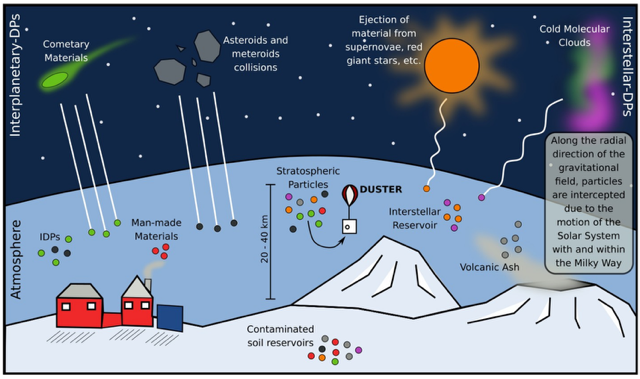
Figure 1. Schematic overview of the DUSTER collection concept: Interplanetary Dust Particles (IDPs) from comets, asteroids, and meteoroid collisions, as well as interstellar dust from supernovae and dense molecular clouds, enter Earth’s atmosphere. Most man-made and terrestrial materials, e.g. volcanic, remain confined to the troposphere or lower stratosphere. The high-altitude stratospheric window, 30 - 40 km, is a unique reservoir for extraterrestrial matter, allowing DUSTER to collect stratospheric particles in a near-contamination-free environment, enabling the recovery of pristine IDPs and possible interstellar dust, intercepted due to the solar system's motion within the Milky Way.
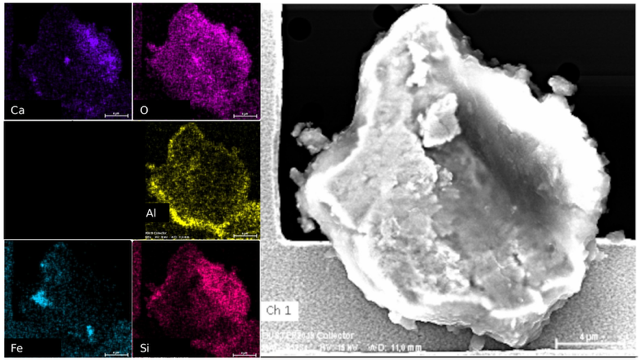
Figure 2. SEM and EDX elemental maps of a stratospheric particle collected by DUSTER. The right image shows a secondary electron micrograph of the collected particle, highlighting its irregular morphology and fragile structure. Elemental maps obtained via EDX reveal the distribution of major elements: calcium (Ca), oxygen (O), aluminum (Al), silicon (Si), and iron (Fe).
The PRIN 2022 research project “Cosmic Dust II: Cosmochemistry and Space Tweezers Technologies for Solar System Science and Exploration", uses this collection to investigate the cosmochemical and mineralogical characteristics of extraterrestrial particles with sizes ranging from about 0.5 µm to 50 µm, a dimension gap yet to be filled. Within this framework, selected subsets of DUSTER IDPs i.e., a total of 11 particles with sizes > 10 µm and of 10 particles with sizes < 5 µm, are undergoing a comprehensive multi-analytical technique campaign. These particles have been selected based on their size, morphology, mineralogy, and surface preservation. For particles larger than 10 µm in size an initial high-resolution SEM imaging, followed by non-destructive spectroscopic techniques, including micro-Infrared (µIR), micro-Raman, and nano-Raman spectroscopy are employed. This facilitates the mapping of mineral phases and organic functional groups, allowing us to identify silicates, sulfides, and carbonaceous matter. IDPs smaller than 5 µm in size are observed with high-resolution transmission electron microscopy (HR-TEM) and 3D electron diffraction tomography (EDT), offering structural and chemical characterization at nanometer scale and discriminate of amorphous versus crystalline domains. A subset of particles will undergo destructive analytical techniques, including nano-scale Secondary Ion Mass Spectrometry (nanoSIMS) for measurement of isotopic compositions at sub-micron scale. This last analysis is critical for tracing potential presolar grains and to understand the source-region signatures within the solar system, but also very challenging when applied to DUSTER collections.
Through this correlated microscopic protocol we aim to build an integrated dataset for each particle, allowing us to characterize its composition, formation history, and potential astrobiological significance. These results are expected to have implications not only for understanding the composition of the near-Earth dust complex and identifying its parent bodies, but also for the broader goals of astrobiology, planetary geology, and Solar System exploration.
References
[1] Flynn, 1997. Collecting interstellar dust grains. Nature, 387, 248. [2] Brownlee 1985. Cosmic dust: collection and research. Annu. Rev. Earth Planet. Sci. 13(1),147-173. [3] Della Corte & Rotundi, 2021. Collection of samples. In Sample Return Missions: The Last Frontier of Solar System Exploration, ed. A. Longobardo. Elsevier, 269-293. [4] Della Corte et al., 2012. In Situ Collection of Refractory Dust in the Upper Stratosphere: The DUSTER Facility. Space Science Reviews, 169, 159-180. [5] Rietmeijer et al., 2016. Laboratory analyses of meteoric debris in the upper stratosphere from settling bolide dust clouds. Icarus, 266, 217-234.
Acknowledgements: we acknowledge the PRIN2022/MUR “Cosmic Dust II: Cosmochemistry and Space Tweezers Technologies for Solar System Science and Exploration” project, ID# 2022S5A2N7, CUP n. I53D23000740006.
How to cite: Tonietti, L., Della Corte, V., Rotundi, A., Dionnet, Z., Folco, L., Maragò, O., Foti, A., Infusino, M., Magazzù, A., Brucato, J. R., Bertini, I., Inno, L., Stefani, S., Rubino, S., Piccioni, G., Suttle, M. D., Davies, F., Ottaviani, S., Cozzolino, F., and Mennella, V.: Uncontaminated Cosmic Dust from the Upper Stratosphere: DUSTER Collections and Multi-Analytical Characterization of micron and sub-micron particles, EPSC-DPS Joint Meeting 2025, Helsinki, Finland, 7–12 Sep 2025, EPSC-DPS2025-1032, https://doi.org/10.5194/epsc-dps2025-1032, 2025.


