Multiple terms: term1 term2
red apples
returns results with all terms like:
Fructose levels in red and green apples
Precise match in quotes: "term1 term2"
"red apples"
returns results matching exactly like:
Anthocyanin biosynthesis in red apples
Exclude a term with -: term1 -term2
apples -red
returns results containing apples but not red:
Malic acid in green apples
hits for "" in
Network problems
Server timeout
Invalid search term
Too many requests
Empty search term
SB4

The session is opened, but not restricted, to the following topics: a) new results from in-orbit observations of sample return missions; b) new laboratory analyses on samples returned from OSIRIS-REx, Hayabusa2, Chang’e 5, Chang’e 6 and past missions (e.g., Luna, Apollo, Stardust, Hayabusa); c) preliminary activities for the Mars Sample Return mission; d) preparation, performed studies and expected results from future sample return missions (e.g., Mars Sample Return, Tianwen2); e) new sample return mission concepts; f) technologies and methods for sample return; g) technologies and concepts for curation facilities; h) technologies and concepts for handling, transportation and analysis of
returned samples in laboratory and between laboratories.
Session assets
The NASA OSIRIS-REx mission returned a sample of ~120 grams from the carbonaceous near-Earth asteroid Bennu. Laboratory analyses of the returned sample revealed that it is dark, featuring brighter inclusions and veins, and contains millimeter-sized stones predominantly exhibiting hummocky, mottled, and angular patterns (Lauretta, Connolly, et al. 2024; Connolly, Lauretta, et al. 2025). These laboratory analyses confirmed that Bennu underwent aqueous alteration, akin to other carbonaceous asteroids, such as asteroid Ryugu (Nakamura et al. 2022).
As part of a NASA Laboratory Analysis of Returned Samples (LARS) study, we have received a chip of the asteroid Bennu, weighing ~113 mg, from NASA's Johnson Space Center curation (OREX-800084-0). This study aims to evaluate the relationship between organic and carbonate phases and their relationship to aqueous processes on the asteroid's parent body. The Bennu chip was transported and stored in a Teflon bag inside a sealed stainless-steel canister before being opened inside a nitrogen-purged glovebox for spectroscopic analyses. The spectroscopic measurements of the Bennu sample were conducted at the Johns Hopkins University (JHU) Applied Physics Laboratory (APL), where we used a nitrogen-purged glovebox to prevent contamination by terrestrial water while opening the sample container and manipulating the sample (installing it on the sample holder).
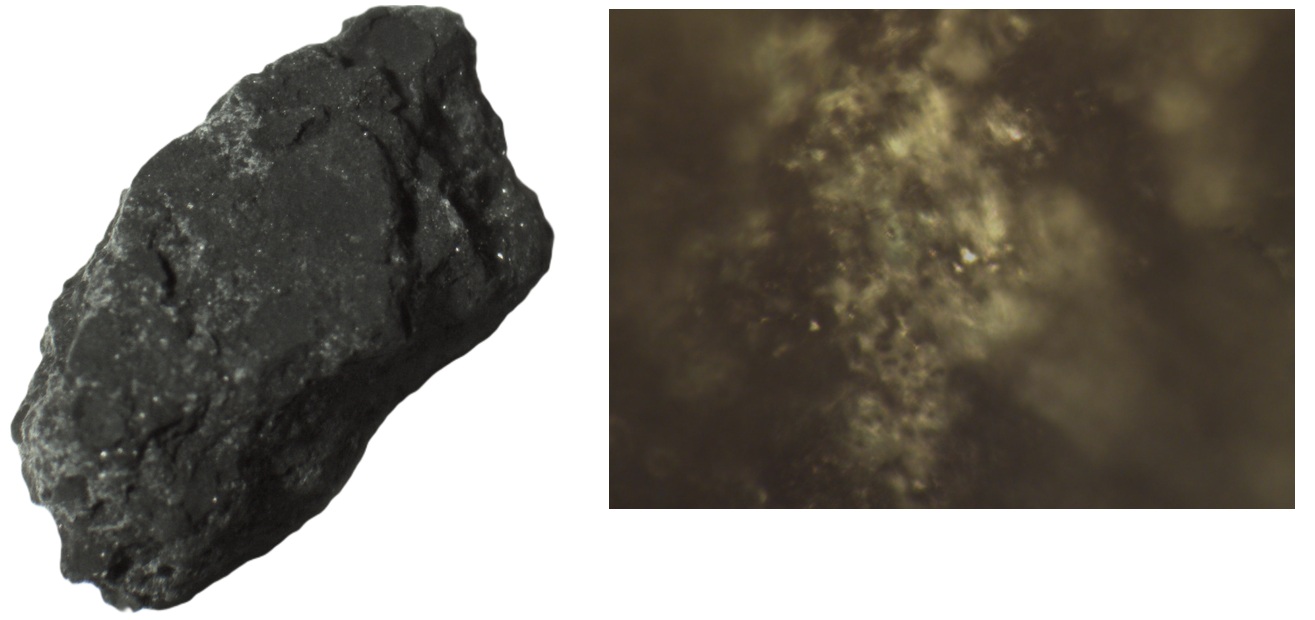
Figure 1. (Left) Microscope image (0.75X) of the Bennu chip OREX-800084-0. The length of the chip is about 9 mm across. (Right) An image (300x200 µm) of a bright clast in the Bennu sample that was spectrally analysed.
Upon opening the canister and unwrapping the Teflon bag in the glovebox, we examined the Bennu chip and found it to have an angular shape (~9 mm x 4 mm x 4 mm) with some bright clasts (~0.5 mm x 1 mm) (Fig. 1, left). Subsequently, we used a nitrogen-purged transfer and measurement container to transport the sample to the APL Geological Near-IR Optimized Microspectroscopic Experiment (GNOME) lab for measurements under nitrogen purge. Reflectance measurements were collected using a Hyperion 2000 FTIR microscope and Invenio-R spectrometer with a spectral field of view of ~100 µm. We collected infrared microscopic (~1.25-28.65 µm) and imaging data from various regions of interest in the Bennu sample (e.g., Fig. 1, right).
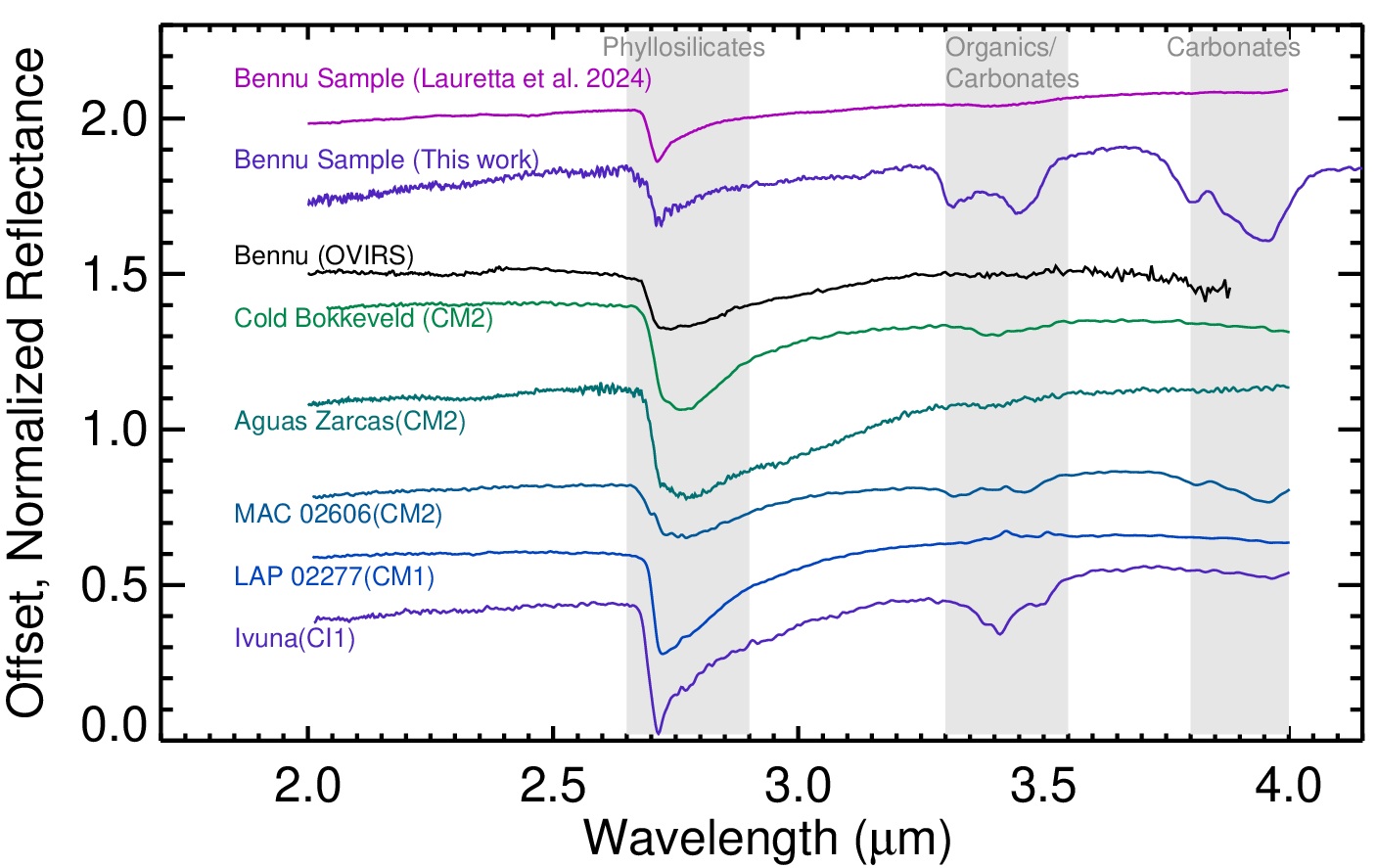
Figure 2. The spectrum we acquired of a bright clast in the Bennu sample is plotted with spectra of other Bennu samples (Lauretta et al. 2024), OSIRIS-REx OVIRS (Hamilton et al. 2019), and CM and CI carbonaceous chondrites (Takir et al. 2013).
Figure 2 presents the measured infrared reflectance spectrum of one of the bright spots shown in Figure 1 (right) from ~ 2 to 4 μm. The longer wavelength data are still being analyzed. The spectrum confirms a narrow absorption band centered at ~ 2.72 μm, which is indicative of Mg-rich serpentine and clay minerals. This absorption feature aligns with those found in CM chondrites, such as LAP 02277, and CI chondrites, like Ivuna. This observation suggests that both Bennu and these meteorites likely experienced similar aqueous alteration environments.
Additionally, the spectrum of the bright clast in the Bennu sample displays two prominent doublet absorptions attributed to the planar carbonate CO32- ion (Buijs & Schutte 1961, Hunt, G.R. & Salisbury 1971); these are located at ~ 3.2-3.4 μm (the overtone 2ν3 of the fundamental vibration ν3 at 6.9 μm) and at ~ 3.8-4.0 μm (a combination of ν1 and ν3, where ν1 corresponds to the fundamental vibration at 9 μm and ν3 at 6.9 μm). This carbonate feature is consistent with dolomite, as Figure 3 (upper) illustrates.
Organic features due to carbon-hydrogen (C-H) bond stretching typically overlap with one of the carbonate doublets at ~3.4 μm. However, the feature observed in the Bennu sample at ~3.4 μm indicates the presence of pure carbonates with no organics (Fig. 3, lower). In this talk, we will discuss additional spectra of the Bennu sample and their implications for constraining the evolution of carbon reservoirs during secondary processing events (e.g., aqueous alteration) experienced by asteroid Bennu.
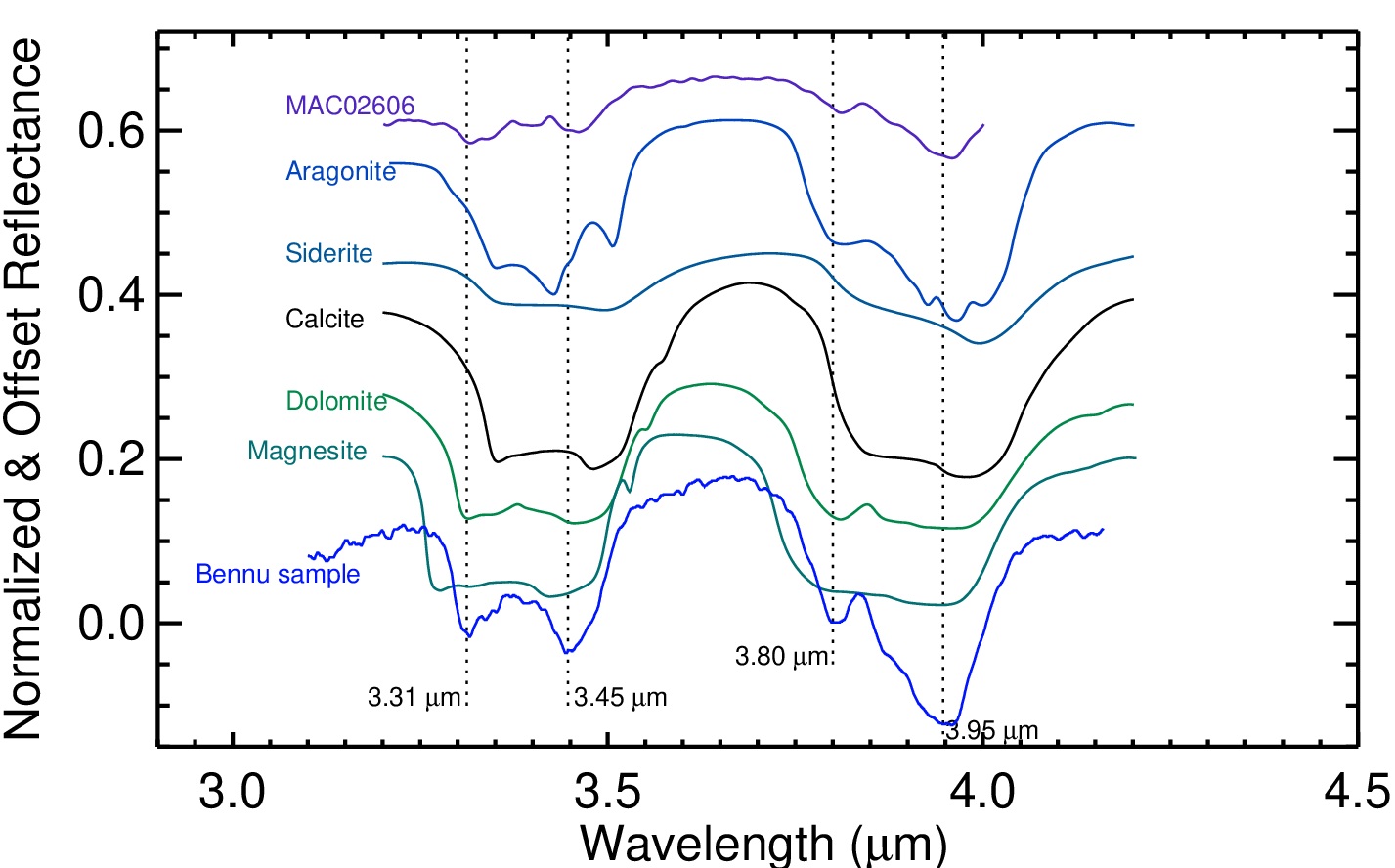
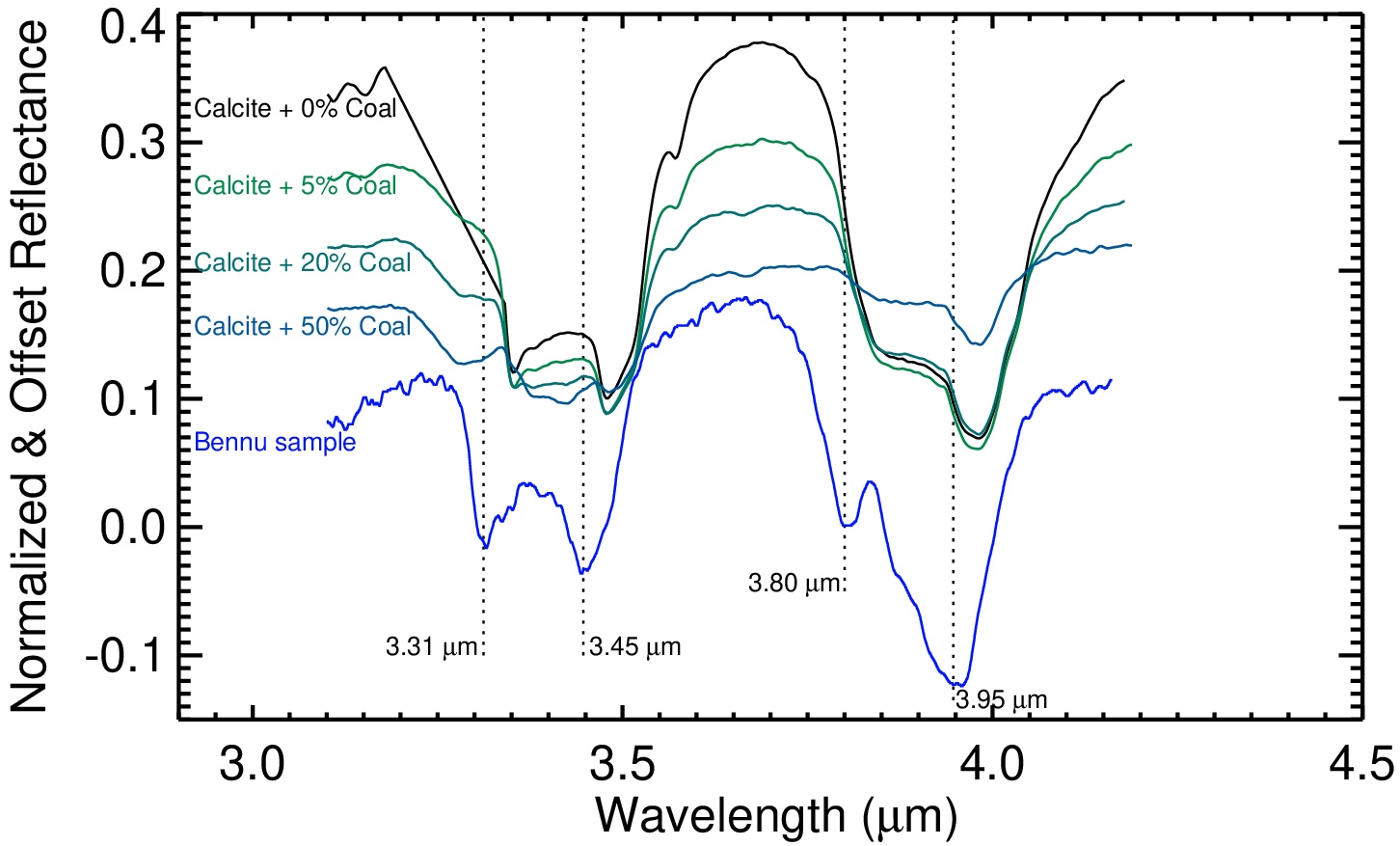
Figure 3. (Upper) The 3-to-4-μm region of the spectrum of the Bennu sample is compared with those of various carbonaceous phases compiled from the RELAB spectral library. The carbonate feature observed in Bennu is consistent with dolomite and inconsistent with calcite. (Lower) The spectrum of our Bennu sample is plotted alongside the spectra of calcite and coal mixtures (Hancock et al., 2025).
Acknowledgements: We would like to acknowledge the support of the NASA LARS grant 80NSSC23K0402. We would also like to thank the OSIRIS-REx mission, including scientists, engineers, and other team members, for their years of dedication to return this sample, as well as the NASA JSC OSIRIS-REx curation team for their work to make the sample available for analysis.
References:
Buijs, K., and Schutte, C.J.H. 1961, Spectrochimica Acta, vol. 17, pp. 927-932.
Connolly Jr., H. C., Lauretta, D. S., et al. 2025, MAPS,1-18.
Hancock, A., et al. 2025, LPSC meeting, Abstract #1350.
Hunt, G.R. & Salisbury,J.W. 1971) Mod. Geol. 2, 23–30.
Lauretta, D. S., Connolly Jr., H. C., et al. 2024, MAPS, 59, Nr 9, 2453–248.
Nakamura, T. et al. 2022, Science, 379, Issue 6634.
Takir, D. et al. 2013, Meteor. Planet. Sci., 48, 1618.
How to cite: Takir, D., Hibbitts, C., Miller, K., and Wagoner, C.: Infrared Spectroscopy of Bennu Sample OREX-800084-0, EPSC-DPS Joint Meeting 2025, Helsinki, Finland, 7–13 Sep 2025, EPSC-DPS2025-678, https://doi.org/10.5194/epsc-dps2025-678, 2025.
Introduction: Carbonaceous asteroid samples offer a unique opportunity to access primitive materials from the early solar system. Alteration processes that occurred during the evolution of asteroids and their parent bodies have affected the structural and spectral characteristics of their surface materials. The JAXA Hayabusa2 and NASA OSIRIS-REx missions successfully returned samples from the asteroids Ryugu and Bennu [1,2]. Using returned samples—preserved from terrestrial contamination— can significantly improve our understanding of alteration mechanisms that occur during the early evolution of the solar system.
The OSIRIS-REx mission returned approximately 120 g of surface material from Bennu in September 2023 [2]. Preliminary analyses of NASA's Bennu samples have revealed similarities with Ryugu samples and CI chondrites, notably a composition rich in phyllosilicates [2]. Here, we present a first characterization of these phyllosilicates using NIR and MIR measurements on Bennu pristine samples, without exposure to the terrestrial environment that could affect their properties.
Samples and Methods: Through a sample exchange agreement between NASA and JAXA, a 0.6 g portion of the Bennu sample, divided into five aggregate samples, was delivered to JAXA’s Extraterrestrial Sample Curation Center (ESCuC) in Sagamihara in August 2024. The Bennu – and Ryugu – samples are now stored there in dedicated ultraclean and N2-purged facilities to prevent from any terrestrial contamination. For this specific study, initial characterization was performed within their preservation chamber first using MicrOmega, a near-infrared hyperspectral imaging microscope developed by the Institut d’Astrophysique Spatiale (Université Paris-Saclay/CNRS) [3] coupled with a LEICA visible microscope. This instrument operates in the 0.99-3.65 µm spectral range with a spatial resolution of 22.5 x 22.5 µm2 per pixel. Additional measurements were then conducted with a µ-FTIR point by point spectrometer with a spectral range between 2 and 12 µm on chosen 70-100 µm spots. Here, we focus on individual mm-sized grains of Bennu samples that were extracted from initial aggregate samples ORX-19000 and ORX-29000 [5]. We investigated the OH vibration band at ~2.7 µm with MicrOmega on ~100 individual grains and the Si-O band at ~10 µm with the µ-FTIR on about half of these grains. For each grain, several spectral parameters were extracted. For the OH band, in the NIR, these include peak position, band depth, reflectance factor at 2.5 µm, and NIR spectral slope. For the Si-O band, in the MIR, key parameters include the positions of the main Reststrahlen band, the Christiansen feature and the first derivative peak, along with the relative distances between them. The results were compared with MicrOmega measurements of Ryugu samples performed within the Curation Facility (e.g., [5]), as well as with external laboratory measurements conducted on Ryugu samples [6,7] and on meteorites [8].
Results and discussion: The OH band properties derived from the average spectra of individual Bennu grains measured with MicrOmega reveal some similarities with those of the Ryugu grains initially analyzed by [5]. Approximately 10% of the Bennu grains exhibit a more redshifted OH band peak position than the rest of the population. In particular, this subset includes grain ORX-10001 [9], measured on both sides with the instruments, which shows a clear spectral dichotomy between its two faces. For these grains, the Si–O stretching band appears broader and presents a redshifted Reststrahlen peak, while the Christiansen feature remains unchanged, compared to the rest of the Bennu collection and to laboratory measurements of Ryugu samples [6,7].
It has been previously suggested that the redshifted Ryugu grains from Chamber A (from the first sampling site) experienced more space weathering [5]. This may indicate varying degrees of surface alteration among the Bennu samples, efficiently probed by the variable position of the OH band. The shift observed in the Si-O band follows the same trend as that seen in ion irradiation in laboratory on carbonaceous chondrites, such as Alais and Tagish Lake [8]. This spectral behavior, however, not identified in Ryugu samples, may indicate a distinct alteration process specific to a fraction of the Bennu material.
These findings suggest peculiar alteration histories of the two bodies, offering new insights into the formation and evolution of planetesimals. Ongoing investigations aim to further understand the alteration processes responsible for this heterogeneity in Bennu, which, at this stage, appears to align with irradiation-induced changes observed in the laboratory on CI meteorites.
Acknowledgments: We thank the Curation Facility team of JAXA for their work on the samples. We also thank the Graduate school of physics of Paris-Saclay University and the CNES for their financial support.
References: [1] Yada, T. et al. (2022) Nat. Astron. 6, p. 214-220. [2] Lauretta, D.S. et al. (2024) Meteorit Planet Sci, 59: 2453-2486. [3] Bibring et al. (2017) Astrobiology 17, 621-626. [4] Fukai, R. et al. (2025) LPSC #1311. [5] Le Pivert-Jolivet, T. et al. (2023) Nature Astronomy 7, 1445–1453. [6] Dionnet, Z. et al. (2023) Meteorit Planet Sci, 59,10.1111/maps. 14068. [7] Amano, K. et al. (2023), Sci Adv. 9, eadi3789. [8] Lantz, C. et al. (2024) Planet. Sci. J. 5 201. [9] Nardelli, L. et al. (2025) LPSC #1928.
How to cite: Nardelli, L., Brunetto, R., Pilorget, C., and Hatakeda, K. and the ISAS/IAS MicrOmega Curation Team: Spectral variations of phyllosilicate features in Bennu grains: evidence from NIR and MIR measurements of pristine returned samples at ISAS Curation Facility., EPSC-DPS Joint Meeting 2025, Helsinki, Finland, 7–13 Sep 2025, EPSC-DPS2025-984, https://doi.org/10.5194/epsc-dps2025-984, 2025.
Introduction: Samples returned from the asteroid Bennu by NASA’s OSIRIS-REx mission [1], and previously from the asteroid Ryugu by JAXA’s Hayabusa2 mission [2], offer unprecedented access to pristine carbonaceous asteroid material, preserved from terrestrial contamination. Ongoing laboratory investigations have shown that phosphates in Bennu occur in various forms, including isolated grains, surface coatings, and vein fillings, present primarily as Mg,Na-phosphates and Ca-phosphates [1]. These materials are often associated with high-reflectance phases in mottled particles and may be linked to bright veins seen in Bennu’s boulders. At the JAXA Extraterrestrial Sample Curation Center (ESCuC) in Sagamihara, Japan, 0.6 g of these samples are stored and analyzed in a controlled, pure N₂-purged environment, enabling high-resolution spectral analysis under conditions that prevent terrestrial contamination [3-6].
Characterizing hydrated phosphorus-bearing phases, particularly phosphates, is critical for understanding the role of fluid-mediated alteration processes in carbonaceous asteroids and the potential availability of bioessential elements like phosphorus in early Solar System materials.
Our study focuses on the diversity of hydrated phosphorus-bearing grains in Bennu, with particular interest in grains resembling Hydrated Ammonium-Magnesium-Phosphorus-rich (HAMP) phases previously detected in Ryugu material [3].
Methods: In September 2024, five bulk Bennu samples (~0.6 g total) were analyzed at ESCuC using the MicrOmega near-infrared hyperspectral microscope and µFTIR point spectroscopy while samples were held in an N2-purged environment to prevent terrestrial contamination [4-5]. The same instrumentation and protocols used for MicrOmega observation of Ryugu [6] enabled comparison across the two bodies.
MicrOmega collects spectra spanning 0.99-3.6 μm with spatial resolution of 22.5 μm per pixel [7]. Spectral image cubes are collected of each bulk at multiple viewing geometries. At 4 azimuths (0, 90, 180, 270o), ~15 MicrOmega images were collected over the bulk sample holder to span the entire bulk sample with overlap so no grains were visible only at image boundaries; this yields ~70 images per bulk sample which were analyzed for spectral variation. The incident angle of 35o allows for variation of illumination conditions as the viewing azimuths are changed. A LEICA visible microscope is coupled to MicrOmega at ESCuC which allows for high resolution visible imagery of the grains within the bulk samples. A secondary bulk campaign was carried out in April-May 2025 to reanalyze bulk samples after removal of the largest individual grains for grain analyses, yielding newly visible smaller grains.
µFTIR point spectra were collected in a N2-purged chamber connected to the MicrOmega purged chamber so that samples could be transferred without terrestrial exposure. The µFTIR point spectrometer collects spectra spanning 2-12 μm over points of interest previously identified with MicrOmega, with spot size 70-100 μm. This spectral range allows for comparison of the 3 μm absorption visible in MicrOmega while also capturing the range of the P-O vibrations at longer wavelengths associated with phosphates [3,8].
Spectra were analyzed for H2O features including a ~3 µm broad absorption in both MicrOmega and µFTIR data. µFTIR spectra were analyzed for the same HAMP-like absorptions as MicrOmega spectra, as well as spectral features visible at longer wavelengths including at 6.9 μm (N-H) and ~9.5 μm (P-O) [3]. The visible features of grains were analyzed using the LEICA visible microscope imagery.
Results and Discussion: We document the breadth of hydrated phosphorus-rich grains found in the 5 Bennu bulk samples returned to Earth by the OSIRIS-REx mission. We identified hydrated (strong absorptions at 3 µm) phosphorus rich (~9.5 µm feature) material, and investigated their visible features and spectral characteristics at multiple viewing geometries. The hydrated phosphorous-rich grains detected also form one population of Bennu’s bright grains.
We compare these spectra of interest with spectra of possible phosphate analogs as well as Ryugu HAMPs. Phosphates are observed as bright grains or inclusions embedded within the low-albedo matrix. Many phosphate spectra are blue-sloped from 1.0-2.7 μm. A subset exhibits the absorptions spectrally consistent with HAMP grains from Ryugu [3], as seen in both MicrOmega and μFTIR spectra. Ongoing analysis will inform on further compositional diversity within Bennu samples.
Future work will expand this dataset with analyses of individually extracted grains. All results will contribute to the JAXA Bennu sample catalog, to be made accessible via AOs. Phosphorous is typically a minor component in carbonaceous material including Bennu [1], so while phosphates were not previously detected via remote sensing of the asteroid’s surface, their observation in returned samples can point to localized, chemically complex alteration histories within Bennu’s regolith.
References: [1] Lauretta D. S. et al., Met. and Planet. Sci. 59, 9, p. 2453-2486 (2024), [2] Yada T. et al., Nat. Astron. 6, p. 214-220 (2022), [3] Pilorget C. et al., Nat. Astron. 6, p. 221-225 (2024), [4] Fukai et al., Lunar and Planetary Science Conference, #1311, (2025), [5] Fukai et al. this conference, [6] Pilorget C., Okada, T. Hamm, V. et al. 2022, Nature Astronomy, 6, 221, [7] Bibring J.-P., Hamm V., Pilorget C., Vago J. L., & the MicrOmega Team. 2017, Astrobiology, 17, 621. [8] Jastrzebski W., Sitarz M., Rokita M., Bulat K. Spectrochimica Acta Part A, 79, 722-727.
How to cite: Sheppard, R., Pilorget, C., Baklouti, D., Loizeau, D., Jiang, T., Nardelli, L., Bibring, J.-P., Mahlke, M., Poulet, F., Brunetto, R., Aleon-Toppani, A., Lantz, C., Hatakeda, K., Okada, T., Fukai, R., Abe, M., Enokido, Y., Kawasaki, S., Riu, L., and Miyazaki, A. and the JAXA team: Characterization of hydrated phosphorous-rich material within Bennu returned samples using near-infrared to mid-infrared spectra, EPSC-DPS Joint Meeting 2025, Helsinki, Finland, 7–13 Sep 2025, EPSC-DPS2025-1622, https://doi.org/10.5194/epsc-dps2025-1622, 2025.
Introduction: Aqueous alteration was a fundamental early geological process in the Solar System, significantly shaping the mineralogical composition of primitive asteroids. Carbonate minerals serve as important tracers for understanding the physicochemical conditions during these alteration events on early planetesimals [1, 2]. This study presents a comprehensive characterisation of carbonate minerals found in the returned samples from asteroids (162173) Ryugu and (101955) Bennu [3, 4], which provide pristine materials analogous to CI chondrites but without terrestrial alteration. Sample analysis was performed using the MicrOmega instrument, operated collaboratively between ISAS, Japan, and IAS, France, at the JAXA Extraterrestrial Sample Curation Center in Sagamihara, Japan [5].
Method: The Hayabusa2 mission returned a total of 5.42g of Ryugu material, split over the chambers A (surface sample) and C (at least in part subsurface sample after artificial cratering) [3]. In August 2024, NASA provided approx. 0.6g of Bennu samples to the ISAS curation facility, containing larger and smaller grains from both inside and outside the OSIRIS-REx sample container.
MicrOmega is a near-infrared hyperspectral microscope, operating between 0.99-3.60µm with a spatial resolution of 22.5µm per pixel on a 250x256 pixel grid [6]. Sample measurements are performed in N2-purged chamber, preventing terrestrial contamination. Between December 2020 and June 2024, we have imaged the entire returned Ryugu mass with MicrOmega as bulk samples and about half in more detail in smaller “sub-bulks” and as individual grains. Since September 2024, we are analysing both sub-bulk samples and individual grains of Bennu with MicrOmega under identical measurement conditions as Ryugu. Measurements include multiple observing geometries (varying azimuth and focus depth) for each sample.
Carbonate-rich pixels were identified using absorption depth criteria and χ2 comparison with synthetic carbonate reference spectra, focusing on the characteristic doublet feature around 3.4µm sensitive to carbonate composition [7, 8]. Pixel detections were grouped into contiguous regions-of-interest, assumed to represent individual carbonate inclusions, and assigned a dominant species (e.g., dolomite, breunnerite, calcite) based on the best spectral match, refined by visual inspection.
Results: We identified 709 distinct carbonate inclusions in Ryugu and 90 in Bennu, with typically two or more measurements by MicrOmega. Inclusion sizes range from single pixel (~20µm in equivalent diameter, i.e. diameter of a circle with equal area) to several hundred pixels (several hundred µm in equivalent diameter). On both asteroids, dolomite (CaMg(CO3)2) and Mg-rich breunnerite ((Mg,Fe)CO3) are the dominant carbonate phases, comprising slighty less than two thirds and one third of inclusions respectively, with minor amounts of calcite (CaCO3) (~5%). Fe-rich breunnerite and tentative Mg-siderite were also found in Ryugu. The mean compositions (inferred from spectral features) of dolomite and breunnerite match closely between the two bodies, as do their relative abundances in terms of total pixel area (~1:1 dolomite:breunnerite ratio overall). These assemblages resemble those in CI chondrites. On both asteroids, carbonates are intimately mixed with phyllosilicates, showing characteristic 2.7µm absorptions. The shape of the 2.7µm signatures in carbonate assemblages differ between both asteroids, suggesting different matrix environments. Breunnerites are the largest inclusions (median ~100-120µm equivalent diameter), followed by dolomites (~70-90µm), while calcites are small (generally one or two pixel, though likely smaller than MicrOmega’s pixel scale of 22.5µm). We observe a spatial separation of dolomite and breunnerite inclusions in samples from both asteroids; they generally do not occur in close proximity. Zoning within inclusions is not detected at the MicrOmega pixel scale. We further note a significant difference between Ryugu's chambers: Chamber C has considerably more breunnerite, while Chamber A is richer in dolomite.
Discussion: The similarity in carbonate assemblages suggests convergent alteration pathways on the parent bodies of Ryugu and Bennu, despite (minor) differences in their isotopic signatures (H, N, O), indicative of different formation environments [4]. Nevertheless, we observe slight differences in the host matrix of the carbonates, based on the shape of the 2.7µm band. We interpret the consistent spatial separation of dolomite and breunnerite at the 10-100µm size scale as remnant of a spatially heterogeneous local water-rock (W/R) ratio that persisted over time. We propose that intermediate W/R ratios favoured dolomite precipitation, while high local W/R ratios suppressed dolomite formation due to Ca2+ dilution and promoted breunnerite precipitation. This W/R-driven mechanism explains the large-scale spatial patterns observed with MicrOmega, however, we note that this pattern breaks at smaller size scales (<10µm), where dolomite-breunnerite assemblages have been observed by other studies [9, 10]. The heterogeneity between Ryugu's chambers suggests they sampled different mixtures of parent body lithologies experiencing different dominant W/R conditions, reinforcing the concept of limited large-scale mixing. We observe no systematic difference in the 2.7µm absorption around dolomites and breunnerites, aligning with isotopic data suggesting Mg incorporation into clays prior to carbonate formation [9].
Conclusion: MicrOmega hyperspectral analysis reveals remarkably similar carbonate populations on Ryugu and Bennu, dominated (at the MicrOmega size scale of 10-100µm) by dolomite and breunnerite with minor calcite, suggesting convergent aqueous alteration pathways. The consistent spatial separation of dolomite and breunnerite suggests the controlling influence of local W/R ratio heterogeneity. Different dolomite-breunnerite ratios between Ryugu's chambers indicate heterogeneity at the sampling scale. These results highlight the critical role of local physicochemical conditions, particularly W/R ratio, in governing carbonate speciation during aqueous alteration on primitive asteroids.
References:
[1] Fredriksson, K. & Kerridge, J. F. 1988, Meteoritics, 23, 35
[2] Endress, M. & Bischoff, A. 1996, Geochim. Cosmochim. Acta, 60, 489
[3] Yada, T. et al. 2022, Nature Astronomy, 6, 214
[4] Lauretta, D. S. et al. 2024, Meteoritics & Planetary Science, 59, 2453
[5] Pilorget, C. et al. 2021, Nature Astronomy, 6, 221
[6] Bibring, J.-P. & the MicrOmega Team. 2017, Astrobiology, 17, 621
[7] Loizeau, D. et al. 2023, Nature Astronomy
[8] Bishop, J. L. et al. 2021, Earth and Space Science, 8
[9] Yamaguchi, A. et al. 2023, Nature Astronomy, 7, 398
[10] McCoy, T. J. et al. 2025, Nature, 637, 1072
How to cite: Mahlke, M., Lantz, C., Pilorget, C., Baklouti, D., Brunetto, R., Hatakeda, K., Jiang, T., Loizeau, D., and Sheppard, R. and the MircOmega: Tracing water's reach: Carbonate mineralogy of Ryugu and Bennu as seen by MicrOmega, EPSC-DPS Joint Meeting 2025, Helsinki, Finland, 7–13 Sep 2025, EPSC-DPS2025-1228, https://doi.org/10.5194/epsc-dps2025-1228, 2025.
Introduction
Samples returned from asteroids Ryugu and Bennu exhibit mineralogical and isotopic similarities to CI carbonaceous chondrites [1–3]. Although CIs are among the leading candidates for delivering the building blocks of life to terrestrial planets [4], their distribution in the solar system remains poorly understood. This is largely due to the featureless nature of primitive asteroids, as well as terrestrial weathering in meteorites. With the availability of pristine spectra from the returned samples, we are now better positioned to identify CI-like asteroids among the large population of primitive asteroids observed in the past decades.
However, remote sensing of Ryugu and Bennu have revealed that space weathering effects may be more complex on primitive asteroids than previously assumed, and its mechanism needs to be better understood to infer the bulk asteroid composition from telescopic data. Despite their compositional and physical similarities, Ryugu and Bennu exhibit differences in their visible spectra. More intriguingly, their visible spectra likely evolved in opposite directions. On Ryugu, fresher craters are brighter and bluer [5, 6], whereas on Bennu, fresher craters are darker and redder [7]. Notably, the spectra of the freshest materials on both asteroids are similar, suggesting a similar initial state. These observations imply that compositionally similar asteroids can undergo divergent spectral evolution, leading to differences in their global spectra [8].
In this study, we investigate the causes of the opposing spectral evolutions of Ryugu and Bennu by integrating spectral analyses of returned samples with remote-sensing measurements of crater spectrophotometry and thermal inertia.
Methods
We measured multi-band visible spectra of over 400 grains and aggregates from Ryugu samples and approximately 660 mg of Bennu aggregate samples at the JAXA curation facility.
We analyzed the visible spectra and phase function slopes of 119 craters on Ryugu based on ONC-T data and 568 craters on Bennu based on MapCam/PolyCam data. The phase function slope was determined by fitting all available photometric data using a Hapke model [9] and calculating the ratio of radiance factors observed under incidence angle (i), emission angle (e), and phase angle (α) of i = 5°, e = 0°, α = 5°, and i = 15°, e = 0°, α = 15°. Thermal inertia values for the craters were obtained from previous studies [10–12].
Results
Limited influence from solar wind and micrometeorites: Our spectral analyses of returned samples suggest that the opposing evolutions of visible spectra may not be fully explained by classical space weathering mechanisms involving solar wind irradiation and micrometeorite bombardment. Although morphological and compositional signatures of these processes—including microcraters, amorphization, and dehydration—have been identified in Ryugu samples [13, 14], the average visible spectra of weathered grains are not statistically distinguishable from those of less weathered grains. Furthermore, although previous studies suggested that solar wind irradiation can exert opposite spectral effects when the hydration state of the material differs [15, 16], the comparable phyllosilicate abundance and bulk hydrogen content of Ryugu and Bennu samples argue against this hypothesis.
Spectral evolution driven by the evolution of surface microphysical properties: We propose that changes in surface microphysical properties —grain size, porosity, and roughness— through thermal fatigue, impacts, and electrostatic levitation may be a more important mechanism. Remote-sensing data show that fresher craters on Ryugu have brighter radiance factor, bluer spectral slope, higher thermal inertia, and shallower phase function slope. All of these trends are inverted on Bennu. Such coevolution of visible spectra with phase function slope and thermal inertia, which are known indicators of microphysical properties, suggests that the opposite evolution of microphysical properties may have driven the opposite spectral evolutions on Ryugu and Bennu.
These results are further validated by the significant spectral change observed after minor powder adhesion on Ryugu grains. A millimeter-sized Ryugu grain (C0179) showed a bluer spectral slope than the remote-sensing spectra after removing the powders adhered to the surface by brushing and high-pressure gas. In contrast, the powders (<50 µm) produced from the same grain exhibited spectral slopes more than twice as red as the remote-sensing spectrum. Remarkably, covering just ~10% of the surface area of the powder-free grain with these fine powders reproduced the global spectrum. This result indicates a direct causal link between microphysical properties and spectra. Nevertheless, the powder-free grain remains bluer than the remote-sensing spectrum of Bennu. This suggests that additional factors—such as a potentially higher abundance of phosphates on Bennu [17]—may also have a non-negligible contribution.
Discussion
Model calculation of grain-size evolution on asteroid surfaces [18] suggests that the difference in asteroid size may be one influential factor causing the opposite microphysical evolutions. On small bodies, electrostatic lofting is the primary mechanism controlling fine grain abundance. Due to a twofold difference in escape velocity, the maximum loftable grain size is ~60 µm for Ryugu and ~32 µm for Bennu. Consequently, fine grains on the order of tens of microns tend to accumulate on Ryugu’s surface but are preferentially lost from Bennu.
Such a mechanism provides the first comprehensive model for explaining the spectral discrepancy revealed by remote sensing and the compositional similarity from sample analyses of Ryugu and Bennu. This further implies that asteroids composed of CI-like materials likely do not correspond to a single spectral type, but may instead be distributed across C, Cb, and B types, due to their diverse microphysical evolution.
References
[1] Yokoyama et al. (2022). Science, 379(6634).
[2] Greenwood et al. (2023). NatAstron, 7(1).
[3] Lauretta et al. (2024). MAPS, 59(9).
[4] Alenxander. (2017). Philos Trans A Math Phys Eng Sci, 375(2094).
[5] Sugita et al. (2019). Science, 364(6437).
[6] Morota et al. (2020). Science, 368(6491)
[7] DellaGiustina et al. (2020). Science, 370(6517).
[8] Yumoto et al. (2024). Icarus, 420.
[9]Hapke (2012). Cambridge university press.
[10] Shimaki et al. (2020). Icarus, 348.
[11] Rozitis et al. (2020). Science advances, 6(41).
[12] Rozitis et al. (2022). JGR: Planets, 127(6).
[13] Noguchi et al. (2023). NatAstron, 7(2).
[14] Matsumoto et al. (2024). Science advances, 10(3).
[15] Lantz et al. (2017). Icarus, 285.
[16] Clark et al. (2023). Icarus, 400.
[17] Milliken et al. (2025). 56th LPSC, #1331.
[18] Hsu et al. (2022). NatAstron, 6(9).
How to cite: Yumoto, K., Tatsumi, E., Sakatani, N., Kanemaru, R., Cho, Y., Morota, T., Yokota, Y., Hamm, M., Golish, D., Kouyama, T., Lauretta, D., Barucci, A., and Sugita, S. and the Hayabusa2 Optical Navigation Camera Team: Skin-deep difference between Ryugu and Bennu driven by the microphysical evolution of surface materials, EPSC-DPS Joint Meeting 2025, Helsinki, Finland, 7–13 Sep 2025, EPSC-DPS2025-1344, https://doi.org/10.5194/epsc-dps2025-1344, 2025.
Please decide on your access
Please use the buttons below to download the supplementary material or to visit the external website where the presentation is linked. Regarding the external link, please note that Copernicus Meetings cannot accept any liability for the content and the website you will visit.
Forward to presentation link
You are going to open an external link to the presentation as indicated by the authors. Copernicus Meetings cannot accept any liability for the content and the website you will visit.
We are sorry, but presentations are only available for users who registered for the conference. Thank you.


Japan Aerospace Exploration Agency (JAXA) has a strategic small-body sample return program to understand the formation, evolution, and migration of planetary building blocks, water, and organics in the early solar system. The JAXA's sample return program started with Hayabusa for S-type asteroid Itokawa in 2010, followed by Hayabusa-2 for C-type asteroid Ryugu in 2020, and the future mission of Martian Moons eXploration (MMX) for Phobos in 2031 (Fig. 1). My presentation covers the recent achievements of Hayabusa 2 and OSIRIS-REx curation at ISAS/JAXA and the recently launched Ryugu Reference Project. I also present an overview of MMX, particularly how we leverage the Hayabusa 2/OSIRIS-REx experience to develop the MMX curation.
The Hayabusa 2 curation is unique in that it acts as a "bridge" between the remote sensing and sample analysis communities. Along with the conventional curation tools (e.g., optical microscope and balance), JAXA installed remote sensing instruments (e.g., ONC: Optical Navigation Camera) in the curation facility for ground truthing. Moreover, a flight spare of MicrOmega (infrared hyperspectral microscope) detected important minor phases (clays, carbonates, organics) in the apparently black Ryugu samples in the early stage of the curation.
Such a unique Hayabusa 2 curation policy expands the activities of OSIRIS-REx curation for JAXA's Bennu fractions (0.66 g) transferred from JSC/NASA on August 21, 2024. Since we received the Bennu fractions, we have completed the basic characterization of bulk fractions; the basic characterization is continued for selective individual grains. The basic characterization includes optical microscopy and further hyperspectral infrared measurements using MicrOmega and an FT-IR attached to the OSRIS-REx clean chamber.
Extending JAXA's curation activity incubates a new project (RRP: Ryugu Reference Project) to maximize the potential merit of the returned sample. The RRP aims to set an international standard for the elemental and isotopic abundances in the solar system using samples from the asteroid Ryugu. This project involves forming a Measurement Definition Team (RRP-MDT) to outline scientific goals and analysis methods. The RRP-MDT will document them in a white paper to ensure that the findings are accessible and beneficial for future research. Based on the MDT's white paper, JAXA will evaluate the significance and scientific merit of proceeding with RRP.
JAXA plans a Phobos sample return mission, MMX, in 2026-2031. The MMX spacecraft is scheduled to be launched in 2026, orbit Phobos and Deimos (multiple flybys), and retrieve and return >10 g of Phobos regolith to Earth in 2031. The Phobos regolith represents a mixture of endogenous Phobos building blocks and exogenous materials that contain solar system projectiles (e.g., interplanetary dust particles and coarser materials) and ejecta from Mars and Deimos. The MMX Sample Analysis Working (SAWT) team outlined the curation and sample analysis protocol to identify Phobos' fragments with different origins. Following the MMX-SAWT report, JAXA curation is designing the MMX curation facility and instrumentation for the system requirement review in 2026.
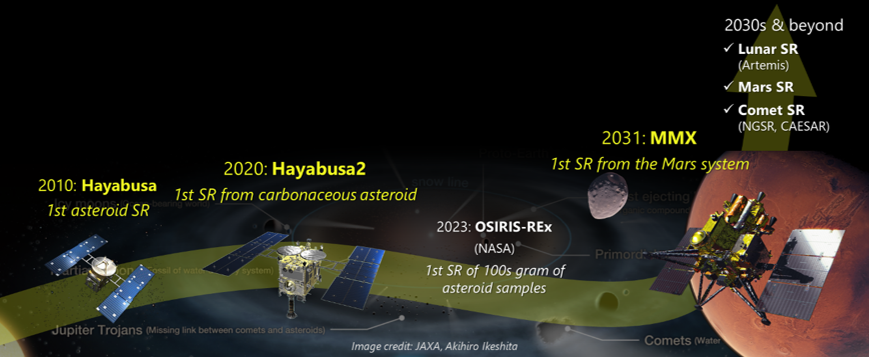
Figure 1: Sample return missions by JAXA (Hayabusa, Hayabusa 2, and MMX) and by international partners (OSIRIS-REx).
How to cite: Usui, T.: From Asteroids to Martian Moons: Recent Achievements and Future Challenges of JAXA's Small-Body Sample Return Missions, EPSC-DPS Joint Meeting 2025, Helsinki, Finland, 7–13 Sep 2025, EPSC-DPS2025-1880, https://doi.org/10.5194/epsc-dps2025-1880, 2025.
The Hayabusa2 mission, led by the Japan Aerospace Exploration Agency (JAXA), represents one of the most ambitious space missions in terms of both technological achievement and scientific return. The mission successfully collected samples from two distinct locations on the surface of asteroid Ryugu, returning approximately 5 grams of material to Earth in December 2020 for laboratory analysis. The first touchdown (TD1) retrieved surface materials stored in Chamber A, while the second touchdown (TD2) collected subsurface materials from approximately 1 meter depth, stored in Chamber C [1].
Preliminary analyses revealed that Ryugu particles share mineralogical similarities with CI chondrites [2], featuring matrices rich in phyllosilicates, iron sulfides (pyrrhotite and pentlandite), carbonates (dolomite and an iron-bearing variety of magnesite known as brunnerite), magnetite, and hydroxyapatite [3,4,5].
In this study, we conducted a comparative analysis of three millimeter-sized particles (A0226-1, A0226-2 (both from Chamber A), and C0242 (from Chamber C) [6]). Sample A0226-2 became detached from A0226-1 during the mounting process. Using a combined FT-IR and Raman spectroscopy approach, we investigated surface differences among these particles.
Methods:
Each particle’s surface was characterized in the mid-IR (2.5 – 16 µm) using a Lumos II FT-IR microscope, with 8× magnification in reflectance mode using MCT-LN mapping (256 scans, 4 cm⁻¹ spectral resolution, 80 µm aperture). A gold plate served as the standard. Measurements were conducted in a nitrogen-enriched glovebox to limit terrestrial alteration.
Raman spectra of graphite within Ryugu particles A0226-1 and C0242 were acquired using a Horiba Jobin-Yvon LabRam IR spectrometer coupled with an Olympus BX41 optical microscope at the University of Firenze, employing a 632.8 nm laser and 1800 gr/mm grating. The maximum laser power was ~ 10 mW (1 mW with a 10% filter) and acquisitions ranged from 10-12 integrations of 5-20s depending on the intensity of spectra and sensitivity of phases, with most measurements comprising 10×10s integrations. All measurements were conducted in an inert nitrogen (N2) environment to minimize alteration from terrestrial atmospheric exposure.
Results and discussion
Median FT-IR spectral analysis (Fig.1) indicates that particles from Chamber A exhibit greater degrees of space weathering than those from Chamber C. Specifically, the 2.72-μm OH-band depth is ~10% shallower in grains A0226-1 and -2 relative to C0242 (~20% and ~30% respectively), consistent with NIRS3 observations showing deeper 2.72-μm bands in fresher subsurface material [7,8] . Additionally, the Si–O stretching band in A0226-1 is red-shifted by ~150 nm relative to C0242, a shift potentially attributable to space weathering effects [9] .
Figure 1: Median reflectance spectra of particles A0226-1 (blue), A0226-2 (green), and C0242 (orange) over the 2–16 µm range.
Raman spectroscopy revealed notable differences in the D- and G-band profiles between grains from Chamber A and C. Graphites in A0226-1 exhibited higher degrees of graphite disorder, represented by the D-band ~1365 cm-1, suggesting increased amorphization due to space weathering [e.g., 10], while graphites in the subsurface grain from Chamber C had little-to-no noticeable D-bands (Fig. 2). Furthermore, the G-band shows a minor decrease in Raman shift and increase in FWHM between Chamber C and A, indicative of organic matter (OM) disruption as a result of weathering [10,11]. Finally, systematic differences in fluorescence between the two sample sites may reflect variations in thermal metamorphism and/or moisture content within OM, consistent with previous findings [12,13,14].
Figure 2: Median Raman spectra obtained from two Ryugu grains A0226-1 and C0242. Vertical dashed lines are at ~ 1365 cm-1 and 1590 cm-1 to represent approximate locations of D- and G-bands respectively.
Finally, investigations into surface compositional variability are being carried out using spectral clustering. Initially, eight spectral parameters were evaluated, followed by dimensionality reduction to facilitate clustering. The analysis revealed four distinct spectral clusters, highlighting subtle heterogeneities across particle surfaces.
References
[1] Tsuda et al., 2020, Acta Astronautica, 171, June 2020, pp. 42-54.
[2] Nakamura et al., 2022. Science, 379, pp.
[3] Nakamura et al., 2022. Proceedings of the Japan Academy, Series B, 98(6), pp. 227-282.
[4] Nakamura et al., 2022. 379(6634): pp.
[5] Yokoyama et al., 2022 Science, 379(6634): eabn7850.
[6] ASRG, ISAS, JAXA et al. (2022)
[7] Galiano et al., 2020 Volume 351, 113959
[8] Kitazato et al., 2021 Nature Astronomy 5, pp. 246–250.
[9] Brunetto et al., 2018. Planetary and Space Science, 158, pp. 38-45.
[10] Bonal et al., 2006. Geochimica et Cosmochimica Acta, 70(7), pp. 1849-1863.
[11] Rotundi et al., 2008. Meteoritics & Planetary Science, 43(1), pp. 367-397.
[12] Brunetto et al., 2014. Icarus, 273, pp. 278-292.
[13] Henry et al., 2019. Earth Science Reviews, 198, article id. 102936.
[14] Bonal et al., 2024. Icarus, 408, article id. 115826.
[15] Komatsu et al., 2024. Meteoritics & Planetary Science, Volume 59, Issue 8, pp. 2166-2185
Acknowledgments: The Ryugu samples used in this paper were distributed through the 2AO Announcement of Opportunity for Hayabusa2 samples (AO2). These samples were referred to the Ryugu Sample Database at https://www.darts.isas.jaxa.jp/curation/hayabusa2/ .
Funding: This work was supported by the National Institute of Astrophysics (INAF) by the PRESTIGE (Pristine Returned Sample Testing InvestiGation and Examination) project
How to cite: Angrisani, M., Palomba, E., Grant, H., D'Amore, M., Romani, M., Shehaj, X., Catelani, T., Arpaia, L., Longobardo, A., Dirri, F., Viviani, G., Cestelli Guidi, M., and Pratesi, G.: Space Weathering and Compositional Variations in Ryugu Samples: FTIR and Raman Spectroscopic Insight, EPSC-DPS Joint Meeting 2025, Helsinki, Finland, 7–13 Sep 2025, EPSC-DPS2025-786, https://doi.org/10.5194/epsc-dps2025-786, 2025.
- Introduction
The JAXA Hayabusa2 mission represents a significant milestone in planetary science. In December 2020, the mission successfully returned samples from two distinct sites of the carbonaceous, C-type, asteroid Ryugu. These samples were expected to provide critical insights into the origin of volatiles including water and organics on Earth, the thermal and aqueous histories of primitive bodies, and the physicochemical processes that related to the earliest stage of our Solar System.
F Following the successful recovery of the re-entry capsule, initial curation activities, primarily consisting of non-destructive observations (such as optical microscopy, FT-IR, MicrOmega, and weight measurements), were conducted at JAXA’s Extraterrestrial Sample Curation Center. Subsequently, the expanded analytical phase was launched to facilitate advanced and multi-institutional investigations by six initial analysis teams and the two Phase2 Curation teams including the Phase2 Curation Kochi team (Ph2K) [1-10].
- Preserve Pristine Nature of Ryugu sample: Contamination Control from curation facility to the institutes
The Ryugu samples are invaluable to planetary science due to their minimal terrestrial contamination, preserving volatiles and complex microstructures of minerals and organics. They preserve volatiles and complex microstructures of minerals and organics, providing insights into the early evolution of the Solar System [3-10]. To minimize contamination during transport to institutes both nationwide and internationally, we developed the Facility-to-Facility Transfer Container (FFTC) and individual sample containers [11] (Fig. 1). These were designed for use within Ryugu-dedicated clean chambers at the JAXA and prioritized ease of cleaning, use of same materials with the clean chamber, operability with thick Viton-coated butyl gloves, and long-term sealing using pure nitrogen.

- A Cross-Platform Pipeline for Extraterrestrial Sample Analysis
The cross-platform analytical pipeline of the Ph2K is designed to establish comprehensive protocols for the analysis of small-volume, volatile-rich extraterrestrial materials from asteroid Ryugu. Its primary objective is to characterize the mineralogical, petrological, chemical, and isotopic properties of the Ryugu samples at mm- to micrometer scales. To maximize scientific gain from the limited sample mass, the protocol follows a “non-destructive-first” strategy, advancing sequentially through increasingly invasive and ultimately destructive analytical techniques (Figs. 2, 3) [11-13].


- Results in case of Ryugu sample analysis by Ph2K
Ph2K plays a vital role in understanding of primitive Solar System materials. Samples returned from asteroid Ryugu exhibit bulk chemical compositions and oxygen isotopic compositions closely matching those of CI chondrites which is similar chemical compositions of the Sun, suggesting that Ryugu represents one of the most chemically primitive materials in the Solar System [e.g., 3-6, 13]. Our analyses revealed abundant hydrated minerals, such as phyllosilicates (i.e., serpentine and saponite) and carbonates, as well as isotopically heavy hydrogen and nitrogen isotopic compositions, pointing to low-temperature alteration and a formation in the cold outer Solar System. Organic matter, rich in aliphatic hydrocarbons, was associated with coarse-grained phyllosilicates, implying that these minerals may have provided environments favorable for organics. These findings support a scenario in which Ryugu accreted from icy and organic-rich particles, migrated inward, and potentially contributed to the delivery of water and organics to early Earth. Further studies of samples from other planetary explorations meteorite, and interplanetary dust particles are essential to expand our understanding of volatile transport and preservation in the early Solar System.
Additional findings by Ph2K include the identification of Ryugu’s precursor body [14], early aqueous alteration within 1.8–5.0 Myr after CAI formation [15], and low ejecta yields from asteroid during impacts [16]. Primitive noble gases with high xenon concentrations [17] and amorphous phases containing phosphorus and ammonium ions were also discovered, suggesting relevance to prebiotic chemistry on a carbonaceous asteroid [18]. Atmospheric exposure experiments further revealed rapid terrestrial alteration for the importance of meteorites and future returned sample curation and storage processes [19].
- Conclusion and perspective
Results from Ph2K have revealed mineralogical inventories, fine-scale isotopic variations, and signatures of low-temperature aqueous alteration with the complex water-mineral-organics coevolution on a carbonaceous asteroid. These findings may support the hypothesis that Ryugu and similar bodies may have played a key role in the delivery of water and organics to the early Earth.
The cross-platform pipeline by Ph2K will serve as a benchmark not only for Ryugu studies but also for future sample return missions, including MMX (Martian Moons eXploration). The continued refinement of small-sample analytical techniques will contribute significantly to the planetary science and the development of next-generation curation protocols [20].
- References
[1] Yada, T. et al. (2021) Nat. Astron. [2] Pilorget, C. et al. (2021) Nat. Astron. [3] Ito, M. et al. (2022) Nat. Astron. [4] Nakamura, E. et al. (2022) Proc. Jpn. Acad. B. [5] Yokoyama, T. et al. (2022) Science. [6] Nakamura, T. et al. (2022) Science. [7] Noguchi, T. et al. (2022) Nat. Astron. [8] Okazaki, R. et al. (2022) Science. [9] Naraoka, H. et al. (2023) Science. [10] Yabuta, H. et al. (2023) Science. [11] Ito, M. et al. (2020) Earth Planets Space. [12] Uesugi, M. et al. (2020) Rev. Sci. Instrum. [13] Yamaguchi, A. et al. (2023) Nat. Astron. [14] Liu, M-C. et al. (2022) Nat. Astron. [15] McCain, K. A. et al. (2023) Nat. Astron. [16] Tomioka, N. et al. (2023) Nat. Astron. [17] Verchovsky, A. B. et al. (2024) Nat. Commun. [18] Pilorget, C. et al. (2024) Nat. Astron. [19] Imae, N. et al. (2024) Meteor. Planet. Sci. [20] Grady, M. et al. (2025) Nat. Astron.
How to cite: Ito, M., Tomioka, N., Uesugi, M., Uesugi, K., Yamaguchi, A., Imae, N., Ohigashi, T., Shirai, N., Nakato, A., Yogata, K., Yada, T., Abe, M., Liu, M.-C., Greenwood, R., Yuzawa, H., and Kimura, M.: Design and Implementation of a Cross-Platform and Multi-Scale Workflow for Volatile-Rich Extraterrestrial Sample Analysis: From Contamination Control to Coordinated Analysis, EPSC-DPS Joint Meeting 2025, Helsinki, Finland, 7–13 Sep 2025, EPSC-DPS2025-89, https://doi.org/10.5194/epsc-dps2025-89, 2025.
Introduction: On June 25th, 2024, China’s Chang’e-6 (CE-6) mission successfully returned the first lunar farside sample from the South Pole–Aitken (SPA) basin [1]. Orbital investigations have revealed hemispheric asymmetries between the lunar farside and nearside, including disparities in crustal thickness, magmatic activity, and geochemical compositions [2-4]. The origin of these fundamental dichotomies remain a subject of debate [5-10]. Notably, all lunar samples collected prior to CE-6 mission, ranging from Apollo 11 to Chang’e-5 (CE-5), were exclusively sourced from the nearside. Comparative studies of lunar samples from both hemispheres could provide key constraints on our understanding of the lunar evolution. Therefore, CE-6 basalts offer a unique opportunity to investigate the composition and evolution of the previously inaccessible farside of the Moon.
Samples and methods: The basalt fragments analysed in this study were from the scooped samples of CE-6 mission allocated by the China National Space Administration (CNSA). The petrography was carried out on a Zeiss Supra 55 field emission scanning electron microscopy (SEM). The major element compositions of plagioclase, pyroxene, olivine, ilmenite and spinel were analysed with a JEOL JXA8230 electron probe. The bulk chemistry of CE-6 lunar basaltic fragments were determined by X-ray fluorescence spectrometry (XRF) and laser ablation inductively coupled plasma mass spectrometry (LA-ICP–MS), respectively.
Results and discussion: The CE-6 basalt fragments studied here are composed of clinopyroxene, plagioclase, and ilmenite, as well as minor amounts of silica, fayalite, ulvöspinel, troilite, phosphates, and Zr-bearing minerals. According to their petrographic characteristics, the basalt fragments can be classified into four distinct textural subtypes: vitrophyric, porphyritic, subophitic, and poikilitic (Figure 1).
The vitrophyric clasts consist of glass and needle-like microcrystals of plagioclase, pyroxene, and ilmenite, which are typically less than 10 μm in size (Figure 1a). The phenocrysts are mainly clinopyroxene (Wo29.7-36.8En29.0-36.1Fs29.2-36.2), ranging from 50 to100 μm, accompanied by a minor amount of slender plagioclase.
The porphyritic clasts display coarse-grained clinopyroxene and plagioclase (An88.7-92.3) phenocrysts (approximately 50 ´ 300 μm) embedded within fine-grained matrix (<10 μm, Figure 1b). The matrix is primarily composed of acicular plagioclase (An76.3-85.2), interstitial clinopyroxene and tiny ilmenite (<5 μm). In contrast to the phenocrysts, the clinopyroxene within the matrix exhibits higher FeO but lower MgO and Cr2O3 contents. Ilmenite needles commonly intersect the matrix plagioclase and pyroxene, indicating a late-stage crystallisation phase.
The subophitic clasts show a diverse range of grain sizes from 20 to 300 μm and consist mainly of plagioclase, clinopyroxene, ilmenite, with minor ulvöspinel, troilite, olivine and cristobalite (Figure 1c). Both clinopyroxene and olivine have compositional zoning, with Mg-rich cores and Fe-rich rims. Plagioclase shows euhedral to subhedral shape with anorthite-rich composition (An83.6-92.0).
The poikilitic clasts are composed of clinopyroxene, plagioclase, ilmenite, and accessory ulvöspinel, troilite, and a mesostasis phase including K-feldspar, fayalite, cristobalite, baddeleyite, tranquillityite, zirconolite, and phosphates (Figure 1d). Plagioclase is anorthite-rich composition (An81.9-94.3). Clinopyroxene displays a large compositional range (Wo8.5-38.9En0.2-55.7Fs20.8-89.8), systematically characterized by Mg-rich cores and Fe-rich rims. Small amounts of Fe-rich olivine (fayalite, Fo1.6) associated with cristobalite, baddeleyite, tranquillityite, zirconolite, and phosphates occur as mesostasis phases representing the late-stage crystallisation products.
The major mineral compositions of basalt fragments with different textures show that the anorthite content in plagioclase varies from 81.1 to 94.3, with an average composition of An87.5Ab12.1Or0.4 (n = 305). Pyroxene in the basalt is predominantly augite, with an average composition of Wo27.4En28.7Fs43.9 (n = 354). Pigeonite is less abundant, with an average composition of Wo15.6En28.5Fs55.9 (n = 169). The composition of ilmenite is homogeneous, with average contents of 51.7% TiO2 and 47.0% FeO. According to the Fe# vs. Ti# correlation diagram of pyroxene, the basalts with porphyritic, subophitic and poikilitic textures in the CE-6 samples are all classified as low-Ti basalts (Fig. 2). Although the composition of vitrophyric pyroxene falls within the range of the high-Ti basalts, petrographic evidence suggests that the ilmenite crystallized after the clinopyroxenes and plagioclase phenocrysts, which follows the typical crystallization sequence of low-Ti basalts [11]. Therefore, we conclude that the CE-6 basalts with different textures in this study are all low-Ti basalts.
References: [1] Li et al., 2024, National Science Review, 11, nwae328. [2] Zuber et al., 1994, Science, 266, 1839-1843. [3] Jolliff et al., 2000, Journal of Geophysical Research, 105, 4197-216. [4] Wieczorek et al., 2013, Science, 339, 671-675. [5] Loper and Warner, 2002, Journal of Geophysical Research, 107, 13-11-13-17. [6] Zhong et al., 2000, Earth and Planetary Science Letters, 177, 131-140. [7] Parmentier et al., 2002, Earth and Planetary Science Letters, 201, 473-480. [8] Zhu et al., 2019, Journal of Geophysical Research, 124, 2117-2140. [9] Jones et al., 2022, Science Advance, 8, eabm8475. [10] Zhang et al., 2022, Nature Geoscience, 15, 37-41. [11] Shearer et al., 2006, Reviews in Mineralogy and Geochemistry, 60, 365-518.

Figure 1: BSE image of typical basaltic fragments with various textures.
Figure 2: Ti# versus Fe# diagram of the pyroxene from CE6 basalt fragments. Fields represent variation in Fe# and Ti# in Apollo very low-Ti, low-Ti, and high-Ti mare basalts.
How to cite: Zhou, Q., Li, C., Liu, J., Liu, B., and Li, H.: Petrology and mineralogy of Chang’e-6 basalts sampled from the South Pole-Aitken Basin, EPSC-DPS Joint Meeting 2025, Helsinki, Finland, 7–13 Sep 2025, EPSC-DPS2025-552, https://doi.org/10.5194/epsc-dps2025-552, 2025.
China’s Chang’E-5 (CE-5) mission successfully returned 1,731 grams of lunar samples from the northeastern region of Oceanus Procellarum in December 2020 (C. Li et al., 2022; Zhou et al., 2022). The landing site, among the Moon’s youngest mare basalts (Morota et al., 2011; Qian et al., 2021; Che et al., 2021; Li et al., 2021), is located at a higher latitude than those explored by NASA’s Apollo and the USSR’s Luna missions, offering a unique opportunity to study previously unexamined lunar material.
Approximately 1 gram of surface-scooped sample (CE5C0100) and 0.5 gram of drilled sample (CE5Z0800) were offered to France. These samples are currently stored at the Muséum National d’Histoire Naturelle (MNHN) in Paris in a dedicated glovebox under ultra-dry and ultra-pure nitrogen. A curation project was initiated to conduct non-destructive, preliminary characterization of the samples and provide reference data before their allocation to the French scientific community under the supervision of CNES. The proposed curation activities are described below.
The CE-5 samples arrived in France stored in glass vials within an aluminum container. To obtain preliminary data on both the samples and containers, X-ray Computed Tomography (XCT) was performed at AST-RX platform (MNHN). The XCT scans at a spatial resolution of 60 µm/pixel enabled measurement of the container’s bottom thickness (~5 mm), empty volume (~800 cm³), and sample volumes (~700 mm³ for the scooped sample and ~360 mm³ for the drilled sample). The XCT images also identified 10–20 grains larger than 500 µm and revealed grains with higher density, heterogeneity, or void space (possible agglutinate).
The container will be opened in a glovebox at MNHN under a controlled atmosphere (<1 ppm O₂ and <1 ppm H₂O). Part of the samples will be transferred to a new custom-made glovebox in a dedicated clean room (ISO7) at Institut de Physique du Globe de Paris (IPGP). A gas extraction procedure will be performed on the drilled sample container using a custom-designed extraction system developed in collaboration between IMPMC and IPGP. The container’s base will be punctured, and the gas will be transferred into an ultra-high vacuum bottle. The gas will then be analysed using a custom-built infrared optical spectrometer at Liphy (CNRS, Grenoble Alpes University).
Non-invasive measurements—including mass and magnetic susceptibility—will be conducted on each bulk sample in the vials. The samples will then be separated in different batches and transferred to a stainless-steel cylinder with a glass window for storage. An optical sensor on the glass window will allow continuous monitoring of O₂ levels inside the cylinder without opening it.
Rehearsals will be conducted using new equipments, including a micro-manipulator located in a new glovebox and dedicated materials and tools to test manipulation, measurements and storage procedures. We are planning to extract the largest grains from the bulk material for dedicated characterization. Both bulk powder and grain samples will undergo basic weighing and imaging. Subsamples will be placed on sapphire dishes, sealed in faculty-to-faculty transfer containers (FFTCs), and sent to collaborating laboratories for infrared spectroscopy, XCT, and X-ray diffraction (XRD). The remaining samples will remain untouched in the storage cylinders in the glovebox at MNHN for future analysis.
Infrared microanalysis of both bulk powder and large grains will be conducted at the Institut d'Astrophysique Spatiale (IAS) using MicrOmega (near-infrared: 0.99–3.65 µm, 22 µm/pixel, Bibring et al., 2017) and FTIR (mid-infrared: 2.5-12.5 µm (4,000-800 cm-1), 5 µm/pixel). Both hyperspectral imagers will aid in identifying characteristic mineral phases (e.g., olivine, pyroxene, plagioclase) in the samples. High-resolution XRD will be conducted at IMPMC, while XCT analysis at micron or sub-micron scale of large grains will be performed at the French synchrotron facility SOLEIL.
These analyses will provide a comprehensive dataset to documenting the samples’ mass, morphology, and mineralogy of both individual grains and bulk-powder batches. The results will be compiled into a catalog database and shared via a dedicated website under CNES supervision. Further details will be presented at the conferences.
Acknowledgements:
We thank the Chang’E-5 mission project for sharing these invaluable lunar samples. We also thank CNES for its full support on the curation activities. The curation activities at MNHN received funding from DIM ACAV+ (Région Ile de France, project C3E), CNES (APR CE5-CURE), the PEPR Origins, project MARCUS (ANR-22-EXOR-0010). The X-ray Computed Tomography (XCT) was performed at the AST-RX, plateau d'Accès Scientifique à la Tomographie à Rayons X du MNHN, UAR 2700 2AD CNRS-MNHN, Paris.
References:
Bibring, J-P., et al. "The micrOmega investigation onboard Hayabusa2." Space Science Reviews 208 (2017): 401-412.
Che, Xiaochao, et al. "Age and composition of young basalts on the Moon, measured from samples returned by Chang’e-5." Science 374.6569 (2021): 887-890.
Li, Chunlai, et al. "Characteristics of the lunar samples returned by the Chang’E-5 mission." National science review 9.2 (2022): nwab188.
Li, Qiu-Li, et al. "Two-billion-year-old volcanism on the Moon from Chang’e-5 basalts." Nature 600.7887 (2021): 54-58.
Morota, Tomokatsu, et al. "Timing and characteristics of the latest mare eruption on the Moon." Earth and Planetary Science Letters 302.3-4 (2011): 255-266.
Qian, Yuqi, et al. "China's Chang'e-5 landing site: Geology, stratigraphy, and provenance of materials." Earth and Planetary Science Letters 561 (2021): 116855.
Zhou, Changyi, et al. "Scientific objectives and payloads of the lunar sample return mission—Chang’E-5." Advances in Space Research 69.1 (2022): 823-836.
How to cite: Jiang, T., Duprat, J., Viennet, J.-C., Poulet, F., Pilorget, C., Brunetto, R., Avice, G., Vayrac, F., Morand, M., Amand, L., Garino, Y., Boccato, S., Engrand, C., Delauche, L., Gattacceca, J., Maurel, C., Kassi, S., Rocard, F., and Mustin, C.: Curation activities progress on the Chang’E-5 samples in France, EPSC-DPS Joint Meeting 2025, Helsinki, Finland, 7–13 Sep 2025, EPSC-DPS2025-1012, https://doi.org/10.5194/epsc-dps2025-1012, 2025.
The stratosphere at altitudes ranging from 30 to 40 km is one of the most suitable and accessible environments to collect pristine interplanetary and interstellar dust particles, where the terrestrial dust component, e.g. volcanic, aeolian and anthropogenic aerosol, is negligible [1-3]. The DUSTER (Dust in the Upper Stratosphere Tracking Experiment and Retrieval) project is a balloon-borne sampling instrument specifically developed to collect Interplanetary Dust Particles (IDPs) with minimal contamination and structural integrity, at collection speed of 7 m/s and flow rates > 1 m3/h. DUSTER includes an adhesive-free collection substrate (Collector), fitted with 13 Transmission Electron Microscope (TEM) grids, directly exposed to the stratospheric airflow. The collection strategy is designed to ensure low-speed impact and capture, avoiding particle fragmentation or heating. The Collector and the Blank, i.e. an identical but unexposed collector, are imaged pre- and post-flight to identify possible pre-existing non-stratospheric particles to be excluded from the sample collection, if observed on the Collector, and to be considered as contaminants, if observed on the Blank. The conceived stringent contamination control protocol positions DUSTER as the only system capable of returning ultra-clean cosmic dust for high-resolution up-to-date laboratory investigations. Four DUSTER stratospheric balloon campaigns have successfully collected IDPs: Svalbard, Norway (2008) and Kiruna, Sweden (2011, 2019, 2021) [4,5]. We focus here on particles coming from the most recent campaigns (Kiruna, 2019 and 2021). These collections yielded hundreds of particles ranging in size from 0.1 to 50 µm, with a predominance in the 1 µm range. The preliminary SEM-based morpho-classification reveals a compositional and structural diversity including compact mineral fragments, porous aggregates, and spherules. Energy-dispersive X-ray (EDX) analyses confirmed the presence of silicates and carbonates, [4,5].
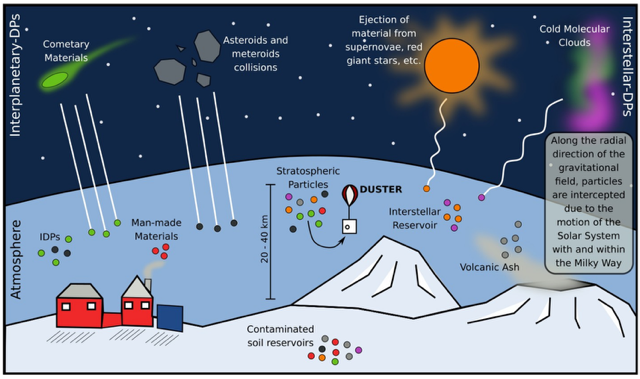
Figure 1. Schematic overview of the DUSTER collection concept: Interplanetary Dust Particles (IDPs) from comets, asteroids, and meteoroid collisions, as well as interstellar dust from supernovae and dense molecular clouds, enter Earth’s atmosphere. Most man-made and terrestrial materials, e.g. volcanic, remain confined to the troposphere or lower stratosphere. The high-altitude stratospheric window, 30 - 40 km, is a unique reservoir for extraterrestrial matter, allowing DUSTER to collect stratospheric particles in a near-contamination-free environment, enabling the recovery of pristine IDPs and possible interstellar dust, intercepted due to the solar system's motion within the Milky Way.
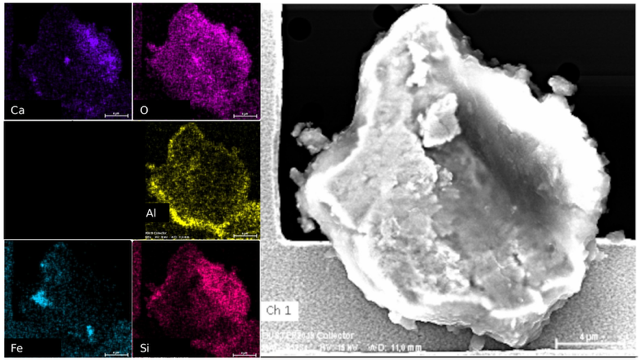
Figure 2. SEM and EDX elemental maps of a stratospheric particle collected by DUSTER. The right image shows a secondary electron micrograph of the collected particle, highlighting its irregular morphology and fragile structure. Elemental maps obtained via EDX reveal the distribution of major elements: calcium (Ca), oxygen (O), aluminum (Al), silicon (Si), and iron (Fe).
The PRIN 2022 research project “Cosmic Dust II: Cosmochemistry and Space Tweezers Technologies for Solar System Science and Exploration", uses this collection to investigate the cosmochemical and mineralogical characteristics of extraterrestrial particles with sizes ranging from about 0.5 µm to 50 µm, a dimension gap yet to be filled. Within this framework, selected subsets of DUSTER IDPs i.e., a total of 11 particles with sizes > 10 µm and of 10 particles with sizes < 5 µm, are undergoing a comprehensive multi-analytical technique campaign. These particles have been selected based on their size, morphology, mineralogy, and surface preservation. For particles larger than 10 µm in size an initial high-resolution SEM imaging, followed by non-destructive spectroscopic techniques, including micro-Infrared (µIR), micro-Raman, and nano-Raman spectroscopy are employed. This facilitates the mapping of mineral phases and organic functional groups, allowing us to identify silicates, sulfides, and carbonaceous matter. IDPs smaller than 5 µm in size are observed with high-resolution transmission electron microscopy (HR-TEM) and 3D electron diffraction tomography (EDT), offering structural and chemical characterization at nanometer scale and discriminate of amorphous versus crystalline domains. A subset of particles will undergo destructive analytical techniques, including nano-scale Secondary Ion Mass Spectrometry (nanoSIMS) for measurement of isotopic compositions at sub-micron scale. This last analysis is critical for tracing potential presolar grains and to understand the source-region signatures within the solar system, but also very challenging when applied to DUSTER collections.
Through this correlated microscopic protocol we aim to build an integrated dataset for each particle, allowing us to characterize its composition, formation history, and potential astrobiological significance. These results are expected to have implications not only for understanding the composition of the near-Earth dust complex and identifying its parent bodies, but also for the broader goals of astrobiology, planetary geology, and Solar System exploration.
References
[1] Flynn, 1997. Collecting interstellar dust grains. Nature, 387, 248. [2] Brownlee 1985. Cosmic dust: collection and research. Annu. Rev. Earth Planet. Sci. 13(1),147-173. [3] Della Corte & Rotundi, 2021. Collection of samples. In Sample Return Missions: The Last Frontier of Solar System Exploration, ed. A. Longobardo. Elsevier, 269-293. [4] Della Corte et al., 2012. In Situ Collection of Refractory Dust in the Upper Stratosphere: The DUSTER Facility. Space Science Reviews, 169, 159-180. [5] Rietmeijer et al., 2016. Laboratory analyses of meteoric debris in the upper stratosphere from settling bolide dust clouds. Icarus, 266, 217-234.
Acknowledgements: we acknowledge the PRIN2022/MUR “Cosmic Dust II: Cosmochemistry and Space Tweezers Technologies for Solar System Science and Exploration” project, ID# 2022S5A2N7, CUP n. I53D23000740006.
How to cite: Tonietti, L., Della Corte, V., Rotundi, A., Dionnet, Z., Folco, L., Maragò, O., Foti, A., Infusino, M., Magazzù, A., Brucato, J. R., Bertini, I., Inno, L., Stefani, S., Rubino, S., Piccioni, G., Suttle, M. D., Davies, F., Ottaviani, S., Cozzolino, F., and Mennella, V.: Uncontaminated Cosmic Dust from the Upper Stratosphere: DUSTER Collections and Multi-Analytical Characterization of micron and sub-micron particles, EPSC-DPS Joint Meeting 2025, Helsinki, Finland, 7–13 Sep 2025, EPSC-DPS2025-1032, https://doi.org/10.5194/epsc-dps2025-1032, 2025.
Introduction: Recent missions, Hayabusa2 and OSIRIS-REx, successfully brought back significant samples from the near-Earth asteroids Ryugu and Bennu [1, 2]. Hayabusa and its successor employed a method of collecting surface grains through impact mobilization. In contrast, OSIRIS-REx used pressurized nitrogen gas to push material into its collection device. Although Touch-And-Go (TAG) manoeuvres are commonly used for asteroid sampling, recent lunar missions, such as the Luna and Chang'e programs [3, 4], have adopted more controlled techniques involving landers that drill and scoop material. During the Apollo program, astronauts primarily collected samples manually using various tools. For the MarcoPolo-R mission study [5], an alternative sampling method, the Brush Wheel System (BWS), was developed and tested, though ultimately not implemented. This system aimed to brush material into a container during landing [6]. To explore and refine another sampling mechanism suitable for both TAG and landing manoeuvres, previous work [6-8] has been examined. This mechanism will be adapted and optimized for a mission profile different from MarcoPolo-R, with the goal of effectively sampling a broad spectrum of grain sizes, applicable to both lunar and asteroidal environments.
Sampler Design: The APOphiS SUrface saMpler (APOSSUM) concept has undergone investigation and development in two concurrent engineering studies at DLR Bremen in 2024, in collaboration with DLR and MPS Göttingen [9, 10]. The initial mission design targeted Apophis' flyby in 2029, when it will pass Earth at a distance of less than 32,000 km. The Brush Wheel System (BWS) was developed as the primary instrument for acquiring grains up to 5 cm in diameter during a TAG maneuver. Currently, the APOSSUM (renamed to Asteroid PrObe Sampler and Sample retUrn Mission) system shall be implemented as a payload for the PRIAMOS mission proposal to sample regolith from a D-type asteroid and for the CoSi mission proposal to study the uppermost surface of a comet. The design of the Brush Wheel System (BWS) features two cylindrical brushes, each 100 mm in length and 100 mm in diameter, driven independently by brushless DC motors. Surface particles ranging from sub-millimeter to centimeter sizes are captured, lifted, and moved into the sampling tube for subsequent collection. A test setup was created to simulate a Touch-And-Go (TAG) maneuver within a 45 cm square sample box. To achieve this, the sampler is suspended by four Dyneema strings, enabling a controlled descent at speeds up to 20 cm/s and at varying angles relative to gravity and/or the sample surface. The flight instrument design incorporates two cameras, providing views of both the surface interaction area and inside the sampling tube. Unlike the breadboard, the flight design may adopt a four-brush configuration, which will be evaluated against the two-brush design based on sampling efficiency, system redundancy, and overall complexity.
First Test Results: The breadboard design underwent extensive testing across a broad spectrum of parameters within our dedicated facility. Particle size and the BWS motor speed emerged as crucial factors influencing sampling efficiency. Notably, particles up to 5 cm in diameter could be sampled with satisfactory efficiency even under Earth's gravity. Currently, porous clay (LECA) and fractured Ytong rocks serve as analogue materials, which can be optionally combined with sand to simulate finer regolith. The use of lunar and Martian soil simulants is also feasible and planned to validate the concept with specific grain size distributions. Motor speeds in the range of 300 to 400 rpm struck a favorable balance between sampling efficiency and motor power requirements, a finding corroborated by our tests. Brush blockage occurred more frequently at lower rotation speeds (e.g., 200 rpm) and at 400 rpm, particles around 40 mm in size were ejected several decimeters from the surface. Other tested parameters included the relative surface angle, particle shapes and sizes, and contact force. Overall, the concept demonstrated robustness against these variations, although sampling efficiency was affected. In the event that a particle larger than the gap between the brushes causes them to jam, a reverse rotation can clear the obstruction, allowing for a subsequent sampling attempt.
Upcoming Development: The Brush Wheel System (BWS) is currently undergoing modifications to ensure compatibility with vacuum environments including brushless DC motors. It will be tested in zero-gravity and simulated lunar gravity conditions during two campaigns in June and October at the Drop-Tower and GraviTower facilities at ZARM in Bremen. Key objectives of these campaigns are to: 1) investigate the interaction between the brushes and the surface material, and 2) validate the system's efficiency under zero- and low-gravity for a range of system parameters. These parameters are consistent with those tested in the atmospheric setup described in the preceding section. Additionally, breadboard model incorporating four brushes is tested under Earth's gravity. Initial test results from the zero-gravity and simulated lunar gravity campaigns will be presented at the conference.
Acknowledgement: We acknowledge financial support by the DLR Agency (50OO2511).
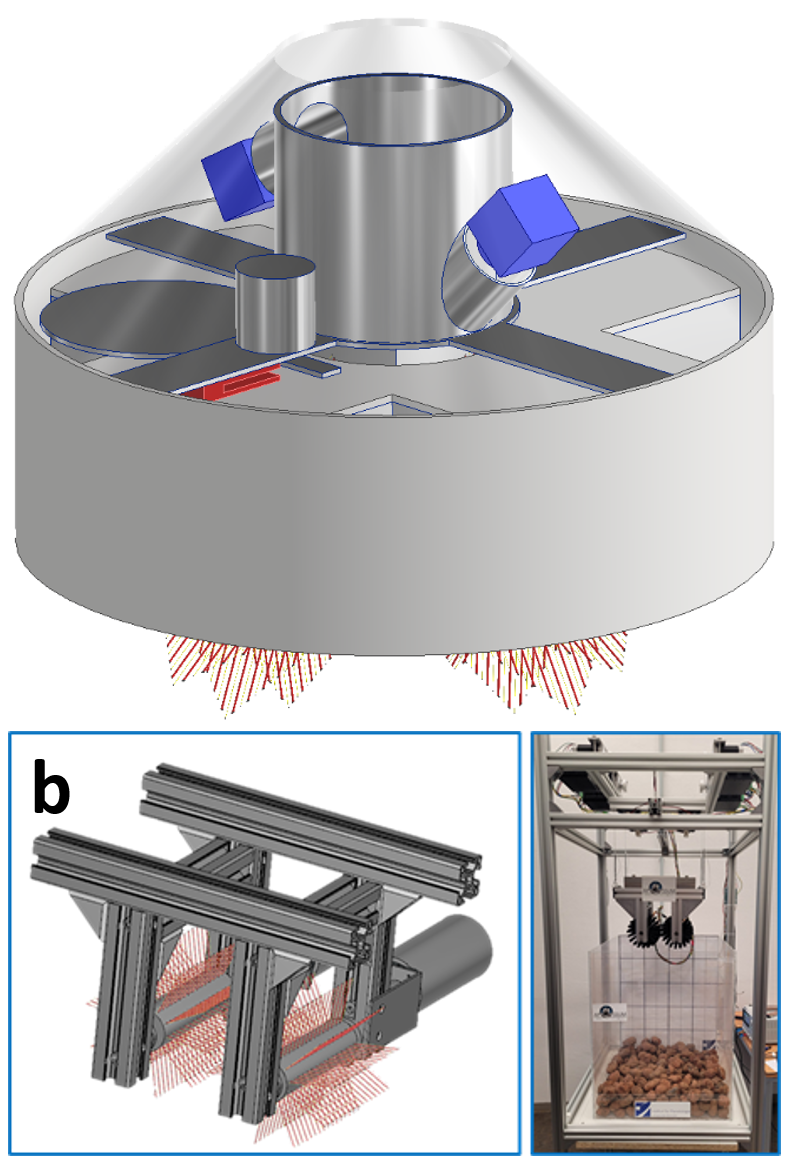
Fig. 1: a) CAD model of the BWS flight design consisting of 4 diamond-shaped brushes, a flap to close the sampling tube and two cameras (blue) to observe surface interaction and material inside the sampling tube. b) BWS breadboard with two cylindrical brushes. c) Test facility to simulate TAG maneuver under Earth gravity.
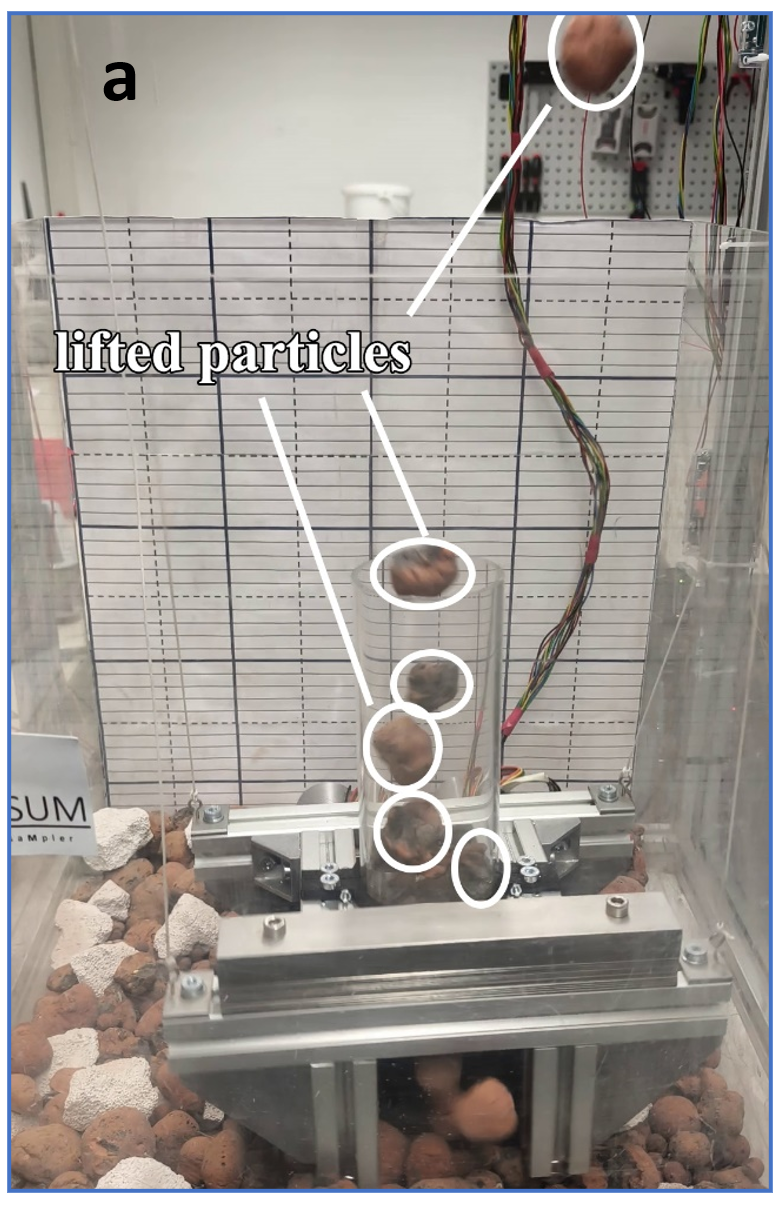
Fig. 2: Snapshot from a video during a test with a brush rotation speed of 400 rpm and an approach velocity of 20 cm/s on ~30-40 mm LECA clay and Ytong rocks. After surface contact many particles are lifted and partially flying up to a meter high (arrow) reaching velocity of ~1 m/s.
References:
[1] Watanabe S. I., et al. (2017) Space Science Reviews, 208, 3-16.
[2] Lauretta D. S. et al. (2024) Meteorit. Planet. Sci., 59, 2453-2486.
[3] Florensky et al (1977) Proc. 8th Lunar Sci. Conf., 3257-3279.
[4] Xiao et al. (2021), Sample return missions, 195-206.
[5] Barucci M. A. et al. (2012) Exp. Astron., 33, 645–684.
[6] Bonitz R. (2012) IEEE Aerospace Conference, Big Sky, MT, USA, pp. 1-6.
[7] Zhang J. et al. (2022) Acta Astronautica, 198, 329-346.
[8] Luo H. et al. (2023) Front. Mech. Eng., 18, 16.
[9] Grundmann J. T. et al. (2025) Apophis T-4 Workshop.
[10] Goldmann M. et al. (2025) Apophis T-4 Workshop.
How to cite: Gundlach, B., Patzek, M., Goldmann, M., Güttler, C., Klingenberg, G., Aussel, B., Grundmann, J. T., and Hilchenbach, M.: APOSSUM – A Brush Wheel System Sampler for Asteroidal Regolith , EPSC-DPS Joint Meeting 2025, Helsinki, Finland, 7–13 Sep 2025, EPSC-DPS2025-1251, https://doi.org/10.5194/epsc-dps2025-1251, 2025.
Please decide on your access
Please use the buttons below to download the supplementary material or to visit the external website where the presentation is linked. Regarding the external link, please note that Copernicus Meetings cannot accept any liability for the content and the website you will visit.
Forward to presentation link
You are going to open an external link to the presentation as indicated by the authors. Copernicus Meetings cannot accept any liability for the content and the website you will visit.
We are sorry, but presentations are only available for users who registered for the conference. Thank you.
Introduction: The returned lunar samples have provided critical information on the formation and evolutionary history of the Moon, contributing to the development of hypotheses such as the Moon’s giant impact into early Earth origin, the Lunar Magma Ocean and the Late Heavy Bombardment [1]. However, all these samples from the 10 Apollo, Luna and CE-5 missions were collected from the lunar nearside [2,3], leaving the far side unexplored from a sample perspective. A significant dichotomy exists between the nearside and far side of the Moon [4,5]. Nearside samples alone, without adequate sampling from the entire lunar surface, especially from the far side, cannot fully capture the geologic diversity of the entire Moon [6]. On 25 June 2024, the Chang’E-6 (CE-6) mission collected 1935.3 g of lunar samples from the South Pole-Aitken (SPA) basin (41.625°S, 153.978°W) representing the first time in history that lunar samples have been retrieved from the Moon’s far side. We focus on the preliminary investigation into the basic physical properties, rock types, petrography, mineralogy and geochemistry of the scooped samples obtained by the CE-6 mission, so as to provide foundational data for future in-depth scientific research to be carried out on these newly returned far-side samples.
Samples and methods: The lunar soils analysed in this study were from the scooped samples of CE-6 mission allocated by the China National Space Administration (CNSA). The bulk density of the soil samples was measured in its natural state and the true density was determined by Quantachrome ULTRAPYC 1200e analyser. The quantification of the mineral phases was conducted using the X-ray diffraction analyser (XRD). The mineral compositions was analysed by electron probe microanalyser (EPMA). The bulk chemical composition of CE-6 lunar soil and basaltic fragments were determined by X-ray fluorescence spectrometry (XRF) [7] and inductively coupled plasma optical emission spectroscopy (ICP–OES), respectively. The trace elements abundance of lunar soils were further determined by laser ablation quadrupole inductively coupled plasma mass spectrometry (LA-Q–ICP–MS).
Results and discussion: The CE-6 soil has a significantly lower bulk density (0.983 g/cm3) and true density (3.035 g/cm3) than the Chang’E-5 (CE-5) samples. This suggests the apparent influence of light components, such as feldspar and glass, and may also indicate a higher porosity for CE-6 lunar soil.
In the particle-size mass distribution, 95% of particles in the CE-6 soil ranges between 5.12 (Φ7.61) and 336.81μm (Φ1.57), with a mean value (= (Φ16+Φ50+Φ84)/3) of 38.98 μm (Φ4.68), a mode value of 27.97 μm (Φ5.16) and a median value (Φ50) of 35.03μm(Φ4.83) (Figure 1). The grain size of CE-6 soils exhibits a bimodal distribution, indicating a mixture of different compositions.
Petrologically, the lithic fragments from scooped soils comprise basalt (∼30%–40%), breccia (∼30%–40%), agglutinate (∼20%–30%), and minor leucocratic clasts (∼10%) (Figure 2). Basalt dominates as the primary lithology, displaying poikilitic and subophitic textures, with subordinate porphyritic and vitrophyric varieties. Breccias include both regolith breccias and impact melt breccias, while leucocratic fragments are dominated by anorthosite and norite.
Mineralogically, the CE-6 soil consists of 32.6% plagioclase (anorthite and bytownite), 19.7% augite, 10% pigeonite and 3.6% orthopyroxene, and with low content of olivine (0.5%) but high content of amorphous glass (29.4%) (Figure 3).
Geochemically, the bulk composition of CE-6 soil is rich in Al2O3 (14%) and CaO (12%) but low in FeO (17%), and trace elements of CE-6 soil such as K (∼630 ppm), U (0.26 ppm), Th (0.92 ppm) and rare-earth elements are significantly lower than those of the lunar soils within the Procellarum KREEP Terrane (Figure 4). The local basalts are characterized by low-Ti (TiO2, 5.08%), low-Al (Al2O3 9.85%) and low-K (∼830 ppm), features suggesting that the CE-6 soil is a mixture of local basalts and non-basaltic ejecta (Figure 5).
The returned CE-6 sample contains diverse lithic fragments, including local mare basalt, breccia, agglutinate, glasses and leucocrate. These local mare basalts document the volcanic history of the lunar far side, while the non-basaltic fragments may offer critical insights into the lunar highland crust, SPA impact melts and potentially the deep lunar mantle, making these samples highly significant for scientific research.
References: [1] Neal et al., 2023, The mineralogical Society of American. [2] McCubbin et al., 20019, Space Science Reviews, 215, 48. [3] Li et al., 2022, National Science Review, 9, nwab188. [4] NRC, 2007, National Academies Press. [5] Jolliff et al., 2000, Journal of Geophysical Research, 105, 4197-216. [6] Wadderburg G.J., 1972, Journal of Aeronautics Astronautics And Aviation, 10, 16-21. [7] Xue et al., 2020, Journal of Analytical Atomic Spectrometry, 35, 2826-2833. [8] Lucy et al., 2006, Reviews in Mineralogy and Geochemistry, 60, 83-219.

Figure 1: The modal mass-grain size distribution of CE-6 lunar soils. The red-colored area represents CE-6 lunar soils, while the orange-dotted reference line derived from CE-5 lunar soil [2].

Figure 2: Typical stereomicrographs of lithic fragments collected from the CE-6 scooped sample. a, typical basalt; b, regolith breccia; c, agglutinate, d, leucocratic; e and f, glass fragments.

Figure 3: Triangular plot of major mineral abundances. CE-6 lunar soils are significantly enriched in pyroxene and low in olivine compared with CE-5.

Figure 4: Elemental variations of CaO, FeO and Th. Database and triangles from Ref. [8]

Figure 5: TiO2, Al2O3 and K classification scheme for mare basalts. The basaltic fragment from CE-6 belongs to the low-Ti/low-Al/low-K species.
How to cite: Li, C., Liu, J., Zhou, Q., Liu, B., and Li, H.: Nature of the lunar far-side samples returned by the Chang’E-6 mission, EPSC-DPS Joint Meeting 2025, Helsinki, Finland, 7–13 Sep 2025, EPSC-DPS2025-88, https://doi.org/10.5194/epsc-dps2025-88, 2025.
Introduction
China’s first lunar sample return mission, Chang’e 5, collected 1731g of Lunar material in December 2020 from the Northern Oceanus Procellarum, a large mare on the western edge of the near side of the Moon. It has been identified to contain some of the youngest mare basalts on the Moon (up to 2 billion years old; Li et al., 2021; Quian et al., 2021). Despite its young age relative to other regions of the Moon, it is still likely material on the surface of this region has experienced extensive space weathering effects over time as a result of physical (e.g., micro-/meteorite) and radiogenic (Solar wind and cosmic rays) bombardment. These produce physical chemical, and mineralogic changes such as amorphization, nanophase metallic iron (npFe0) production, melting, and vaporisation (e.g., Denevi et al., 2023). The effects of these processes can cause significant changes to the infrared spectra of bodies, which affects our ability to reliably interpret remote sensing data. It is therefore highly important to have a thorough understanding of the effects and extent of space weathering on a range of airless bodies in the Solar System, to mitigate the impact it can have on existing and future studies.
Methods
Near- to mid- FT-IR spectra were collected using a Bruker VERTEX 80V FT-IR Spectrometer with a Hyperion 2000 Microscope on a 10mg aliquot of CE5 lunar soil at the Hangzhou Institute for Advanced Study, UCAS. Spectra ranged from 600 – 4000 cm-1 (2.5 – 16.6 µm) with a resolution of 2cm-1. A total of ~250 spectra, corresponding to over 100 individual grains, were analysed for bulk characterisation. Following this, 28 large grains ranging from ~ 270 µm up to ~850 µm in diameter were handpicked under a binocular microscope and mounted on conductive carbon tape for field emission scanning electron microscopy (FE-SEM) and energy dispersive X-ray spectroscopy (EDS) analysis using a HITACHI-SU8020 FE-SEM, also at HIAS.
Results & Discussion
Reflectance IR spectra of almost all mineral grains across the 10mg aliquot contain clear Christiansen features (CF, ~8 µm) and Restrahlen bands (RB, ~ 9-12 µm), a summary of which can be seen in figure 1. The soil is largely composed of high and low Ca-pyroxenes, olivines, plagioclase feldspars, and smaller amounts of phosphates, and glasses, in agreement with existing mineralogical analyses of CE5 soils (e.g., Yang et al., 2022; Zhang et al., 2022). Previous correlations between the intensity contrast of the strongest RB - CF and approximate sample maturity, as determined by the content of npFe0 have been performed on Apollo 14, 15, and 16 samples (Morlok et al., 2022). When considering the determined intensity contrasts of these CE5 grains in the framework of previous Apollo samples, we find that the grains, particularly those with higher levels of crystallinity, appear to be very immature. This suggests that regolith sampled by CE5 has experienced low levels of space weathering relative to previously sampled lunar regions. This is in line with previous measurements, and the fact that CE5 samples being some of the youngest material sampled on the Moon (Li et al., 2021; Yang et al., 2022). Nevertheless, some grains do show signs of weathering relative to standards. For example, crystalline features tend to be broadened and muted, possibly due to surface amorphization (e.g., Morlock et al., 2022). Similarly, many of the spectra exhibiting signs of spectral amorphization also contain CF which are slightly redshifted, further indicating at least minor levels of space weathering on surface materials around the CE5 sampling region (Kumari et al., 2024). Geochemical and optical investigations are still ongoing at the time of submission, which will provide the opportunity to further characterise and potentially quantify the variations in effects between different mineral types within these young mare samples.
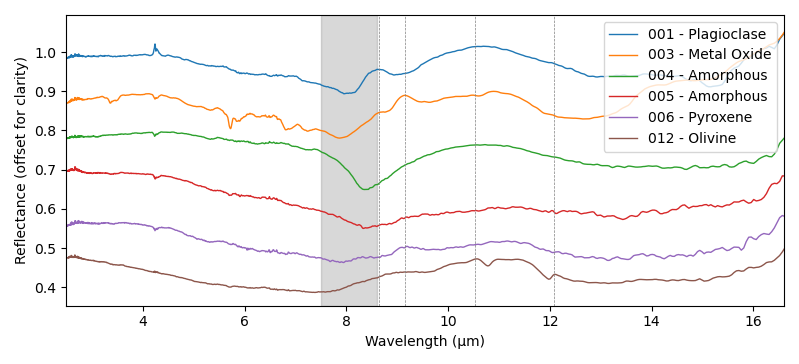
Figure 1: Summary comparison of 6 different grain types which have been separated from the CE5 regolith. The grey region encompasses the Christiansen Feature range, where more pristine crystalline phases exhibit CFs at shorter wavelengths, and vertical dashed lines represent crystalline features.
References
Denevi, B.W., Noble, S.K., Christoffersen, R., Thompson, M.S., Glotch, T.D., Blewett, D.T., Garrick-Bethell, I., Gillis-Davis, J.J., Greenhagen, B.T., Hendrix, A.R., Hurley, D.M., Keller, L.P., Kramer, G.Y., Trang, D., 2023. Space Weathering At The Moon. Reviews in Mineralogy and Geochemistry 89, 611–650. https://doi.org/10.2138/rmg.2023.89.14
Kumari, N., Glotch, T.D., Shirley, K.A., Greenhagen, B.T., Byron, B.D., 2024. Effects of space weathering on the Christiansen feature position of lunar surface materials. Icarus 412, 115976. https://doi.org/10.1016/j.icarus.2024.115976
Li, Q.-L., Zhou, Q., Liu, Y., Xiao, Z., Lin, Y., Li, J.-H., Ma, H.-X., Tang, G.-Q., Guo, S., Tang, X., Yuan, J.-Y., Li, J., Wu, F.-Y., Ouyang, Z., Li, C., Li, X.-H., 2021. Two-billion-year-old volcanism on the Moon from Chang’e-5 basalts. Nature 600, 54–58. https://doi.org/10.1038/s41586-021-04100-2
Morlok, A., Joy, K.H., Martin, D., Wogelius, R., Hiesinger, H., 2022. Laboratory IR spectroscopy of soils from Apollo 14, 15, and 16: Spectral parameters and maturity. Planetary and Space Science 223, 105576. https://doi.org/10.1016/j.pss.2022.105576
Qian, Y., Xiao, L., Head, J.W., van der Bogert, C.H., Hiesinger, H., Wilson, L., 2021. Young lunar mare basalts in the Chang’e-5 sample return region, northern Oceanus Procellarum. Earth and Planetary Science Letters 555, 116702. https://doi.org/10.1016/j.epsl.2020.116702
Yang, Y., Jiang, T., Liu, Y., Xu, Y., Zhang, H., Tian, H.-C., Yang, W., Zou, Y., 2022. A Micro Mid-Infrared Spectroscopic Study of Chang’e-5 Sample. Journal of Geophysical Research: Planets 127, e2022JE007453. https://doi.org/10.1029/2022JE007453
Zhang, H., Zhang, Xian, Zhang, G., Dong, K., Deng, X., Gao, X., Yang, Y., Xiao, Y., Bai, X., Liang, K., Liu, Y., Ma, W., Zhao, S., Zhang, C., Zhang, Xiaojing, Song, J., Yao, W., Chen, H., Wang, W., Zou, Z., Yang, M., 2022. Size, morphology, and composition of lunar samples returned by Chang’E-5 mission. Sci. China Phys. Mech. Astron. 65, 229511. https://doi.org/10.1007/s11433-021-1818-1
How to cite: Grant, H., Xu, X., Tong, T., Huang, S., Luo, S., Wang, X., Longobardo, A., Palomba, E., and Shu, R.: Spectral identification of low levels of space weathering on Chang’e 5 regolith grains, EPSC-DPS Joint Meeting 2025, Helsinki, Finland, 7–13 Sep 2025, EPSC-DPS2025-1781, https://doi.org/10.5194/epsc-dps2025-1781, 2025.
Introduction: During the Reconnaissance phase of NASA’s OSIRIS-REx mission, the Thermal Emission Spectrometer (OTES) acquired high–spatial resolution emissivity spectra over Bennu’s four prospective sampling sites [1, 2]. We analyse the calibrated OTES dataset archived in the Planetary Data System [3] to quantify compositional and mineralogical diversity across the original four candidate sample sites (Nightingale, Kingfisher, Osprey, and Sandpiper) and to explore possible drivers of Bennu’s surface heterogeneity, including implications for Bennu’s mineralogy and space-weathering history.

Figure 1: Site-Averaged Emissivity Spectra with Annotated Band Parameters
Methods: Calibrated emissivity spectra (5.7-100 µm) were linked to corresponding OCAMS imagery [5] to place the thermal infrared measurements in geological context, by cross-referencing observation times. For every spectrum we derived four diagnostic band parameters: Christiansen Feature (CF), silicate stretching band, silicate bending band and spectral slope, following the methods outlined in [6]. Each site contains thousands of spectral observations (site-averaged for visualization in Figure 1). The corresponding band parameters were compared using three statistical models: Principal Component Analysis (PCA) [5], k-Nearest Neighbors (KNN) [7], and Analysis of Variance (ANOVA) [8]. The three methods compare the mean and variance of each individual observation per site, considering how the in-group variance (i.e. the spread within all observations of a single site) compares to the out-group variance (i.e. the spread from other sites).
Results: Significant differences in emissivity spectra emerged among the four sites. PCA indicated that the first three components explain 85.5% of spectral variance, distinguishing Kingfisher as notably unique, with Sandpiper and Osprey exhibiting the greatest similarity. The KNN analysis corroborated PCA findings, reaching optimal classification accuracy (47%) at k = 21. ANOVA highlighted significant variability among the sites, especially in the spectral slope parameter (F = 762.8), suggesting differences in particle size distribution and space weathering could be driving factors in the detected heterogeneity [9]. Band ratio analyses provided additional insight into site-specific mineralogical distinctions, notably the relationship between silicate features and aqueous alteration indicators [10].

Figure 2: Distributions of Band Parameters by Site
Discussion: Variability in spectral parameters aligns with documented particle size frequency distributions and known space weathering spectral types across Bennu’s surface [9]. Nightingale, the mission’s selected sample site, captures representative global characteristics, contrasting with Kingfisher’s distinct compositional and physical attributes, potentially related to differences in Fe/Mg content and degree of aqueous alteration [10].
Conclusion: Integrative use of multiple statistical approaches confirms the compositional and physical diversity of Bennu's surface, as seen through the four prospective sites. These analyses provide a framework for interpreting returned sample data and offer insights into the connections between mineralogy, particle size, and space weathering processes on small airless body surfaces.
References: [1] Lauretta D. S. et al (2021) Sample Return Missions. [2] Hamilton V. et al. (2021) A&A (Vol. 650). [3] Christensen, P. R. et al. (2019) NASA Planetary Data System [4] Christensen P. R. et al. (2018) Space Science Reviews (Vol. 214, Issue 5). [5] Rizk B. et al (2018) Space Science Reviews (Vol. 214, Issue 1). [6] Xie B. et al (2022) Minerals (Vol. 508, Issue 12). [7] Kramer O. (2013) Intelligent Systems Reference Library (13-23). [8] Sawyer S. (2009) Journal of Manual & Manipulative Therapy. [9] Clark B. E. et al (2023) Icarus (Vol. 400). [10] Bates H. et al (2020) MaPS (Vol. 55, Issue 1).
How to cite: Belhadfa, E., Shirley, K., and Bowles, N.: Spectral Variability and Compositional Insights from Asteroid (101955) Bennu’s Sampling Sites Using OTES Data , EPSC-DPS Joint Meeting 2025, Helsinki, Finland, 7–13 Sep 2025, EPSC-DPS2025-548, https://doi.org/10.5194/epsc-dps2025-548, 2025.
Abstract Informed by findings about the sample from asteroid Bennu, we apply a new simulation methodology to better understand how Van der Waals (VdW) forces work between spherical and non-spherical particles. Then we find a theoretical model that relates particle size and shape, as well as porosity and connectivity to the tensile strength of a self-gravitating aggregate and apply the model to calculate the strength of the surface of asteroid Bennu based on the experimentally measured value of particle-particle cohesion.
Introduction The strength of granular asteroids has been the focus of many research efforts as it could explain why asteroids are observed to have high spin rates that exceed their self-gravity. About a decade ago, the source of this cohesive or tensile strength was traced back to the VdW forces that exist between any two particles in contact [1]. These VdW forces would allow the small pebbles and dust in a small asteroid to act as weak cement keeping the larger rocks and boulders in place, providing the needed strength. This finding was based on simulations with spherical particles, as VdW forces vary as the particle diameter d, and the number of contacts across a surface varies as 1/d¯2, tensile strength varies as 1/d¯.
Recent theoretical work [2] claims that the cohesive VdW force between real particles is particle-size independent, depending only on the particles' surface roughness. If this is so, and assuming that all particles have statistically the same roughness, the magnitude of the cohesive force should be a constant. This makes tensile strength, and so the cohesive strength, dependent on 1/d¯2.
In 2020, the OSIRIRS-REx mission successfully collected a sample from the surface of asteroid Bennu. Calculations in [3, 4, 5] showed that the surface of Bennu should be near cohesionless. Collected particle sizes range from submicron dust to a stone 3.5 cm long. Millimeter-scale and larger stones typically have hummocky or angular morphologies [6]. Keeping this mind, we carry out new simulations using the LMGC90 code, which implements a Non-Smooth Contact Dynamics Method [7], allowing us to simulate polyhedral regolith and keeping cohesive forces as a constant.
The Contact Dynamics (CD) method In CD, particles are assumed to be perfectly rigid and to interact through mutual exclusion and Coulomb friction. The frictional contact interactions are described as complementarity relations, without regularisation, between the relative velocities of the particles and the corresponding forces at the contact points. As a direct consequence, the characteristic time of the system is determined by the dynamics of the particles and larger time-steps than in regular methods can be used. Particle motion is no longer regular but includes speed jumps reflecting multiple collisions and collective friction between particles.
Figure 1: Simulation setup to measure the tensile strength of a granular bridge [8]. (Left) initial state, (right) bridge failure. Colours indicate motion direction.
Simulation Setup The simulation setup carries out a direct measurement of the tensile strength of a self-gravitating granular system formed either by spherical and polyhedral particles. To do this, we place two large (1m) boulders connected by cm size, cohesive regolith (see Fig. 1). The regolith are dodecahedrons and their axis ratios (ay/ax and az/ax) vary between 0.4 and 1. We also carry out simulations with spheres in order to directly compare against our previous findings [8].
The boulders are pulled apart by increasingly opposing forces until the bridge is broken. During this process, we monitor the dynamics of the particles forming the bridge. The pulling forces as well as the cohesive forces between the grains, and the time step of the simulations are graduated so that the process is quasi-static [9]. The constant cohesive force is set to f0=9×10⁻⁷ N and the increments in pulling force are done in steps of 2% of the total gravitational attraction on one of the boulders every 5 s.
Results Tensile strength can be directly measured from the micro-structure of the system [9] and estimated using a modified Rumpf equation. However, a diameter for a polyhedral particle is not uniquely defined and is difficult to relate particle size to tensile strength. In fact, the results for particles with the same ax would all line up on one particle size if we followed the common procedure to extract particle size distributions. However, if we instead define an equivalent diameter deq as the diameter of a sphere that has the same volume as the non-spherical particle, it is possible to observe a trend (see Fig. 2(left)) and a collapse of all measurements and the prediction (σT=Zcνf0/πdeq), where Zc is the connectivity number and ν is the filling fraction.
Fig. 2 (Left) Tensile strength σT as a function of mean equivalent particle diameter deq for all particle shapes (color level). The black dashed line is a fit in the form of 1/d2eq. (Right) Upper and lower limits of the tensile strength of granular media formed by particles with the characteristics of the sample taken from asteroid Bennu. The dashed, green line is the upper limit of the tensile strength of Bennu’s surface.
Applying the model developed here and the material parameters obtained from the sample and Bennu, and taking 1 mm as the deq of the average particle size (average sample particle size = 1.2 mm) that was measured for the sample, the tensile strength should be approximately between 0.001-0.01 Pa; certainly close to be strengthless even in a small asteroid.
References: [1] P. Sánchez, et al. (2014) Meteoritics & Planetary Science, [2] B. N. J. Persson, et al. (2022) Tribology Letters 70(2):34, [3] R.-L. Ballouz, et al. (2021) Monthly Notices of the Royal Astronomical Society 507(4):5087 ISSN 0035-8711, [4] K. J. Walsh, et al. (2022) Science Advances,[5] D. S. Lauretta, et al. (2022) Science 377(6603):285, [6]D. S. Lauretta, et al. (2024) Meteoritics & Planetary Science 59(9):2453, [7] J. J. Moreau (1994) Eur J Mech A 13:93, [8] P. Sánchez, et al. (2018) Planetary and Space Science 157:39 ISSN 0032-0633, [9] E. Azéma, et al. (2018) Phys Rev E 98:030901.
How to cite: Sánchez, P., Azéma, E., Jardine, K., Hoover, C., Biele, J., Ryan, A. J., Ballouz, R.-l., Macke, R. J., Pajola, M., Connolly Jr., H. C., and Lauretta, D.: Asteroid Regolith Strength Modelling Informed by Bennu Sample Measurements, EPSC-DPS Joint Meeting 2025, Helsinki, Finland, 7–13 Sep 2025, EPSC-DPS2025-1443, https://doi.org/10.5194/epsc-dps2025-1443, 2025.
Introduction: Primitive extraterrestrial materials, such as carbonaceous chondrites and returned asteroid samples, exhibit considerable mineralogical and chemical heterogeneity across a wide range of spatial scales—from nanometers to millimeters. This heterogeneity reflects the complex interplay of processes occurring both before and after the accretion of these bodies. Among the features that preserve the record of these evolutionary stages, porosity remains one of the least understood parameters. Pores of various sizes—ranging from nanometers to micrometers—are found within these materials, along with larger-scale fractures, and can provide key insights into their thermal, aqueous, and mechanical history.
Methods: In this study, we have investigated the multiscale pore structure of a millimeter-sized grain, A0159, from the C-type asteroid Ryugu, returned by the Hayabusa2 mission. This grain is particularly interesting due to its complex internal structure, including a prominent carbonate vein and the coexistence of multiple lithologies [1,2]. To characterize the three-dimensional pore architecture across scales, we performed X-ray computed tomography (XCT) analyses at two different resolutions.
First, the entire grain was imaged using micro-XCT at the PSICHE beamline (Synchrotron SOLEIL, France) with a voxel size of 1.3 µm, enabling the identification of larger pores and fractures. Then, ~30 μm³ sub-volumes were extracted from surface regions of distinct lithologies. Finally, Zernike nano-XCT was conducted at the ANATOMIX beamline (Synchrotron SOLEIL, France) using phase-contrast imaging with a voxel size of 50 nm.
Results & Discussion: Our multiscale analyses revealed a highly complex pore network (Figure 1), with over 10,000 individual pores detected at each scale. We have performed a statistical analysis of their geometrical properties, including size distribution, degree of anisotropy, and elongation index. Preliminary results indicate the coexistence of distinct pore size regimes with characteristic geometrical signatures. In particular, micrometer-scale pores tend to be more elongated and anisotropic, while nanoscale pores appear more circular.
We will discuss how these contrasting pore geometries reflect different stages in the evolution of Ryugu's parent body. Our findings will be compared with previous studies suggesting that nanoscale porosity may be inherited from pre-accretional processes [3], while the larger and more elongated pores are likely the result of later-stage modifications, such as those caused by shock events, aqueous alteration or thermal stress [4].
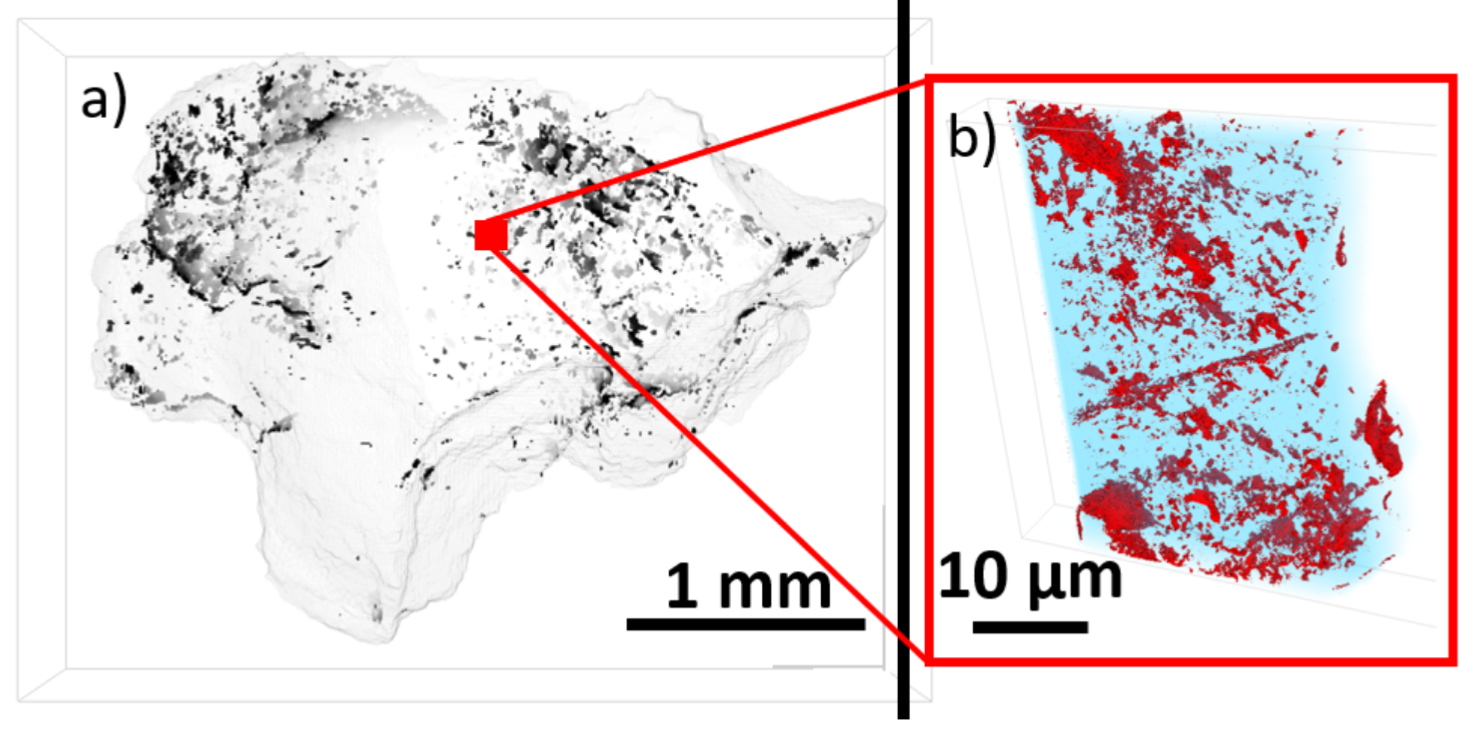
Figure 1 : 3D pores network (a) observed at the micrometric scale (in black) inside Ryugu A0159 and (b) at the nanometric scale (in red) inside a small cube extracted from Ryugu A0159.
Acknowledgment: We thank JAXA for providing the Ryugu sample A0159 as part of the first Hayabusa2 A0 and K. Hatakeda and M. Matsumoto for their help. This work is the result of a collaboration between IAS, CNRS, Université Paris-Saclay, and JAXA, and was supported by CNES, the ANR (LARCAS project, ANR-22-CE49-0009-01), and the SOLEIL synchrotron facility.
References: [1] Jossé et al. (2025), EPSC 2025, [2] Jossé et al. (2025) submitted to MAPS, [3] Zanetta, P. M. (2021) GeCoA 295, 135–154, [4] Genge M.J. (2024) Nat Astron 8, 1544–1552.
How to cite: Dionnet, Z., Jossé, L., Aléon-Toppani, A., Brunetto, R., Rascle, J., Djouadi, Z., King, A., Scheel, M., and Heripre, E.: Constraining the evolution of the asteroid Ryugu through 3D multiscale porosity analysis, EPSC-DPS Joint Meeting 2025, Helsinki, Finland, 7–13 Sep 2025, EPSC-DPS2025-944, https://doi.org/10.5194/epsc-dps2025-944, 2025.
INTRODUCTION & CONTEXT
Ryugu is a C-type asteroid, rich in carbon and organic compounds, and is considered to have evolved relatively little since its formation. It therefore represents a major scientific target for understanding the origins and early formation of Solar System bodies. As a relatively accessible near-Earth asteroid, it was selected by the Japanese Space Agency (JAXA) to be sampled as part of the Hayabusa2 mission. In December 2020, approximately 5 grams of material were successfully returned to Earth, enabling the development of various scenarios regarding Ryugu’s formation and evolution.
Ryugu is thought to originate from a larger parent body, estimated to have had a diameter ranging from several tens to several hundreds of kilometers [1, 2]. This body likely formed between 1.8 and 2.9 million years after the first solid components of the Solar System, beyond 3–4 AU, in a cold region where water (H2O) and carbon dioxide (CO2) could exist in the form of ice [2]. The parent body, mostly composed of ice, amorphous silicates (GEMS-like material), some minerals (metals, sulfides, and anhydrous silicates) and organics [3, 4, 5], would have experienced internal heating due to the radioactive decay of aluminum-26 leading to the melting of ices and the onset of mineralogical aqueous alteration depending on the location within the body [6]. These processes created local heterogeneities enriched in secondary minerals. Major impact events also contributed to the brecciation of the surface and the possible formation of second-generation asteroids, such as rubble piles, of which Ryugu is believed to be one [7].
The breccias that resulted from these catastrophic events are composed of fragments (or clasts) of various mineralogical assemblages cemented within a fine-grained matrix [8]. The lithological diversity observed in these breccias reflects the complex geological evolution of planetary surfaces and bodies in the Solar System, making their study essential for better understanding the processes that shaped these objects.
In this context, and to overcome the limitations of traditional 2D analyses, we developed a semi-automated method called Local Histogram (LH) segmentation ([9], publication in prep.), applied to a millimetric grain from Ryugu using Synchrotron-Radiation X-Ray Micro-Computed Tomography (SR-μXCT) dataset. This approach enables the 3D identification and visualization of mineralogical heterogeneities while minimizing manual intervention.
RESULTS & PERSPECTIVES
The analysis of a single grain revealed a composite of five distinct lithologies. Three of them (Lith I, II, and III) are matrix-dominated but differ in their contents of carbonates, magnetite, calcium phosphates, and sulfides. The widespread presence of hydrated phyllosilicates attests to an aqueous alteration process that led to the formation of these lithologies. Their current juxtaposition could be the result of a brecciation event that brought together materials from different depths within the parent body, consistent with rubble-pile formation simulations [10].
The 3D segmentation, combined with fracture analysis, revealed a clear fracture separating Lith I and Lith II, strengthening the hypothesis of a brecciation event. However, the contiguous (Lith I, II, then III) and sometimes concentric distribution in 3D also suggests a progressive, potentially radial alteration process, affecting each lithology differently (from the less altered Lith I to the carbonate-rich Lith III). Among the other detected lithologies are (i) a millimetric carbonate vein [11] (Lith IV), which appears to crosscut Lith II and III, suggesting that the aqueous event responsible for its formation occurred after the event(s) that juxtaposed or differentially altered these lithologies, and (ii) aggregates of large opaque minerals (mainly magnetite), associated with matrix and/or carbonates (Lith V), found within both Lith II and III, whose relative origin remains to be determined through further analysis. The 3D analysis enabled the formulation of several hypotheses concerning lithology formation; however, additional studies are required to converge on a consistent and coherent scenario. Thanks to 3D segmentation, specific zones of interest were precisely targeted for further investigation.
Two sections were prepared using Xe-pFIB and subsequently analyzed by scanning electron microscopy (SEM) and infrared spectroscopy. Preliminary results suggest a possible genetic link between the fracture network and the crystallization of the carbonate vein, providing new insights into fragmentation processes.In conclusion, this work highlights the complex thermal, aqueous, and mechanical histories that lead to the formation of meteoritic breccias. It underscores the crucial contribution of 3D analysis in reconstructing the geological evolution of small Solar System bodies.
ACKNOWLEDGEMENT
We thank JAXA for providing the Ryugu A0159 sample during the first Hayabusa2 AO. We acknowledge K. Hatakeda, M. Matsumoto, S. Pont, F. Borondics, C. Sandt, C. Le Guillou, F. Brisset, C. Boukary, D. Baklouti, Z. Djouadi, C. Lantz, and O. Mivumbi for their contributions. This work involved collaboration between IAS, CNRS, Université Paris-Saclay, and JAXA, with funding from CNES, ANR (LARCAS project, ANR-22-CE49-0009-01), Region Ile-de-France (DIM-ACAV), and SOLEIL.
REFERENCES
[1] K. A. McCain et al., Nature Astronomy, vol. 7, no. 3, pp. 309–317, 2023.
[2] E. Nakamura et al., Proceedings of the Japan Academy, Series B, vol. 98, no. 6, pp. 227–282, 2022.
[3] A. Tsuchiyama et al., Geochimica et Cosmochimica Acta, 2024.
[4] H. Yabuta et al., Science, vol. 379, no. 6634, p. eabn9057, 2023.
[5] T. Nakamura et al., Science, vol. 379, no. 6634, p. eabn8671, 2023.
[6] A. Yamaguchi et al., Nature Astronomy, vol. 7, pp. 1–8, 03 2023.
[7] W. Herbst et al., The Planetary Science Journal, vol. 2, no. 3, p. 110, 2021.
[8] A. Bischoff et al., Meteorites and the early solar system II, pp. 679–712, 2006.
[9] L. Jossé et al., LPI Contributions, vol. 3036, p. 6017, 2024.
[10] P. Michel et al., Science, vol. 294, no. 5547, pp. 1696–1700, 2001.
[11] L. Jossé et al., abstract, METSOC 2024
How to cite: Jossé, L., Dionnet, Z., Aléon-Toppani, A., Brunetto, R., King, A., Gardés, E., and Héripré, E.: 3D Detection and Analysis of Lithologies in Ryugu: Insights into its Complex Geological Formation, EPSC-DPS Joint Meeting 2025, Helsinki, Finland, 7–13 Sep 2025, EPSC-DPS2025-1487, https://doi.org/10.5194/epsc-dps2025-1487, 2025.
On December 6, 2020, JAXA's Hayabusa2 spacecraft successfully returned to Earth a re-entry capsule containing samples from the carbonaceous asteroid (162173) Ryugu. The capsule, recovered in South Australia, was transported to JAXA's curation facility in Sagamihara, Japan, where the sample container was opened and initial characterization was conducted under contamination-controlled conditions. During this initial characterization, the near-infrared reflectance spectra of the Ryugu samples were obtained using a Fourier Transform Infrared (FTIR) spectrometer. These spectra exhibited similar spectral features and a higher signal-to-noise ratio compared to those obtained from Ryugu's surface by the spacecraft's onboard near-infrared spectrometer, NIRS3 [1,2]. This provides a valuable opportunity to refine the calibration of Hayabusa2's remote sensing instruments. NIRS3 is a point spectrometer that continuously acquires spectral data over the 1.8-3.2 µm wavelength range with a field of view of 0.1 degrees [3]. During Hayabusa2's proximity operations, the entire surface of Ryugu was mapped, and a narrow absorption feature at 2.72 µm, attributed to hydrated minerals, was detected [4]. However, due to uncertainties in the radiometric calibration of NIRS3, the presence of regional variations in the intensity of the 2.72 µm absorption feature remains unclear. Here, we recalibrated the NIRS3 data using laboratory spectra of the returned Ryugu samples and re-evaluated the spectral characteristics across Ryugu's surface.
FTIR spectra obtained from three sub-bulk samples stored in chamber A of the sample container were used. These spectra were resampled to match the wavelength resolution of the NIRS3 spectra and compared with the average NIRS3 spectra acquired near the equatorial region of Ryugu. Photometric corrections were applied to the NIRS3 spectra to match the geometric conditions with those of the FTIR. As a result, the reflectance values from NIRS3 were approximately 10% lower than those from FTIR. However, this discrepancy may be due to contamination from the sapphire sample dish and is within the uncertainty range of the NIRS3 radiometric calibration. Good agreement was observed in both the intensity and shape of the 2.72 µm absorption feature, as well as in the overall spectral slope. These results indicate no significant differences between the NIRS3 and FTIR spectra, supporting the validity of using the Ryugu sample spectra as a reference for recalibrating the NIRS3 data of the asteroid's surface.
We derived new radiometric calibration coefficients for NIRS3 using the spectra of the Ryugu samples and incorporated them into the data processing pipeline to produce an updated global spectral map of Ryugu. The recalibrated NIRS3 spectra show that both the band area of the 2.72 µm absorption feature and the spectral slope increase with increasing latitude, consistent with findings from OSIRIS-REx observations of asteroid Bennu [5]. These latitudinal trends may reflect variations in particle size, porosity, or surface roughness. In this presentation, we present the spectral characteristics of Ryugu's surface based on the recalibrated NIRS3 spectra, and discuss the results of applying this new calibration to previously acquired NIRS3 spectra of the Moon.
References:
[1] Yada et al. (2021) Nature Astronomy 6, 214-220. [2] Hatakeda et al. (2023) Earth, Planets and Space 75:46. [3] Iwata et al. (2017) Space Science Review 208, 317-337. [4] Kitazato et al. (2019) Science 364, 272-275. [5] Simon et al. (2020) Science 370, eabc3522.
How to cite: Kitazato, K., Abe, M., Hatakeda, K., Yada, T., and Iwata, T.: Calibration of the Hayabusa2 near-infrared spectrometer using laboratory spectra of Ryugu samples, EPSC-DPS Joint Meeting 2025, Helsinki, Finland, 7–13 Sep 2025, EPSC-DPS2025-1279, https://doi.org/10.5194/epsc-dps2025-1279, 2025.
1. Introduction
The NASA/ESA Mars Sample Return (MSR) Campaign aims to bring Martian rock and soil specimens to Earth for high-priority scientific investigations, marking a landmark achievement in planetary exploration [1]. As part of the MSR Sample Receiving Project (SRP) Pre-Basic Characterization Phase, these samples will first undergo non-destructive analysis inside a dedicated Sample Receiving Facility (SRF) while still enclosed in precision-engineered titanium tubes. One of the first techniques applied will be high-resolution X-ray computed tomography (HR XCT), used to non-destructively generate detailed 3D digital representations of samples. These digital twins will contribute to a comprehensive sample catalogue, supporting subsample allocation through competitive, open science announcements. To ensure XCT delivers maximal structural information at micron-level resolution while preserving sample integrity, it is critical to optimize scanning protocols—balancing image quality with minimal radiation dose. This initiative lays the groundwork for curatorial excellence and scientific readiness, ensuring that returned Martian materials are studied using state-of-the-art methods while preserving their pristine condition for future research. This ongoing study describes the first imagery, data simulation and dose simulation results, alongside the feasibility of scanning within the Sample Tube Isolation Container (STIC).
2. Methodology & Results:
XCT Imaging
Test scans of two types of analogue test samples (i.e., loose unconsolidated rocks and solid rock cores) were performed using the High-Energy CT system Optimized for Research or HECTOR [2] at the Ghent University Centre for X-ray Tomography (UGCT). Starting with a low-resolution scan (60 µm) of the complete tube and a high-resolution scan (7µm) of the tube filled with loose unconsolidated rocks, a resolution of 10 µm was chosen as voxel size for the other datasets. The voltage (120 kV) was set to match bench-top sized HR XCT systems to be potentially used in the SRF. The same settings have been applied to image the solid rock cores in their sample tubes as well as within the STIC.
Simulations of datasets
Simulations of virtual samples have been recreated by segmenting the loose grain and solid rock from the surrounding air and tubing from HR XCT images of the analogue test samples. Using the in-house developed realistic projection simulator [3], mineral phases have been recreated to anticipate all possible mineral compositions of the Mars samples [4]. The HR XCT images of these virtual samples have been used to assess the image quality (contrast) and application potential in predicting the composition of the unopened samples.
Dose simulations
To simulate the dose deposition in the samples during XCT scanning, a workflow was developed using the Monte Carlo code PENELOPE [5]. The cone-beam geometry as well as the polychromatic X-ray beam is taken into account.
3. Discussion:
The sample tubes of well-defined dimensions largely determine the boundary conditions under which the samples can be optimised. The diameter of the sample tube, and the STICs around the tube, set the limitations on the achievable voxel size to be around 10 µm. On the other hand, the titanium material of the sample tube serves as an excellent filter and omits the need for extra hardware beam filtering, although such filter may reduce the radiation dose. Visible image artefacts seem to be rather caused by the irregular shape of the tube (especially the fin at the bottom of the tube) but remain appreciably low for the investigation of the rock material within.
The contrast between the different mineral phases is improved by lowering the initial voltage of the X-ray source. A voltage of 120 kV is considered to be a good trade-off between high image quality and low image artefacts due to beam hardening. The projection simulator enabled the prediction of the relative gray values of the mineral phases and can be used to better predict the mineral content of the unopened samples. Optimizing the differentiation between specific minerals of interest could benefit from further adjusting the HR XCT settings or by using hyperspectral HR XCT.
4. Conclusions:
From the preliminary results, a resolution of 10µm is sufficient to retrieve valuable information from the Martian samples in the SRF, prior to opening the tubes. However, careful assessment of the deposited dose and the effects thereof is still needed.
Acknowledgements
This study is funded by ESA under ESA contract number AO/1-12041/23/NL/AT.
References:
[1] G. Kminek et al., 2022; [2] Masschaele et al., 2013; [3] Dhaene et al., 2015; [4] Morrison et al. 2024; [5] Baró et al., 1995
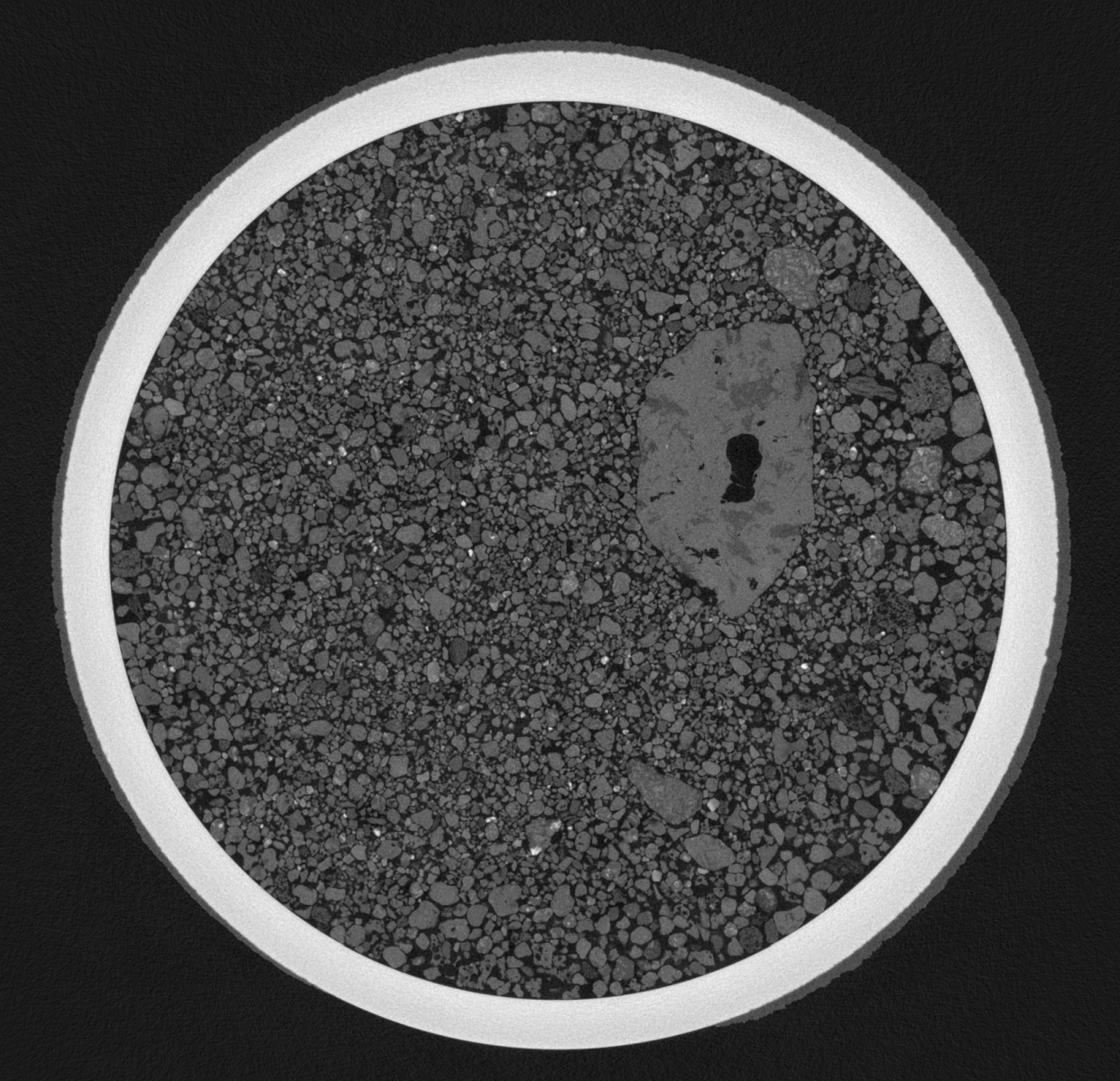
Example micro-CT slice of the sample tube with a granular analogue sample, scanned at Ghent University (voxel size: 10 µm)
How to cite: Boone, M. N., Buyse, F., Baert, T., Vincze, L., Josipovic, I., Tack, P., Van Hoorebeke, L., Zemeny, A., Thiessen, F., Sefton-Nash, E., and Kminek, G.: Pre-basic characterizations for the Mars Sample Return Sample Receiving Project: preliminary results of X-ray micro-CT analysis, EPSC-DPS Joint Meeting 2025, Helsinki, Finland, 7–13 Sep 2025, EPSC-DPS2025-1504, https://doi.org/10.5194/epsc-dps2025-1504, 2025.
Introduction
A challenge in sample return missions to restricted bodies such as Mars, Europa, and Enceladus is enabling mineralogical and geochemical analyses whilst maintaining cleanliness and containment. Notably, due to the potential for back-contamination of Earth from possible extant life on these bodies, strict contamination control measures must be taken for the purposes of planetary protection [1]. These measures restrict how analyses can be performed on the samples until they have been sterilised or judged safe. As the first step of scientific analysis for Mars Sample Return (MSR), for example, sealed samples would undergo a set of measurements called Pre-Basic Characterisation, or Pre-BC [2]. These data would be used to inform tube opening and decide experimental plans for subsequent multi-instrument analyses. Pre-BC includes X-ray CT and magnetic measurements but X-ray Diffraction (XRD) for identification and quantification of crystalline mineral phases is currently only planned for a later phase, due to the need for sample powdering to achieve sufficient diffraction signal using a conventional laboratory diffractometer.
XRD using a synchrotron source enables sampling of sealed MSR sample tubes, but tubes must be kept in containment throughout transport and measurements. We have developed a prototype container at Space Park Leicester that can be used to take unopened drill tubes in a Sample Receiving Facility to a synchrotron beamline such as Diamond Light Source’s I12 and perform XRD analysis whilst maintaining containment.
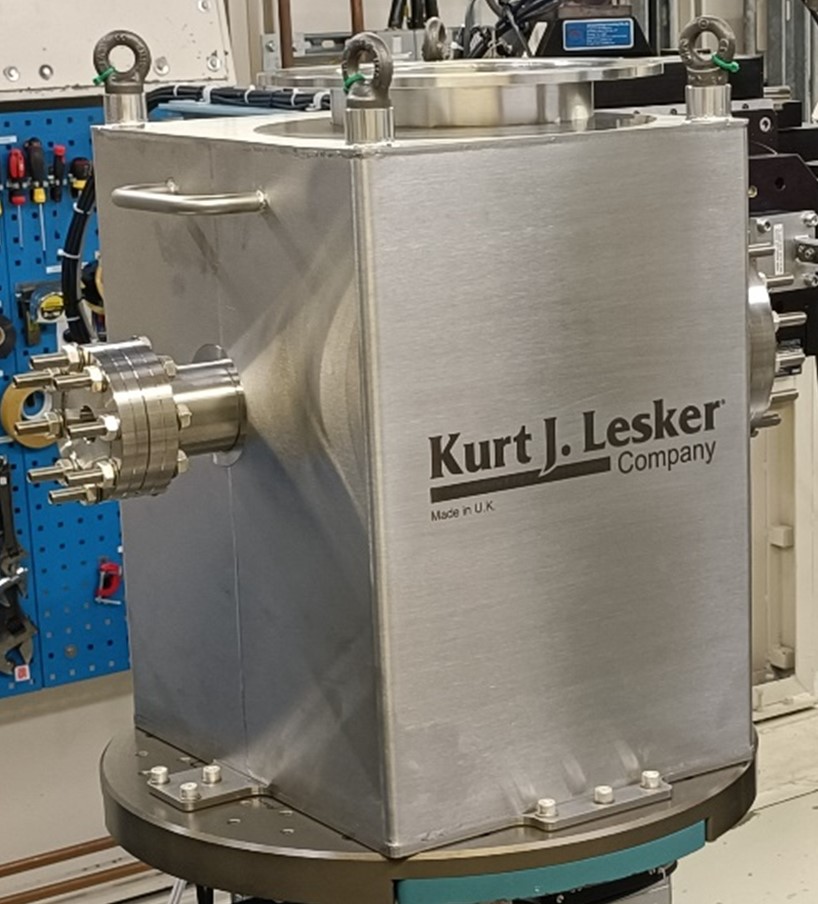
Figure 1: MSR sample tube container for synchrotron XRD.
Method
The sample container used stainless steel construction in accordance with the permissible materials list for MSR samples. Remotely operated, low-offgassing motorised stages were used to position the sample tube and rotate it for spatial averaging. The windows were made out of fused silica, with a 30 mm diameter, 1 mm thick inlet window, and 100 mm diameter, 2 mm thick outlet.
Synchrotron powder XRD measurements were taken at the I12-JEEP beamline at Diamond Light Source. The diffraction methodology was similar to our previous study [3] at I12 in which a basaltic sediment from Þórisjökull, Iceland collected as an MSR analogue through the SAND-E program [4] in just a Ti sample tube analogue was analysed as a feasibility test. The only differences were a 56.59 keV X-ray energy and a 1224.7 mm sample-to-detector distance. Four samples were measured: a solid basalt core from Skye, UK; an Old Red Sandstone core from Pembrokeshire, UK; the Icelandic regolith analogue mentioned previously; and mudstone fragments from Watchet, UK. The last two are official Jezero Crater Mars analogues. Sample analogues inside sample tubes were placed inside the container and diffraction measurements were performed through the windows. An empty tube was also measured as reference.
Semi-quantitative analysis was used to identify the mineral phases present and roughly estimate their quantity, shown for the Icelandic sediment in Fig. 2. Diffraction patterns had the window and tube background subtracted after intensity scaling to enable this analysis as in Adam et al. [3], though this method is imperfect. Rietveld refinement is in progress for more accurate phase quantification.
Results
The expected three constituent minerals, plagioclase, pyroxene, olivine, could still be identified, though with differences in atomic site occupancy for two of the phases (andesine, diopside, and larnite compared to the expected anorthite, diopside, and forsterite). The Figure of Merit of the phase matches was reduced: from 0.792, 0.783, and 0.764 for plagioclase, pyroxene, and olivine respectively, to 0.710, 0.670, and 0.705. Estimated quantity also changed from 42.3%, 34.5% and 23.2%, to 34.5%, 25.9% and 39.6%, respectively, though precise quantification is not expected from this semi-quantitative approach and will come from Rietveld refinement.
Peaks were observed to be broader with the container, increasing overlap and thus reducing identification and quantification accuracy. This also increased the size of the 2-theta regions affected by the sample tube’s Ti diffraction peaks, reducing available angles for sample analysis. A broad amorphous diffraction peak was observed between 2.5 and 3° caused by the fused silica exit window. The entrance window’s diffraction was blocked by the container geometry.
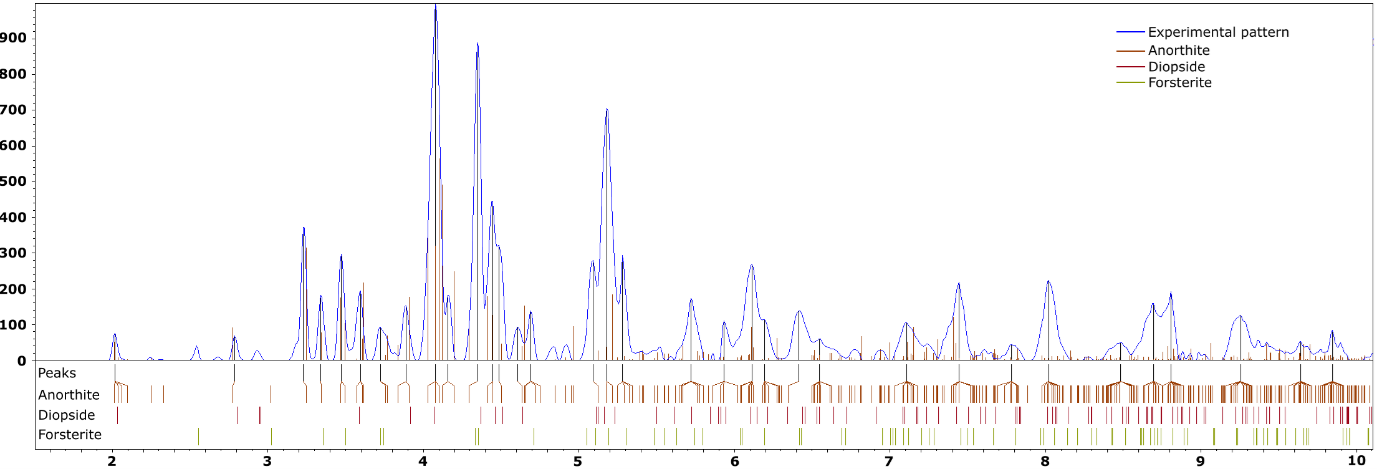
Figure 2: Semi-quantitative phase analysis of the Icelandic basaltic sediment analogue in the sample tube without the container, with the empty titanium tube pattern subtracted.
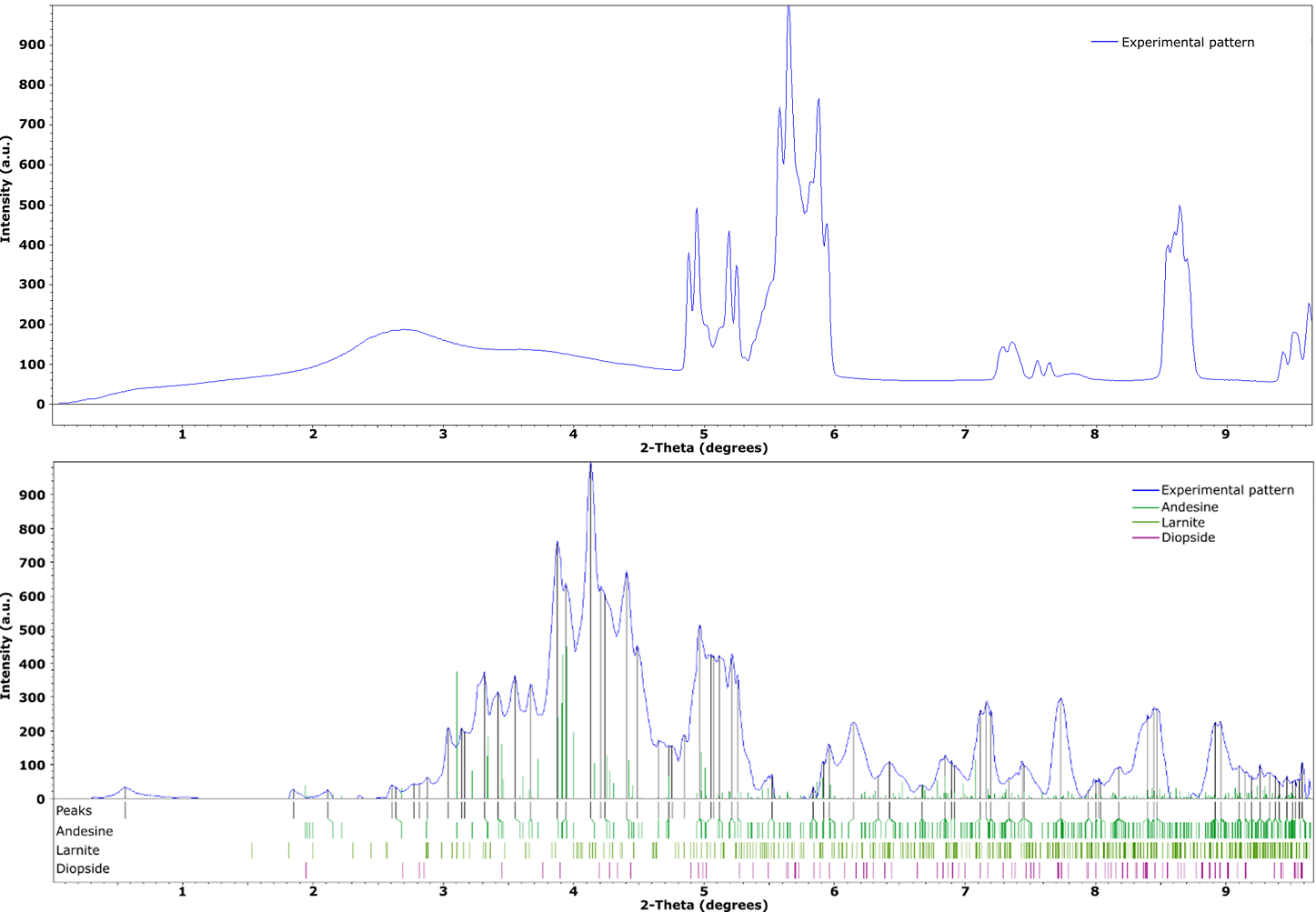
Figure 3: Top: diffraction pattern of the container windows and empty titanium sample tube analogue. Bottom: Semi-quantitative phase analysis of the Icelandic basaltic sediment analogue in the sample tube in the container, with the above pattern subtracted. Note that patterns are not to relative scale.
Conclusions
This work has shown that powder XRD analysis of sealed sample tubes is possible inside of a suitably designed container. However, accuracy is not high, though this needs to be confirmed and quantified through further data analysis. Windows should be kept as thin as is safe to reduce background signal, particularly the exit window which is the primary contributor. Design optimisations to the container can be made that can reduce this through, e.g., positioning the sample closer to the exit window, enabling a reduction in diameter and thus required thickness for the atmosphere pressure differential required for safe containment. Diffraction measurements of the container windows and sample tube were very helpful for data analysis and should be taken for the Sample Receiving Project’s final hardware. While the sample and tube analogues were designed for MSR, much of it can be adapted with relatively little change to samples from other restricted Earth return bodies, or indeed any contamination-sensitive but potentially hazardous or pathogenic sample.
Acknowledgements: This work was funded by UKSA Emerging Technologies grant UKSAG22_0031_ETP2-030. Beamtime on beamline I12 was provided by Diamond Light Source under proposal MG30591. The SAND-E program was supported by NASA PSTAR program #80NSSC18K1519.
Bibliography
[1] UN (2002) UN Treaties & Principles on Outer Space. [2] Tait K.T., et al., Preliminary Planning for Mars Sample Return Curation Activities in a Sample Receiving Facility. Astrobiology, 2022. 22(S1), S-57-S-80. [3] Adam L., Bridges J.C., et al. 2024 Synchrotron X-ray Diffraction for Sealed Mars Sample Return Sample Tubes. Meteorit Planet Sci, 59: 40-54.; [4] Ewing R. et al. (2020) LSPC LI, Abstract #JSC-E-DAA-TN78511.
How to cite: Adam, L., Bridges, J. C., Martindale, A., Holt, J. M. C., Bedford, C. C., Busquets, J. M., White, A. E. L., Zillhardt, T., and McNaughton, T. J.: Synchrotron X-Ray Diffraction of Restricted Earth Return Samples in Containment, EPSC-DPS Joint Meeting 2025, Helsinki, Finland, 7–13 Sep 2025, EPSC-DPS2025-1999, https://doi.org/10.5194/epsc-dps2025-1999, 2025.
Introduction
Melted micrometeorites (i.e. cosmic spherules) have not only been found to be ubiquitous across the Earth’s surface, but also throughout the geological record [1,2]. Several thousands of fossil cosmic spherules have been recovered across the Phanerozoic [3,4], and additionally several tens have been extracted from Archean sediments [5]. Although diagenesis may affect most particles, if recovered in sufficient numbers, selected specimens may display well-preserved textures and geochemical composition, which may also be applicable to their oxygen (O-)isotopic composition. This is particularly interesting as the O-isotopic composition is expected to reflect that of their parent bodies and the terrestrial atmosphere at the time of flash heating, the latter applying particularly to metal-rich (I-)type cosmic spherules [6,7]. As such, pristine fossil cosmic spherules represent windows into the history of dust-producing events in the inner Solar System and may record the oxidative capacity of Earth’s paleoatmospheres. However, a quantitative and non-destructive measure to determine the degree of terrestrial alteration applied to (fossil) micrometeorites is currently lacking. This work evaluates the potential of micro-Raman spectroscopy as an effective tool to assess terrestrial alteration in fossil cosmic spherules (particularly I-types) and the potential to uncover pristine samples without destructive analysis.
Samples and Method
Fossil cosmic spherules in this work are from the collections available at the AMGC/VUB, including samples from the Chanxhe outcrop (Belgium) of late-Devonian limestone [8]. A LabRAM HR Evolution (HORIBA Scientific) confocal spectrometer is used to obtain micro-Raman spectra (laser wavelength: λ=532 nm, spot size 1-2 µm, objective: x50LWD) of the spherule exteriors. For the purpose of bulk representativity, a minimum of twelve individual spectra have been measured for each spherule. Furthermore, to avoid the artificial production of hematite during acquisition [9], the laser was operating at 10% of its maximum intensity (meaning at 2.4 mW). Each individual spectrum is the combination of two sets of 1-minute measurements. The grading was of 600 gr/mm, implying a spectral resolution of around 2 cm-1.
First Results and Discussion
Preliminary results based on four I-type fossil cosmic spherules from the Chanxhe outcrop are presented in Fig. 1. We observe that innate iron oxide signatures (as seen in modern I-type cosmic spherules) generally coexist, or are overridden, by bands that (at least) partially resemble hematite. The presence of hematite in fossil cosmic spherules would be consistent with previous SEM studies (e.g. [10]) and is interpreted to reflect replacing primary iron oxides through weathering [11]. However, despite all four samples originating from the same outcrop, the degree of hematite(-like) replacement is highly variable. While certain samples only contain spectral signatures of hematite(-like) (i.e. #3 and #4), cosmic spherule #1 is spectrally indifferent from moderately-weathered modern Antarctic samples. These results imply that #1 may be relatively well-preserved, although additional spectra on the sectioned interior and SEM-EDS analysis are still required to confirm or infirm these interpretations. Through the analysis of these first results, it appears that the average relative intensity of the hematite(-like) (e.g. 1290-cm1-band) versus the primary iron-oxide (e.g. 660-670 cm-1) bands may be a potentially useful metric in assessing weathering in fossil (I-type) cosmic spherules. Further developments on a larger sample size will be presented during the conference.
Conclusion
In addition to being non-destructive, Raman spectroscopy provides quantitative means of evaluating terrestrial weathering in fossil cosmic spherules, including the identification of potentially pristine samples. This novel methodology may thus prove useful in tracing pristine particles that may aid in refining the dynamics of the ancient Solar System and/or Earth’s paleoclimate.
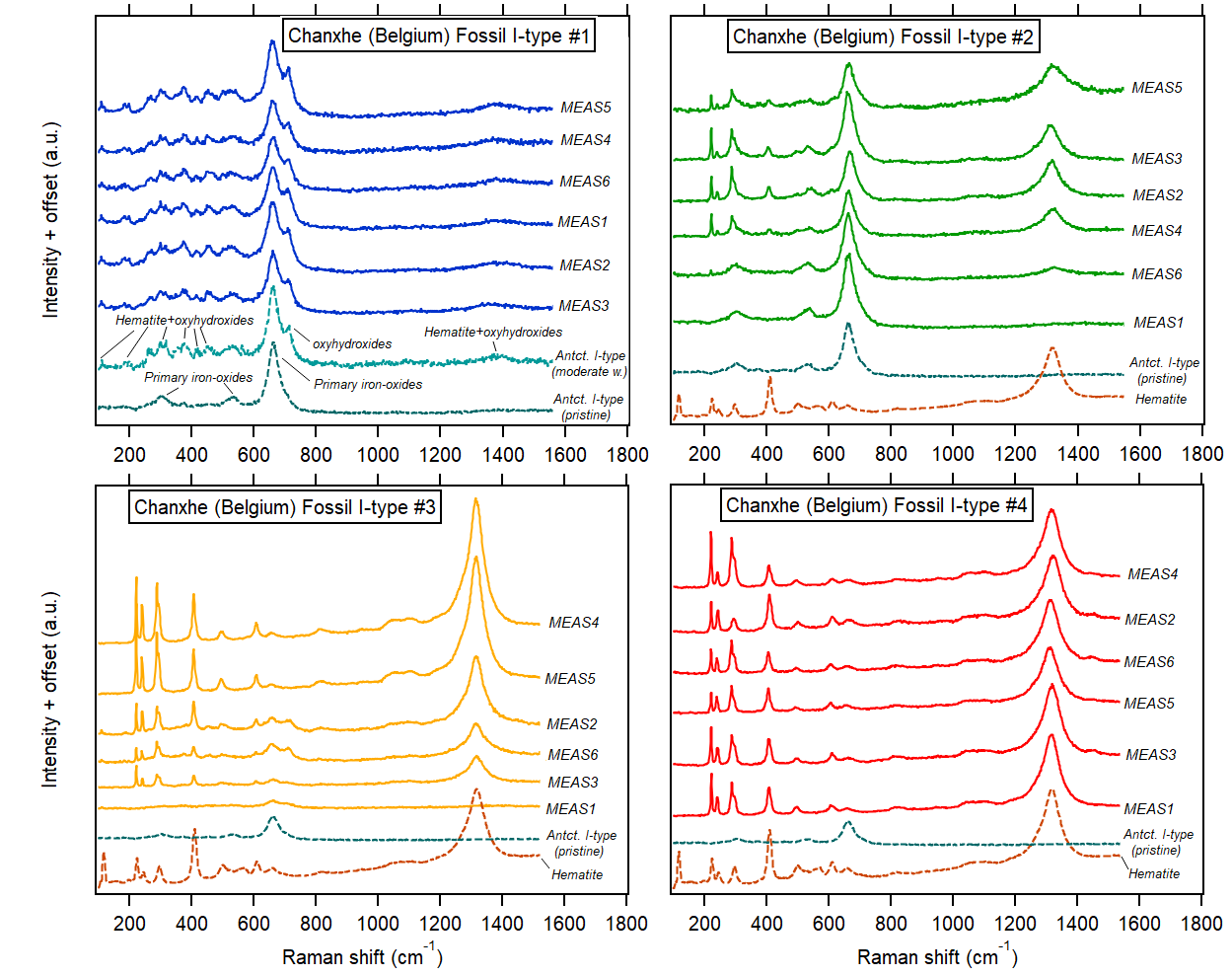
Fig. 1: Compilation of micro-Raman spectra obtained of four fossil I-type cosmic spherules from the late-Devonian Chanxhe (Belgium) collection [8] compared to two modern Antarctic I-types (one pristine and another moderately weathered), plus hematite. “Fossil I-type #1” may potentially be a relatively well-preserved sample based on its spectral similarity with modern Antarctic micrometeorites (e.g. weak hematite/oxyhydroxide-like bands). Note that although Antarctic I-types commonly display spectral evidence of weathering (hematite and/or oxyhydroxides), these bands tend to be significantly weaker than observed in our fossil samples (particularly hematite, as notably seen in Fossil I-types #3 and #4). The Antarctic spherules are from the collections available at the AMGC/VUB and were measured as part of this work. The hematite spectrum was extracted from the RRUFF database (ID: R040024.3). Offset was added for the purpose of clarity.
References
[1] Taylor, S., & Brownlee, D. E. 1991. Meteoritics 26(3):203–211.
[2] Suttle, M. D., & Genge, M. J. 2017. Earth and Planetary Science Letters 476:132–142.
[3] Mutch, T. A. 1964. Annals of the New York Academy of Sciences 119:166–185.
[4] Krämer Ruggiu, L., et al. 2022. 85th Annual Meeting of the Meteoritical Society [Abstract].
[5] Tomkins, A., et al. 2016. Nature 533:235–238.
[6] Pack, A., et al. 2017. Nature communications 8(1):15702.
[7] Fischer, M. B., et al. 2021. Paleoceanography and Paleoclimatology 36(3):e2020PA004159.
[8] Krämer Ruggiu, L., et al. 2025. (This conference).
[9] Jubb, A.M., & Allen, H.C. 2010. ACS Appl. Mater. Interfaces 2:2804–2812.
[10] Onoue, T., et al. 2011. Geology 39(6):567–570.
[11] Suttle, M. D., & Genge, M. J. 2017. 80th Annual Meeting of the Meteoritical Society [Abstract].
How to cite: Prestgard, T., Krämer Ruggiu, L., Binu Beena, D., Jonckheere, F., Pesola, J., Zelinsky, C., Boschi, S., Thiemens, M., Baert, K., and Goderis, S.: Raman Spectroscopy as a Tool to Study the Preservation of Cosmic Spherules in the Geological Record, EPSC-DPS Joint Meeting 2025, Helsinki, Finland, 7–13 Sep 2025, EPSC-DPS2025-1396, https://doi.org/10.5194/epsc-dps2025-1396, 2025.
Introduction
Sample return missions provide the ultimate ground truth to better understand and interpret remote sensing data and enable a far more detailed analysis of extraterrestrial material than is possible via in-situ methods. Through technological advances in recent decades it is now possible to bring samples back from small bodies. Successful sample return missions have been carried out for the asteroids Itokawa and Ryugu (Hayabusa 1 [1] and 2 [2]), and most recently Bennu (OSIRIS-REx [3]). The Martian Moons eXploration (MMX) mission [4] aims to bring back samples from Phobos in 2031, and samples from Mars itself could be reality in the near future [5]. Sample return is a growing field of research and there is increased need for laboratory facilities capable of analyzing these small and sensitive samples. In response to this the Sample Analysis Laboratory (SAL) is being constructed at the German Aerospace Center in Berlin. SAL builds on the existing [6] Planetary Spectroscopy Laboratory (PSL) at the DLR Berlin, which offers facilities for spectral and micro-spectral characterisation of samples from the UV/visible to mid-infrared wavelength range, as well as analysis with Raman spectroscopy and digital 3D microscopy. In addition, the capabilities of the current sample preparation laboratory [7] are being extended to support the new instrumentation.
The goal of SAL is to provide a comprehensive range of instrumentation for structural, geochemical, mineralogical and elemental analysis at one location in a clean room environment for the analysis of extraterrestrial material in the form of returned samples and meteorites, allowing efficient analysis with a minimal disturbance to sensitive material. The long term aim of SAL is to establish a European center for extraterrestrial sample curation and analysis in Berlin in close cooperation with the Museum für Naturkunde (MfN).
SAL setup and instruments
The SAL facility consists of 80 m2 of clean room space on the ground floor of the DLR Institute of Space Research (former Institute of Planetary Research) in Berlin. Underneath the clean room is a technical room where vacuum pumps, cooling systems, and power and gas supplies will be housed, reducing contamination sources in the clean room, as well as improving the working environment. Three major new analytical instruments have been purchased for SAL: a JEOL iHP200F Field Emission Electron Microprobe Analyzer (FE-EMPA), a JEOL JSM-IT800 Field Emission Scanning Electron Microscope (FEG-SEM) and a Malvern Panalytical Empyrean X-ray Diffraction (XRD) system, shown in Figure 1a), b) and c) respectively. In addition to these a Brucker Hyperion 2000 FTIR microscope, interfaced with an existing Brucker Vertex 80V spectrometer and a Keyence VHX-7000 3D microscope (Figure 1d) and e)) have been acquired.
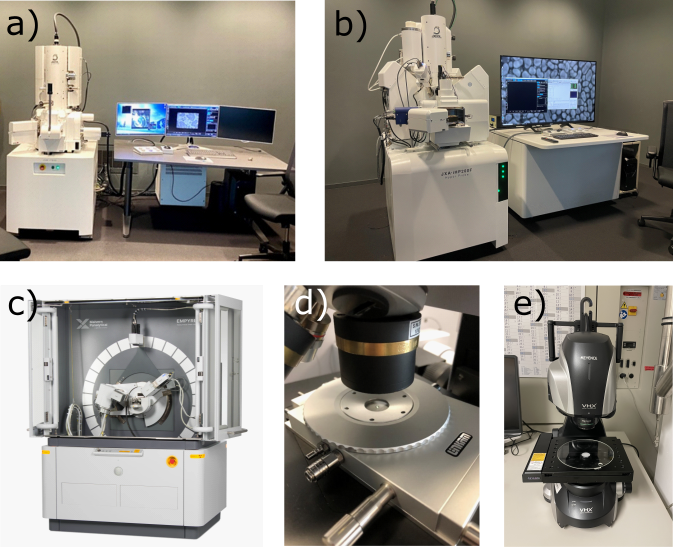
Figure 1. a). JEOL FEG-SEM. b). JEOL FE-EMPA. c). Malvern Panalytical XRD. d) Brucker FTIR microscope. e) Keyence digital 3D microscope.
The FE-EMPA is equipped with 5 wavelength dispersive x-ray spectrometers (WDS) with the interchangeable crystals TAPL/J, LDE1L/2, PETL/J/H and LIF/L/H, enabling a comprehensive coverage of elements and increased flexibility and efficiency in elemental mapping. In addition, it has an energy dispersive x-ray spectrometer (EDS) for rapid mapping and identification of target areas. The SEM is equipped with an EDS detector for rapid compositional mapping of samples. An additional backscattered electron (BSE) detector enables detailed topographical measurements. The XRD has Bragg-Brentano geometry, which can be switched to parallel beam geometry, and a Cu kα source with a 1Der detector. The sample form is flexible, from powders to larger solid objects. Localised µ-XRD analyses can be performed by reducing the beam spot size down to 140µm. All three devices have dedicated sealed transport vessels allowing sample transfer from the glovebox environment to the instruments under a controlled atmosphere. Two glove boxes will be acquired, for sample storage and for sample manipulation. Both glove boxes will be N2-purged and have an ISO 5 particle contamination requirement with active O2 and H2O monitoring. Vacuum compatible surface requirements and materials will be used to reduce contamination sources. Each glove box will have space for up to two users and will be equipped with a viewing port for sample documentation with a camera or microscope. The layout of the instruments and gloveboxes in the laboratory is shown in Figure 2.
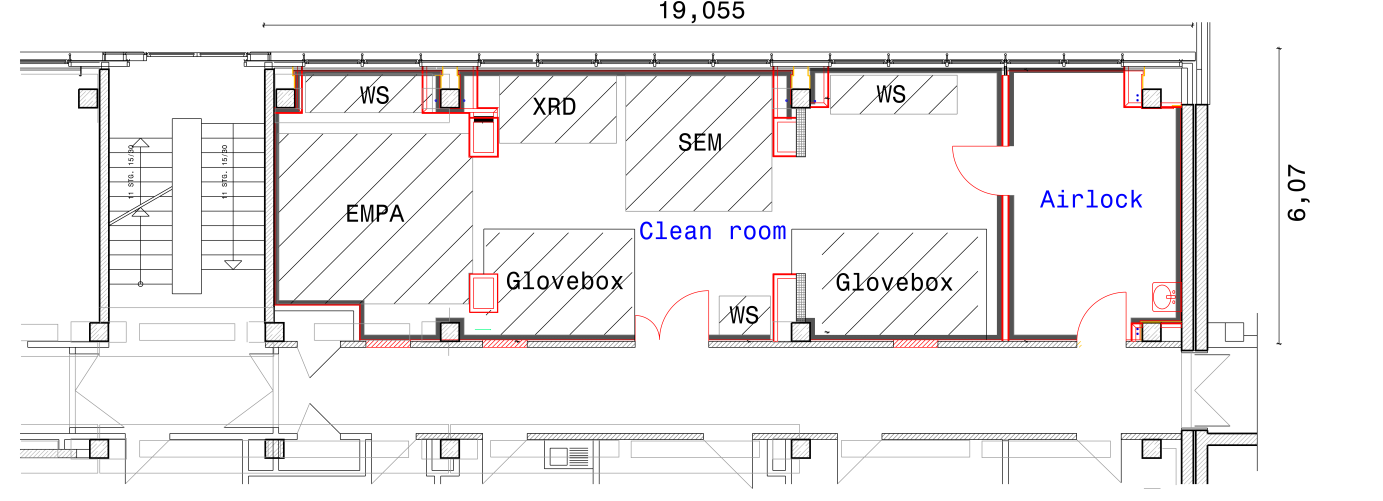
Figure 2. The layout of the Sample Analysis Laboratory with key instruments indicated. Hatched areas represent the service space requirement for the instruments, not the instrument footprints.
Outlook
The current status (as of April 2025) of the construction site is shown in Figure 3. In the coming months the new floor and the air purification system will be installed. The SAL clean room is due to be finished in September 2025. Following this there will be a phase of instrument installation and comissioning before SAL is fully functioning in spring 2026.
Figure 3 The current status of the building SAL progress (April 2025). The rooms have been stripped back, the partitioning wall has been removed, the necessary reinforcements and openings for the air purification system have been made, and the openings for conduits for the technical supplies have been made.
As well as providing a center for sample analysis SAL aims to be a European center for extraterrestrial sample curation. To achieve, we are working in close collaboration with the Museum für Naturkunde (MfN) in Berlin as well as with partners at NASA and JAXA to develop curatorial knowledge and procedures with the mid-term aim of receiving MMX returned samples in 2031.
References
[1] A. Tsuchiyama et al. (2011) Science 333, 1125-1128, 10.1126/science.1207807. [2] T. Nakamura et al. (2023) Science 379, abn8671, 10.1126/science.abn8671. [3] D.S. Lauretta, et al. (2017) Space Sci Rev 212, 925–984. https://doi.org/10.1007/s11214-017-0405-1 [4] K. Kuramoto et al. (2022) Earth, Planets and Space, 74, 12. 10.1186/s40623-021-01545-7 [5] B. K. Muirhead et al. (2020) Acta Astronautica, vol. 176, pp. 131–138, doi: 10.1016/j.actaastro.2020.06.026. [6] J. Helbert et al. (2023) LPI Contributions, 2806, 1989. [7] J. Helbert et al. (2024) SPIE13144, https://doi.org/10.1117/12.3027601
How to cite: Garland, S., Helbert, J., Maturilli, A., Van den Neucker, A., Bonato, E., Hamann, C., Greshake, A., Alemanno, G., Hecht, L., Adeli, S., Büttner, I., and Rauer, H.: The Sample Analysis Laboratory (SAL) at the German Aerospace Center (DLR) Berlin - a cutting edge laboratory for extraterrestrial material analysis, EPSC-DPS Joint Meeting 2025, Helsinki, Finland, 7–13 Sep 2025, EPSC-DPS2025-981, https://doi.org/10.5194/epsc-dps2025-981, 2025.
Introduction
The conceptual development of a Ceres Sample Return mission has intensified interest in the detailed topographic characterization of Occator Crater, a 92 km-wide impact crater on dwarf planet Ceres. This geologically young [1,2] crater hosts carbon-rich bright deposits [3,4,5] - Cerealia Facula and Vinalia Faculae - that are surface expressions of cryovolcanic processes linked to a ~40–50 km-deep brine reservoir [6,7]. These deposits contain a unique combination of sodium carbonates, ammonium chloride, and other hydrated salts [3,4,5] that were only recently exposed to the surface [2,3,8] and may preserve a record of past subsurface aqueous activity. Several Ceres landing site assessments [9] and mission concepts [10] have already considered Occator, with particular attention on these bright faculae as scientifically compelling targets. The success of such missions will depend on accurate, high-resolution Digital Terrain Models (DTMs) to enable safe landing, mobility, and efficient surface operations.
Figure 1. Pan-sharpened RGB orthomisaic of Cerealia Facula [2].
Background
To support ongoing and future mission development efforts, we present a new set of high-resolution DTMs of Occator Crater and its interior faculae [11]. These were generated using stereophotogrammetric (SPG) and multi-view shape-from-shading (SfS) techniques applied to Dawn Framing Camera [12] (FC) data from multiple mission phases. The datasets include global coverage from the High and Low Altitude Mapping Orbit (HAMO, LAMO), as well as extremely high-resolution data from the highly elliptical XMO7 orbit acquired during Dawn’s second extended mission (XM2). This multitemporal, multi-geometry coverage forms the basis for precise terrain modeling at multiple spatial scales.
Methodology
Our initial DTM products were derived using the USGS ISIS and NASA's ASP [13,14], generating terrain models at Ground Sample Distances (GSDs) of up to 17 m. The workflow incorporated radiometric correction, photometric normalization using Hapke parameters tailored to Ceres’ surface [15], manual tie-point generation for improved co-registration, bundle adjustment [16], and a careful exclusion of over-exposed images covering the faculae.
Results
An important component of our study involved evaluating published DTMs of Occator Crater, including those produced by DLR [17] and JPL [18]. Our comparison demonstrated significant differences in effective resolution, vertical offsets, and absolute elevation, especially in the complex terrains of Cerealia and Vinalia Faculae. These findings underline the need for further investigation into the sources of these discrepancies, particularly with regard to co-registration accuracy, bundle adjustment stability, and the impact of surface albedo variations on photoclinometry. Our improved terrain models, are suitable for detailed analyses of surface slopes and terrain roughness - key parameters in landing site certification and mobility planning. As illustrated in Figures 2 and 3, Cerealia Facula exhibits highly variable slopes, with regions on and near Cerealia Tholus exceeding 30°, as well as rugged, fractured terrains that pose potential hazards. Only few regions of the surface exhibits slopes <10°, which is considered acceptable for many landing systems. Vinalia Faculae shows broader, flatter regions (<10° slope) with lower local slope variation, though terrain roughness remains a factor at decameter scales. These observations suggest that while scientifically attractive, the faculae present both opportunities and challenges for safe landing and sampling.
Figure 2. Overview of the location of the topographic profile across Cerealia Tholus.
Figure 3. Topographic profiles across Cerealia Tholus of currently published and archived DTMs.
Foresight
To overcome the limitations of our current DTM generation process and further improve terrain fidelity, we are actively developing a new, more robust processing pipeline. This updated approach is based on an iterative co-registration strategy that incorporates all available image data during each refinement stage. Rather than producing separate DTMs for each mission phase, our method begins with a coarse SPG model at HAMO GSD and progressively incorporates higher-resolution data in successive co-registration and DTM generation steps. This will help minimize vertical mismatches between datasets and enable consistent resolution enhancement.
In addition, we plan to expand our SPG processing to include images acquired through the Dawn FC’s narrow-band filters. Preliminary tests show that incorporating these images substantially increases 3D-point density, particularly in areas where clear filter coverage is limited.
While the DTMs presented in this study already provide valuable insight into Occator's topography, particularly for scientific interpretation and regional context, they should not be considered final for engineering use in sample return mission planning. Further refinement is underway to resolve discrepancies between independent datasets, improve the vertical coherence across resolution levels, and produce terrain models optimized for operational robustness. These improvements will be essential for deriving high-fidelity hazard maps, supporting precision landing simulations, and developing terrain-relative navigation solutions.
Ultimately, our efforts contribute to building the necessary geospatial infrastructure to support in-situ exploration of Ceres. The topographic products currently in development will provide a consistent, high-resolution foundation. As the planning and definition of a Ceres Sample Return mission continues to advance, our ongoing work will play a central role in providing the detailed surface context required for mission architecture design, risk mitigation, and the successful return of brine-related samples from one of the most intriguing astrobiological targets in the Solar System.
Bibliography
[1] Neesemann et al. 2019. Icarus 320. [2] Neesemann et al. (2025). Icarus (in review) [3] De Sanctis et al. 2020. Nature Astronomy 4. [4] De Sanctis et al. 2020. Space Science Reviews 216. [5] De Sanctis et al. 2016. Nature 536. [6] Raymond et al. 2020. Nature Astronomy 4. [7] Scully et al. 2020. Nature Communications 11. [8] Nathues et al. 2020. Nature Astronomy 4. [9] Scully et al. 2021. Planetary Science Journal 2. [10] Castillo-Rogez et al. 2022. Planetary Science Journal 3. [11] Neesemann et al. 2025. Remote Sensing 17. [12] Sierks et al. 2011. Space Science Reviews 163. [13] Beyer et al. 2018. Earth and Space Science 5. [14] Alexandrov et al. 2018. Earth and Space Science 5. [15] Li et al. 2019. Icarus 322. [16] Edmunson et al. 2012. ISPRS Annals of the Photogrammetry, Remote Sensing and Spatial Information Sciences 1. [17] Preusker et al. 2016. LPSC 47. [18] Park et al. 2019. Icarus 319.
How to cite: Neesemann, A., Scully, J., Castillo-Rogez, J., Ermakov, A., Park, R., Raymond, C., van Gasselt, S., Jaumann, R., Walter, S., and Postberg, F.: Ceres Landing Site Planning - Requirements for DTMs and Current Status, EPSC-DPS Joint Meeting 2025, Helsinki, Finland, 7–13 Sep 2025, EPSC-DPS2025-1621, https://doi.org/10.5194/epsc-dps2025-1621, 2025.
We report on the mission design and the target selection for the PRIAMOS (PRImordial Asteroid Mission to understand the Origin of the Solar system) mission to a D-type asteroid in a near Earth orbit [1]. PRIAMOS consists of a lander/return capsule "Asteroid Probe Operations, Sampling, and Sample Return Module" or APOSSUM, as a head unit and a transfer stage "Injection and Payload Carrier Module" (IPCM) that will inject the spacecraft into the asteroid orbit and which also carries instruments for the characterisation of the asteroid. The APOSSUM will sample the surface of the asteroid and will return to Earth after about three month at the asteroid without IPCM and will release its reentry capsule, which is planned to land in Australia.
Based on ESA’s M8 mission call framework, the mission aims for an asteroid that is reachable with the Ariane 64 as launcher. The mission is supposed to be concluded within a time frame of less than two years after launch. This limits the possible targets to Near Earth Asteroids (NEA). Three Asteroids are being considered at this point, with one as a designated first choice: 2009CV, a D-type asteroid in an Apollo orbit [2,3]. The search for further possible targets is ongoing.
For 2009CV we present a timeline of launch, possible trajectories and return to Earth as shown in Figure 1. Further, we discuss the different options for transfer trajectories and alternative targets.
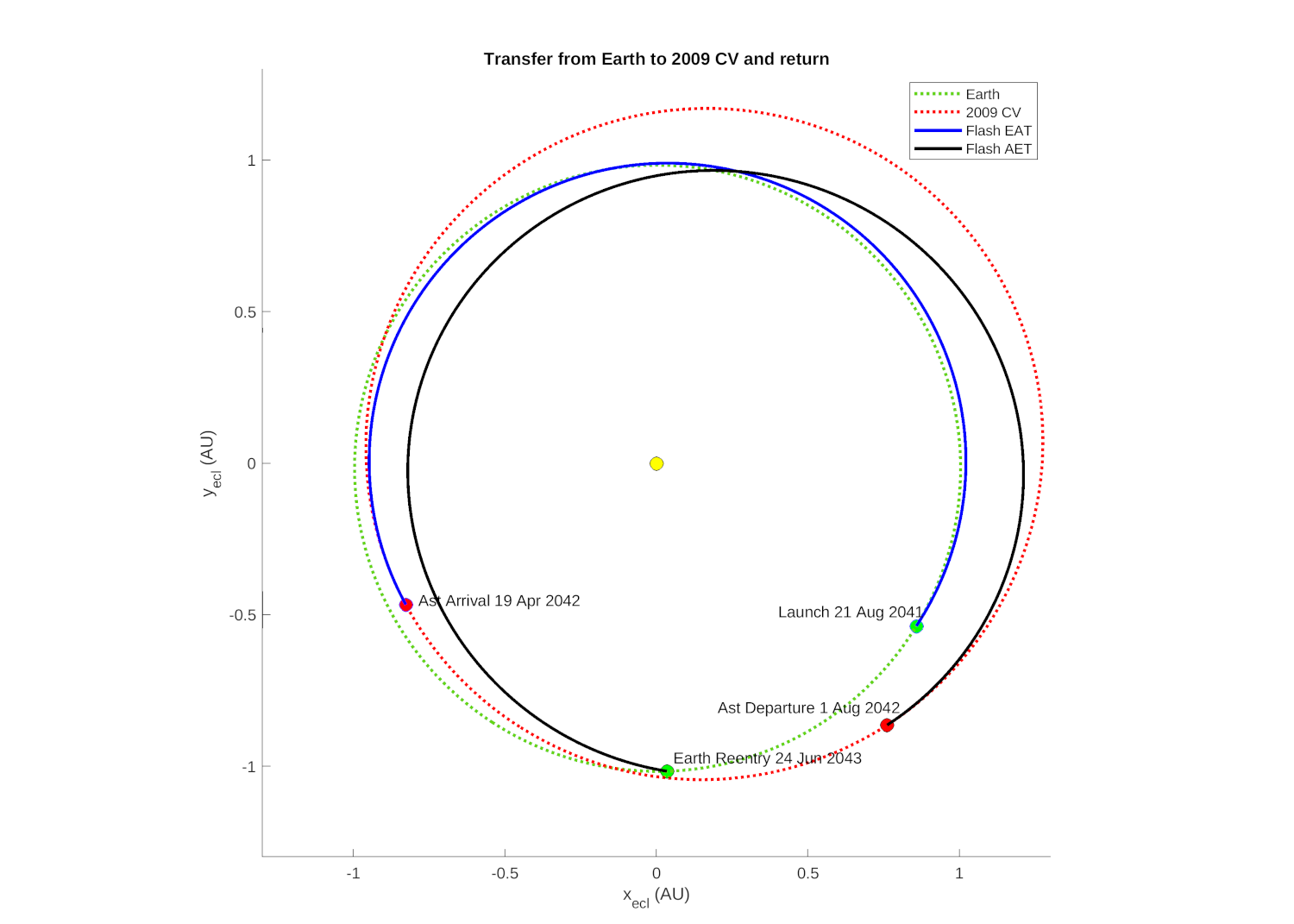
Figure 1: Transfer of PRIAMOS between Earth and 2009CV and back.
[1] Kleine et al., this conference, 2025.
[2] M. A. Barucci u. a., „Small D-type asteroids in the NEO population: new targets for space missions“, Monthly Notices of the Royal Astronomical Society, Bd. 476, Nr. 4, S. 4481–4487, Juni 2018, doi: 10.1093/mnras/sty532.
[3] https://neo.ssa.esa.int/search-for-asteroids?tab=physprops&des=2009CV
How to cite: Stenzel, O., Kleine, T., Hilchenbach, M., Hallmann, M., Herberhold, M., Renggli, C., Ho, T.-M., Grundmann, J., and Krupp, N.: Mission Design and Target Selection for PRIAMOS, a European Asteroid Sample Return Mission, EPSC-DPS Joint Meeting 2025, Helsinki, Finland, 7–13 Sep 2025, EPSC-DPS2025-1677, https://doi.org/10.5194/epsc-dps2025-1677, 2025.
PDS4 for planetary missions
Planetary data acquired by flight and landed missions scientific instruments are currently archived in several planetary science archives, such as the ESA Planetary Science Archive, or the NASA PDS, following the Planetary Data System (PDS) standard. In PDS version 4 (PDS4), a product consists in zero to many data files and a PDS4 label (XML or LBLX) capturing the metadata attributes of the product. Those metadata attributes are critical to identify PDS4 products, associate products to specific missions, instruments, time of data acquisition, targets, and fully describe the data and document object(s) properties. The PDS4 standard allows to open data products easily, which can be archived in many possible data formats (ASCII, binary, FITS, CDF, …) and structures (tables, images, cubes, …), using a standard PDS4 data reader.
PDS4 dictionaries usage
While common metadata attributes are part of the PDS4 core information model, so-called PDS4 “discipline”, “mission” or “instrument” local data dictionaries extend the capabilities of the core information model and capture the specifics of the data products. In particular, discipline and instrument dictionaries usually cover a wide flavour of very specific attributes and classes dealing with e.g. imaging instrument settings (Imaging dictionary), spectral measurement techniques (Spectral and Spectral Library dictionaries), observing geometries (Geometry dictionary). Instruments onboard classical flight and landed missions easily make use of these dictionaries. Data acquired on collected samples with specific on-ground instrumentation in dedicated facilities are however very diverse and may not fit all within the scope of the existing discipline dictionaries.
Archiving sample science data in PDS4 format
With the increase of planetary sample return missions, the need to better support the PDS4 archiving for returned sample data arise. In the framework of the Analogue Sample Library project, we are acquiring and archiving data and documentation on terrestrial analogue samples of planetary bodies collected on the field. The data products generated encompass sample description and classification, catalogues, field reports, chemical testing, strength testing, X-ray diffraction (XRD), X-ray Computed Tomography (XCT), and many others. These many data sets are usually recorded in very diverse formats (proprietary and non-proprietary). As a first step, we are currently migrating the data products into PDS4-compliant formats (CSV tables and binary cubes). Instruments, facilities, samples and investigations are being registered in PDS4 to fill the products metadata. New PDS4 dictionaries better suited for sample science products are being designed, in order to capture the sample material high-level properties and geological context. New attributes are being identified to capture metadata at product level related to the new types of measurements performed on the samples. We will present the status of project.
How to cite: Cornet, T., Ciocco, M., Krzesinska, A., Mikesell, D., Kydland Lysdahl, A., Kminek, G., and Sefton-Nash, E.: Archiving sample science data in PDS4: Challenges and solutions, EPSC-DPS Joint Meeting 2025, Helsinki, Finland, 7–13 Sep 2025, EPSC-DPS2025-1813, https://doi.org/10.5194/epsc-dps2025-1813, 2025.
Please decide on your access
Please use the buttons below to download the supplementary material or to visit the external website where the presentation is linked. Regarding the external link, please note that Copernicus Meetings cannot accept any liability for the content and the website you will visit.
Forward to presentation link
You are going to open an external link to the presentation as indicated by the authors. Copernicus Meetings cannot accept any liability for the content and the website you will visit.
We are sorry, but presentations are only available for users who registered for the conference. Thank you.
Please decide on your access
Please use the buttons below to download the supplementary material or to visit the external website where the presentation is linked. Regarding the external link, please note that Copernicus Meetings cannot accept any liability for the content and the website you will visit.
Forward to session asset
You are going to open an external link to the asset as indicated by the session. Copernicus Meetings cannot accept any liability for the content and the website you will visit.
We are sorry, but presentations are only available for users who registered for the conference. Thank you.