
 1,1,
1,1,- 1University of Belgrade, Faculty of Mathematics, Department of Astronomy, Serbia (dusan.marceta@matf.bg.ac.rs)
- 2Astronomical Observatory Belgrade, Serbia
Context
Recently, several asteroids with super-fast rotation rates, ranging from just 10 seconds to a few minutes, have been observed to exhibit significant drift in their semi-major axes, potentially caused by the Yarkovsky effect. Standard analytical models of the Yarkovsky effect suggest that these objects must possess extremely low thermal inertia to produce such strong orbital drift under rapid rotations. However, such low thermal inertia implies specific structural characteristics, such as a fine regolith layer and/or a highly porous internal structure, both of which are challenging to sustain under the intense inertial stresses caused by their extreme rotational rates.
The strong Yarkovsky effect observed under extremely fast rotation can seem counterintuitive. Since existing analytical models of the Yarkovsky effect rely on various assumptions, their applicability to cases of extremely fast rotation, where some of these assumptions may no longer hold, becomes questionable. We aim to evaluate the validity of the analytical models in such scenarios and to determine whether the observed drift in the semi-major axis of rapidly rotating asteroids can be explained by the Yarkovsky effect.
Methods and Model Validation
To test the analytical model’s validity under fast spins, we developed an open-source numerical model of the Yarkovsky effect, tailored to address cases of super-fast rotation. Given that extremely low thermal inertia effectively forms an insulating surface layer, where thermal wave penetration depths can be on the order of microns, the model is designed to deliver high-resolution calculations in both depth and time. This allows for precise modeling of steep spatial and temporal temperature gradients on and beneath the asteroid's surface, which is essential for accurately computing the Yarkovsky drift in scenarios involving super-fast rotation.
Figure 1 presents a comparison of the Yarkovsky drift computed using our numerical model and a standard analytical model for a fictitious asteroid on a circular orbit (R = 10 m, ρ = 1000 kg/m3, Cp = 1000 J/(kgK), a = 1 au), considering three values of thermal conductivity k and rotation periods ranging from 10 seconds to 2 hours. A comparison between our numerical model and the analytical model shows very good agreement, confirming that the observed semi-major axis drift can be attributed to extremely low thermal inertia.
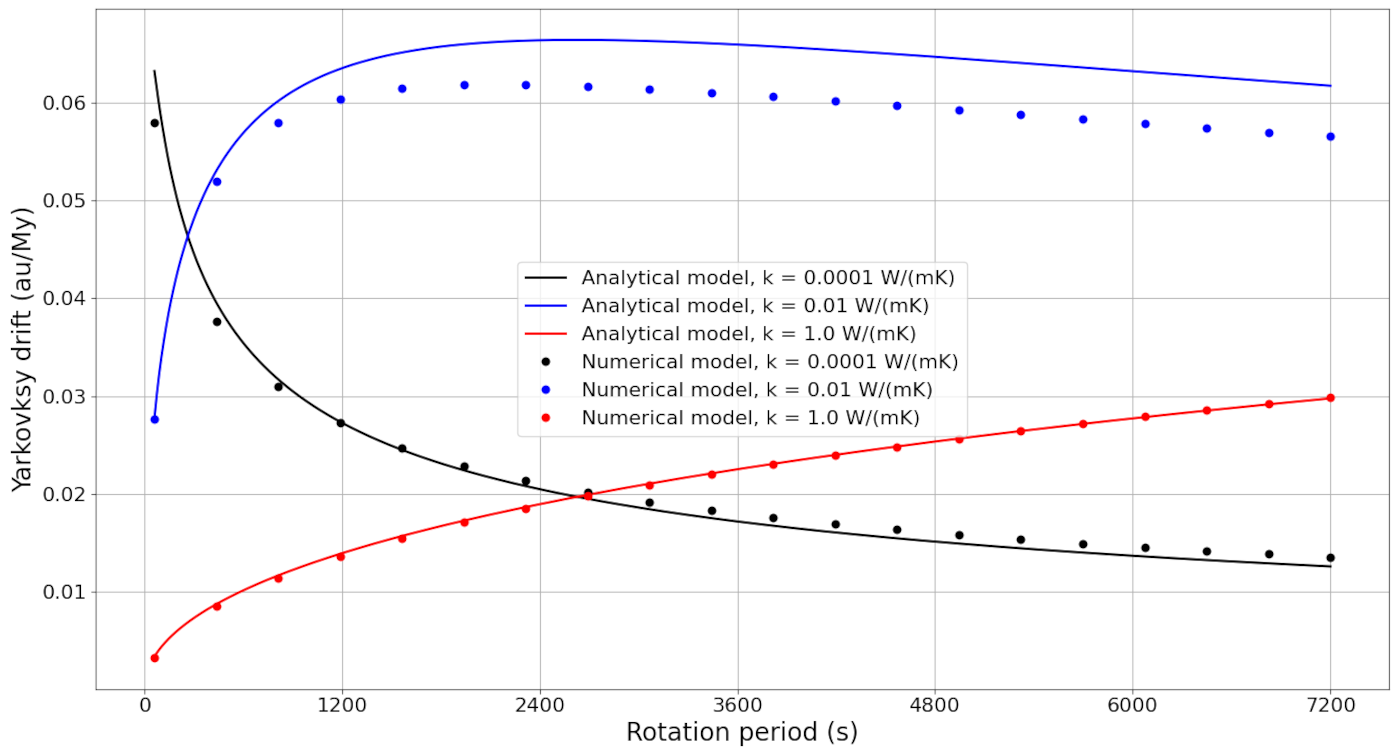
Figure 1: Comparison of Yarkovsky drift computed using the numerical and standard analytical model (Vokrouhlický 1998, 1999)
Results
As an illustrative example, we present the thermal characteristics of the super-fast rotating near-Earth asteroid 2016 GE1, for which a rotation period of approximately 34 seconds has been measured.
The analysis assumes the following nominal parameters: a= 2.06 au, e = 0.52, D = 14 m, ρ = 2500 kg/m3, Cp = 1000 J/(kg K), and a spin axis orthogonal to the orbital plane. JPL reports a relatively large semi-major axis drift of da/dt = 0.058 au/My.
Figure 2 illustrates the resulting extreme temperature gradient with depth, showing variations of several tens of degrees within a fraction of a millimeter beneath the surface.
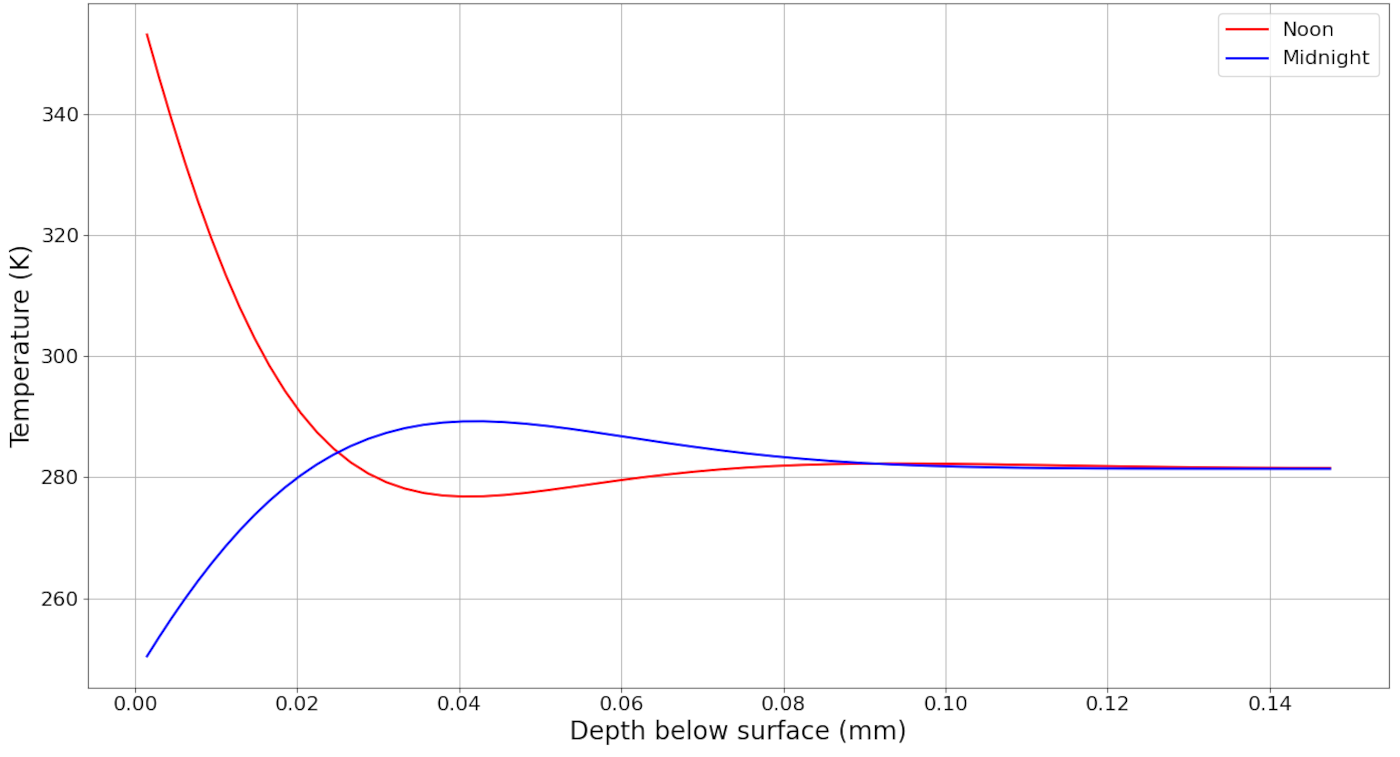
Figure 2: Temperature variation with depth beneath the surface of asteroid 2016 GE1
As a consequence of the steep subsurface temperature gradients, we observe a pronounced diurnal temperature variation, despite the extremely rapid rotation. Figure 3 shows the diurnal temperature cycle at the equator, both at perihelion and aphelion.
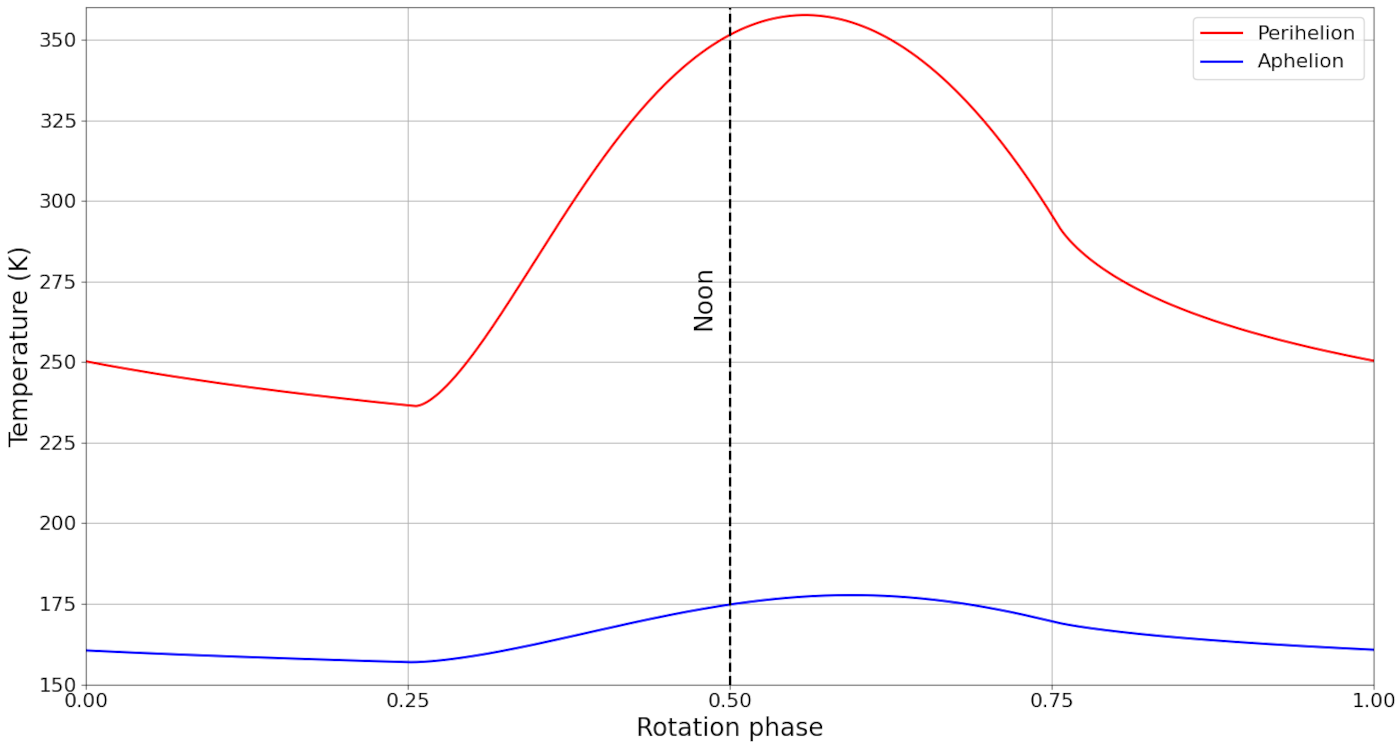
Figure 3: Diurnal temperature variation at the equator of 2016 GE1
A significant difference is evident between these two orbital positions, resulting in the Yarkovsky drift being predominantly generated near perihelion, as illustrated in Figure 4, which shows that the drift near perihelion is an order of magnitude greater than at aphelion. Given that low thermal conductivity plays a crucial role in the Yarkovsky drift of super-fast rotators, this highlights the importance of modeling the thermal properties of asteroids as a function of heliocentric distance in order to obtain realistic estimates of the drift.
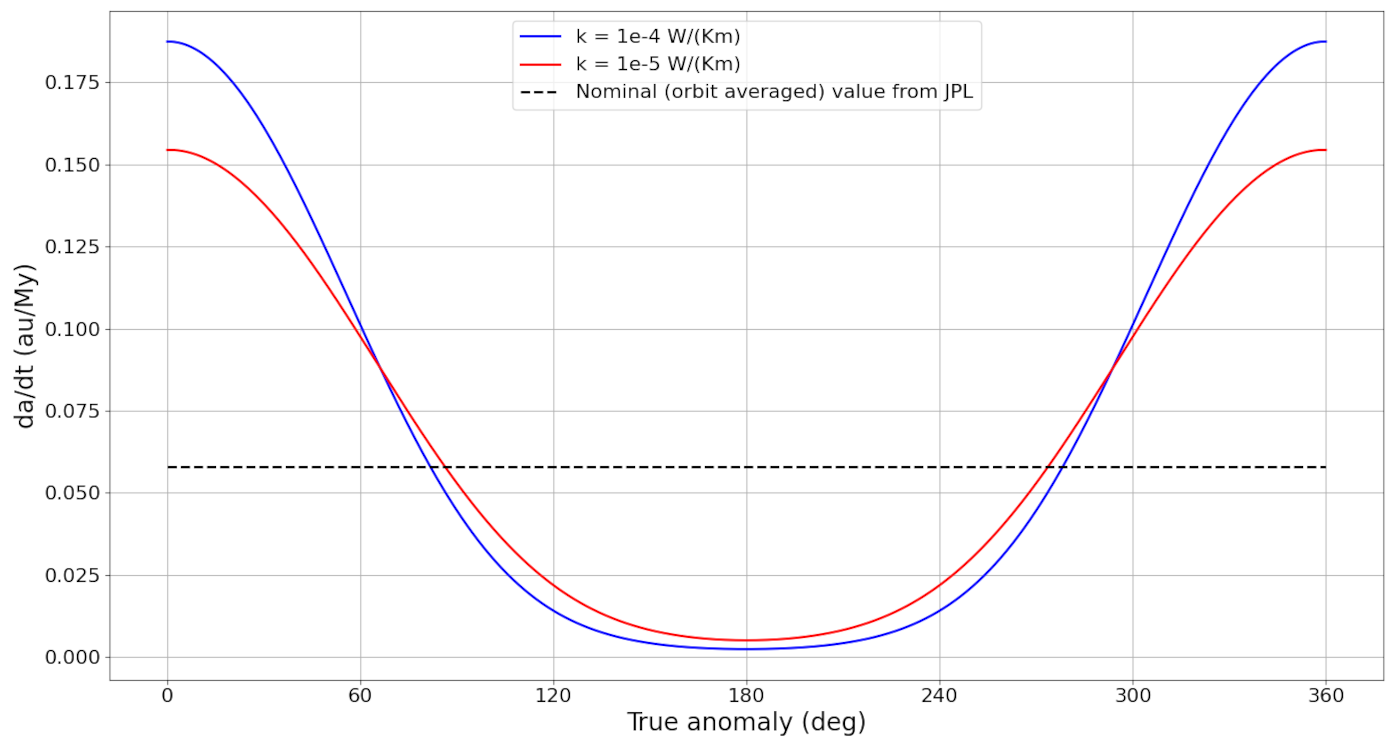
Figure 4: Dependence of the Yarkovsky drift on orbital position for a highly eccentric orbit of 2016 GE1
The developed model demonstrates that a significant Yarkovsky drift can be sustained even in cases of extremely rapid rotations. This finding potentially implies that specific structural characteristics, such as a fine regolith layer and/or a highly porous internal structure, can persist despite the intense inertial stresses caused by extreme rotational rates.
References:
Vokrouhlický , D. 1998.Diurnal Yarkovsky effect as a source of mobility of meter-sized asteroidal fragments. I. Linear theory. Astronomy and Astrophysics 335, 1093–1100.
Vokrouhlický, D. 1999. A complete linear model for the Yarkovsky thermal force on spherical asteroid fragments. Astronomy and Astrophysics 344, 362–366.
Acknowledgements: This research was supported by The Science Fund of the Republic of Serbia through Project No. 7453 Demystifying enigmatic visitors of the near-Earth region (ENIGMA)
How to cite: Marceta, D., Novakovic, B., and Gavrilovic, M.: Numerical Modelling of the Yarkovsky Effect for Super-Fast Rotating Asteroids, EPSC-DPS Joint Meeting 2025, Helsinki, Finland, 7–12 Sep 2025, EPSC-DPS2025-1040, https://doi.org/10.5194/epsc-dps2025-1040, 2025.


