
- 1JPYP Business Service Ltd, Alajärvi, Finland (teemu.ohman@jpyp.fi)
- 2Arctic Planetary Science Institute, Rovaniemi, Finland (teemu.ohman@planetaryscience.fi)
Introduction
Lappajärvi is a ~22 km impact crater of Late Cretaceous age (77.85 ± 0.78 Ma) in western Finland, hosting a lake of the same name (Fig. 1). The crater morphology is preserved with an almost continuous rim rising up to 100 m above the lake surface. As an open body of water within the preserved topographic rim of an impact crater, Lappajärvi is Europe’s largest impact crater lake.
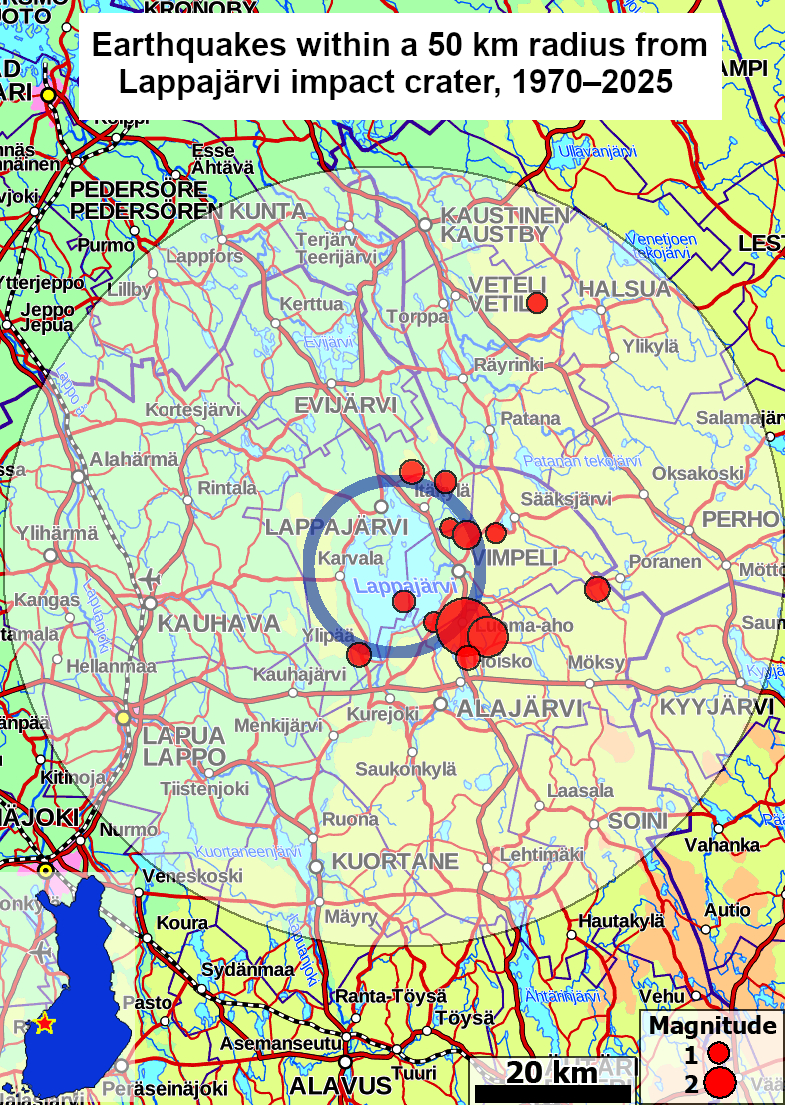
Figure 1. The red dots mark the epicentres of earthquakes within a 50 km radius of Lappajärvi crater. The blue circle approximates the 22 km rim-to-rim diameter. Earthquake data: Inst. of Seismology, Univ. of Helsinki. Base map: Nat. Land Surv. of Finland / CC BY 4.0.
The target rocks consist mainly of ~1.96–1.91 Ga mica schists and gneisses with minor mafic volcanics (e.g., pillow lavas) and carbonate rocks. The latter have been quarried since the late 1800s. The supracrustal sequence was intruded by granitoids at ~1.91–1.88 Ga, but although significant in the region, they are not a major component of the crater itself. One of the intrusions, the Paalijärvi granodiorite, includes the enigmatic “lumpy granite”, which has puzzled researchers for over a century (Fig. 2). The last important igneous event in the area was the intrusion of granite pegmatites at ~1.82–1.80 Ga.
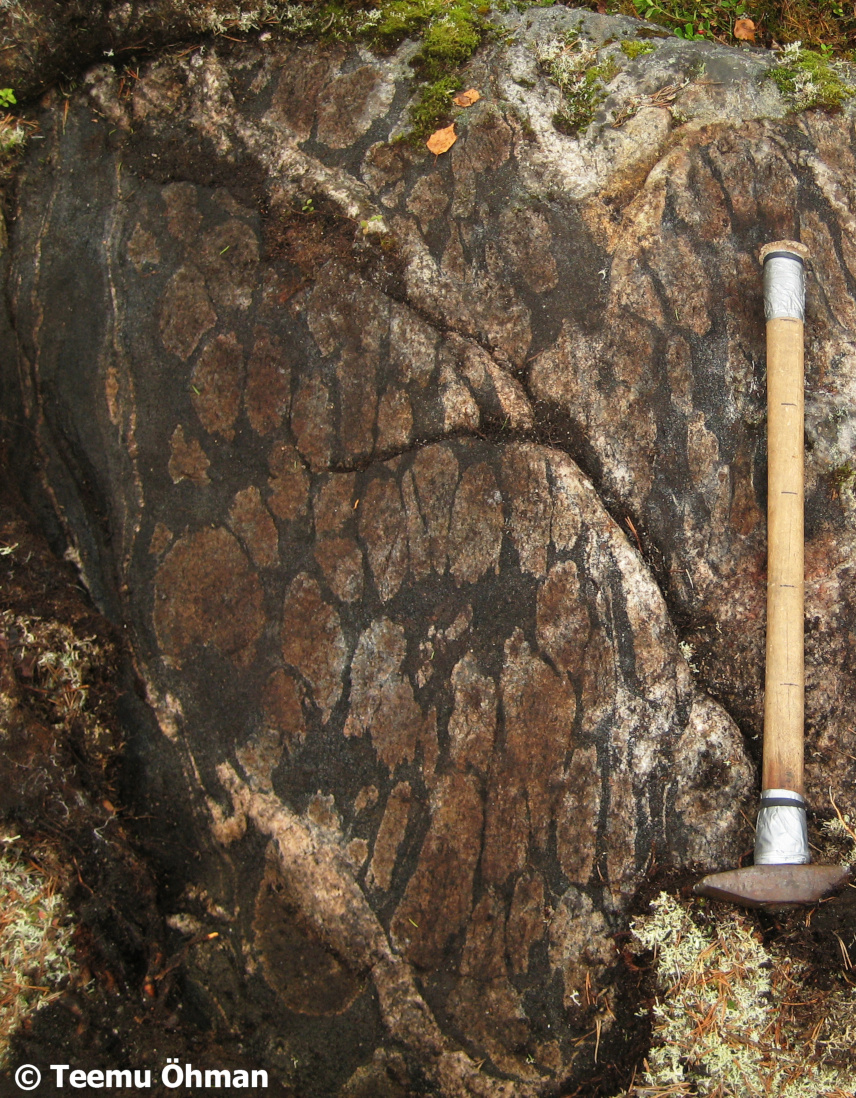
Figure 2. “Lumpy granite” displays elliptical granitic lumps within a hornblende-rich matrix. Hammer shaft has scale marks every 10 cm.
Early Cambrian and Ordovician sedimentary rocks were also present at the time of the impact. They are not cropping out, but have been encountered in drillings as well as rare boulders within the glacial drift. They contain small carbonaceous fossils (SCFs), including possibly the world’s oldest remains of annelids (ringed worms).
In 2024, the world-class geological, biological, historical and cultural heritage of the region was formally recognised as Impact Crater Lake Lappajärvi UNESCO Global Geopark (UGGp) was established. In addition to, e.g., natural resources, geoconservation and education, science is one of the main focus areas of Geoparks. Thus, Geoparks are encouraged to work with academic institutions to engage in active scientific research. Here, some of the outstanding science questions in Impact Crater Lake Lappajärvi UGGp are highlighted.
Geology
The Geological Survey of Finland carried out four deep drillings in Lappajärvi in 1988–1990, three of them being crucial for understanding the structure of the crater (henceforth referred to as kärnäite, suevite and sediment cores). The first drilling penetrated ~145 m of impact melt rock, locally known as kärnäite after the central Kärnä island where it crops out. Beneath the impact melt rock is suevitic breccia. However, different authors provide highly diverging views of the thickness of the suevitic layer (5 m vs. 30 m). This, combined with the evolving understanding of suevitic breccias in general, warrants a new look at the kärnäite core, especially as detailed logging reports or descriptions have never been published.
The severely understudied suevite core in the southern part of the Kärnä island encompasses over 140 m of suevitic and lithic breccias. In addition, two intercalations of sedimentary rocks were found within the suevitic rocks. They contain Early and Middle Cambrian as well as Ordovician acritarchs, although the age of their redeposition is considered unknown. Given the recent developments in the analytical methods of SCFs, a new assessment of the siltstones in the suevite core are in order. This is emphasized by the fact that pre-Quaternary Phanerozoic sediments are exceedingly rare in Finland.
The sediment core was drilled in the eastern annular trough of the crater. In addition to preserving a unique sequence of post-impact Pleistocene sediments, the core contains ~18 m of pre-impact sand- and siltstones. These were previously interpreted to be Mesoproterozoic in origin, but a subsequent study of acritarchs and SCFs has shown them to be over half a billion years younger, i.e. Early Cambrian. This highlights the scientific potential of reanalysing the existing drill cores and other data.
Lappajärvi impactites were affected by hydrothermal alteration for hundreds of thousands of years. This resulted in, e.g., the formation of chalcedony and agate, as well as calcite veins and vugs. A peculiar, colour-changing green mineral may well be a result of the hydrothermal phase too (Fig. 3). These poorly studied precipitates offer ample opportunities for mineralogical and stable isotope research.
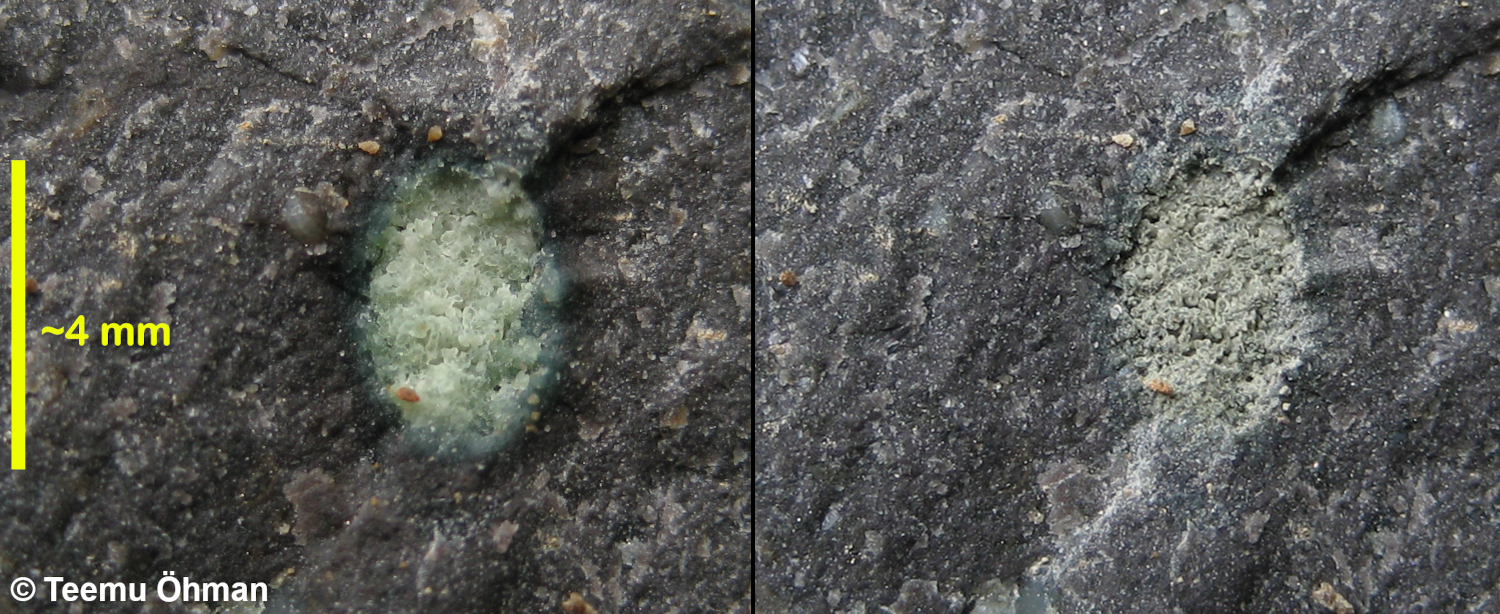
Figure 3. Kärnäite contains a mineral that changes its colour within minutes of being exposed.
Geophysics
Geophysically, one of the prominent but generally unknown features of the Lappajärvi crater is the striking clustering of seismic activity on the rim (Fig. 1). This includes the largest earthquake (magnitude 3.8) in Finland since the beginning of systematic seismic measurements in 1970. This is hardly a coincidence. However, no studies of this apparent prolonged instability of the crater rim have been published.
Lappajärvi also offers great possibilities for muon imaging. This rapidly evolving field is based on the ability of cosmic-ray induced atmospheric muons to pass through materials of different densities. Density variations between different impactites, target rocks and crater-fill sediments would be easily detectable by muon imaging, as should, for example, be the faults of the terrace zone. However, muon imaging has not yet been utilized in an impact crater setting. In Lappajärvi, a muon downhole detector could be placed in the still largely open kärnäite drill hole. This would provide a cost-effective means to precisely determine the rather poorly constrained horizontal extent of the impact melt sheet. Muon telescopes, in concert with microseismic monitoring, could shed light on the rim structure and the causes of its on-going shaking.
Conclusions
Lappajärvi is an easily accessible impact crater with a long research history. A wealth of data already exists, but much of it is in need of new interpretations. Impact Crater Lake Lappajärvi UNESCO Global Geopark can serve as a nexus for researchers as well as for educators wanting to visit and study this classic impact site.
References
Due to limitations in the local space-time continuum, references will be provided in the presentation.
How to cite: Öhman, T.: Lappajärvi Impact Crater – Fostering Research in a UNESCO Global Geopark, EPSC-DPS Joint Meeting 2025, Helsinki, Finland, 7–12 Sep 2025, EPSC-DPS2025-1047, https://doi.org/10.5194/epsc-dps2025-1047, 2025.


