
 1,2,1,1,1,
- 1Université Paris Cité, Institut de physique du globe de Paris, CNRS, Paris, France (mdai@ipgp.fr)
- 2School of Earth and Space Sciences, University of Science and Technology of China, Hefei, China
The scattering attenuation structure of the Martian lithosphere provides key insights into its composition, volatile content, and the geological processes that have shaped the planet’s evolution, including crustal differentiation and impact-induced fracturing. Prior studies of seismic scattering on Mars have largely focused on high-frequency coda envelope modeling using analytical techniques (Lognonné et al., 2020; Karakostas et al., 2021; Menina et al., 2021; Menina et al., 2023) . However, such approaches are inherently limited in their ability to capture the complexity of the Martian subsurface. In this study, we leverage the long-duration, low-frequency coda waves recorded by the SEIS experiment (Lognonné et al., 2019; Lognonné et al., 2023) on InSight (Banerdt et al., 2020) and generated by the largest marsquake recorded, S1222a (Kawamura et al., 2022; Onodera et al., 2023), to delve into the Martian lithospheric scattering structure through full waveform numerical simulations. Using the SPECFEM3D_GLOBE software package (Komatitsch & Tromp, 2002), we model seismic wave propagation accounting for realistic topography, crustal layering including Moho undulations, and stochastic structural variations that represent subsurface heterogeneities. Our simulations successfully reproduce the envelope of long-period scattered coda associated with Rayleigh and Love waves of S1222a and provides new estimations of the S1222a moment and magnitude as function of scattering strength.
Our findings indicate that at frequencies between 0.04 and 0.08 Hz, variations in surface topography and Moho relief, while influential on surface wave travel times, are insufficient to account for the observed strength of the scattered coda waves. Instead, these features are best attributed to large-scale crustal heterogeneities. By fitting the observed coda envelopes with a von Karman-type scattering model, we estimate correlation lengths of 10–20 km and maximum velocity perturbations of 20–30%. Additionally, we find that the southern highlands exhibit background velocities approximately 10% higher than the northern lowlands, along with enhanced scattering strength characterized by maximum perturbations reaching up to 40% (Figure 1). Considering the older geological age and higher crater density of the southern hemisphere (Tanaka et al., 2014), our simulation results imply that the enhanced scattering in the southern highlands may reflect an ancient crust that is highly fractured due to intense meteoritic bombardment, or that preserves more pronounced lithological heterogeneities associated with the formation and long-term evolution of the Martian crustal dichotomy.
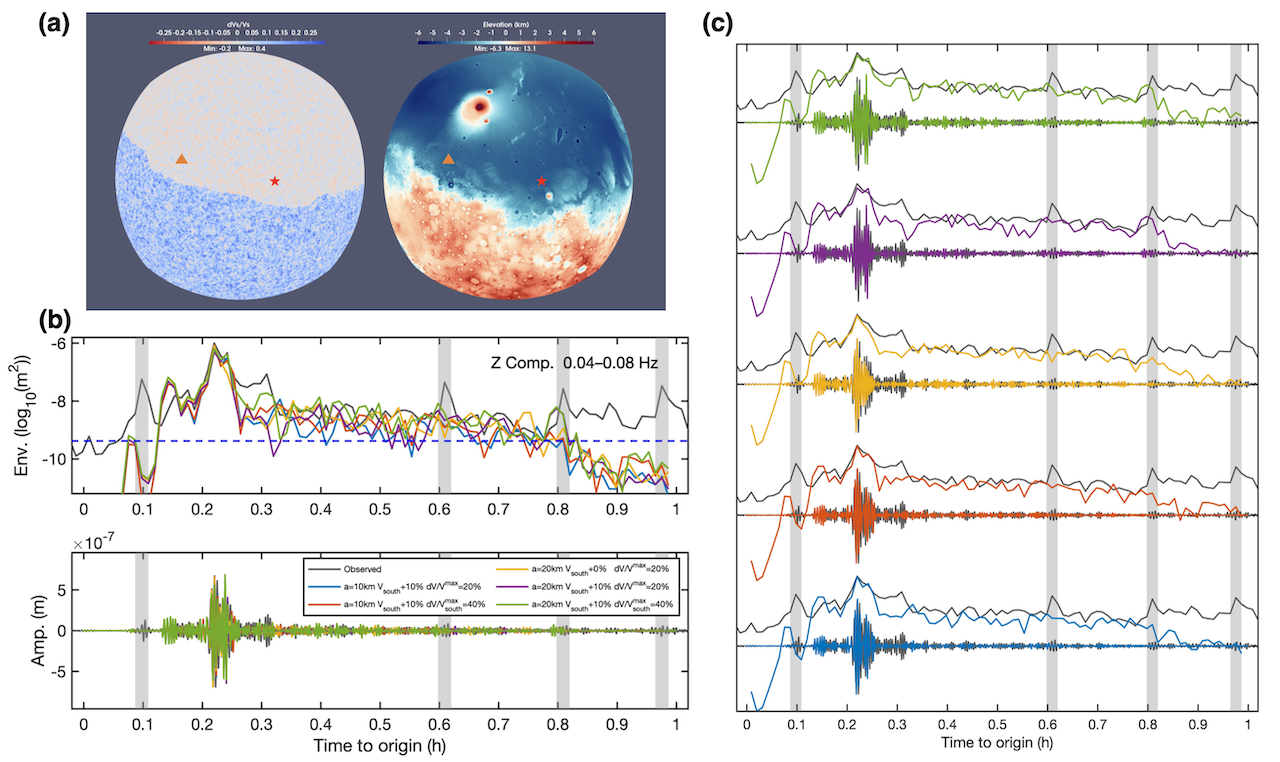
Figure 1. Simulation results. (a) Model configuration. We run the simulation in one chunk covering 120 degrees in both latitude and longitude directions. Surface topography and Moho relief are incorporated into the mesh. Velocity perturbations are generated based on the von Karman scattering model and superimposed on the background velocity structure. The left panel shows the spatial distribution of these perturbations: the northern lowlands exhibit maximum velocity perturbation of 20%, whereas the southern highlands show a 10% increase in background velocities and a maximum perturbation amplitude of up to 40%. The right panel presents the surface topography. The red star marks the epicenter of event S1222a, while the orange triangle indicates the InSight lander location. (b) Comparison between observed and simulated data. The top and bottom panels display envelopes and waveforms, respectively, comparing observations (gray lines) with simulation results (colored lines). Light gray bars highlight glitch-affected time windows. The blue dashed line represents the upper bound of the noise level, calculated as the mean plus three standard deviations of the noise. Colored lines correspond to simulations with varying model parameters, including different correlation lengths, a 10% increase in background velocity in the southern highlands, and a maximum perturbation amplitude of 40% in that region. (c) Individual simulation results. Same as (b), but the simulation results are shown separately for clarity.
References
Banerdt, W. B., Smrekar, S. E., Banfield, D., Giardini, D., Golombek, M., Johnson, C. L., et al. (2020). Initial results from the InSight mission on Mars. Nature Geoscience, 13(3), 183-189. https://doi.org/10.1038/s41561-020-0544-y
Karakostas, F., Schmerr, N., Maguire, R., Huang, Q., Kim, D., Lekic, V., et al. (2021). Scattering Attenuation of the Martian Interior through Coda‐Wave Analysis. Bulletin of the Seismological Society of America, 111(6), 3035-3054. https://doi.org/10.1785/0120210253
Kawamura, T., Clinton, J. F., Zenhäusern, G., Ceylan, S., Horleston, A. C., Dahmen, N. L., et al. (2022). S1222a - the largest Marsquake detected by InSight. Geophysical Research Letters, 49, e2022GL101543. https://doi.org/10.1029/2022GL101543
Komatitsch, D., & Tromp, J. (2002). Spectral-element simulations of global seismic wave propagation—I. Validation. Geophysical Journal International, 149(2), 390-412. https://doi.org/10.1046/j.1365-246X.2002.01653.x
Lognonné, P., Banerdt, W. B., Clinton, J., Garcia, R. F., Giardini, D., Knapmeyer-Endrun, B., et al. (2023). Mars Seismology. Annual Review of Earth and Planetary Sciences, 51, 643-670. Review. https://doi.org/10.1146/annurev-earth-031621-073318
Lognonné, P., Banerdt, W. B., Giardini, D., Pike, W. T., Christensen, U., Laudet, P., et al. (2019). SEIS: Insight’s Seismic Experiment for Internal Structure of Mars. Space Science Reviews, 215(1), 12. https://doi.org/10.1007/s11214-018-0574-6
Lognonné, P., Banerdt, W. B., Pike, W. T., Giardini, D., Christensen, U., Garcia, R. F., et al. (2020). Constraints on the shallow elastic and anelastic structure of Mars from InSight seismic data. Nature Geoscience, 13(3), 213-220. https://doi.org/10.1038/s41561-020-0536-y
Menina, S., Margerin, L., Kawamura, T., Heller, G., Drilleau, M., Xu, Z., et al. (2023). Stratification of Heterogeneity in the Lithosphere of Mars From Envelope Modeling of Event S1222a and Near Impacts: Interpretation and Implications for Very-High-Frequency Events. Geophysical Research Letters, 50(7), e2023GL103202. https://doi.org/10.1029/2023GL103202
Menina, S., Margerin, L., Kawamura, T., Lognonné, P., Marti, J., Drilleau, M., et al. (2021). Energy Envelope and Attenuation Characteristics of High‐Frequency (HF) and Very‐High‐Frequency (VF) Martian Events. Bulletin of the Seismological Society of America, 111(6), 3016-3034. https://doi.org/10.1785/0120210127
Onodera, K., Maeda, T., Nishida, K., Kawamura, T., Margerin, L., Menina, S., et al. (2023). Seismic Scattering and Absorption Properties of Mars Estimated Through Coda Analysis on a Long-Period Surface Wave of S1222a Marsquake. Geophysical Research Letters, 50(13), e2022GL102716. https://doi.org/10.1029/2022GL102716
Tanaka, K. L., Robbins, S. J., Fortezzo, C. M., Skinner, J. A., & Hare, T. M. (2014). The digital global geologic map of Mars: Chronostratigraphic ages, topographic and crater morphologic characteristics, and updated resurfacing history. Planetary and Space Science, 95, 11-24. https://doi.org/10.1016/j.pss.2013.03.006
How to cite: Dai, M., Lognonné, P., Kawamura, T., Menina, S., Xu, Z., and Kizhaekke Pakkathillam, S.: Numerical Modeling the Long Period Scattering Features of Marsquake S1222a, EPSC-DPS Joint Meeting 2025, Helsinki, Finland, 7–12 Sep 2025, EPSC-DPS2025-1061, https://doi.org/10.5194/epsc-dps2025-1061, 2025.


