Comet C/2022 E3 (ZTF) is a long-period comet discovered on March 2, 2022 by the Zwicky Transient Facility. Initially a faint object, it brightened significantly as it approached the inner Solar System, becoming visible to the naked eye in early 2023 under dark skies. The comet passed perihelion at 1.11 au on January 12, 2023, and made its closest approach to Earth on February 1, 2023, at a distance of about 0.28 au. C/2022 E3 was notable for its green coma, caused by strong diatomic carbon (C2) emission, providing a valuable opportunity for photometric and spectroscopic studies of its activity and composition.
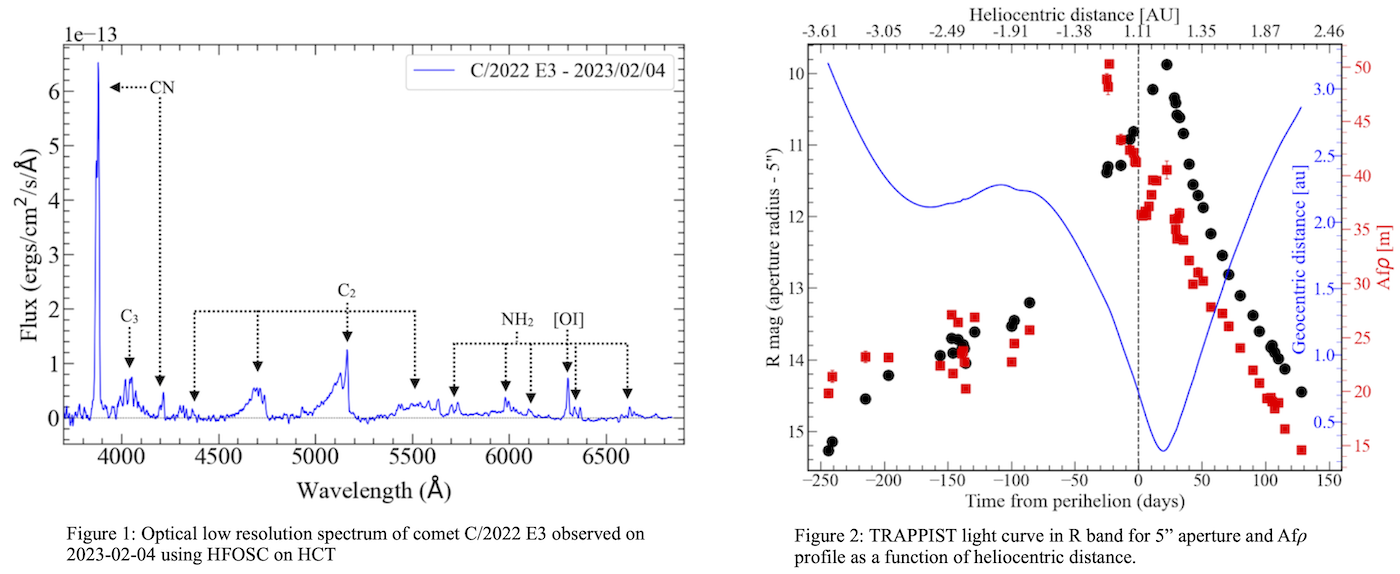
In this work, we present a comprehensive study of comet C/2022 E3 based on a multi-epoch observational campaign combining imaging (broad band BVRI filters and narrow-band HB filters; OH, CN, C₂, C₃, NH for gas species and BC, GC, RC for the dust continuum [1]) from the TRAPPIST-North and -South telescopes [2], with low- and high-resolution optical spectroscopy from the Himalayan Chandra Telescope in India. The comet was monitored over a span of approximately 373 days encompassing its perihelion passage, from 2022 May 12 (rh = 3.52 au, inbound) to 2023 May 20 (rh = 2.22 au, outbound). This extensive dataset allowed us to trace the evolution of dust activity (using the proxy Af(0)ρ [3]) and production rates and rate ratios of key gas species and investigate the physical and compositional properties of the comet's coma. The optical spectrum revealed emissions from the regular neutral molecular species CN, C2, C3, NH2, and forbidden oxygen line as shown in Figure 1.
The combined dataset was utilised to extract the production rates and activity trends of the dust and gas species. The complete activity trend reveals a structured evolution of volatile release, with asymmetric behaviour around perihelion for a few species and evidence for changing molecular dominance as a function of heliocentric distance. Over the period of observation, C/2022 E3 demonstrates a behaviour consistent with a typical carbon-chain comet. While the production rates of the gas species peaked around perihelion; Q(OH) = (3.72+/-0.35)x1028 molec/s, Q(NH) = (2.63+/-0.21)x1026 molec/s, Q(CN) = (8.13+/-0.32)x1025 molec/s, Q(C2) = (1.07+/-0.02)x1026 molec/s, Q(C3) = (2.09+/-0.08)x1025 molec/s, and the Afrho measured in the narrow band filters peaked 25 days prior to perihelion; Afρ(BC) = (3802+/-114) cm, Afρ(RC) = (5370+/-53) cm; the apparent magnitude peaked at about 22 days after perihelion which is not usually observed. This difference in peak for the apparent magnitude was a direct effect of the close approach of the comet with Earth, about 22 days after perihelion, as shown in Figure 2.
The extensive photometric data was used to analyse the dust color in both broad and narrow band images across the heliocentric range to look for any variation. The series of CN imaging data obtained from the TRAPPIST telescopes allowed us to estimate the comet’s nucleus rotation period through the analysis of periodic structures in the coma morphology. Medium-resolution spectroscopy (R~30,000) was employed to investigate the forbidden atomic oxygen lines [OI] at 5577 Å (green) and 6300/6364 Å (red doublet). The moderate spectral resolution allowed us to disentangle cometary and telluric components, enabling the computation of the green-to-red (G/R) intensity ratio. We analysed the variation of the G/R ratio as a function of both nucleocentric distance and heliocentric distance, providing insight into the relative contributions of H2O, CO2, and CO as the parent species of atomic oxygen [4,5,6].
This combined observational study highlights the importance of linking low- and high-resolution spectroscopic datasets with imaging for a holistic understanding of cometary activity and composition.
Acknowledgements
A.K acknowledges support from the Wallonia-Brussels International (WBI) grant. This work is a result of the bilateral Belgo-Indian projects on Precision Astronomical Spectroscopy for Stellar and Solar system bodies, BIPASS, funded by the Belgian Federal Science Policy Office (BELSPO, Government of Belgium; BL/33/IN22_BIPASS) and the International Division, Department of Science and Technology, (DST, Government of India; DST/INT/BELG/P-01/2021(G)).
References
[1] Farnham, T., The HB Narrowband Comet Filters: Standard Stars and Calibrations. Icarus 147, 180–204 (2000); [2] Jehin, E. et al., TRAPPIST: TRAnsiting Planets and PlanetesImals Small Telescope. The Messenger 145, (2011); [3] A'Hearn et al., Comet Bowell 1980b, The Astronomical Journal 89-4, 579-591 (1984);[4] Festou M., Feldman P. D., 1981, A&A, 103, 154; [5] Bhardwaj A., Raghuram S., 2012, ApJ, 748, 13; [6] Raghuram S., Bhardwaj A., 2014, A&A, 566, A134

 1,
1,


