SB3 | Observational investigations of comets

SB3

Observational investigations of comets
Co-organized by EXOA
Convener: Nicolas Biver | Co-conveners: Oleksandra Ivanova, Emmanuel Jehin, Cyrielle Opitom, Martin Rubin
Orals THU-OB6
| Thu, 11 Sep, 16:30–18:00 (EEST)
 
Room Jupiter (Hall A)
Orals FRI-OB2
| Fri, 12 Sep, 09:30–10:30 (EEST)
 
Room Jupiter (Hall A)
Orals FRI-OB3
| Fri, 12 Sep, 11:00–12:30 (EEST)
 
Room Jupiter (Hall A)
Orals FRI-OB4
| Fri, 12 Sep, 14:00–16:00 (EEST)
 
Room Jupiter (Hall A)
Posters THU-POS
| Attendance Thu, 11 Sep, 18:00–19:30 (EEST) | Display Thu, 11 Sep, 08:30–19:30
 
Finlandia Hall foyer, F144–165
Thu, 16:30
Fri, 09:30
Fri, 11:00
Fri, 14:00
Thu, 18:00
The characterization of cometary nuclei and their dust, gas and plasma environment is being done through in-situ and remote observations techniques.
In the context of the Rosetta mission and missions to small bodies including Comet Interceptor, and international observing campaigns of bright comets such as 12P/Pons-Brooks, C/2023 A3 (Tsuchinshan-ATLAS), C/2024 G3 (ATLAS), we solicit presentations on recent investigations.

The session will present results of optical, infrared or radio observations of comets and
active bodies obtained from ground-based telescopes, space observatories such as JWST, as
well as recent results from in-situ measurements from space missions.

Session assets

Orals THU-OB6: Thu, 11 Sep, 16:30–18:00 | Room Jupiter (Hall A)

Chairpersons: Cyrielle Opitom, Erica Bufanda, Said Hmiddouch
Lessons from comet 67P/Churyumov-Gerasimenko
16:30–16:42
|
EPSC-DPS2025-1696
|
On-site presentation
Raphael Marschall, Alessandro Morbidelli, Yves Marrocchi, and Thorsten Kleine

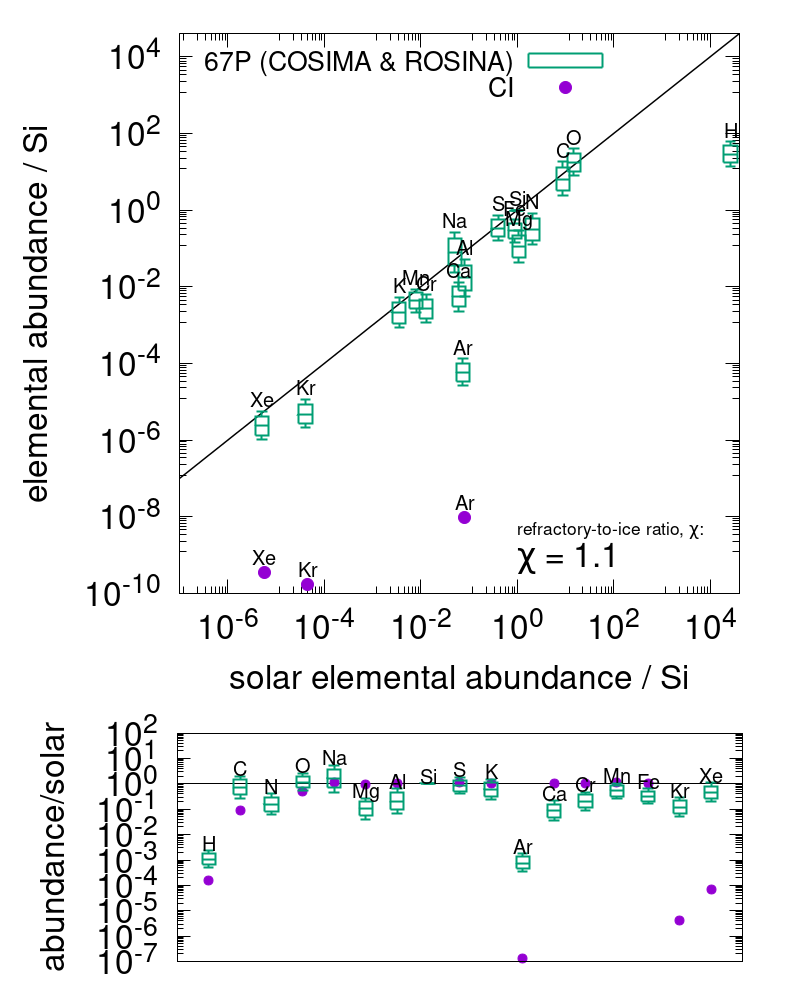
Comets, asteroids, and other small bodies are thought to be remnants of the original planetesimal population of the Solar System. As such, their physical, chemical, and isotopic properties hold crucial details on how and where they formed and how they evolved. Yet, placing precise constraints on the formation region of these bodies has been challenging. Data from spacecraft missions has a particularly high potential of addressing the question of the origin of the visited bodies. ESA’s Rosetta mission to comet 67P/Churyumov-Gerasimenko returned data from the comet for two years on its journey around the Sun. This extensive data set has revolutionised our view of comets and still holds unsolved problems. Here we present the elemental composition of 67P [Fig. 1]. We constrain the refractory-to-ice ratio to 0.5 < χ < 1.7, and present the bulk elemental abundances for 67P of H, C, N, O, Na, Mg, Al, S, K, Ar, Ca, Cr, Mn, Fe, Kr, and Xe [Marschall, Morbidelli, and Marrocchi 2025]. We find the noble gas xenon in near-solar elemental abundance in comet 67P. This is notable because the cometary xenon has a non-solar isotopic composition [Marty et al. 2017]. The fact that comets have xenon in solar elemental abundance but not in solar isotopic composition does not fit into the current scheme for the formation and evolution of the proto-solar disk [Nanne et al. 2019]. That cometary xenon is depleted in r-process isotopes, which is usually associated with non-carbonatious material, is puzzling. By modifying the Nanne scheme, we will present a new model that can reconcile these constraints from comet 67P. 


Figure 1: The elemental abundane of comet 67P using Rosetta/ROSINA and Rosetta/COSIMA data for a  refractory-to-ice ratio to χ = 1.1 . The figure is adapted from Marschall, Morbidelli, and Marrocchi 2025.

How to cite: Marschall, R., Morbidelli, A., Marrocchi, Y., and Kleine, T.: A modified formation scenario of the proto-solar disk constrained by comets, EPSC-DPS Joint Meeting 2025, Helsinki, Finland, 7–13 Sep 2025, EPSC-DPS2025-1696, https://doi.org/10.5194/epsc-dps2025-1696, 2025.

16:42–16:54
|
EPSC-DPS2025-894
|
Virtual presentation
Kathleen Mandt, Adrienn Luspay-Kuti, and Jacob Lustig-Yaeger

In recently published work we found that because Rosetta coma composition observations of 67P/Churyumov-Gerasimenko (67P/C-G) are local coma measurements, they are highly sensitive to being influenced by ice sublimating from dust near the spacecraft. This means that the local dust cycle on the comet should be considered when driving values meant to reflect the nucleus abundances and isotope ratios. Previous analysis of the Rosetta mass spectrometer (ROSINA DFMS) data took a least squares approach to fitting that stepped through each unknown parameter one parameter at a time. However, each DFMS spectrum has at least six and as many as fifteen free parameters. By fitting one parameter at a time, the uncertainty in the fit of each parameter propagates through the fit creating much greater uncertainties than represented by any difference between the fit and the data. We have developed a new technique for evaluating the Rosetta observations that fits all unknown parameters of a single spectrum. Through this approach we derive more accurate estimates of the true uncertainty in the fit and are able to reliably fit a much larger number of spectra. When we applied this method to derive D/H we found that the previously reported anomalously high D/H was a result of enrichment in D/H on dust grains and was not inherent to the comet. By evaluating measurements in the context of the well-established dust cycle we determined that the nucleus D/H is closer to terrestrial values. These values are more reasonable allowing 67P/C-G to agree with other Jupiter Family Comets (JFCs) as well as the abundances of CO and N2 measured by DFMS. In this presentation we provide an update to the abundances of hypervolatiles and other isotope ratios base on our new method for fitting the observations and on our understanding of the comet dust cycle.

How to cite: Mandt, K., Luspay-Kuti, A., and Lustig-Yaeger, J.: Variability of hypervolatile abundances and isotope ratios in the coma of 67P/Churyumov-Gerasimenko, EPSC-DPS Joint Meeting 2025, Helsinki, Finland, 7–13 Sep 2025, EPSC-DPS2025-894, https://doi.org/10.5194/epsc-dps2025-894, 2025.

16:54–17:06
|
EPSC-DPS2025-1257
|
ECP
|
On-site presentation
Daniel Müller, Kathrin Altwegg, Jean-Jacques Berthelier, Robin Bonny, Michael Combi, Johan De Keyser, Antea Doriot, Stephen Fuselier, Nora Hänni, Martin Rubin, and Susanne Wampfler

Cometary dust is a key tracer of early Solar System material, preserving primitive components that offer insight into comet formation and evolution. ESA’s Rosetta mission to comet 67P/Churyumov-Gerasimenko (67P) provided an unprecedented opportunity to study the dust and gas environment of a comet's inner coma in situ, over a two-year period surrounding its perihelion in August 2015. Due to the spacecraft’s low relative velocity with respect to the nucleus, dust particles could be collected with minimal alteration (Longobardo et al., 2022).

Dedicated dust instruments aboard Rosetta, including GIADA (Grain Impact Analyzer and Dust Accumulator) and COSIMA (Cometary Secondary Ion Mass Analyzer), characterized dust grain velocities, sizes, and densities (Agarwal et al., 2017), while MIDAS (Micro-Imaging Dust Analysis System), the first Atomic Force Microscope flown in space, revealed detailed micro- and nanoscale structures (Bentley et al., 2016; Mannel et al., 2019). In addition, the ROSINA (Rosetta Orbiter Spectrometer for Ion and Neutral Analysis) suite – though primarily a gas analyzer – also contributed to dust studies. Its COPS (Comet Pressure Sensor) detected transient dust events (Pestoni et al., 2023) and the DFMS (Double Focusing Mass Spectrometer) enabled chemical analysis of volatiles released during phases with a lot of dust in the coma (Hänni et al., 2022).

We report on the detection of H3O+ (hydronium ion) at m/z = 19 in DFMS’s neutral mode and its correlation with gas species associated with dust events, pointing to a link between H3O+ formation and salt-bearing dust grains. Salts, particularly ammonium salts, have also been proposed as key contributors to the nitrogen depletion observed in cometary comae (Altwegg et al., 2020, 2022; Poch et al., 2020). Additionally, we present a comparative analysis of the D/H ratio in H2O in the ambient gas coma versus that observed during dust events, when water was released from grains. These results are further compared to D/H ratios from the literature for the gas and dust phase, for instance in the refractory organics measured by the COSIMA instrument (Paquette et al., 2021).

We discuss the implications of the presence of H3O+ released from dust grains, its potential formation pathways, and isotopic ratios for understanding salt chemistry and the coupling between volatile and solid phases in cometary comae.

References:
Agarwal, J. et al., 2017, MNRAS, https://doi.org/10.1093/mnras/stx2386
Altwegg, K. et al., 2020, Nat Astron., https://doi.org/10.1038/s41550-019-0991-9
Altwegg, K. et al., 2022, MNRAS, https://doi.org/10.1093/mnras/stac2440
Bentley, M. et al., 2016, Nature, https://doi.org/10.1038/nature19091
Hänni, N. et al., 2022, Nat. Commun., https://doi.org/10.1038/s41467-022-31346-9
Longobardo, A. et al., 2022, MNRAS, https://doi.org/10.1093/mnras/stac2544
Mannel, T. et al., 2019, A&A, https://doi.org/10.1051/0004-6361/201834851
Paquette, J. A. et al., 2021, MNRAS, https://doi.org/10.1093/mnras/stab1028
Pestoni, B. et al., 2023, A&A, https://doi.org/10.1051/0004-6361/202245279
Poch, O. et al., 2020, Science, https://doi.org/10.1126/science.aaw7462

How to cite: Müller, D., Altwegg, K., Berthelier, J.-J., Bonny, R., Combi, M., De Keyser, J., Doriot, A., Fuselier, S., Hänni, N., Rubin, M., and Wampfler, S.: H3O+ and D/H ratios in dust-related outgassing at 67P: Evidence for salt-rich grains?, EPSC-DPS Joint Meeting 2025, Helsinki, Finland, 7–13 Sep 2025, EPSC-DPS2025-1257, https://doi.org/10.5194/epsc-dps2025-1257, 2025.

17:06–17:18
|
EPSC-DPS2025-1556
|
On-site presentation
Giovanna Rinaldi, John Noonan, Matteo Teodori, Luca Maggioni, Abhinav Jindal, Michelangelo Formisano, and Gianfranco Magni

The primary goal of this work is to investigate the properties of the inner coma of comets and establish connections between the processes occurring within it and specific locations on the surface and subsurface of the comet. The analysis of gas and dust in the inner coma and their connection with the surface of comets is crucial to understand the context of cometary activity and represents an important reference for the ESA and JAXA missions as Comet Interceptor and for small bodies showing ‘’cometary activity’’. Additionally,  future Vera C. Rubin Observatory observations, the James Webb Space Telescope (JWST), and the Extremely Large Telescope (ELT) will increase the need for understand comet activity as they rapidly discover and characterize new objects. Those efforts rely on the capability to model and forecast the activity of comets, which in turn relies on connecting observed activity to surface properties and regions.

The work is developed in two parts:

1-  Our first focus is the analysis of the dust and gas coma of comet 67P using data acquired by the ESA Rosetta mission during the period between July and November 2015, when activity was near its peak postperihelion.

2-  The second focus is the development of a Lagrangian code based on the Smoothed Particle Hydrodynamics (SPH) method to investigate transient phenomena, such as volatile and refractory emissions from the surface (M. Teodori et al. 2024, 2025).

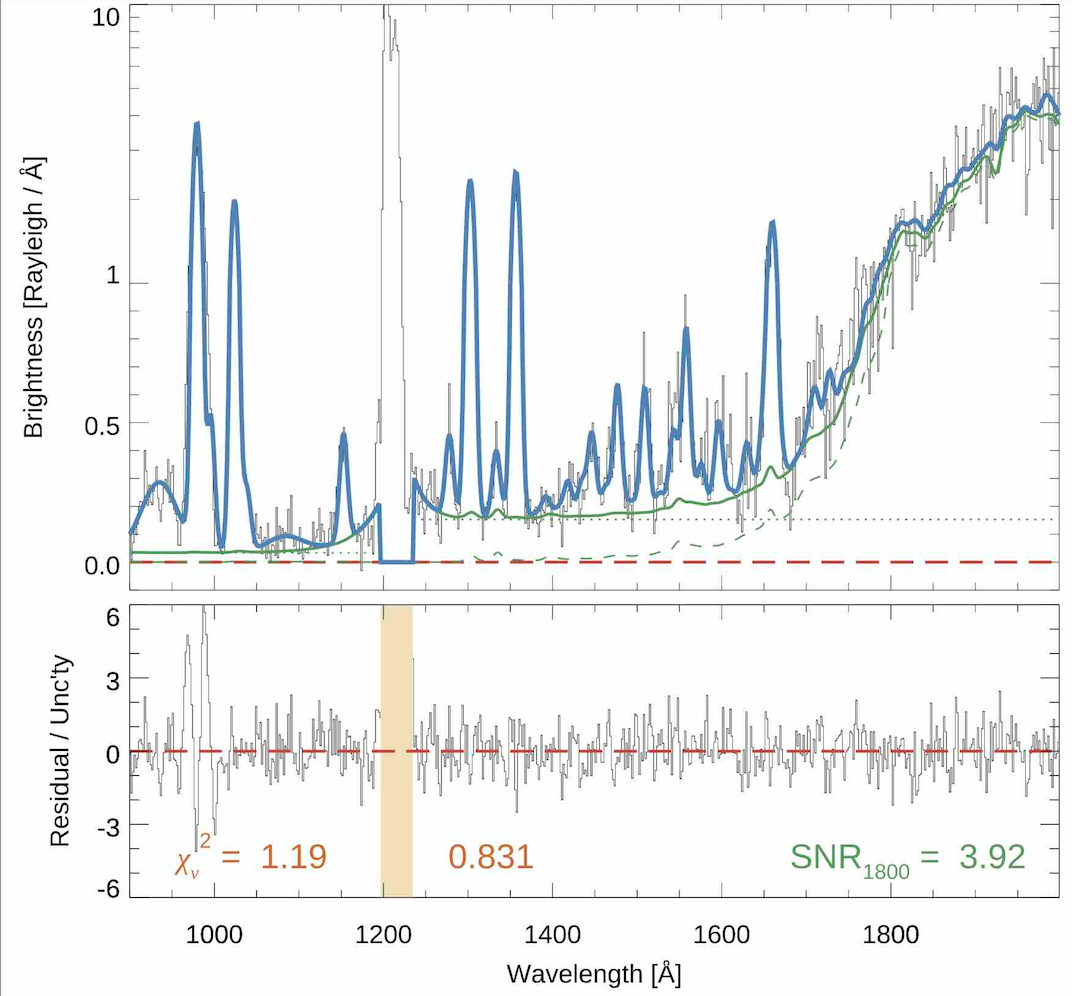
The Visible InfraRed the Thermal Imaging Spectrometer (VIRTIS) and the ALICE ultraviolet spectrograph, observed and detected a series of outbursts and jets (Rinaldi et al. 2018, Noonan et al. 2021). H2O, CO2, and O2 were all indirectly observed by ALICE within outbursts via emission fingerprints of dissociative electron impact from the daughter products H, C, and O, identified in the spectra as the first two members of the H I Lyman series, OI multiplets at 1152, 1304, and 1356 Å, and weak multiplets of C I at 1561 and 1657 Å . VIRTIS detected and characterized the dust properties of the jets and outburst in terms of radial profile, light curve, color, and dust mass loss in the VIS and IR wavelength range. The outburst observations show that mixed gas and dust outbursts can have different spectral signatures representative of their initiating mechanisms, with outburst showing indicators of a cliff collapse origin or showing fresh volatiles being exposed via a deepening fracture. Preliminary analysis shows the cometary activity observed after some outburst events has a moderate CO2/H2O ratio, while others show only a large increase in reflected light due to dust. When connected to specific surface regions and provided with the proper spectral signal, this analysis opens up the possibility of remote spectral classification of cometary activities with future work.

The second focus of this work is to consider the physical processes driving the comet activity. We aim at simulating gas and dust emission from a surface fracture, by introducing an advanced numerical model that adopts the Smoothed Particle Hydrodynamics (SPH) approach. The code accounts for multiple components and incorporates several physical mechanisms. Among them, phase transitions (mainly sublimation and deposition), viscous dynamical interaction between gas and solid components (dust and eventually icy grains), solar radiation, and volatile-surface dynamical and thermal interactions. Preliminary results will be presented during this session.

How to cite: Rinaldi, G., Noonan, J., Teodori, M., Maggioni, L., Jindal, A., Formisano, M., and Magni, G.: The analysis of dust and gas emission at 67P/Churyumov-Gerasimenko sheds light on cometary activity, EPSC-DPS Joint Meeting 2025, Helsinki, Finland, 7–13 Sep 2025, EPSC-DPS2025-1556, https://doi.org/10.5194/epsc-dps2025-1556, 2025.

17:18–17:30
|
EPSC-DPS2025-1944
|
On-site presentation
Xiaotong Yun, Gabriella Stenberg Wieser, Hans Nilsson, Sofia Bergman, Song Fu, and Binbin Ni

Abstract

Rosetta measurements at comet 67P revealed ion speeds of 5–10 km/s, far exceeding the observed speed of the neutral gas of 0.5–1 km/s. Models assuming an ion speed similar to the neutral gas also give good agreement with measurements of ion densities. This discrepancy points to a missing mechanism in our understanding of ion-neutral coupling. One possible explanation would be a presence of counter-streaming ions. Two ion populations, moving anti-cometward and cometward, respectively, would result in a low bulk speed but high individual velocities. Such counter-streaming populations may also drive wave generation, particularly ion acoustic waves, which have been detected within the diamagnetic cavity and could arise from ion-ion instabilities.

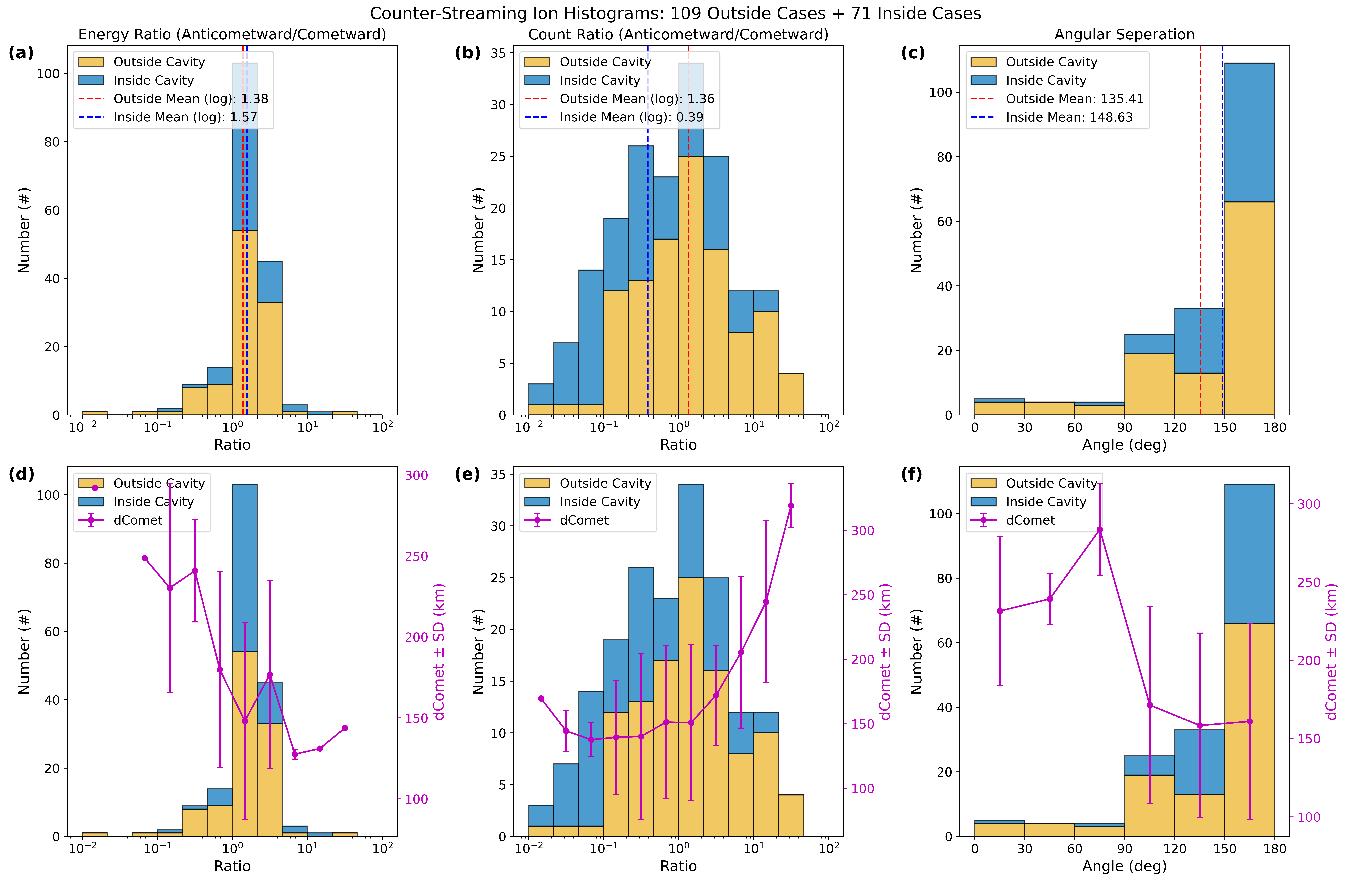
Using high- and normal-resolution data from Rosetta’s RPC-ICA instrument recorded near the diamagnetic cavity, we identify and statistically characterize counter-streaming ion populations. We find the counter-streaming ions are often observed in this region. Our results further reveal a dependence on cometocentric distance which can be seen in Figure 1. At smaller distances, (1) the ratio between the mean energy of the anti-cometward and cometward ions is higher, (2) the ratio of the observed number of counts of anti-cometward and cometward ion is lower, and (3) the angle between the streaming directions of the two populations is larger. In addition, we find that some parameters, for example the angle between the streaming populations, is different inside and outside of the diamagnetic cavity. These findings provide statistical insights into counter-streaming ions, demonstrating how local plasma conditions shape ion dynamics in the cometary environment


Figure 1. Statistical analysis of counter-streaming ion populations. (a–c) Stacked histograms showing the distributions of (a) the ratio of the mean energy, (b) the ratio between the observed counts, and (c) angular separation between ion flow directions. Yellow and blue bars represent populations outside and inside the diamagnetic cavity, respectively. Red and blue dashed lines denote the mean values for each parameter outside and inside the cavity, respectively. (d–f) Same as (a–c), but omitting the mean value lines (red/blue dashed lines), and adding a right y-axis showing cometocentric distance (±SD) as a magenta solid line with dots marking bin means and vertical error bars representing standard deviations.

How to cite: Yun, X., Stenberg Wieser, G., Nilsson, H., Bergman, S., Fu, S., and Ni, B.: Characteristics of Counter-Streaming Ions at Comet 67P, EPSC-DPS Joint Meeting 2025, Helsinki, Finland, 7–13 Sep 2025, EPSC-DPS2025-1944, https://doi.org/10.5194/epsc-dps2025-1944, 2025.

17:30–17:42
|
EPSC-DPS2025-867
|
On-site presentation

Tony L. Farnham, Maximus Hood, Jessica M. Sunshine, and Michael S.P. Kelley

The Rosetta spacecraft orbited comet 67P/Churyumov-Gerasimenko (C-G) from 2014-2016, where it characterized the comet's behavior in detail.  Although the in situ mission is over, remote observations monitoring the comet's behavior should be continued, to reveal how the comet evolves over the course of subsequent apparitions.

The Transiting Exoplanet Survey Satellite (TESS) was designed to observe extrasolar planets by continuously staring at a wide-field (24° x 96°) sector of the sky for 27 days.  Comets occasionally pass through the TESS field of view, where high-cadence images are recorded for as long as the comet remains in the field.  We can use these images to study the long-term spatial and temporal behavior of the comet. TESS' excellent photometric qualities track the secular and rotational lightcurves of the comet to reveal how its activity changes with time.  The continuous, extended duration of the observations is also ideal for monitoring for outbursts and other spontaneous transient events.  The thousands of images obtained by TESS can also be registered on the nucleus and coadded to produce deep images that reveal faint morphological features.  This capability has made TESS an excellent tool for discovering and characterizing cometary dust trails and for characterizing comae in weak and distant comets.

Due to fortuitous circumstances, comet C-G was ideally placed for TESS observations during its 2021 apparition.  C-G passed through six consecutive sectors, where it was imaged almost continuously every 10 minutes for 159 days (21 Aug 2021 through 27 Jan 2022).  These observations bracketed perihelion (r=1.2 AU), with r ranging from 1.5 AU inbound to 1.6 AU outbound, and provide a record of the object's long-term behavior during this time period.  Preliminary analyses of the observations show activity levels that peaked about three weeks post-perihelion, with several small outbursts detected at random times.  C-G displays a moderate dust tail as well as a bright dust trail that extends several tens of degrees from the nucleus (see figure).


How to cite: Farnham, T. L., Hood, M., Sunshine, J. M., and Kelley, M. S. P.: TESS Observations of Comet 67P/Churyumov-Gerasimenko, EPSC-DPS Joint Meeting 2025, Helsinki, Finland, 7–13 Sep 2025, EPSC-DPS2025-867, https://doi.org/10.5194/epsc-dps2025-867, 2025.

17:42–18:00
Nucleus and coma properties of comets

Orals FRI-OB2: Fri, 12 Sep, 09:30–10:30 | Room Jupiter (Hall A)

Chairpersons: Léa Ferellec, Martin Rubin
09:30–09:42
|
EPSC-DPS2025-1233
|
On-site presentation
The Nucleus of Comet 28P/Neujmin 1: Lightcurves, Rotation Period, and Phase Function
(withdrawn)
David Schleicher, Matthew Knight, Brian Skiff, and Allison Bair
09:42–09:54
|
EPSC-DPS2025-941
|
ECP
|
On-site presentation
Vincent Okoth, Cyrielle Opitom, and Colin Snodgrass

Comets are among the most primitive and unaltered small bodies in the solar system, offering critical insights into the early conditions of solar system formation. Originating from distant reservoirs such as the Oort Cloud, Scattered Disk, and Kuiper Belt, these icy relics preserve material from the primordial solar nebula. As they aproach the Sun, sublimation of volatile ices and dust creates expansive comae and tails, the structures of which reveal details about the physical properties and activity of their nuclei. Here, we present the results of narrowband imaging and morphological analysis of the coma of comet C/2006 P1 (McNaught), focusing on constraining its rotation period.

Comet C/2006 P1 was observed using the 3.6-meter New Technology Telescope (NTT) at La Silla Observatory, Chile, with the ESO Multi-Mode Instrument (EMMI). Observations were conducted between January 27 and February 4, 2007, with an additional observing run from February 25 to 28, 2007, approximately 15 to 48 days post-perihelion. The imaging programme employed both broadband filters (B, V, R) and six comet-specific narrowband filters (CN, C3, C2, NH2, and blue/red continuum) to isolate various gas and dust components within the coma.

We used multiple image processing techniques to enhance the cometary coma structures. These included azimuthal mean and median profile subtraction and division, azimuthal renormalization, and division by a 1/ρ profile. These techniques revealed diversed morphological features such as spiral arcs, linear jets, and fan-shaped structures, particularly prominent in the CN-filter images. We used periodic repetition and evolution of these features over time to constrain the comet’s rotation period.

To constrain the rotation period of C/2006 P1, we used two techniques independently: (1) Root Mean Square (RMS) analysis of time-series morphological variability and (2) tracking of angular displacement of distinct coma features. Both methods rely on the assumption of a stable, principal-axis rotational state and persistent active regions on the nucleus.

In the RMS approach, we normalized and divided sequential images by each other to highlight temporal changes in morphology. We plotted RMS of resultant division as a function of the time difference between observations as shown in figure 1. Here, the minima correspond to epochs where the coma morphology matches earlier states, implying integer multiples of the rotation period have elapsed. This technique was applied to the January 31–February 4 and February 25–28 epochs separately, as they provided good but different temporal coverage with different number and types of structures. We obtained a rotation period estimate of 11.3 ± 0.5 hours from the RMS minima.

In our second approach, angular displacement technique, we measured the position angles of distinct structures (e.g., linear jets and fans) at multiple epochs. The angular displacement ∆θ between features observed at times t1 and t2 was computed and used to obtain angular velocity ω = ∆θ/t. The rotation period P was subsequently calculated using P = 360. This method gave us a rotation period of 5.65 ± 0.9 hours, approximately half the value obtained from the RMS. Such a discrepancy may reflect challenges in distinguishing between full and half-rotation periods, especially in cases where the coma displays symmetric morphological features. The factor-of-two difference likely arises from the RMS method capturing repeated morphology at intervals corresponding to twice the rotation period. This might be because of insufficient temporal coverage, as our observations were limited to only about 30-minute windows at the beginning or end of the night, making it impossible to reliably detect periods under 8-10 hours using RMS approach.

Both methods showed strengths and limitations. The RMS approach offers statistical robustness and is relatively insensitive to subjective feature identification but can be affected by transient non-periodic events or variable seeing conditions. The angular displacement method provides a direct geometric interpretation but is more sensitive to feature misidentification and measurement uncertainties. By employing both techniques, we achieved a more comprehensive constraint on the rotational state of C/2006 P1.

Despite its exceptional brightness, the rotation period of comet C/2006 P1 (McNaught) had never been directly determined. A 21-hour estimate proposed by Kulyk et al. (2010), based on tail simulations, lacked confirmation from morphological observations. The results presented in this study represent the first observationally grounded constraints on the comet’s rotation period derived from narrowband imaging of its coma. The inferred rotation periods of C/2006 P1 suggest a relatively rapid nucleus spin rate, consistent with its pronounced and dynamic coma morphology. Moreover, the results offer insights into the spatial distribution of activity on the nucleus, possibly indicating two dominant sources or a highly anisotropic activity pattern.

Figure 1: A plot of the RMS resulting from division of normalized CN images with each other as a function of the time difference (in days) between the images, covering observation between 29 Jan to 04 Feb (Left) and 26-28 Feb, 2007 (Right). The minima in the RMS repeats itself at an integer number times the rotation period. It suggests a rotation period estimate of C/2006 P1 to be 11.3 ± 0.5 hours, a factor of two difference from the jet angular tracking method which gave an estimate of 5.65 ± 0.9 hours.


How to cite: Okoth, V., Opitom, C., and Snodgrass, C.: Rotation Period of Comet C/2006 P1 (McNaught) Through Coma Morphology, EPSC-DPS Joint Meeting 2025, Helsinki, Finland, 7–13 Sep 2025, EPSC-DPS2025-941, https://doi.org/10.5194/epsc-dps2025-941, 2025.

09:54–10:06
|
EPSC-DPS2025-1414
|
On-site presentation
Ivano Bertini, Jean-Baptiste Vincent, Raphael Marschall, Fiorangela La Forgia, Alessandra Mura, Laura Inno, Stavro Ivanovski, Michael Küppers, Cecilia Tubiana, and Vladimir Zakharov

Comets are primitive planetesimals we can study to infer knowledge about the initial stages of formation of our Solar System. Dust is the largest mass component among cometary materials. Emitted dust particles are anysotropic scatterers of the incident solar light and their nature can be investigated with remote sensing studies. Among such studies, the measurement of the coma phase function curve has an important role for several aspects. Once inverted with theoretical and laboratory studies, the intimate nature (i.e. size, size distribution, composition, and shape) of the emitted dust particles can be investigated. The phase function knowledge is needed when adjusting cometary dust production rates for effects depending on the observational geometry when correlation of data obtained throughout large time intervals is performed. Finally, the coma phase function is useful for space instruments planning since it provides inputs for optimal exposure times, mainly in case observations are spanning a large range of phase angles during close approaches. This will be particularly valuable in the framework of the future ESA Comet Interceptor mission which is going to pass close to a Dynamically New Comet, carrying instruments such the EnVisS (Entire Visible Sky) camera which will image the coma with a large phase angle coverage in a short amount of time.

In order to provide an useful tool to address the aforementioned scientific topics, we used literature data to build a new composite phase function for cometary dust comae. We fitted Henyey-Greenstein (HG) functions to the literature data of 11 comets covering different dynamical classes and we connected them in a continuous way as all data values were coming from a single comet with average scattering properties. We then fitted our result with a compound HG curve and compared it with previous comprehensive models. Our approach contains recent literature data which were not included in previous models. These recent data are providing a good temporal coverage of the cometary coma scattering behavior at small and large phase angles. The most notable difference between our and previous models is found in the description of the forward scattering surge, where our model depicts a scattered intensity one order of magnitude larger than previous ones. This finding is extremely important since it shows that the choice of the phase function model may have severe consequences when scientific interpretation and planning of the observational strategy regarding forward scattering data are taken into account.

Acknowledgements: Contribution of I. Bertini and L. Inno was supported by the ASI-INAF agreement n. 2023-14-HH.0.


How to cite: Bertini, I., Vincent, J.-B., Marschall, R., La Forgia, F., Mura, A., Inno, L., Ivanovski, S., Küppers, M., Tubiana, C., and Zakharov, V.: A Composite Phase Function for Cometary Dust Comae, EPSC-DPS Joint Meeting 2025, Helsinki, Finland, 7–13 Sep 2025, EPSC-DPS2025-1414, https://doi.org/10.5194/epsc-dps2025-1414, 2025.

10:06–10:18
|
EPSC-DPS2025-1777
|
On-site presentation
Emmanuel Jehin, Pierre Hardy, Elsa Blond Hanten, Damien Hutsemékers, Jean Manfroid, and Sandrine Sohy

Introduction. Comets play a crucial role in understanding the formation and evolution of the Solar System, as they preserve the most pristine material from its early stages. Composed of rock, dust, organic material, and ices, comets release gases and dust when heated by the Sun, forming an atmosphere (coma) and characteristic tails. To advance our understanding of comets, it is essential to determine  their composition and the physical processes at play and one method is the analysis of the optical spectra of their gazeous coma. At optical wavelengths, these spectra are characterized by emission lines mainly produced from fluorescence-resonance of cometary radicals, ions, and atoms which are the subproducts of the photionization and other processes acting on the larger parent molecules sublimating from the nucleus ices. Identifying correctly these lines among the forest of thousands of lines of the molecular bands at high resolution, is a first and essential step, especially as many remain unidentified despite advances in telescope technology, instrumentation, and laboratory line lists. This has motivated our team to build an atlas of cometary lines, which is a list of validated lines from high resolution and high signal to noise spectra obtained in the last two decades by the Liège team with the 8-m ESO Very Large Telescope (VLT) and covering the whole near-UV and optical range from 3040 A to 10400 A.

High resolution optical spectra. The most comprehensive catalog of cometary optical spectral lines until recently was that of comet 122P/de Vico, compiled by Cochran and Cochran at the McDonald Observatory and published in 2002 [1]. The observation of the bright long period comets C/2002 T7 (LINEAR) in 2004 and more recently in 2018 comet C/2016 R2 (PANSTAARS) with the high-resolution UVES spectrometer (R~100,000) coupled with the large telescope area of the VLT led to some of the best cometary optical spectra ever obtained. These spectra were reduced using the ESO UVES pipeline [2], cosmic rays were removed and SNR improved by combining several spectra taken the same night, and they were wavelength calibrated and shifted in the Earth frame, by considering the geocentric velocities. After a very careful dust continuum subtraction by small wavelength regions using the solar spectrum of Kurucz [3], as well as the removal of the telluric absorptions in the redest part of the spectrum,  we studied the cometary emission lines by developing an automatic line detection tool [4], and by identifying them using high-resolution molecular line lists found in the Exomol database [5], derived from recent fluorescence models [6, 7], or more generally found in the literature [1,4,8,9]. The sky emission line atlas observed by VLT/UVES in 2001 [10] was used to confirm the cometary nature of detected emission lines. Emission lines of CO+ and N2+ ions were analyzed thanks to the unique spectrum of comet C/2016 R2 (PanSTARRS), because those species are much brighter in this comet compared to most of other comets [6, 7, 11].

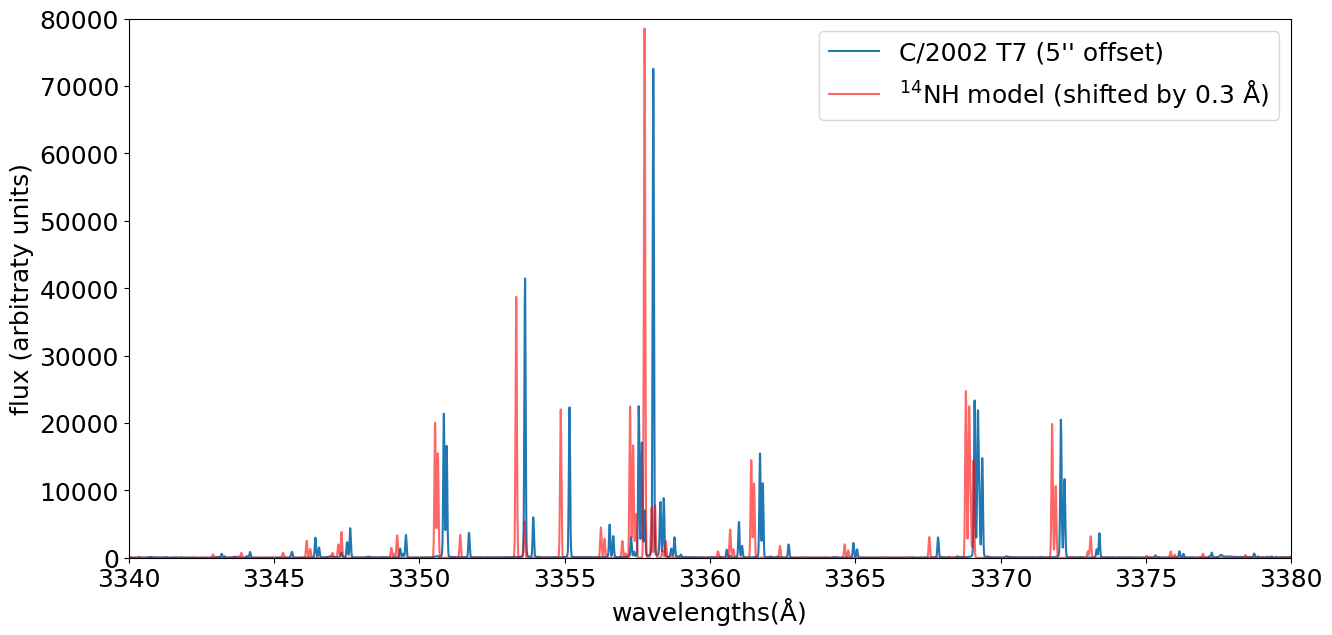
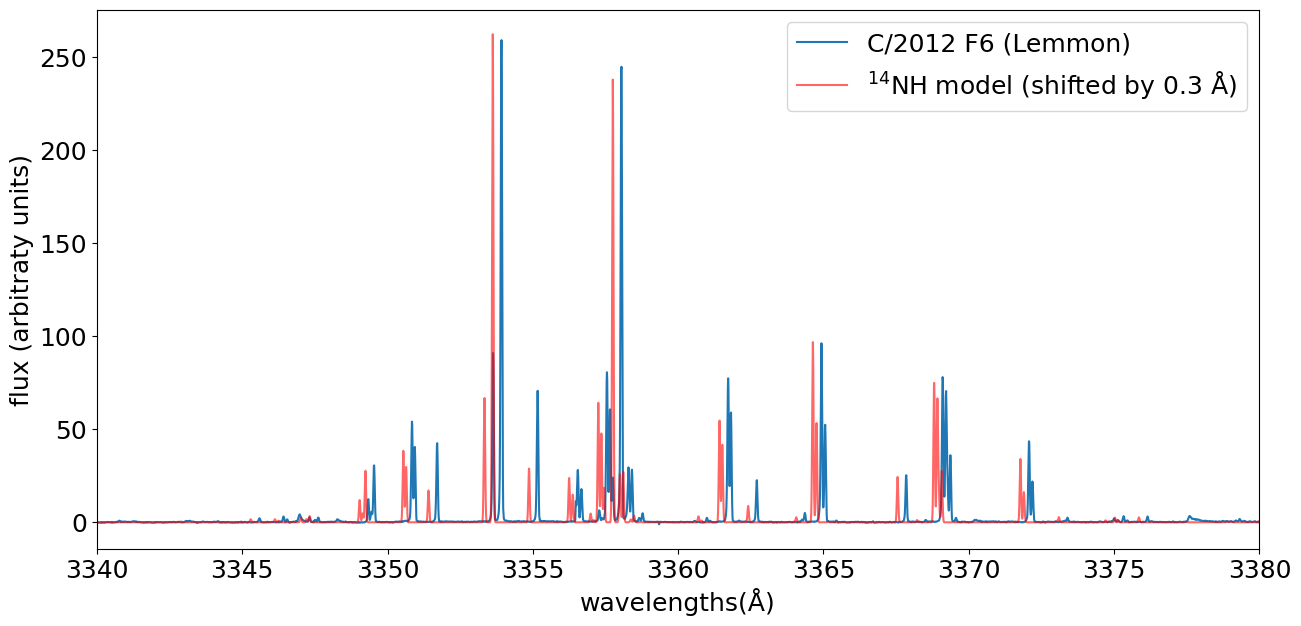
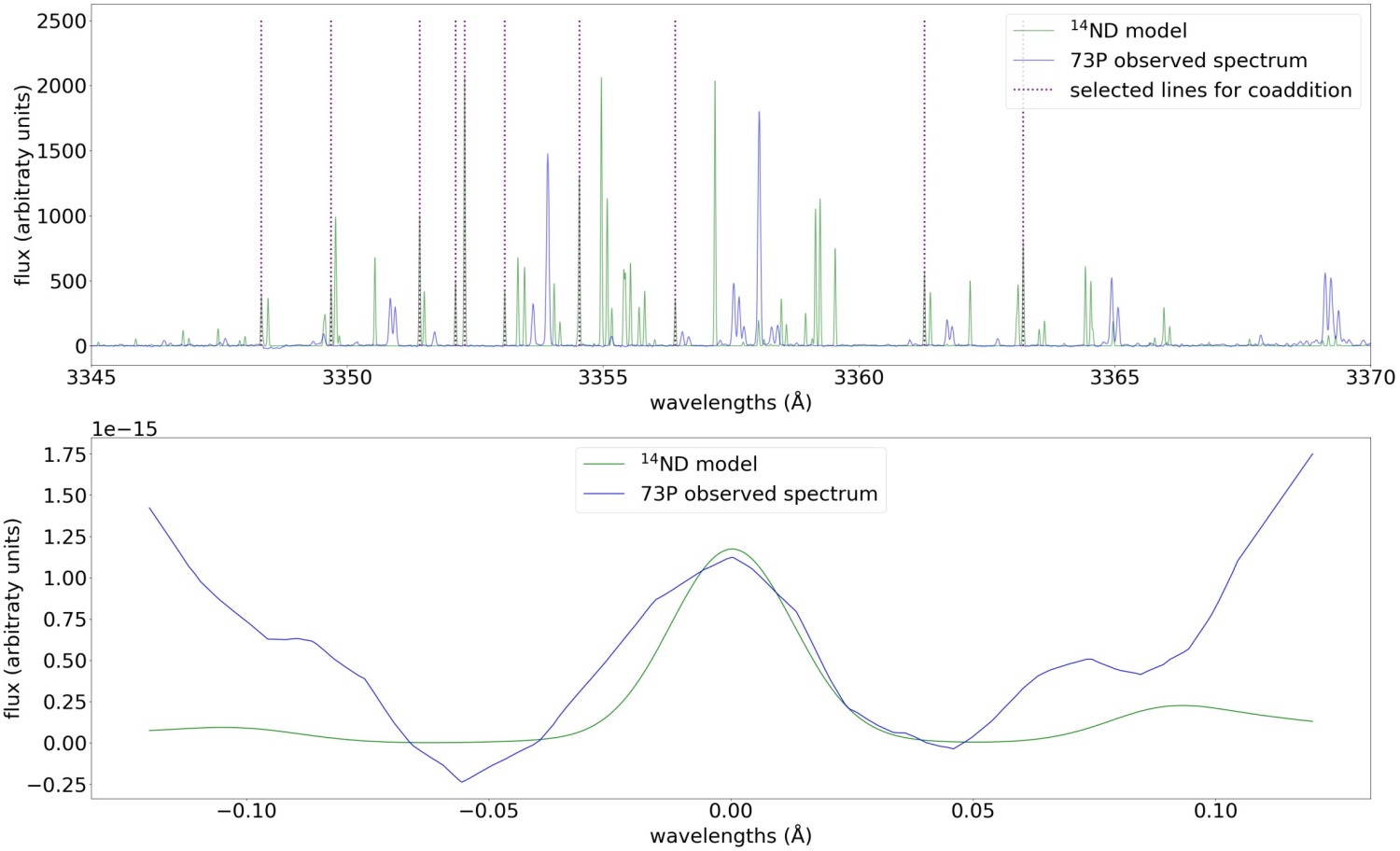
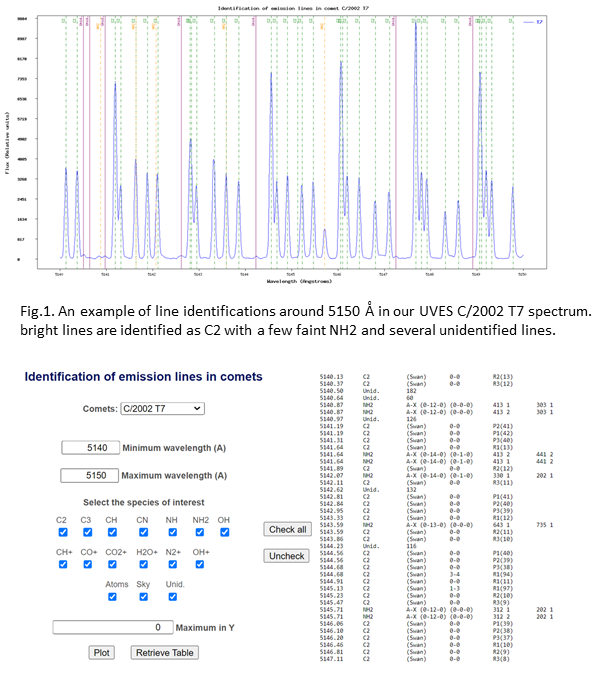
The Cometary line Atlas.   We present here a new atlas containing about 22,000 detected emission lines. Among those, approximately 75% were successfully identified as radicals (OH, NH, S2, CN, CH, C3, C2, NH2), ions (OH+, CH+, H2O+, CO+, N2+, CO2+) or atoms ([OI], [CI], [NI], NaI, FeI, NiI). The online tool allows you to check those emission lines, or the species your are interesed in, for a given wavelength range, by displaying them to the high quality spectrum of comet C/2002 T7 (LINEAR), or any comet spectrum normalised and wavelength calibrated to the laboratory rest frame into the system in ascii format (wavelength; flux). With the input of the velocity of the comet with respect to the Earth (the Doppler shift) you can also check the position of the sky lines in the spectrum. Figure 1 represents a small region of the atlas, where C2, NH2, and unidentified lines are indicated and shows the line list and transitions information that can be retreived as a table for the displayed spectrum.

Perspectives. A key aspect of the project involves conducting up-to-date laboratory measurements and developing models to obtain new modelled line positions for comparison with the observed spectra in order to solve the puzzle of the still thousands of lines not identified yet and improve the atlas.

Link to the online atlas. The Liège cometary line atlas can be reached on the following webpage. Comments to improve the tool are welcome.
https://www2.cometa.uliege.be/Cometary_Lineatlas

References

[1] Cochran, A. L., & Cochran, W. D. (2002). "A high spectral resolution atlas of comet 122P/de Vico". Icarus, 157(2), 297-308.

[2] Ballester, P., Modigliani, A., Boitquin, O., et al. (2000). "The UVES Data Reduction Pipeline" The Messenger, 101, 31

[3] Kurucz, R. L. (2005). "New atlases for solar flux, irradiance, central intensity, and limb intensity" Mem. S.A.It Suppl., vol. 8, 189. 

[4] Hardy, P. (2022) “Atlas of cometary lines obtained from a high-resolution spectrum of comet C/2002 T7 (LINEAR),” Master’s thesis, University of Liège.

[5] Tennyson, J., “The 2024 release of the ExoMol database: Molecular line lists for exoplanet and other hot atmospheres”, Journal of Quantitative Spectroscopy and Radiative Transfer, vol. 326, 2024. 

[6] Rousselot, P., Jehin, E., Hutsemékers, D., Opitom, C., Manfroid, J., & Hardy, P. (2024). "12CO+ and 13CO+ fluorescence models for measuring the 12C/13C isotopic ratio in comets." Astronomy & Astrophysics, 683, A50.

[7] Rousselot, P., Anderson, S. E., Alijah, A., et al. (2022). N+2 fluorescence spectrum of comet C/2016 R2 (PanSTARRS) Astronomy & Astrophysics, 661, A131.

[8] Hardy, P., Jehin, E., Rousselot, P., Hutsemekers, D., & Manfroid, J. (2023, August). "Atlas of Cometary Lines Obtained from High-Resolution Optical Spectra of Comets C/2002 T7 (LINEAR) and C/2016 R2 (PanSTARRS)". In Asteroids, Comets, Meteors Conference.

[9] Blond-Hanten, E. (2024) "Investigation of unidentified lines in optical cometary spectra", Master’s thesis, University of Liège.

[10] Hanuschik R. W. (2003) " A flux-calibrated, high-resolution atlas of optical sky emission from UVES". Astronomy & Astrophysics 407, 1157-1164

[11] Opitom, C., Hutsemékers, D., Jehin, E., et al. (2019). Astronomy & Astrophysics 624, A64

How to cite: Jehin, E., Hardy, P., Blond Hanten, E., Hutsemékers, D., Manfroid, J., and Sohy, S.: An online high resolution atlas of near-UV and optical cometary emission lines, EPSC-DPS Joint Meeting 2025, Helsinki, Finland, 7–13 Sep 2025, EPSC-DPS2025-1777, https://doi.org/10.5194/epsc-dps2025-1777, 2025.

10:18–10:30
|
EPSC-DPS2025-824
|
On-site presentation
Cyrielle Opitom and Madeleine McLeod

Despite over a century of cometary observations, we are still struggling to understand the activity of comets. Questions such as ‘what drives the activity of comets at different distances from the Sun?’ or ‘Does the activity of all comets evolve in a similar way?’ remain  unanswered. This is in part due to the difficulty to observe the drivers of cometary activity: H2O, CO, and CO2 can only be detected simultaneously using space observatories. JWST has proven an incredible resource to answer these questions [1,2], but only a limited number of comets have been observed so far.

The last decade has seen the advent of large field of view Integral Field Spectrographs (IFUs) for observations at optical wavelengths. These instruments, such as MUSE on the 8-m Very Large Telescope [3], present an interesting opportunity to characterize the distant activity of comets, due to the combination of spatial and spectral information they provide. Large scale IFUs on ground-based telescopes can be particularly useful to probe cometary activity drivers that are typically difficult to measure from the ground, including H2O, CO, CO2- and potentially O2 - through the study of some of their dissociation products such as oxygen [4,5]. IFUs are generally very sensitive to faint extended emission and are thus ideal tools for the observations of active small bodies in the solar system.

We have observed a number of comets over a wide range of distances from the Sun with the MUSE instrument of the VLT over the last 7 years. We use these data to measure the ratio between the green (557 nm) and the two red line (630 and 637 nm) forbidden oxygen lines at optical wavelength, usually referred to as G/R ratio. We focus on observations of 29P//Schwassmann–Wachmann 1, the most distant comet observed with MUSE, for which we were able to detect forbidden oxygen lines. Comparing the very high measured G/R ratio, consistent with an activity driven by CO, to that measured for other comets at smaller heliocentric distances, and to direct observations of the activity drivers with JWST or ground-based radio observatories, we demonstrate that MUSE constitutes a powerful tool to study the activity evolution of comets that were previously thought too distant or too faint for ground-based optical spectroscopy.

References: [1] Snodgrass C. et al., 2025, MNRAS in press (arXiv 2503.14071) [2] Faggi S.  et al., 2024, Nature Astronomy, Volume 8, Issue 10, pp. 1237-1245 [3] Bacon R., et al., 2010, Proceedings of the SPIE, Volume 7735, id. 773508 [4] Kwon Y., Opitom C., Lippi M.,   Astronomy & Astrophysics, Volume 674, id.A206, 11 pp. [5] Opitom C., et al., 2020, Astronomy & Astrophysics, Volume 644, id.A143, 7 pp.

How to cite: Opitom, C. and McLeod, M.: Using ground-based IFUs to constrain cometary activity drivers, EPSC-DPS Joint Meeting 2025, Helsinki, Finland, 7–13 Sep 2025, EPSC-DPS2025-824, https://doi.org/10.5194/epsc-dps2025-824, 2025.

Distant activity and monitoring of comets

Orals FRI-OB3: Fri, 12 Sep, 11:00–12:30 | Room Jupiter (Hall A)

Chairpersons: Daniel Müller, Emmanuel Jehin
11:00–11:15
|
EPSC-DPS2025-1691
|
ECP
|
On-site presentation
Léa Ferellec

Comets are icy small bodies assumed to be mostly unaltered since their formation, making them key tracers of the early stages of the Solar System. Efforts have been deployed to establish classifications of comets in the hope of connecting the current populations to different formation and evolution histories. On the one hand, from a dynamical standpoint, it has been found that comets exist in two main reservoirs before being deflected towards the inner Solar System: the Oort Cloud and the Kuiper Belt. On the other hand, by quantifying the composition of the gas produced by comets, it has also been shown that some comets could be considered as carbon-depleted, displaying low C2/CN abundance ratios (e.g. [1],[2],[3]). This talk will present two surveys tackling current challenges in our understanding of dynamical and composition-based classifications of comets:


Probing the composition of comets via optical spectroscopy

While carbon-depletion is believed to be a primordial feature of depleted comets, there is no direct link between the dynamical origin of a comet and its carbon content, which is puzzling. Some studies (e.g. [4],[5]) have reported a decrease of the measured C2/CN ratio with the heliocentric distance of comets at the time of observation, suggesting that our understanding of C2 production in comae might be incomplete and that C2 based taxonomies could be biased. Since previous composition studies have typically covered short heliocentric distances (<2au) and different authors have used different sets of modelling parameters (in particular photodissociation scalelengths) to derive these abundance ratios, it is difficult to compare their findings and assess these effects.

I will present a survey of comet volatiles using optical long-slit spectroscopy, aiming to investigate trends and biases in observed compositions. Spectra were acquired for 35 comets using the Isaac Newton Telescope’s Intermediate Dispersion Spectrograph. Having produced a semi-automated pipeline to reduce and analyse this large volume of data, I calculated production rates and upper limits for the main volatile species visible in the near-UV/optical range: OH, NH, C2, CN, C3, CH.

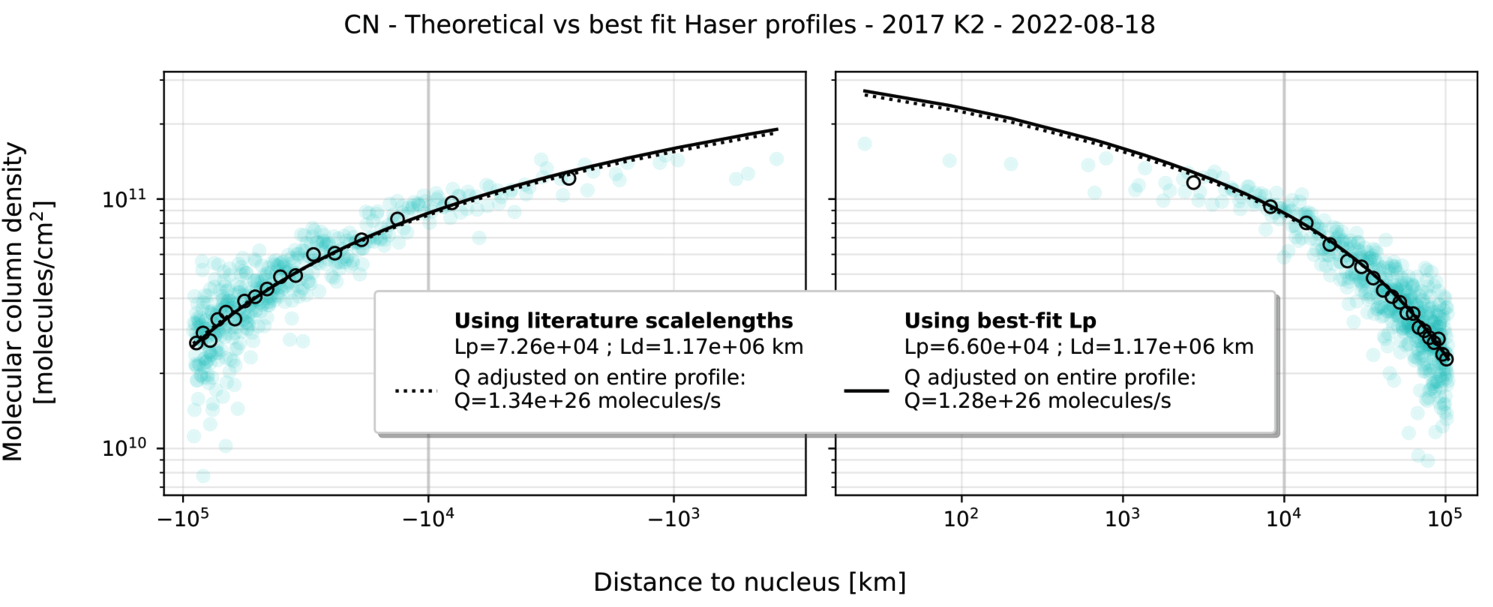
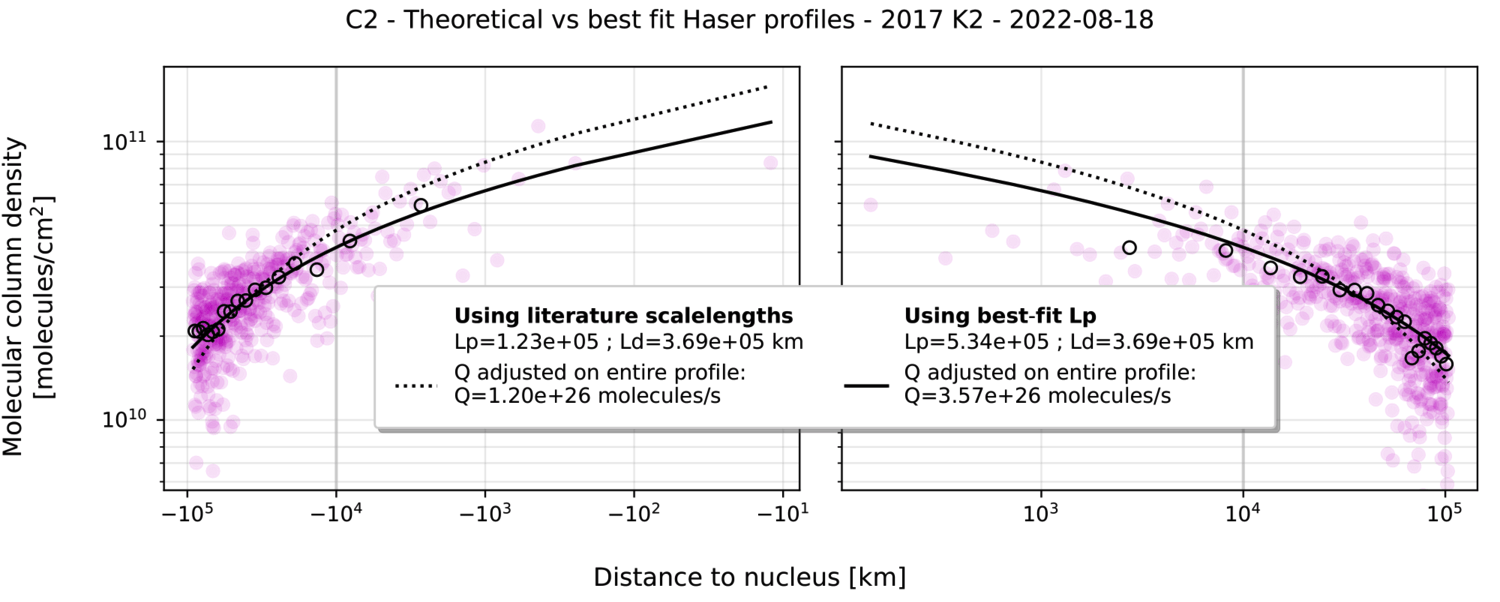
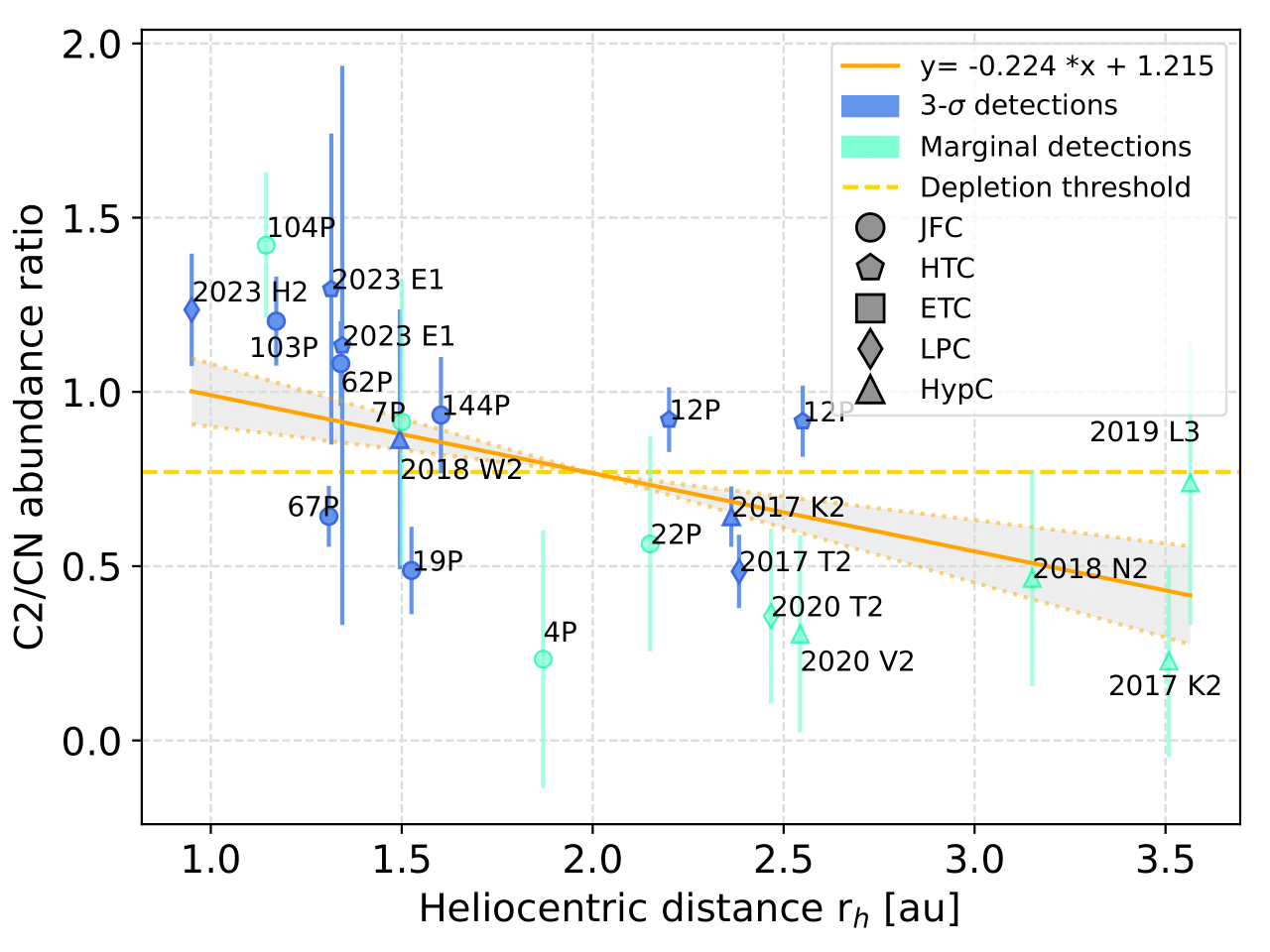
From these production rates, derived from a Haser outgassing model and commonly used photodissociation scalelengths, I find C2/CN ratios consistent with a decreasing trend between 1 and 3.5au (Fig 1a). This effect compromises the validity of a universal depletion-threshold, as most comets observed beyond 2au fall into the depletion range. For a few comets such as 12P or C/2017 K2, I determined and modelled the spatial distributions of volatiles as seen along the slit. This analysis shows that a Haser model using literature scalelengths often does not reproduce the measured C2 profiles (e.g. Fig 1b), rendering C2 production rate measurements inaccurate.


A targeted search for Main Belt Comets

The recent discovery of comets hidden in the Main Asteroid Belt [6][7] blurs the traditional distinction between asteroids and comets. However, too few Main Belt Comets (MBCs) are currently known to understand the characteristics and origin of this third comet reservoir.

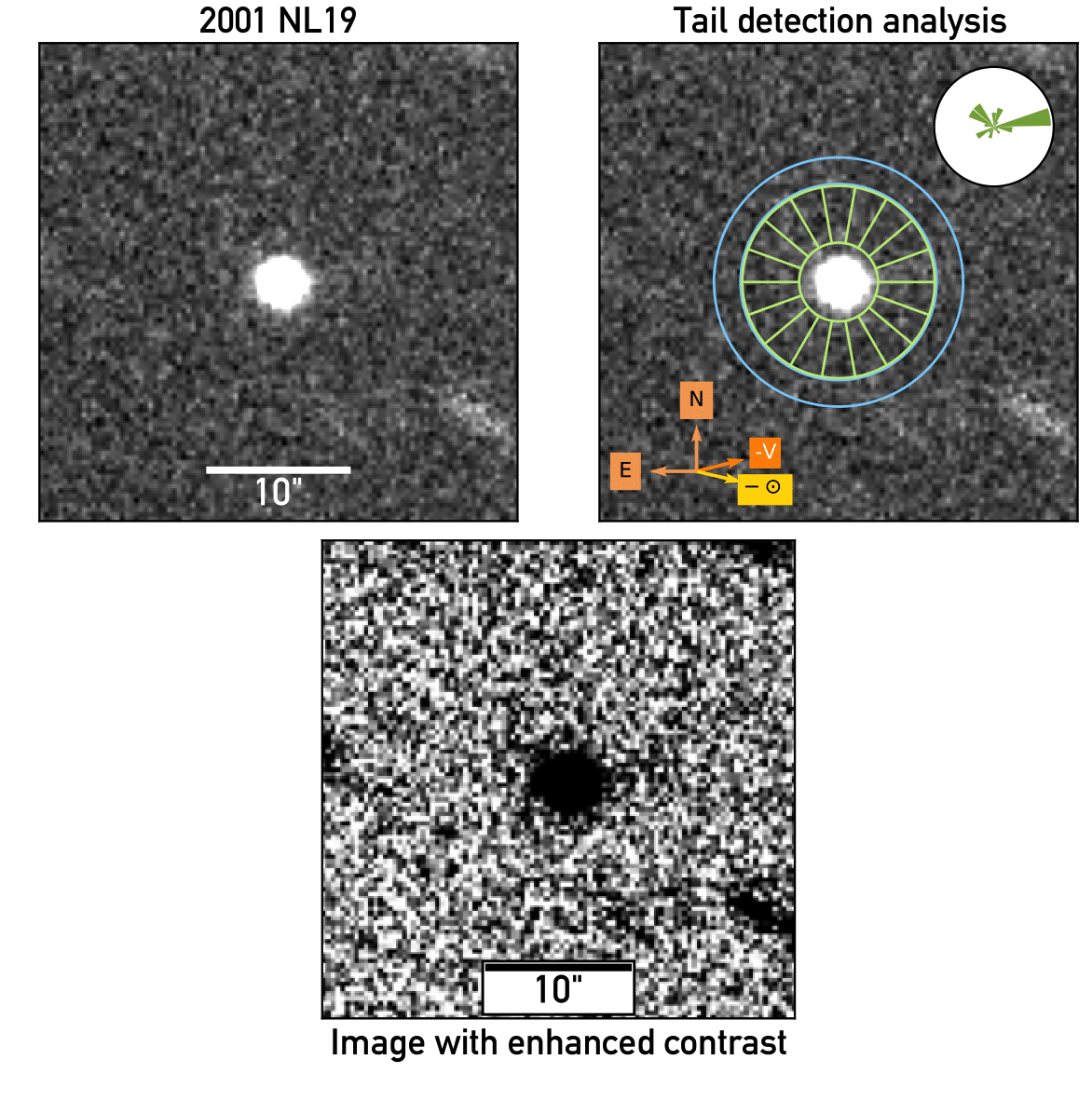
I will present an imaging survey looking for active asteroids in the hope of identifying more MBCs. Using the Isaac Newton Telescope’s Wide Field Camera, r-band observations of more than 500 asteroids were conducted. These were selected based on their closeness to perihelion and on a hypothesis from [8] that MBCs would more likely be found among objects with a longitude of perihelion close to that of Jupiter. After applying wedge photometry and point-spread function analysis methods adapted from [9] to detect activity features, I made one tentative tail detection on images of asteroid 2001 NL19 (279870) (Fig 2). From images acquired with the Liverpool Telescope at the asteroid’s following perihelion, I did not detect recurring activity.


Fig 1a: Measured C2 to CN ratios vs. heliocentric distance over on our entire sample of comets. Different marker types represent different dynamical types of comets. JFC: Jupiter Family Comet; HTC: Halley-Type Comet; ETC: Encke-Type Comet; LPC: Long-Period Comet; HypC: Hyperbolic Comet. Dark and light blue markers indicate 3-σ measurements and marginal detections respectively. A yellow dashed line indicates the depletion threshold corresponding to the survey of [1].


Fig 1b: Molecular density profiles of CN (top) and C2 (bottom) observed in C/2017 K2 along the slit of the spectrograph. Solid lines represent Haser model profiles with literature photodissociation scalelengths, modelling the expected distribution of a daughter species produced by the dissociation of a parent species coming from the nucleus. Dotted lines represent Haser model profiles with parent scalelengths adjusted to match the observed profiles, ultimately resulting in higher C2 to CN ratios.

Fig 2: INT-WFC r-band image of asteroid 2001 NL19 (279870) observed on 2019 November 07. The circular plot in the top-right figure shows the relative brightness of different wedges around the object, showing a bright anomaly towards the West which was flagged as statistically significant compared to bright wedges found around reference stars on the same image. A faint tail like feature is visible in the West direction, consistent with the anti-solar and anti-velocity directions, and inconsistent with the trailing direction of a potential background star.


References:

[1] A’Hearn M. F., Millis R. C., Schleicher D. O., Osip D. J., Birch P. V., 1995, Icarus, 118, 223

[2] Fink U., 2009, Icarus, 201, 311

[3] Cochran A. L., Barker E. S., Gray C. L., 2012, Icarus, 218, 144

[4] Langland-Shula L. E., Smith G. H., 2011, Icarus, 213, 280

[5] Newburn R. L., Spinrad H., 1989, AJ, 97, 552

[6] Hsieh H. H., Jewitt D. C., Fernández Y. R., 2004, AJ, 127, 2997

[7] Kelley, M.S.P., Hsieh, H.H., Bodewits, D., Saki M., Villanueva G. L., Milam S. N., Hammel H. B., 2023, Nature, 619, 720–723

[8] Kim Y., JeongAhn Y., Hsieh H. H., 2018, AJ, 155, 142

[9] Sonnett S., Kleyna J., Jedicke R., Masiero J., 2011, Icarus, 215, 534

How to cite: Ferellec, L.: Searching for new insights into dynamical and composition-based comet taxonomies, EPSC-DPS Joint Meeting 2025, Helsinki, Finland, 7–13 Sep 2025, EPSC-DPS2025-1691, https://doi.org/10.5194/epsc-dps2025-1691, 2025.

11:15–11:27
|
EPSC-DPS2025-721
|
On-site presentation
Bin Yang, Silvia Protopapa, and Michael S. P. Kelley

Introduction  Water ice, the most abundant solid in protoplanetary disks, plays a critical role in planet formation by enhancing grain growth and  planetesimal formation. In the Solar System, it likely contributed to the cores of giant planets and the volatiles of the terrestrial planets. The physical structure of water ice, amorphous versus crystalline, is sensitive to the temperature and pressure at the time of formation, as well as to the subsequent thermal evolution. Comets, as some of the best-preserved icy relics of the protoplanetary disk, offer a unique window into the physical properties of primordial materials. Recent discoveries of distant, active Oort cloud comets, beyond the water-ice sublimation line, present rare opportunities to study intrinsically bright, minimally evolved nuclei under conditions of reduced coma activity relative to comets observed at smaller heliocentric distances. Targeted observations of kilometer-sized, non-outbursting distant comets are an important piece of the puzzle for probing the properties of water ice released from the surface and/or interior of minimally processed nuclei, shedding light on the characteristics of ices in the Oort Cloud reservoir.
Observations  We conducted near-infrared (IR) spectroscopic observations of three typical-sized, quiescent distant comets—C/2019 O3, C/2019 E3, and C/2019 F2, using the Near-Infrared Spectrograph (NIRSpec) Integral Field Unit (IFU) on board the James Webb Space Telescope (JWST). All targets have perihelia beyond 8.8 au, where the local blackbody temperature is ~93 K. At such low temperatures, if amorphous water ice is present in the nucleus, it may never undergo large-scale crystallization. Our primary goal was to detect and characterize diagnostic features of crystalline water ice, particularly the 1.65-μm absorption band and the 3.1-μm Fresnel reflection peak. We also searched for supervolatiles species (CO, CO₂) and organics, including methanol, HCN, and aromatic and aliphatic hydrocarbons.
Results and Discussion JWST spectra reveal diagnostic water ice absorption features in all three comets, along with fluorescence emissions from CO and CO₂. Despite similar heliocentric distances, the comets display striking diversity in both volatile production rates and the characteristics of the water ice features, including variations in band depth and spectral shape. While comets C/2019 O3 and C/2019 E3 exhibit a typical 1/ρ coma profile consistent with steady-state outflow, comet C/2019 F2 shows a markedly different morphology, suggesting a non-standard ejection mechanism or evolutionary history. We explore possible explanations for this unusual coma structure and discuss its implications for understanding the drivers of activity in distant comets.  These findings enhance our knowledge of the physical state of water ice and contribute to a broader understanding of volatile evolution in outer solar system bodies.

How to cite: Yang, B., Protopapa, S., and Kelley, M. S. P.: Characterizing the Properties of Water Ice in Distant Oort Cloud Comets with JWST, EPSC-DPS Joint Meeting 2025, Helsinki, Finland, 7–13 Sep 2025, EPSC-DPS2025-721, https://doi.org/10.5194/epsc-dps2025-721, 2025.

11:27–11:39
|
EPSC-DPS2025-1155
|
On-site presentation
Olga Harrington Pinto and Dennis Bodewits

1. Introduction

Centaurs are small bodies on unstable orbits between Jupiter and Neptune that dynamically evolve from the trans-Neptunian scattered disk into Jupiter family comets (JFCs). Their intermittent cometary activity, driven by sublimation of volatiles at 5–10 au, offers unique windows into the primordial volatile inventory of the outer Solar System. Before JWST, direct measurements of CO2, and CO in Centaur comae were sparse: CO was detected in a few centaurs, CO2 remained directly undetected.In this presentation we will discuss the comparisons and correlations of centaurs with trans Neptunian objects, and Oort cloud comets.

2. Observations and Data

2.1 Centaurs

JWST program GO 2416 observed five active centaurs: 29P/SW1, C/2008 CL94 (Lemmon), C/2014 OG392 (PanSTARRS), C/2019 LD2 (ATLAS), and 39P/Oterma; in IFU prism mode with dedicated background visits. Each spectrum spans 0.6–5.3 µm at R ∼ 100, enabling detection of emission lines and absorptions of volatiles and ices.

2.2 Trans-Neptunian Objects

Recent JWST observations of TNOs have classified their near-IR reflectance spectra into three classes—Bowl, DoubleDip, and Cliff-type—based on absorption features around 3 µm and spectral slopes (Licandro et al., 2024). These classes correlate with water ice, organics, and silicates, tracing different formation environments in the outer disk.

2.3 Oort Cloud Comets

JWST observations of OCCs have employed NIRSpec and MIRI IFUs to study these comets at a variety of heliocentric distances. Recent sutdies reveal hyperactive water production (>90% active fraction), multiple volatiles (H2O, 12CO, 13CO, CO2, CH3OH, CH4, CN, H2CO, C2H6, HCN, NH2, OH prompt emission), and a dust composition dominated by amorphous carbon, Mg–Fe silicates, and Mg-rich crystalline olivine (Woodward et al., 2025).

3. Results

Several centaurs exhibit clear detections of CO (4.7 µm), CO2 (4.26 µm), and H2O (2.7 µm) emission lines. 29P/SW1 shows heterogeneous outgassing regions traced by mapped CO jets, indicating localized active areas (Faggi et al., 2024). JWST provided the first detection of CO2 in 39P/Oterma beyond 5 au, demonstrating sensitivity orders of magnitude beyond previous limits (Harrington Pinto et al., 2023).

4. Discussion and Conclusions

Centaurs occupy an evolutionary niche; they bear surface signatures of TNOs yet they show early stages of volatile loss into JFCs. The matching volatile ratios (CO/H2O, CO2/H2O) across centaur and Oort Cloud comet populations support a continuum of primordial compositions modified by heliocentric distance and thermal history. JWST NIRSpec IFU has, for the first time, provided a direct and sensitive inventory of volatiles in active centaurs, revealing two distinct compositional groups that align with TNO spectral classes and connect to Oort Cloud comet properties. These findings strongly suggest centaurs as transitional bodies bridging outer-solar-system reservoir compositions and the dynamic, compositional diversity of inner solar system comets. Future JWST monitoring over multiple apparitions and expanded target samples will further elucidate the thermal and chemical evolution of small bodies tracing planetary system origins.


References:

Faggi, S., Villanueva, G. L., McKay, A., Harrington Pinto, O., Kelley, M. S. P., Bockelee-Morvan, D., Womack, M., ´ Schambeau, C. A., Feaga, L., DiSanti, M. A., Bauer, J. M., Biver, N., Wierzchos, K., and Fernandez, Y. R. (2024). Heterogeneous outgassing regions identified on active centaur 29P/Schwassmann–Wachmann 1. Nature Astronomy, 8(10):1237–1245.

Harrington Pinto, O., Kelley, M. S. P., Villanueva, G. L., Womack, M., Faggi, S., McKay, A., DiSanti, M. A., Schambeau, C., Fernandez, Y., Bauer, J., Feaga, L., and Wierzchos, K. (2023). First Detection of CO2 Emission in a Centaur: JWST NIRSpec Observations of 39P/Oterma. , 4(11):208.

Licandro, J., Pinilla-Alonso, N., Holler, B., Wong, I., de Pra, M., Melita, M., Souza Feliciano, A. C., Brunetto, R., Guilbert-Lepoutre, A., Henault, E., Lorenzi, V., Stansberry, ´ J., Schambeau, C., Harvison, B., Pendleton, Y., Cruikshank, D., Mueller, T., Emery, J., McClure, L., and Peixinho, N. (2024). Deciphering TNOs thermal evolution through Centaur surface studies using JWST. In European Planetary Science Congress, pages EPSC2024–984.

Woodward, C. E., Bockelee-Morvan, D., Harker, D. E., Kelley, M. S. P., Roth, N. X., Wooden, D. H., and Milam, S. N. (2025). A JWST Study of the Remarkable Oort Cloud Comet C/2017 K2 (PanSTARRS). arXiv e-prints, page arXiv:2504.19849.

How to cite: Harrington Pinto, O. and Bodewits, D.: Volatile Voyagers: How Centaurs Chart the Transition from TNOs to Inner-System Comets, EPSC-DPS Joint Meeting 2025, Helsinki, Finland, 7–13 Sep 2025, EPSC-DPS2025-1155, https://doi.org/10.5194/epsc-dps2025-1155, 2025.

11:39–11:51
|
EPSC-DPS2025-972
|
ECP
|
On-site presentation
Alessandra Mura, Monica Lazzarin, Fiorangela La Forgia, Gabriele Cremonese, Luca Bizzocchi, Andrea Farina, Paolo Ochner, Pamela Cambianica, and Giovanni Munaretto

Comets are some of the oldest objects in our solar system and are often seen as remnants from its formation. The nuclei of comets are thought to have formed inward in the solar system, in the giant planets’ region, where ice can easily form. Later, the giant planets changed the paths of smaller bodies and pushed many into areas where comets are now found (Ceccarelli et al. 2022). The Kuiper Belt contains the precursors of short-period comets, which have low-inclination orbits, while the Oort Cloud is a distant region with long-period comets that are considered to be among the least altered objects since the formation of the solar system. The outside of a comet’s nucleus is exposed to cosmic and interstellar radiation, which creates a protective layer of tough material. This layer helps to keep the ices inside safe (Prialnik & Bar-nun 1988).

The upcoming Comet Interceptor (CI) mission by ESA (Jones & et. al 2024) represents the initial attempt to strategically meet an Oort Cloud comet as it travels toward the inner Solar System. The mission aims to intercept a Dynamically New Comet (DNC) or an interstellar object (Meech et al. 2017; de León et al. 2019) before its perihelion passage, offering a unique chance to collect data on its composition, activity, and the surrounding dust and gas. Given the brief timeframe between a comet’s detection and its approach to perihelion, the CI mission is set to launch without a specific target. Instead, it will depend on identifying a suitable target post-launch. This strategy requires a solid understanding of the expected behaviour and activity of DNCs. Understanding these comets’ evolution is vital to optimize the mission’s scientific results.
Spectroscopic analysis plays a crucial role in defining the composition of cometary ices, providing insights about a wide range of molecules detectable across various wavelengths. In the visible range, cometary spectra are dominated by molecular bands of daughter species such as OH, CN, C2, C3, CH,
and NH2, which result from the photolysis of parent molecules. These daughter species can either sublimate directly from the nucleus or be ejected into the coma, with their distribution acting as a key indicator of the comet’s internal composition. In the infrared range, spectra display rovibrational transitions of primary parent molecules, such as H2O, CO2, CH4, HCN, NH3, and NH2 (Bockelée-Morvan & Biver 2017). Additionally, atomic lines from alkali metals like Na and K are observed in the coma, providing essential data for studying the solar system’s original elemental abundances (Fulle et al. 2013). 

Observing comets from a high inbound distance from perihelion is crucial to understand their behaviour as they approach the Sun for the first time. One of the main objectives of current research, in anticipation of the Comet Interceptor mission, is to identify the primary drivers of cometary activity.
The purpose is to determine how and when the transition from one activity driver to another occurs. For instance, several comets with well-documented high-distance activity, such as C/2017 K2 (active at rh = 23.7 AU) (Jewitt et al. 2017), C/2010 U3 Boattini (active at 25.8 AU) (Hui et al. 2019), and
C/2014 UN271 Bernardinelli-Bernstein (active at 23.8 AU) (Farnham et al. 2021), are believed to have their activity driven by volatile species other than water ice. These comets are thought to be primarily influenced by sublimation of supervolatiles like CO or CO2 (A’Hearn et al. 2011). 
In preparation for the Comet Interceptor mission, a detailed series of spectroscopic observations of Oort Cloud comets has been carried out using the Telescopio Nazionale Galileo with the DOLORes and NICS instruments, covering a total wavelength range of 3800 - 25000 Å. This initiative involved six programs (AOT 37-41-42-43-44-45), through which 31 comets were observed, of which 11 are long-period comets and 20 are Hyperbolic. Notably, four of the hyperbolic comets meet the criteria for classification as DNC. These programs encompass heliocentric distances ranging from 1.4 to 9.2 AU, offering an extensive overview of the general behaviour of long-period and hyperbolic comets along various segments of their inbound trajectories.

Preliminary results indicate that there are few signs of activity in terms of gas emissions. At great distances from the Sun, the primary indicator of a comet’s activity is its dust environment. In addition to spectral data, imaging frames of the targets have been collected to monitor the shape and development of the coma alongside gas emission observations. In these data, beyond 5 AU, the coma appears condensed, and the continuum shape in the spectrum is very narrow. As we get closer, the thickness of the continuum increases, the diameter of the coma begins to expand, and only below 3 AU, certain
spectroscopic features start to emerge, such as CN blue band and C2 Swan bands.

This work presents the preliminary results from the analysis of this large campaign of observations with TNG. Also, one of the newest discoveries of ideal Comet Interceptor virtual targets is covered by this presentation.
C/2024 E1 (Wierzchos) is one of the most recently discovered long-period comet currently in its inbound arc and very little is still known about this target. Discovered in March 2024, C/2024 E1 was located 8 AU from the Sun and is expected to pass perihelion on January, 20, 2026 within Earth’s orbit. For this
target, at the time of this writing, two spectra with MODS at LBT and three spectra from AFOSC at INAF Copernico telescope in the visual range have been collected. The results of these spectra will be compared with JWST observation of the comet (PI: C. Snodgrass, Snodgrass et al. (2025), preprint). 

How to cite: Mura, A., Lazzarin, M., La Forgia, F., Cremonese, G., Bizzocchi, L., Farina, A., Ochner, P., Cambianica, P., and Munaretto, G.: Spectroscopy of Dynamically New and Long Period Comets from TelescopioNazionale Galileo, EPSC-DPS Joint Meeting 2025, Helsinki, Finland, 7–13 Sep 2025, EPSC-DPS2025-972, https://doi.org/10.5194/epsc-dps2025-972, 2025.

11:51–12:03
|
EPSC-DPS2025-830
|
ECP
|
On-site presentation
Irene Mariblanca-Escalona, Luisa María Lara López, Fernando Moreno Danvila, Pedro José Gutiérrez Buenestado, and Marçal Evangelista Santana

We present our recent efforts to measure the dust-to-gas ratio in several comets, motivated by the need to improve our understanding of this critical parameter, which provides key constraints for dust-to-ice interior models and dust-gas interaction processes. We will focus on the results obtained for the Jupiter Family Comet (JFC) 7P/Pons-Winnecke (hereafter 7P) during its 2021 apparition (Mariblanca-Escalona et al. 2025). Additionally, we are conducting similar observations of the dynamically new comet (DNC) C/2024 E1 (Wierzchos). We will share preliminary results based on the data collected so far.

  • BACKGROUND:

Comets belong to different dynamical classes that reflect their origins and evolutionary histories. JFCs, such as 7P, have undergone multiple perihelion passages, leading to thermal processing and alteration of their surface layers. In contrast, DNCs are considered among the most pristine objects in the Solar System, offering valuable insights into its formation and early evolution. However, determining how unaltered these comets truly are remains challenging, largely because critical magnitudes such as the dust-to-ice ratio cannot be measured directly. Even for the well-studied 67P/Churyumov-Gerasimenko, accurately determining the dust-to-ice ratio has proven elusive (e.g., Choukroun et al. 2020). From ground-based observations, the dust-to-gas ratio measured in the coma provides the most accessible proxy for this critical parameter. 

However, accurately determining the dust-to-gas ratio requires thorough characterization of both the dust and gas components of the coma. Moreover, due to the variability of cometary activity, continuous monitoring is essential to capture the coma’s changing properties over time, and therefore, to properly capture the evolution of the dust-to-gas ratio. Driven by the need to better understand the evolution of the dust-to-gas ratio in comets, we have initiated an observational program to characterize the gas and dust environments of multiple comets. Our program is also developed in support of the Comet Interceptor mission. By focusing on DNCs and backup candidates like 7P (initially proposed as a mission target in Schwamb et al. 2020), our work bridges fundamental cometary science with practical mission needs, supporting the planning of the instrument onboard and data interpretation of the Comet Interceptor mission. 

  • OBSERVATIONS: 

After estimating the dust-to-gas ratio for 7P at 1.25 AU using broadband imaging and long-slit visible spectroscopy, we began a similar observational program for the DNC C/2024 E1 (Wierzchos) at Calar Alto Observatory (Spain) in March 2025. So far, we have obtained data at heliocentric distances around 4 AU, with guaranteed observing time until 3.4 AU and additional time requested down to 2.2 AU. Our observations are designed to capture data at intervals of roughly 0.1 AU, allowing us to tightly constrain the temporal evolution of the dust-to-gas ratio throughout the comet’s trajectory.

  • METHODS:

Dust: We analyse the dust environment using a forward Monte Carlo dust tail code (Moreno, F.,  2022), which uses images to derive the dust production rate, size distribution, and ejection velocities of the dust particles. Reliable modeling requires images at several heliocentric distances, therefore, comprehensive and continuous monitoring is essential.

Gas: We derive column density profiles of the observed radicals (CN, C2, C3, and NH2) and fit the column density profiles using the classical Haser and Festou models to estimate production rates of the observed radicals. If these standard models fail to fit the data reliably using classical scale lengths, we plan to to better explore additional processes, such as grain fragmentation and distributed sources, to better understand the coma’s physical and chemical complexity.

We calculate the dust-to-gas ratio by estimating the water production rate using the empirical relation log⁡(QOH/QCN) = 2.5 (A'Hearn et al. 1995) and combining this with the dust loss rate derived from our Monte Carlo dust tail model.

  • RESULTS (7P): 

We observed 7P during its 2021 apparition from Calar Alto Observatory (Spain), using broadband imaging (1.71–1.25 AU pre-perihelion) and long-slit spectroscopy near 1.25 AU pre-perihelion, supplemented by ZTF r-Sloan images before and after perihelion. 

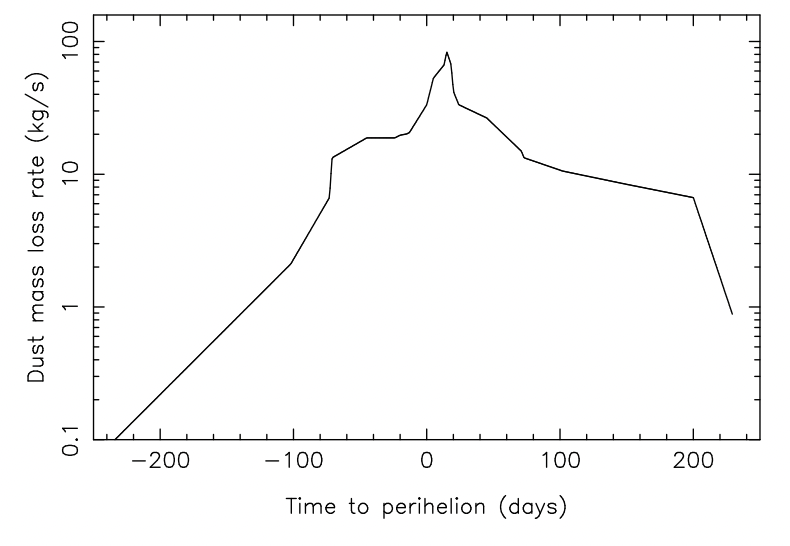
Dust analysis: Our Monte Carlo model generally matched the observed isophotes covering both pre- and post-perihelion observations. We found a peak dust production rate of 83 kg s⁻¹ occurring 15 days after perihelion (see Fig. 1). The derived parameters, including a power-law size distribution index of −3.7 and ejection velocities ranging from 3 m s⁻¹ for the largest particles (0.1 m) to 23 m s⁻¹ for the smallest (5 µm), are consistent with typical cometary dust characteristics.


Figure 1. Derived dust mass loss rate as a function of time to perihelion for 7P.

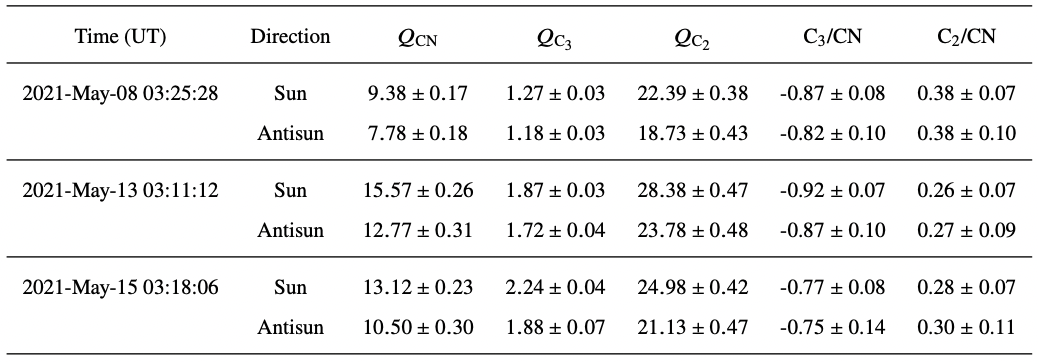
Gas: We fitted the column density profiles with a classical Haser mode, analyzing sunward and anti-sunward directions separately. We adopted parent and daughter scale lengths from A’Hearn et al. (1995), scaling them as rₕ². Tab. 1 shows the production rates obtained along with the logarithmic ratios of the production rates of C3 and C2 relative to CN. Using the C3/CN and C2/CN ratios, we found that  7P cannot be classified as carbon-depleted, though it is somehow C3-depleted. 

Table 1: Gas production rates of 7P for different species (in units of 10²³ s⁻¹), and the logarithmic ratios of the production rates of C3 and C2 relative to CN:  C3 /CN and C2 /CN.

We estimated a dust-to-gas mass ratio of ∼2 at 1.25 AU, indicating a dust-rich composition. Our work significantly broadens the previously limited understanding of the activity and characteristics of 7P.

References

  • A'Hearn M. F., et al., 1995, Icarus, 118, 223
  • Choukroun M., et al., 2020, Space Sci. Rev , 216, 44
  • Mariblanca-Escalona I., et al. 2025, MNRAS, 538, 1329
  • Moreno F., 2022, Universe, 8, 366
  • Schwamb M. E., et al., 2020, RNAAS, 4, 21

How to cite: Mariblanca-Escalona, I., Lara López, L. M., Moreno Danvila, F., Gutiérrez Buenestado, P. J., and Evangelista Santana, M.: Dust and gas characterization of 7P/Pons-Winnecke and C/2024 E1 (Wierzchos) in support of the Comet Interceptor mission, EPSC-DPS Joint Meeting 2025, Helsinki, Finland, 7–13 Sep 2025, EPSC-DPS2025-830, https://doi.org/10.5194/epsc-dps2025-830, 2025.

12:03–12:15
|
EPSC-DPS2025-1785
|
On-site presentation
Said Hmiddouch, Emmanuel Jehin, Manuela Lippi, Mathieu Vander Donckt, Abdelhadi Jabiri, Youssef Moulane, Jean Manfroid, Damien Hutsemekers, and Zouhair Benkhaldoun

C/2017 K2 (PanSTARRS), hereafter K2, is a dynamically new comet, discovered by the Pan-STARRS survey [1] in May 2017, when it was at a heliocentric distance of rh=16.1 au [2]. Further investigations enabled to find a prediscovery images of comet K2 exhibiting activity at a very large distance of 23.8 au in May 2013 ([3]). K2 is the second most distant active comet ever discovered, with CO detected in significant abundance at 6.72 au by Yang et al. (2021) [4], potentially accounting for its activity at such a large heliocentric distance.

I will present a detailed study of the comet activity and composition while crossing the water sublimation line using various instruments, including broad and narrow band photometry with TRAPPIST and optical and NIR high-resolution spectroscopy with UVES and CRIRES+ at the 8-m ESO-VLT.

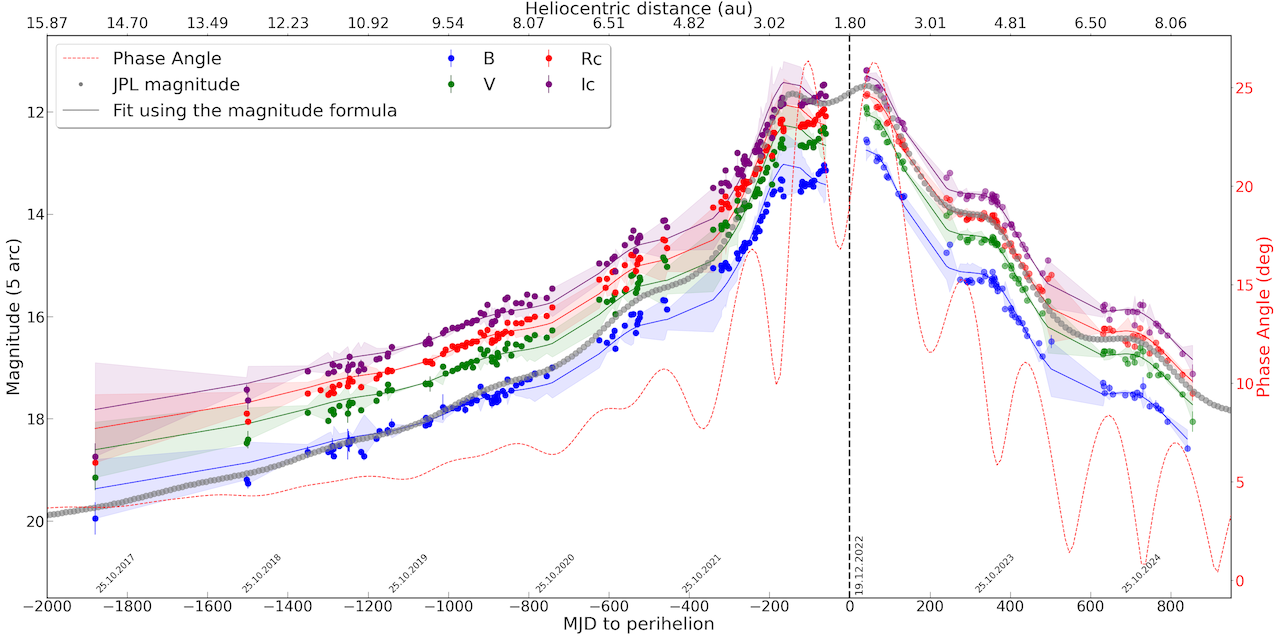
We used both TRAPPIST-North (TN) and –South (TS) [5], to monitor comet K2 for almost eight years. Our observations started with the TN on October 25, 2017, using broad-band filters. At that time, the comet was 15.18 au from the Sun and had a visual magnitude of 19.7 (Figure1). We continued observing the comet with both broadband and HB comet narrowband filters using the TS telescope from September 9, 2021, when it became visible and brighter from the southern hemisphere (rh=5.4 au), until April 20, 2025, after perihelion at 8.46 au. We collected a total of 2204 BB and 174 NB images. The light curve is shown in Figure 1. The brightest magnitude of the comet, with a 5 arcsecond aperture, was 11.18 in the R filter on January 30, 2023. The colors are surprisingly constant throughout the whole range of heliocentric distances, except near the perihelion (< 2.0 au), where the gas contamination of the broadband filters B and V by CN and C2, respectively, is visible. We first detected CN and C2 radicals at the end of March 2022, followed by the majority of other radicals that appeared in the coma about a month later, except for NH, which was observed in mid-August 2022. CN remained detectable in our data until mid-October 2023 at 3.88 au, while C2 and C3 were no longer observed after early October at 3.83 au. OH was detected until September 20 at 3.69 au, while NH was detected until the end of March 2023 at 2.20. The production rates of these daughter species have been derived from a Haser model [6] using the main emission bands and compared to expected parent species detected with CRIRES+ simultaneously.

The Afρ parameter, a proxy for the dust production [7], reached a peak value of approximately 15,000 cm on January 29, 2023, at 1.87 au, placing comet K2 among the most active long-period comets. The Afρ values exhibit significant trends, including a peculiar behavior observed between −260 and −170 days before perihelion (corresponding to heliocentric distances of 3.60 to 2.74 au), where a notable drop is followed by a rapid increase. Based on the production rates, we calculated their ratios relative to CN and OH, as well as the dust-to-gas ratios. Comet K2 falls into the typical compositional group, which is defined by a characteristic abundance of C2 and C3 relative to CN and OH.

 To thoroughly investigate the composition of K2 in the optical range and its evolution while getting closer to perihelion, and compare it to other long-period comets. We conducted a program with the high-resolution Ultraviolet Visual Echelle Spectrograph (UVES) at the VLT, at three different epochs before and after the water sublimation line (≈3.5 au). CO2+ ions are detected, but CO+ are never detected, showing that K2 is not a CO+ rich comet like C/2016 R2 [8], observed at the same distance and whose optical spectrum was dominated by CO+ bands. The high resolution and sensitivity of UVES enabled the detection of all three forbidden oxygen [OI] emission lines at each epoch. This also allowed for the calculation of the green-to-red (G/R) intensity ratio.

Observations were conducted with CRIRES+ over three nights, simultaneously with UVES. The settings were chosen to capture major primary volatiles (e.g., H2O, CO, C2H6, CH4, HCN, NH3) and monitor their evolution as the comet approached the Sun. Despite K2’s significant activity at large heliocentric distances, our infrared observations show a contrasting picture: a very weak dust continuum and faint emission lines from several parent species. Notably, the infrared signatures of species commonly seen in the optical, such as H2O, C2H2, and HCN, were barely detectable even when the comet appeared bright. This suggests the comet remained too far from the Sun (Rh > 2 au) for efficient sublimation of water and other less volatile species. Instead, hypervolatiles like CO and CO2 were likely the main drivers of the strong activity observed at these distances. Due to the weak flux, deriving accurate production rates was challenging, however, the data still allowed comparison between parent species in the infrared and daughter species in the optical.

This combined observational approach underscores the value of integrating high-resolution spectroscopic data of both optical and IR with photometric measurements to achieve a comprehensive understanding of cometary activity and composition.


Figure 1: TRAPPIST light curve of comet C/2017 K2 measured within a radius aperture of 5-arcseconds.


References:
[1] Kaiser, N. & Pan-STARRS Team. 2002, in American Astronomical Society Meeting Abstracts, Vol. 201
[2] Wainscoat, R. J., Wells, L., Micheli, M., & Sato, H. 2017, Central Bureau Electronic Telegrams, 4393, 1
[3] Jewitt, D., Hui, M.-T., Mutchler, M., et al. 2017, ApJ, 847, L19
[4] Yang, B., Jewitt, D., Zhao, Y., et al. 2021, ApJ, 914, L17
[5] E. Jehin et al. 2011, The Messenger, 145, 2-6
[6] Haser, L. 1957, Bulletin de l’Academie Royale de Belgique, Vol. 43
[7] A’Hearn, M. F., Schleicher, D. G., Millis, R. L., Feldman, P. D., & Thompson, D. T. 1984, The Astronomical Journal, 89, 579
[8] Opitom, C., Hutsemékers, D., Jehin, E., et al. 2019, A&A, 624, A64

How to cite: Hmiddouch, S., Jehin, E., Lippi, M., Vander Donckt, M., Jabiri, A., Moulane, Y., Manfroid, J., Hutsemekers, D., and Benkhaldoun, Z.: Long-Term Activity and Compositional Evolution of Comet C/2017 K2(PanSTARRS) from Photometric and High-Resolution Spectroscopic Observations, EPSC-DPS Joint Meeting 2025, Helsinki, Finland, 7–13 Sep 2025, EPSC-DPS2025-1785, https://doi.org/10.5194/epsc-dps2025-1785, 2025.

12:15–12:27
|
EPSC-DPS2025-1066
|
ECP
|
On-site presentation
Aravind Krishnakumar, Mathieu Vander Donckt, Youssef Moulane, Said Hmiddouch, Emmanuel Jehin, Goldy Ahuja, Shashikiran Ganesh, Devendra Sahu, Jabiri Abdelhadi, and Zouhair Benkhaldoun
Comet C/2022 E3 (ZTF) is a long-period comet discovered on March 2, 2022 by the Zwicky Transient Facility. Initially a faint object, it brightened significantly as it approached the inner Solar System, becoming visible to the naked eye in early 2023 under dark skies. The comet passed perihelion at 1.11 au on January 12, 2023, and made its closest approach to Earth on February 1, 2023, at a distance of about 0.28 au. C/2022 E3 was notable for its green coma, caused by strong diatomic carbon (C2) emission, providing a valuable opportunity for photometric and spectroscopic studies of its activity and composition.
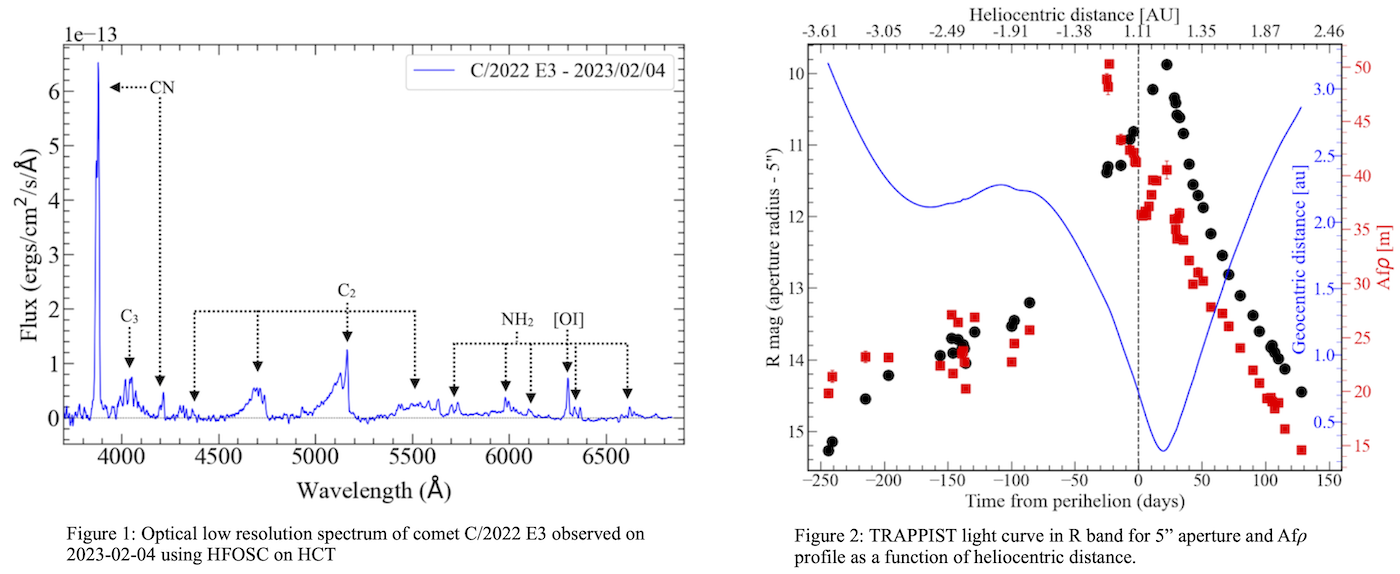
In this work, we present a comprehensive study of comet C/2022 E3 based on a multi-epoch observational campaign combining imaging (broad band BVRI filters and narrow-band HB filters; OH, CN, C₂, C₃, NH for gas species and BC, GC, RC for the dust continuum [1]) from the TRAPPIST-North and -South telescopes [2], with low- and high-resolution optical spectroscopy from the Himalayan Chandra Telescope in India. The comet was monitored over a span of approximately 373 days encompassing its perihelion passage, from 2022 May 12 (rh = 3.52 au, inbound) to 2023 May 20 (rh = 2.22 au, outbound). This extensive dataset allowed us to trace the evolution of dust activity (using the proxy Af(0)ρ [3]) and production rates and rate ratios of key gas species and investigate the physical and compositional properties of the comet's coma. The optical spectrum revealed emissions from the regular neutral molecular species CN, C2, C3, NH2, and forbidden oxygen line as shown in Figure 1.
The combined dataset was utilised to extract the production rates and activity trends of the dust and gas species. The complete activity trend reveals a structured evolution of volatile release, with asymmetric behaviour around perihelion for a few species and evidence for changing molecular dominance as a function of heliocentric distance. Over the period of observation, C/2022 E3 demonstrates a behaviour consistent with a typical carbon-chain comet. While the production rates of the gas species peaked around perihelion; Q(OH) = (3.72+/-0.35)x1028 molec/s, Q(NH) = (2.63+/-0.21)x1026 molec/s, Q(CN) = (8.13+/-0.32)x1025 molec/s, Q(C2) = (1.07+/-0.02)x1026 molec/s, Q(C3) = (2.09+/-0.08)x1025 molec/s, and the Afrho measured in the narrow band filters peaked 25 days prior to perihelion; Afρ(BC) = (3802+/-114) cm, Afρ(RC) = (5370+/-53) cm; the apparent magnitude peaked at about 22 days after perihelion which is not usually observed. This difference in peak for the apparent magnitude was a direct effect of the close approach of the comet with Earth, about 22 days after perihelion, as shown in Figure 2.
The extensive photometric data was used to analyse the dust color in both broad and narrow band images across the heliocentric range to look for any variation. The series of CN imaging data obtained from the TRAPPIST telescopes allowed us to estimate the comet’s nucleus rotation period through the analysis of periodic structures in the coma morphology. Medium-resolution spectroscopy (R~30,000) was employed to investigate the forbidden atomic oxygen lines [OI] at 5577 Å (green) and 6300/6364 Å (red doublet). The moderate spectral resolution allowed us to disentangle cometary and telluric components, enabling the computation of the green-to-red (G/R) intensity ratio. We analysed the variation of the G/R ratio as a function of both nucleocentric distance and heliocentric distance, providing insight into the relative contributions of H2O, CO2, and CO as the parent species of atomic oxygen [4,5,6].
This combined observational study highlights the importance of linking low- and high-resolution spectroscopic datasets with imaging for a holistic understanding of cometary activity and composition.

Acknowledgements

A.K acknowledges support from the Wallonia-Brussels International (WBI) grant. This work is a result of the bilateral Belgo-Indian projects on Precision Astronomical Spectroscopy for Stellar and Solar system bodies, BIPASS, funded by the Belgian Federal Science Policy Office (BELSPO, Government of Belgium; BL/33/IN22_BIPASS) and the International Division, Department of Science and Technology, (DST, Government of India; DST/INT/BELG/P-01/2021(G)). 

References

[1] Farnham, T., The HB Narrowband Comet Filters: Standard Stars and Calibrations. Icarus 147, 180–204 (2000); [2] Jehin, E. et al., TRAPPIST: TRAnsiting Planets and PlanetesImals Small Telescope. The Messenger 145, (2011); [3] A'Hearn et al., Comet Bowell 1980b, The Astronomical Journal 89-4, 579-591 (1984);[4] Festou M., Feldman P. D., 1981, A&A, 103, 154; [5] Bhardwaj A., Raghuram S., 2012, ApJ, 748, 13; [6] Raghuram S., Bhardwaj A., 2014, A&A, 566, A134

How to cite: Krishnakumar, A., Vander Donckt, M., Moulane, Y., Hmiddouch, S., Jehin, E., Ahuja, G., Ganesh, S., Sahu, D., Abdelhadi, J., and Benkhaldoun, Z.: Investigating the Molecular Activity and Composition of Comet C/2022 E3 via Photometry and Optical Spectroscopy, EPSC-DPS Joint Meeting 2025, Helsinki, Finland, 7–13 Sep 2025, EPSC-DPS2025-1066, https://doi.org/10.5194/epsc-dps2025-1066, 2025.

12:27–12:30
Recent comets and coma composition

Orals FRI-OB4: Fri, 12 Sep, 14:00–16:00 | Room Jupiter (Hall A)

Chairpersons: Oleksandra Ivanova, Mathieu Vander Donckt
14:00–14:12
|
EPSC-DPS2025-917
|
ECP
|
Virtual presentation
Nathan Roth, Stefanie Milam, Martin Cordiner, Charles Woodward, Nicolas Biver, Dominique Bockelee-Morvan, Jeremie Boissier, Anthony Remijan, and Steven Charnley

Comets afford a window into the chemistry and physics of planet formation. Through remote sensing of coma gases, the composition of nucleus ices can be inferred and placed into the context of the protoplanetary disk midplane and solar system formation. As all-sky survey capabilities continually improve, comets are being discovered at ever larger heliocentric distances (rH), enabling investigations of their outgassing behavior far outside the rH = 2-3 au window where H2O, the dominant ice in most comets, first begins vigorously subliming. On the other hand, some of these comets will never cross the H2O sublimation zone. Understanding what clues to solar system formation are preserved in the nuclei of these distantly active comets requires relating compositional measurements at much larger rH to the majority of remote sensing work, which takes place when comets are at or inside 1 au from the Sun.

Here we report analysis of ALMA observations of distantly active comet C/2017 K2 (PanSTARRS) in three epochs when the comet was at rH = 4 au, 3.5 au, and 3 au. We observed emission from HCN, CO, CH3OH, H2CO, CS, HNC, and thermal emission from the nucleus and dust coma at millimeter wavelengths. We will discuss the evolution of the spatial distributions, outgassing kinematics, and molecular abundances in the coma as the comet approached the H2O sublimation zone and compare our results to measurements taken when H2O sublimation had activated [1,2] thereby placing them into context with the larger comet population.

This work makes use of ALMA data ADS/JAO.ALMA #2021.1.00862.S.

References:

[1] Woodward et al. 2025, “A JWST Study of the Remarkable Oort Cloud Comet C/2017 K2 (PanSTARRS)”, PSJ, In Press, doi: https://doi.org/10.3847/PSJ/add1d5

[2] Ejeta et al. 2025, “Infrared Compositional Measurements of Comet C/2017 K2 (Pan-STARRS) at Heliocentric Distances Beyond 2.3 au”, AJ, 169, 102

How to cite: Roth, N., Milam, S., Cordiner, M., Woodward, C., Biver, N., Bockelee-Morvan, D., Boissier, J., Remijan, A., and Charnley, S.: ALMA Imaging of Comet C/2017 K2 (PanSTARRS) En Route to the H2O Sublimation Zone, EPSC-DPS Joint Meeting 2025, Helsinki, Finland, 7–13 Sep 2025, EPSC-DPS2025-917, https://doi.org/10.5194/epsc-dps2025-917, 2025.

14:12–14:24
|
EPSC-DPS2025-1065
|
ECP
|
On-site presentation
Patrick Lierle, Carl Schmidt, Jeffrey Morgenthaler, Quanzhi Ye, Qicheng Zhang, Gabriele Cremonese, Giovanni Munaretto, Pamela Cambianica, and Ilya Ilyin

Comets are among the most primitive bodies in the Solar System, preserving primordial materials from the early formation of the Solar System. Among various species observed in cometary comae, sodium is relatively lesser understood due to the high environmental temperature required for its sublimation, which restricts the observable samples to near-Sun comets. Here we present an analysis of five comets using a combination of narrowband imaging and high-resolution spectroscopy.


Coronagraph Imaging

In early July 2020, comet C/2020 F3 (NEOWISE) approached the Sun for the first time in nearly 4,500 years. Comet NEOWISE was observed by the Planetary Science Institute’s Io Input/Output Facility (IoIO; Morgenthaler et al., 2019) 35-cm coronagraph from July 7-16. Narrowband filters were used to isolate the dust and sodium gas emissions in the comae, and this apparition at only 0.33 AU from the Sun allowed some of the best quality images of a cometary sodium tail taken to date, as seen in Figure 1.  For inner solar system comets, sodium is often the brightest emission line available to ground-based telescopes thanks to its efficient resonant scattering of sunlight near the maximum of the solar irradiance spectrum. Strong radiation pressure from resonant scattering shapes sodium gas into a vast anti-sunward tail.

Figure 1: Narrowband filtered images of continuum dust reflectance and sodium D line emission in C/2020 F3 (NEOWISE). At 86° phase angle, the sodium tail here appears nearly orthogonal to the line of sight.

Structure in cometary sodium emissions is shaped by the collisional entrainment in the bulk outflow from the nucleus, additional dusty sources, the temperature of the atoms, absorption of intervening sunlight in the dense coma regions, and radiation pressure. At a certain radius from the nucleus, Na atoms collisionally decouple from the bulk outflow velocity with a thermal distribution. While it is challenging to uniquely parameterize the collisional radius, outflow velocity, and gas temperature, additional insight can be gained from emission line profiles at ample spectral resolutions of R >100,000 thanks to Doppler broadening.


Resolved Linewidth Measurements

During the IoIO imaging campaign, C/2020 F3 (NEOWISE) was also observed with the Lowell Discovery Telescope’s Extreme Precision Spectrometer (EXPRES; Jurgenson et al., 2016), at a resolving power of R = 150,000. At a phase angle of 108° and heliocentric distance of 0.46 AU, forward modeling of the line profiles that accounts for hyperfine structure retrieves effective temperatures ranging 1750 to 1950 K. The RMS velocity of this Doppler broadening is equivalent to 1.13 to 1.19 km/s, which suggests that collisional coupling to the bulk water outflow velocity is the dominant component in the emission line shape.

Figure 2: Outflow velocity at five comets with varying heliocentric distances as derived from resolved Na D emissions. Comets near 90° phase angle roughly follow the r-0.5 relationship outlined by Budzien et al. (1994). C/2023 A3 was measured at both ~0.4 and 0.85 AU and shows variation consistent with this trend. Comets with phase angle >20° from quadrature are shown as outlines.

The water outflow velocity in comets is well known to vary with heliocentric distance. The often-cited relationship of vH2O = 0.85r-0.5 applied by Budzien et al. (1994) is a compromise between hydrodynamical models, which suggest 0.7r-0.5 (Gombosi et al., 1986), and radio observations of OH and HCN at 1P/Halley, which suggest 1.1r-0.5 (Combi, 1989). By comparing Na linewidths in a survey of comets at varying heliocentric distance, we find that the thermal velocity derived from Na linewidths produces a similar relationship. Figure 2 shows linewidth-derived outflow velocity for five comets at a range of heliocentric distances. All spectra were obtained with EXPRES, with the exception of the C/2023 A3 data point at 0.85 AU, which was obtained using the Large Binocular Telescope’s Potsdam Echelle Polarimetric and Spectroscopic Instrument (PEPSI; Strassmeier et al., 2015). Na D2 speeds appear systematically higher, implying that the line core may exceed unity optical depth. Comets 96P, 2P, and C/2023 A3 were observed at phase angles >20° from quadrature, which caused distortion of the line shape due to projection effects along the tail, resulting in outflow speeds higher than the overall trend.


Monte-Carlo Modeling

Figure 3: Preliminary results of Monte-Carlo modeling sodium gas in the coma of C/2020 F3 (NEOWISE), assuming here a collisional radius of 10,000 km, bulk outflow speed of 1.5 km/s and gas temperature of 150 K.

Phase angle distortion of the emission line profiles can be accounted for with Monte-Carlo modeling, and with nearly concurrent imaging and spectroscopy in the case of C/2020 F3 (NEOWISE), this approach has good potential to uniquely quantify the parameters that control sodium dynamics in its coma. We adapt the Monte-Carlo model of C/2012 S1 (ISON) by Schmidt et al. (2015), and this presentation will describe attempts to self-consistently simulate both spatial structure in the tail and Doppler broadening near the optocenter, using C/2020 F3 (NEOWISE) as a case study. A preliminary model run is shown in Figure 3, though it does not yet include emission from within the collisional radius and emission from dusty sources, which will broaden the tail. Work thus far suggests that spectrally resolved sodium emissions could offer a proxy for the water outflow velocity, enabling a new method at optical wavelengths.

How to cite: Lierle, P., Schmidt, C., Morgenthaler, J., Ye, Q., Zhang, Q., Cremonese, G., Munaretto, G., Cambianica, P., and Ilyin, I.: Sodium in Cometary Comae at Various Distances from the Sun, EPSC-DPS Joint Meeting 2025, Helsinki, Finland, 7–13 Sep 2025, EPSC-DPS2025-1065, https://doi.org/10.5194/epsc-dps2025-1065, 2025.

14:24–14:36
|
EPSC-DPS2025-74
|
ECP
|
On-site presentation
Pamela Cambianica, Giovanni Munaretto, Gabriele Cremonese, Alessandra Mura, Fiorangela La Forgia, Luca Bizzocchi, Monica Lazzarin, Cristina Puzzarini, Mattia Melosso, Vania Lorenzi, and Walter Boschin

Introduction: Comets are among the most pristine remnants of the early Solar System [1], preserving volatile ices, refractory dust, and organic compounds that offer insights into the protoplanetary disk [2, 3, 4]. When approaching the Sun, sublimation processes release gas and dust, making comets key targets to study chemical and physical evolution. Molecular emissions in cometary comae reveal volatile inventories and photochemical processes. Comet C/2023 A3 (Tsuchinshan-ATLAS) is an Oort Cloud comet discovered by the Asteroid Terrestrial-impact Last Alert System (ATLAS) on January, 2023. This dynamically new comet reached its perihelion on September 27, 2024, at a distance of 0.39 au from the Sun. As the comet approached the inner Solar System, its activity increased significantly, with a substantial production of dust [5]. In this study, we analyze pre- and post-perihelion optical spectra of comet C/2023 A3, obtained with DOLORES at the Telescopio Nazionale Galileo (TNG) on May 1, 2024, and with the PEPSI spectrograph on the Large Binocular Telescope (LBT) on October 27, 2024. We derive the CN production rate and upper limits for other volatiles. Additionally, we present a post-perihelion high-resolution catalog of emission lines, and compare the emission features and elemental abundances of C/2023 A3 with those observed in other comets.

Methods: Due to the strong dust contamination and low gas emission observed pre-perihelion, only the CN emission band could be detected (see Fig. 1), while upper limits were derived for other molecular species (C₂, C₃, NH₂, see Fig. 2). Post-perihelion, thanks to high-resolution spectroscopy, we built a detailed catalog of emission lines for comet C/2023 A3.

Fig. 1. 𝑇𝑜𝑝 𝑝𝑎𝑛𝑒𝑙. Gaussian fit to the CN emission band centered at 3881.68 Å in the comet’s spectrum. The black line represents the observed spectrum, the red line is the fitted Gaussian profile, the blue dashed line indicates the central wavelength, and the shaded area corresponds to the total flux under the curve. 𝐵𝑜𝑡𝑡𝑜𝑚 𝑝𝑎𝑛𝑒𝑙. Zoomed-in view of the CN emission band and its Gaussian fit. The detailed view highlights the agreement between the fitted Gaussian profile (red line) and the observed data (black line), with the shaded area representing the integrated flux. The central wavelength is marked by the blue dashed line [10]. The CN production rate was determined by fitting a Gaussian profile to the CN (B–X) emission band at 3883 Å and applying a Haser model [8] to account for the spatial distribution in the coma. Fluxes were converted into production rates using standard fluorescence efficiencies and expansion velocities scaled to the heliocentric distance. For undetected species, upper limits were calculated based on the noise level around the expected emission wavelengths, assuming a 3σ threshold, and converted into 

production rates using the same formalism adopted for CN. The strong dust continuum was modeled and subtracted by fitting a low-order polynomial to emission-free regions and using a scaled solar analog spectrum. Following [9], the post-perihelion catalog includes both molecular bands (e.g., CN, C₂, NH₂) and atomic lines (e.g., Na I, K I), enabling a comprehensive analysis of the comet's volatile and atomic inventory. Emission line fluxes were measured by fitting Gaussian profiles after local subtraction of residual solar and telluric features, and were used to derive relative abundances and to compare C/2023 A3 with other comets.

Fig. 2. Top panel: Observed spectrum of comet C/2023 A3 in the spectral region of the C2 bandhead at 5168.64 Å. The black line represents the observed spectrum, while the blue dashed line marks the expected central wavelength of the molecular feature. The shaded red region indicates the area where the emission would be expected, but no significant detection is observed. Middle panel: Same as the top panel but for the C3 bandhead at 4003.65 Å. Bottom panel: Same as the previous panels but for the NH2 bandhead at 5537.27 Å.

Results: Pre-perihelion observations revealed the presence of CN emission in comet C/2023 A3, with a derived production rate of (3.89 ± 0.21) × 10²⁵ molec/s. Due to the strong dust contamination, no other molecular emissions were detected, and we derived upper limits for C₂, C₃, and NH₂: Q(C₂) < 1.30 × 10²⁵ molec/s, Q(C₃) < 3.12 × 10²⁴ molec/s, and Q(NH₂) < 2.79 × 10²⁵ molec/s. The Afρ parameter, an indicator of dust production, was measured at 4329 ± 56 cm, confirming the comet's high dust activity. The production rate ratios log(Q(C₂)/Q(CN)) < −0.48 and log(Q(C₃)/Q(CN)) < −1.10 classify C/2023 A3 as a carbon-depleted comet [10]. Post-perihelion, high-resolution observations with PEPSI at the LBT allowed the construction of a detailed catalog of emission lines. We identified several molecular and atomic species, including CN, C₃, C₂, CH, CO⁺, Na, O I, NH₂, and K.

Conclusions: Comet C/2023 A3 (Tsuchinshan-ATLAS) exhibits characteristics typical of dynamically new, carbon-depleted comets. Pre-perihelion observation confirmed significant dust activity and indicates that C/2023 A3 is a carbon-depleted comet, consistent with previous classifications of dynamically new comets. Post-perihelion high-resolution spectroscopy enabled the detection of multiple molecular and atomic species, enriching our understanding of the comet's chemical inventory.
These results contribute to the broader characterization of volatile and elemental abundances in Oort Cloud comets, providing important constraints for models of Solar System formation and evolution.

Acknowledgements: This research used the facilities of the Italian Center for Astronomical Archive (IA2) operated by INAF at the Astronomical Observatory of Trieste.

References: [1] Morbidelli, A., et al., 2015. A&A 583, A43 [2] Russo, N.D., et al., 2016. Icarus 278, 301–332. [3] Mumma, M.J., et al., 2011. Annu. Rev. Astron. Astrophys. 49, 471–524. [4] Lippi, M., et al., 2024. APJ. Lett. 970, L5. [5] Mugrauer, M., 2024. Astron. Telegram 16911, 1. [6] Tody, D., 1986. Proc. SPIE 627, 733–748. [7] Horne, K., 1986. Publ. Astron. Soc. Pac. 98, 609. [8] Haser, L., 1957. Bull. Acad. R. Belg. 43, 740–750. [9] Cambianica, P., et al., 2021. A&A. 656, A160. [10] Cambianica, P., et al., 2025, PSS, Volume 261, 106102.


How to cite: Cambianica, P., Munaretto, G., Cremonese, G., Mura, A., La Forgia, F., Bizzocchi, L., Lazzarin, M., Puzzarini, C., Melosso, M., Lorenzi, V., and Boschin, W.: Pre- and post-perihelion observations of the carbon-depleted comet C/2023 A3 (Tsuchinshan-Atlas) , EPSC-DPS Joint Meeting 2025, Helsinki, Finland, 7–13 Sep 2025, EPSC-DPS2025-74, https://doi.org/10.5194/epsc-dps2025-74, 2025.

14:36–14:48
|
EPSC-DPS2025-1381
|
On-site presentation
Long-term activity and outburst of comet 12P/Pons–Brooks from broad-band photometry
(withdrawn)
Zhong-Yi Lin, Yu-Chi Cheng, Jie-Lin Yang, and Wing-Huen Ip
14:48–15:00
|
EPSC-DPS2025-1309
|
ECP
|
On-site presentation
Ruining Zhao, Bin Yang, Michael S. P. Kelley, Silvia Protopapa, Aigen Li, and Jifeng Liu

Cometary outbursts are sudden increases in brightness caused by various mechanisms, including cliff collapse, pressure pockets, or impacts etc. The most plausible explanation for recurring and large-scale outbursts may be the crystallization of amorphous water ice. 12P/Pons-Brooks, a Halley-type comet with recurring outbursts, presents a valuable case study for understanding the nature of cometary activity. This work aims to analyze the near-infrared (NIR) and optical spectra of 12P during two major outbursts in October and November 2023, characterize its dust and gas properties, and explore the underlying triggering mechanisms.

We obtained three NIR spectra during two outbursts in October and November 2023, using the 3-m Infrared Telescope Facility (IRTF) and the Palomar 200-inch Telescope (P200), respectively. As shown in Figure 1, all three NIR spectra exhibited absorption bands at 1.5 and 2.0 μm, consistent with the diagnostic absorption features of water ice, superimposed on a red dust-scattering continuum. Through a single-scattering dust model, we found that the November 2 spectrum can be well explained by micrometer-sized crystalline ice at 140-170 K, along with sub-micrometer-sized amorphous carbon. Analysis of the NIR spectra reveals no significant weakening in the depth of the water ice absorption bands from October to November, despite stronger sublimation being expected at smaller heliocentric distances. Possible explanations include: a slight shift in size distribution towards larger grains; continuous replenishment of icy grains from the nucleus; or the presence of exceptionally pure ice.

An optical spectrum was obtained with the Lijiang 2.40-m Telescope during the November outburst.  As shown in Figure 2, emission bands of CN, C2, C3 and NH2 were detected. The C3/CN and C2/CN ratios suggest that 12P was “typical” in C3 abundance but near the limit of C2-depletion at the time of observation. In terms of the Afρ value, 12P is a dusty comet when compared to Halley-type and Jupiter-family comets at similar heliocentric distances.

Combining NIR and optical observations, we found that the specific kinetic energy of the November outburst was about 8 × 10³ J kg-¹, suggesting a triggering mechanism similar to 332P/Ikeya--Murakami and 17P/Holmes, likely the crystallization of amorphous water ice, though other mechanisms remain possible due to limited evidence. In addition, a refractory-to-ice ratio of >1.7 is derived from the total mass loss of dust and gas.

This study provides new insights into the physical properties of water ice grains in outbursting comets. The findings reinforce the hypothesis that crystallization of amorphous water ice is a dominant mechanism driving such events. The results have broader implications for understanding cometary evolution and outburst dynamics, particularly for Halley-type comets.

Figure 1: NIR spectra of 12P taken with SpeX and TSpec. The date and instrument are labeled below the respective spectrum. The red-system band of CN and the two water ice absorption bands are labeled. Spectral regions heavily contaminated by telluric absorption are masked in gray. The “emission” feature near 1.3 μm in the Nov. 3 spectrum is due to imperfect telluric correction. The Nov. 2 spectrum is well reproduced by a dust model (red line), with the best-fit parameters labeled at the bottom: δ-the mass ratio of amorphous carbon to water ice in the coma, α-power-law index of the grain size distribution, ap-the peak grain size.

Figure 2: (a) Optical spectrum of 12P taken on Nov. 2. Also shown are the spectrum of a G2V star (grey line) and the reproduced dust continuum (red dashed lines). (b) Emission component in the spectrum of 12P. Emission bands of CN, C3, C2, and NH2 are labeled.

How to cite: Zhao, R., Yang, B., Kelley, M. S. P., Protopapa, S., Li, A., and Liu, J.: Optical and Near-Infrared Spectroscopy of Outbursting Comet 12P/Pons-Brooks, EPSC-DPS Joint Meeting 2025, Helsinki, Finland, 7–13 Sep 2025, EPSC-DPS2025-1309, https://doi.org/10.5194/epsc-dps2025-1309, 2025.

15:00–15:12
|
EPSC-DPS2025-540
|
On-site presentation
Manuela Lippi, Sara Faggi, Martin Cordiner, Boncho Bonev, Cyrielle Opitom, and Geronimo Villanueva

We present the results obtained from VLT/CRIRES+ observations of the Halley-type comet 12P/Pons-Brooks, during its exceptional apparition in 2024. 

Comets are considered among the least processed bodies of the solar system. Stored in a frozen environment from their formation to the present day, they are expected to retain most of the chemical and mineralogical properties associated with their formation site. Thus, chemical differences among comets coming from different reservoirs (e.g., Jupiter Family vs Oort Cloud comets) can provide important insights into the chemical and physical conditions prevalent in our protoplanetary disc about 4.6 billion years ago, and test a possible radial gradient in the chemistry of forming icy planetesimals, along with the dynamical models that predict their dissemination [1,2,3].

Infrared (IR, 2 - 5 μm) spectroscopic studies of comets provide key information on the relative abundances of many primary (parent) molecules thought to be released directly from the nucleus (e.g., H2O, CH3OH, CH4, C2H6, CO, NH3, H2CO, …), allowing for chemical characterisation. The most recent IR statistics show chemical variability within the comet population but no distinct chemical groups [4,5]. Nonetheless, several dynamical classes of comets remain underrepresented in terms of compositional studies, with Halley-type comets (HTCs) being the least investigated. HTCs are linked to the Oort cloud, but have dynamically evolved into shorter (decades long) orbital periods. 

In 2024, 12P/Pons-Brooks (hereafter 12P) reached perihelion on April 20, at 0.78 au, becoming one of the brightest comets in the last decades, and giving the opportunity to easily measure its chemical composition from ground-based observatories. 

We will show 12P spectra obtained in July 2024 using the cross-dispersed spectrograph CRIRES+ at ESO/VLT, and report retrieved rotational temperatures, production rates and relative abundances for H2O, CO, CH3OH, CH4, C2H6, NH3, H2CO, HCN, C2H2. In addition, we will explore for significant upper limits for species characterised by fainter spectral emission lines such as HDO, HCl and C2H4

Results for 12P will be put in the overall picture of comet composition, taking into account results from CRIRES+ observations of comets in the last four years (e.g., C/2021 A1 (Leonard) [6], C/2023 H2 (Lemmon) [7], and C/2017 K2 (PANSTARRS) [8]), and more generally considering the existing databases [4,5], to determine whether there are statistically significant differences in composition among the various dynamical types (Halley-type vs Jupiter Family vs long-period and dynamically new Oort Cloud comets).

Following [9], we will finally compare abundance ratios measured in 12P and other comets to those found in planet-forming disks surrounding young solar analogues (104 — 106 years old, see for example [10,11]), with the final aim of understanding the degree of chemical reprocessing in the disk (inherited vs reset scenario) and/or the possibility of material evolution in comets after their formation. 

References: [1] Mumma, M. J., & Charnley, S. B., 2011, ARA&A, 49, 471; [2] Eistrup, C., et al., 2019, A&A, 629, A84; [3] Morbidelli, A., & Rickman, H., 2015, A&A, 583, A43; [4] Dello Russo, N., et al., 2016, Icarus, 278, 301; [5]  Lippi, M., et al., 2021, AJ, 162, 74; [6] Lippi et al., 2023, A&A, 676, A105; [7] Lippi et al., 2024, A&A, 689, A77; [8] S. Hmiddouch et al., in preparation; [9] Lippi, M., et al., 2024, ApJ, 970, L5; [10]​​ Podio L., et al., 2020, A&A, 644, A119; [11] Yang et al., 2021, APJ, 910, 1.

How to cite: Lippi, M., Faggi, S., Cordiner, M., Bonev, B., Opitom, C., and Villanueva, G.: CRIRES+ investigations of the volatile composition of Halley-type comet 12P/Pons-Brooks during its exceptional passage in 2024, EPSC-DPS Joint Meeting 2025, Helsinki, Finland, 7–13 Sep 2025, EPSC-DPS2025-540, https://doi.org/10.5194/epsc-dps2025-540, 2025.

15:12–15:24
|
EPSC-DPS2025-801
|
Virtual presentation
Erika Gibb, Mohammad Saki, Michael DiSanti, Boncho Bonev, Nathan Roth, Sara Faggi, Neil Dello Russo, Ronald Vervack, Geronimo Villanueva, Hideyo Kawakita, and Younas Khan

Comets are remnants from the early solar system and retain volatiles from the time and place of their formation in the outer protoplanetary disk. Gravitational interactions with the young giant planets scattered many of them into one of two main dynamical reservoirs where they have been preserved since their formation: the Kuiper Belt and the Oort Cloud. Subsequent perturbations have modified some cometary orbits towards the inner solar system where they can be observed. Comets from the Kuiper Belt may be perturbed into short period (<20 year) orbits that are primarily affected by Jupiter’s gravity. These are known as Jupiter Family comets (JFCs). Oort cloud comets (OCCs) can be perturbed, primarily by galactic tides, into very long period (>200 year) orbits.  The long residences of cometary nuclei in the cold, outer solar system has allowed them to preserve the volatiles they formed with, giving them the potential to provide a window on the chemical and physical processes that occurred during planet formation.


A subset of OCCs have dynamically evolved into shorter (decades long) orbital periods. These Halley-type comets (HTCs) are the least well studied class because there are relatively few of them compared to other OCCs. In addition, their relatively longer orbital periods, compared to JFCs, results in a very small number of bright apparitions since the advent of sensitive high-resolution spectrographs. For these reasons, only two HTCs (1P/Halley and 8P/Tuttle) have had their parent volatile compositions well characterized to date, which is insufficient to make a meaningful compositional comparison with the other dynamical families. However, HTCs are of particular interest because they have the potential to help resolve long-standing questions in comet science.


This work focuses on HTC 12P/Pons-Brooks (hereafter 12P), which was discovered in 1812 and observed again in 1883-84 and 1953-54. Its 2024 apparition was particularly favorable for infrared daytime observations. We performed high-resolution (λ/Δλ~50,000), near-infrared spectroscopic measurements with iSHELL at the NASA Infrared Telescope Facility (IRTF) on eight dates between 2024 February 15 (pre-perihelion, Rh = 1.4 au) and 2024 May 1 (post-perihelion, Rh = 0.80 au). With these observations we address four key questions in comet science:


  • Does comet volatile composition depend on the comet’s dynamical history? In particular, is the observed composition of comets with shorter periods affected by thermal processing during multiple close approaches to the Sun? Volatile compositions have been measured in both JFCs and OCCs and vary within each dynamical class. Of particular interest are hypervolatiles, which have been suggested to be depleted in JFCs relative to OCCs. One possible explanation is that multiple (and frequent) close perihelion passages cause preferential loss of more hypervolatile ices from the nuclei of JFCs. Another is that JFCs and OCCs may have formed in different (or not entirely overlapping) regions of the protoplanetary disk. One way to distinguish between these two scenarios is to study HTCs, which come from the Oort cloud, but have dynamically evolved to much shorter orbital periods than other OCCs.
  • Does small heliocentric distance affect the composition measured in the coma of a comet? Past observations have suggested a systematic enrichment of H2CO, NH3, and C2H2 for comets observed within approximately 0.8-1 au from the Sun, thought to be caused by more complex (less volatile) species that disintegrate at small heliocentric distances once a thermal threshold is reached. 12P was observable between 1.4-0.78 au, enabling investigation of the heliocentric dependences of these key volatiles. 
  • How is the composition of volatiles subliming from the comet’s surface connected to that of the interior? 12P underwent repeated outbursts during its two most recent apparitions and was observed to outburst repeatedly in 2024. Such outbursts have been observed in other comets (such as 67P/Churyumov-Gerasimenko) and are often attributed to the collapse of surface features, such as cliff walls, exposing fresh material to sublimation. Hence 12P offered the possibility to sample more pristine subsurface material that had not been subject to surface heating and processing.
  • How do seasons affect observed compositions? Depending on nucleus size, shape, orientation, and rotational properties, different areas of the surface may be exposed to solar irradiation and sublimate as a comet orbits the Sun. The Rosetta mission demonstrated that the high obliquity (52⁰) of 67P led to variations in coma composition owing to both diurnal and seasonal effects. 12P was observed before, near, and after perihelion in search of coma compositional variations owing to seasonal changes on its large (33 km) nucleus, if such occur on this comet.


We report production rates (molecules s-1), rotational temperatures, and relative abundances among measured volatiles (C2H6, CH3OH, H2CO, HCN, C2H2, NH3, CO, OCS, and H2O) in 12P. We will compare the composition of 12P to the few other HTCs observed to date (see also the DiSanti et al. and Saki et al. presentations at this meeting), as well as to comets of other dynamical types, and discuss implications for addressing the four science questions above. 


This work was supported by the NSF AARG program (awards 2009910 and 2009398) and NASA SSO (80NSSC22K1401). We also thank the IRTF staff for helping to make these challenging daytime observations successful.

How to cite: Gibb, E., Saki, M., DiSanti, M., Bonev, B., Roth, N., Faggi, S., Dello Russo, N., Vervack, R., Villanueva, G., Kawakita, H., and Khan, Y.: Comet 12P/Pons-Brooks: The Importance of Halley-Type Comets to Understanding the Early Solar System, EPSC-DPS Joint Meeting 2025, Helsinki, Finland, 7–13 Sep 2025, EPSC-DPS2025-801, https://doi.org/10.5194/epsc-dps2025-801, 2025.

15:24–15:36
|
EPSC-DPS2025-1102
|
Virtual presentation
Michael DiSanti, Erika L. Gibb, Mohammad Saki, Boncho P. Bonev, Neil Dello Russo, Ronald J. Vervack, Jr., Younas Khan, Sara Faggi, Nathan X. Roth, Hideyo Kawakita, and Geronimo L. Villanueva

Comets contain the best-preserved known remnant material of solar system formation. Their volatile compositions provide clues to extant conditions in the protosolar disk at the time and place of their formation [[i],[ii]]. Subsequent gravitational interactions with the young giant planets scattered comet nuclei into the Kuiper belt and Oort cloud reservoirs, representing the primary dynamical source regions for ecliptic comets and nearly isotropic comets, respectively. Ecliptic comets have low orbital inclinations and typically become observable as Jupiter-family comets (JFCs) at smaller heliocentric distances (Rh). Nearly isotropic comets have random inclinations and manifest as longer period or non-returning comets, a dynamical class often termed Oort cloud comets (OCCs). Through gravitational interaction with the giant planets, a subset of OCCs transition to Halley-type comets (HTCs), having semi-major axes < 40 au [[iii]].


Spectroscopic studies at IR and millimeter / submillimeter wavelengths permit quantifying constituent ices housed in cometary nuclei (referred to as “native” ices). When sublimed through solar heating, these ices release parent volatiles (molecules) into the coma. Measuring abundances for 8 – 10 distinct parent volatiles (at times more) has become common in the IR (from l ~ 2.8 – 5.0 µm). The number of comets so characterized to date is ~ 50, and these comprise a continually evolving parent volatile compositional taxonomy [[iv]]. Characterizing the parent volatile compositions of HTCs provides an important bridge between JFCs, which experience frequent solar heating due to their short orbital periods, and dynamically new or very long-period comets that have experienced relatively little heating. However, to date only two HTCs have been characterized in detail, 1P/Halley and 8P/Tuttle, with only 8P having been available for study using high-resolution IR spectroscopy. Therefore, more HTCs are needed to draw meaningful comparisons to the overall population of comets.


Fortuitously, 2024 provided relatively rare opportunities to measure the compositions of two HTCs, 12P/Pons-Brooks and 13P/Olbers. For results from our observational campaign on 12P, see the Gibb et al. presentation (this meeting). Here, we report production rates and abundance ratios for six parent volatiles in 13P from daytime observations using iSHELL [[v]] at the NASA-IRTF on UT 2024 August 16. H2O and CO were measured together in one iSHELL setting, and CH4, C2H6, CH3OH, and H2CO were measured together in a second setting.  Our study is coordinated with a dedicated 13P iSHELL run in early August that characterized the parent volatile composition in greater detail (see Saki et al. presentation, this meeting), yet lacked sufficient geocentric Doppler shift (Δdot) to test CO or CH4. By mid-August, Δdot had increased sufficiently to test these two critical “hypervolatile” species.


Our measurements revealed significantly enriched abundances (relative to H2O) of CO and CH4 (the two most volatile ices/parent molecules measured in the IR), compared with their mean abundances among OCCs, whereas C2H6 and CH3OH were close to their mean values [4]. Possible interpretations regarding the processing history of the ices incorporated into the nucleus of 13P will be discussed.


We acknowledge support through NASA SSO Program awards 22-SSO22_0013 (MD, SF, NXR) and 80NSSC22K1401 (NDR, BPB, RJV), and through NSF award AST-2009398 (NDR, BPB). We also thank the IRTF staff for their help in making these challenging daytime observations successful.


[i] Bockelée-Morvan, D., et al. 2004, in Comets II, ed. M. C. Festou, H. U. Keller, & H. A. Weaver (Tucson, AZ: Univ. Arizona Press), 391

[ii] Mumma, M.J. & Charnley, S.B. 2011 ARA&A 49, 471

[iii] Levison, H.F. 1996, Comet taxonomy, ASP Conference Series, 107, 173

[iv] Dello Russo, N., et al. 2016 Icarus 278, 301

[v] Rayner, J., et al. 2016 Proc SPIE 9908, 990884

How to cite: DiSanti, M., Gibb, E. L., Saki, M., Bonev, B. P., Dello Russo, N., Vervack, Jr., R. J., Khan, Y., Faggi, S., Roth, N. X., Kawakita, H., and Villanueva, G. L.:  Enriched CO and CH4 abundances in Halley-Type Comet 13P/Olbers through high-resolution near-IR spectroscopy, EPSC-DPS Joint Meeting 2025, Helsinki, Finland, 7–13 Sep 2025, EPSC-DPS2025-1102, https://doi.org/10.5194/epsc-dps2025-1102, 2025.

15:36–15:48
|
EPSC-DPS2025-1172
|
ECP
|
Virtual presentation
iSHELL Observations of Halley-Type Comet 13P/Olbers: Investigating Primary Volatile Composition in a Rare Dynamical Class.
(withdrawn)
Mohammad Saki, Erika Gibb, Boncho Bonev, Michael DiSanti, Nathan Roth, Neil Dello Russo, Ronald Vervack, Sara Faggi, Geronimo Villanueva, and Hideyo Kawakita
15:48–16:00

Posters: Thu, 11 Sep, 18:00–19:30 | Finlandia Hall foyer

Display time: Thu, 11 Sep, 08:30–19:30
Chairperson: Said Hmiddouch
F144
|
EPSC-DPS2025-838
|
ECP
|
On-site presentation
Abhinav Jindal, Daniel Kurlander, Jason Soderblom, Samuel Birch, and Jean-Baptiste Vincent

The Rosetta mission to comet 67P/Churyumov-Gerasimenko (hereafter 67P) provided an unparalleled dataset that has revolutionized our understanding of comets. Rosetta observed activity on 67P for over two years, using its large instrument payload to acquire over 200 GB of data with high spatial and temporal resolution (Taylor et al. 2017). Despite this wealth of data, one of Rosetta’s primary scientific goals — unraveling the mechanisms driving cometary activity — remains unrealized (Vincent et al. 2019, Thomas et al. 2019, Keller and Kührt 2020). The sheer volume and complexity of the data, combined with the lack of efficient tools, have made comprehensive analysis challenging.

Currently, retrieving all data associated with a specific region of interest (ROI) requires manually searching through thousands of images (Barrington et al. 2023) — a daunting and time-consuming task. As a result, while several surface changes have been documented  (Groussin et al. 2015; El-Maarry et al. 2017; Pajola et al. 2017; Vincent et al. 2019; Fornasier et al. 2019a,b; Birch et al. 2019; Jindal et al. 2022; Davidsson et al. 2022; Jindal et al. 2024), many significant and subtle changes remain undetected (e.g., Barrington et al. (2023)), leaving gaps in our understanding of 67P’s evolution. Discovering and characterizing these changes could provide critical insights into the processes driving cometary activity, shedding light on when, where, and how comets erode, all of which remain poorly understood (El-Maarry et al. 2019, Vincent et al. 2019).

With no new missions to comets on the horizon, Rosetta’s dataset will remain the cornerstone of cometary science for at least the next decade, if not longer. To fully realize its potential and enable efficient and comprehensive querying and analysis of all its data, we are creating an open-source tool — the Rosetta Search and Characterization Tool (RoSCo) — that is capable of efficiently and accurately mapping Rosetta data onto 67P’s complex shape. RoSCo allows users to select a ROI on a three-dimensional shape model of 67P and returns all associated data acquired by Rosetta’s Narrow Angle Camera (NAC, Keller et al. 2007). Furthermore, the tool also allows users to analyze the data and map changes on a pixel-scale, which may then be mapped directly onto the shape model of the comet (see Figure 1), allowing subsequent modelling.

These capabilities make RoSCo an all-in-one tool for analyzing Rosetta NAC data that reduces the analysis time from weeks to hours and provides, for the first time, an efficient way for comprehensively mapping the evolution of 67P’s surface. RoSCo utilizes publicly available routines through USGS’s Integrated Software for Imagers and Spectrometers (ISIS) as well as the Navigation and Ancillary Information Facility’s (NAIF) SPICE toolkit (Acton 1996), making it readily adaptable to other Rosetta instruments and upcoming and future small body missions such as Lucy (Levison et al. 2021), Hera (Michel et al. 2022), and Ramses (Kueppers et al. 2023).

Fig. 1. Workflow demonstration for RoSCo. (a/b) Two images taken months apart of an ROI within the Hatmehit region on 67P (red boxes). Differences in orientation and illumination make change detection challenging. Using RoSCo, images are projected into a common reference frame (ai and bi), enabling pixel-level comparisons. Users can mark and save observed changes on these projected images (c), which can then be mapped onto the comet’s shape model (d) and saved externally on a facet-by-facet basis. For clarity, (c) shows the net change (2016–2014), with ∼100 additional changes identified in intervening images. “Erosion” indicates smooth terrain loss where new features are exposed or scarps form, while “Deposition” denotes areas where features are muted or buried under fresh smooth terrain layers.

References

Taylor et al. 2017, Phil. Trans. R. Soc. A, 375, 20160262.

Vincent et al. 2019, Space Sci. Rev., 215, 30.

Thomas et al. 2019, Space Sci. Rev., 215, 47.

Keller and Kührt 2020, Space Sci. Rev., 216, 14.

Barrington et al. 2023, JGR Planets, 128, e2022JE007723.

Groussin et al. 2015, A&A, 583, A36.

El-Maarry et al. 2017, Science, 355, 1392.

Pajola et al. 2017, NatAstro, 1, 0092.

Fornasier et al. 2019a, A&A, 630, A7.

Fornasier et al. 2019b, A&A, 630, A13.

Birch et al. 2019, GRL, 46, 12794.

Jindal et al. 2022, Planet. Sci. J., 3, 193.

Davidsson et al. 2022, MNRAS, 516, 6009.

Jindal et al. 2024, JGR Planets, 129, e2023JE008089.

El-Maarry et al. 2019, Space Sci. Rev., 215, 36.

Keller et al. 2007, Space Sci. Rev., 128, 433.

Acton 1996, Planet. Space Sci., 44, 65.

Levison et al. 2021, Planet. Sci. J., 2, 171.

Michel et al. 2022, Planet. Sci. J., 3, 160.

Kueppers et al. 2023, Bulletin of the AAS, 55, 8.

How to cite: Jindal, A., Kurlander, D., Soderblom, J., Birch, S., and Vincent, J.-B.: RoSCo: A new tool to navigate Rosetta’s dataset, EPSC-DPS Joint Meeting 2025, Helsinki, Finland, 7–13 Sep 2025, EPSC-DPS2025-838, https://doi.org/10.5194/epsc-dps2025-838, 2025.

F145
|
EPSC-DPS2025-1635
|
ECP
|
On-site presentation
Daniella Glezina, Raphael Marschall, and Cecilia Tubiana

Comet 67P/Churyumov–Gerasimenko provides a rare opportunity to explore the interplay between illumination geometry, seasonal activity, and dust coma structure, thanks to ESA’s Rosetta mission. In this study, we examine directional asymmetries in the inner coma brightness using OSIRIS Wide-Angle Camera (WAC) images. We focus on azimuthal profiles at a fixed radial distance from the nucleus, allowing us to quantify day-night brightness ratios and assess whether peak intensities align with the projected subsolar direction.

A Python-based processing pipeline was developed to enable the automatic selection, calibration, and analysis of OSIRIS WAC images. This tool supports large-scale, reproducible analysis of the dust coma by systematically extracting azimuthal intensity distributions along circular profiles at a fixed impact parameter (typically 10–12 km from the nucleus center). This radius is commonly used in cometary coma studies as it approximates the force-free radial flow regime, where column densities scale as 1/r, enabling a robust comparison of brightness profiles across time and observational geometry (Gerig et al. 2018, Zakharov et al. 2018).

First stages of our research included reproducing the work of Gerig et al. (2021), who tracked the dayside-to-nightside (DS:NS) brightness ratio over the mission timeline. Indeed, the ratio grows from 2.5 to 4 as the comet moves from 1.88 AU to perihelium at 1.25 AU (perihelium). One might expect a much greater contrast in brightness under the assumption that solar illumination is the primary driver of gas and dust emission, particularly considering that the nightside outgassing was estimated to contribute only around 2-10% of the total production (Bieler et al. 2015). 

The key observation from this work is that the primary direction of the dust emission  almost never lies precisely in the subsolar direction, and the minimum is not strictly antipodal as would be expected in a purely illumination-driven model for a spherical nucleus. 

This misalignment suggests that the comet's rotation, orientation, and shape, as well as possibly thermal inertia effects, significantly influence the spatial distribution of dust emission. By quantifying the angular offset between the peak brightness and the subsolar direction over time, we aim to better understand the role of topographically shaded regions, thermal lag, and non-uniform subsurface volatile distribution in shaping the dust coma.

The underlying cause of such asymmetries is likely linked to 67P’s seasonal illumination cycle, driven by its extreme axial tilt (52°). This results in a variation of the sub-solar latitude between +52° and -52° over its 6.45-year orbit. The obliquity causes prolonged northern summer near aphelion, with the southern hemisphere (e.g., Anhur region) in darkness. Around perihelion (1.24 AU), the subsolar point shifts rapidly southward, causing intense but brief southern summer activity. These cycles together with the non-spherical shape create strong asymmetries in outgassing, which in turn shape the spatial dust distribution.

Figure 1 shows how the peak of the intensity distribution shifts relatively to the subsolar direction (0°) during the comet's inbound journey. Positive values indicate that peak lies towards the afternoon, while negative values correspond to shifts towards the morning. In Figure 2 we see the comparison of two images: one (25.07.2015) with a calibrated morning peak associated with the neck region, other (27.06.2015) with multiple peaks.

In future work, these results could be compared with existing models or used to guide targeted simulations of localized activity. While further analysis is needed to fully interpret the observed offsets, our method offers a reproducible way to characterize asymmetries in the dust coma and supports a deeper understanding of cometary dust dynamics.

Figure 1: Angular difference between sub-solar direction and direction of the maximum intensity changing with heliocentric distance.

Figure 2: Circular histograms of azimuthal brightness extracted at 12 km impact parameter from 2 OSIRIS/WAC images (27.06.2015 on the left, 25.07.2015 on the right). Green bars indicate normalized brightness as a function of angle. The yellow arrow marks the solar direction. The brightness maximum is offset from the subsolar point, demonstrating non-radial symmetry in coma structure.


How to cite: Glezina, D., Marschall, R., and Tubiana, C.: Tracing Asymmetries in the 67P’s Dust Coma Brightness Distribution Using Rosetta’s OSIRIS Observations, EPSC-DPS Joint Meeting 2025, Helsinki, Finland, 7–13 Sep 2025, EPSC-DPS2025-1635, https://doi.org/10.5194/epsc-dps2025-1635, 2025.

F146
|
EPSC-DPS2025-1142
|
On-site presentation
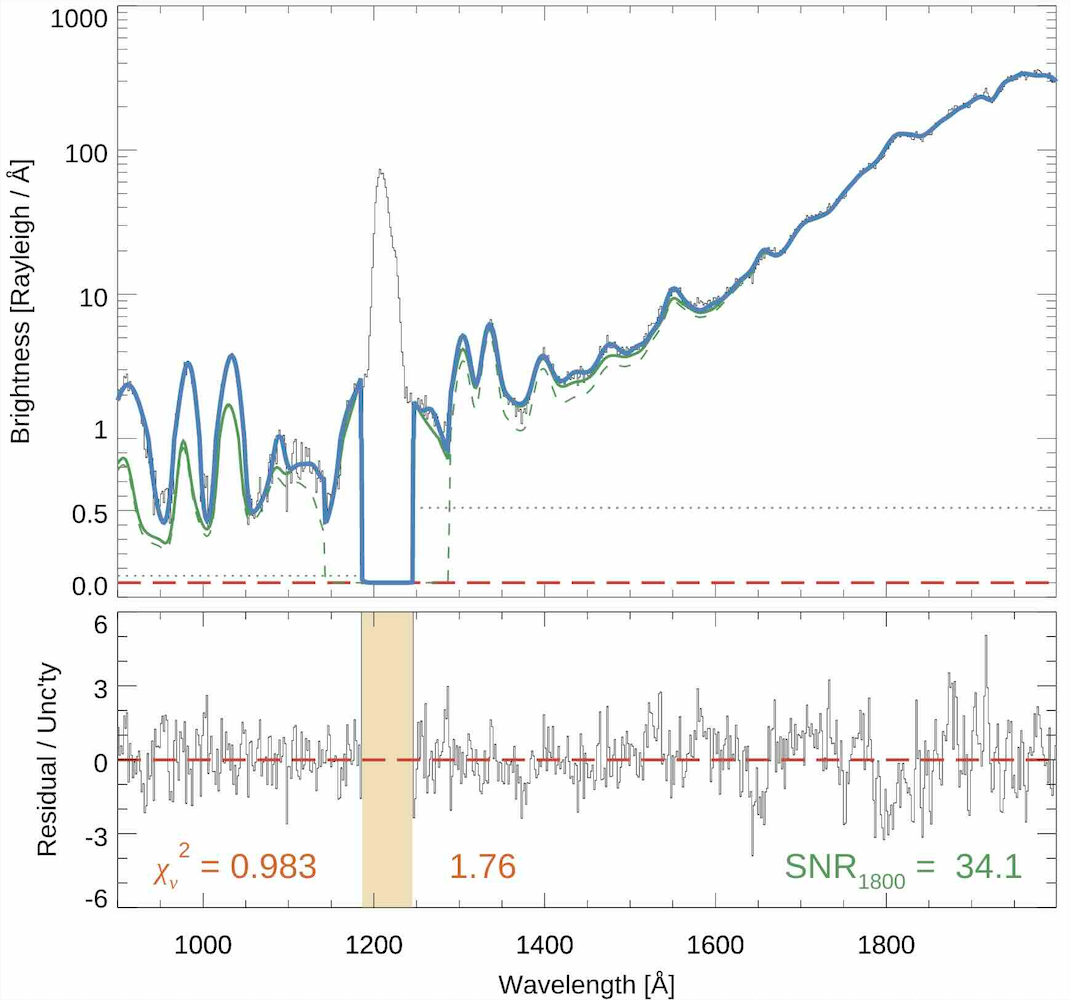
Lori M. Feaga, Ronald J. Vervack, and Brian A. Keeney

The Rosetta mission to comet 67P/Churyumov-Gerasimenko (67P) was a truly remarkable achievement in cometary science and has facilitated a tremendous advance in our understanding of both comets and cometary processes (see various chapters in Comets III). During its 2014–2016 escort phase as 67P traveled inbound from ~4 au to 1.24 au and back out again, Rosetta observed the comet’s coma and nucleus throughout its perihelion passage in unprecedented detail with a variety of remote sensing and in situ measurements. Ultraviolet (UV) observations acquired by the Alice UV spectrograph (Stern et al. 2007) are particularly valuable as UV measurements of comets are uncommon since they can only be achieved from space. Therefore, the Alice data arguably represent the best, most complete set of UV comet observations we have today.

Rosetta/Alice revealed that 67P exhibited a wide variety of coma activity as it responded to both large-scale seasonal changes such as heterogeneous outgassing from the nucleus (as the subsolar latitude moved from one hemisphere to the other) and more localized, short-term events such as outbursts or the passage of coronal mass ejections (CMEs) from the Sun. These long- and short-term variations in activity are evident in atomic emission from H, O, C, and S, molecular emission from CO in the Fourth Positive and Cameron bands, and absorption by H2O, all of which were regularly observed by Alice (e.g., Noonan et al. 2018, 2020; Feldman et al. 2016; Keeney et al. 2017, 2019). At the same time, the nucleus of 67P was also observed to evolve, as the overall slope of the nucleus bi-directional reflectance (BDRF) spectra obtained by Alice changed during the Rosetta escort phase (e.g., Feaga et al. 2015). Analyses of Alice data to date, however, have focused only on subsets of the data, providing just hints of what Alice can tell us about 67P. No systematic investigation of the complete set of Alice data has been carried out, owing to both the size and complexity of the dataset.

While the nearly 71,000 Alice spectral-spatial raw and calibrated science images are archived in the Planetary Data System Small Bodies Node (PDS-SBN), no advanced data products were generated prior to the end of mission funding. The goal of this archival project is to prepare a comprehensive, user-accessible database of the most important scientific quantities that can be derived from the Alice observations. We have optimized an existing and highly capable spectral fitting code to be applied consistently across the full Alice dataset from 1000 Å to 1950 Å. The code implements an approach that physically and meaningfully constrains a fit to each spectrum as the sum of known components to remove instrumental effects and background levels and ultimately extract atomic and molecular emission and nucleus reflectance (Fig. 1). The retrieved values (e.g., atomic line intensities, molecular column densities, bi-directional reflectance of the nucleus) will be included in the database. The database will be supplemented with documentation and graphics to aid in access, visualization, and interpretation of the derived results (Fig. 2). The final database and document collection will be submitted as PDS4 compliant files to the PDS-SBN in late 2025 and should be available to the community in 2026.

Upon completion, this archival project will enable more in-depth analyses of the Alice data and facilitate multi-instrument comparisons to place the Alice data into the broader mission context. By aiding in our understanding of the full scope of 67P’s properties, behavior, and environment, this database will add to the legacy of the Rosetta mission.

This work is supported by the NASA ROSES-2020 NNH20ZDA001N-PDART program grant 80NSSC21K0884.

Figure 1. Representative plots of Rosetta/Alice data showing features of the data and various elements of the spectral fit with residuals (background components are in green, final fits with background plus emissions are in blue). The example pre-perihelion spectrum on the left is dominated by the nucleus reflecting solar light while the example post-perihelion spectrum on the right is dominated by coma gas and dust emissions.

Figure 2. Example visualization to be included with the archive showing the extracted CO Fourth Positive column densities for a single Alice exposure. Lines-of-sight (LOS) intersecting the anti-sunward side of the coma are shaded in dark gray, LOS intersecting the nucleus are shaded in light gray, and LOS intersecting the sunward coma are shaded in yellow. A smooth, radially dependent fall-off of the CO can be seen in the sunward coma.


References

Feaga, L. M., S. Protopapa, E. Schindhelm, et al., Far-UV phase dependence and surface characteristics of comet 67P/Churyumov-Gerasimenko as observed with Rosetta Alice, Astron & Astrophys 583, A27, doi:10.1051/0004-6361/201526671, 2015.

Feldman, P. D., M. F. A’Hearn, L. M. Feaga, et al., The nature and frequency of the gas outbursts in comet 67P/Churyumov-Gerasimenko observed by the Alice far-ultraviolet spectrograph on Rosetta, Astrophys J Lett 825, L8, doi:10.3847/2041-8205/825/1/L8, 2016.

Keeney, B. A., S. A. Stern, M. F. A’Hearn, et al., H2O and O2 Absorption in the Coma of Comet 67P/Churyumov-Gerasimenko Measured by the Alice Far-Ultraviolet Spectrograph on Rosetta, MNRAS 469, S158, doi:10.1093/mnras/stx1426, 2017.

Keeney, B. A., S. A. Stern, R. J. Vervack, Jr., et al., Upper limits for emissions in the coma of comet 67P/Churyumov-Gerasimenko near perihelion as measured by Rosetta’s Alice far-UV spectrograph, Astron J 158, 252, doi:10.3847/1538-3881/ab552e, 2019.

Meech, K. J., M. R. Combi, D. Bockelee-Morvan, S. N. Raymond, and M. E. Zolensky (Eds.), Comets III, Space Science Series, University of Arizona Press, 2024.

Noonan, J. W., S. A. Stern, P. D. Feldman, et al., Ultraviolet observations of coronal mass ejection impact on comet 67P/Churyumov-Gerasimenko by Rosetta Alice, Astron J 156, 16, doi:10.3847/1538-3881/aac432, 2018.

Noonan, J. W., G. Rinaldi, P. D. Feldman, et al., Analysis of hybrid gas-dust outbursts observed at 67P/Churyumov-Gerasimenko, Astron J 162, 4, doi:10.3847/1538-3881/abf8b4, 2021.

Stern, S. A., D. C. Slater, J. Scherrer, et al., Alice: The Rosetta ultraviolet imaging spectrograph, Space Sci Rev 128, 507, doi:10.1007/s11214-006-9035-8, 2007.

How to cite: Feaga, L. M., Vervack, R. J., and Keeney, B. A.: Database of extracted coma and nucleus properties of 67P/Churyumov-Gerasimenko from Rosetta/Alice UV observations, EPSC-DPS Joint Meeting 2025, Helsinki, Finland, 7–13 Sep 2025, EPSC-DPS2025-1142, https://doi.org/10.5194/epsc-dps2025-1142, 2025.

F147
|
EPSC-DPS2025-258
|
On-site presentation
Martin Rubin, Kathrin Altwegg, Jean-Jacques Berthelier, Robin F. Bonny, Michael R. Combi, Johan De Keyser, Antea C. Doriot, Stephen A. Stephen A., Tamas I. Gombosi, Nora P. Hänni, Daniel R. Müller, and Susanne F. Wampfler

Between 2014 and 2016, ESA’s Rosetta mission followed comet 67P/Churyumov-Gerasimenko (67P). During that time, the Rosetta Orbiter Spectrometer for Ion and Neutral Analysis (ROSINA, Balsiger et al. 2007) mass spectrometer suite monitored the composition of the gas coma and its evolution along the part of the comet’s trajectory from more than 3.5 au inbound, through perihelion at 1.24 au, and outbound again to almost 4 au.

The cyano radical, CN, is a molecule that is regularly observed in the coma of comets. Its origin, however, has been debated in the literature (Fray et al. 2005, Hänni et al. 2020). CN may have been released directly in the impactor plume formed by NASA’s Deep Impact mission at comet Tempel 1 (Cochran et al. 2007, Jackson et al. 2009). On the other hand, CN is also produced from the dissociation of higher-mass CN-bearing molecules, such as C2N2, HCN, HC3N, and CH3CN (Hänni et al. 2021), but these species are not always abundant enough to explain the amount of CN observed in the coma (Bockelée-Morvan et al. 1984) or the corresponding dissociation times or scale lengths may not match (Bockelée-Morvan and Crovisier 1985, Haser 1957, Huebner and Mukherjee 2015).

In this presentation, we will report on ROSINA data of CN for almost the entire Rosetta mission. Specifically, we will investigate the possibility that at least a part of the CN is stored as a parent radical species inside the ices of comet 67P’s nucleus.


References

  • Balsiger et al., ROSINA – Rosetta Orbiter Spectrometer for Ion and Neutral Analysis, SSR, 128(1), 745–801, 2007.
  • Bockelée-Morvan et al., Hydrogen cyanide in comets - Excitation conditions and radio observations of comet IRAS-Araki-Alcock 1983d, A&A 141, 2, 411-418, 1984.
  • Bockelée-Morvan and Crovisier, Possible parents for the cometary CN radical - Photochemistry and excitation conditions, A&A 151, 90, 1985.
  • Cochran et al., Observations of Comet 9P/Tempel 1 with the Keck 1 HIRES instrument during Deep Impact, Icarus, 187, 156-166, 2007
  • Fray et al., The origin of the CN radical in comets: A review from observations and models, PSS, 53, 12, 1243-1262, 2005.
  • Hänni et al., First in situ detection of the CN radical in comets and evidence for a distributed source, MNRAS 498, 2239–2248, 2020
  • Hänni et al., Cyanogen, cyanoacetylene, and acetonitrile in comet 67P and their relation to the cyano radical, A&A 647, A22, 2021.
  • Haser, Distribution d’intensité dans la tête d’une comète, Bulletins de l'Académie Royale de Belgique, 43, 740–750, 1957.
  • Huebner and Mukherjee, Photoionization and photodissociation rates in solar and blackbody radiation fields, PSS 106, 11–45, 2015.
  • Jackson et al., The temporal changes in the emission spectrum of comet 9P/Tempel 1 after deep impact, ApJ, 698, 1609-1619, 2009

How to cite: Rubin, M., Altwegg, K., Berthelier, J.-J., Bonny, R. F., Combi, M. R., De Keyser, J., Doriot, A. C., Stephen A., S. A., Gombosi, T. I., Hänni, N. P., Müller, D. R., and Wampfler, S. F.: CN storage in comet 67P/Churyumov-Gerasimenko, EPSC-DPS Joint Meeting 2025, Helsinki, Finland, 7–13 Sep 2025, EPSC-DPS2025-258, https://doi.org/10.5194/epsc-dps2025-258, 2025.

F148
|
EPSC-DPS2025-869
|
ECP
|
On-site presentation
Rhiannon Hicks, Yanga Fernandez, Stephen Lowry, Carey Lisse, and Harold Weaver

Comets are widely viewed as preserving some of the compositional and structural properties of the planetesimals in the solar system during its formation. Studying their current physical properties is essential for understanding their surface evolution over time. Albedo is an intrinsic physical property influenced by an object’s material composition, porosity, regolith, and surface roughness, and is important for context when studying e.g. shape, color, and surface heterogeneity. Cometary nuclei generally do have very low albedo values, alluding to their primitive surfaces. However, the actual geometric albedo distribution of comets is not well-constrained, as literature provides this quantity for only 29 comets, with 19 of those being Jupiter Family Comets (JFCs) [1]. The lack of albedo values is due to multiple observational limitations. First, comae tend to obscure the comet nuclei when they are best observable, and second, each target’s radius must be obtained independently. We present here preliminary results from our work to measure the JFC albedo distribution in a statistically significant subset of the population by avoiding both of these problems. We have obtained R-band imaging photometry of about 100 JFC nuclei with known, independent radii from the SEPPCoN survey using the Spitzer telescope [2] and other sources [1]. We have generally made use of 3-8 meter telescopes (e.g. ARC at Apache Point, VLT, PAL200) to observe these comets at multiple epochs when they are ~3-5 au from the Sun, i.e. when the nuclei, while faint, have minimal or no activity. A montage of our Apache Point data can be seen in the figure below. To avoid too much extrapolation, we reference our results to a 10 degree phase angle, and assume a typical linear phase coefficient of 0.04 mag/deg. We will present our albedo analysis thus far, including an assessment of the mean albedo and of any possible anomalous albedos, and a comparison of JFC albedos with those of related populations such as Centaurs, Trojans, and Trans-Neptunian Objects (TNOs). The results of this work have the potential to provide much needed insight into the current distribution of albedo values for JFCs, and will help constrain their placement in the broader population of small bodies albedos. We hope to in the future make use of publicly available infrared (e.g. SPHEREx, NEO-Surveyor) and visible (e.g. Vera Rubin Observatory) data to augment the sample size of albedos. Acknowledgements: We acknowledge support from NASA’s SSERVI program via award 80NSSC19M0214 for the Center for Lunar and Asteroid Surface Science. [1] M. M. Knight, et al. Physical and Surface Properties of Comet Nuclei from Remote Observations, in Comets III (K. J. Meech et al., Eds.), U. Arizona Press, Tucson, 2024, pp. 361-404.  [2] Y. R. Fernández, et al. Icarus, 226, 1138, 2013. 

How to cite: Hicks, R., Fernandez, Y., Lowry, S., Lisse, C., and Weaver, H.: JFC Reflectivity Reassessed: Preliminary Albedos and Statistical Trends, EPSC-DPS Joint Meeting 2025, Helsinki, Finland, 7–13 Sep 2025, EPSC-DPS2025-869, https://doi.org/10.5194/epsc-dps2025-869, 2025.

F149
|
EPSC-DPS2025-132
|
On-site presentation
Adeline Gicquel, James Bauer, Yaeji Kim, and Yuna Kwon

The Wide-field Infrared Survey Explorer (WISE) mission was launched in 2009 to survey the entire sky in the mid-infrared (3.4, 4.6, 12, and 22 μm). By October 2010, the primary and secondary cryogen tanks were depleted, making the 12 and 22 μm channel inoperable while the mission continued to collect data until February 2011, when the spacecraft was placed into hibernation. The spacecraft was then reactivated in December 2013 (Mainzer et al. 2014), was re-named NEOWISE and has accumulated data using the two infrared wavelength bands (3.4 and 4.6 mm). After more than a decade searching for Near-Earth Objects (NEOs), the mission ended in August 2024.


WISE/NEOWISE primary goal was to discover and characterize Near-Earth Objects (Wright et al. 2010) but was also able to constraint dust and gas production rate. The dust signal is dominating the signal in the W1 band (3.4 μm) and can be used to constrain the gas signal in the W2 band (4.6 μm). One of the advantages of the NEOWISE data is that we can constrain CO and CO2 (CO+CO2) production in comets. Due to significant telluric contamination, CO2 is detectable only from space (Bockelée-Morvan et al. 2004), owing to its self-absorption in Earth’s atmosphere. WISE/NEOWISE increased dramatically the amount of comet’s data to constrain gas and dust production rate when comets are showing activity.


We will investigate the building blocks of comets — cometary gas and dust components. We will use data from NEOWISE - Year 1 and Year 2 of the reactivated mission (2014 and 2015). We will focus on CO+CO2, which are known to be the most abundant volatiles in comets after water. They are likely the main driver of the activity of comets at large heliocentric distances (Rh≥3 AU). Getting simultaneous gas and dust production in comets is very useful to derive the dust-to-gas ratio which is a fundamental parameter influencing cometary activity and constraining cometary origin. We will investigate the relationship between gas and dust production rates and the perihelion distance (q) of detected comets, along with their heliocentric distance (Rh) evolution.


How to cite: Gicquel, A., Bauer, J., Kim, Y., and Kwon, Y.: Investigations of cometary gas and dust using WISE/NEOWISE from Year 1 and Year 2 of the reactivating mission, EPSC-DPS Joint Meeting 2025, Helsinki, Finland, 7–13 Sep 2025, EPSC-DPS2025-132, https://doi.org/10.5194/epsc-dps2025-132, 2025.

F150
|
EPSC-DPS2025-78
|
On-site presentation
Anita Cochran

The spectra of comets consist of a combination of emission lines of gaseous species that have sublimed
from the nuclear ice as the comet is heated on approach to the Sun superposed on an absorption 
spectrum arising when the dust in the coma reflects solar light.  Since most of the gaseous species
are molecules, the gas features are best viewed either at low spectral resolving power, to study a molecular
band as a whole, or at high spectral resolving power, to be able to study individual lines and line 
ratios.  We have been using the McDonald Observatory 2.7 m Harlan J. Smith Telescope with the 
Tull Coude spectrograph to observe comets with resolving power, R=λ/(Δ λ)=60,000
in the optical region from 3700Á to 1.0 microns since 1995.  These spectra are now being archived
in the Planetary Data System (PDS) Small Bodies Node (SBN) for use by the whole community and for archiving.
The archive will ultimately consist of over 80 comets.  Observations of individual comets vary from a 
single night's spectra on the optocenter to multiple nights of observations of a particular comet. Some
cometary spectra were obtained at a variety of cometocentric distances.  

For all comets in the archive, we include logs of the observations including heliocentric distance,
geocentric distance, heliocentric radial velocity, geocentric radial velocity, position in the coma, weather,
and ancillary calibration spectra.  The spectra themselves are FITS files with several extensions to
enable users to access the spectra with a variety of data tools.  The data reduction process and archiving
formats are described.

In this poster, we will indicate the structure of the archive, list the comets, indicate the progress of building
the archive and show some examples.

How to cite: Cochran, A.: An Archive of High Spectral Resolviing Power Optical Observations of Comets, EPSC-DPS Joint Meeting 2025, Helsinki, Finland, 7–13 Sep 2025, EPSC-DPS2025-78, https://doi.org/10.5194/epsc-dps2025-78, 2025.

F151
|
EPSC-DPS2025-1175
|
ECP
|
On-site presentation
Aren Beck, Charles Schambeau, and Yan Fernandez

Cometary nuclei preserve clues to our early solar system and spectroscopic studies of both their surfaces and surrounding comae—clouds of gas and dust that activate during solar approach—offer critical insight into their composition and evolution. Specifically, cometary surface spectra reveal the materials present on the object’s outermost layers, which record evidence of past and ongoing surface processing. Characterization of these surfaces also enables comparisons—and potential connections—to other small body populations (e.g., asteroids, centaurs, and trans-Neptunian objects) providing perspective into the myriads of gravitational rearrangements experienced by these objects since our solar system’s formation. However, obtaining spectroscopic data for a large number of cometary nuclei remains challenging. Their small, dark surfaces often make them difficult to observe during inactive periods, which typically occur at larger heliocentric distances. Conversely, during observations at smaller heliocentric distances, their proximity to the Sun increases the likelihood of activity, where the enshrouding presence of comae leads to an entanglement of the signals received and complicates efforts to isolate nucleus-only information.

To address this observational challenge, we investigate whether an established coma modeling and removal technique, originally developed for broadband imaging [e.g., 1, 2, 3], can be adapted to spectroscopic integral field unit (IFU) observations of comets. IFU systems capture both spatial and spectral information, where each spectral wavelength element corresponds to a reconstructed 2D image of the instrument’s field of view (FOV), such as that produced by JWST’s NIRSpec IFU (see Figure 1). This data structure presents a potential opportunity to isolate high-resolution, nucleus-only spectra by modeling and removing the coma’s contribution from each of the spectrum’s wavelength resolution elements. A successful coma subtraction requires sufficient details of the coma’s 2D surface-brightness distribution to generate an accurate coma model, a task enabled by imaging’s larger FOVs. However, IFU instruments typically have smaller FOVs, raising uncertainties about their ability to provide enough coma information for accurate modeling. Our work aims to evaluate the efficacy and limits of the nucleus extraction technique’s application to IFU data.

Rather than relying on real comet data for the method’s validation, where coma and nucleus flux contributions are inherently uncertain a priori, our approach utilizes synthetic comet “observations” created to mimic real data, but with known input signals for each component. These simulated datasets create a controlled environment that enables rigorous validation of coma modeling accuracy and the potential for recovering clean nucleus spectra under realistic observing circumstances. Here, we present our progress towards this goal and preliminary simulation results focused on comet data acquired with the JWST NIRSpec IFU in Prism mode.

Figure 1. A JWST NIRSpec spectrum of the active comet/centaur 29P/Schwassmann-Wachmann 1 [4] is shown where individual datacube wavelength slices are identified. The coma’s surface brightness is clearly visible in the wavelength slices. Our project seeks to identify if the coma modeling and removal procedure proven successful in broadband imaging studies can be applied to smaller FOV IFU data. For reference, the JWST NIRSpec IFU FOV is 3” x 3”.

References:

[1] P. Lamy and I. Toth, "Direct detection of a cometary nucleus with the Hubble Space Telescope," Astronomy and Astrophysics, vol. 293, pp. L43-L45, 1995.

[2] C. M. Lisse, "The Nucleus of Comet Hyakutake (C/1996 B2)," Icarus, vol. 140, no. 1, pp. 189-204, 1999.

[3] Y. R. Fernandez, "Physical properties of cometary nuclei," PhDT, 1999.

[4] Faggi, S., “Heterogeneous outgassing regions identified on active centaur 29P/Schwassmann–Wachmann 1”, Nature Astronomy, vol. 8, no. 10, pp. 1237–1245, 2024.

How to cite: Beck, A., Schambeau, C., and Fernandez, Y.: Unveiling Comet Nuclei Surface Spectra: Validating a Coma Subtraction Technique for IFU Comet Observations, EPSC-DPS Joint Meeting 2025, Helsinki, Finland, 7–13 Sep 2025, EPSC-DPS2025-1175, https://doi.org/10.5194/epsc-dps2025-1175, 2025.

F152
|
EPSC-DPS2025-628
|
On-site presentation
Jorma Ryske
Abstract
Cometary CN jets with a corkscrew effect can be observed using a commercially available narrowband UV filter having a 11nm bandwidth centered near the CN (0,0) emission line at 3883Å with amateur size telescopes [1]. The commercial CN filter Semrock Brightline 387BW11 (387nm center with a measured bandpass from 380nm to 395nm [2]) includes also cometary ion emission lines of N2+ (0,0) at 3914Å and partly CO+ (4,0) red end 3800Å line.
 
Comet C/2022 E3 (ZTF) and comet 12P/Pons-Brooks have been observed, both showing ion tail signal, using this commercial CN bandwidth filter. Bright comet C/2023 A3 (Tsuchinshan-ATLAS) was also observed with CN and a wide band red filter for comparison.
 
1. Introduction
The commercial CN filter’s (Semrock Brightline 387/11nm) actual bandpass has been measured earlier with a high resolution spectrometer [2]. Figure 1 shows the CN emission spectra and two ionic emission lines marked, N2+ and CO+ (4,0). The N2+ band is fully inside the filter’s bandpass and should be detected if it exists in a comet’s coma or tail. CO+ red end is also inside the bandpass. 
 
2. Observations
 
2.1 Comet C/2022 E3 (ZTF)
Comet C/2022 E3 (ZTF) was observed on 21.2.2023 with the CN 387/11nm filter and the 0.3m telescope at observatory M00 Viestikallio Finland. The image (Figure 2) shows a large CN coma but also a 30’ long ion tail. The ion tail was changing it’s structure during blinking of 30x60s exposures. The filter bandpass area make it possible that the observed ion tails are either from N2+ or CO+ emission. A wide band Red filter (660nm center, and 60nm bandpass) was used to detect dust emissions, a probable H2O+ and possible red leak. The R band tail PA’s were different than the CN band ion tails. (Figure 2).
 
2.2 Comet 12P/Pons-Brooks
The 12P/Pons-Brooks observation with CN filter on 17.11.2023 shows a possible wide structured ion tail at solar wind direction PA 39°. The red filter image shows a short wide dust tail. (Figure 3). 12P/Pons-Brooks was an active comet having many outbursts during 2023-2024 [6].
 
2.3 Comet C/2023 A3 (Tsuchinshan-ATLAS)
The C/2023 A3 (Tsuchinshan-ATLAS) observations with the CN and R filter were obtained on 20.10.2024 from observatory Y71 Makroskooppi Spain. They show a dim wide tail at solar wind direction PA 72°.  The wide band Red (650 nm center/110nm wide) filter image shows a very bright wide dust tail toward the solar wind direction, (Figure 4). Quite similar dim ion tails in these CN and R filter observations are probably from possible CO+, H2O+ ions and a red leak signal.
 
3. Equipment and software
 
3.1 Equipment
The telescope used in observatory M00 Viestikallio Finland was a 305mm aperture and 1205mm focal length f/4 Newtonian with coma corrector. The CCD-camera was a cooled QSI690wsg having a Sony ICX814 CCD-sensor. Filters used were Semrock BrightLine CN 387/11nm (center 387nm, bandpass 11nm) diameter 26mm and 31mm, Astrodon Gen2 R 660/60nm and Antlia Dark series R 650/110nm filter.
 
The telescope used in observatory Y71 Makroskooppi Spain was a 305mm aperture and 2400mm focal length f/8 corrected Dall-Kirkham telescope. A CMOS-camera was a cooled QHY600M having a Sony IMX455 CMOS-sensor. Filters used were Semrock BrightLine CN 387/11nm diameter 31mm and Antlia Dark series R 650/110nm filter.
 
3.2 Software
NINA software was used to control observatory, telescope and camera. TychoTracker software was used to image processing, plate solving, astrometric measurement and stacking.
 
4. Figures
 

Figure 1: Semrock Brightline “CN” filter 387/11nm measured bandpass ([2]) with CN 3883Å, N2+ (0,0) at 3914Å, CO+ (4,0) 3780Å & 3800Å emission lines marked.


Figure 2: C/2022 E3 (ZTF) with filters CN and R, 2023-01-21. Left/CN image possible CO+ ion tail in PA’s marked as Tail 1 PA 285°, Tail 2 PA 270°. Right/R image has dust tail PA marked, also possible H2O+ ion tail at PA 290°.


Figure 3: 12P/Pons-Brooks with filters CN and R, 2023-11-17. Left/CN image possible N2+ and/or CO+ ion tail in PA’s marked as Tail 1 PA 25°, Tail 2 60°. Right R image has wide dust Tail 1 at PA 40°.


Figure 4: C/2023 A3 (Tsuchinshan-ATLAS) with filters CN and R, 2024-10-20. Left CN filter tail signal probably from CO+ and red leak. Right R filter image shows strong dust tail and possible H2O+ ion tail.


5. Summary and Conclusions

These comets observed with the commercial CN filter with bandwidth 380nm – 395nm make it possible that there are ionic tail signals from N2+ and/or CO+. This will need more observations with future medium bright comets together with high resolution spectrographic observations to confirm what are the specific ions. Observations made by amateur/pro-am resources and telescopes can be used as an “observation alarm” trigger, i.e when N2+/ CO+ ionic signals are observed, high resolution spectrograph observations can be considered.


Acknowledgements
Special thanks to Anita Cochran /University of Texas at Austin, Tony Farnham /University of Maryland, Emmanuel Jehin /Université de Liège, Matthew Knight /United States Naval Academy of analyzing and giving feedback of observations and to this abstract.

References

[1] EPSC-DPS 2019: Cometary CN cyanogen jet observations using small telescopes with narrowband UV filter, J. Ryske, https://meetingorganizer.copernicus.org/EPSC-DPS2019/EPSC-DPS2019-1980-1.pdf

[2] CN Filter Tests, M. Knight, University of Maryland 2018, https://wirtanen.astro.umd.edu/46P/CN_filter_test.shtml

[3] Spectroscopic Investigations of Fragment Species in the Coma, Comets II, P. Feldman, A. Cochran, M. Combi.

[4] Strong CO+ and N2+ Emission in Comet C/2016 R2 (Pan-STARRS), A. Cochran, A. McKay,  https://doi.org/10.3847/2041-8213/aaab57

[5] MNRAS 2024: An updated fluorescence emission model of CO+ for cometary science, S. Bromley, J. Noonan, A. Cochran, https://doi.org/10.1093/mnras/stae456

[6] MNRAS 2025: Mass of particles released by comet 12P/Pons–Brooks during 2023–2024 outbursts, M. Gritsevich, M. Wesołowski, A. Castro-Tirado https://doi.org/10.1093/mnras/staf219

How to cite: Ryske, J.: Cometary ion tail observations using commercial CN narrowband UV 387nm/11nm filter, EPSC-DPS Joint Meeting 2025, Helsinki, Finland, 7–13 Sep 2025, EPSC-DPS2025-628, https://doi.org/10.5194/epsc-dps2025-628, 2025.

F153
|
EPSC-DPS2025-495
|
On-site presentation
Philippe Rousselot, Leila Rebadj, Emmanuël Jehin, Pierre Hardy, Damien Hutsemékers, and Jean Manfroid

The CN radical is a well known species in cometary spectra. It was first identified in 1881 in the bright comet C/1881 K1 also known as comet Tebbutt (Huggins, 1881) thanks to its bright near-UV emission band, observed at that time as two emission lines located at 387 and 388.3 nm. This relative ease of observation of this band has allowed the abundance of CN to be measured in many comets, contributing to the establishment of cometary taxonomic groups (see e.g. A’Hearn et al., 1995). It also offers the possibility of measuring the 14N/15N and 12C/13C isotopic ratio of this species and its parent molecule (Arpigny et al., 2003 ; Manfroid et al., 2009 ; Bockelée-Morvan et al., 2015). The main contributor to CN is HCN but it is not the only one, this radical also being produced by dust grains or by other parent molecules ejected from the nucleus (Fray et al., 2005 ; Hänni et al., 2020).

A quantitative study of CN abundance requires modeling its fluorescence spectrum and a good knowledge of the different transition probabilities. Arpigny (1964) showed that the CN spectrum cannot be explained by a Boltzmann distribution but rather by solving a system of steady-state equations describing a resonance-fluorescence excitation mechanism. A first fluorescence model was published by Tatum & Gillespsie (1977) who calculated the radiance of the (0,0) band at 388 nm as a function of the heliocentric velocity. A similar model was performed by Mumma et al. (1978), but with a different Einstein-A coefficient and solar spectrum (integrated over the solar disk), leading to significantly different results. More detailed fluorescence models were published later by Schleicher (1983), Tatum (1984), Zucconi & Festou (1985), Kleine et al., (1994) and Schleicher (2010). Some of these models include the three main isotopologues (12C14N, 13C14N, 12C15N). More recently Paganini & Mumma (2016) published a model covering infrared and optical wavelengths for the main isotopologue 12C14N.

All these models rely heavily on the data available in the scientific litterature regarding transition probabilities. Thanks to an improved line list for radiative transitions between the first three electronic levels of CN we decided to develop a new CN fluorescence model. The calculation method for this large data set is presented in Kozlov et al. (2024) and the complete data (energy levels and transition probabilities between and within electronic level) are available in the ExoMol database1. Our model can be compared with the high-resolution spectra obtained with the UVES spectrometer at VLT for different comets, over the last two decades.

To model the CN emission spectrum of comets, both in the optical and infrared domains, it is necessary to consider the first three electronic levels : X2Σ+, A2Πi and B2Σ+. These states produces three band systems : the red system (A-X), the violet system (B-X) and the LeBlanc system (B-A). The main (0,0) emission band observed in comets at 388 nm belongs to the violet system. These three electronic transitions, as well as the different transitions inside them, are taken into account in the ExoMol data used in our model.

Our model is based on a steady-state equilibrium. We used the formalism developped by Zucconi & Festou (1985), that is, we reduced the system of equations to the number of levels of the ground electronic state (X), which led to the calculation of the relative populations of the levels of this state. The relative populations of the upper state are then derived from these ground state populations, since they are several orders of magnitude smaller than the ground state relative populations.

The results of this new model will be presented and compared to observational data obtained with the UVES spectrometer at VLT. This modeling is in good agreement with the observational data. Fluorescence efficiency – g factors – will also be presented, for the three main isotopologues.

References

  • A’Hearn M.F. et al., 1995, Icarus 118, 223
  • Arpigny C., 1964, AnAp 27, 393
  • Arpigny C. et al., 2003, Science, 301, 1522
  • Bockelée-Morvan D. et al., 2015, Space Sci. Rev., 197, 47
  • Fray N. et al., 2005, PSS 53, 1243
  • Hänni N. et al., 2020, MNRAS 498, 2239
  • Huggins W., 1881, Proc. Roy. Soc. 33, 1
  • Kleine M. et al., 1994, ApJ 436, 885
  • Kozlov S.V. et al., 2024, ApJS 275 :29
  • Manfroid J. et al., 2009, A&A 503, 613
  • Mumma M.J. et al., 1978, BAAS 10, 587
  • Paganini L. & Mumma M.J., 2016, ApJS 226:3
  • Schleicher D.G., 1983, PhD Univ. Maryland
  • Schleicher D.G., 2010, AJ 140, 973
  • Tatum J.B., 1984, A&A 135, 183
  • Tatum J.B. & Gillespsie M.I., 1977, ApJ 218, 569
  • Zucconi J.M. & Festou M.C., 1985, A&A 150, 180

1https://www.exomol.com/

How to cite: Rousselot, P., Rebadj, L., Jehin, E., Hardy, P., Hutsemékers, D., and Manfroid, J.: A new cometary fluorescence model for CN and its isotopologues, EPSC-DPS Joint Meeting 2025, Helsinki, Finland, 7–13 Sep 2025, EPSC-DPS2025-495, https://doi.org/10.5194/epsc-dps2025-495, 2025.

F154
|
EPSC-DPS2025-1474
|
ECP
|
On-site presentation
Pierre Hardy, Philippe Rousselot, Cyril Richard, Vincent Boudon, Xavier Landsheere, Alexandre Voute, Laurent Manceron, and Fridolin Kwabia Tchana
While the cyano radical (CN) is a well-known and prominent feature in cometary optical spectra, its origin remains poorly understood. In particular, although hydrogen cyanide (HCN) is considered the primary parent molecule of CN, it is not abundant enough to account for the observed amounts of the radical (Fray et al., 2005). As a result, cyanogen (C2N2) has been proposed as a secondary potential parent molecule.
Among the major breakthroughs achieved by the Rosetta mission, the discovery of around 40 new molecular species—previously undetected in comets—by the ROSINA mass spectrometer has considerably improved our understanding of cometary chemical diversity. Cyanogen was among the most recently identified molecules in the coma of 67P (Hänni et al., 2021). Although the low derived mixing ratios suggest it is unlikely to produce CN in sufficient amounts on its own, further investigation of its abundance in other comets is essential to better constrain its potential role as a CN precursor and to improve our understanding of cometary chemistry.
In this context, we investigated the presence of cyanogen in near-infrared cometary spectra. In the HITRAN database (Gordon et al., 2022), only the far-infrared ν5 band of C2N2 (Fayt et al., 2012) is currently included, and no spectroscopic data are available above 310 cm-1. Notably, one of the molecule's fundamental vibrational bands, ν3, centered at 2158 cm-1 (4.63 μm), has never been studied at high spectral resolution. This band is particularly interesting as it lies within the M-infrared atmospheric window, a region relatively free from atmospheric emission lines of H2O and CO2.
We present here, for the first time, a high-resolution analysis of line positions and intensities in the ν3 band region of C2N2, based on laboratory infrared spectra. From this, we derived molecular parameters for both the ground and excited vibrational states using PGOPHER (Western, 2017).
This spectroscopic analysis enabled the construction of the first line-by-line fluorescence model of cyanogen. Excitation rates for individual lines of the ν3 band in cometary comae are also presented (Fig. 1).
Finally, we present an upper limit for the abundance of cyanogen in comet C/2022 E3 (ZTF), observed in 2023 with JWST (Milam et al., 2023). We discuss how future instruments such as METIS on the ELT could further improve this limit, or even allow a detection of cyanogen in a bright comet.
 
Figure 1: Emission g-factors of C2N2 expressed in photons s-1 molecule-1 at T=50 K.
 
This work is part of the COSMIC project (Computation and Spectroscopy of Molecules in the Infrared for Comets), funded by the EIPHI Graduate School. https://gradschool.eiphi.ubfc.fr/?p=3710
 
References
 
Fayt A., Joly A., Benilan Y., Manceron L., Kwabia-Tchana F., Guillemin J.-C., 2012, Frequency and intensity analyses of the far infrared ν5 band system of cyanogen (C2N2) and applications to Titan, Journal of Quantitative Spectroscopy and Radiative Transfer 113, 1195-1219.
Fray N., Bénilan Y., Cottin H., Gazeau M.-C., Crovisier J., 2005, The origin of the CN radical in comets: A review from observations and models. Planetary and Space Sciences 53(12), 1243–1262.
Gordon I.E., Rothman L.S., Hargreaves R.J. et al., 2022, The HITRAN2020 molecular spectroscopic database, Journal of Quantitative Spectroscopy and Radiative Transfer 277.
Hänni N., Altwegg K., Balsiger H. et al., 2021, Cyanogen, cyanoacetylene, and acetonitrile in comet 67P and their relation to the cyano radical, Astronomy And Astrophysics, 647.
Milam S. N., Roth N. X., Villanueva G.L., Wong I., Kelley M. S. P., Bockelée-Morvan D., Hammel H. B., 2023, Asteroids, Comets, Meteors Conference 2023, LPI Contrib. No 2851.
Western C.M., 2017, PGOPHER: A program for simulating rotational, vibrational and electronic spectra, Journal of Quantitative Spectroscopy and Radiative Transfer 186, 221-242.

How to cite: Hardy, P., Rousselot, P., Richard, C., Boudon, V., Landsheere, X., Voute, A., Manceron, L., and Kwabia Tchana, F.: A cometary fluorescence model of cyanogen in the near-infrared, EPSC-DPS Joint Meeting 2025, Helsinki, Finland, 7–13 Sep 2025, EPSC-DPS2025-1474, https://doi.org/10.5194/epsc-dps2025-1474, 2025.

F155
|
EPSC-DPS2025-1523
|
ECP
|
On-site presentation
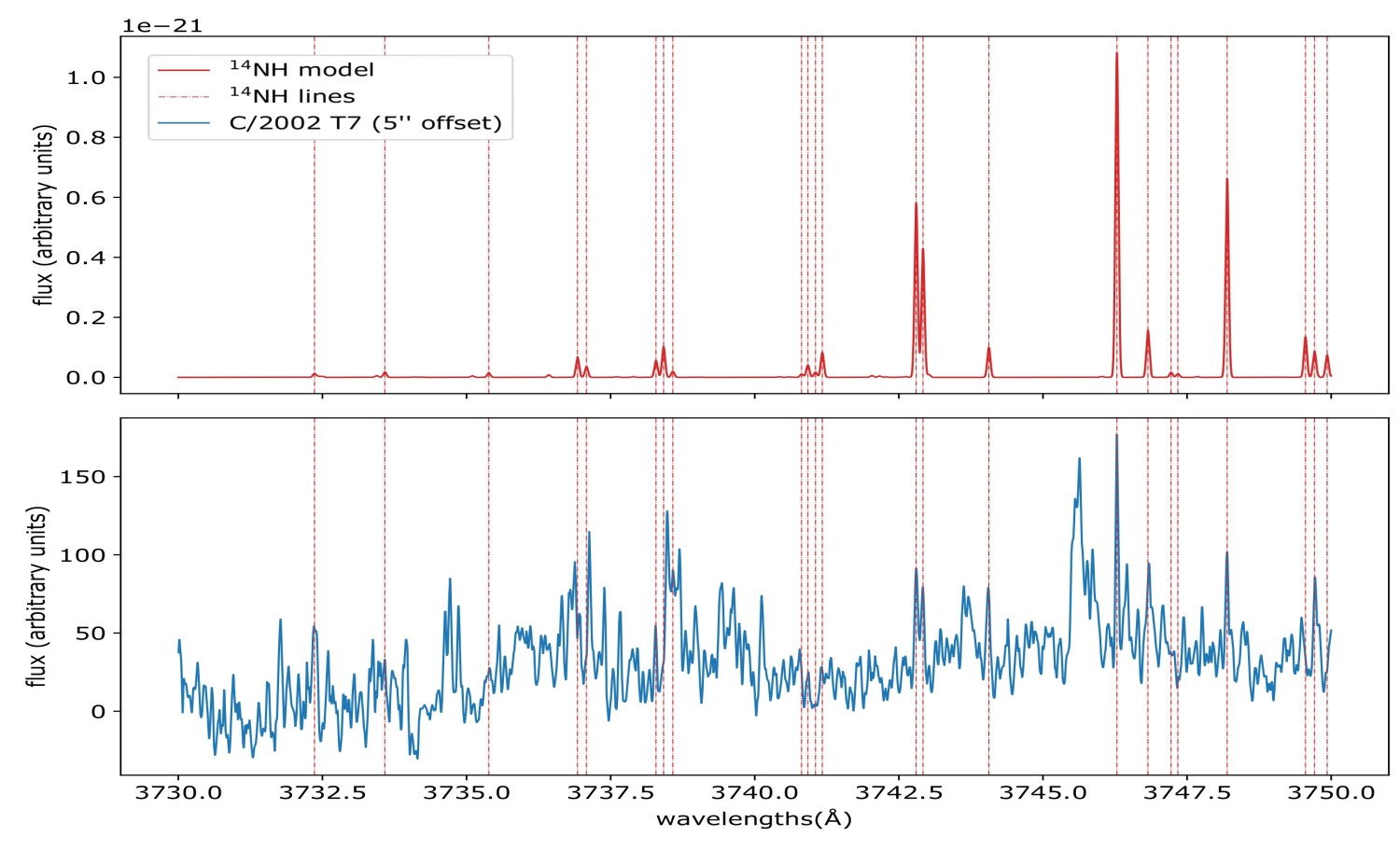
Elsa Blond Hanten, Philippe Rousselot, Emmanuël Jehin, Pierre Hardy, Damien Hutsemékers, and Jean Manfroid

This study presents an updated fluorescence model for the NH radical and its isotopologues (14NH, 14ND, and 15NH) in cometary spectra, offering new insights into the isotopic composition of nitrogen-bearing molecules and, in particular, the deuterium-to-hydrogen (D/H) ratio in comets. NH is a photodissociation product of ammonia (NH₃), commonly detected in the visible spectral range of comets.

Scientific Context and Motivation

Comets are considered among the most primitive celestial bodies in the Solar System, preserving information from its early formation phases. Spectroscopic observations of comets allow researchers to probe their chemical compositions. The NH radical has been detected in cometary spectra as early as the beginning of the 20th century and originates from the breakdown of ammonia. Initial models of NH fluorescence spectra, such as those by Litvak & Kuiper (1982) and refined by Kim et al. (1989), enabled initial analysis of this molecule, but suffered from limited accuracy due to outdated atomic and molecular data and incomplete observational coverage.

In light of new Einstein coefficients made available by the ExoMol project (Perri & McKemmish 2024) and the availability of high-resolution cometary spectra from UVES at ESO's Very Large Telescope, this study aims to reconstruct and enhance the fluorescence models of NH and its isotopologues. Specifically, it investigates comets C/2002 T7 (LINEAR), C/2012 F6 (Lemmon), and 73P/Schwassmann–Wachmann, to both improve the NH model and derive isotopic ratios, including D/H, for nitrogen-bearing molecules in cometary comae.

Methods and Modeling Approach

The core methodology centers on building and applying detailed fluorescence models for the 14NH, 14ND, and 15NH radicals. These models incorporate new laboratory-derived Einstein coefficients and simulate the population distribution among molecular energy levels. The population distributions are calculated by solving a system of radiative transfer equations using a matrix-based method inspired by Zucconi & Festou (1985), which reduces computational complexity while ensuring accuracy.

The modeling included electronic transitions within the A³Πᵢ − X³Σ⁻ system, pure rotational and vibrational transitions within the ground electronic state. Intensity simulations for multiple rovibrational bands were performed, including (0-0), (0-1), and (1-1), under varying heliocentric distances and velocities to match specific observational conditions of the selected comets.

High signal-to-noise, high-resolution UVES spectra from the VLT were used to validate the modeled emission lines. Coaddition was employed to enhance signal detection of weak lines in the observational data. This approach was crucial for extracting isotopic signals from comets with low concentrations of 14ND and 15NH.

Results and Line Identification

The revised model accurately reproduced observed spectral lines of 14NH and identified the previously undetected (0-1) band around 3750 Å (Figure 1).

Comparison with observational spectra at different heliocentric distances (0.68 au for T7 and 1.175 au for F6) showed strong agreement, confirming the model's robustness (Figure 2 & 3). Fluorescence efficiencies (g-factors) derived from the models were found to be about 20% higher than in previous studies.


The study also successfully detected the presence of 14ND in Comet 73P, enabling for the first time the measurement of the D/H ratio in the NH radical (Figure 4). The derived isotopic ratio 14ND/14NH was 2.7 × 10⁻³ ± 1.8 × 10⁻³. In comets T7 and F6, the signal from ND was too weak to allow for a reliable measurement. No detection of 15NH was achieved due to the minimal wavelength shift (as little as 0.008 Å from 14NH) (Figure 5).

Discussion and Implications

The successful identification of 14ND in 73P represents a significant milestone, as this is the first direct D/H ratio measurement in NH, a nitrogen-bearing species in cometary comae. The result aligns well with the upper limit of (D/H)NH ≤ 0.006 previously derived in Comet Hyakutake and the D/H ratio in ammonia (1.1 × 10⁻³) measured in Comet 67P by the Rosetta spacecraft. These findings reinforce the observation that D/H ratios in nitrogen-bearing molecules tend to be an order of magnitude higher than those in water.

This discrepancy in isotopic ratios among cometary species has important implications for understanding the origin and processing of volatiles in the early Solar System. It suggests either differing formation environments for water and ammonia or subsequent fractionation processes affecting these molecules differently. Additionally, the improved g-factors for NH and its isotopologues will enable more accurate future measurements of nitrogen isotopic ratios in comets, once spectral resolutions improve to a level that can distinguish 15NH lines.

Conclusions

This study provides an enhanced fluorescence model for 14NH, 14ND, and 15NH, validated by high-resolution spectroscopic observations of three comets. The new model allows the identification of previously undetected spectral features and the computation of updated fluorescence efficiencies. Importantly, it enabled the first D/H measurement in NH, revealing isotopic fractionation trends that match prior findings for other nitrogen-bearing species and diverge from water-based measurements.

This work contributes to the advancement of isotopic studies of cometary volatiles and emphasizes the importance of continued high-resolution spectroscopic observations. In particular, future instruments with improved spectral resolution may make it possible to distinguish closely spaced spectral lines, such as those of 14NH and 15NH.

How to cite: Blond Hanten, E., Rousselot, P., Jehin, E., Hardy, P., Hutsemékers, D., and Manfroid, J.: NH fluorescence models for measuring cometary D/H isotopic ratios, EPSC-DPS Joint Meeting 2025, Helsinki, Finland, 7–13 Sep 2025, EPSC-DPS2025-1523, https://doi.org/10.5194/epsc-dps2025-1523, 2025.

F156
|
EPSC-DPS2025-1076
|
On-site presentation
Donna Pierce, David Heson, Steven Bromley, Dennis Bodewits, Ryan Fortenberry, and Rebecca Firth

Comets are regarded as primitive remnants left over from the formation of the solar system.  As comets approach the sun, the ices in their nuclei sublimate to form their comae.  Therefore, understanding the chemical composition of cometary comae is vital for understanding the formation and evolution of our solar system.  The relative abundances of cometary volatile species, often measured with respect to H2O or other abundant volatiles, provides critical information about a comet’s thermal history and evolutionary pathway.  These volatiles sublimate under slightly different conditions and have different polarizabilities [1], making their abundance ratios sensitive probes of the temperature and environment of ice formation. 

The chemical composition of cometary comae is obtained through analysis of emission spectra at optical, IR, and/or near-UV wavelengths.  However, obtaining these data for neutral chemical species that lack permanent dipole moments and/or have transitions that conflict with atmospheric absorption features is particularly challenging.  One promising approach is to take advantage of spectral transitions of their corresponding cations in the UV/optical regimes accessible by ground-based observatories such as SOAR and the VLT.  To determine chemical abundances of these ions in the coma we need to understand both ionization and excitation processes.  Here, we present the results of our study of the production and emission mechanisms of N2+, which has been observed previously in comets [2, 3].

Using quantum chemical methods, we have determined transition rates (Einstein A coefficients) for N2+, as well as the full rovibronic structure of this diatomic cation at wavelengths from 200 nm and above.  

Fluorescence emission models of the A-X and B-X bands of N2+ have been constructed from a combination of new theoretical data and existing experimental data. Our synthetic spectra agree with observed cometary spectra containing the N2+ B-X band. Further, we investigate the level of complexity required to fully and accurately model the band luminosities of the strong (0,0) band typically used to derive N2+ column densities from cometary spectra.

Dominant production pathways for N2+ have been investigated using a large-scale chemical reaction network and suggest that photochemical production mechanisms in the coma dominate for N2+.

These studies are part of a larger effort to understand and predict the spatial distribution of several notable cometary cations and their spectra across a variety of dynamical classes and cometary compositions. The modeled band luminosities are expected to impact the interpretation of cationic emission features and their connections to their presumed parent molecules (e.g. N2).

This material is based on work supported by the National Science Foundation under grant no. AST-2407815 at Auburn University.  Any opinions, findings, and conclusions or recommendations expressed in this material are those of the authors and do not necessarily reflect the views of the National Science Foundation.


[1]  Rubin, M., Altwegg, K., van Dishoeck, E. F., and Schwehm, G., 2015, ApJL, 815, 11.

[2]  Cochran, A. L, and McKay, A. J., 2018, ApJL, 854, 10.

[3] Opitom, C. et al., 2019, A&A, 624, 64.


How to cite: Pierce, D., Heson, D., Bromley, S., Bodewits, D., Fortenberry, R., and Firth, R.: Gas-Phase Chemical and Spectral Modeling of N2+ in Cometary Atmospheres, EPSC-DPS Joint Meeting 2025, Helsinki, Finland, 7–13 Sep 2025, EPSC-DPS2025-1076, https://doi.org/10.5194/epsc-dps2025-1076, 2025.

F157
|
EPSC-DPS2025-1342
|
On-site presentation
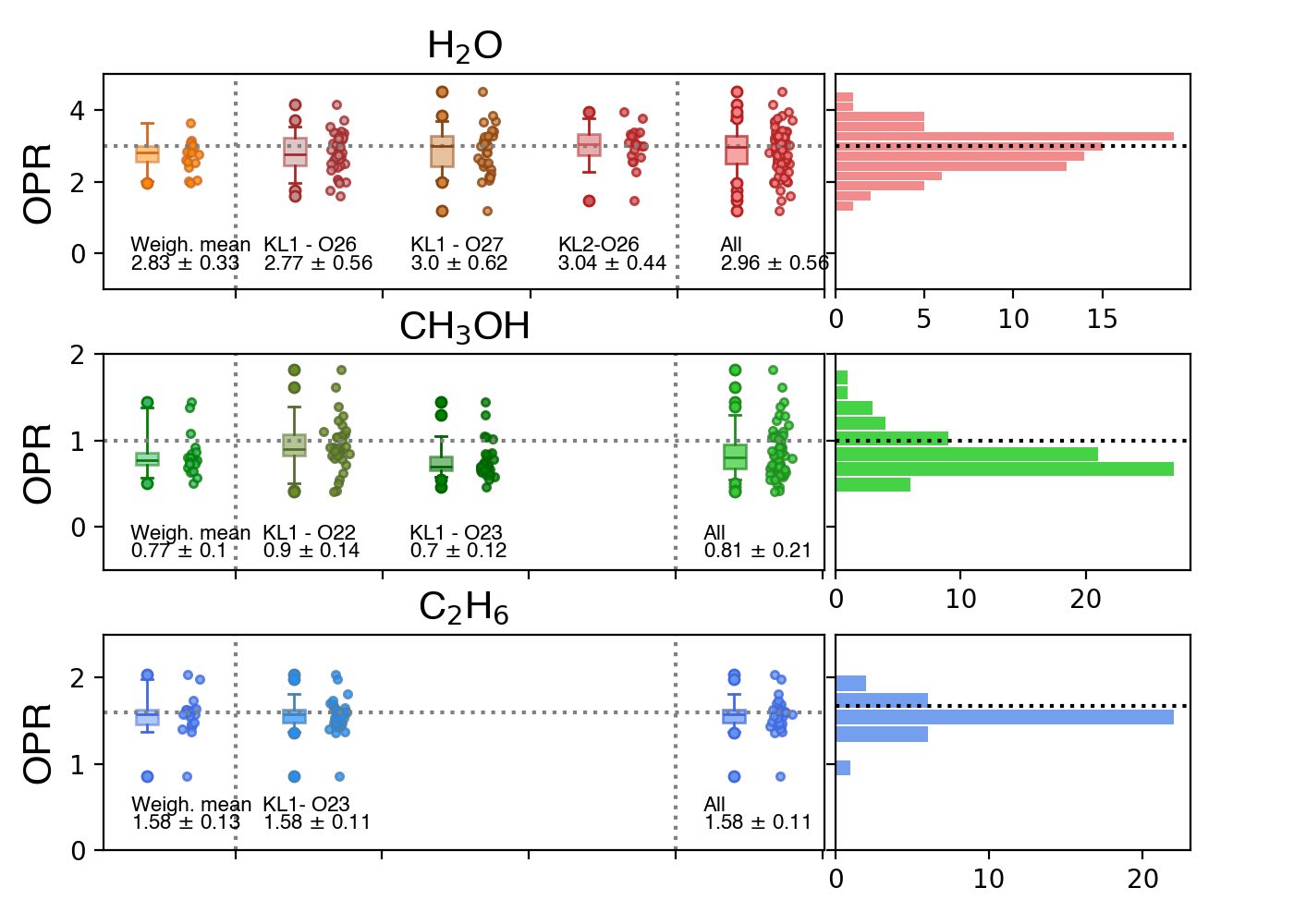
Manuela Lippi, Sara Faggi, Geronimo Villanueva, and Boncho Bonev

Different spin configurations in multi-hydrogenated species (e.g., H2O, H2, H2CO, and NH3) are temperature dependent and once molecules are formed, forbidden rules prevent them from changing their spin state via thermal and collisional processes. For this reason, the relative ratios of species with different spin configurations (hereafter OPRs) have long been employed as cosmogonic thermometers and clocks in setting the formation conditions for species in the Interstellar medium (ISM), protoplanetary disks, and comets [1,2,3]. In particular, the comparison of these ratios from several species in different astrochemical environments may provide key clues on the physical and chemical processes that contribute to planet formation. 

In recent years, the amount of observational data on nuclear spin ratios has grown rapidly, also thanks to increasing instruments sensitivity, and improved statistics and modelling. As a result, a debate about the reliability of spin temperatures as cosmogonic thermometers has started. In fact, observed discrepancy among the comet population and between comets, protoplanetary disks and and star-forming regions suggest that the nuclear-spin conversion may be possible in some cases [4,5,6,7]. This idea is indeed supported by recent laboratory experiments showing that nuclear spin conversion is possible for H2 and water ice desorption and recondensation in the ISM and protoplanetary disks [8] and during sublimation processes in the coma of active comets [5], meaning it is not possible to determine the molecular formation temperature from the spin ratios in these cases. 

In this context, we will present for the first time a comprehensive statistical analysis of the spin isomeric ratios in a sample of 20+ comets, for H2O CH3OH, C2H6, CH4, and H2CO (see for example Fig. 1). These measurements were obtained in a systematic way by employing modern data reduction procedures and ad-hoc developed molecular models (e.g., [9,10]). Data were searched for possible observational biases by comparing results from different instrumental settings and observing conditions (e.g., heliocentric distance of the comet at the time of observations). In general, we find that the majority of the OPRs are consistent with thermal equilibrium independently from the analysed species (e.g., OPR ~ 3 for water and ~ 1 for methanol), even if some exceptions are present. 

If we consider the OPR cosmogonic, the results are thus in favour of different formation temperatures for the different molecules, higher for water (T > 40 - 50 K) than for organic species. In alternative, nuclear spin conversion during phase transition, desorption, and/or in the coma of active comets is occurring in the majority of the cases, changing this ratio to the statistical one. Further analysis will include spatially resolved measurements along the slit when possible (as in [4]) and comparison with the most recent results related to planet- and star- forming regions.

Fig 1: Example of the statistical analysis of OPRs of water, methanol and ethane that we implemented for our database of 20 comets observed in the infrared. 

How to cite: Lippi, M., Faggi, S., Villanueva, G., and Bonev, B.: Do spin temperatures in water and organics in comets test the primordial conditions in our protoplanetary disk?, EPSC-DPS Joint Meeting 2025, Helsinki, Finland, 7–13 Sep 2025, EPSC-DPS2025-1342, https://doi.org/10.5194/epsc-dps2025-1342, 2025.

F158
|
EPSC-DPS2025-1478
|
On-site presentation
Manuela Lippi, Linda Podio, Catherine Walsh, Martin Cordiner, Claudio Codella, and Lisa Giani

Comets are considered fossils from the early solar system, and comparing their composition to that found in planet-forming disks surrounding young solar analogues (104 — 106 years old) can provide key insights into the physical, chemical, and evolutionary processes that shaped our planetary system [1,2]. 

Our previous analysis of the [CH3OH]/[H2CO] and [CH3OH]/[NH3] abundance ratios in a database of 35+ comets from infrared and sub-mm high-resolution ground-based spectroscopy, showed a consistency between Class 0 hot-corinos, inner regions of Class II disks, and comets, supporting the so called “inheritance scenario” [3]. The study also underlined the importance of including in the analysis as many objects as possible, in order to identify possible data biases and avoid consequent misinterpretation of the results. 

Here we will present how the same statistical methodology can be applied to additional species, investigating in detail the [CH3CN]/[CH3OH] abundance ratio. Methyl cyanide is one of the most abundant and widely diffuse interstellar complex organic molecules, which most likely form in the gas-phase from methanol (see for example [4]), and as methanol it may play an important role in the synthesis of more complex organics as well as prebiotic molecules. We will investigate statistically the [CH3CN]/[CH3OH] abundance ratios in comets, considering a large sample of data from the literature (e.g., [7,8]) and comprising recent results from ALMA and CRIRES+ observations of comets (e.g., C/2023 A3 (Tsuchinshan-ATLAS) and 12P/Pons-Brooks). When tested against the latest findings in star-formation research (e.g., [9,10]), the [CH3CN]/[CH3OH] ratios in comets and hot-corinos are consistent, pointing again in favour of an inheritance scenario, as we previously found for the [CH3OH]/[H2CO] and [CH3OH]/[NH3] ratios. 

References: [1] Mumma, M. J., & Charnley, S. B., 2011, ARA&A, 49, 47; [2] Ceccarelli, C., et al., 2023, in Protostars and Planets VII: [3] Lippi, M., et al., 2024, ApJ, 970, L5; [4] Giani, L., et al., 2023, MNRSA, 526, 3, 4535;  [7] M. A., Cordiner, et al., 2023, ApJ, 953, 59; [8] Biver, N., et al., 2022, A&A 668, A171; [9] Belloche, A., et al. 2020, A&A, 635, 198, [10] Yang et al., 2021, APJ, 910, 1.

How to cite: Lippi, M., Podio, L., Walsh, C., Cordiner, M., Codella, C., and Giani, L.: Is the [CH3CN]/[CH3OH] abundance ratio in comets inherited from the early stages of planet formation?, EPSC-DPS Joint Meeting 2025, Helsinki, Finland, 7–13 Sep 2025, EPSC-DPS2025-1478, https://doi.org/10.5194/epsc-dps2025-1478, 2025.

F159
|
EPSC-DPS2025-54
|
On-site presentation
Jianchun Shi

Comets have multiple origins, among which Halley-type comets and long-period comets originate from the Oort Cloud. Compared with long-period comets, Halley-type comets have shorter orbital periods. Therefore, observational studies of Halley-type comets can provide more opportunities for studying the active evolution of Oort cloud objects. As a Halley-type comet, 12P/Pons–Brooks has returned four times since its discovery, and has been very active with frequent outbursts. In order to monitor the activity changes of 12P/Pons–Brooks, we used the 80cm high-precision telescope at the Yao’an Observatory of the Purple Mountain Observatory of the Chinese Academy of Sciences to conduct B, V , R broadband filter imaging observations of 12P/Pons–Brooks from December 11 to 15, 2023. The photometric results in R-band show that the A(0)f ρ value of 12P/Pons–Brooks on December 15, 2023 is 15169 cm, which has increased significantly compared with the previous few days. The morphological analysis reveals that there is an obvious jet inside the coma of 12P/Pons–Brooks on December 15. The change of A(0)f ρ with aperture also reflects that 12P/Pons–Brooks is in a non-steady-state outburst state on December 15. These characteristics all indicate that 12P/Pons–Brooks is in an outburst state on December 15, 2023.

How to cite: Shi, J.: Analysis of the activity of Halley Family Comet 12P/Pons–Brooks during December 11 to 15, 2023, EPSC-DPS Joint Meeting 2025, Helsinki, Finland, 7–13 Sep 2025, EPSC-DPS2025-54, https://doi.org/10.5194/epsc-dps2025-54, 2025.

F160
|
EPSC-DPS2025-1646
|
ECP
|
On-site presentation
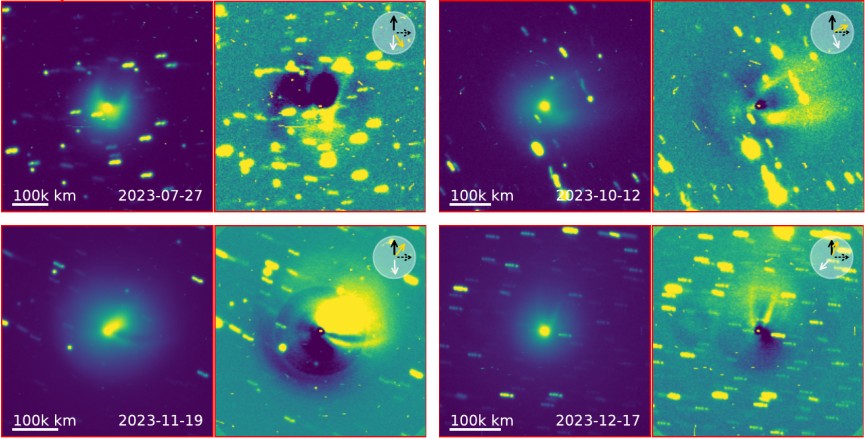
Mathieu Vander Donckt, Emmanuel Jehin, Aravind Krishnakumar, Christophe Adami, Said Hmiddouch, Jean Manfroid, Shashikiran Ganesh, Zouhair Benkhaldoun, Audrey Delsanti, and Abdelhadi Jabiri

We present photometric and spectroscopic observations of comet 12P/Pons-Brooks (hereafter 12P) during its 2024 passage. 12P is a 71 years period comet on a Halley-type orbit discovered by J.L. Pons in 1812 and rediscovered during its following passage by W.R. Brooks in 1883 [1,2]. As during previous passages, the comet showed during its recent approach several impressive outbursts [3], with up to 4 units of magnitude increase. Peculiarly, those outbursts occurred at heliocentric distances between 4 and 2.5 au, excluding the sublimation of water ice as the main source of this activity. A recent study looking in more details at the mass and energy releases by the outbursts pointed towards the crystallization of amorphous water ice as a likely mechanism [4].

Our photometric survey contains over 130 nights of observation with the TRAPPIST-North and -South telescopes [5] from May 6, 2023 (rh = 4.62 au, inbound), to September 7, 2024 (rh = 2.06 au, outbound). We collected images with broad-band Johnson–Cousins filters (BVRI) as well as narrow-band HB filters [6] (OH, CN, C2, C3 and NH for gas species and RC, GC and BC for the dust continuum) to compute the comet's gas activity, using the Haser model [7], and dust activity, using the proxy A(0)fρ [8].

From the lightcurve we detect more than 10 outbursts, accompanied with gas and dust activity increases; OH production rate reaching values as high as 1029 molecules/s and A(0)fρ as high as 105 cm. Individual dust images show the formation of a horn-shaped coma and the expansion of a dust shell the days following the strongest outbursts (see Fig. 1). Since we had images for several days after outbursts, the dust shell velocity could be measured. Observations with narrow-band filters allowed the study of the gas and dust ratios behaviour during those events, which differs from recent observations of outbursting comets closer to the Sun.
Analysis of CN jet features allowed us to estimate to rotation period of the comet and measure the gas ejection velocity in the plane of the sky

Long-slit low resolution spectra were obtained at the Observatoire de Haute Provence with the MISTRAL instrument [9] (5.5’x1.9’’ slit, R~700@6000 Å) on the night of March 23, 2024, when the comet was at a heliocentric distance of 0.94 au. The spectra were extracted from the observed data and calibrated to analyse the emissions from the different molecular bands. Usual emission bands from the neutral molecular species, C2 , NH2 , CN, were observed. Additionally, a detection of H2O+ close to the photocenter has also been made.

Fig. 1: Comet 12P/Pons-Brooks in the R filter during different outbursts. Left is the unmodified image and right is the image after subtraction by an azimedian profile. The dust shell and the two horns are visible during all the shown outbursts, although the shape of the horns change between the occurrences. The yellow and white arrows are the antisunward and the negative of the target heliocentric velocity vector directions, respectively. Images are oriented north up and east right.

References

[1] Gary W Kronk, Cometography: a catalog of comets. Vol. 4, 1933-1959, Cambridge University Press (2009)
[2] Kronk, G. W. 1999, Cometography: Volume 2, 1800-1899: A Catalog of Comets (Cambridge University Press)
[3] ATel#16194, ATel#16202, ATel#16223, ATel#16229, ATel#16254, ATel#16270, ATel#16282, ATel#16315, ATel#16338, ATel#16343, ATel#16408, ATel#16498
[4] Jewitt and Luu, Multiple Outbursts of Halley-Type Comet 12P/Pons-Brooks, arXiv:2504.20316 (2025)
[5] Jehin, E. et al., TRAPPIST: TRAnsiting Planets and PlanetesImals Small Telescope. The Messenger 145, (2011).
[6] Farnham, T., The HB Narrowband Comet Filters: Standard Stars and Calibrations. Icarus 147, 180–204 (2000).
[7] Haser, L., Distribution d’intensité dans la tête d’une comète. Bulletins de l'Académie Royale de Belgique 43 pp. 740-750 (1957)
[8] A'Hearn et al., Comet Bowell 1980b, The Astronomical Journal 89-4, 579-591 (1984)
[9] Schmitt, J. et al., Multi-purpose InSTRument for Astronomy at Low-resolution: MISTRAL@OHP. Preprint at http://arxiv.org/abs/2404.03705 (2024).

Acknowledgments

This work is a result of the bilateral Belgo-Indian projects on Precision Astronomical Spectroscopy for Stellar and Solar system bodies, BIPASS, funded by the Belgian Federal Science Policy Office (BELSPO, Government of Belgium; BL/33/IN22_BIPASS) and the International Division, Department of Science and Technology, (DST, Government of India; DST/INT/BELG/P-01/2021(G)). M.V.D. acknowledges support from the French-speaking Community of Belgium through its FRIA grant

How to cite: Vander Donckt, M., Jehin, E., Krishnakumar, A., Adami, C., Hmiddouch, S., Manfroid, J., Ganesh, S., Benkhaldoun, Z., Delsanti, A., and Jabiri, A.: Photometric and spectroscopic monitoring of the outbursting Halley-type comet 12P/Pons-Brooks, EPSC-DPS Joint Meeting 2025, Helsinki, Finland, 7–13 Sep 2025, EPSC-DPS2025-1646, https://doi.org/10.5194/epsc-dps2025-1646, 2025.

F161
|
EPSC-DPS2025-1369
|
ECP
|
On-site presentation
Giovanni Munaretto, Gabriele Cremonese, Pamela Cambianica, Rosario Brunetto, Jerome Aléon, Alice Aléon-Toppani, Alessandra Mura, Ilya Ilyin, Felice Cusano, Olga Kuhn, Mattia Melosso, Luca Bizzocchi, Monica Lazzarin, Fiorangela La Forgia, and Cristina Puzzarini

Introduction

Comet C/2023 A3 (Tsuchinshan-ATLAS) is a dynamically new Oort Cloud comet discovered by The Asteroid Terrestrial impact Last Alert System (ATLAS) on February 2023. A high-resolution (R=130000) spectrum of C/2023 A3 taken with the PEPSI spectropgraph on the Large Binocular Telescope (LBT) revealed usual cometary molecules and ions (CN, C2, CH, O I, NH2). We also detected Sodium (Na), and the much more rare emission lines of Potassium (K), previously identified only in 67/P, C/2011 L4 (PANSTARRS) [1], C/1965 S1 (Ikeya-Seki) [2], C/1995 O1 (Hale-Bopp) [3], Halley [4] and 67/P [5]. Lithium was not detected. The identification of both Na and K provides an interesting opportunity to investigate the alkali content of C/2023 A3. Since alkalis originate from the nucleus refractory material [1,5], estimating their abundances is key to investigate the composition of the cometary nuclei building blocks.


Observations and Data Analysis

Comet C/2023 A3 was observed on 27 Oct 2024 with the PEPSI spectrograph at LBT, in monocular mode (8.4 m). A 30 min spectrum, with the target fiber centered on the comet nucleus was obtained with spectral resolving power of approx. 130000 from 3800 to 9000A. The comet was at 0.8 AU from the Sun, and 0.8 AU form the Earth, receding with a heliocentric radial velocity of 33.6 km/s and a geocentric radial velocity of 56.2 km/s (ephemeris from JPL Horizons). Absolute flux calibration has been performed using standard star HR7950 and the solar and telluric lines were removed. The resulting 1D continuum removed spectra of C/2023 A3 is shown on Fig. (1). Line intensities were calculated by fitting a gaussian profile. Errors on line intensities were calculated by propagating the errors on the gaussian fit and adding, in quadrature, the standard deviation of the continuum. We measured the Sodium (Na) 5889.95 A and 5895.92 A lines and the Potassium (K) 7664.73 A and 7698.96 A lines. We did not detect any line corresponding to the position of the Lithium (Li) 6707.8 A line, so we provide a 3σ upper limit.

Fig. 1. Continuum removed spectrum of C/2023 A3 obtained on 27 Oct 2024

Fig. 2. Top : spectrum of C/2023 A3 around the K I 7664.9 A line and fitted local continuum (red). Mid: continuum-removed spectrum a best-fit emission line. Bottom: gaussian fit residuals. 
Results

Following the approach of [1] we calculated relative abundances Na/K and Na/Li from the measured line intensities. We obtain a Na/K=145±6 abundance, which becomes Na/K=39±2 once corrected for photoionization [1]. We repeated the process for Lithium, using its 3σ upper upper limit, and get a lower limit on the relative abundance Na/Li≥5861.74, that becomes Na/Li≥1521 after correction for photoionization [1]. Other processes capable of extracting alkalis are thermal desorption, photon-stimulated desorption, solar wind sputtering and micro-meteoroid vaporization, but they do not  alter the relative abundances of the released atoms. 

Conclusions

A high resolution spectrum of C/2023 A3 allowed to estimate its nucleus Na/K ratio and provide lower limits for the Na/Li ratio. The latter,  higher than the solar and chondritc values (103,[6]),  confirm that C/2023 A3 is depleted in Li, similarly to C/1965 S1 (Ikeya-Seki) and C/2011 L4 (PANSTARRS) [1]. While this supports that comets may be depleted in lithium, a higher samples size would be required for a robust conclusion. The Na/K ratio of C/2023 A3 is higher than the solar one (15.5, [6]), contrary to all the other comets in which it was estimated. Higher than solar Na/K ratio are detected in a number of meteorites. This includes chondrites affected by chemical alteration, possibly due to fluid circulation, and their partial melts [7] or achondrites such as cumulate eucrites [8], formed from the crystallization of magma deep inside Vesta [9], and highly metamorphosed and shock-modified mesosiderites and ureilites [8]. Higher than solar Na/K ratios are also expected from aqueous alteration of chondritic material [10] and have been detected in Saturn’s E-rings grains [11] and on Europa’s ice shell [12].
C/2023 A3 Na/K ratio suggests that its nucleus underwent significant chemical alteration. Given the comet size and dynamically new nature, we exclude  endogenous or exogenous alterations occurring during its history in the Oort cloud. Instead, processes such as melt extraction during incipient partial melting and fluid circulations during aqueous alteration, shock metamorphism and/or brine evaporation can potentially fractionate Na from K and result in elevated Na/K ratio. While these are unlikely to occur on a cometary nucleus, they were common on the propotoplanets. 
C/2023 A3 nucleus could therefore be a collisional fragment of a planetesimal that underwent these alterations processes and was ejected in the Oort-cloud by the giant planet instability [13]. As a consequence, C/2023 A3 is the first example of a comet which is not tracing the composition of leftover, primordial Solar System material but the geologic processes occurring on the planetesimals. This result represents the first evidence that comets may form from different parent materials and, as asteroids and meteorites, trace a much greater range of early Solar System processes.
 

Acnowledgments:
The LBT is an international collaboration among institutions in the United States, Italy, and Germany. LBT Corporation partners are The University of Arizona on behalf of the Arizona university system; Istituto Nazionale di Astrofisica, Italy; LBT Beteiligungsgesellschaft, Germany, representing the Max-Planck Society, the Astrophysical Institute Potsdam, and Heidelberg University; The Ohio State University; and The Research Corporation, on behalf of The University of Notre Dame, University of Minnesota, and University of Virginia.

References
[1] Fulle, M. et al., (2013). ApJL771(2),L21. [2] Preston, G. W.1967ApJ 147 718 [3]Fitzsimmons A. and Cremonese G. 1997IAUCirc.6638 1 [4]Jessberger, E. K., et al., (1988). Nature,332(6166),691–695[5]Wurz, P. et al.,(2015).A&A583,A22. [6] Asplund, M., Grevesse, N., Sauval, A. J., & Scott, P. 2009 ARA&A 47,481 [7] Aleon, J. e tal., PNAS, 117(15), 8353–8359 (2020);[9] Hublet, G. et al.,Geochim.Cosmochim.Acta 218,73–97 (2017) [8] Mittlefehldt, D.W. in Treatise in Cosmochemistry vol 1. Meteorites and Cosmochemical Processes, pp. 235–266 (2014) [10] Zolotov, M. Y. Icarus 220(2),713–729(2012) [11] Postberg, F., et al.,Nature 459(7250),1098–1101(2009) [12] Johnson, R.E et al., Icarus 156(1),136–142(2002) [13] Morbidelli, A., et al.,Astron. Astrophys. 583,43(2015)


How to cite: Munaretto, G., Cremonese, G., Cambianica, P., Brunetto, R., Aléon, J., Aléon-Toppani, A., Mura, A., Ilyin, I., Cusano, F., Kuhn, O., Melosso, M., Bizzocchi, L., Lazzarin, M., La Forgia, F., and Puzzarini, C.: High Resolution Spectroscopy of Comet C/2023 A3 (Tsuchinshan–ATLAS): insight into Sodium, Potassium and Lithium abundances, EPSC-DPS Joint Meeting 2025, Helsinki, Finland, 7–13 Sep 2025, EPSC-DPS2025-1369, https://doi.org/10.5194/epsc-dps2025-1369, 2025.

F162
|
EPSC-DPS2025-206
|
On-site presentation
Yoshiharu Shinnaka, Hideyo Kawakita, Hitomi Kobayashi, and Ko Tsujimoto

Comets are considered among the most pristine objects in the solar system. The main components of cometary ices are H2O, CO2, and CO (Mumma & Charnley 2011). These chemical compositions reflect the physico-chemical evolution of the early solar system, particularly the formation temperatures of cometary ices. For comets that have frequently approached the Sun within a few au (e.g., a Jupiter-family comet), volatile species such as CO2 (sublimation temperature Tsub ~70 K) and CO (Tsub ~25 K) are thought to have been selectively sublimated from the surface of the nucleus due to the solar heating. However, it remains unclear whether the observed abundances of CO2 and CO relative to H2O in such comets reflect their primordial compositions or are the result of evolutionary effects. To address this issue, we focus on a comet making its first approach to the inner solar system from the Oort Cloud, a so-called Dynamically New Comet (DNC). DNCs are thought to be among the most pristine icy bodies, as they have undergone little thermal alteration by solar heating since their formation in the solar nebula 4.6 billion years ago.

The abundance ratios of H2O:CO2:CO in comets have been determined by two methods: (1) direct measurements using space-based infrared facilities (e.g., Ootsubo et al. 2012), and (2) indirect estimates based on the intensity ratios of three forbidden emission lines of atomic oxygen (photodissociation products of primary volatile species) obtained through high-resolution optical spectroscopy (e.g., Shinnaka et al. 2020). In the second method, the CO2/H2O abundance ratio is derived from the intensity ratio between the "green line" at 557.7 nm and the "red lines" at 630.0 and 636.4 nm of the atomic oxygen forbidden emissions (Decock et al. 2013, McKay et al. 2016).

              To investigate the abundance ratios of CO2 relative to H2O in the DNC C/2023 A3 (Tsuchinshan-ATLAS), we conducted high-resolution spectroscopic observations with the High Dispersion Spectrograph (HDS) on the Subaru Telescope atop Maunakea in April 2024 (at a heliocentric distance rh = 2.8 au during the inbound orbit), October 2024 (at rh = 0.9 au, where the nucleus surface becomes warm enough for all volatiles to fully sublimate), and June 2025 (at rh = 4.1 au during the outbound orbit). We discuss the heliocentric dependence of chemical compositions based on our new data and comparison with previous studies.

References

Decock et al. 2013, A&A, 555, A34.

McKay et al. 2016, Icarus, 266, 249.

Mumma & Charnley 2011, ARA&A, 49, 471.

Ootsubo et al. 2012, ApJ, 752, 15.

Shinnaka et al. 2020, PSJ, 4, 125.

How to cite: Shinnaka, Y., Kawakita, H., Kobayashi, H., and Tsujimoto, K.:  The CO/H2O Abundance Ratio in the Dynamically New Comet C/2023 A3 (Tsuchinshan-ATLAS) using Forbidden Oxygen Emission Lines, EPSC-DPS Joint Meeting 2025, Helsinki, Finland, 7–13 Sep 2025, EPSC-DPS2025-206, https://doi.org/10.5194/epsc-dps2025-206, 2025.

F163
|
EPSC-DPS2025-1182
|
ECP
|
On-site presentation
Ko Tsujimoto, Hideyo Kawakita, Yoshiharu Shinnaka, and Hitomi Kobayashi

  Comets, icy small bodies formed approximately 4.6 billion years ago during the formation of the solar system and which have remained in distant regions for most of their lifetimes, are thought to preserve pristine information about the early solar system. Therefore, studying comets is essential for understanding the processes and materials (ice and dust) involved in the formation of the solar system.

  The primary constituents of cometary ices are H₂O, CO₂, and CO. Once these molecules sublimate from the nucleus surface, they are photo-dissociated into fragments by the solar UV radiation, producing atomic oxygen through several reaction channels. Not only are oxygen atoms in the electronic ground state 3P produced, but also excited states ¹D and 1S. These excited states are meta-stable, with lifetimes of ~110 seconds for the 1D state and ~1 seconds for the 1S state. Oxygen atoms in the 1D state emit forbidden lines at 6300 Å and 6364 Å (red lines), while those in the 1S state emit the forbidden line at 5577 Å (green line). Measuring the intensity ratio between the green and red lines I₅₅₇₇ / (I₆₃₀₀ + I₆₃₆₄), known as the green-to-red (G/R) ratio, allows for estimating the relative abundance of CO₂ with respect to H₂O (CO₂/H₂O) in the coma (Cochran & Cochran 2001; Furusho et al. 2006; Huffman et al. 2024 and references therein).

  However, this method has is based on the assumption that all excited oxygen atoms emit the photons as forbidden emission. In the inner coma, where the gas density is sufficiently high, the oxygen atoms in the 1D and 1S state can collide with water molecules and are de-excited to the ground state without emitting photons. This collisional quenching is especially significant for oxygen O(¹D) due to its longer radiative lifetime. As a result, quenched oxygen atoms do not contribute to the observed emission spectrum, potentially leading to an overestimation of the CO₂ abundance derived from the G/R ratio (Decock et al. 2015). Therefore, it is necessary to correct for this effect in the G/R ratio in order to accurately determine the CO₂/H₂O ratio.

  To address this issue, it is necessary to investigate the spatial distribution of the forbidden emission of atomic oxygen (i.e., the G/R ratio as a function of the distance from the nucleus). Decock et al. (2015) demonstrated that the G/R ratio varies significantly with nucleocentric distance, increasing markedly within 1000 km due to the quenching effects.

  In this study, we aim to more accurately estimate the CO₂/H₂O ratio by analyzing the spatial distribution of forbidden atomic oxygen lines. We conducted high-dispersion optical spectroscopic observations of comet C/2023 A3 (Tsuchinshan-ATLAS) on October 31 and November 1, 2024 (at heliocentric distance of 0.9 au), using the High Dispersion Spectrograph (HDS) mounted on the Subaru Telescope at the summit of Maunakea, Hawaii. Based on the obtained data, we discuss the spatial distribution of forbidden emission lines and compare the observed profiles with model results.

How to cite: Tsujimoto, K., Kawakita, H., Shinnaka, Y., and Kobayashi, H.: Spatial intensity profiles of forbidden atomic oxygen emission lines in C/2023 A3 (Tsuchinshan-ATLAS), EPSC-DPS Joint Meeting 2025, Helsinki, Finland, 7–13 Sep 2025, EPSC-DPS2025-1182, https://doi.org/10.5194/epsc-dps2025-1182, 2025.

F164
|
EPSC-DPS2025-1122
|
On-site presentation
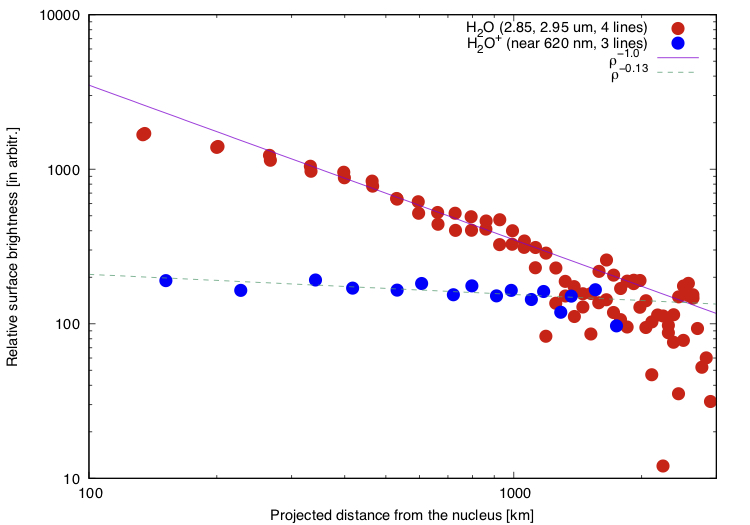
Hideyo Kawakita, Hitomi Kobayashi, Yoshiharu Shinnaka, Ko Tsujimoto, Michael A. DiSanti, Ronald J. Vervack, Jr., Boncho Bonev, and Neil Dello Russo

Comets are remnants of small, icy bodies that formed in the early solar system 4.6 billion years ago. After their formation, these small icy bodies were scattered into distant, cold reservoirs where they have spent most of their lifetimes under cold conditions. Because cometary ices were not significantly heated by the Sun during their time in these reservoirs, they have retained information about the formation of the solar system. The chemistry of cometary ices is usually investigated by observing gas species in the coma through remote observations. However, chemical reactions occurring in the dense inner coma region may alter the gas composition. Therefore, understanding the physico-chemical evolution of the gas in the inner coma region is essential to determining the chemical composition of cometary ices.

   The gaseous coma of a comet is weakly ionized, and the dominant ionic species is H3O+ in the innermost coma of a comet at ~1 au from the Sun. The H3O+ is produced through the ion-molecule chemical reaction; H2O+ + H2O → H3O+ + OH, whereas H2O+ is primarily produced by the photoionization of H2O in the coma by the solar EUV radiation field. The H2O+ ion is the starting point of cometary gas ionization. In situ measurements by spacecraft, such as Giotto for 1P/Halley and Rosetta for 67P/Churyumov-Gerasimenko, have usually been used to investigate cometary H2O+ ions in the inner coma. In contrast, ground-based observations of cometary H2O+ ions were conducted to investigate plasma tails. Because H2O+ exhibits many rovibronic transitions in the optical wavelength region, a combination of a large-aperture telescope and a high-resolution optical spectrograph enables us to reveal the distribution of H2O+ in the inner coma, especially when the comet is close to the Earth.

   We present the spatial brightness profile of H2O+ emission in the inner coma of comet C/2023 A3 (Tsuchinshan-ATLAS), where the projected distance is less than ~2,000 km from the nucleus. This profile was extracted from the two-dimensional spectra of the comet observed on UT2024 Oct 31, using the High Dispersion Spectrograph (HDS) mounted on the Subaru telescope. On the same night, we also observed the comet using NIRSPEC on the Keck II telescope and obtained the spatial brightness profile of H2O emission in the inner coma. A direct comparison between the spatial profiles of H2O+ and H2O in the inner coma provides insight into the physico-chemical conditions in this region. In particular, a shallow slope for the distribution of H2O+in the logarithmic plot (see figure below) may reflect the ionization condition of unmagnetized plasma within the diamagnetic cavity of the comet. Ground-based observations of cometary H2O+ and H2O are expected to support a future comet mission, such as Comet Interceptor. In this mission, the main spacecraft and probes will fly by a cometary nucleus at a distance of approximately 1,000 km from the nucleus. Both the ground-based observations and the in situ measurements by the spacecraft can cover similar distances from the nucleus.

This study is financially supported by NASA SSO grants 80NSSC22K1401 (RJV, NDR, BPB) and 22-SSO22_0013 (MD), and NSF AST-AST-2009398 (NDR, BPB).

Figure 1: Spatial brightness profiles of H2O+ and H2O in the inner coma of comet C/2023 A3 (Tsuchinshan-ATLAS) on UT2024 Oct 31.

How to cite: Kawakita, H., Kobayashi, H., Shinnaka, Y., Tsujimoto, K., DiSanti, M. A., Vervack, Jr., R. J., Bonev, B., and Dello Russo, N.: Simultaneous spectroscopic observations of comet C/2023 A3 (Tsuchinshan-ATLAS) in the optical and near-infrared wavelength regions: Spatial brightness profiles of H2O+ and H2O, EPSC-DPS Joint Meeting 2025, Helsinki, Finland, 7–13 Sep 2025, EPSC-DPS2025-1122, https://doi.org/10.5194/epsc-dps2025-1122, 2025.

F165
|
EPSC-DPS2025-694
|
On-site presentation
Hitomi Kobayashi, Hideyo Kawakita, Michael A. DiSanti, Boncho P. Bonev, Neil Dello Russo, and Ronald J. Vervack, Jr. and the Keck II/NIRSPEC observing team of comet C/2023 A3

Comets are rich in organics and volatiles, and are considered among the least altered bodies in the solar system. The materials preserved in comets are thought to have experienced a wide range of thermal and density environments, from the interstellar molecular cloud core to the protoplanetary disk. Isotopic and mineralogical analyses of cometary dust and (independently) comparisons between relative volatile abundances in comets with predictions from astrochemical models have suggested the existence of large-scale radial transport processes within the disk (e.g., Aikawa et al., 2024; Willacy et al., 2022; Altwegg et al., 2019 and references therein). Thus, cometary materials were likely incorporated through complex evolutionary pathways. After their formation in the inner region of the early solar system (~5 to 30 au from the Sun), comets are thought to have been dynamically scattered into distant reservoirs such as the Kuiper Belt and Oort Cloud. Jupiter-family comets (JFCs), which are trapped by Jupiter’s gravity, have made multiple passages through the inner solar system, during which highly volatile species may have been selectively depleted due to solar heating. In contrast, dynamically new comets (DNCs), which are on their first passage into the inner solar system since being ejected to the Oort Cloud, have remained in cold and distant regions for most of their orbital histories. Thus, their chemical compositions are less likely to have been altered and can provide key constraints on the physical and chemical processes that occurred from the molecular cloud to the solar nebula.

High-resolution near-infrared spectroscopy enables direct detection of volatile species sublimated from the ices in the cometary nucleus. To date, the number of DNCs studied with this technique remains very limited (~10 comets, not all studied in detail, e.g., Dello Russo et al., 2016). For this reason, each new opportunity for an in-depth compositional analysis of a DNC has the potential to bring significant insights.

C/2023 A3 (Tsuchinshan–ATLAS) is a dynamically new comet that brightened to V-magnitude ~-4 near perihelion in late September 2024 and became a prominent visible object in the evening sky around mid-October during its closest approach to Earth. We conducted high-resolution near-infrared spectroscopic observations using NIRSPEC on the Keck II telescope on UT 2024 October 31 (heliocentric distance 0.91 au, geocentric distance 0.95 au, and was then receding from Earth at +60.6 km/s).  Despite its dust-rich nature, emission lines of volatiles were detected, including H2O, OH, HCN, C2H2, CH4, C2H6, and CH3OH. We derived the water production rate and molecular mixing ratios relative to H2O. In this presentation, we compare the composition of C/2023 A3 with other DNCs and with comets from other dynamical classes, to assess its chemical characteristics in the context of differing compositional abundances among the comet population. We also compare the mixing ratios with the results derived from the optical spectra taken by the Subaru Telescope with the high-dispersion spectrograph (HDS) on the same night. The results from these optical observations will be presented separately (Kawakita et al., 2025; Shinnaka et al., 2025; Tsujimoto et al., 2025).

This study is financially supported by NASA SSO grants 80NSSC22K1401 (RJV, NDR, BPB) and 22-SSO22_0013 (MD), and NSF AST-AST-2009398 (NDR, BPB).

Rererences
Aikawa et al. 2024, in Comets III, edited by Karen. J. Meech et al., University of Arizona Press, pp. 33–62.
Willacy et al. 2022, ApJ, 931, 164
Altwegg et al. 2019, Ann. Rev. Astron. Astrophys., 57, 113
Dello Russo et al. 2016, Icarus, 278, 301
Kawakita et al. 2025, EPSC-DPS Joint meeting 2025
Shinnaka et al. 2025, EPSC-DPS Joint meeting 2025
Tsujimoto et al. 2025, EPSC-DPS Joint meeting 2025

How to cite: Kobayashi, H., Kawakita, H., DiSanti, M. A., Bonev, B. P., Dello Russo, N., and Vervack, Jr., R. J. and the Keck II/NIRSPEC observing team of comet C/2023 A3: The Volatile Composition of Dynamically New Comet C/2023 A3 (Tsuchinshan-ATLAS) Based on High-Resolution Near-Infrared Spectroscopy, EPSC-DPS Joint Meeting 2025, Helsinki, Finland, 7–13 Sep 2025, EPSC-DPS2025-694, https://doi.org/10.5194/epsc-dps2025-694, 2025.