
 1,3,1,2,
- 1University of Victoria, Physics and Astronomy, Canada [UVic]
- 2Herzberg Astronomy And Astrophysics Research Centre, 5071 W. Saanich Rd. Victoria, BC, V9E 2E7 Canada [HAA]
- 3Université Marie et Louis Pasteur, CNRS, Institut UTINAM (UMR 6213), OSU THETA, F-25000 Besançon, France
- 4Dept of Physics and Astronomy, University of British Columbia, Vancouver, BC, Canada [UBC]
- 5University of Regina, Regina, SK, Canada [UofRegina]
The outer Solar System preserves a reservoir of material from the formation of our planetary system and provides evidence of the distant past. Objects in the Trans-Neptunian region have experienced little to no thermal or collisional processing, and objects classified as dynamically cold are expected to still be on primordial orbits. The orbital dynamics and physical structure of the objects found in the Trans-Neptunian region allow us to learn how the Solar System formed and developed. This distant region allows us to study the primordial building blocks of the Solar System that no longer exist in an unmodified form in the inner Solar System.
Objects in Mean Motion Resonance (MMR) with Neptune are one of the more significant populations in the distant solar system (beyond distances of 70 au). Resonant populations have very specific orbital characteristics (angular orbital elements, semi-major axis, etc.) that result in varying but quantifiable detectability for each resonance. We define distant resonances as those beyond, but not including, the 2:1 resonance. We include all resonances at semimajor axes greater than 48 au, and with a sufficient number of detections to be statistically relevant. Using recent improvements in the determination of the size-frequency distribution of the Kuiper belt we provide new estimates of the population sizes of these distant resonant orbits. These population estimates provide a key input into understanding the expectation for the discovery of objects at large heliocentric distances.
Our knowledge of the Trans-Neptunian region is incomplete. As we examine larger heliocentric distances our detection efficiency rapidly decreases. Trans-Neptunian Objects (TNOs) can only be directly observed in reflected sunlight which varies with an r-4 relationship. Due to the extreme faintness of TNOs at large heliocentric distances, an extremely significant population of objects could exist. At distances as close as 90 au [1] populations could rival the size of the known Kuiper belt while still escaping detection, see Figure 1. If every object in the Kuiper belt (Hr < 9) were concentrated into a narrow, low inclination ring, this ring would be on the cusp of detection at 100 au. It is clear that significant populations with novel structure and valuable insights into the Solar System could exist in the regions beyond 70 au where detection rapidly becomes increasingly difficult.
In order to examine this region, it is of vital importance to understand what we already know to exist in this distant region. While probing this region directly is very difficult, the population that resides there is not completely unknown. Known objects with semi major axis beyond ~70 au are usually either very large, on eccentric orbits, or both. Large objects are easier to detect as they reflect more light. Objects with eccentric orbits have perihelia much closer to the sun and therefore become much brighter allowing easier detection near their perihelion passage. The most prominent known populations with these large eccentricities are objects in resonance with Neptune, with many possessing large eccentricities and aphelion distances >70 au. As we probe fainter magnitudes, and therefore greater distances, it is important to be able to disentangle known populations from possible new populations.
The Vera C. Rubin Observatory Legacy Survey of Space and Time will revolutionize our understanding of the Solar System, however this survey will be less sensitive to the most distant Trans-Neptunian regions. LSST will increase the number of known TNOs by an order of magnitude. However, despite massively increased sky coverage, it will have a similar limiting magnitude as the OSSOS survey (~24.5). This results in an effective distance limit of 80-90 au for all but the most massive TNOs. See Figure 2 for a survey simulation of the OSSOS survey (orange points) and note the steep drop off in detections in the 80-90 au range. These results will be analogous to the depth of LSST, except with a much larger sky coverage for LSST. Furthermore, the currently planned LSST Deep fields are not on the ecliptic and will be insensitive to objects on low inclination orbits. This highlights the need for a dedicated deep drilling field on the solar ecliptic to enable the exploration of possible in-situ formed component in the distant Solar System.
The regions of the Solar System beyond 70 au are a fascinating frontier. In the examination of this region it is important to be able to distinguish between known “excited” populations like resonant objects and their large eccentricities and the possible discovery of unknown “cold” populations with low inclination and eccentricity distributions. An entire second cold classical belt could exist at 90 au and it would have escaped detection by modern surveys. As currently planned, LSST, while incredibly powerful, is not the right mechanism to explore this region and dedicated search efforts will be required if we wish to learn more about the distant reaches of our Solar System. Study of objects in resonance with Neptune are the first step toward doing so.
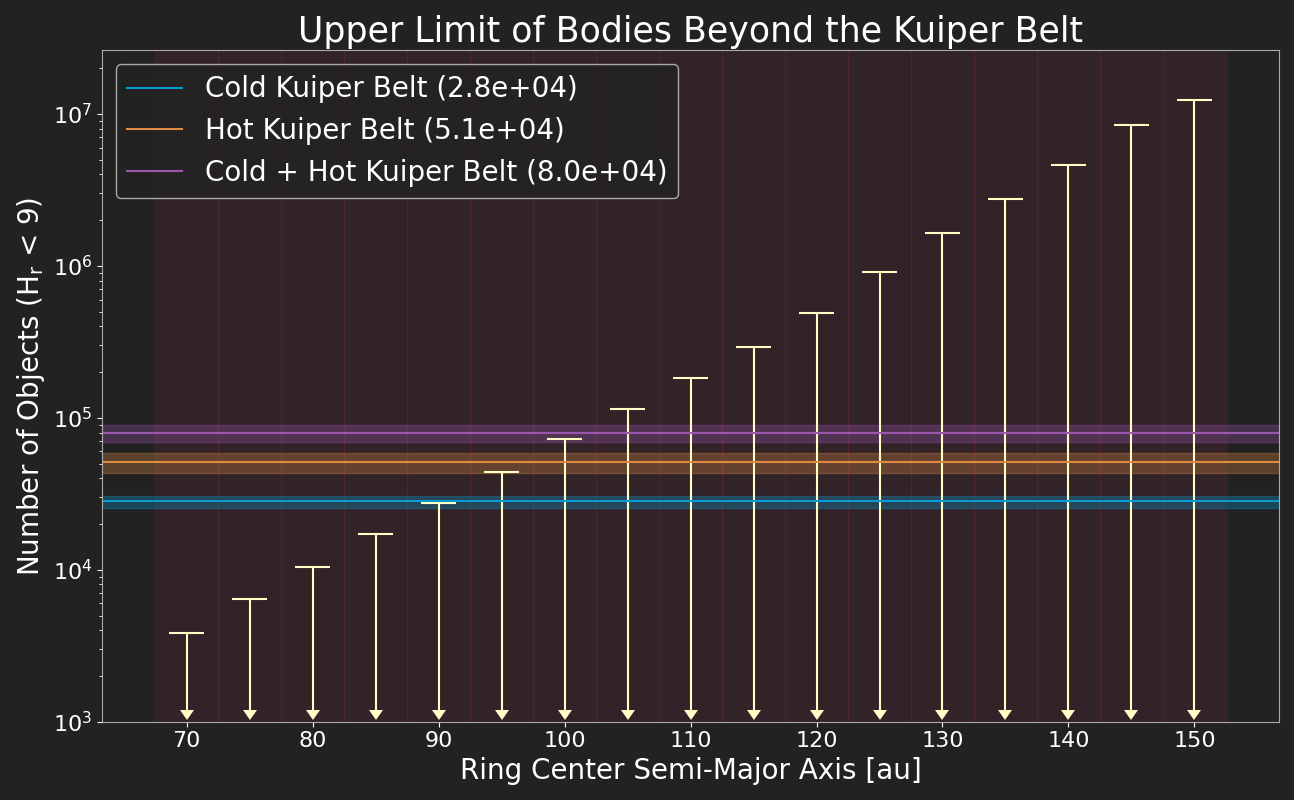
Figure 1 – Graph of the upper limit on the number of objects with Hr < 9 before detection would be likely at increasing heliocentric distance. Each ring represents a simplified orbital toy model. The number of objects was determined by the OSSOS Survey Simulator and characterization data for several modern surveys. Horizontal lines represent the number of objects in the cold Kuiper belt (blue), hot Kuiper belt (orange), and both combined (purple).
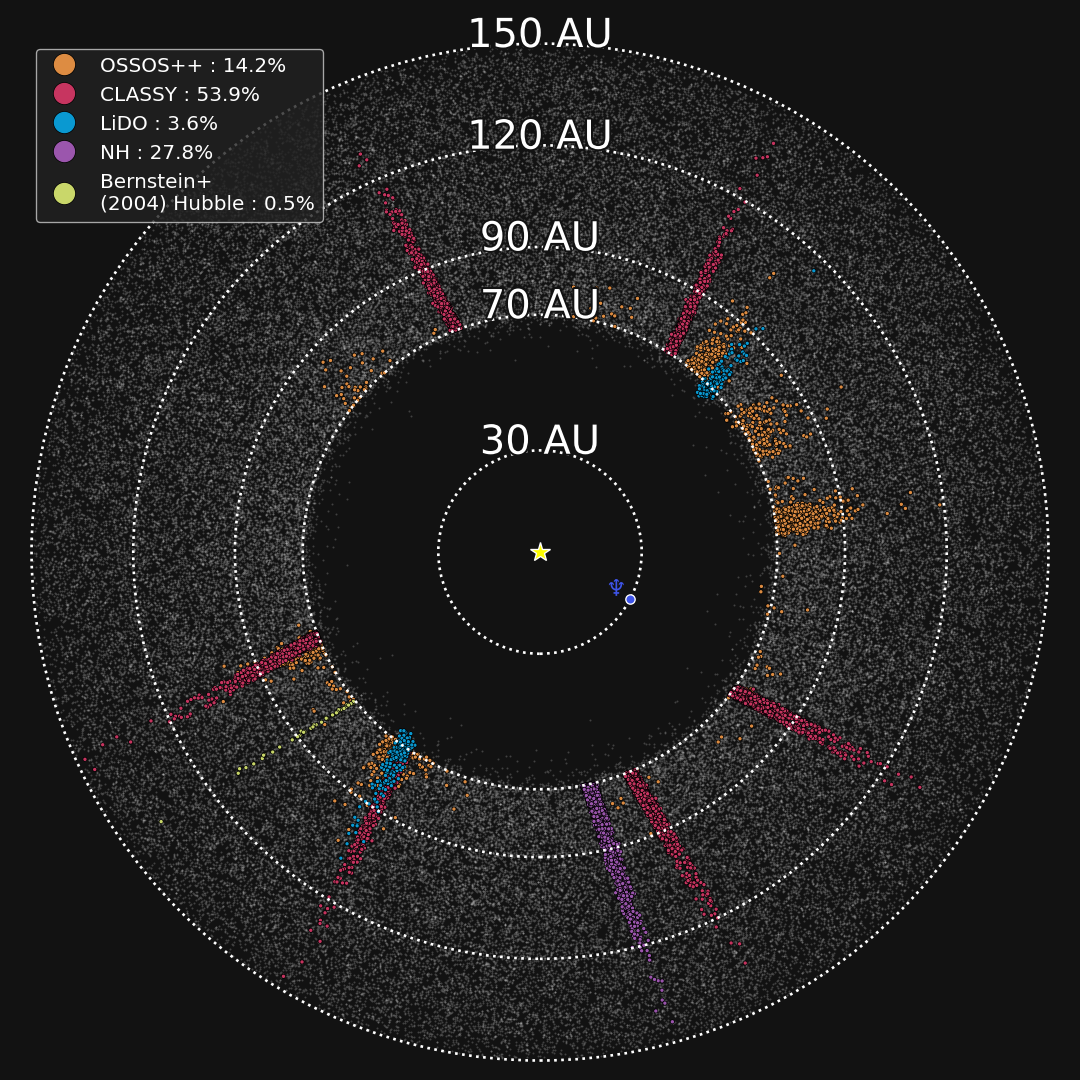
Figure 2 – Figure demonstrating oversampled OSSOS Survey Simulator output for several modern surveys and how their detection numbers drop off with distance for a >70 au heliocentric distance ring. Note the (orange) OSSOS++ points that correspond to a detection limit of ~24.5, which is broadly similar to the LSST survey limit. LSST will have greatly increased sky coverage, but it is expected that detection efficiency will drop off in a similar manner to OSSOS in the 80-90 au range. Contrast this with deeper searches like CLASSY (red) that are able to detect more distant objects.
References
1. Gladman & Volk (2021), Transneptunian Space, Annual Review of Astronomy and Astrophysics, Volume 59, pp. 203-246
How to cite: Peltier, L., Kavelaars, J., Petit, J., Gladman, B., Fraser, W., and Lawler, S.: Distant Resonances in the Outer Solar System, EPSC-DPS Joint Meeting 2025, Helsinki, Finland, 7–12 Sep 2025, EPSC-DPS2025-1072, https://doi.org/10.5194/epsc-dps2025-1072, 2025.


