SB0 | Small Body Dynamics

SB0

Small Body Dynamics
Conveners: Oleksandra Ivanova, Dominique Bockelee-Morvan, Michael Küppers, Jean-Baptiste Vincent, Raphael Marschall, Laura Woodney, Driss Takir
Orals THU-OB6
| Thu, 11 Sep, 16:30–18:00 (EEST)
 
Room Neptune (rooms 22+23)
Posters THU-POS
| Attendance Thu, 11 Sep, 18:00–19:30 (EEST) | Display Thu, 11 Sep, 08:30–19:30
 
Finlandia Hall foyer, F132–139
Thu, 16:30
Thu, 18:00
The objective of the General Session is to accommodate abstracts from a program group that do not align with the themes of any existing sessions within the same program group. Please note that all submitted abstracts may be reallocated to a different session at the discretion of the respective session chairs.

Session assets

Orals: Thu, 11 Sep, 16:30–18:00 | Room Neptune (rooms 22+23)

Chairpersons: Dominique Bockelee-Morvan, Michael Küppers
16:30–16:45
|
EPSC-DPS2025-1072
|
ECP
|
On-site presentation
Lowell Peltier, Jj Kavelaars, Jean-marc Petit, Brett Gladman, Wesley Fraser, and Samantha Lawler

The outer Solar System preserves a reservoir of material from the formation of our planetary system and provides evidence of the distant past. Objects in the Trans-Neptunian region have experienced little to no thermal or collisional processing, and objects classified as dynamically cold are expected to still be on primordial orbits. The orbital dynamics and physical structure of the objects found in the Trans-Neptunian region allow us to learn how the Solar System formed and developed. This distant region allows us to study the primordial building blocks of the Solar System that no longer exist in an unmodified form in the inner Solar System.

Objects in Mean Motion Resonance (MMR) with Neptune are one of the more significant populations in the distant solar system (beyond distances of 70 au). Resonant populations have very specific orbital characteristics (angular orbital elements, semi-major axis, etc.) that result in varying but quantifiable detectability for each resonance. We define distant resonances as those beyond, but not including, the 2:1 resonance. We include all resonances at semimajor axes greater than 48 au, and with a sufficient number of detections to be statistically relevant. Using recent improvements in the determination of the size-frequency distribution of the Kuiper belt we provide new estimates of the population sizes of these distant resonant orbits. These population estimates provide a key input into understanding the expectation for the discovery of objects at large heliocentric distances.

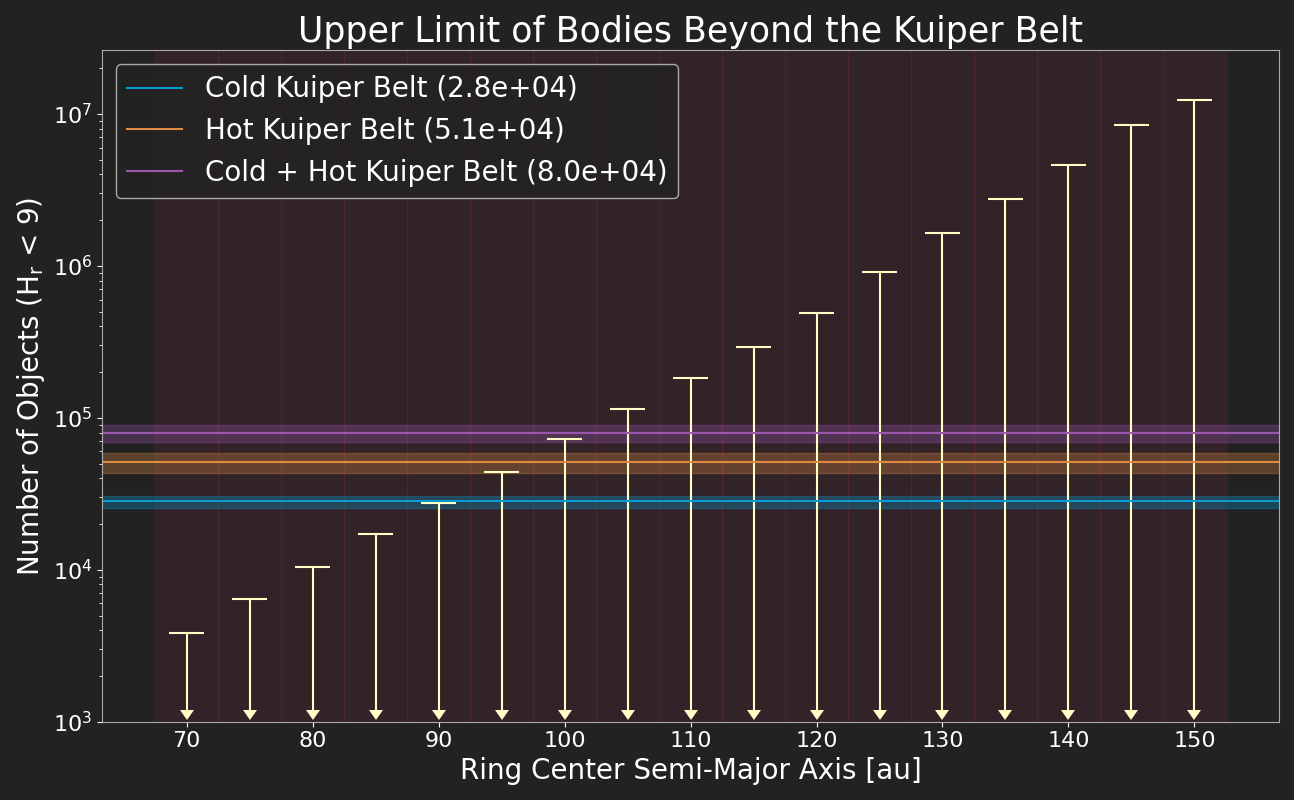
Our knowledge of the Trans-Neptunian region is incomplete. As we examine larger heliocentric distances our detection efficiency rapidly decreases. Trans-Neptunian Objects (TNOs) can only be directly observed in reflected sunlight which varies with an r-4 relationship. Due to the extreme faintness of TNOs at large heliocentric distances, an extremely significant population of objects could exist. At distances as close as 90 au [1] populations could rival the size of the known Kuiper belt while still escaping detection, see Figure 1. If every object in the Kuiper belt (Hr < 9) were concentrated into a narrow, low inclination ring, this ring would be on the cusp of detection at 100 au. It is clear that significant populations with novel structure and valuable insights into the Solar System could exist in the regions beyond 70 au where detection rapidly becomes increasingly difficult.

In order to examine this region, it is of vital importance to understand what we already know to exist in this distant region. While probing this region directly is very difficult, the population that resides there is not completely unknown.  Known objects with semi major axis beyond ~70 au are usually either very large, on eccentric orbits, or both. Large objects are easier to detect as they reflect more light. Objects with eccentric orbits have perihelia much closer to the sun and therefore become much brighter allowing easier detection near their perihelion passage. The most prominent known populations with these large eccentricities are objects in resonance with Neptune, with many possessing large eccentricities and aphelion distances >70 au. As we probe fainter magnitudes, and therefore greater distances, it is important to be able to disentangle known populations from possible new populations.

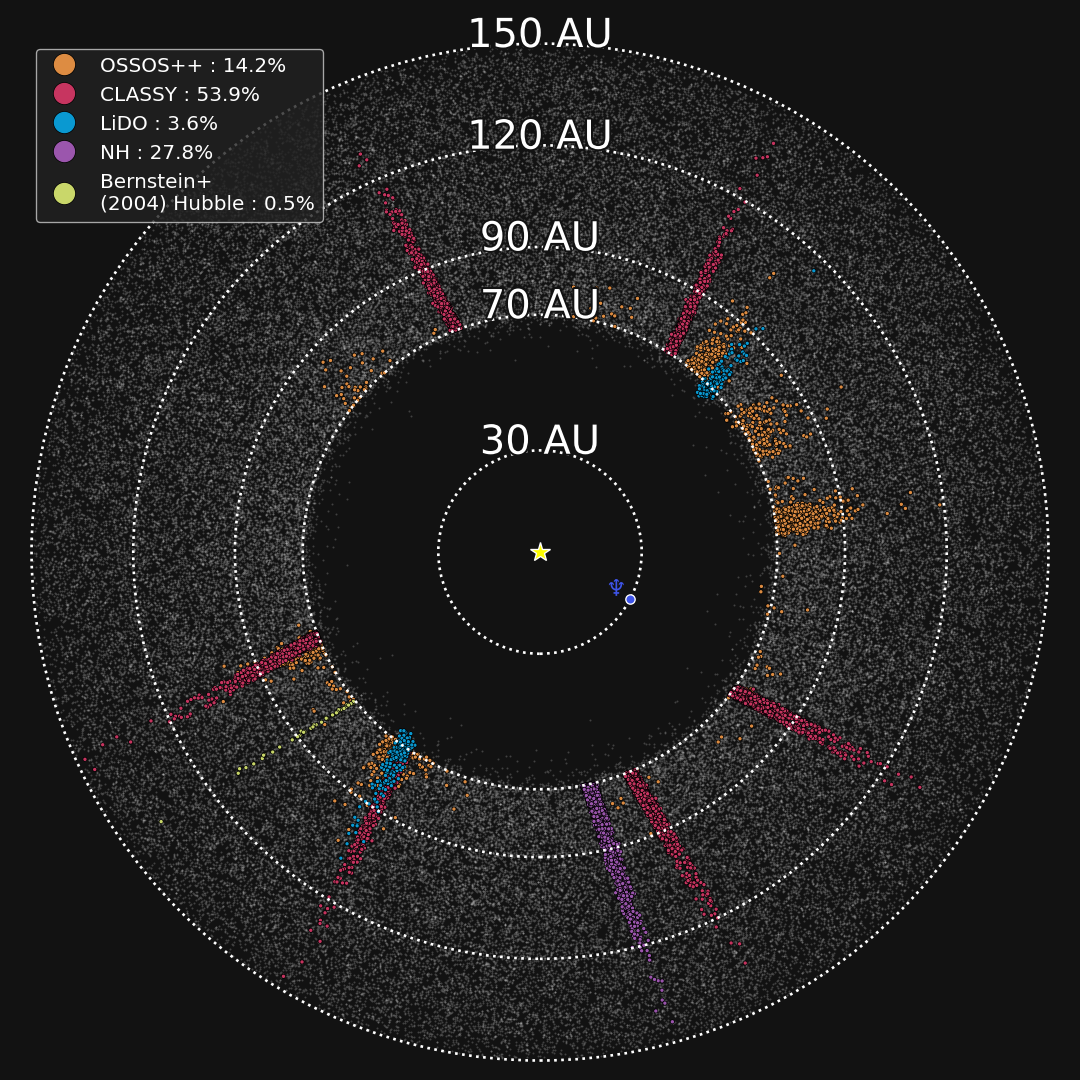
The Vera C. Rubin Observatory Legacy Survey of Space and Time will revolutionize our understanding of the Solar System, however this survey will be less sensitive to the most distant Trans-Neptunian regions. LSST will increase the number of known TNOs by an order of magnitude. However, despite massively increased sky coverage, it will have a similar limiting magnitude as the OSSOS survey (~24.5). This results in an effective distance limit of 80-90 au for all but the most massive TNOs. See Figure 2 for a survey simulation of the OSSOS survey (orange points) and note the steep drop off in detections in the 80-90 au range. These results will be analogous to  the depth of LSST, except with a much larger sky coverage for LSST. Furthermore, the currently planned LSST Deep fields are not on the ecliptic and will be insensitive to objects on low inclination orbits. This highlights the need for a dedicated deep drilling field on the solar ecliptic to enable the exploration of possible in-situ formed component in the distant Solar System.

The regions of the Solar System beyond 70 au are a fascinating frontier. In the examination of this region it is important to be able to distinguish between known “excited” populations like resonant objects and their large eccentricities and the possible discovery of unknown “cold” populations with low inclination and eccentricity distributions. An entire second cold classical belt could exist at 90 au and it would have escaped detection by modern surveys. As currently planned, LSST, while incredibly powerful, is not the right mechanism to explore this region and dedicated search efforts will be required if we wish to learn more about the distant reaches of our Solar System. Study of objects in resonance with Neptune are the first step toward doing so.

Figure 1 – Graph of the upper limit on the number of objects with Hr < 9 before detection would be likely at increasing heliocentric distance. Each ring represents a simplified orbital toy model. The number of objects was determined by the OSSOS Survey Simulator and characterization data for several modern surveys. Horizontal lines represent the number of objects in the cold Kuiper belt (blue), hot Kuiper belt (orange), and both combined (purple).

Figure 2 – Figure demonstrating oversampled OSSOS Survey Simulator output for several modern surveys and how their detection numbers drop off with distance for a >70 au heliocentric distance ring. Note the (orange) OSSOS++ points that correspond to a detection limit of ~24.5, which is broadly similar to the LSST survey limit. LSST will have greatly increased sky coverage, but it is expected that detection efficiency will drop off in a similar manner to OSSOS in the 80-90 au range. Contrast this with deeper searches like CLASSY (red) that are able to detect more distant objects.

References

1.    Gladman & Volk (2021), Transneptunian Space, Annual Review of Astronomy and Astrophysics, Volume 59, pp. 203-246

How to cite: Peltier, L., Kavelaars, J., Petit, J., Gladman, B., Fraser, W., and Lawler, S.: Distant Resonances in the Outer Solar System, EPSC-DPS Joint Meeting 2025, Helsinki, Finland, 7–13 Sep 2025, EPSC-DPS2025-1072, https://doi.org/10.5194/epsc-dps2025-1072, 2025.

16:45–17:00
|
EPSC-DPS2025-974
|
ECP
|
On-site presentation
Kate Minker, Benoit Carry, and Frédéric Vachier

The very wide binary asteroid (VWBA) population is a small subset of the population of known binary and multiple asteroids made of systems with very distant satellites and long orbital periods, on the order of tens to hundreds of days. The origin of these systems is debatable, and most members of this population are poorly characterized.


Most members of this class were discovered by direct imaging, through general surveys or targeted studies of asteroid families (Merline et al. 2002, 2003a,b, 2004; Tamblyn et al. 2004), and several potential members of this class have been predicted through lightcurve studies (Warner & Stephens 2019).
In 2012, (2577) Litva became the first member of these predicted VWBA systems to be confirmed by direct imaging (Merline et al. 2013a,b).
Analysis of asteroid observations in recent surveys  (with PanSTARRS and ESA Gaia, Ou et al. 2022; Liberato et al. 2024), and evidence in cratering records (Herrera et al. 2024) indicate that this population may be substantial, but this has yet to be confirmed by observations.


 In our recent work (Minker et al. 2025), we aimed to study the known members of this unique group. To do so, we developed orbital solutions for some members of the VWBA population, allowing us to constrain possible formation pathways for this unusual population. We compiled all available high-angular-resolution imaging archival data of VWBA systems from large ground- and space-based telescopes, including the Keck, Gemini, Very Large, Large Binocular, and Hubble Space Telescopes. Images were reduced with standard calibration techniques, as well as halo-reduction algorithms to improve the visibility of the satellite (see Fig. 1). We measured the astrometric positions of the satellite relative to the primary at each epoch and analyzed the dynamics of the satellites using the Genoid genetic algorithm (Vachier et al. 2012). 


We determined new orbital solutions for five systems, (379) Huenna, (2577) Litva, (3548) Eurybates, (4674) Pauling, and (22899) Alconrad. We find a significantly eccentric (e=0.30) best-fit orbital solution for the outer satellite of (2577) Litva, moderately eccentric (e=0.13) solutions for (22899) Alconrad, and a nearly circular solution for (4674) Pauling (e=0.04). We also confirmed previously reported orbital solutions for (379) Huenna and (3548) Eurybates (Vachier et al. 2022 and Brown et al. 2021, respectively).


 It is unlikely that BYORP expansion could be solely responsible for the formation of VWBAs, as only (4674) Pauling matches the necessary requirements for active BYORP expansion. It is possible that the satellites of these systems were formed through YORP spin-up and then later scattered onto very wide orbits. Additionally, we find that some members of the population are unlikely to have formed satellites through YORP spin-up, and a collisional formation history  (escaping ejecta model, see Durda et al. 2004) is favored. In particular, this applies to VWBAs within large dynamical families, such as (22899) Alconrad and (2577) Litva, or large VWBA systems such as (379) Huenna and NASA's Lucy mission target (3548) Eurybates. The extremely limited observational datasets limit our current understanding of this population. In the future, utilizing unconventional observational techniques such as speckle interferometry (Aristidi et al. 2023) or indirect methods, such as detection through Gaia astrometry (Liberato et al. 2024) could contribute to the study and discovery of these objects.


Although the binary systems discussed in this work exhibit substantial dynamical diversity, their spin properties are globally inconsistent with those of the candidate VWBAs proposed in various works by Warner et al. (e.g. Warner & Stephens 2020, 2019; Warner 2016). However, some members of the Warner et al. population bare a resemblance to the report sensing properties of former Lucy mission target (152830) Dinkinesh, which was found during flyby to have a contact-binary satellite - suggesting that perhaps these objects are not very wide binary asteroids, but asteroids with very wide satellites!


Figure 1: Observation of (4674) Pauling, before and after the application of halo-subtraction algorithms.

References:

Aristidi, E., Carry, B., Minker, K., et al. 2023, MNRS,  524, 4

Brown, M. E., Levison, H. F., Noll, K. S., et al. 2021, Pla. Sci. Journal, 2, 170

Durda, D. D., Bottke, W. F., Enke, B. L., et al. 2004, Icarus, 167, 382

Herrera, C., Carry, B., Lagain, A., & Vavilov, D. E. 2024, A&A, 688, A176

Merline, W. J., Close, L. M., Siegler, N., et al. 2002, IAU Circ., 7827, 2

Merline, W. J., Close, L. M., Tamblyn, P. M., et al. 2003a, IAU Circ., 8075, 2

Merline, W. J., Tamblyn, P. M., Chapman, C. R., et al. 2003b, IAU Circ., 8232, 2

Merline, W. J., Tamblyn, P. M., Dumas, C., et al. 2004, IAU Circ., 8297, 1

Merline, W. J., Tamblyn, P. M., Warner, B. D., et al. 2013a, IAU Circ., 9267, 1

Merline, W. J., Tamblyn, P. M., Warner, B. D., et al. 2013b, Central Bureau Electron. Telegrams, 3765, 1

Minker, K., Carry, B., Vachier, F., et al., 2025 A&A, in press.

Ou, J., Baranec, C., & Bus, S. J. 2022, Pla. Sci. Journal, 3, 169

Tamblyn, P. M., Merline, W. J., Chapman, C. R., et al. 2004, IAU Circ., 8293, 3

Vachier, F., Berthier, J., & Marchis, F. 2012, A&A, 543, A68

Vachier, F., Carry, B., & Berthier, J. 2022, Icarus, 382, 115013

Warner, B. D. 2016, Minor Planet Bull., 43, 306 Warner, B. D., & Stephens, R. D. 2019, Minor Planet Bull., 46, 153

Warner, B. D., & Stephens, R. D. 2020, Minor Planet Bull., 47, 37

How to cite: Minker, K., Carry, B., and Vachier, F.: Orbits of very distant asteroid satellites, EPSC-DPS Joint Meeting 2025, Helsinki, Finland, 7–13 Sep 2025, EPSC-DPS2025-974, https://doi.org/10.5194/epsc-dps2025-974, 2025.

17:00–17:12
|
EPSC-DPS2025-1013
|
ECP
|
On-site presentation
Dallin Spencer, Volk Kathryn, Bernardinelli Pedro, Trilling David, Ragozzine Darin, and Malhotra Renu and the DEEP Collaboration

The DECam Ecliptic Exploration Project (DEEP) was an NOAO/NOIRLab survey program that was allocated 47.5 nights from 2019-2023 to carry out a very deep survey for trans-Neptunian objects (TNOs). We reached a survey depth of around VR~26.8 through combining four hours of images with digital tracking (also known as shift and stack). Results to date are presented in a series of papers: Paper I (survey design; Trilling et al. 2024); Paper II (observational strategy; Trujillo et al. 2024); Paper III (survey simulation; Bernardinelli et al. 2024); Paper IV (shapes of TNOs in single exposures; Strauss et al. 2024); Paper V (brightness distribution of faint cold classical TNOs; Napier et al. 2024); Paper VI (orbits of a subset of DEEP objects; Smotherman

et al. 2024); and Paper VII (strengths of several super-fast rotating asteroids; Strauss et al. 2024b). Several more papers are in preparation. A summary of the efficacy of the DEEP program in comparison to other TNO surveys is shown in Figure 1 (Trilling et al. 2024).

Here we present the status of the processing of the full dataset, which is near completion. We have processed all DEEP images consistently using the LSST Science Pipelines, with the inclusion of injected sources across the full magnitude range accessible to the survey, as well as with the inclusion of resolved binary sources that allow us to test our performance in identifying such TNOs. We have studied multiple imaging differencing strategies to optimize their completeness vs magnitude for moving object identification, pushing our data towards fainter magnitudes, as well as applied multiple shift-and-stack and linking approaches, thus allowing us to reach our predicted yield of thousands of TNOs.

Additionally, studying the orbital architecture of the TNO populations offers critical insights into Solar System formation and evolution, shedding light on processes such as accretion, planetary migration, and the possible existence of yet-undiscovered planets. Increasing the catalog of known TNOs and studying the dynamical patterns present in the known population is therefore a high priority of the planetary science community. Using the Small Body Dynamics Tool (SBDynT), we produce a preliminary dynamical analysis of the new TNOs discovered by DEEP, including resonance occupation identification and proper orbital elements.  This expanded catalog of objects and their dynamical properties enables a more comprehensive comparison with known TNO distributions, potentially offering new constraints on the formation and migration history of the outer Solar System. These calculated proper elements and mean motion resonance classifications of the DEEP survey objects demonstrate the importance of systematic dynamical studies in guiding future observational efforts, particularly in the era of large-scale surveys such as the Vera C. Rubin Observatory’s LSST. The code used to complete the study, SBDynT, is publicly available on GitHub (SBDynT; https://github.com/small-body-dynamics/SBDynT). Development of SBDynT is supported by NASA PDART grant 80NSSC23K0886.

How to cite: Spencer, D., Kathryn, V., Pedro, B., David, T., Darin, R., and Renu, M. and the DEEP Collaboration: Diving DEEP into the Kuiper Belt: Dynamical Analysis of Newly Discovered TNOs, EPSC-DPS Joint Meeting 2025, Helsinki, Finland, 7–13 Sep 2025, EPSC-DPS2025-1013, https://doi.org/10.5194/epsc-dps2025-1013, 2025.

17:12–17:24
|
EPSC-DPS2025-350
|
On-site presentation
Aldo Dell'Oro

A significant part of what we know about the past evolution of the small bodies in our Solar System relies on the solution of the classical problem of modeling the statistics of the mutual impacts.Regardless of their are Main Belt Asteroids, Edgeworth-Kuiper belt objects or bodies forming debris disks around other stars in different phases of evolution, the determination of the frequencies of the mutual collisions and the distribution of the impact speed is a common problem and those parameters are fundamental for the modeling of their evolution and interpretation of the observational data. In the present contribution we aims to discuss some theoretical issues and advancement related to this problem.

The parameters of impact (frequency, relative velocity, impact geometry, and so on) are all fundamental quantities underpinning many models of global evolution of small bodies populations. Such models aim to reproduce the evolution in time of the size distribution of the debris, the production of collisional families (like the dynamical asteroid families in the Main Belt, but not only) and the production of dust. The latter feature is related to important observables, and in some cases the only observable in terms of infrared excess revealing the presence of collisionally active debris disks around other stars. For those reasons, statistics of the parameters of impact require a case-by-case careful model calibration.

A consolidated approach in Solar System studies is to try to compute the impact probabilities starting from the orbital elements of the bodies under investigation. Very few analytic or semi-analytic theories to solve the problem have been developed, including the  most general one developed so far (Dell'Oro 2017). In any case all such methods require as input a list or a distribution of orbits, from which the probabilities of collision are derived. Beyond the validity of the dynamical hypotheses underlying the different methods, the choice of orbits to use proves to be a critical point. In the case of debris disks around other stars, the forced choice is to assume simplified hypotheses about the distribution of the semimajor axes, taking into account the presence of perturbing planets.  In the case of our Solar System, the abundance of data about the orbits of small bodies can be misleading. First of all, orbits catalogs are affected by different type of observational bias.  A crude use of the available data entails implicit assumptions about the orbital distributions that can be wrong (especially with respect to the distribution of physical dimensions).

Another problem concerns the type of orbits to be used.  Minor Planet Center archive provides osculating elements the validity of which is limited to the present epoch.  AstDyS archive includes also proper elements, quasi-constant of motion describing the long-term essential dynamical features of the asteroids (aside from the influence of the non-gravitational forces), fundamental parameters for the identification of the asteroid families. On the other hand, the use of proper semimajor axes, proper eccentricities and proper inclinations alone do not enlighten all the features of the asteroid motion, affecting the computation of the statistical parameters of impact.  The question if it is preferable to use the osculating elements, as a representative snapshot of the dynamical status of the system, rather than proper elements as "mean" values of the previous one, has not been investigated yet.

Moreover, because of the influence of the perturbing planets and depending on the values of the forcing elements, the presence of secular perturbations does not always allow us to ignore subtle correlations among the variations of the orbital elements. The most classical approach consists in approximating the orbital evolution assuming semimajor axes, eccentricities and inclination fixed, while node longitudes and arguments of perihelion are set uniformly distributed (Wetherill 1967, Bottke 1994). A first attempt to overcome these limitations showed the importance to take into account the non-uniform orientation of the orbits (Dell'Oro & Paolicchi 1998), but that model was not yet able to take into account the correlation between eccentricity and longitude of perihelion, or between inclination and longitude of the nodes caused by the secular perturbations. Only recently a new mathematical approach has been developed in order to address this problem (Dell'Oro 2017).

In this presentation will we discuss the impact of the observational bias on the computation of the velocities and probability of collision among asteroids, the  different output obtained using osculating or proper elements, and we show some examples of the effects of the secular perturbations in our Solar System, also in comparison to what happen in more dynamically "hot" environments.

References

  • Bottke W.F. et al. 1994, Icarus, 107, 255.
  • Dell’Oro A. 2017. Monthly Notices of the Royal Astronomical Society, 467, 4817.
  • Dell'Oro A., Paolicchi P. 1998. Icarus, 136, 328.
  • Wetherill G.W. 1967. Journal of Geophysical Research, 72, 2429.

How to cite: Dell'Oro, A.: Secular perturbations and statistics of asteroid collisions, EPSC-DPS Joint Meeting 2025, Helsinki, Finland, 7–13 Sep 2025, EPSC-DPS2025-350, https://doi.org/10.5194/epsc-dps2025-350, 2025.

17:24–17:36
|
EPSC-DPS2025-881
|
ECP
|
Virtual presentation
Rosita Kokotanekova, Pedro Bernardinelli, Daniel Hestroffer, Susanne Pfalzner, and Sean Raymond

The objects beyond Neptune are thought to be the most pristine material remaining from the formation process of our solar system. Therefore, one of the most important tasks in planetary science is to understand the architecture of the outer solar system and explain the remarkable diversity in the physical properties and compositions of trans-Neptunian objects (TNOs), Oort cloud comets, and irregular satellites. The most widely accepted models, which successfully reproduce many observed features of the outer solar system, belong to the family of planetary instability models (see Nesvorny, 2018, for a review) derived from the original Nice model by Tsiganis et al. (2005). These models have withstood the test of time and have been successfully adapted to account for the growing body of observational evidence.

Some features of the outer solar system populations, however, pose challenges to the planet-migration models. For example, the existence of Sedna-like TNOs on highly eccentric orbits and high-inclination TNOs are difficult to explain using planet instability model simulations on their own. These and other anomalies have opened avenues for exploring additional mechanisms to populate the trans-Neptunian region, notably the hypothesis for the existence of an undiscovered massive planet in the outer solar system (e.g. Batygin & Brown, 2016). Another scenario, which has recently shown promising results, is the stellar flyby hypothesis (see Pfalzner et al., 2024). In that framework, the outer solar system's architecture could be replicated by the flyby of a star several billion years ago. This event could have occurred either as an alternative or in addition to planet migration.

The dynamical models proposed to explain the solar system's architecture serve as a backbone of planetary science research. They shape our understanding of early solar system evolution and are incorporated into the assumptions of almost every major research project focused on minor planets. It is therefore essential that these models are rigorously tested and continuously refined based on state-of-the-art observations. 

We are now at a pivotal moment for evaluating theoretical hypotheses against new observations. The last few years have brought an abundance of new observational evidence, some of which is challenging the existing models. Following the first two cycles of JWST, we now have an unprecedented window into the direct compositional evidence of TNOs and irregular satellites. Additionally, recent large TNO survey programs (e.g., DES, OSSOS) have significantly advanced our understanding of the orbital distribution and the range of surface properties and physical characteristics of TNOs. Last but not least, the in-situ experiments of space missions (Rosetta and New Horizons) have provided unprecedented details about the properties of comets and TNOs.

In order to consolidate the community’s understanding of how recent observational evidence aligns with the different dynamical models, we are organizing a 3-day Forum on 3–5 September 2025, hosted by the International Space Science Institute (ISSI) in Bern, Switzerland. The forum will bring together around 25 key members of the community with transdisciplinary expertise, encompassing observations of the orbital, physical, chemical, and surface properties of TNOs, irregular satellites, and comets, as well as planetary instability and stellar flyby models. The primary focus will be to work toward consensus on the key observational tests of these dynamical models that should be prioritized in the coming years.  

We will aim to solidify agreement on the main priorities for making optimal use of recent and upcoming major observing facilities (including JWST and the ELTs), particularly in preparation for the Rubin Observatory’s LSST survey, launching in 2025. For example, LSST is expected to increase the number of observed TNOs from ~4,000 to more than 35,000 over the next five years. Given the volume of data expected from LSST and the limited resources for follow-up observations, it will be essential to identify the most pressing questions that need to be addressed in order to test the existing dynamical models and improve our understanding of the processes that shaped the early solar system. The forum’s main outcome will be a peer-reviewed publication summarizing the current level of agreement between models and observations, and outlining the diagnostic observational tests that should be prioritized in the near future. At EPSC/DPS, we will share the key outcomes of the forum, highlight the main insights, and open the discussion to the wider community. The EPSC/DPS presentation will offer an excellent opportunity to engage the wider community and to gather further input on how we can best test and refine current models for the formation and evolution of the outer solar system.

References 

  • Batygin, K., & Brown, M. E. (2016), The Astronomical Journal, 151, 22
  • Nesvorný, D. (2018), Annual Review of Astronomy and Astrophysics, 56, 137
  • Tsiganis, K., Gomes, R., Morbidelli, A., & Levison, H. F. (2005), Nature, 435, 459
  • Pfalzner, S., Govind, A., & Portegies Zwart, S. (2024), Nature Astronomy, 8, 1380

How to cite: Kokotanekova, R., Bernardinelli, P., Hestroffer, D., Pfalzner, S., and Raymond, S.: Observational Tests of the Dynamical Models for Outer Solar System Formation, EPSC-DPS Joint Meeting 2025, Helsinki, Finland, 7–13 Sep 2025, EPSC-DPS2025-881, https://doi.org/10.5194/epsc-dps2025-881, 2025.

17:36–17:48
|
EPSC-DPS2025-956
|
ECP
|
On-site presentation
Amir Siraj, Scott Tremaine, and Christopher Chyba

At large semimajor axes ($a \gtrsim 50 \mbox{\;AU}$), the mean plane of the Kuiper belt is expected to be the ``invariable plane,'' which is orthogonal to the angular-momentum vector of the known solar system. However, if there were an additional unseen planet or planets in the outer solar system, the expected mean plane of the distant Kuiper belt could differ from the current definition of the invariable plane. While there is a general consensus that the mean plane of the Kuiper belt is consistent with the invariable plane for $50\mbox{\;AU}\lesssim a \lesssim 100 \mbox{\;AU}$, not much is known about the mean plane of the Kuiper belt at $a \gtrsim 100 \mbox{\;AU}$. We measure the mean plane of the Kuiper belt at semimajor axes of $100 - 400 \mbox{\;AU}$ and investigate the effects of hypothetical unseen planets of various masses and orbits on the mean plane.

How to cite: Siraj, A., Tremaine, S., and Chyba, C.: Is the Distant Kuiper Belt Warped or Flat?, EPSC-DPS Joint Meeting 2025, Helsinki, Finland, 7–13 Sep 2025, EPSC-DPS2025-956, https://doi.org/10.5194/epsc-dps2025-956, 2025.

17:48–18:00
|
EPSC-DPS2025-892
|
On-site presentation
Othon Winter, Lucas Pereira, and Daniela Mourão
Summary: The comet Halley presents a very short Lyapunov time. It is of the order of just one orbital period. However, it does not show any strong chaotic radial characteristic in a timescale of tens of orbital periods. That can be interpreted as a confined chaotic motion.  In the current work we use an approach of computing the maximum Lyapunov Characteristic Exponent (LCE) divided into two components: one taking into account just the radial contribution and other without considering the radial contribution. This approach has already been applied to asteroids and small satellites of Saturn, which were identified as having confined chaos dynamical feature, and had small eccentricity orbital (< 0.1). However, the Halley's orbit is highly eccentric (> 0.96), what makes the study a challenge. The results found in this work show that the radial contribution of the maximum LCE of Halley is not dominant. Nevertheless, the problem is more complicated. Close encounters with the planets, mainly Jupiter, play an important role on its chaotic behavior. A detailed analysis of this dynamics will be presented. 


A traditional tool for detecting whether a dynamical system is chaotic or not is based on the exponential variation of trajectories in phase space. The Maximum Characteristic Lyapunov Exponent (LCE) calculates this exponential divergence with respect to an initial separation between the trajectories, i.e., it verifies the sensitivity to the initial conditions of the sound system (Benettin et al. 1980). The inverse of the maximum LCE results in the Lyapunov time. This quantity is a time scale required for a chaotic system to exhibit its chaotic behavior.
 
In orbital dynamics, there are cases in which bodies present a relatively short Lyapunov rhythm, but their orbits do not present significant radial variations. Even after the Lyapunov time has passed, the body is still confined to a well-defined region of space. This is called "confined chaos". Having a radial variation that is not very significant motivates us to seek to understand the radial behavior of the orbit by analyzing the maximum LCE. One idea is to rewrite the maximum LCE using the radial distance of the orbit, or radial contribution of the maximum LCE, and see how close it is to the "complete" maximum LCE. If the radial contribution is very close to the maximum LCE, we can conclude that the chaos of the orbit is expressed radially, that is, after the Lyapunov time, the behavior of the orbit will show significant radial variations. Otherwise, if the radial contribution is treated as irrelevant near the maximum LCE, we can conclude that the radial chaos is weak and, even after the Lyapunov time, the orbit will show a radial behavior of small variation. Adopting this strategy, Winter et al. (2010) developed an approach for the design of the radial component of the maximum LCE. This strategy considered the case of planar motion and was applied to the main belt asteroids and the shepherd satellites of the F ring (see Saturn, Prometheus and Pandora) (Winter et al, 2010). More recently, Pereira et al. (2024) generalized the strategy to the three-dimensional case and applied it to the case of Saturn's satellite Atlas.
 

The works found in the literature indicate that comet 1P/Halley has chaotic behavior, with some different results about its Lyapunov time. The smallest of them found so far was approximately 70 years by Muñoz-Gutiérrez, Reyes-Ruiz and Pichardo (2015). On the other hand, its orbital evolution for several hundred years does not show any strong radial irregularity, indicating a confined chaotic behavior. However, in the case of Halley, the orbital eccentricity is quite high (> 0.96) in comparison with that of the asteroids and small satellites of Saturn (< 0.1) studied previously. 

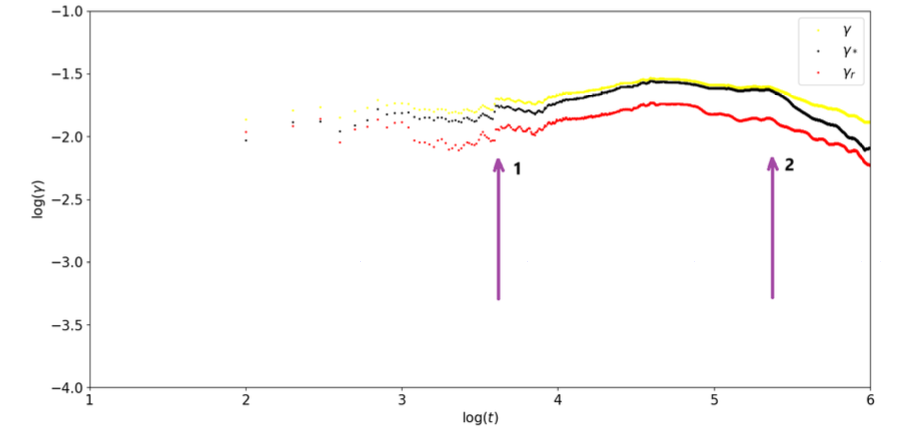
Applying the approach described above, the results shown in Figure 1 indicate that the radial contribution of the maximum LCE of Halley is not dominant, but it is also not neglegible. The dynamical evolution of Halley is more complicated. Muñoz-Gutiérrez, Reyes-Ruiz and Pichardo (2015) and Boekholt et al. (2016) showed that Jupiter has strong influence on Halley’s chaotic motion. We also found that the close encounters with the planets, mainly Jupiter, play an important role on its chaotic behavior. A more detailed analysis of this dynamics will be presented.

Figure 1. Lyapunov exponent for comet Halley. The yellow points represent Halley's maximum LCE, given by γ, the black points represent the LCE without taking into account the radial contribution (or remainder), given by γ∗, and the red points represent the radial contribution of the LCE, given by γr. The indications of numbers 1 and 2 correspond to close encounters with Jupiter.


Acknowledgements

This study was financed by CAPES – Finance Code 001, CNPq – Proc. 305210/2018-1, and FAPESP – Proc. 2016/24561-0.


References

Benettin, G. et al. Lyapunov Characteristic Exponents for smooth dynamical systems and for hamiltonian systems; a method for computing all of them. Part 1: Theory. Meccanica, 15, 9, 1980

Boekholt, T.C.N. et al. The origin of chaos in the orbit of comet 1P/Halley. MNRAS, 461, 4, 3576–3584, 2016.

Muñoz-Gutiérrez, M.A.; Reyes-Ruiz, M.; Pichardo, B. Chaotic dynamics of comet 1P/Halley: Lyapunov exponent and survival time expectancy. MNRAS, 447, 4, 3775–3784, 2015.

Pereira, L.S.; Mourão, D.C.; Winter, O.C. Confined Chaos and the chaotic angular motion of Atlas, a Saturn's inner satellite. MNRAS, 529, 1012-1018, 2024.

Winter, O.C; Mourão, D.C.; Giuliatti Winter, S.M. , Short Lyapunov time: a method for identifying confined chaos. A&A,523, A67, 2010.

How to cite: Winter, O., Pereira, L., and Mourão, D.: On the Chaotic Dynamics of Comet 1P/Halley, EPSC-DPS Joint Meeting 2025, Helsinki, Finland, 7–13 Sep 2025, EPSC-DPS2025-892, https://doi.org/10.5194/epsc-dps2025-892, 2025.

Posters: Thu, 11 Sep, 18:00–19:30 | Finlandia Hall foyer

Display time: Thu, 11 Sep, 08:30–19:30
F132
|
EPSC-DPS2025-1110
|
ECP
|
On-site presentation
Ian Matheson and Renu Malhotra

Laplace-Lagrange linear secular theory describes the mean orbit plane forced by the massive planets for small body populations outside mean motion resonances. The mean planes of several non-resonant populations inside the asteroid belt and Kuiper belt have been shown to match the Laplace plane to within the statistical limits imposed by the observed populations and the methods used in calculating the mean plane. Although linear secular theory is considered inapplicable within mean motion resonances, we show that it describes the forced planes of the Hilda asteroids in Jupiter’s interior 3:2 mean motion resonance and of the Hilda and Schubart collisional families therein, to the level of statistical precision with which those can be computed from the orbital data. We use the Hilda asteroids as a test population because they are observationally complete up to absolute magnitude H ≈ 15.7, and up-to-date catalogs are available to identify collisional families therein. This gives a statistically useful sample of thousands (n ~ 2100) of resonant objects that can be studied on a population level while limiting the statistical uncertainties to those inherent in parameter estimation without the need to account for the observational biases of various sky surveys. At the present time and for at least 2 Myr into the future, the mean orbit planes of the Hilda collisional family and the Schubart collisional family are statistically indistinguishable from each other and from the local instantaneous Laplace plane as predicted by Laplace-Lagrange linear secular theory based on the known planets. However, they are also statistically indistinguishable from the orbit plane of Jupiter. We estimate that a sample population ~100 times larger is necessary to statistically distinguish between the Laplace plane and Jupiter plane as hypothetical “true” forced planes for the Hilda asteroids. In the coming decade, the Rubin observatory may be able to push the completeness limit to dimmer magnitudes and enable a more sensitive test of Laplace theory within the Hilda region. For more tests of Laplace theory for resonant populations, we consider the mean plane of the Hilda asteroids in a solar system with a fictitious more massive, highly inclined Saturn, and we study the mean planes of the Plutino and Twotino groups in the Kuiper belt. As of the time we write this abstract, we do not have results for these last-mentioned studies, but we hope to have preliminary findings to share by the time of the conference. IM gratefully acknowledges funding by NASA FINESST grant #80NSSC23K1362.

How to cite: Matheson, I. and Malhotra, R.: On the forced planes of the Hilda asteroids and other resonant groups, EPSC-DPS Joint Meeting 2025, Helsinki, Finland, 7–13 Sep 2025, EPSC-DPS2025-1110, https://doi.org/10.5194/epsc-dps2025-1110, 2025.

F133
|
EPSC-DPS2025-898
|
On-site presentation
Rotational Spectroscopy of (16) Psyche: New Constraints on Surface Heterogeneity
(withdrawn)
Rodolpho Degen, Jorge M. Carvano, and Marçal Evangelista-Santana
F134
|
EPSC-DPS2025-908
|
On-site presentation
Dmitrii Vavilov, Sarah Greenstreet, Samuel Cornwall, and Siegfried Eggl

As the number of known near-Earth objects (NEOs) continues to grow, particularly with the expected contributions from the Vera C. Rubin Observatory’s Legacy Survey of Space and Time (LSST), there is an increasing need for efficient methods to study NEO dynamical histories. Detailed N-body integrations of asteroid orbits provide valuable insights into their past evolution, including the probabilities of origin from different source regions, typical timescales of residence within the NEO population, and the timing of transitions into near-Earth space. However, such integrations are computationally expensive and not always feasible when quick assessments of  individual or small numbers of objects is desired.

We present a new online resource, Rubin Rocks, a web-based service and API that provides access to precomputed statistical information on the dynamical evolution of NEOs. Users can input orbital elements of a given NEO, including optional uncertainty information (e.g., a covariance matrix), and receive estimates of source region probabilities, dynamical behaviors, and typical lifetimes derived from large-scale numerical simulations of the NEO population. This allows rapid investigation of the likely origin and long-term evolution of a given object without performing new integrations.

For users who require a more detailed and object-specific analysis of an asteroid’s dynamical evolution, we also offer access to a new high-performance collocational integrator called Lobbie. This Fortran-based code is available upon request and is particularly well suited for long-term orbital integrations. Compared to widely-used integrators such as REBOUND’s IAS15, Lobbie demonstrates at least twice the speed while providing higher numerical accuracy, making it a valuable tool for detailed dynamical studies.

How to cite: Vavilov, D., Greenstreet, S., Cornwall, S., and Eggl, S.: Rubin Rocks: An online tool for assessing the statistical dynamical evolution of near-Earth objects in the age of LSST, EPSC-DPS Joint Meeting 2025, Helsinki, Finland, 7–13 Sep 2025, EPSC-DPS2025-908, https://doi.org/10.5194/epsc-dps2025-908, 2025.

F135
|
EPSC-DPS2025-2091
|
ECP
|
On-site presentation
Patrick Franco and Sebastien Charnoz

Introduction: Planets form within protoplanetary disks surrounding protostars. Both the star and the disk originate from the collapse of a dense molecular cloud. The condensation of the earliest solids, Calcium Aluminium-rich Inclusions (CAIs), marks the time zero of the solar system (ss). These refractory minerals are increasingly thought to form contemporaneously with the assembly of the protoplanetary disk, as their existence requires extremely high temperatures and widespread distribution across the disk [1-2].
In contrast to carbonaceous meteorites (non-CI) and Earth, which are enriched in refractory elements as CAIs, non-carbonaceous chondrites (NCC), which should have formed closer to the Sun, exhibit a sub-solar abundance trend of refractory elements such as Al and Mg, both relative to Si. This could be due to the loss of a refractory-rich component from a disc with the original solar composition [3-4].
[5] has proposed an astrophysical scenario for the sequestration of refractory elements from the NCC source region, which suggests that massive olivine condensation increased the dust concentration in the disk as it cooled down, suppressing magneto-rotational instability and prompting the rapid formation of the first planetesimals. This process isolated the condensed solids, preventing their further interaction with gas-solid equilibrium chemistry. Later, as temperatures dropped further, new “residual condensates” could form from the residual gas. Then, NCCs likely formed from a mixture of these residual condensates and solar-composition materials, including local grains non-accreted into the first planetesimals and possibly grains migrating from outer regions to the residual region, without element fractionation.

Whereas there is a general agreement that CAIs may have condensed in high temperature conditions, a major conundrum is how to make Enstatite and Ordinary chondrites with non-solar composition (with lower Al/Si and Mg/Si ratios compared to solar) [5]. So, here, we individually track the different refractory components (Al, Mg, and Si) and investigate their radial distribution along the disk.
Methods: We simulate a 1D protoplanetary disk using a Python-based code DustPy, to evolve systems with gas and dust [7]. We initially distribute the gas surface density radially following [8]. We have also modeled the early infall into the disk by implementing an external source term, Sext, with a flux of mass of 0.5e-5MSun/year falling within 0.2au (Fig. 1).
Our planar disk extends from 0.1 to 100 au with 40 grid cells, from which 16 refined cells around 2 au. To accurately study dust growth evolution, each radial point contains 78 logarithmically spaced mass bins every mass decade, and the growth and fragmentation of dust is calculated using Smoluchowski's equation. We set the standard dust/gas ratio value to 0.01. The newly formed star has radius RStar = 0.1au, mass MStar = 0.3MSun. Dust grain sizes start with minimum radii of 0.5 microns and bulk densities of around 1.25 g cm-3.

Results: Figure 3 showcases the evolution of surface density of refractory elements (Al, Mg, and Si) when we apply the  phase equilibrium codeFASTCHEMCOND [10-11] in the post-simulation. The pressure maxima in surface density occurs now near 1au after hundreds of years due to evolution of pressure profile. As the infall material reaches the midplane, it accumulates in the inner disk region, increasing the pressure in it. This material moves outwards due to the viscous spreading, reaching the condensation zone (gray dotted line), when some gas starts to condensate. Figure 4 presents
the average radial velocity of gas and dust. Small dust grains are the most abundant in the first thousand years and they are strongly coupled to the gas flow. Fractionation of the element abundances are observed during all evolution of the disk, especially in the condensation fronts.
Our results show that the dynamical evolution of a viscously evolving protoplanetary disk, when coupled with realistic dust growth and condensation models, naturally leads to the fractionation of refractory elements such as Al, Mg, and Si. The emergence of a pressure bump near the MRI front, as a result of the viscosity transition, prevents the immediate inward drift of solids and promotes a local accumulation of their surface density. This process leads to variations in condensation of the gas, which results in element fractionation over time. These findings support the idea that the observed depletion of refractory elements in non-carbonaceous chondrites is caused by early disc processes.
Our next steps will investigate the relationship between radial mixing and chemical evolution as both the disk becomes accretionary and the global temperature of the disk cools.
References: [1] Drążkowska, J. & Dullemond, C. P. (2018) AAP, 614, A62 [2] Pignatale F. C. et al. (2018) AJL, 867, L23 [3] Larimer J. W. (1979) Icarus, 40, 446-454. [4] Alexander, C.M.O’D. (2019). Geochim. Cosmochim., 254, 246 [5] Morbidelli A. (2020) Earth and Planet. Sci. Letters 538,116220 [7] Charnoz S. et al. (2019), A&A 627, A50 [8] Lynden-Bell & Pringle (1974) MNRAS 168, 603-637 [9] Birnstiel T. et al. (2012) A&A 539, A148 [10] Zhu, Z. et al. (2010) ApJ, 713, 1134 [11] Kitzmann D. et al. (2024) MNRAS 527, 7263–7283 [12] Stock J. W. et al. (2018) MNRAS, 479, 865.


FIGURE 1: Surface density evolution (y-left) of gas (blue line) and 100 x dust (orange line). Dust-to-gas ratio (gray solid line, y-right) as a function of distance r over time. Dotted gray line stands for condensation temperature, Tcond, before which dust is evaporated.


FIGURE 2: The graph shows the temperature (blue line, y-left) and pressure (black line, y-right) profiles evolution as a function of distance r over time. It is possible to note the pressure bump rising around 2au.


FIGURE 3: Surface density profiles of aluminium (Al, orange), magnesium (Mg, red), and silicon (Si, cyan) in both dust and gas phases (solid and dashed lines, respectively). Dotted and dashed black lines stand for condensation and MRI temperatures, respectively.


FIGURE 4. Mean radial velocities of dust (orange line) and gas (blue line). Dotted and dashed gray lines stand for condensation and MRI temperatures, respectively.

How to cite: Franco, P. and Charnoz, S.: Dynamical Evolution of Refractory Elements in an alpha-Protoplanetary Disk, EPSC-DPS Joint Meeting 2025, Helsinki, Finland, 7–13 Sep 2025, EPSC-DPS2025-2091, https://doi.org/10.5194/epsc-dps2025-2091, 2025.

F136
|
EPSC-DPS2025-374
|
ECP
|
On-site presentation
Wen-Han Zhou

The Yarkovsky effect, a well-established mechanism in planetary science, results from anisotropic thermal re-emission on the surfaces of rotating small bodies (Vokrouhlicky et al 2015). As sunlight heats an asteroid’s surface, the re-radiation of this energy, especially from the afternoon hemisphere, creates a recoil force that alters the object’s orbit over time. This subtle but persistent force plays a key role in the long-term heliocentric orbital evolution of small bodies such as near-Earth asteroids. Until recently, however, its role in binary asteroid systems—where two bodies are gravitationally bound in mutual orbit—remained largely unexplored.

In a recent study, Zhou et al. (2024) discovered the so-called Binary Yarkovsky effect (BY), which governs the long-term evolution of mutual orbits within binary asteroid systems, separate from their heliocentric trajectories. This discovery significantly advances our understanding of small-body dynamics. In particular, Zhou et al. demonstrated that the Binary Yarkovsky effect on the secondary (BYS) can efficiently drive the secondary asteroid toward a synchronous state, where its spin period matches its orbital period. The direction of this evolution depends on whether the primary casts a shadow on the secondary's orbit. If shadowing occurs, BYS acts to synchronize the secondary; otherwise, it pushes the system away from synchronization. This mechanism provides a compelling explanation for the observational fact that most small binary asteroids possess synchronously rotating secondaries, even though the expected tidal dissipation in such low-mass systems (primary radius < 1 km) is too weak to induce synchronization.

In this work, we present a comprehensive analysis of BYP, including its physical modeling, numerical characterization, and observational implications (Zhou 2024). We numerically compute the radiation recoil forces acting on rapidly rotating primary asteroids, accounting for thermal inertia and geometric eclipses. An example of the eclipse is shown in Fig. 1. By fitting the numerical results, we derive an empirical formula for BYP and use it for estimate of the orbital drift rates of known binary asteroids.

Fig. 1. Left: Snapshots of the temperature field of the binary asteroids. Diagrams (a)-(d) illustrate the anti-clockwise orbit of the secondary asteroid around the primary. Both the primary and secondary have spin rates of 3 hours. The other properties of the binary system are detailed in Sect.~\ref{sec:frequency}. In phase (a) the primary is partially eclipsed by the secondary, while in phase (c) the primary fully eclipses the secondary. Right: Tangential accelerations due to thermal forces for the primary (blue) and secondary (red). The eclipse periods are represented by shaded areas. The net force averaged over one orbital period produces the Binary Yarkovsky effect.

Our simulations confirm that BYP acts to bring the primary’s spin toward the mutual orbital frequency, just as BYS does for the secondary. However, BYP does not require the secondary to be asynchronous—meaning it remains effective in many binaries previously thought to be dynamically static.

Fig. 2. The BYP-induced orbital drift rate for confirmed small binary asteroids, assuming thermal inertia of 100 tiu (left) and 500 tiu (right). The colours indicate the heliocentric semi-major axis, with bluer colours representing greater distances from the Sun. The size of each circle corresponds to the size of the primary asteroid. 

Our calculations reveal that BYP is actively shrinking the mutual orbits of most known small binary asteroids. The BYP-induced orbital drift rates for small binary asteroids (primary radius < 1 km) range from –0.001 to –1 cm yr-1 (Fig. 2). We find that the predicted orbital drift rates of BYP for pre-impact asteroid Didymos and asteroid (175706) 1996 FG3 are consistent with the observed values (e.g. Scheirich et al. 2024 and references therein). However, the results show a discrepancy for systems 2001 SL9 and 1999 KW4, suggesting complex dynamics in these systems also involving the BYORP and tides (Cuk & Burns, 2005; Jacobson & Scheeres, 2011). We conclude that the BYP is changing the mutual orbits of most discovered binary asteroids and it should be considered along with BYORP and tidal effects when studying binary systems’ long-term dynamics.


References

Ćuk, M., & Burns, J. A. (2005). Effects of thermal radiation on the dynamics of binary NEAs. Icarus176(2), 418-431.

Jacobson, S. A., & Scheeres, D. J. (2011). Long-term stable equilibria for synchronous binary asteroids. The Astrophysical Journal Letters736(1), L19.

Scheirich, P., Pravec, P., Meyer, A. J., Agrusa, H. F., Richardson, D. C., Chesley, S. R., ... & Moskovitz, N. A. (2024). Dimorphos orbit determination from mutual events photometry. The Planetary Science Journal5(1), 17.

Vokrouhlický, D., Bottke, W. F., Chesley, S. R., Scheeres, D. J., & Statler, T. S. (2015). The Yarkovsky and YORP effects. In P. Michel, F. E. DeMeo, & W. F. Bottke (Eds.), Asteroids IV (pp. 509–531). University of Arizona Press.

Zhou, W. H., Vokrouhlický, D., Kanamaru, M., Agrusa, H., Pravec, P., Delbo, M., & Michel, P. (2024). The Yarkovsky effect on the long-term evolution of binary asteroids. The Astrophysical Journal Letters968(1), L3.

Zhou, W. H. (2024). The binary Yarkovsky effect on the primary asteroid with applications to singly synchronous binary asteroids. Astronomy & Astrophysics692, L2.


How to cite: Zhou, W.-H.: Orbital Contraction of Small Binary Asteroids Driven by the Binary Yarkovsky Effect on the Primary Asteroid, EPSC-DPS Joint Meeting 2025, Helsinki, Finland, 7–13 Sep 2025, EPSC-DPS2025-374, https://doi.org/10.5194/epsc-dps2025-374, 2025.

F137
|
EPSC-DPS2025-946
|
On-site presentation
Joaquin Fernandez, Marcel Popescu, Noemí Pinilla-Alonso, Miquel Serra-Ricart Serra-Ricart, Javier Licandro, Miguel R. Alarcón, Lucía Matamoros Pava, and Estela Fernández Valenzuela
The (617) Patroclus is a binary asteroid system located in the trailing Trojan group (L5) of
Jupiter. The two components, Patroclus and Menoetius (the satellite), orbit a common center of
mass and are nearly equal in size. Studies suggest that Jupiter’s Trojan asteroids, including
Patroclus and Menoetius, may have originated from the outer solar system and were later captured
into their current orbits during the migration of the giant planets (e.g., Morbidelli et al., 2005). The
binary nature of this system adds another layer of importance, as such systems are thought to form
under specific conditions. Their mutual orbit provides valuable insights into the distribution of
mass, size, and material in the early solar system (e.g., Merline et al., 2001). The Lucy spacecraft is
expected to fly by this system in 2033, marking the final encounter of its 12-year journey.
 
A particularly useful technique for studying binary asteroids involves observing mutual
events—eclipses or occultations—that occur when the orbital plane of the system aligns with both
the Sun and the observer. This alignment allows for the accurate determination of key orbital
parameters and the physical characteristics of the system, including mutual orbital elements and the
shape of the bodies. As a result, we initiated an observing campaign that ran during both the 2017–
2018 season and the 2024–2025 season.
 
We observed a total of 7 events using various telescopes across the Earth during 2017-2018.
During 2024-2025 we took advantage of the cutting edge instruments provide by Light Bridges, the
Twin Two Mtere telescopes and we were able to capture 15 complex events (occultations and
eclipses). These telescopes are locate at at the Teide Observatory of the Instituto de Astrofisica de
Canarias (IAC), that Light Bridges operates in the island of Tenerife, Canary Islands (Spain). The
observations made with TTT were performed using the Luminance filter. The log of all these
observations is shown in Table 1.
 
We retrieved the right ascension and declination of (617) Patroclus from the Minor Planet
Center. We modeled the two components, Patroclus and Menoetius, as ellipsoids and ran a two-
body problem code for various orbital parameters. To determine the best orbital solution, we
implemented a grid search algorithm. The light curves were computed by considering three
elements in the plane of sight: the projections of Patroclus, Menoetius, and the shadow cast by the
body in front. We then calculated the flux contribution from the foreground body and the portion of
its shadow covering the background body at each timestamp using the following formula:
 
 
Thanks to the new model implemented in this study, we obtained a refined orbital solution
by trying to match all the 22 events. The best match between (Figure 1) the model and the
observations was achieved using the following orbital parameters: a (semi-major axis) = 692.4 ± 5
km, e (eccentricity) = 0.018 ± 0.018, i (inclination) = 164.8° ± 0.2, L (mean longitude) = 114.13° ±
5, Ω (longitude of the ascending node) = 270.04° ± 2.3, T (orbital period) = 4.272797 ± 0.00003
days. The estimated dimensions are 118.76 × 107.3 × 104.78 km for Patroclus, and 110.7 × 96.88 ×
94.24 km for Menoetius.
Observation log: N.images refers to the number of frames acquired for each event; UT start and UT
end indicate the start and end times of each observation in UTC; details on the telescope,
instrument, filter, and exposure time (Texp) used for each observation night are also included.
 
As noted by Pinilla-Alonso et al. (2022), there is a discrepancy in the superior events when
attempting to match the model to the upper occultation data. This difference is attributed to a crater
located at the south pole of Menoetius, as proposed in that study. Our new observations are
consistent with this interpretation (e.g. Figure 2).
 
Figure 1: Example of an observed (blue) and simulated (black) light curve for an inferior mutual
event in the Patroclus–Menoetius system. The simulated lightcurve was obtained using the best
solution we found
 
Figure 2: Example of an observed (blue) and simulated (black) light curve for an superior mutual
event in the Patroclus–Menoetius system.The simulated lightcurve was obtained using the best
solution we found

How to cite: Fernandez, J., Popescu, M., Pinilla-Alonso, N., Serra-Ricart, M. S.-R., Licandro, J., R. Alarcón, M., Matamoros Pava, L., and Fernández Valenzuela, E.: The properties of the (617) Patroclus binary system derived from the mutualevents of 2017–2018 and 2024–2025, EPSC-DPS Joint Meeting 2025, Helsinki, Finland, 7–13 Sep 2025, EPSC-DPS2025-946, https://doi.org/10.5194/epsc-dps2025-946, 2025.

F138
|
EPSC-DPS2025-992
|
On-site presentation
Filipe Monteiro, André Amarante, José Silva-Cabrera, and Daniela Lazzaro

Introduction

Photometric lightcurves observations have been intensively applied to derive many important physical information of asteroids, such as rotational properties (rotational period and spin direction) and shape model (Kaasalainen et al., 2004; Durech et al., 2015). Asteroids lightcurves also have been extensively used to detect and characterize binary systems (Pravec et al., 2006).  The current observational evidence indicates that small binary systems (D = 0.2–10 km), both in the main belt asteroid and in the near-Earth region, can form by rotational fission of reaccumulated bodies, likely as a result of the YORP effect. Here, we will present the lightcurves analysis for a possible binary asteroid, denominated (243566) 1995 SA, as well as a dynamic analysis of its surface. This work is part of our extensive observational campaign for the physical characterization for a large sample of asteroids, in particular, of near-Earth asteroids (NEAs) within the scope of the IMPACTON Project (Rondón et al., 2019, 2022; Monteiro et al., 2020, 2021, 2023).

Observations and data reduction

Photometric observations of binary systems are being performed using the 1.0-m f/8 telescope of the Observatório Astronômico do Sertão de Itaparica (OASI, Brazil) of the IMPACTON project (Rondón et al., 2020), as well as two small instruments (0.61 m and 0.36 m telescopes) of the Blue Mountain Observatory (BMO, Australia). Lightcurve observations were carried out using sidereal tracking and an R-Johnson-Cousins filter. The images were taken with an exposure time according to the object magnitude and sky motion. To obtain photometric spectra, observations were made using the g, r, i, z Sloan Digital Sky Survey (SDSS) filters, using differential tracking mode. The science images were calibrated following the standard procedures, including bias, dark and flat-field images.

The rotation periods were derived using a Fourier series analysis (Harris et al., 1989) while the spin direction and shape model were obtained by applying the lightcurve inversion method (Kaasalainen and Torppa, 2001; Kaasalainen et al., 2001). To investigate binary periods, we used the "Dual Period Search" tool in MPO Canopus software which is based on the method described by Pravec et al. 2006. To obtain the color indices and the photometric spectrum of some objects, we used standard field stars to calculate the zero-point of the night and, consequently, the calibrated magnitude of the asteroid. Thus, the photometric spectrum was derived from the observed color indices minus the solar color indices and transformed to normalized reflectance at the r filter.

Results

We investigated the lightcurves of about 20 NEA with rotational periods between 2 and 3 h. For 8 of them, binarity signatures were found in their lightcurves (Monteiro et al., 2023). Fig. 1 shows the primary and secondary lightcurves of a possible binary NEA denominated (243566) 1995 SA. For this NEA, in addition to the primary and secondary lightcurves, we derived the minimum relative size of the components (D2/D1) of 0.37 (from the depth of the mutual event). The lightcurve obtained during its apparition in March 2014 showed a secondary lightcurve, but no clear mutual events, with a period of about 16 h. 

Figure 1 - Lightcurves of (243566) 1995 SA. Left: the primary lightcurve component. Right: the secondary lightcurve showing a possible mutual event observed on the 25th July 2014. The primary lightcurve component was subtracted.

By applying the lightcurve inversion method, we derived the ecliptic longitude and latitude of the pole direction (𝜆, 𝛽 = 228°, -20°), as well as an approximately oblate shape for this NEO, with axes ratio of a/b = 1.07, a/c = 1.34,and b/c = 1.26. Fig. 2 shows the convex shape model for the NEA 1995 SA (Monteiro et al. submitted). Photometric data were also obtained using the SDSS g-, r-, i-, and z-band filters, allowing to derive the colour indices and photometric spectra. 1995 SA was classified as an S-type asteroid, using Carvano’s taxonomy.

Figure 2 – Convex shape model for the NEO (243566) 1995 SA reconstructed from the lightcurves for the best-fit pole (𝜆, 𝛽 = 228°, -28°).

These results were used to investigate the surface dynamics of NEA 1995 SA in search of evidence for binary formation. Specifically, we analyzed its geopotential surface, surface accelerations, slopes, and escape velocity across its entire surface (Monteiro et al., submitted). As an example, Fig. 3 presents a geopotential map of this object. The dynamics assessment was conducted using a shape model derived from lightcurve data. Consequently, these findings provide initial insights into the potential formation mechanism of its possible satellite.

Fig. 3 - Map of the geopotential computed across the surface of the NEA 1995 SA.

Conclusions

Our physical characterization of the NEA 1995 SA includes its rotational and orbital periods, spin direction, shape model, color indices, and photometric spectrum. Additionally, we build upon previous findings that identified satellite signatures in its lightcurves (Monteiro et al. 2023), providing new evidence that supports the binary nature of 1995 SA. Notably, the surface dynamics of 1995 SA offer insight into the material loss from a progenitor body. Based on these results, we reinforce that binary objects in this population can originate from rotational fission (Monteiro et al., submitted).

Acknowledgements

F.M. thanks the financial support given by the São Paulo Research Foundation (FAPESP), Brasil - Process Number 2024/16260-6. Support by CNPq (310964/2020-2) and FAPERJ (E-26/202.841/2017 and E-26/201.001/2021) is acknowledged by D.L.

References

Carvano, J. et al., 2010. A&A, 510:A43.

Durech, J.,et al., 2015. Asteroids IV, pages 183-202.

Harris A. W., et al., 1989, Icarus, 77, 171.

Kaasalainen, M. and Torppa, J. (2001). Icarus, 153:24-36.

Kaasalainen, M., Torppa, J., and Muinonen, K., 2001. Icarus, 153:37-51.

Kaasalainen, M., et al., 2004. Icarus, 167(1):178-196.

Monteiro, F., et al., 2020. MNRAS, 495, 3990-4005.

Monteiro, F., et al., 2021. MNRAS 507, 5403–5414.

Monteiro, F., et al., 2023. Icarus, 390, p. 115297.

Pravec, P., et al., 2006, Icarus, 181, 63.

Rondón, E., et al., 2019. MNRAS, 484:2499–2513.

Rondón, E., et al., 2022. Icarus 372, 114723.

How to cite: Monteiro, F., Amarante, A., Silva-Cabrera, J., and Lazzaro, D.: Physical and dynamical analysis of the potential binary near-Earth asteroid (243566) 1995 SA, EPSC-DPS Joint Meeting 2025, Helsinki, Finland, 7–13 Sep 2025, EPSC-DPS2025-992, https://doi.org/10.5194/epsc-dps2025-992, 2025.

F139
|
EPSC-DPS2025-1589
|
ECP
|
On-site presentation
Tim Arnet and Veerle J. Sterken

The heliosphere is a “bubble” of plasma that forms around the Sun through a pressure balance between the outflowing solar wind and the interstellar medium. The Sun is currently traversing the local interstellar medium at a relative velocity of approximately 26 km s−1. Due to the Sun’s motion, interstellar dust grains present in the interstellar medium are transported through the heliosphere’s boundary, from the upwind direction.

Dust grains in a space environment are subject to a variety of charging mechanisms, which result in an overall equilibrium charge on their surface. In the interstellar medium and in the solar wind, the primary charging mechanisms are plasma collection, secondary electron emission, and photoelectric emission. The charge acquired by a dust grain depends on several factors, including the size, composition, and structure of the dust grain itself, as well as on the characteristics of the surrounding environment.

The trajectories of charged dust grains are influenced by the magnetic field in the environment they are moving through due to the emerging Lorentz force. When approaching the heliosphere, the interstellar magnetic field starts to get disturbed by the solar wind (heliospheric) magnetic field. The amount of trajectory deflection an inflowing interstellar dust grain experiences depends on its charge-to-mass ratio. Consequently, not all interstellar dust grains enter the solar system.

We discuss the dust charging with a particular focus on the influence of the space environment conditions that are expected at different locations throughout the heliosphere, including the boundary regions and including short-term and long-term variations of the environmental conditions due to the solar activity. Using these results, we show the influence of heliospheric properties on the dust grain trajectories at the heliospheric interface in specific. The results will help to understand the physical processes occurring at the boundary of the heliosphere.

How to cite: Arnet, T. and Sterken, V. J.: Charging and Dynamics of Interstellar Dust throughout the Heliosphere, EPSC-DPS Joint Meeting 2025, Helsinki, Finland, 7–13 Sep 2025, EPSC-DPS2025-1589, https://doi.org/10.5194/epsc-dps2025-1589, 2025.