
 1,3
1,3- 1University of Belgrade, Faculty of Mathematics, Department of Astronomy, Serbia (dusan.marceta@matf.bg.ac.rs)
- 2Michigan State University, Department of Physics and Astronomy
- 3Politecnico di Milano, Department of Aerospace Science and Technology
We study the dynamical properties of interstellar objects (ISOs) that are capable of impacting the Earth. We simulate a synthetic population of approximately 1010 ISOs with kinematic properties characteristic of M-dwarf stars. From this population, we identify a subset of about 105 objects with trajectories consistent with potential Earth impacts.
The results indicate that ISO impactors preferentially approach from the direction of the solar apex and the galactic plane, exhibiting flux enhancements of up to a factor of ~2 relative to the mean, as illustrated in Fig. 1.
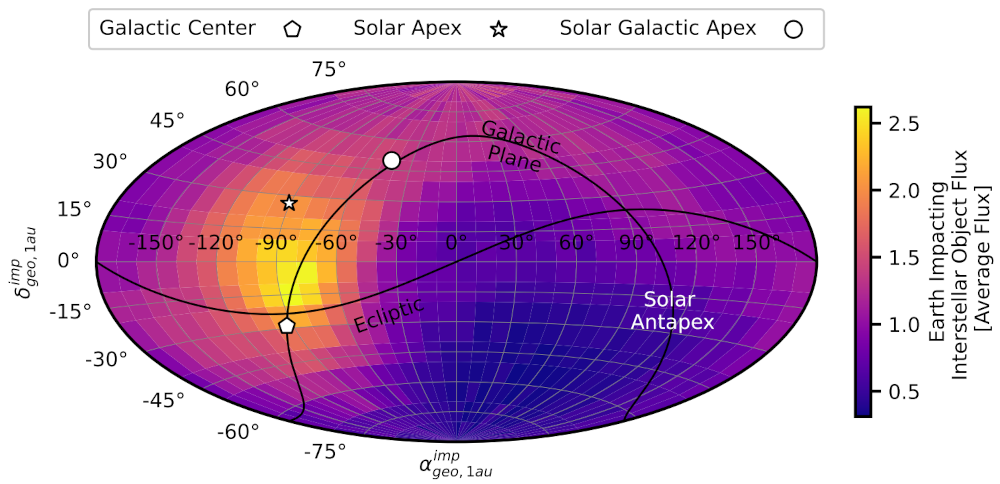
Figure 1: Radiants of impacting interstellar objects in the geocentric frame. The objects tend to arrive from directions aligned with the solar apex and the galactic plane.
The velocity distribution of Earth-impacting ISOs differs from that of the overall interstellar population, as shown in Fig. 2. Impactors exhibit a peak in geocentric velocities at approximately 72 km/s.
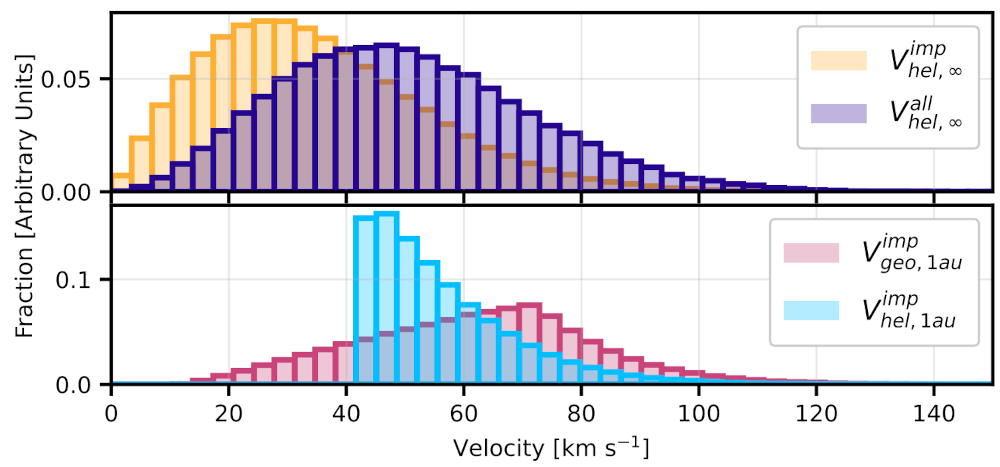
Figure 2: Velocity distributions of Earth-impacting interstellar objects compared to the full interstellar population. The Earth's motion adds to the ISO velocities, resulting in a shift of the distribution toward higher values in the geocentric frame.
We find a significant substructure in the parameter space comprising radiants, impactor velocity, and solar longitude at the time of impact, suggesting a pronounced seasonal dependence of Earth-impacting interstellar objects. Fig. 3 shows the radiants of these objects as a function of solar longitude and velocity. The results indicate that faster interstellar impacts are more likely to occur in the spring, when the Earth is moving towards the solar apex.
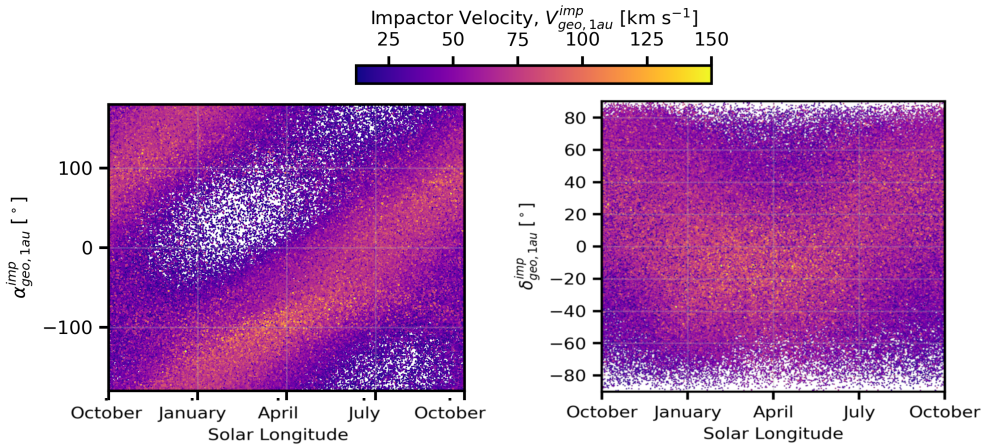
Figure 3: Faster interstellar objects are more likely to impact the Earth in the spring when the Earth is moving towards the apex. The declination distribution of high-velocity impactors mirrors the ecliptic plane. Velocities are calculated in the geocentric frame.
On the other hand, interstellar objects are more likely to impact the Earth when it is in the direction of the antapex, which occurs during winter. Fig. 4 shows the distribution of total relative impacts as a function of solar longitude.

Figure 4: Interstellar objects are more likely to impact the Earth in the winter than in the spring.
We also analyze Earth locations most likely to experience impacts from interstellar objects. Fig. 5 shows the relative flux of these impactors on the Earth's surface.
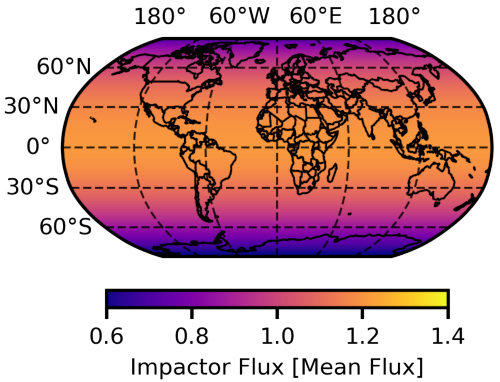
Figure 5: Interstellar objects are more likely to impact the Earth at low latitudes close to the equator. There is a slight preference for impactors in the Northern hemisphere.
To calculate this distribution, we consider that a given radiant can result in impacts at multiple locations on the Earth. Specifically, a single radiant corresponds to an entire hemisphere of possible approach directions, defined by orbits parallel to that radiant. Our results indicate that interstellar objects are more likely to impact the Earth at low latitudes near the equator, with a slight preference for the Northern hemisphere due to the location of the solar apex.
How to cite: Marceta, D., Seligman, D., and Peña-Asensio, E.: The Distribution of Earth-Impacting Interstellar Objects, EPSC-DPS Joint Meeting 2025, Helsinki, Finland, 7–12 Sep 2025, EPSC-DPS2025-1080, https://doi.org/10.5194/epsc-dps2025-1080, 2025.


