SB1 | Interstellar objects: from theory to observations

SB1

Interstellar objects: from theory to observations
Co-organized by MITM/EXOA
Convener: Michele T. Bannister | Co-conveners: Rosemary Dorsey, Chris Lintott, Susanne Pfalzner, Matthew M. Knight, Darryl Seligman, Cyrielle Opitom, Colin Snodgrass
Orals FRI-OB3
| Fri, 12 Sep, 11:00–12:30 (EEST)
 
Room Earth (Veranda 2)
Posters THU-POS
| Attendance Thu, 11 Sep, 18:00–19:30 (EEST) | Display Thu, 11 Sep, 08:30–19:30
 
Finlandia Hall foyer, F140–143
Fri, 11:00
Thu, 18:00
Interstellar objects (ISOs) have become a novel field of Galactic small body studies, connecting the formation history of our Solar System to the processes of planetesimal creation and evolution that play out in planetary systems across the Milky Way.

The known population of ISOs is expected to increase soon, following 1I/`Oumuamua in 2017 and 2I/Borisov in 2019, as the planetary science community reaps the benefits of a new generation of survey telescopes. At the given epoch, the intrinsic ISO population remains observationally unconstrained; theoretical predictions are equally influential as observed physical characteristics on our understanding.

This session explores the past, present, and future research on interstellar objects, and is therefore open to contributions from a wide range of topics, including (but not limited to):
- Planetesimal formation and ejection mechanisms
- ISO dynamics in the Galaxy
- Evolutionary processing of small bodies e.g. in the interstellar medium or tidal disruption
- The relationships of Solar System populations to ISOs
- Observational characterisation of the known ISO population, 1I and 2I
- Population modelling & predictions for future ISO discoveries
- Mission concepts for in-situ ISO observation

Session assets

Orals: Fri, 12 Sep, 11:00–12:30 | Room Earth (Veranda 2)

Chairpersons: Susanne Pfalzner, Cyrielle Opitom, Matthew M. Knight
11:00–11:12
|
EPSC-DPS2025-1462
|
On-site presentation
Chris Lintott, Matthew Hopkins, Michele Bannister, Rosemary Dorsey, and John Forbes

In preparation for Rubin and an upcoming targeted precursor survey on CFHT, we present the latest version of the Ōtautahi-Oxford model for the detection of ISOs by LSST, including predictions for the velocity distribution of such objects in the solar neighbourhood derived from Gaia along with predictions from a simple chemical model. The combination produces a rich ‘chemodynamic’ signature with correlations between velocity, chemistry and age, allowing us to test the model with the expected yield from LSST.  These correlations with velocity allow us to infer the properties of each ISO upon discovery, allowing the prioritisation of exceptional objects for time-critical follow-up. We also describe future improvements to the model, including a more sophisticated chemical treatment, which will increase its explanatory power.

How to cite: Lintott, C., Hopkins, M., Bannister, M., Dorsey, R., and Forbes, J.: The Chemodynamics of Interstellar Objects , EPSC-DPS Joint Meeting 2025, Helsinki, Finland, 7–13 Sep 2025, EPSC-DPS2025-1462, https://doi.org/10.5194/epsc-dps2025-1462, 2025.

11:12–11:27
|
EPSC-DPS2025-1629
|
ECP
|
On-site presentation
Rosemary Dorsey, Matthew Hopkins, Michele Bannister, Samantha Lawler, Chris Lintott, Alex Parker, and John Forbes

Survey simulation is a numerical tool used to contextualize the discoveries of modern surveys. In Solar System science, telescopic campaigns yield biased subsets of the overall intrinsic small body populations. Understanding the observational biases of a given group of objects is imperative to interpreting the survey discoveries (or lack thereof).

Interstellar objects (ISOs) are planetesimals, either asteroidal or cometary, which are unbound from their origin planetary system. ISOs are expected to be bountiful in the Milky Way; simulations have shown that the Solar System ejected most of its planetesimals during its early evolution and it is sensible to extrapolate that other planetary systems may do the same. Even so, to date there have only been two confirmed serendipitous ISO passages through the Solar System, 1I\`Oumuamua and 2I\Borisov. Discovery of the next interstellar object, 3I, is uncertain; the physical size and number density of ISOs are largely unconstrained. However, recent analysis of the solar neighbourhood using data from the Gaia mission (Hopkins et al. 2025) has provided a model for the characteristics of the local ISO population with which to survey simulate discoveries in upcoming surveys.

In this dissertation talk, I will discuss the challenges of simulating ISOs in a realistic survey, introduce the new innovations in survey simulating used in this work (in comparison to historical approaches), and provide probabilistic predictions for the characteristics of the ISO discoveries in the upcoming Legacy Survey of Space and Time (LSST).

How to cite: Dorsey, R., Hopkins, M., Bannister, M., Lawler, S., Lintott, C., Parker, A., and Forbes, J.: Innovations in Modern Survey Simulation: Predicting Interstellar Objects in LSST, EPSC-DPS Joint Meeting 2025, Helsinki, Finland, 7–13 Sep 2025, EPSC-DPS2025-1629, https://doi.org/10.5194/epsc-dps2025-1629, 2025.

11:27–11:39
|
EPSC-DPS2025-1080
|
On-site presentation
Dusan Marceta, Darryl Seligman, and Eloy Peña-Asensio

We study the dynamical properties of interstellar objects (ISOs) that are capable of impacting the Earth. We simulate a synthetic population of approximately 1010 ISOs with kinematic properties characteristic of M-dwarf stars. From this population, we identify a subset of about 105 objects with trajectories consistent with potential Earth impacts.

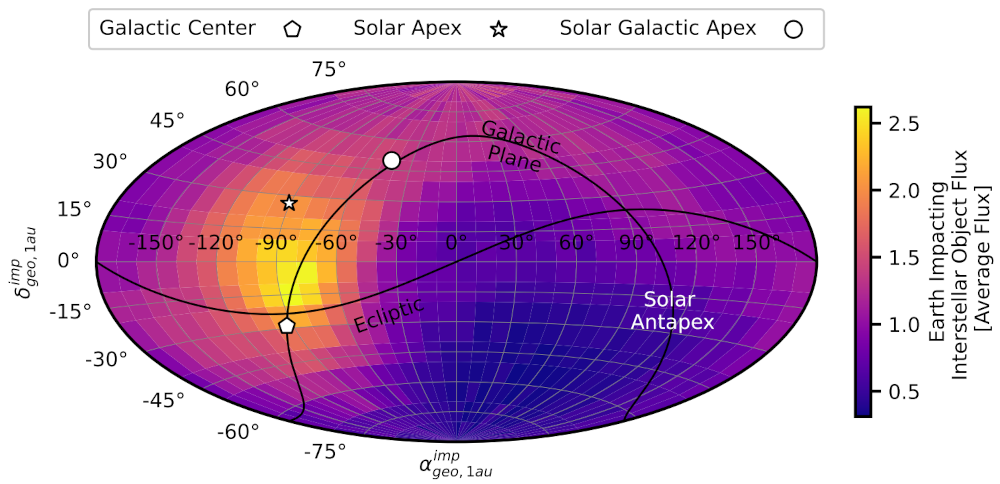
The results indicate that ISO impactors preferentially approach from the direction of the solar apex and the galactic plane, exhibiting flux enhancements of up to a factor of ~2 relative to the mean, as illustrated in Fig. 1.

Figure 1: Radiants of impacting interstellar objects in the geocentric frame. The objects tend to arrive from directions aligned with the solar apex and the galactic plane.

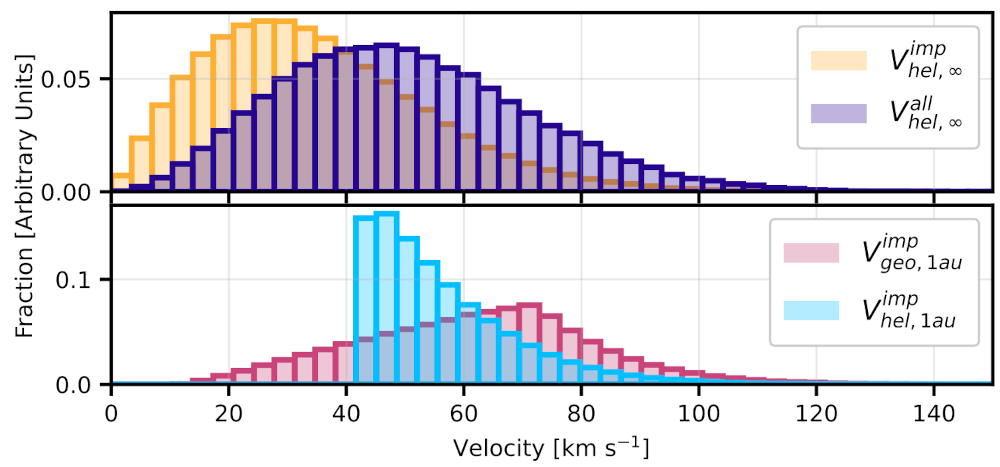
The velocity distribution of Earth-impacting ISOs differs from that of the overall interstellar population, as shown in Fig. 2. Impactors exhibit a peak in geocentric velocities at approximately 72 km/s.

Figure 2: Velocity distributions of Earth-impacting interstellar objects compared to the full interstellar population. The Earth's motion adds to the ISO velocities, resulting in a shift of the distribution toward higher values in the geocentric frame.

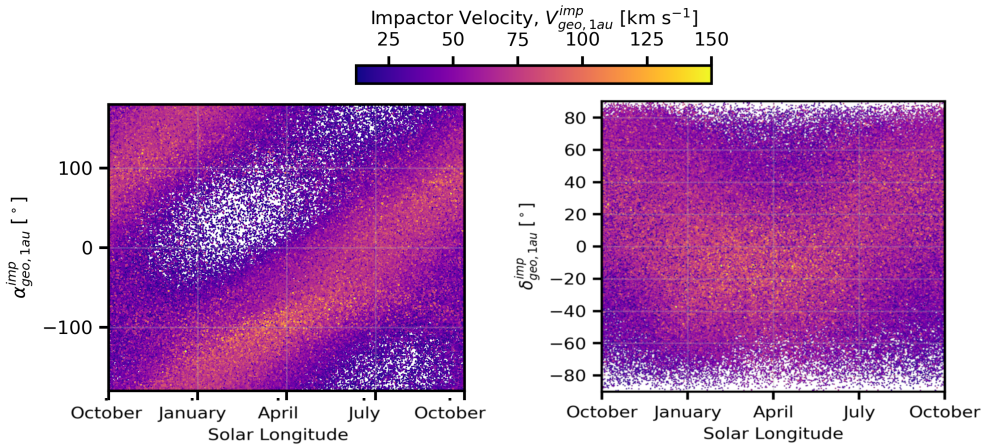
We find a significant substructure in the parameter space comprising radiants, impactor velocity, and solar longitude at the time of impact, suggesting a pronounced seasonal dependence of Earth-impacting interstellar objects. Fig. 3 shows the radiants of these objects as a function of solar longitude and velocity. The results indicate that faster interstellar impacts are more likely to occur in the spring, when the Earth is moving towards the solar apex.

Figure 3: Faster interstellar objects are more likely to impact the Earth in the spring when the Earth is moving towards the apex. The declination distribution of high-velocity impactors mirrors the ecliptic plane. Velocities are calculated in the geocentric frame.

On the other hand, interstellar objects are more likely to impact the Earth when it is in the direction of the antapex, which occurs during winter. Fig. 4 shows the distribution of total relative impacts as a function of solar longitude.

Figure 4: Interstellar objects are more likely to impact the Earth in the winter than in the spring.

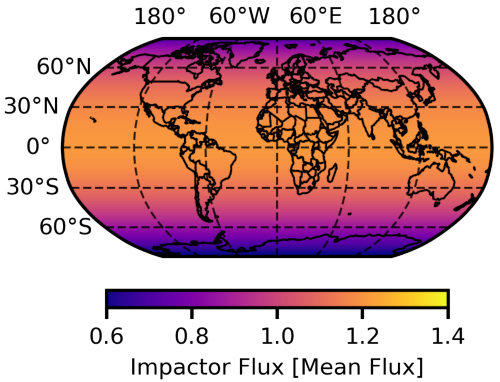
We also analyze Earth locations most likely to experience impacts from interstellar objects. Fig. 5 shows the relative flux of these impactors on the Earth's surface.

Figure 5: Interstellar objects are more likely to impact the Earth at low latitudes close to the equator. There is a slight preference for impactors in the Northern hemisphere.

To calculate this distribution, we consider that a given radiant can result in impacts at multiple locations on the Earth. Specifically, a single radiant corresponds to an entire hemisphere of possible approach directions, defined by orbits parallel to that radiant. Our results indicate that interstellar objects are more likely to impact the Earth at low latitudes near the equator, with a slight preference for the Northern hemisphere due to the location of the solar apex.

How to cite: Marceta, D., Seligman, D., and Peña-Asensio, E.: The Distribution of Earth-Impacting Interstellar Objects, EPSC-DPS Joint Meeting 2025, Helsinki, Finland, 7–13 Sep 2025, EPSC-DPS2025-1080, https://doi.org/10.5194/epsc-dps2025-1080, 2025.

11:39–11:51
|
EPSC-DPS2025-468
|
On-site presentation
Yukun Huang, Brett Gladman, and Eiichiro Kokubo

The gravitational scattering of planetesimals by a planet—arguably the primary channel for producing interstellar objects—remains a fundamental challenge within the circular restricted three-body problem (CR3BP). Although the underlying dynamics are deterministic, the extreme sensitivity of orbital-element changes to each encounter’s exact distance and orientation renders the process highly chaotic. Consequently, most investigations have relied exclusively on numerical integrations, especially once particles cross the planet’s orbit. Here, we introduce a novel analytical framework employing a patched-conic approximation to model the collective scattering of an ensemble of test particles. By averaging over all possible flyby parameters, we derive explicit expressions for the drift and diffusion coefficients of the normalized orbital energy. We then solve the resulting Fokker–Planck equation to obtain a closed-form solution for the time evolution of the particle distribution. The characteristic scattering timescale emerges naturally, scaling as ${P_{p}}{M_{p}^{2}}$, where $P_{p}$ and $M_{p}$ are the planet’s orbital period and mass ratio. Our analytical solution constitutes a universal law that can be applied to any exoplanetary system to estimate ejection rates and the velocity distribution of interstellar objects. This work provides a fast alternative to expensive simulations, opening a new avenue for studying how interstellar objects are distributed across the galaxy.

How to cite: Huang, Y., Gladman, B., and Kokubo, E.: Interstellar Objects from Planetary Scattering: An Analytical Solution, EPSC-DPS Joint Meeting 2025, Helsinki, Finland, 7–13 Sep 2025, EPSC-DPS2025-468, https://doi.org/10.5194/epsc-dps2025-468, 2025.

11:51–12:03
|
EPSC-DPS2025-2042
|
ECP
|
On-site presentation
Leah Albrow, Michele Bannister, and John Forbes

Interstellar objects (ISOs) are released from their progenitor planetary systems through dynamical mechanisms that impart a wide range of ejection velocities. These velocity distributions influence the propagation and long-term dynamical evolution of ISOs within the Galactic potential. Understanding these distributions is critical for interpreting the population of ISOs that will be observed in Rubin’s Legacy Survey of Space and Time (LSST) and by NEOSurveyor.

We assess the effect of dynamical instabilities across a broad range of planetary system architectures on both the ejection rates and velocities of ISOs. Specifically, we consider gravitational scattering driven by large-scale dynamical instabilities—a common evolutionary pathway for planetary systems. We performed an ensemble of more than 2,000 N-body simulations using the REBOUND package, exploring varying numbers of planets and total planetary system masses embedded within a massless planetesimal disk. We tracked planetesimal ejections over the first 10 Myr of each system’s evolution, following gas disk dispersal.

1: Thirty example systems in their initial configuration.

We find that ejection velocities are generally low, with typical values of only a few km/s for systems undergoing instability-driven scattering. The ejection velocity and the fraction of planetesimals ejected are strongly correlated, allowing us to identify two primary categories of planetary systems. In the first, ejection velocities cluster around 1–2 km/s, with ejection fractions ranging from 0.1 to 0.8. In the second, ejection velocities span 2–5 km/s, and the corresponding ejection fractions are consistently above 0.4. These categories are distinguishable based on system architecture parameters: lower ejection fractions are associated with high mass partitioning, low planetary multiplicity, overall lower total system mass, and the ejection of fewer planets during the simulation—indicative of the absence of a global dynamical instability.

While ISOs undergo subsequent dynamical heating as they orbit through the Galaxy, our results suggest that their initial kinematic distributions retain a memory of their parent systems’ architectures and dynamical histories. This influence may be observable in the present-day Galactic ISO population. It offers a new avenue for constraining the dynamical histories of exoplanetary systems, through ISO surveys.

2: Scatter plot of all of the completed integrations, showing the two clustered ejection fraction and velocity trends.

How to cite: Albrow, L., Bannister, M., and Forbes, J.: The ejection velocities of interstellar objects signpost their progenitor system architectures, EPSC-DPS Joint Meeting 2025, Helsinki, Finland, 7–13 Sep 2025, EPSC-DPS2025-2042, https://doi.org/10.5194/epsc-dps2025-2042, 2025.

12:03–12:15
|
EPSC-DPS2025-1170
|
Virtual presentation
John Forbes, Michele Bannister, Chris Lintott, Angus Forrest, Simon Portegies Zwart, Rosemary Dorsey, Leah Albrow, and Matthew Hopkins

Upcoming surveys are likely to discover a new sample of interstellar objects (ISOs) within the Solar System, but questions remain about the origin and distribution of this population within the Galaxy. ISOs are ejected from their host systems with a range of velocities, spreading out into tidal streams. We simulate ISO streams orbiting in the Galaxy, and derive a simple model for their density distribution over time. We then construct a population model to predict the properties of the streams in which the Sun is currently embedded. We find that the number of streams encountered by the Sun is quite large, ~ 106 or more. However, the wide range of stream properties means that for reasonable future samples of ISOs observed in the Solar System, we may see ISOs from the same star ("siblings"), and we are likely to see ISOs from the same star cluster ("cousins"). We also find that ISOs are typically not traceable to their parent star, though this may be possible for ISO siblings. Any ISOs observed with a common origin will come from younger, dynamically colder streams.

How to cite: Forbes, J., Bannister, M., Lintott, C., Forrest, A., Portegies Zwart, S., Dorsey, R., Albrow, L., and Hopkins, M.: Streams of interstellar objects, EPSC-DPS Joint Meeting 2025, Helsinki, Finland, 7–13 Sep 2025, EPSC-DPS2025-1170, https://doi.org/10.5194/epsc-dps2025-1170, 2025.

12:15–12:27
|
EPSC-DPS2025-41
|
ECP
|
On-site presentation
Cole Gregg and Paul Wiegert

The idea of a coherent stream of material stemming from a single point of origin in the Galaxy and moving through the Solar System is compelling. Such streams, if they exist, could allow the linking of interstellar material detected near Earth—such as meteoroids or objects like ‘Oumuamua—and their source regions, placing these particles in a broader galactic context.

In this presentation, we explore whether known nearby debris disk stars—such as Beta Pictoris, Vega, Fomalhaut, and Epsilon Eridani—can act as significant sources of interstellar material reaching the Solar System. These systems are among the most well-studied examples of young, dusty environments where planet formation and planetesimal scattering processes are actively underway. Given their proximity and their history of strong collisional activity, they are natural candidates for the direct transport of extrasolar material to us.

In this work, we model each system's past trajectory through the Galaxy using a time-independent, axisymmetric, three-component potential of Miyamoto & Nagai (1975), including bulge, disk, and halo components. Simulations trace each system backward in time up to 100 million years, depending on the system’s estimated age.  Material is assumed to be ejected continuously from each system throughout this interval, with ejection speeds drawn from the planetary-scattering velocity distribution described by Bailer-Jones (2018). Ejection directions are randomized to represent isotropic scattering.

Each particle’s trajectory is numerically integrated through the Galactic potential, and its intersection with the Sun is recorded to determine whether and when it enters the Solar System. This enables us to evaluate not only whether material from each system can reach the Solar System, but also to estimate the efficiency of transfer and the characteristics of the resulting interstellar streams.

Our results demonstrate that material from each of the systems modelled to date can indeed intersect the Solar System. We derive expected fluxes of both large interstellar objects (potentially detectable by telescopic surveys) and smaller meteoroids (potentially detectable as meteors in Earth’s atmosphere). We estimate the number of such detections that might be expected per year from each system, and how these fluxes vary depending on assumptions about ejection rate.

These findings suggest that the Solar System is embedded in a complex environment of interstellar debris, with a potentially traceable contribution from specific nearby systems. Future observational campaigns for interstellar material within our Solar System may benefit from these predictions.

How to cite: Gregg, C. and Wiegert, P.: A Catalogue of Interstellar Material Delivery From Nearby Debris Disks, EPSC-DPS Joint Meeting 2025, Helsinki, Finland, 7–13 Sep 2025, EPSC-DPS2025-41, https://doi.org/10.5194/epsc-dps2025-41, 2025.

12:27–12:30

Posters: Thu, 11 Sep, 18:00–19:30 | Finlandia Hall foyer

Display time: Thu, 11 Sep, 08:30–19:30
Chairpersons: Rosemary Dorsey, Chris Lintott, Colin Snodgrass
F140
|
EPSC-DPS2025-1575
|
On-site presentation
Arika Higuchi, Marc Fouchard, Melaine Saillenfest, Alexandre Bougakov, and Takashi Ito

As the Solar System moves through the Galaxy, it occasionally passes through regions of diffuse gas, such as the interstellar medium or molecular clouds. While such rarefied gas generally has negligible effects on most Solar System bodies, it may influence the orbits of small, distant comets.

In particular, long-period comets in the Oort cloud, which is thought to host a vast population of icy bodies, are potentially sensitive to weak external forces. Their orbital velocities are extremely small—on the order of a few meters per second—and their bulk densities are typically lower than 1 g/cm3. These characteristics make them susceptible to even modest levels of gas drag.

Some giant molecular clouds (GMCs) possess both high masses and significant gas densities, potentially generating appreciable drag forces. Whereas gravitational perturbations from such clouds are largely independent of comet size, gas drag exhibits a strong size dependence.

In this study, we model the Solar System's motion through a uniform background gas and examine the resulting orbital evolution of distant comets using both analytical methods and numerical simulations. The Epstein drag law is adopted to describe the gas drag in the free molecular regime.

Our preliminary results suggest that two types of orbital evolution are possible: (1) rapid escape from the Solar System, and (2) gradual inward migration toward the inner Solar System. We derive the parameter regimes under which each outcome occurs, based on the comet’s initial size, density, and orbital velocity. These dynamical outcomes may affect the long-term population and size-frequency distribution of comets in the Solar system.

This type of orbital evolution is not limited to the Solar System; it could also occur in cometary clouds surrounding other stars. In future work, we aim to extend our analysis to discuss the size-frequency distribution of bodies ejected into the Galactic environment via this mechanism, as well as their subsequent orbital evolution under the influence of Galactic tides and other large-scale forces. Some of these ejected bodies may eventually enter the Solar System and be detected as interstellar objects, providing a rare observational opportunity to probe the dynamical histories and size distributions of distant cometary populations that would otherwise be unobservable.

This work is supported by the Programme de Planétologie (PNP) of CNRS/INSU, co-funded by CNES.

How to cite: Higuchi, A., Fouchard, M., Saillenfest, M., Bougakov, A., and Ito, T.: Orbital Evolution of Distant Comets under Interstellar Gas Drag during the Solar System’s Motion through the Galaxy, EPSC-DPS Joint Meeting 2025, Helsinki, Finland, 7–13 Sep 2025, EPSC-DPS2025-1575, https://doi.org/10.5194/epsc-dps2025-1575, 2025.

F141
|
EPSC-DPS2025-1212
|
Virtual presentation
Michele Bannister and John Forbes

A population of interstellar objects (ISOs) may exist that originate from the Solar System, rather than from other stars. Such a foreground would challenge straightforward analysis of the ISO sample expected to be gathered by upcoming sky surveys. We assess whether small bodies unbound from the Solar System can experience dynamical evolution in the Galactic potential that places them on re-encounter trajectories. These ‘quasi-interstellar objects’ (quasi-ISOs) primarily depart the Solar System from the recent (∼ 3 Myr ago) erosion of the outer Oort cloud. After orbiting nearby beyond the tidal radius, they re-encounter the Solar System due to dynamical heating in the Galactic potential. Meanwhile, the primary population of ISOs produced by the Solar System early in its life will be too spread-out in the Galaxy to contribute significantly to the observed sample. Caution will thus be needed only with the slowest detected ISOs: any observed quasi-ISOs will typically have low v values more like those of long-period comets, providing a reliable means of distinguishing them. We predict that the observed ISO sample will be truly Galactic, with a low rate of quasi-ISOs within the upcoming Vera C. Rubin Observatory’s Legacy Survey of Space and Time.

How to cite: Bannister, M. and Forbes, J.: The potential for quasi-interstellar objects, EPSC-DPS Joint Meeting 2025, Helsinki, Finland, 7–13 Sep 2025, EPSC-DPS2025-1212, https://doi.org/10.5194/epsc-dps2025-1212, 2025.

F142
|
EPSC-DPS2025-1927
|
On-site presentation
Susanne Pfalzner

The discovery of 1I/Oumuamua and 2I/Borisov showed that significant numbers of interstellar objects (ISOs) populate interstellar space. Their omnipresence means that ISOs also reside in protoplanetary discs, which are the reservoir for forming planets. There, ISOs could kick start planet formation by overcoming the 1-m barrier present in the standard model of planet formation (Grishin et al. 2019, Pfalzner & Bannister 2019, Mara-Martin & Norman 2022).  

However, not all stars seem equally likely to capture TNOs in their discs. Simulations of the capture of ISOs in molecular clouds indicate that ISOs are predominately captured by massive stars or in star cluster environments (Pfalzner et al. 2021). 

Exoplanet statistics show considerable differences between the planetary systems around high-mass and those around low-mass stars. Main-sequence FGK stars host more larger planets than low-mass stars, whereas M dwarfs host about a factor of three more small planets
 (Mulders et al. 2021). However, the mass is not simply redistributed into more smaller planets. Surprisingly, the average heavy-element mass decreases with increasing stellar mass. Thus, despite M star discs containing ten times less mass, they are nearly 20 times as efficient as F stars in converting the disk’s heavy-element content into planetary material. Besides, high-mass stars have, on average, much shorter disc lifetimes (1-3 Myr) than low-mass stars (5-10 Myr). Thus, giant planets have to form on extremely short time scales. 

We investigate the potential connection between the observed short disc lifetime around massive stars and the different probabilities of capturing ISOs in the discs. 

References
Grishin, E., Perets, H.B., & Avni, Y. 2019, MNRAS, 487, 3, 3324. 
Pfalzner, S. & Bannister, M.T. 2019, ApJL, 874, 2, L34.
Moro-Martin, A. & Norman, C. 2022, ApJ, 924, 2, 96. 
Pfalzner, S., Paterson, D., Bannister, M.T., et al. 2021, ApJ, 921, 2, 168. 
Mulders, G.D., Drkazkowska, J., van der Marel, N., et al. 2021, ApJL, 920, 1, L1. 

How to cite: Pfalzner, S.: Interstellar objects function as seeds for planet formation predominantly around high-mass stars, EPSC-DPS Joint Meeting 2025, Helsinki, Finland, 7–13 Sep 2025, EPSC-DPS2025-1927, https://doi.org/10.5194/epsc-dps2025-1927, 2025.

F143
|
EPSC-DPS2025-1348
|
On-site presentation
Sophie Deam, Michele Bannister, Cyrielle Opitom, Matthew M. Knight, Ryan Ridden-Harper, Darryl Z. Seligman, Alan Fitzimmons, Aurélie Guilbert-Lepoutre, Emmanuel Jehin, Laurent Jorda, Michael Marsset, Youssef Moulane, Philippe Rousselot, Pierre Vernazza, and Bin Yang

The interstellar comet 2I/Borisov is the first interstellar object where compositional characterisation was possible throughout its entire perihelion passage. We report all 16 epochs of a comprehensive optical observation campaign with ESO VLT’s integral field spectrograph MUSE, spanning 126 days from 2019 November 14 to 2020 March 19. The spatial dust emission of 2I/Borisov was predominantly smooth, with no seasonal effect. A jet-like feature was consistently visible. The gas production morphology of its coma is also smooth and similar for C2, NH2, and CN: symmetric around the photocentre. The production rates of these species gently declined into and beyond perihelion, until 2I’s outburst and splitting event in early 2020 March. NH2 then significantly spiked, with a only moderate rise in C2 and CN; the dust emission also slightly reddened. 2I/Borisov is a carbon-depleted, very NH2-rich comet relative to those yet measured in the Solar System. 

How to cite: Deam, S., Bannister, M., Opitom, C., Knight, M. M., Ridden-Harper, R., Seligman, D. Z., Fitzimmons, A., Guilbert-Lepoutre, A., Jehin, E., Jorda, L., Marsset, M., Moulane, Y., Rousselot, P., Vernazza, P., and Yang, B.: A portrait throughout perihelion of the NH2-rich interstellar comet 2I/Borisov, EPSC-DPS Joint Meeting 2025, Helsinki, Finland, 7–13 Sep 2025, EPSC-DPS2025-1348, https://doi.org/10.5194/epsc-dps2025-1348, 2025.