
 2,2
2,2- 1University of Washington, Seattle, USA (vavilov@uw.edu)
- 2Laboratoire Temps Espace, Observatoire de Paris-PSL, CNRS, Paris, France
Accurate orbital determination of asteroids relies on fitting observational data using weighted least-squares techniques. The reliability of this method is strongly dependent on how weights are assigned to different types of observations. In many cases, the uncertainties are poorly estimated, and combining data with very different precisions—such as ground-based and space-based observations—can introduce biases or underutilize valuable measurements.
We present a simple and effective reweighting scheme that addresses these challenges by properly scaling the influence of each observation type. While the method itself is straightforward, it leads to significant improvements in the quality of orbit fits when datasets of varying precision are combined.
To demonstrate its utility, we applied the scheme to asteroid orbit determinations that include both ground-based data and high-precision astrometry from the Gaia mission on a reduced observation set (Fig. 1). In many cases, the reweighting of observations allowed us to obtain the orbit that produces more accurate ephemeris positions. The reweighting scheme prevents overestimation of the observation uncertainty of ground-based data.
As a practical application, we used the method to analyze the orbit of the newly discovered asteroid 2024 YR₄ that on February 18 reached over 2% probability of collision with the Earth. The revised weighting allowed us to obtain a high-quality orbit significantly earlier than would have been possible otherwise. This, in turn, led to a more accurate estimate of its future trajectory and a reduction in its impact probability.
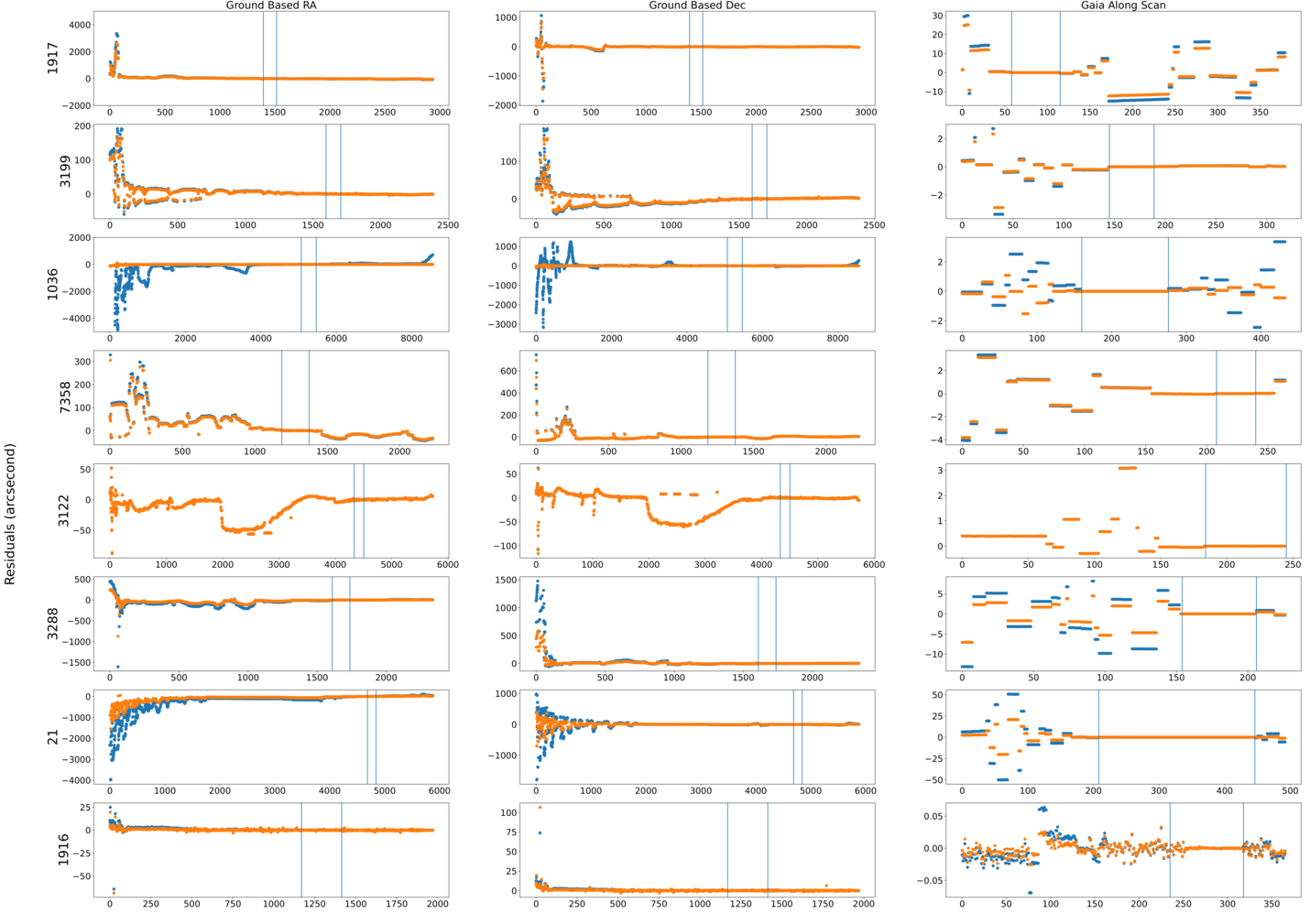
Figure 1. Comparison for the propagated O-C using the orbit before and after applying the new weights. The orange points show the results using the new weights and the blue points are for the original weights. The x-axis of the graph is the observed index for a better overview of the points. The vertical blue lines define the sub set selected for performing the orbit fitting. First and second columns are O-C in right ascension and declination of ground based observations; the third column is in Gaia observations along scan.
How to cite: Vavilov, D., Liu, Z., and Hestroffer, D.: Reweighting the Observations: A Simple Fix for 2024 YR4 orbit precision and impact probability, EPSC-DPS Joint Meeting 2025, Helsinki, Finland, 7–12 Sep 2025, EPSC-DPS2025-1104, https://doi.org/10.5194/epsc-dps2025-1104, 2025.


