MITM20 | 2024 YR4: Navigating Uncertainty in Impact Threat Assessment and Planetary Defense

MITM20

2024 YR4: Navigating Uncertainty in Impact Threat Assessment and Planetary Defense
Co-organized by SB
Convener: Eric MacLennan | Co-conveners: Artem Burdanov, Maxime Devogele, Marco Micheli, Andy Rivkin, Zuri Grey, Julia de Leon, Petr Pravec
Orals THU-OB5
| Thu, 11 Sep, 15:00–16:00 (EEST)
 
Room Neptune (rooms 22+23)
Posters THU-POS
| Attendance Thu, 11 Sep, 18:00–19:30 (EEST) | Display Thu, 11 Sep, 08:30–19:30
 
Finlandia Hall foyer, F130–131
Thu, 15:00
Thu, 18:00
On 27 January, the near-Earth asteroid 2024 YR4 was assigned a Torino Scale impact rating of 3, reaching a record high impact probability with Earth in 2032 before further observations ruled it out as a threat. This session will present on the multiple observations and methodologies used to assess the impact risk posed by 2024 YR4 on both Earth and the Moon. We will feature telescopic observational campaigns—including astrometric, photometric, and spectroscopic investigations—that together offer crucial insights into the determination of the orbit and physical properties. In addition, the session will discuss modeling techniques for physical characterization and dynamic simulations, as well as logistical challenges and lessons learned that can inform our response to future impact threats from similar objects. Participants are invited to share research findings and innovative approaches that enhance our planetary defense strategies.

Session assets

Orals: Thu, 11 Sep, 15:00–16:00 | Room Neptune (rooms 22+23)

Chairpersons: Eric MacLennan, Maxime Devogele
15:00–15:12
|
EPSC-DPS2025-939
|
On-site presentation
Marco Micheli

Asteroid 2024 YR4 was discovered on 27 December 2024 by the Chilean station of the ATLAS survey, as a fast-moving magnitude 16.5 object. In less than 24 hours, prediscovery data and immediate follow-up from the Catalina Sky Survey, as well as additional follow-up from other stations, allowed for its designation by the MPC, followed by an initial assessment of its impact threat, which proved non-negligible for a possible impact in December 2032.

Regular follow-up continued over the following days, while the object receded from Earth, becoming fainter and slower. During these initial phases, the brightness of the object made it an easy target for small apertures, but at the same time its fast angular motion across the sky introduced additional challenges due to trailing and/or timing precision.

By early January the object had been observed by many follow-up facilities, not only for astrometry, but also for physical characterization purposes. These physical characterization datasets, typically consisting of multiple high SNR images from moderately large telescopes, were also made available by the observers for astrometric purposes, and allowed for the extraction of high-precision astrometry, with accurately determined astrometric uncertainties. When incorporated into the orbit determination process, the data significantly improved the orbital accuracy, leading to the noticeable increase in impact probability that brought 2024 YR4 to the attention of the entire world.

Once the object had become sufficiently prominent, even larger apertures came into play. By the end of January, the asteroid had crossed into magnitude 22 territory, where most amateur follow-up stations cannot provide adequate follow-up. From then on, increasingly larger professional facilities became the dominant astrometric contributors: multiple 2-meter-class telescopes provided excellent data until early February 2025, followed by larger facilities.

Once 10-meter-class telescopes became necessary, the important coordination role of IAWN ensured that active observers with access to these facilities could exchange information about which instruments they were planning to use, and on the timeline of the planned observations. This allowed the community to obtain astrometry from multiple facilities, ensuring resilience to possible station-specific biases, while at the same time optimizing the use of valuable telescope resources. Fortunately, late February observations by some of these large telescopes, including ESO’s VLT, resulted in an orbital improvement sufficient to completely exclude the possibility of an impact with Earth in 2032.

A successful proposal to JWST, submitted earlier on by a broad collaboration of astronomers, nevertheless gave the community the opportunity to test the capabilities of the telescope for planetary defense purposes. Observations with both the near-infrared NIRCam and the mid-infrared MIRI instruments were collected in March 2025, and provided a further extension of the astrometric coverage. One additional set of images, pushing the limits of how faint JWST can observe, is still scheduled for May 2025 at the time of this writing: if successful, it will prove the value of JWST as a follow-up asset for very faint asteroids, uniquely capable of detecting threatening asteroids that are otherwise too faint for ground-based telescopes.

As of 2025, a non-negligible chance of impact with the Moon in 2032 remains: although no longer a planetary defense threat, 2024 YR4 is still a high priority scientific target, and will likely remain under scrutiny at least until the next observational opportunity in 2028.

The case of 2024 YR4 represented a unique opportunity for the community of NEO observers to test their technical and collaborative capabilities in a high-profile situation. The results were overall extremely successful, from an astrometric and dynamical perspective: the object was effectively followed up, ensuring near-constant coverage with limited waste of observational resources.

In this talk, we will present the results of this international effort, with a particular focus on the lessons learned while dealing with the specific challenges posed by this target, and how the community can be ready for a future high-profile situation like 2024 YR4.

How to cite: Micheli, M.: Coordinated Planetary Defence in action: astrometric follow-up of asteroid 2024 YR4, EPSC-DPS Joint Meeting 2025, Helsinki, Finland, 7–13 Sep 2025, EPSC-DPS2025-939, https://doi.org/10.5194/epsc-dps2025-939, 2025.

15:12–15:24
|
EPSC-DPS2025-1364
|
On-site presentation
Laura Faggioli, Marco Fenucci, Francesco Gianotto, Davide Farnocchia, Steve Chesley, Paul Chodas, Fabrizio Bernardi, Giovanni Valsecchi, Alessia Bertolucci, and Lisa Bedini

Asteroid 2024 YR4 was discovered on 27 December 2024 by the ATLAS survey, and within days, preliminary orbit determinations revealed a non-negligible probability of Earth impact in December 2032. Less than a month after discovery, the impact probability (IP) had increased significantly, eventually reaching 1% which caused the Torino Scale (TS) to raise to 3, the highest value recorded post-Apophis. This critical threshold triggered immediate coordination among international centres, including ESA’s NEO Coordination Centre (NEOCC), NASA’s CNEOS, and NEODyS, and prompted the International Asteroid Warning Network (IAWN) to issue an official alert to the Space Mission Planning Advisory Group (SMPAG). The rapid evolution of the scenario, together with the unusually high TS, made 2024 YR4 a unique and instructive test case for the global planetary defence infrastructure.

In this contribution, we present a detailed overview of the methodologies employed to monitor and quantify the threat posed by YR4, with a particular focus on dynamical modelling and impact monitoring techniques. Our operational workflow relied on continuous updates to the orbital solution, as new astrometric data became available, and on a systematic treatment of observational uncertainties. Particular care was taken to ensure the stability and consistency of the predictions in the presence of heterogeneous data inputs.

We show the temporal evolution of the IP and the associated uncertainty region, highlighting key decision points where the estimated risk crossed critical thresholds and needed renewed assessments. The first critical moment occurred on 27 January, when the IP reached 1.3%, causing the Torino Scale rating to rise to level 3. A subsequent increase led to a peak IP of approximately 3% on 18 February, but two days later the impact probability began to decrease, and on 8 March, the potential Earth impact scenario for 2032 was formally excluded. This sequence of events illustrates the dynamic nature of impact risk evaluation and the importance of closely tracking the evolution of uncertainty over time to support timely and well-informed decisions. Special attention is devoted to the characterization of the uncertainty region at various epochs, which played a central role in understanding the risk dynamics and guiding response strategies. The assessment also included future statistical projections based on the observability conditions, which were primarily used to understand the expected evolution of the risk over time and to anticipate how the IP might respond to future observations. Particular attention was devoted on the role on the expected contribution of James Webb Space Telescope observations, that were later performed in mid-March.

An additional aspect emerged during the monitoring phase: in addition to the impact probability with Earth, a non-negligible probability of impact with the Moon was also identified. This lunar risk is currently under assessment and continues to be monitored as new data become available, adding an additional dimension to the case, and illustrating the broader scope of modern impact monitoring efforts.

We also reflect on the coordination between centres during the high-alert phase, which included regular exchanges of orbital solutions, comparisons of uncertainty regions, and extensive discussions on the treatment and weighting of observational data. These exchanges were facilitated by timely sharing of information from a diverse set of observing stations and by a collaborative spirit aimed at ensuring coherent and robust impact monitoring. Particular effort was devoted to identifying and mitigating the influence of outliers or biased data points in the astrometric input, thereby ensuring convergence among independent analyses. Despite some differences in methodology and implementation, the independent results aligned closely, ultimately supporting a consistent assessment that led to the exclusion of any 2032 Earth impact scenario.

This case represents a valuable opportunity to evaluate and reflect on our operational procedures in a real-world near-crisis context. It underscores the importance of transparent, multi-centre collaboration, timely data sharing, and robust modelling capabilities for maintaining an effective planetary defence strategy. We conclude by outlining the main lessons learned and suggesting possible enhancements to current monitoring frameworks, including the integration of systematic lunar impact risk evaluation and improved coordination mechanisms for rapid and effective information dissemination within the global Planetary Defence Community.

How to cite: Faggioli, L., Fenucci, M., Gianotto, F., Farnocchia, D., Chesley, S., Chodas, P., Bernardi, F., Valsecchi, G., Bertolucci, A., and Bedini, L.: Coordinated Planetary Defence in action: orbit determination and impact monitoring of asteroid 2024 YR4, EPSC-DPS Joint Meeting 2025, Helsinki, Finland, 7–13 Sep 2025, EPSC-DPS2025-1364, https://doi.org/10.5194/epsc-dps2025-1364, 2025.

15:24–15:36
|
EPSC-DPS2025-1302
|
On-site presentation
Maxime Devogele, Marco Micheli, Olivier Hainaut, Nicholas Moskovitz, Juan Luis Cano, Francisco Ocana, Dora Fohring, Luca Conversi, and Richard Moisll

The Near-Earth Object 2024 YR4 (hereafter YR4) was discovered by the ATLAS survey [1] on December 27 2024. With an H magnitude estimated around H = 24 [2], YR4 size is estimated to be between 40 to 90 meters [2]. 


At time of discovery its brightness was around 16.5 magnitude and moving across the sky at high speed. Shortly after discovery, YR4 was found to display a high probability of impacting the Earth in 2032 and was classified as a Torino scale 1 virtual impactor [3]. 


For a few hours to days, its visual magnitude was ideal for detailed physical characterization observations such as polarimetry or spectroscopy. However, due to the timing of its discovery during the end of the year holidays, very few observations were performed at that time. A few days later, YR4 was already a few magnitudes fainter, limiting the number of telescopes able to gather physical characterization observations.  


On January 7, we obtained color observations with the Lowell Discovery Telescope when YR4 was already much fainter at a V~20 magnitude. The observations showed that YR4 could potentially be an S-type or L, K-type. S-types tend to have larger albedo than L or K-type (however, very few albedo of L and K-types for NEOs have been determined). It is thus highly important to distinguish between these two taxonomic classifications. 


To gather more information on the composition of YR4, a Director Discretionary Proposal (DDT) was submitted to the ESO Very Large Telescope to obtain Near Infra-Red colors of YR4 using the HAWK-I instrument [4]. The proposal was submitted on Sunday January 19 at night, accepted during the day of January 20 and observed during the night of the January 20 to 21. 


Analysis of the NIR color dataset shows good agreement with the S or L, K-type composition, but is unfortunately not sufficient to be able to distinguish between the two. To be able to assess if YR4 is a S or L, K-type, spectroscopy in both the visible and near-infrared would be needed. Visible spectroscopy has been obtained for YR4, but no NIR spectroscopy is available. 


Simultaneously to the HAWK-I observations, we also obtained observations in the R band with the FORS2 instrument on the VLT. These observations were used to connect the visible colors/spectroscopy of YR4 with our new NIR colors observations. We also used these observations to obtain a high signal to noise ratio lightcurve. Our lightcurve shows a rotation period around P=19.5 minutes with an amplitude of 0.4 magnitude. 


[1] Tonry, J. L. et al. ATLAS: A High-cadence All-sky Survey System. PASP 130, 064505 (2018)

[2] https://neo.ssa.esa.int/search-for-asteroids?sum=1&des=2024YR4

[3] https://neo.ssa.esa.int/risk-list

[4] Pirard, J.-F. et al. HAWK-I: A new wide-field 1- to 2.5-μm imager for the VLT. in vol. 5492 1763–1772 (2004)

How to cite: Devogele, M., Micheli, M., Hainaut, O., Moskovitz, N., Cano, J. L., Ocana, F., Fohring, D., Conversi, L., and Moisll, R.: Coordinated Planetary Defence in action: Colors and lightcurve of asteroid 2024 YR4, EPSC-DPS Joint Meeting 2025, Helsinki, Finland, 7–13 Sep 2025, EPSC-DPS2025-1302, https://doi.org/10.5194/epsc-dps2025-1302, 2025.

15:36–15:48
|
EPSC-DPS2025-1252
|
On-site presentation
Andrew Rivkin, Eric MacLennan, Bryan Holler, Artem Burdanov, Julien DeWit, Maxime Devogele, Petr Pravec, Marco Micheli, Cristina Thomas, Davide Farnocchia, Alison Glantzberg, Jessie Dotson, Lorien Wheeler, Heidi Hammel, Thomas Müller, and Julie de León

The asteroid 2024 YR4 was discovered in late December 2024, and over the next several weeks as its orbit was refined its estimated probability of an Earth impact in 2032 rose above 3%. Per international protocols, the International Asteroid Warning Network (IAWN) issued a memo alerting the Space Mission Planning Advisory Group (SMPAG) and the United Nations Office of Outer Space affairs of a possibility of an impending impactor [1], the first time these protocols were triggered since they were established in 2014.  Based on spectral information and absolute magnitude, the diameter of 2024 YR4 was estimated to be 40-90 m by IAWN. Interestingly, this range bracketed the 50-m diameter above which SMPAG begins mission options planning [2], increasing the importance of an accurate size measurement. Happily, one facility was able to make such a measurement of 2024 YR4 as it receded from the Earth and Sun: JWST.

Via Director’s Discretionary Time, we obtained roughly 4 hours of observing time on JWST, which amounts to roughly 10 hours of observatory time when overheads such as slewing, settling, instrument changes, etc. are included. The main goal of the program was to determine the diameter of 2024 YR4 via modeling of mid-infrared spectrophotometry, and so the majority of the observing time utilized the Mid-Infrared Instrument (MIRI), though Near-Infrared Camera (NIRCam) observations were also included both to support the thermal modeling results and to provide astrometry for continued orbital improvements. Because 2024 YR4’s spin period is about 19.5 minutes [3], the MIRI and NIRCam exposures were set to 20 minutes’ length to allow an average measurement to be obtained over an entire rotation period and avoid lightcurve effects.

JWST is limited to observations at solar elongations from 85-135°, and 2024 YR4 entered the JWST observing window on 8 March 2025. NIRCam images were successfully taken with the F150W2 and F322W2 filters on that day, though guide star acquisition issues prevented MIRI data from being collected. MIRI observations with the F1280W, F1000W, and F1500W filters were successfully made, along with additional NIRCam images with the F150W2 and F322W2 filters, on 26 March.  At this writing, additional measurements are anticipated in May but have not yet occurred.

The team very quickly performed thermal modeling on the data, finding the diameter of 2024 YR4 to be 60 ± 7 m, with a 92% chance of being above 50 meters in size. A memo was prepared for IAWN with this result for their use, and delivered to them approximately 30 hours after the data became available to the team. A more technical report was submitted to the Research Notes of the AAS around 24 hours later [4], as a means of rapidly informing the community and the public. In the time since these two communications, the team has continued to work on more sophisticated thermal modeling analysis.

In addition to the thermal modeling, astrometric positions for 2024 YR4 were extracted from the NIRCam data obtained on both 8 March and 26 March and passed to the Minor Planet Center. Given the small field of view for NIRCam compared to typical search or follow-up telescopes, it was found that future astrometric campaigns using JWST would benefit from only considering observing times where the field of view containing asteroid of interest included several Gaia stars, rather than depending on kismet.

While the impact probability of 2024 YR4 was already decreasing by the time the JWST observations began, obtaining, reducing, and analyzing the data were still worthwhile. The experience in observation design, communication within and outside the planetary defense community, and data analysis gained in early 2025 will be used to help prepare for the next potential impact situation and inform our response. JWST played a key role in obtaining critical information about 2024 YR4, and our lessons learned will help optimize its use, if needed, in the future.

We will present an overview of the JWST observations of 2024 YR4, how it might have performed in the hypothetical scenarios discussed at various conferences and tabletop exercises, and how it might best be used in the coming era of Rubin and NEO Surveyor.

References: [1] International Asteroid Warning Network, “Potential for Impact of Near-Earth Asteroid 2024 YR4 on 22 December 2032”, [2] SMPAG-RP-003, “Recommended criteria & thresholds for action for a potential NEO impact threat" [3] International Asteroid Warning Network, “2024 YR4 Home”, [4] Rivkin, A. S., et al. "JWST Observations of Potentially Hazardous Asteroid 2024 YR4." Research Notes of the AAS9.4 (2025): 70.

How to cite: Rivkin, A., MacLennan, E., Holler, B., Burdanov, A., DeWit, J., Devogele, M., Pravec, P., Micheli, M., Thomas, C., Farnocchia, D., Glantzberg, A., Dotson, J., Wheeler, L., Hammel, H., Müller, T., and de León, J.: JWST as a Planetary Defense Asset: The Case of 2024 YR4 , EPSC-DPS Joint Meeting 2025, Helsinki, Finland, 7–13 Sep 2025, EPSC-DPS2025-1252, https://doi.org/10.5194/epsc-dps2025-1252, 2025.

15:48–16:00
|
EPSC-DPS2025-934
|
On-site presentation
Thomas Müller, Eric MacLennan, Bryan Holler, Artem Burdanov, Julien de Wit, Andy Rivkin, Luca Conversi, Maxime Devogele, Jessie Dotson, Davide Farnocchia, Allison Glantzberg, Heidi Hammel, Marco Micheli, Stefanie Milam, Petr Pravec, and Cristina Thomas

The Apollo-type near-Earth asteroid (NEA) 2024 YR4 was discovered on 25 December 2024, only a few hours after it had passed Earth at a distance of approximately 2.2 lunar distances. In December 2028, it will again approach the Earth-Moon system, this time at a distance of about 20 lunar distances. As of this writing, it has a 3.8% impact probability with the Moon on 22 December 2032.
The orbit of 2024 YR4 is highly eccentric and has a low inclination (semi-major axis a = 2.52 au, eccentricity e = 0.66, inclination i = 3.4°), crossing the orbits of Earth (perihelion at 0.85 au), Mars, and even extending beyond the main asteroid belt (aphelion at 4.18 au). The object is estimated to be about 60 ± 7 meters in diameter (Rivkin et al. 2025a), with a rotation period of approximately 19.5 minutes, based on lightcurves showing ~0.4 mag variations (P. Pravec, SBO-NASA mailing list, 03-Jan-2025). An initial lightcurve inversion analysis by Bolin et al. (2025) suggests an oblate shape with an axial ratio of ~3:1 and a spin axis oriented towards (l, b) = (~42°, ~−25°). Its measured color indices are consistent with S-type or L-/K-type asteroids.

To date, no radar observations or successful occultation measurements have been obtained, and the size estimate is based solely on a simple radiometric analysis using single-epoch, three-band JWST/MIRI observations.

We conducted a combined JWST/NIRCAM and MIRI multi-epoch observing campaign (Rivkin et al. 2025b). Here, we re-analyzed all available MIRI imaging data from March and May 2025 using advanced post-processing and filtering techniques. Our flux extraction and uncertainty estimates were validated against faint calibration stars and then applied consistently across various data products: from single calibrated integration images and per-dither images to combined 4-dither, multi-integration mosaics per band. The observations on March 26, 2025 (r = 1.81 au, D =1.08 au, a = 28°) in filters F1000W, F1280W, and F1500W covered one full rotation of the asteroid, while the May F1000W observations (YR4 located at the inner asteroid belt region beyond 2 au, but still seen under a similar phase angle of about 28°) captured three full rotations.

We applied simple thermal models, including the Near-Earth Asteroid Thermal Model (NEATM; Harris 1998) and the Fast-Rotation Model (FRM; Lebofsky et al. 1978), to derive estimates of size, albedo, and beaming parameter. In parallel, we used thermophysical modeling (TPM; Lagerros 1998; Delbo et al. 2015, and references therein) to test various spin and shape solutions (Bolin et al. 2025; MacLennan et al. 2025), constrain thermal properties, and refine the size–albedo solution. The final TPM results are discussed in the context of other decameter-scale asteroids (e.g., Burdanov et al. 2025).

Our analysis also provides a basis for predicting future JWST observing opportunities for YR4 and offers improved constraints on non-gravitational forces acting on the asteroid, which are relevant for long-term orbit predictions and impact risk assessment.

Acknowledgement:

P.P. has been supported by the "Praemium Academiae" award by the Academy of Sciences of the Czech Republic, grant AP2401.


References:

  • Bolin, B.T., Hanuš, J., Denneau, L., Bonamico, R., Abron, L.-M., et al., The Discovery and Characterization of Earth-crossing Asteroid 2024 YR4, The Astrophysical Journal Letters, 984, L25, 12 pp (2025)
  • Burdanov, A. Y., de Wit, J., Brož, Müller, T.G., Hoffmann, T., et al., JWST sighting of decametre main-belt asteroids and view on meteorite sources, Nature, 638, 74 (2025)
  • Delbo, M., Mueller, M., Emery, J., Rozitis, B, Capria, M.T., Asteroid Thermophysical Modeling, in Asteroids IV, Patrick Michel, Francesca E. DeMeo, and William F. Bottke (eds.), University of Arizona Press, Tucson, 895 pp, ISBN: 978-0-816-53213, p107-128 (2015)
  • Harris, A.W., A Thermal Model for Near-Earth Asteroids, Icarus 131, 291-301 (1998)
  • Lagerros, J.S.V, Thermal physics of asteroids, PhD Thesis, Uppsala University, 377L (1998)
  • Lebofsky, L.A., Veeder, G.J., Lebofsky, M.J., Matson, D.L., Visual and Radiometric Photometry of 1580 Betulia, Icarus, 35, 336-343 (1978)
  • MacLennan, E., et al., Shape and Spin Properties of 2024 YR4 from Multi-filter Lightcurve Observations, EPSC/DPS 2025 (2025)
  • Rivkin, A.S., Müller, T.G., MacLennan, E., Holler B., Burdanov, A., et al., JWST Observations of Potentially Hazardous Asteroid 2024 YR4, Research Notes of the AAS, 9, 70 (2025a)
  • Rivkin, A.S., et al., JWST MIRI and NIRCAM Observations of Potentially Hazardous Asteroid 2024 YR4, EPSC/DPS-2025 (2025b)

How to cite: Müller, T., MacLennan, E., Holler, B., Burdanov, A., de Wit, J., Rivkin, A., Conversi, L., Devogele, M., Dotson, J., Farnocchia, D., Glantzberg, A., Hammel, H., Micheli, M., Milam, S., Pravec, P., and Thomas, C.: A Thermophysical Model Study for 2024 YR4 based on JWST/MIRI Measurements, EPSC-DPS Joint Meeting 2025, Helsinki, Finland, 7–13 Sep 2025, EPSC-DPS2025-934, https://doi.org/10.5194/epsc-dps2025-934, 2025.

Posters: Thu, 11 Sep, 18:00–19:30 | Finlandia Hall foyer

Display time: Thu, 11 Sep, 08:30–19:30
Chairperson: Andy Rivkin
F130
|
EPSC-DPS2025-1689
|
ECP
|
On-site presentation
Eric MacLennan, Petr Pravec, Maxime Devogele, Karri Muinonen, Artem Burdanov, Julien de Wit, Thomas Müller, Kamil Hornoch, Petr Fatka, Peter Kušnirák, Zuri Gray, Grigori Fedorets, Mikael Granvik, Nicholas Moskovitz, Andrew Rivkin, and Brian Holler

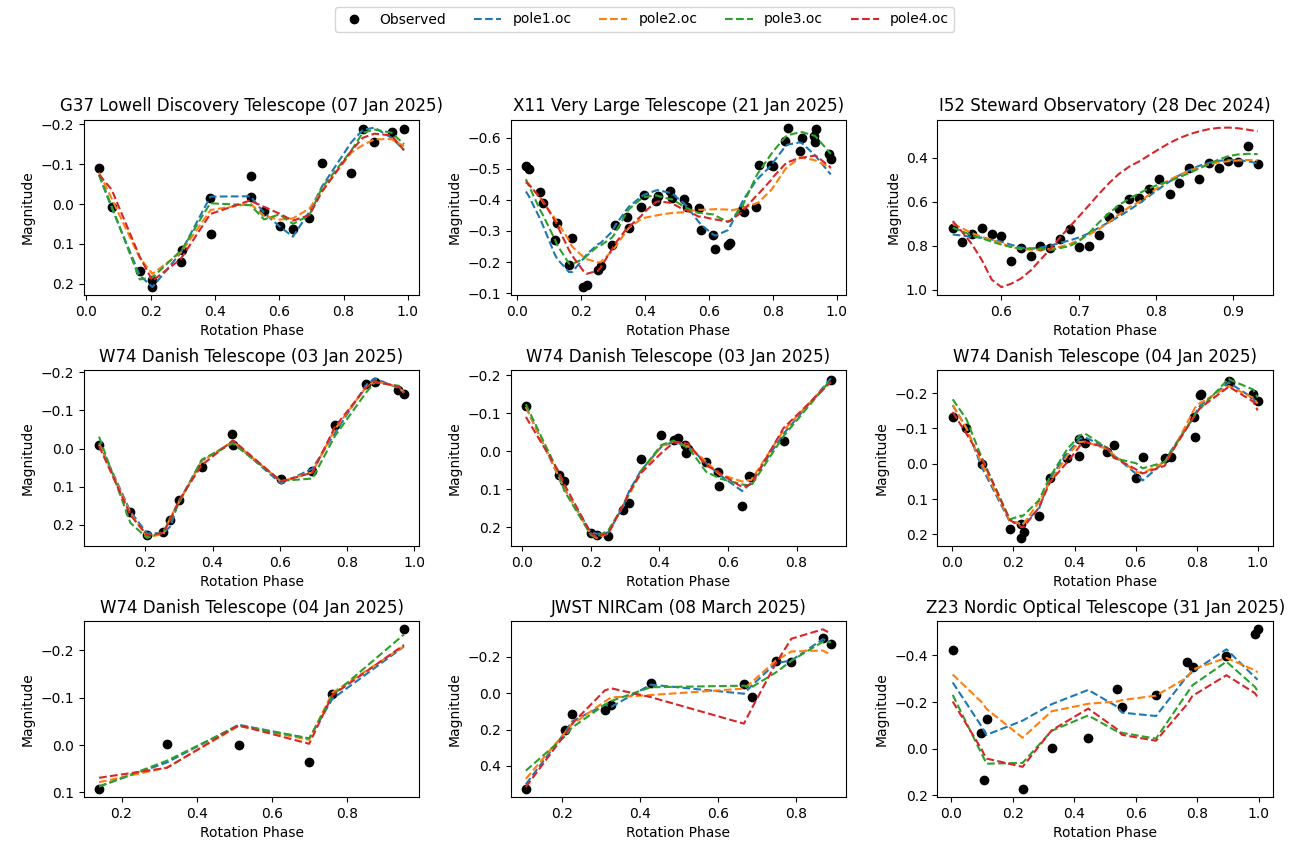
The potentially hazardous asteroid 2024 YR4 (hereafter YR4) made a close approach to Earth in December 2024 through February 2025 coinciding with its discovery. During this time period, it was targeted by several ground-based telescopes and its impact probability increased above 3%, prompting action by the International Asteroid Warning Network (IAWN). As a result of this observational effort, we make use of several dense-in-time photometric lightcurves, as acquired by several ground-based observing facilities: ESO’s Very Large Telescope, the Lowell Discovery Telescope, Steward Observatory, the Danish 1.54 meter telescope, and the Nordic Optical Telescope. Photometry was acquired from these facilities using distinct astronomical filters, motivating the calculation of color transformations to a common wavelength.

In addition to ground-based efforts, YR4 was targeted on 08 March by the James Webb Space Telescope’s Near Infrared Camera (JWST/NIRCam) for which photometry was acquired in the wide F150W2 and F322W2 filters [1]. Thermal emission overcomes reflected light at longer wavelengths in the F322W2 filter and introduces complications for lightcurve interpretation, thus we use the relative photometry measured in the F150W2 filter.

The entire dataset constitutes high-quality measurements of YR4’s brightness over a roughly 3-month period (Figure 1). Using these lightcurves, we confirm the rotation period to be 0.324390 ± 0.000005 hours and search for plausible shape and spin state solutions. The initial efforts from a pole-scanning search using ellipsoids [2] reveals a few preferred and some unfavored regions. We use these regions in a convex shape inversion procedure to derive four candidate spin poles, with corresponding shapes, representing local best-fit solutions. We then use a MCMC routine [3] to generate a large set of viable shape and spin solutions that are consistent with our lightcurve dataset.

Figure 1. Model fits to our suite of optical lightcurves from various observatories over different dates.

Observations of YR4’s thermal emission with JWST’s Mid Infrared Imager (MIRI) taken on 26 March and 11 May will be used to discern between the potential shape and spin solutions. In turn, the shapes and spins will be used to constrain the size, albedo, and thermal properties of YR4. We will present the latest results at the conference, compare to other shape solutions [4], and discuss the broader implications on the origin of YR4 as well as for planetary defense strategies.


Acknowledgements:

The work at Ondřejov and the observations with the Danish 1.54-m telescope at La Silla were supported by "Praemium Academiae" award to P. Pravec by the Academy of Sciences of the Czech Republic, grant AP2401.

References:

[1] Rivkin et al. (2025) RNAAS 9, 70. [2] Muinonen et al. (2015) P&SS, 118, 227–241. [3] Muinonen et al. (2020) A&A 642, A138. [4] Bolin et al. (2025) ApJL 984 L25.

How to cite: MacLennan, E., Pravec, P., Devogele, M., Muinonen, K., Burdanov, A., de Wit, J., Müller, T., Hornoch, K., Fatka, P., Kušnirák, P., Gray, Z., Fedorets, G., Granvik, M., Moskovitz, N., Rivkin, A., and Holler, B.:  Shape and Spin Properties of 2024 YR4 from Multi-filter Lightcurve Observations, EPSC-DPS Joint Meeting 2025, Helsinki, Finland, 7–13 Sep 2025, EPSC-DPS2025-1689, https://doi.org/10.5194/epsc-dps2025-1689, 2025.

F131
|
EPSC-DPS2025-1104
|
Virtual presentation
Dmitrii Vavilov, Ziyu Liu, and Daniel Hestroffer

Accurate orbital determination of asteroids relies on fitting observational data using weighted least-squares techniques. The reliability of this method is strongly dependent on how weights are assigned to different types of observations. In many cases, the uncertainties are poorly estimated, and combining data with very different precisions—such as ground-based and space-based observations—can introduce biases or underutilize valuable measurements.

We present a simple and effective reweighting scheme that addresses these challenges by properly scaling the influence of each observation type. While the method itself is straightforward, it leads to significant improvements in the quality of orbit fits when datasets of varying precision are combined.

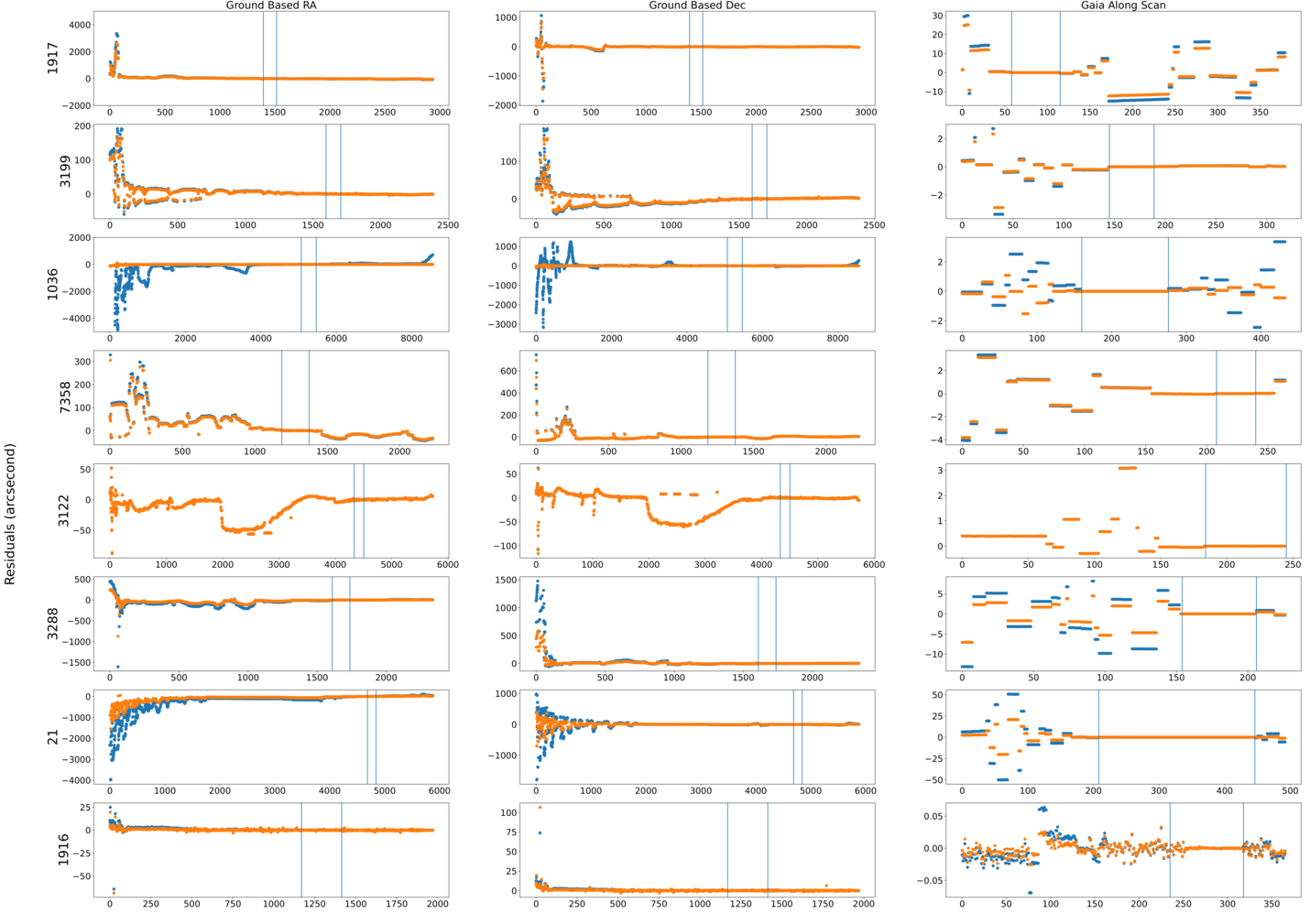
To demonstrate its utility, we applied the scheme to asteroid orbit determinations that include both ground-based data and high-precision astrometry from the Gaia mission on a reduced observation set (Fig. 1). In many cases, the reweighting of observations allowed us to obtain the orbit that produces more accurate ephemeris positions. The reweighting scheme prevents overestimation of the observation uncertainty of ground-based data.

As a practical application, we used the method to analyze the orbit of the newly discovered asteroid 2024 YR₄ that on February 18 reached over 2% probability of collision with the Earth. The revised weighting allowed us to obtain a high-quality orbit significantly earlier than would have been possible otherwise. This, in turn, led to a more accurate estimate of its future trajectory and a reduction in its impact probability.


Figure 1. Comparison for the propagated O-C using the orbit before and after applying the new weights. The orange points show the results using the new weights and the blue points are for the original weights. The x-axis of the graph is the observed index for a better overview of the points. The vertical blue lines define the sub set selected for performing the orbit fitting. First and second columns are O-C in right ascension and declination of ground based observations; the third column is in Gaia observations along scan.

How to cite: Vavilov, D., Liu, Z., and Hestroffer, D.: Reweighting the Observations: A Simple Fix for 2024 YR4 orbit precision and impact probability, EPSC-DPS Joint Meeting 2025, Helsinki, Finland, 7–13 Sep 2025, EPSC-DPS2025-1104, https://doi.org/10.5194/epsc-dps2025-1104, 2025.