
 2,4,4,3
- 1(phil.christensen@asu.edu)
- 2Southwest Research Institute, Boulder, CO
- 3Jet Propulsion Laboratory, Pasadena, CA
- 4Planetary Science Institute, Tucson, AZ
- 5University of Colorado, Boulder, CO
- 6Cornell University, Ithaca, NY
- 7University of California, Santa Cruz, CA
The Europa Thermal Emission Imaging System (E-THEMIS) on the Europa Clipper spacecraft will investigate the temperature and physical properties of Europa using thermal infrared images in three wavelength bands at 7-14 µm, 14-28 µm and 28-70 μm [Christensen et al., 2024]. The specific objectives of the investigation are to 1) understand the formation of surface features, including sites of recent or current activity, in order to understand regional and global processes and evolution and 2) to identify safe sites for future landed missions. The E-THEMIS radiometric calibration includes removing the thermal emission from the instrument housing, optical elements, and filters using observations of space and an internal calibration flag [Christensen et al., 2024]. On February 28, 2025, the Clipper spacecraft performed a close flyby of Mars for a trajectory gravity assist. Twenty four hours prior to closest approach the spacecraft pointed the E-THEMIS instrument at Mars and performed a sequence that scanned E-THEMIS across the planet at a slew rate of 100 micro-radians per second. This rate is the same as what be used to image Europa during each flyby [Pappalardo et al., 2024]. This activity accomplished two primary objectives: 1) collect images of a well-characterized target (Mars) to validate the E-THEMIS calibration methodology and software prior to the first observations of Europa; and 2) rehearse the data collection procedure that will be used to obtain global observations of Europa.
Mars makes an excellent thermal calibration target because it has been extensively studied and characterized by numerous thermal infrared instruments. The E-THEMIS observations were simulated using modeled surface temperatures generated using global maps of thermal inertia albedo made from the MGS TES data [Christensen et al., 2001], together with the krc thermal model [Kieffer, 2013]. The wavelength-dependent atmospheric absorption and emission was modeled using data from the UAE Emirates Mars Mission EMIRS thermal infrared spectrometer [Amiri et al., 2022; Edwards et al., 2021]. EMIRS collects global scans of hyperspectral data from 6-100 µm at 5 and 10 cm-1 spectral sampling at ~200 km spatial resolution [Edwards et al., 2021]. These spectra were resampled from wavenumber to wavelength and weighted by the three E-THEMIS spectral bandpasses to produce 3-band simulated E-THEMIS global images. EMIRS data were not collected simultaneously with the E-THEMIS imaging, but global observations were acquired at the same season and within 5° of latitude, 10° of longitude, and 0.3 H local time of the E-THEMIS data. Fig. 1 shows an example of the nearest EMIRS observation to the E-THEMIS observing conditions of sub-spacecraft latitude=20.3° N, longitude=163.0° E, local time=11.48 H, and Ls=50.5°. A transfer function from the krc-generated surface temperatures and the bandpass-weighted EMIRS data was created by averaging the ratio of forty-five EMIRS observations to the krc-generated surface temperatures. Simulated E-THEMIS observations were produced using the average of these ratios and the krc surface temperatures. The results are given in Fig. 2. The E-THEMIS data could not be transmitted to Earth until Clipper was more than 2 AU from Sun due to spacecraft thermal constraints. As a result the data were received on Earth on May 7, 2025, and the results and an assessment of the E-THEMIS calibration will be discussed.
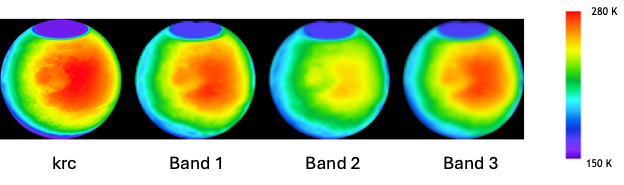
Fig. 1. Measured Mars temperatures. Comparison of temperature globes for surface temperature (krc model) and E-THEMIS-bandpass-weighted EMIRS data for Bands 1, 2, and 3. The EMIRS observations were acquired on Feb. 17, 2025, at a sub-spacecraft viewing geometry of 16.0° N latitude, 174.1° E longitude, 11.60 H local time, and 45.5° Ls.
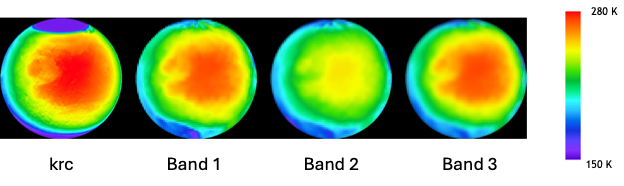
Fig. 2. Simulated E-THEMIS temperature images. The data for each E-THEMIS band were created using the krc model surface temperatures transferred to E-THEMIS wavelength bands using a transfer function derived from EMIRS observations.
References
Amiri, H., D. Brain, O. Sharaf, P. Withnell, M. McGrath, M. Alloghani, M. Al Awadhi, S. Al Dhafri, O. Al Hamadi, and H. Al Matroushi (2022), The emirates Mars mission, Space Science Reviews, 218(1), 4.
Christensen, P. R., et al. (2001), The Mars Global Surveyor Thermal Emission Spectrometer experiment: Investigation description and surface science results, J. Geophys. Res., 106, 23,823-823,871.
Christensen, P. R., J. R. Spencer, G. L. Mehall, M. Patel, S. Anwar, M. Brick, H. Bowles, Z. Farkas, T. Fisher, and D. Gjellum (2024), The Europa Thermal Emission Imaging System (E-THEMIS) Investigation for the Europa Clipper Mission, Space Science Reviews, 220(4), 1-65.
Edwards, C. S., P. R. Christensen, G. L. Mehall, S. Anwar, E. A. Tunaiji, K. Badri, H. Bowles, S. Chase, Z. Farkas, and T. Fisher (2021), The Emirates Mars Mission (EMM) Emirates Mars InfraRed Spectrometer (EMIRS) Instrument, Space science reviews, 217, 1-50.
Kieffer, H. H. (2013), Thermal model for analysis of Mars infrared mapping, J. Geophys. Res, 116, 451-470.
Pappalardo, R. T., B. J. Buratti, H. Korth, D. A. Senske, D. L. Blaney, D. D. Blankenship, J. L. Burch, P. R. Christensen, S. Kempf, and M. G. Kivelson (2024), Science Overview of the Europa Clipper Mission, Space Science Reviews, 220(4), 1-58.
How to cite: Christensen, P., Spencer, J., Piqueux, S., Mehall, G., Anwar, S., Abramov, O., Hayne, P., Howett, C., Mellon, M., Nimmo, F., Rathbun, J., Buratti, B., and Pappalardo, R.: Europa Thermal Emission Imaging System (E-THEMIS) cruise observations of Mars, EPSC-DPS Joint Meeting 2025, Helsinki, Finland, 7–13 Sep 2025, EPSC-DPS2025-1105, https://doi.org/10.5194/epsc-dps2025-1105, 2025.


