
 1,7,8
1,7,8- 1Planetary Systems Branch, NASA Ames Research Center, Moffett Field, United States of America (diane.h.wooden@nasa.gov)
- 2Minnesota Institute for Astrophysics, School of Physics and Astronomy, University of Minnesota, Minneapolis, United States of America (chickw024@gmail.com)
- 3Observatoire de Paris, Paris, France (dominique.bockelee@obspm.fr)
- 4Department of Astronomy and Astrophysics, University of California, San Diego, United States of America (dharker@ucsd.edu)
- 5Astrochemistry Laboratory, Solar System Exploration Division, NASA Goddard Space Flight Center, United States of America (nathaniel.x.roth@nasa.gov)
- 6Department of Physics, American University, Washington, DC, United States of America (nathaniel.x.roth@nasa.gov)
- 7Department of Astronomy, University of Maryland, College Park, United States of America (msk@astro.umd.edu)
- 8Astrochemistry Laboratory, Solar System Exploration Division, NASA Goddard Space Flight Center, Greenbelt, United States of America (stefanie.n.milam@nasa.gov)
Comets are amongst the most primitive bodies in the solar system, containing volatile ices and dust particles from eras of protoplanet formation. Multiple perihelion passages of comets into the inner solar system cause a stratification of volatiles within their nuclei, with the most volatile ices preserved at greater depths. Comet nuclei also evolve from the redeposition of particles not lost from their gravity fields. On their first sojourns into the solar system, dynamically new Oort cloud comets offer important opportunities to study their comae volatiles and dust particles less encumbered by nuclei evolution.
Comet C/2017 K2 was one such dynamically new Oort cloud comet. Observations of comet K2 by the James Webb Space Telescope (JWST) at 2.35 au provided an ideal opportunity to search for polycyclic aromatic hydrocarbons (PAHs) in its coma [1]. High signal-to-noise ratio NIRSpec and MRS spectra were obtained. Emission bands centered at 3.42 µm, 6.9 µm, and 8.55 µm, and a plateau 6.3—8.6 µm, were identified and modeled with the Ames PAHdb Python Suite utilizing an excitation energy of 5770K appropriate for the Sun. PAHs with multiple hydrogens on their peripheral bonding sites were found to be very important in explaining the spectrum of comet K2 [1]. Such PAHs have been described as ‘aliphatic PAHs’ [2], PAHs with –CH2 side groups, and Hn-PAHs or ‘moderately hydrogenated’ PAHs [3]. PAHs embedded in water ice may have acquired additional H atoms, and PAHs in water ice irradiated with UV generate PAH cations, and these cations persist upon water ice sublimation [1].
The broad spectral coverage of NIRSpec and MRS was crucial for modeling thermal dust emission from coma particles [4, 5], necessary for determining the baseline beneath potential PAH bands [1]. Figure 1 shows the best-fit thermal model fitted to MRS 4.9—27 µm SED (Fλ vs. λ) after subtraction of an extrapolated scattered light component fit derived from the NIRSpec spectrum. A notable 3.42 µm feature, not accounted for by the NASA Planetary Spectrum Generator (PSG) molecular emission line model, was considered in modeling PAH emissions. The ‘PAH extract’ residual spectrum was computed as the MRS flux minus the emission lines, scattered light, and thermal model ‘F(total)’, and then median filtered (shown in navy in Fig. 1).
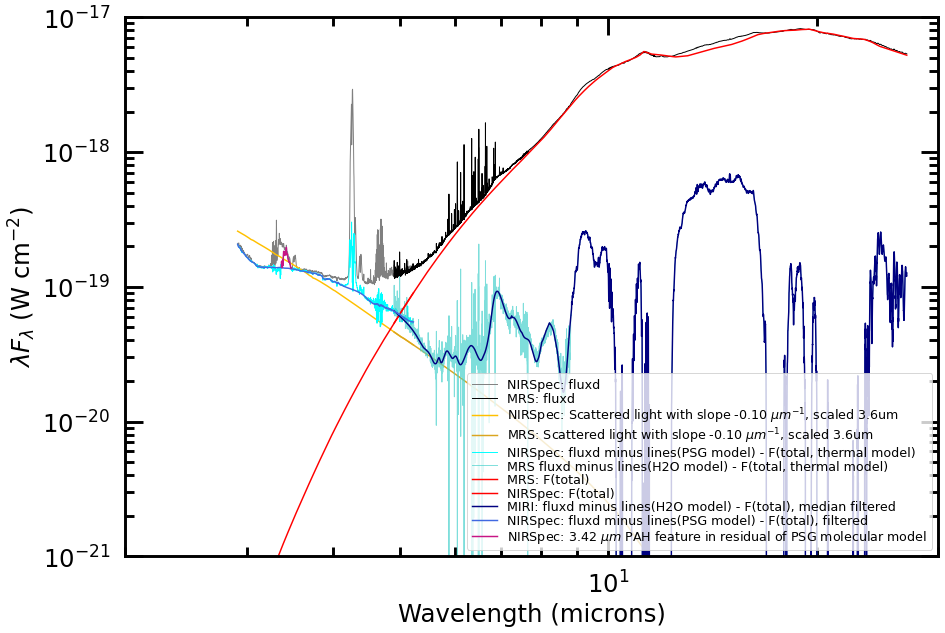
Figure 1. Spectral decomposition of flux of comet K2: NIRSpec (gray); PSG-fitted molecular emission lines subtracted (cyan) and then filtered (blue, cf. [1]); NIRSpec scattered light fit (yellow) extrapolated to MRS (gold); MRS best-fit thermal model fitted to the scattered-light-subtracted flux (‘F(total)’, red) and extrapolated to NIRSpec (red). The residual (violet-red) and median filtered residual (navy) contain PAH emissions. Dust emissions from high-temperature oxides such as those from CAIs may explain the residual at 12.5-16.5 µm. (Adapted from [1])
Figure 2 shows the best-fit PAHdb model for comet K2 using a 5770 K (blackbody) excitation cascade and restricted to PAHs with less than 101 carbon atoms (NC<=100). Heavily hydrogenated PAHs, characterized by –CH2 side groups (NCH2 >0) [3], are present in the coma of comet K2. The Rosetta Mission ROSINA mass spectrometer detected aromatic molecules in comet 67P/Churymov-Gerasimenko (67P), although the fragmentation signatures were not sufficiently prominent to allow identification at >~35 atoms: ROSINA detected hydrogenated PAHs with NC=10 spanning normal hydrogenation to fully hydrogenated (C10H8 Naphthalene through C10H18 Decahydronaphthalene) [6]. ROSINA detected linear chain organic molecules, heterocycles, and PAHs in the ratios of 6:3:1 [6].
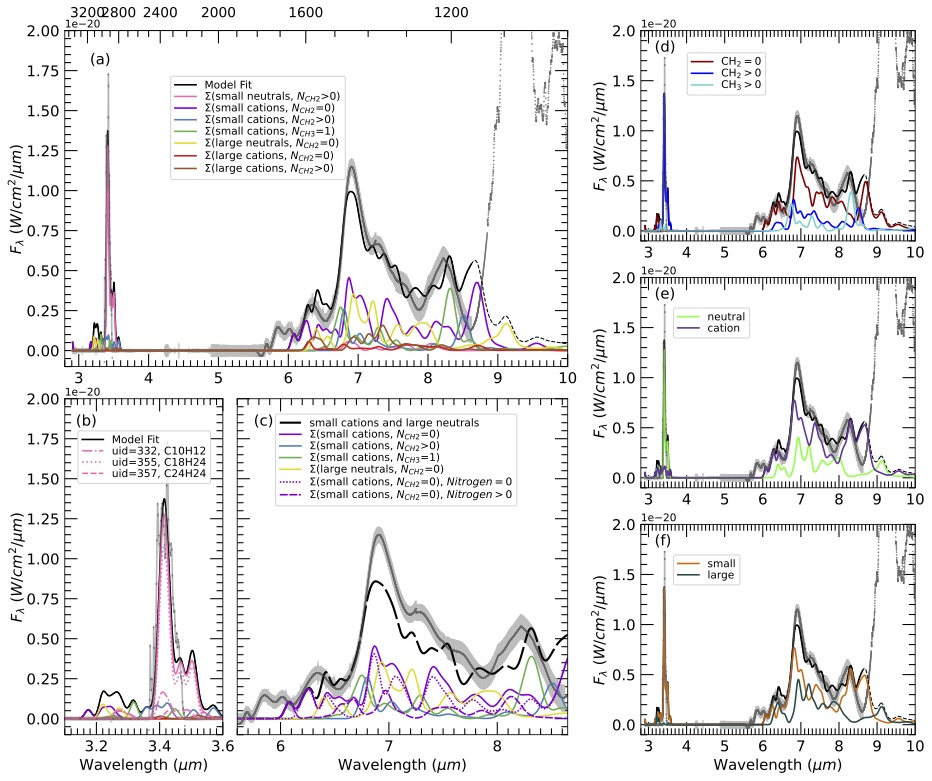
Figure 2. Model for PAH emissions in comet K2. Heavily hydrogenated PAHs, characterized by –CH2 sidegroups (NCH2 >0) [3], are present in the coma of comet K2. (b) Small (NC≤40) neutral PAHs fit the isolated 3.42 µm feature. (c) Small cations and large (NC>40) neutrals primarily contribute to the 6.9 µm and 8.55 µm features, and the emission plateau. Large neutrals and cations contribute. The upcoming PAH database v4.0 will have more large PAHs. (Adapted from [1].)
Based on their comparison of the organics to those in the ISM using the diagram of Hydrogen Deficiency Index versus Natoms (for comet K2, see Fig. 24 in [1]) for comet 67P versus ISM sources, Hanni et al. [6] conclude that cometary organics have an ISM heritage with evolution. The PAHdb model for K2 extends to larger Natom than ROSINA. Comet K2 has PAHs not as fully hydrogenated as comet 67P, yet supports the Hanni et al. view of potential inheritance from the ISM. The formation of PAH cations and hydrogenation of PAHs in water ice may provide a natural explanation of hydrogenated PAHs in cometary comae. High sensitivity JWST NIRSpec and MRS observations of more comets are needed to deepen our understanding of the evolution of aromatic molecules in the protoplanetary disk at the comet-forming epoch.
This work is based in part on observations made with the NASA/ESA/CSA James Webb Space Telescope Cycle 1 GO program 1556 whose analysis was supported via STSci grant JWST-GO-01566.003-A.
References:
[1] Woodward, C.E. et al. 2025, A JWST Study of the Remarkable Oort Cloud Comet C/2017 K2 (PanSTARRS), Planetary Sci. J. (in press) arXiv:2504.19849
[2] Yang, X. J., et al. 2016, On the aliphatic versus aromatic content of the carriers of the ‘unidentified’ infrared emission features, MNRAS 462, 1551 doi:10.1093/mnras/stw1740
[3] Sandford, S. A., et al. 2013, The Infrared Spectra of Polycyclic Aromatic Hydrocarbons with Excess Peripheral H Atoms (Hn-PAHs) and their Relation to the 3.4 and 6.9 µm PAH Emission Features, ApJS 205:8 doi:10.1088/0067-0049/205/1/8
[4] Harker, D.E. et al. 2024, Dust Properties of Comets Observed by Spitzer, Planetary Sci. J. 4, 242 doi:10.3847/PSJ/ad0382
[5] Bockelee-Morvan, D., et al. 2024, Chemical and Physical Properties of Cometary Dust, in Comets III, ed. K. J. Meech et al., Space Sci. Ser., U. AZ Press. doi:10.48550/arXiv.2305.03417
[6] Hänni, N. et al. 2022, Identification and characterization of a new ensemble of cometary organic molecules, Nature Comm. 13:3639 doi:10.1038/s41467-022-31346-9
How to cite: Wooden, D., Woodward, C., Bockelee-Morvan, D., Harker, D., Roth, N., Kelley, M., and Milam, S.: JWST Discovers Heavily Hydrogenated PAHs in the Coma of the Dynamically New Oort Cloud Comet C/2017 K2 (Pan-STARRS), EPSC-DPS Joint Meeting 2025, Helsinki, Finland, 7–12 Sep 2025, EPSC-DPS2025-1109, https://doi.org/10.5194/epsc-dps2025-1109, 2025.


