MITM15 | Solar System Science from JWST

MITM15

Solar System Science from JWST
Co-organized by OPS/SB
Convener: Leigh Fletcher | Co-conveners: Imke de Pater, Thierry Fouchet, Stefanie Milam, Heidi Hammel
Orals WED-OB2
| Wed, 10 Sep, 09:30–10:30 (EEST)
 
Room Venus (Veranda 3)
Orals THU-OB2
| Thu, 11 Sep, 09:30–10:30 (EEST)
 
Room Mercury (Veranda 4)
Orals THU-OB3
| Thu, 11 Sep, 11:00–12:27 (EEST)
 
Room Mercury (Veranda 4)
Posters THU-POS
| Attendance Thu, 11 Sep, 18:00–19:30 (EEST) | Display Thu, 11 Sep, 08:30–19:30
 
Finlandia Hall foyer, F107–124
Wed, 09:30
Thu, 09:30
Thu, 11:00
Thu, 18:00
JWST has proven to be an essential component in the current era of planetary exploration. Via a combination of high-resolution infrared imaging (NIRCam), and spatially resolved spectroscopy (MIRI, NIRSpec and NIRISS), JWST has been delivering transformative new insights into the origins and physicochemical phenomena shaping the myriad worlds of the Solar System.

Solar System observations have accounted for 4-6% of all JWST time allocated during the first three cycles, with almost every major body being viewed at least once in JWST’s major instrument modes, as well as >100 small bodies across the Solar System. This has generated a host of new discoveries, from the atmospheres and ionospheres of giant planets; to the distribution of ices on ocean moons; the hydration properties of small bodies; the chemical composition of comets; and the taxonomy of Trans-Neptunian Objects to tell the story of Solar System evolution. These exceptional new insights will set the scene for the next generation of planetary missions beyond Mars, both those en route to their destinations (e.g., Lucy, Psyche, JUICE, Europa Clipper and others), and those preparing for the next steps in our exploration of the Solar System.

This interdisciplinary session welcomes papers spanning the entire planetary science community, reporting new discoveries using JWST in any discipline.

Session assets

Orals WED-OB2: Wed, 10 Sep, 09:30–10:30 | Room Venus (Veranda 3)

Chairperson: Leigh Fletcher
JWST Giant Planet Systems
09:30–09:42
|
EPSC-DPS2025-421
|
On-site presentation
Maryame El Moutamid, Matthew Hedman, Mark Showalter, Imke de Pater, Matthew Tiscareno, Damya Souami, and Jack Lissauer

Recent JWST NIRCam observations obtained through Program #6379 provide the deepest imaging yet of Uranus’s faint rings and small moons. The observations utilize the FULLP subarray of the short-wavelength detector, yielding a field of view spanning ~900,000 km, which is sufficient to cover the system out to Titania and to briefly capture Oberon near the corners of some images.  A full analysis of the dataset is ongoing, but the quality of the data is sufficient to reveal rings roughly an order of magnitude fainter than the known rings, and previously unseen moons with radii greater than 2 km. We will present the detailed results of our analysis of these images, including the orbital and photometric properties of any newly discovered moons. 

How to cite: El Moutamid, M., Hedman, M., Showalter, M., de Pater, I., Tiscareno, M., Souami, D., and Lissauer, J.: New JWST Discoveries on the Uranian System, EPSC-DPS Joint Meeting 2025, Helsinki, Finland, 7–13 Sep 2025, EPSC-DPS2025-421, https://doi.org/10.5194/epsc-dps2025-421, 2025.

09:42–09:54
|
EPSC-DPS2025-959
|
On-site presentation
Imke de Pater, Mark Showakter, Matt Hedman, Heidi Hammel, Mike Roman, Leigh Fletcher, Maryame El Moutamid, Matt Tiscareno, and Damya Souami

The outermost rings in the uranian system, the  µ and the v rings, were discovered on HST images taken in 2003-2005 (Showalter & Lissauer, 2006). The color of the rings was established soon thereafter from Keck images taken in 2005 (de Pater et al., 2006). While the v ring had the typical red color as expected for dusty rings, the  µ ring seemed to be as blue as Saturn’s E ring. The spectra of these rings were based on two datapoints: one in the visible and one in the infrared (2.12  µm), while the infrared data point of the  µ ring was only a 3-sigma upper limit.

In July-August 2007 we used NIRC2 on the Keck telescope in Hawaii at 2.12 and 1.63 µm in an attempt to detect the  µ ring. At this time the ring plane was almost edge-on (B=0.62-0.24 deg.), and these data show the first detection of the  µ ring at infrared wavelengths.

More recently, the Uranian rings were imaged by JWST in 2023 as part of the Cycle 1 Outreach Campaign (#2739), which illustrated JWST’s remarkable sensitivity to the faint dust rings. In 2024, JWST GTO program #2768 included the first Uranus rings science observations (in addition to other planet-related goals). We also include deep exposures from 2025, taken for JWST GO #6379 which was specifically focused on the uranian rings and inner moons to characterize the uranian system in the immediate environment of the planet. All JWST observations were obtained with NIRCam, at wavelengths between 1.4 and 4.8  µm and ring opening angles B = 56-65 deg. These data show both the µ and ν rings at several wavelengths.

We complement these infrared datasets with HST data at visible wavelengths, obtained between 2003 and 2013, at several ring opening angles between roughly minus 20 and plus 20 deg.

We used the images to construct spectra of both rings to validate their color. We confirm that the v ring is indeed red, and the  µ ring blue. Both rings show strong absorption bands at 3  µm, indicative of water ice and/or OH-rich material.

As previously noted, the µ ring peaks in brightness very close to the orbit of Mab, which probably serves as a source body for the fine (icy) dust grains, although the mechanism at work remains obscure. The radial profile of both rings is triangular at all wavelengths, similar to that observed by HST and Voyager at visible wavelengths (Showalter & Lissauer, 2006). However, the µ ring appears to be radially wider at shorter wavelengths, suggesting that smaller dust grains are distributed more widely than are the larger grains that dominate at IR wavelengths. This is consistent with models that suggest that non-gravitational forces play an important role in this ring. We further noticed a steep decline in the intensity of the µ ring in HST data from 2003 through 2006.

References:

 de Pater, I., Hammel, H.B., Gibbard, S., Showalter, M.R., 2006. Science 312, 92.

Showalter, M.R., Lissauer, J.J., 2006. Science 311, 973.


How to cite: de Pater, I., Showakter, M., Hedman, M., Hammel, H., Roman, M., Fletcher, L., El Moutamid, M., Tiscareno, M., and Souami, D.: Characterization of the outer Uranian rings in the visual and near-IR using Keck, JWST, and HST observations , EPSC-DPS Joint Meeting 2025, Helsinki, Finland, 7–13 Sep 2025, EPSC-DPS2025-959, https://doi.org/10.5194/epsc-dps2025-959, 2025.

09:54–10:06
|
EPSC-DPS2025-1210
|
On-site presentation
Michael Roman, Leigh Fletcher, Heidi Hammel, Patrick Irwin, Oliver King, Naomi Rowe-Gurney, Julianne Moses, Glenn Orton, Imke de Pater, Henrik Melin, Jake Harkett, Matthew Hedman, Simon Toogood, and Stefanie Milam

Introduction: Due to Uranus’ weak thermal radiance, the thermal and compositional structures of its atmosphere have remained poorly characterised. Here, using the unprecedented sensitivity of JWST's MIRI and NIRSpec instruments, we present an analysis of Uranus' spatially resolved spectrum spanning the near- and mid-infrared, revealing how temperatures, composition, and clouds vary across the planet's northern hemisphere.

Observations: JWST observed Uranus on 8--9 January 2023 (program1248) as part of the Solar System Guaranteed Time Observations (GTO). Integral field spectroscopy (IFS) with the Near-Infrared Spectrograph (NIRSpec) and the Mid-Infrared Instrument/Medium Resolution Spectrometer (MIRI/MRS) were combined to provide nearly simultaneous and continuous spatial and spectral data between 1.66 and 28.70 microns.

Temperatures: The nearly continuous spectral coverage offered by the combination of NIRSpec and MIRI provide constraints on the temperature structure from the stratosphere down to several bars. The average temperature-pressure vertical profile is largely consistent with that determined from Spitzer [1], but the spatially resolved JWST reveal how these temperatures vary with latitude in the stratosphere and cloud layer for the first time [2]. They also suggest the possibility of a sub-adiabatic cloud layer.

Chemistry: Our radiative transfer analysis of MIRI-MRS spectra 1) provide new constraints on minor species in Uranus’ stratosphere and 2) reveals how various hydrocarbons vary as a function of latitude. The observed distributions are indicative of a combination of seasonal photochemistry [3] and dynamical processes, as we will briefly discuss.

Clouds and hazes: Finally, we briefly examine the vertical cloud structure and its latitudinal variation as sensed by NIRSpec data. The data reveal the opacity of Uranus clouds and hazes spanning the transition from scattered sunlight to thermal emission for the first time. The overall vertical structure suggested by these new data largely agrees with that of prior work [3,4,5], but a comparison between observed and model spectra reveal interesting discrepancies and possibly a need for additional sources of opacity.


[1] Orton, G.S., Fletcher, L.N., Moses, J.I., Mainzer, A.K., Hines, D., Hammel, H.B., Martin-Torres, F.J., Burgdorf, M., Merlet, C., Line, M.R.: Mid-infrared spectroscopy of uranus from the spitzer infrared spectrometer: 1. determination of the mean temperature structure of the upper troposphere and stratosphere. Icarus 243, 494–513 (2014)

[2] Roman, M.T., Fletcher, L.N., Orton, G.S., Rowe-Gurney, N., Irwin, P.G.: Uranus in northern midspring: persistent atmospheric temperatures and circulations inferred from thermal imaging. The Astronomical Journal 159(2), 45 (2020)

[3] Moses, J.I., Fletcher, L.N., Greathouse, T.K., Orton, G.S., Hue, V.: Seasonal stratospheric photochemistry on uranus and neptune. Icarus 307, 124–145 (2018)

[4] Sromovsky, L.A., Karkoschka, E., Fry, P.M., Pater, I., Hammel, H.B.: The methane distribution and polar brightening on uranus based on hst/stis, keck-nirc2, and irtf/spex observations through 2015. Icarus 317, 266–306 (2019)189

[5] Irwin, P.G., Teanby, N.A., Fletcher, L.N., Toledo, D., Orton, G.S., Wong, M.H.,Roman, M.T., Perez-Hoyos, S., James, A., Dobinson, J.: Hazy blue worlds:A holistic aerosol model for uranus and neptune, including dark spots

[6] Roman, M.T., Banfield, D., Gierasch, P.J.: Aerosols and methane in the ice giant atmospheres inferred from spatially resolved, near-infrared spectra: I. uranus, 2001–2007. Icarus 310, 54–76 (2018)

How to cite: Roman, M., Fletcher, L., Hammel, H., Irwin, P., King, O., Rowe-Gurney, N., Moses, J., Orton, G., de Pater, I., Melin, H., Harkett, J., Hedman, M., Toogood, S., and Milam, S.: Temperature, Composition, and Cloud structure in Atmosphere of Uranus from MIRI-MRS and NIRSpec-IFU Spectra, EPSC-DPS Joint Meeting 2025, Helsinki, Finland, 7–13 Sep 2025, EPSC-DPS2025-1210, https://doi.org/10.5194/epsc-dps2025-1210, 2025.

10:06–10:18
|
EPSC-DPS2025-813
|
ECP
|
On-site presentation
Oliver King, Jonathan Nichols, Leigh Fletcher, John Clarke, Imke de Pater, Henrik Melin, Luke Moore, and Chihiro Tao

H3+ is one of the key components of the auroral emissions from the Solar System’s giant planets. Produced from auroral precipitation ionising neutral hydrogen molecules, H3+ can have lifetimes ~100 s in the Jovian ionosphere, leading to highly variable emission in active regions. H3+ radiates strongly in the near infrared with a temperature and density dependent spectrum, providing a significant source of cooling for the upper atmosphere of Jupiter.

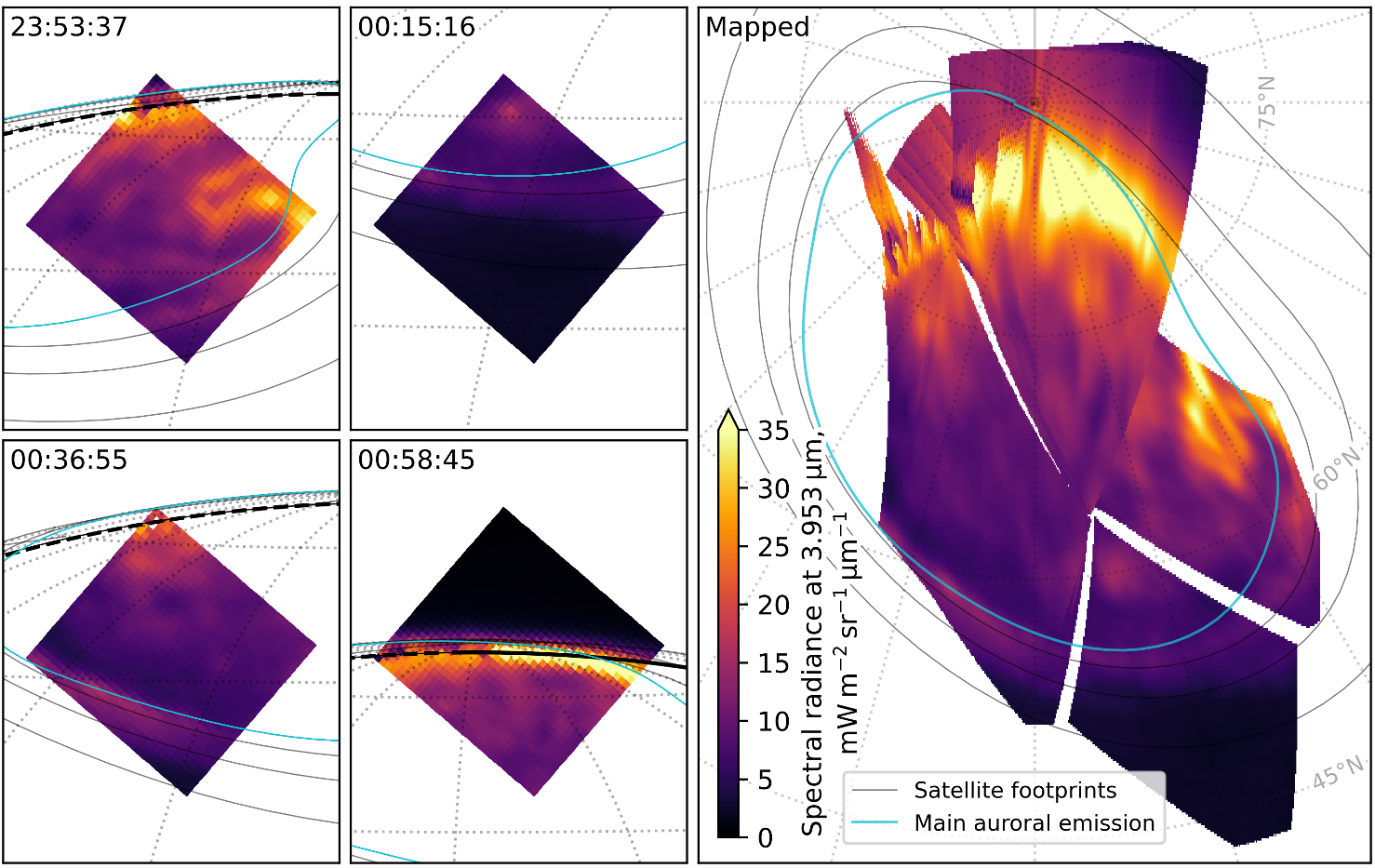
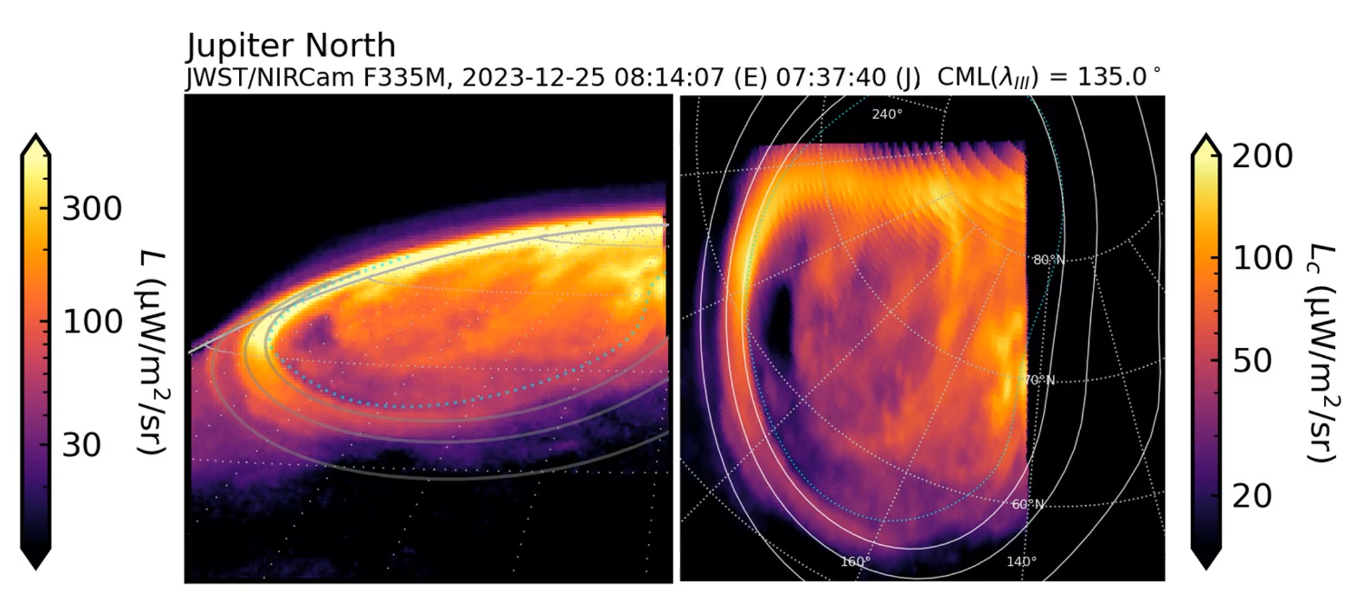
We present spatially and temporally resolved JWST/NIRCam and JWST/NIRSpec observations of Jupiter’s north polar auroral H3+ emissions. In December 2023, NIRCam observed Jupiter using the F335M filter with a ~3 s time resolution and ~190 km spatial resolution (Figure 1). This filter, centred at 3.35 µm measures the broadband H3+ emission, and can be used to measure the time variability and spatial structure of the H3+ aurora across the entire polar region (Nichols+2025). Subsequently, in January 2024, NIRSpec acquired 3 – 5 µm spectra with a ~30 s time resolution and ~300 km spatial resolution (Figure 2). This spectral range includes the bright H3+ emissions around 3.5 µm and 4 µm, which we can use to probe the H3+ density and temperature in the Jovian ionosphere. The high sensitivity, spectral, spatial and temporal resolutions offered by these two JWST instruments offers an unprecedented window into the evolution and time variability of H3+ at Jupiter.

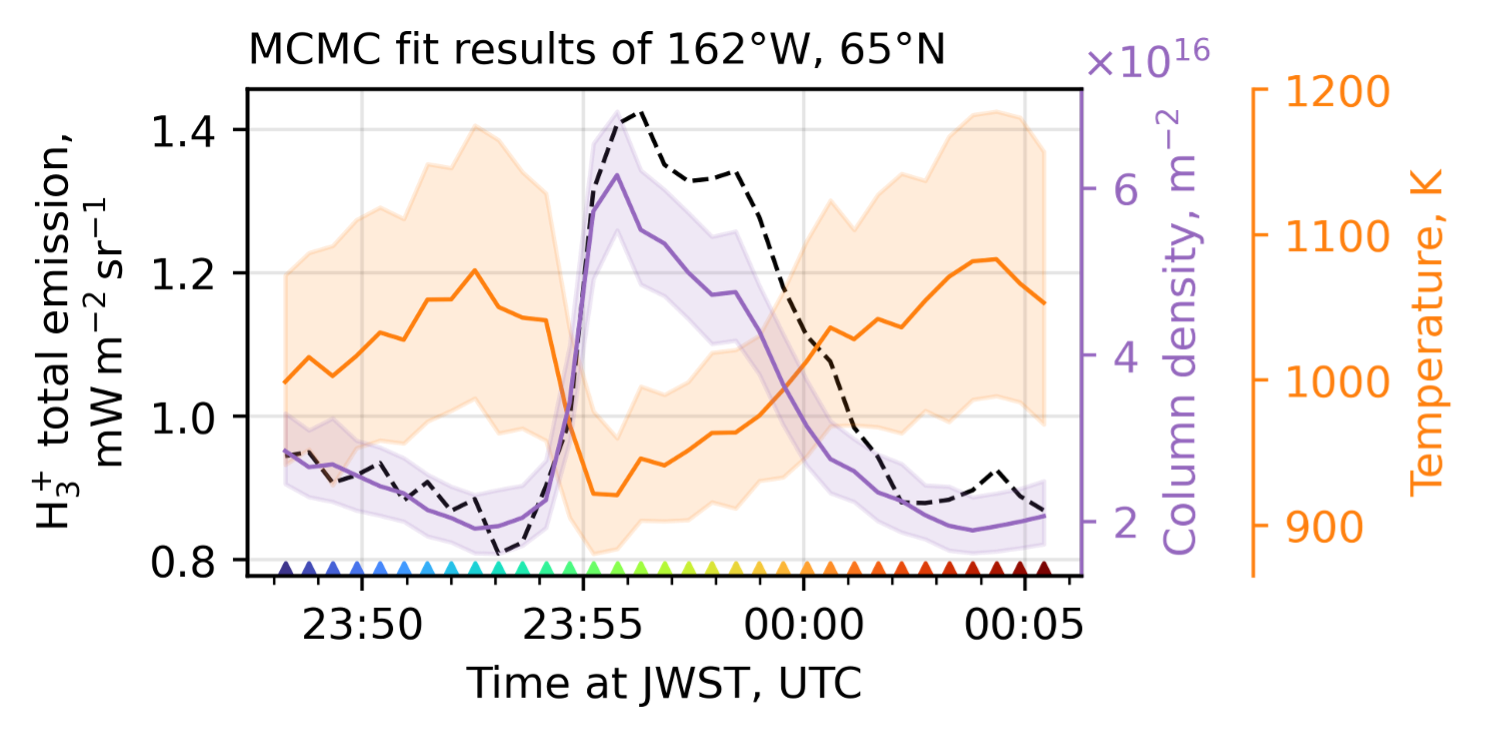
We have developed a custom Monte Carlo wrapper of the h3ppy Python package to fit and model the observed H3+ NIRSpec spectra and study the evolution of temperature and number density during transient events. We show that during transient brightening events column density rapidly increases (over ~30s) while the temperature decreases, suggesting that brightening is caused by the production of a cooler layer of H3+.

Figure 1: JWST/NIRCam observations of Jupiter’s north polar aurora (Nichols+2025). The ~3 second time resolution allows us to the measure rapid variation and morphological changes of the H3+ intensity over the entire auroral region.

Figure 2: Spatial coverage of JWST/NIRSpec observations of Jupiter’s north polar aurora. Each observed location has a full 3-5 µm spectra (R=2700), acquired with a time resolution of ~30 seconds, providing a comprehensive spatial, spectral and temporal observations of Jupiter’s infrared auroral emissions.

Figure 3: Transient brightening of Jupiter’s H3+ aurora observed by JWST/NIRSpec. The column density (purple) increases rapidly during the brightening event, while the temperature (orange) decreases.

How to cite: King, O., Nichols, J., Fletcher, L., Clarke, J., de Pater, I., Melin, H., Moore, L., and Tao, C.: JWST observations of Jupiter's time variable H3+ auroral emissions, EPSC-DPS Joint Meeting 2025, Helsinki, Finland, 7–13 Sep 2025, EPSC-DPS2025-813, https://doi.org/10.5194/epsc-dps2025-813, 2025.

10:18–10:30
|
EPSC-DPS2025-817
|
On-site presentation
Tom Stallard, Henrik Melin, Luke Moore, Emma Thomas, Katie Knowles, Paola Tiranti, and James O'Donoghue

For more than three decades, thermalised emissions from the ionic molecule trihydrogen, H3+, have been used to explore the ionospheres of the outer planets.  These observations, made by a combination of ground-based and in-orbit spacecraft telescopes, have allowed us to reveal both auroral and equatorial processes, understand the flow of energy from the aurora and even follow the ion winds within the auroral regions, revealing the driving currents that produce these features. But for every outer planet, these observatories have reached some fundamental limit, constrained by the limitations of Earth’s turbulent atmosphere, the low spectral resolution of instruments sent to these world and the lack of sensitivity to explore the weak emissions from transient thin gases at the very top of these atmospheres.

In the past three years, JWST has fundamentally revolutionised our understanding of the ionosphere of every one of these worlds. In a sequence of observations that includes GOT and ERS time at the very start of JWST’s mission, as well as a series of GO observations in Cycles 2, 3 and now 4, we have been garnering incredible, high sensitivity, highly-spatially resolved views at unprecedented detail.

At Jupiter, a familiar ionosphere has been bejewelled with intricate new small-scale details. Images of the non-auroral emissions capture the broad-scale ionospheric features in individual images at an equivalent detail to past maps combining 150 hours of telescope time, but between these broad features, small scale structures have been observed for the first time, suggestion a highly dynamic ionosphere with complex wave activity (Figure 1).  This complexity is now seen across the disk, in a sequence of observations that not only reveals these details (measurements that will be presented in detail within the Jupiter magnetosphere session), but also provides us with details of the vertical structures within Jupiter’s ionosphere, from pole to equator (again to be discussed in detail within the Jupiter session). We have also revealed complexity within Jupiter’s Io footprint, and across the northern auroral region.

Figure 1. Complex ionospheric wave activity above Jupiter’s Great Red Spot, revealed by Melin et al., 2024. The ionosphere is shown in red, with reflected sunlight from the underlying spot shown in blue.

At Saturn, the past constraints of weak emission and high background signal have greatly limited any spatially resolved measurements in either temperature or density, and have prevented any view of sub-auroral ionospheric structures. With JWST, we have revealed complex structures and dynamics, providing the first direct view of the thermal gradients that drives Saturn’s enigmatic planetary-period aurora. We have also discovered a string of sub-auroral beads that occur along the flank of the main auroral region, an unprecedented ionospheric feature that might be associated with Saturn’s unique alignment between the magnetic and rotational pole (Figure 2).

Figure 2. A polar map of Saturn’s sub-auroral ionosphere, imaged for the first time with JWST. Here, the transient weak auroral emission is saturated within this map, instead focusing on emission equatorward of the aurora. The sub-auroral region between 180-300oW reveals a string of dark beads, fixed in longitude.


Past observations of Uranus have measured the planet-wide temperature and density for decades, but only the most recent ground-based measurements have begun to reveal auroral structures.  Similarly, Voyager II struggled to reveal the aurora in detail and Hubble Space Telescope observations can only observe the aurora of Uranus at their very brightest. Our past Earth-bound myopic views have been startlingly shattered by JWST, revealing a complex ionosphere and aurora for the first time. We are able to resolve detailed auroral structures and the first vertical profiles of the infrared ionosphere (to be discussed in detail within two separate presentations within the Uranus session), as well as previously unknown equatorial structure, sometimes directly associated with the planet’s magnetic field.

Finally, at Neptune, Voyager II provided the only views we have ever had of that planet’s aurora. Since 1989, ground-based observations have failed to detect any H3+ emission from the ionosphere, and Hubble has failed to detect an auroral signature. JWST has lifted the darkness at Neptune, providing incredible views of the aurora, as well as complex ionospheric structures (Figure 3).


Figure 3. Neptune’s infrared ionosphere (Melin et al., 2024). Complex auroral and ionospheric structures are revealed in this detection of H3+ at Neptune.


How to cite: Stallard, T., Melin, H., Moore, L., Thomas, E., Knowles, K., Tiranti, P., and O'Donoghue, J.: JWST’s transformational observations of Giant Planet ionospheres, EPSC-DPS Joint Meeting 2025, Helsinki, Finland, 7–13 Sep 2025, EPSC-DPS2025-817, https://doi.org/10.5194/epsc-dps2025-817, 2025.

Orals THU-OB2: Thu, 11 Sep, 09:30–10:30 | Room Mercury (Veranda 4)

Chairpersons: Oliver King, Thierry Fouchet
09:30–09:42
|
EPSC-DPS2025-447
|
ECP
|
On-site presentation
Pablo Rodriguez-Ovalle, Thierry Fouchet, Thibault Cavalié, Michel Dobrijevic, Leigh N. Fletcher, Camille Lefour, Emmanuel Lellouch, James Sinclair, Bilal Benmahi, Simon Toogood, Michael H. Wong, and Imke de Pater

The 1994 impact of comet Shoemaker Levy 9 on Jupiter triggered the injection of new chemical species into the planet’s stratosphere – including H₂O, CO, HCN and CS – that had never been detected before [1,2,3]. Recent studies have also proposed that similar cometary impacts may have delivered similar species to other outer planets [4,5,6].

The temporal and spatial evolution of these SL9-derived species has since been monitored in Jupiter. These molecules were originally injected at 44S, confined to a narrow layer at 0.1 mbar. Over the following years, these molecules have diffused vertically, reaching pressure levels of 3 mbar by 2017, and have also dispersed horizontally across the planet. Notably, recent ALMA observations revealed that CO is now evenly distributed across latitudes [7]. However, other molecules, such as HCN and CO, show unexpected spatial patterns that challenge current transport and chemical models. First, HCN is well mixed at mid-latitudes but it exhibits polar depletion [7]. Second, CO, a daughter molecule of the SL9-derived CO and HO, presented an enhanced abundance in the South Polar Region in 2000 as revealed by Cassini/CIRS observations [8].

We analyzed James Webb Space Telescope (JWST) Mid InfraRed Instrument (MIRI) medium-resolution spectroscopy observations from latitudes of 17S to 26S, and from 45S towards the south pole to retrieve the molecular abundances of CO₂, H₂O, and HCN (see Figure 1) by coupling a radiative transfer code with an inversion algorithm. This model was used to retrieve, in the first place, the temperature from the CH4 ν4 band in first place and, in the second place, the abundance of the species for the different latitudes.

Our results show a complex latitudinal structure for each molecule. Regarding HCN, comparisons with ALMA (2017) and Cassini/CIRS (2000) allow us to assess its temporal evolution. Using a simple transport model, we could suggest a possible origin for its polar depletion, that could be linked to the presence of stratospheric aerosols. These aerosols could trigger heterogeneous chemical reaction that can lead to the adsorption of HCN onto these aerosols. For the oxygenated molecules, this is the first time H₂O’s meridional distribution has been mapped with such resolution , and the first time CO₂ has been observed in Jupiter since 2000 with Cassini/CIRS. We observed the column density to be affected at the regions where the auroral oval is present. Interestingly, both H₂O and CO₂ show variations linked to Jupiter’s southern auroral oval, with CO₂ exhibiting strong depletion and H₂O showing enhancement in the same region. This potential anti-correlation is not well understood and may indicate the involvement of an unknown mechanism — possibly initiated by particle precipitation or complex meridional transport — that affects the oxygen exchange between these molecules.

While these findings mark a significant step forward in understanding post-impact chemistry and atmospheric dynamics, several questions remain unclear, particularly the chemical relationship between the oxygenated molecules. Upcoming JWST Cycle 4 observations (PI: Rodriguez-Ovalle) will provide a full meridional coverage of these molecules (see figure 2), and are expected to shed some light on the chemistry and transport behind H₂O and CO₂.

Figure 1. Top panel: Example of Jupiter spectral region (zonally averaged) encompassing CH4 lines and the H2O ν2 lines at 75S (red), 65S (blue) and 25S (black). The vertical lines display the spectral features of CH4 (black) and NH3 (orange). Bottom left panel: Same but for HCN ν2 band (zonally averaged) next to C2H2 lines. Bottom right panel: Same but for CO2 ν2 band. The grey regions mark the positions of the emission lines of each molecule. The spectra at 65S is shifted to match the continuum emission of the 75S spectrum. The offset values in nW.cm−2.sr−1 / cm−1 are indicated in the legend of each panel.


Figure 2: MIRI/MRS footprints on Jupiter for a single dither for channels 1 (blue) and 3 (red). The order of the observation is labeled from 1 to 10. The northern auroral oval is marked in fuchsia.


[1] Lellouch et al., 1995. Chemical and thermal response of Jupiter’s atmosphere following the impact of comet Shoemaker–Levy 9. Nature, 373:592–595, February 1995. ISSN 1476- 4687. doi: 10.1038/373592a0.

[2] Marten et al., 1995. The collision of comet Shoemaker-Levy 9 with Jupiter: Detection and evolution of HCN in the stratosphere of the planet. Geo- phys. Res. Lett., 22(12):1589–1592, June 1995. ISSN 0094-8276. doi: 10.1029/95GL00949.

[3] Bjoraker et al., 1996. Detection of Water after the Collision of Fragments G and K of Comet Shoemaker–Levy 9 with Jupiter. Icarus, 121(2):411–421, June 1996. ISSN 0019-1035. doi: 10.1006/icar.1996.0096.

[4] Cavalié et al., 2010. A cometary origin for CO in the stratosphere of Saturn? Astron. Astrophys., 510:A88, February 2010. ISSN 0004-6361. doi: 10.1051/0004-6361/200912909.

[5] Lellouch et al. 2005. A dual origin for Neptune's carbon monoxide? Astron. Astrophys. 430, 2, February 2005. ISSN: 0004-6361. doi: 10.1051/0004-6361:200400127

[6] Moreno et al., 2017. Detection of CS in Neptune’s atmosphere from ALMA observations. Astron. Astrophys. 608, L5. ISSN: 0004-6361. doi: 10.1051/0004-6361/201731472

[7] Cavalié et al., 2023. Evidence for auroral influence on Jupiter’s nitrogen and oxygen chemistry revealed by ALMA. Nat. Astron., 7:1048–1055, September 2023. ISSN 2397-3366. doi: 10.1038/s41550-023-02016-7.

[8] Lellouch et al., 2006. On the HCN and CO2 abundance and distribution in Jupiter’s stratosphere. Icarus, 184 (2):478–497, October 2006. ISSN 0019-1035. doi: 10.1016/j.icarus.2006.05.018.

How to cite: Rodriguez-Ovalle, P., Fouchet, T., Cavalié, T., Dobrijevic, M., Fletcher, L. N., Lefour, C., Lellouch, E., Sinclair, J., Benmahi, B., Toogood, S., Wong, M. H., and de Pater, I.: The evolution of comet-impact products in Jupiter’s atmosphere using JWST-MIRI observations , EPSC-DPS Joint Meeting 2025, Helsinki, Finland, 7–13 Sep 2025, EPSC-DPS2025-447, https://doi.org/10.5194/epsc-dps2025-447, 2025.

09:42–09:54
|
EPSC-DPS2025-1275
|
On-site presentation
Arrate Antunano, Pablo Rodriguez-Ovalle, Ricardo Hueso, Thierry Fouchet, Agustín Sánchez-Lavega, Imke de Pater, Glenn S. Orton, and Leigh N. Fletcher

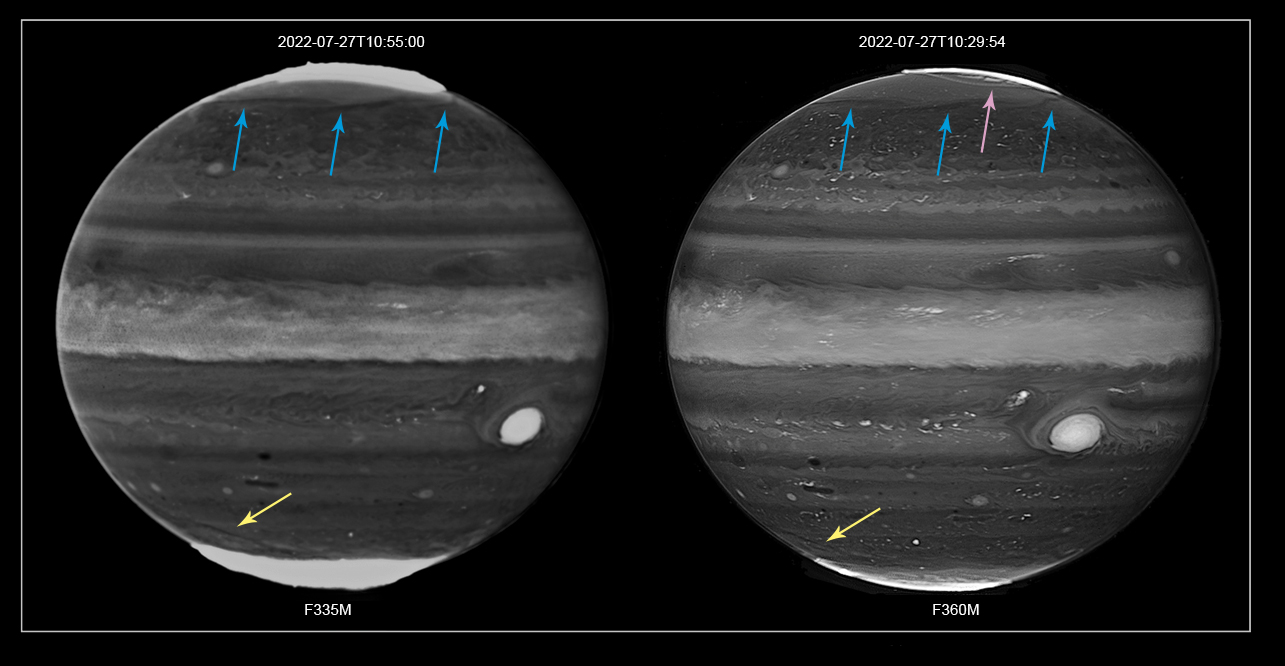
Elongated cloud structures in Jupiter’s polar and subpolar regions have been observed in JunoCam images [1]. These clouds present a variety of sizes and colours, and are mainly observed near the terminator, suggesting that these clouds are located at high altitudes. These elongated and elevated clouds could be divided in three main groups depending on their albedo: (i) high albedo clouds; (ii) low albedo clouds; and (iii) high albedo clouds featuring large shadows. So far, their nature remains largely unexplained. Similarly, JWST/NIRCam images of Jupiter at wavelengths between 1.65 µm and 3.60 µm captured on July 22, 2022 as part of the Early Release Science program 1373 [2], also showed dark and bright filamentary structures on Jupiter’s polar and subpolar regions. Among the diverse observed elongated structures, we focus this study on three different phenomena (all indicated in Figure 1).

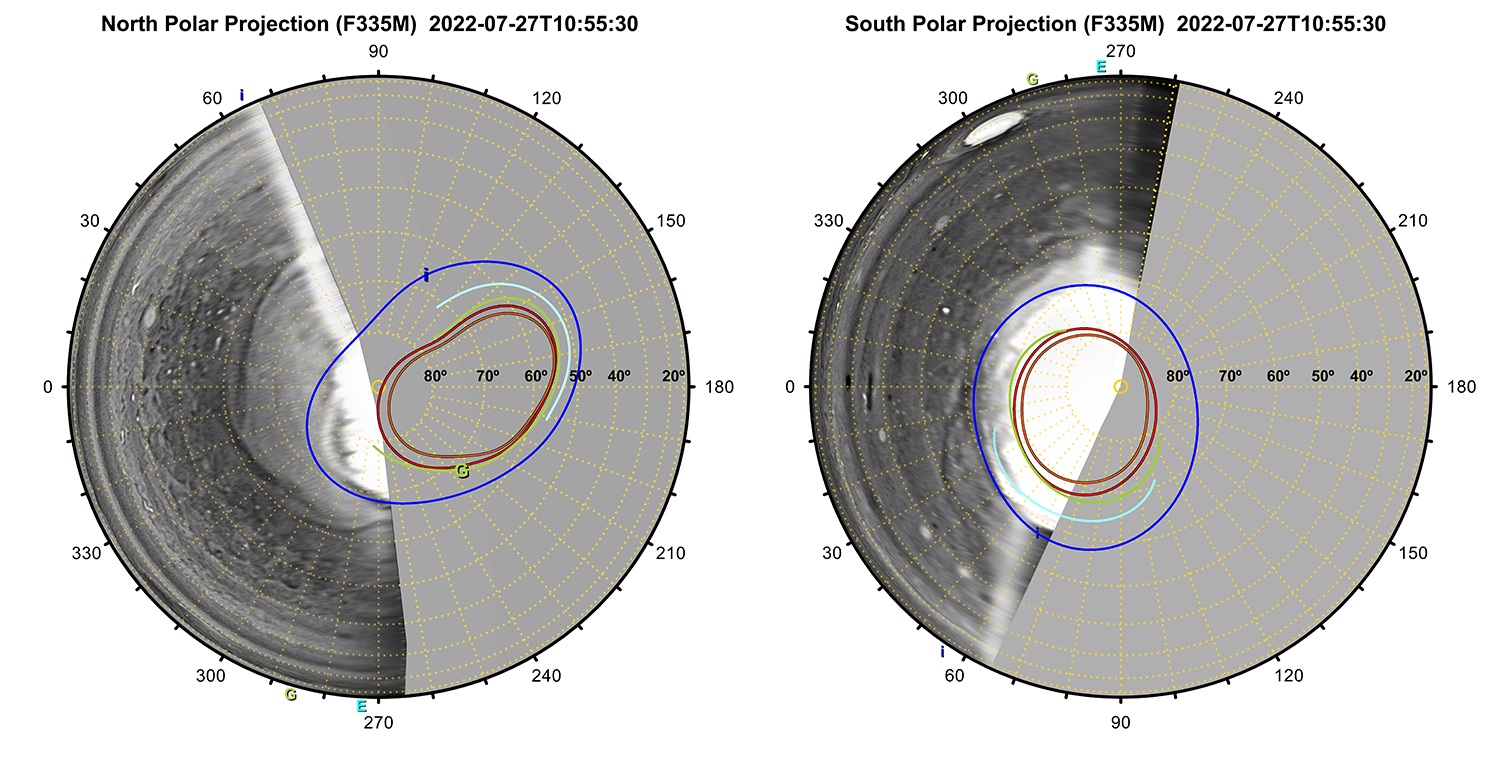
The first feature is a low-albedo, elongated feature located at the sub-polar region near 50°-60° latitude south in 3.35-µm and 3.6-µm images (sensing stratospheric hazes and tropospheric clouds). This feature displays a fast meridional movement with peak velocities of 30 m/s and does not follow the usual zonal movement of Jupiter’s troposphere and stratosphere. However, the most poleward extend of this feature (near -60° latitude) follows a zonal flow. This, together with its shape, suggest that this perturbation was originated near -60° latitude and rapidly propagated equatorward. Additionally, the observed fast meridional movement hints at this feature being located at high altitudes, above the zonal flow regime. Analysis of the aurora activity and Io’s footprint compared with the polar most latitude of the dark feature and its width open the possibility that this feature might be directly related to Io’s footprint where the flux of energetic particles in Jupiter’s upper stratosphere might locally modify the chemistry of the atmosphere (see Figure 2).

The second phenomena analysed in this study are low-albedo features present at the boundary of the polar hazes in the north polar region at 1.64 µm, 2.12 µm, 3.35 µm and 3.6 µm. Unlike in the south polar region, the northern high latitudes display elongated and straight dark filaments that move with the background, creating a boundary-like structure. Similar features have previously been observed in JunoCam images at the same latitudes, appearing as slightly bright, narrow, and elongated clouds. The origin of these features, unlike the dark filament in the southern hemisphere, does not seem to be related aurora or activity from the satellite’s footprints.

The third feature is a bright arc-like structure observed in the northern polar region at latitudes higher than 70° in 3.35-µm and 3.6-µm images. Due to the lack of image pairs at 3.6 µm that could be used to track motions, we are not able to characterise its dynamics. So far, the presence of this feature remains a mystery.

In this presentation, we will share an analysis of these rare structures in Jupiter’s polar and subpolar regions, characterising their sizes, distribution and dynamics, and we will also propose different candidates that could explain the nature of these features.

Figure 1. Images of Jupiter taken by NIRCAM onboard the JWST at 3.35 µm (left) and 3.60 µm (right), showing the diverse elongated featured analysed in this study.

Figure 2. Polar projections at 3.35 µm showing the potential relation of the dark filament in the south polar region and the bright arc in the north polar region with Io’s footprint (indicated in dark blue). The red solid lines represent the average position of the aurora, the light blue solid line represent Europa’s footprint and the green solid line represents Ganimede’s footprint. 

References: [1] Hueso, R., Sánchez-Lavega, A., Fouchet, T. et al. An intense narrow equatorial jet in Jupiter’s lower stratosphere observed by JWST. Nat Astron 7, 1454–1462 (2023). [2] Orton, G.S., Rogers, J. et al. Jupiter’s High-Altitude Hazes as Observed by JunoCam. Geophysical Research Abstracts, Vol. 21, EGU2019-3188 (2019).

How to cite: Antunano, A., Rodriguez-Ovalle, P., Hueso, R., Fouchet, T., Sánchez-Lavega, A., de Pater, I., Orton, G. S., and Fletcher, L. N.: Filamentary structures in Jupiter’s polar regions, EPSC-DPS Joint Meeting 2025, Helsinki, Finland, 7–13 Sep 2025, EPSC-DPS2025-1275, https://doi.org/10.5194/epsc-dps2025-1275, 2025.

09:54–10:06
|
EPSC-DPS2025-1254
|
ECP
|
On-site presentation
Gideon Yoffe and Sahar Shahaf

Europa is a prime candidate for extraterrestrial life due to its subsurface ocean (Carr et al., 1998). Its surface offers a partial glimpse into oceanic processes while also acting as the interface between the moon’s internal geology and the extreme conditions of Jupiter’s magnetosphere. Shaped by both internal activity and external irradiation (Chyba and Phillips, 2002; Nordheim et al., 2022), Europa’s surface exhibits spatial and spectral variability that is key to interpreting its composition and assessing its astrobiological potential.

We present a novel data-driven analysis of JWST NIRSpec-IFU (Böker et al., 2022) observations of Europa’s leading hemisphere, using spectral decomposition to isolate dominant modes of variability.

The NIRSpec-IFU data form a three-dimensional cube with two spatial dimensions (nrowncol) and one spectral dimension. Each spatial pixel ("spaxel") records a high-resolution reflectance spectrum from ~1.0–5.2 μm. We flatten the cube into a two-dimensional matrix S∈Rm×n, where nrow×ncol, and n is the number of wavelength bins.

To analyze the spatial-spectral structure, we apply singular value decomposition (SVD) independently to seven spectral bands centered on diagnostic features: the 1.65 μm crystalline ice absorption feature, the 3.1 μm Fresnel peak of crystalline water ice (Hansen and McCord, 2004), the 3.5 μm hydrogen peroxide absorption (H2O2) (Trumbo et al., 2019; Wu et al., 2024), two carbon dioxide (CO₂) isotopologue absorptions near 4.25 μm and 4.38 μm (Trumbo and Brown, 2023; Villanueva et al., 2023), and two newly identified broadband continuum features. The SVD takes the form:

Sλ∈band=UΣV

The columns of V represent the principal spectra v(i), where v(0) captures the average spectral shape across the hemisphere, and higher orders describe progressively weaker, spatially variable deviations from it. The columns of U are the spatial modes, u(i), which specify how much each v(i) contributes at each spaxel. Each local spectrum is thus approximated as a weighted sum of a global mean and a few spatially structured variations in shape.

We focus on the first two modes for each band, encoding the mean shape and the strongest perturbation. The spatial modes exhibiting variability, u(1), are fitted with spherical harmonics (), yielding a sparse, smooth representation of hemispheric structure and enabling consistent comparison across bands. Figure 1 illustrates the first two principal spectra, v(0) and v(1), and the first spatial mode, u(1), for the seven analyzed bands. Figure 2 illustrates a projection of the fitted models for u(1) of the seven bands onto Europa’s leading hemisphere.
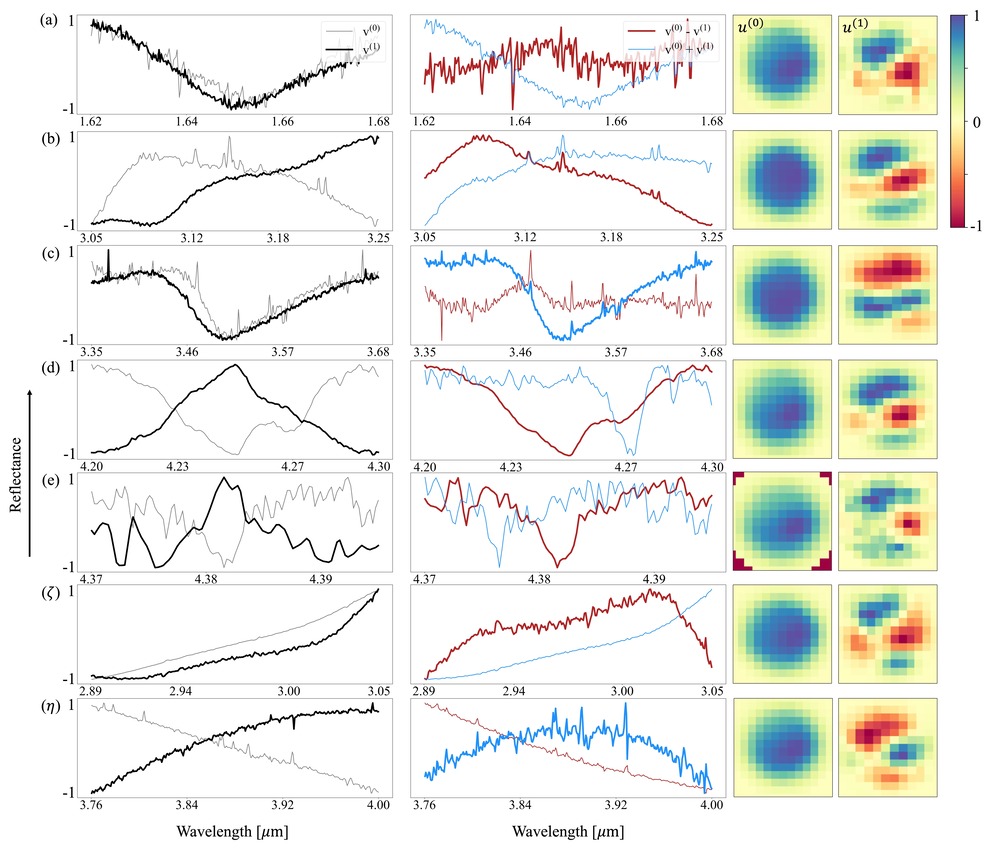
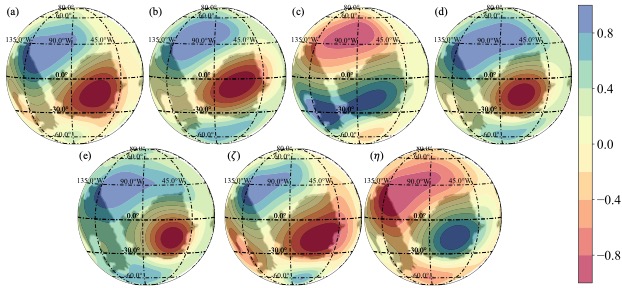
Figure 1. Spectral and spatial modes of seven spectral bands on Europa. Panels (a)–(e) correspond to the selected molecular bands: (a) 1.65 μm crystalline ice absorption band, (b) ~3.1 μm water ice Fresnel peak, (c) ~3.5 μm H₂O₂ absorption, (d) ~4.25 μm CO₂ doublet, and (e) ~4.38 μm ¹³CO₂ absorption. Two newly characterized broadband absorption features are labeled ζ and η. The zeroth- (mean) and first-order spectral modes, v(0) and v(1), are shown in gray and black, respectively, in the left panels. The sum and difference between these modes are shown in the middle panels (blue for sum, red for difference). The two right panels display the zeroth- and first-order spatial modes, u(0) and u(1), respectively.

Figure 2. Qualitative projections of best-fit spherical harmonic models for the first-order spatial modes, u(1), associated with five molecular bands (labeled a–e) and two broadband continuum features (labeled ζ and η), overplotted on a binary mask of Tara and Powys Regiones (black).

The first-order principal spectra, v(1), extracted from each band isolate the dominant sources of reflectance variability across Europa’s leading hemisphere. Each mode captures a clear, physically interpretable spectral deviation from the mean profile. In the 1.65 μm water ice band, the principal spectrum reflects variations in band depth and symmetry, consistent with disordered ice with lesser bulk crystallinity. The 3.1 μm Fresnel peak's principal spectrum reflects a transition between amorphous and crystalline phases at the surface (Hansen and McCord, 2004). In the hydrogen peroxide band, v(1) reveals broadening of the 3.5 μm feature, consistent with mixed ice phases (Giguerre and Harvey, 1959). Decomposition of the CO₂ bands shows that variability in the 4.25 μm doublet reflects shifts between disordered and crystalline CO₂ profiles, while variations in the 4.38 μm ¹³CO₂ feature primarily track abundance changes (Trumbo and Brown, 2023; Villanueva et al., 2023). The two broadband continuum features also exhibit simultaneous broadening, likely related to disordered and impure ice texture (Hansen and McCord, 2004).

Our results reveal a change in ice texture concentrated in southern Tara Regio, traced by the 1.65 μm crystalline ice band, the 3.1 μm Fresnel peak, and two broadened continuum features. These co-located signals point to porous, impure ice. The broadening of the 3.5 μm H₂O₂ band and the localized CO₂ enrichment further support this texture anomaly. Our modeling shows that persistent surface crystallinity in this region likely arises from porosity rather than a thermal anomaly (Thelen et al., 2024). Since porous ice enhances volatile retention (Baragiola et al., 2003), these findings suggest that apparent surface "freshness" may thus reflect structural preservation rather than recent exposure, essential for interpreting Europa’s spectral and habitability signatures.

References

Baragiola, R. A. (2003). Planet. Space Sci., 51, 953–961.

Böker, T. et al. (2022). Astron. Astrophys., 661, A82.

Carr, M. H. et al. (1998). Nature, 391, 363–365.

Chyba, C. F. et al. (2002). Orig. Life Evol. Biosph., 32, 47–67.

Hansen, G. B. et al. (2004). J. Geophys. Res. Planets, 109, E1.

Giguerre, P. and Harvey, K. (1959). Journal of Molecular Spectroscopy, 3, 36-45.

Nordheim, T. A. et al. (2022). Planet. Sci. J., 3, 5.

Trumbo, S. K. et al. (2023). Science, 381, 1308–1311.

Trumbo, S. K. et al. (2019). Astron. J., 158, 127.

Villanueva, G. L. et al. (2023). Science, 381, 1305–1308.

Wu, P. et al. (2024). Planet. Sci. J., 5, 220.

Thelen, A. et al. (2024). Planet. Sci. J. 3, 56.


How to cite: Yoffe, G. and Shahaf, S.: Spectral decomposition reveals surface processes on Europa, EPSC-DPS Joint Meeting 2025, Helsinki, Finland, 7–13 Sep 2025, EPSC-DPS2025-1254, https://doi.org/10.5194/epsc-dps2025-1254, 2025.

10:06–10:18
|
EPSC-DPS2025-1816
|
ECP
|
On-site presentation
Benjamin Sharkey, Andrew Rivkin, Richard Cartwright, Bryan Holler, Joshua Emery, and Cristina Thomas

The irregular satellites of Jupiter are a swarm of small, asteroid-like objects in orbit from ~100-400 Jupiter radii from the planet. These objects are thought to have been captured after the planet formed, although their precise origins remain obscure. Previous results have found the Jovian irregular satellites to contain a wide abundance of materials, suggestive of complex parent bodies that include peers amongst both the Jovian Trojans and the main belt. We will discuss mid-infrared observations taken of eight Jovian irregular satellites with JWST (~5-14 microns), with particular comparison to previous MIR observations of Jovian Trojan asteroids, main belt asteroids, and in light of recent near-infrared spectroscopy also collected as part of this program. By modeling the combination of both satellites' reflected sunlight and thermal emission, we will discuss improved constraints on the sizes, albedos, and textural properties of our sample.

How to cite: Sharkey, B., Rivkin, A., Cartwright, R., Holler, B., Emery, J., and Thomas, C.: The Jovian Irregular Satellites with MIRI LRS, EPSC-DPS Joint Meeting 2025, Helsinki, Finland, 7–13 Sep 2025, EPSC-DPS2025-1816, https://doi.org/10.5194/epsc-dps2025-1816, 2025.

10:18–10:30
|
EPSC-DPS2025-909
|
On-site presentation
Michael Kelley, Silvia Protopapa, Cyrielle Opitom, Colin Snodgrass, Davide Farnocchia, Marco Micheli, Yanga Fernández, and Adam McKay

Comets are small solar system objects that undergo periods of mass-loss (activity) due to insolation-driven sublimation.  When a comet is active, surface and near-surface material is ejected from the nucleus and made available for study in a rarefied environment.  Thus, cometary mass-loss provides a window into the bulk composition of cometary nuclei.  However, activity often precludes direct characterization of their surfaces.  Yet, spectra of cometary nuclei are invaluable, as they can be directly compared to trans-Neptunian objects, centaurs, etc., providing key insights into how environmental factors shape the observable properties of primitive bodies. To date, surface spectroscopy has only been achieved for a handful of comets, primarily Jupiter-family comets such as 67P/Churyumov–Gerasimenko and 9P/Tempel 1 (e.g., Sunshine et al. 2006; Barucci et al. 2016), the best of which were obtained through dedicated spacecraft missions.

With the advent of JWST, we now have the capability to directly observe the surfaces of many cometary nuclei at distances where their activities have stopped.  This even includes long-period comets, such as the subject of our presentation here: great comet C/1995 O1 (Hale-Bopp). Hale-Bopp is a long-period comet originating from the Oort Cloud, which passed perihelion in 1997, at a distance of 0.9 au from the Sun.  It was one of the brightest and best-observed comets of the 20th century, largely owing to the size of the nucleus.  The comet is notable for having a higher than typical CO/H2O coma mixing ratio, even for Oort cloud comets (Harrington Pinto et al. 2023).   It remained active out to 27 au, likely driven by CO sublimation (Szabó et al. 2012; Kramer et al. 2014), beyond which only a point-source nucleus has been detected.

With Hale-Bopp’s activity apparently ceased, the spectroscopic study of a large CO-rich nucleus has been made possible.  We used JWST's NIRSpec and NIRCam instruments to characterize its nuclear surface at 46 au from the Sun.  Analysis of the NIRCam data show no evidence for activity.  The low resolution NIRSpec spectrum from 0.8 to 4 μm shows evidence for surface water ice through diagnostic features at 1.5, 2.0, and 3 μm (Mastrapa et al. 2009).  The clear detection of water ice is in stark contrast to the minimal (<1% by surface area) water ice coverage seen by spacecraft visits to Jupiter-family comets, but has more in common with recent JWST spectra of TNOs (Pinilla Alonso et al. 2025).  An apparent absorption feature at 3.4 to 3.5 μm suggests the presence of C–H bearing organics, but the low spectral resolution may preclude precise identifications.  The 4 to 5 μm spectrum lacks emission features from CO2 and CO gases.  Despite the warm temperatures suffered by the comet in the inner-solar system, the nucleus surface is not desiccated, but remains enriched with water ice, likely due to continued mass-loss outside of the water sublimation zone.  We argue that the canonical 4% visual albedo may not be appropriate for distant observations of returning long-period comets.  These data offer a fascinating point of comparison to trans-Neptunian objects and centaurs, bodies with similar origins but markedly different dynamical and thermal histories.

Support for this work was provided by NASA through a grant from the Space Telescope Science Institute, which is operated by the Association of Universities for Research in Astronomy, Inc., under NASA contract NAS 5-03127.

How to cite: Kelley, M., Protopapa, S., Opitom, C., Snodgrass, C., Farnocchia, D., Micheli, M., Fernández, Y., and McKay, A.: The Icy Surface of Great Comet Hale-Bopp at 46 au as Revealed by JWST, EPSC-DPS Joint Meeting 2025, Helsinki, Finland, 7–13 Sep 2025, EPSC-DPS2025-909, https://doi.org/10.5194/epsc-dps2025-909, 2025.

Orals THU-OB3: Thu, 11 Sep, 11:00–12:30 | Room Mercury (Veranda 4)

Chairpersons: Stefanie Milam, Heidi Hammel
JWST Small Bodies
11:00–11:12
|
EPSC-DPS2025-419
|
On-site presentation
Michael Brown, Samantha Trumbo, and Swaroop Chandra

Deuterated water is a powerful tracer of the inheritance of unprocessed interstellar ice in planetary systems, giving a window into how interstellar ices, organics, and dust are directly incorporated into the outer regions of disks. In our own protoplanetary nebula, unprocessed dust grains delivered from cold molecular clouds could have carried water ice with a D/H ratio enriched by orders of magnitude above the bulk solar system. Direct incorporation of this ice into growing bodies in the outer solar system would lead to the unmistakable isotopic signature of the presence of interstellar ices in our planetary system

Unfortunately, attempts to accurately measure the D/H in water ice from the icy outer solar system beyond the giant planets have yielded inconsistent results. D/H can be measured in multiple species in cometary coma as the comets arrive into the inner solar system, but the comets measured have been found to have D/H ranging from the terrestrial value to enrichments by about a factor of 4, sometimes within the same comet. The sublimation and jetting processes active on these rapidly heating comets could lead to strong fractionation effects that could easily change D/H measured in the gaseous coma, making any interpretation of the values difficult.

Measuring D/H of water ice in the solid phase on the surface of cold distant inactive objects should give results significantly less affected by fractionation effects and could finally reveal the true D/H on objects in the outer solar system. JWST observations have now demonstrated that deuterated water can be directly detected via the 4.13 µm O-D stretch (analogous to the 3 μm O-H stretch), leading to the promise of detections of deuterated water through the outer solar system.

We examine all JWST data in which the 4.13 µm feature of deuterated water might be present, including the satellites and rings of Saturn, the satellites of Uranus, and Centaurs and Kuiper belt objects. We present detections or upper limits to the detections of these lines on objects throughout the solar system.

Converting the detections of the 4.13 μm absorption to a D/H ratio requires significant laboratory calibration and validation. We describe our current progress on this task.

How to cite: Brown, M., Trumbo, S., and Chandra, S.: Deuterated Water in the Outer Solar System, EPSC-DPS Joint Meeting 2025, Helsinki, Finland, 7–13 Sep 2025, EPSC-DPS2025-419, https://doi.org/10.5194/epsc-dps2025-419, 2025.

11:12–11:24
|
EPSC-DPS2025-521
|
On-site presentation
Olivier Mousis, Aaron Werlen, Tom Benest Couzinou, and Antoine Schneeberger

Deuterium, a heavy isotope of hydrogen, serves as a vital tracer in understanding the formation and evolution of the Solar System. Recent observations by the James Webb Space Telescope (JWST) have significantly expanded the dataset of D/H ratios in methane on the Kuiper Belt Objects (KBOs) Eris and Makemake, offering new insights into their chemical composition and origins. Our study explores the elevated D/H ratios in methane on these distant bodies, placing the findings within the broader context of protosolar nebula dynamics and chemistry. We propose that the methane on these KBOs has a primordial origin, challenging previous hypotheses that suggested abiotic methane production through internal heating processes.

To test this hypothesis, we employed a time-dependent protoplanetary disk model, integrated with a deuterium chemistry module to simulate the isotopic exchange between methane and hydrogen in the gas phase of the protosolar nebula. By incorporating observational constraints, such as the D/H ratio measured in methane in comet 67P/Churyumov-Gerasimenko, we refined our understanding of the primordial D/H abundance that would have been incorporated into the methane during its formation.

The results of the simulations indicate that the observed D/H ratios in methane on Eris and Makemake align well with a primordial origin. Our findings suggest that methane on these KBOs likely originated in the protosolar nebula and was sequestered in solid forms, such as pure condensates or clathrates, within the building blocks of these bodies before their accretion. These results provide a straightforward and plausible explanation for the high D/H ratios observed in methane on Eris and Makemake, without necessitating the complex internal production mechanisms previously proposed.

This work contributes to our understanding of the chemical processes in the early Solar System, suggesting that the chemical signatures preserved in the methane of KBOs are remnants of the primordial material from which the outer Solar System bodies formed.

How to cite: Mousis, O., Werlen, A., Benest Couzinou, T., and Schneeberger, A.: Insight into the Primordial Origins of Methane on Eris and Makemake from D/H Ratios, EPSC-DPS Joint Meeting 2025, Helsinki, Finland, 7–13 Sep 2025, EPSC-DPS2025-521, https://doi.org/10.5194/epsc-dps2025-521, 2025.

11:24–11:39
|
EPSC-DPS2025-1132
|
ECP
|
On-site presentation
Marielle Eduardo, Anastasia Morgan, Wesley Fraser, David Trilling, Gary Bernstein, Matthew Holman, John Stansberry, Bryan HIlbert, Will Grundy, and Kevin Napier

Trans-Neptunian Objects (TNOs), which are the small bodies beyond the orbit of Neptune, are regarded to be the most primitive members of the Solar System, and as such, provides valuable insights into both history and the current state of the outer Solar System.

Their size distribution (SD), which can be inferred from their observed magnitude distributions, has remained relatively unaltered since the formation of the Solar System. This physical property is crucial for testing theoretical models of planet formation because it reflects the outcomes of accretion, collisional processes, and dynamical evolution over the history of the Solar System [1]. Therefore, comparing the observed size distribution with those predicted by models helps to constrain the proposed physical processes and underlying initial conditions that shaped the current Solar System. However, the relative faintness and distance of TNOs limits ground-based searches to only about m(r)~27 magnitude [2], while the lack of observations on the SD of TNOs smaller than m(r)~28 (D~20km) leaves theoretical models poorly constrained [3,4].

Using images obtained from our JWST Cycle 1 program #1568 we searched for ultra-faint TNOs to further constrain planet formation models. With this program’s NIRCam images, and simultaneous HST imaging, we detect and characterize TNOs as faint as m(r)~29.8 mag and as small as ~7 km (assuming 15% albedo) in diameter to explore never-before probed regions of the TNO size distribution. This is by far the deepest Solar System survey to date, with at least a visible magnitude deeper than the landmark survey by Bernstein et al. (2004) that used the Hubble Space Telescope (HST). 

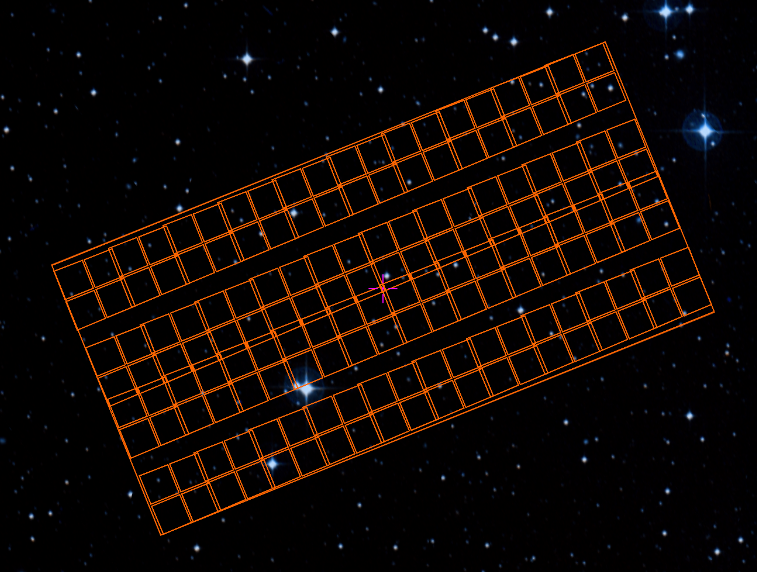
Program #1568 is a 3-epoch pencil beam sky survey conducted using NIRCam filters with effective wavelengths of ~1.5µm (F150W2) and 3.2µm (F322W2), centered  on a region of the sky near 13h RA, -10° Dec. The observations are near the ecliptic plane, where the sky density of cold classical TNOs is maximal.  The observations were taken from Jan 24 - Feb 4, 2023, at solar elongation of ~100 degrees, where the TNOs are near their turnaround points and are least likely to move off of the NIRCAM field of view. Figure 1 shows the observation layout of this program. A deep combined background image is subtracted from individual exposures, which are then digitally tracked and stacked at different rates of motion to search for TNOs.

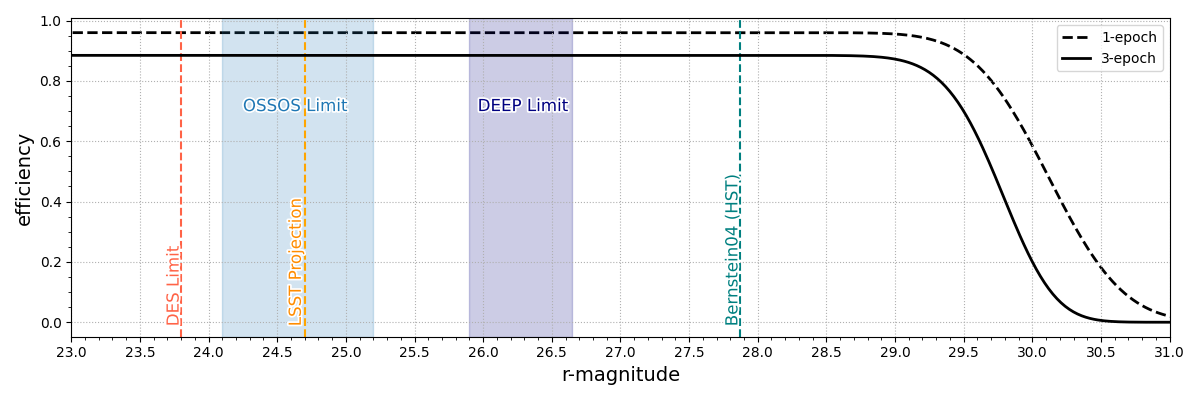
The probability with which a TNO will be detected as a good track during a single epoch, whether it falls on a detector during both dithers, is quantified using the implanted artificial moving objects.  It is well fit by the functional form , with the bright-end efficiency p0=0.96, the magnitude of half that efficiency at m0=28.92 (F150W2), and transition width w = 0.61 mag (see Figure 2).
We present our preliminary set of candidate sources detected with a total SNR of 15. By constraining their orbital parameters, we measure the faint end of the luminosity function for both the dynamically cold and hot components, and present their implications to the TNO SD down to diameters of 7 km. In future work, we will conduct a detailed analysis to determine which functional form of the size distribution best characterizes the observed population. This will offer deeper insights into the physical mechanisms governing the formation and evolution of the cold and hot populations, as well as the Kuiper Belt as a whole.


Figures:

Figure 1. Observation footprints of the survey, consisting of 10×2 mosaic tiles. Each tile was observed with eight short-wavelength detectors (small squares with a 64″×64″ FOV) and two long-wavelength detectors, each equivalent in size to four short-wavelength detectors, covering 129″ × 129″. Two exposures were taken at each of the 20 mosaic tiles. Each of the two exposures consisted of three 215s integrations, and were acquired at dither positions  <1" apart. The total exposure time per tile was thus 1290 sec.


Figure 2. Recovery efficiency for implanted sources in the JWST survey as a function of r-band magnitude, assuming a nominal color r-F150W2=~ 1.2 mag. The dashed curve represents the efficiency from a single-epoch observation, while the solid black curve shows the cube of the upper completeness function, which is the expected probability of detection in all three epochs, and agrees with the implant results. The vertical lines represent the (range of) 50% completeness levels in several previous and upcoming TNO surveys: DES [6], OSSOS [7], LSST [8], DEEP [4] and [5]. This plot was inspired from Figure 10 of [4].


References: 

[1] Fraser, W. C., Brown, M. E., Morbidelli, A., Parker, A., & Batygin, K. 2014, Astrophys J, 782, 100 [2] Fraser, W. C., & Kavelaars, J. J. 2009, Astron J, 137, 72 

[3] Kavelaars, J. J., Petit, J.-M., Gladman, B., et al. 2021, Astrophys J Lett, 920, L28

[4] Napier, K. J., Lin, H. W., Gerdes, D. W., et al. 2024, Planet Sci J, 5 (IOP Publishing), 50

[5] Bernstein, G. M., Trilling, D. E., Allen, R. L., Brown, M. E., & Holman, M. 2004, 128

[6] Bernardinelli, P. H., Bernstein, G. M., Sako, M., Yanny, B., Aguena, M., et al. 2022, ApJS, 258, 41.

[7] Bannister, M. T., Gladman, B. J., Kavelaars, J. J., et al. 2018, ApJS, 236, 18

[8] Ivezić, Ž., Kahn, S. M., Tyson, J. A., et al. 2019, ApJ, 873, 111

How to cite: Eduardo, M., Morgan, A., Fraser, W., Trilling, D., Bernstein, G., Holman, M., Stansberry, J., HIlbert, B., Grundy, W., and Napier, K.: The Luminosity Function Of Ultra-Faint Trans-Neptunian Objects Detected By James Webb Space Telescope, EPSC-DPS Joint Meeting 2025, Helsinki, Finland, 7–13 Sep 2025, EPSC-DPS2025-1132, https://doi.org/10.5194/epsc-dps2025-1132, 2025.

11:39–11:51
|
EPSC-DPS2025-1796
|
On-site presentation
Noemi Pinilla-Alonso, Rosario Brunetto, John Stansberry, Bryan Holler, Heidi Hammel, Jonathan I. Lunine, Dean C. Hines, and Stefanie Milam and the DiSCo & GTO-KBO Teams

The launch of the James Webb Space Telescope (JWST) marked the beginning of a new era in the understanding of our solar system and of planetary systems around other stars, whether they are mature or still in the process of formation. With its unprecedented sensitivity in the infrared, JWST’s spectroscopic instruments have proven to be uniquely suited for identifying and characterizing the fundamental ingredients required to form icy worlds—both those orbiting the giant planets in our solar system and the vast, distant population of trans-Neptunian objects (TNOs), which are believed to be the source of most short-period comets.

In its first year of operations, JWST has delivered the most comprehensive and homogeneous collection of spectra of TNOs to date, thanks to two key programs: DiSCo (Discovering the Surface Composition of TNOs Pinilla-Alonso et al. 2025, Licandro et al. 2025, Brunetto et al. 2025, Henault et al. 2024, De Pra et al. 2025) and the GTO-KBO program (Emery et al. 2024, Grundy et al. 2024, Glein et al. 2024, Pinilla-Alonso et al. 2024). These spectra span a wide range of object types—from small, apparently inactive Centaurs to the larger, cometary-like ones like Chiron, and from small (~100 km) TNOs to the largest known dwarf planets (Eris, Makemake, Haumea). The study of this dataset, combined with results from other targeted programs in cycles 2 to 4, reveals that the current surface composition of TNOs largely reflects the primordial materials that formed planetesimals before the dynamical dispersal of the trans-Neptunian region. Among these materials, three ices, coexisting with silicates and complex organic matter, emerge as the most influential in shaping the surface chemistry of TNOs: water ice, carbon dioxide ice, and methanol.

Furthermore, JWST observations are helping to disentangle long-standing questions about the colors of TNOs observed in visible-light photometry. The spectral evidence now indicates that these colors are more closely influenced to refractory materials—such as silicates and complex organic compounds—than to the presence or absence of surface ices. Importantly, these refractory components are not uniformly distributed across the TNO population, pointing to complex histories of thermal processing, irradiation, and surface renewal.

These discoveries also resonate beyond our solar system. JWST has begun to unveil the mineral and volatile composition of exoplanetary systems, including the detection of silicate clouds in hot-Jupiter atmospheres and the presence of ices and complex organics in debris and protoplanetary disks. By comparing the early building blocks of icy bodies in our solar system to the materials observed in other planetary systems, we gain crucial insight into the universality—or uniqueness—of the processes that led to planet formation.

In this context, the James Webb Space Telescope has also provided groundbreaking evidence of frozen water in the debris disk surrounding the young star HD 181327, located 155 light-years away (Chen et al. 2025). Researchers have recently confirmed the presence of crystalline water ice within this disk, directly linking the formation of icy bodies to the broader processes of planetary system evolution. This crystalline ice, also found in our Solar System’s Kuiper Belt and Saturn’s rings, exists alongside fine dust particles, forming tiny “dirty snowballs.” Webb’s sensitive instruments detected over 20% water ice in the outer regions of the debris disk, confirming the vital role of water ice in shaping the chemical environment of young planetary systems. The detection of water ice in these disks is essential for understanding the formation of gas giants and the delivery of volatiles, like water, to rocky planets, thus providing a deeper understanding of planetary evolution both within and beyond our own solar system.

In this talk, we will highlight the most significant JWST findings related to the solar system, particularly TNOs, and discuss how these results complement and inform our understanding of planetary formation and evolution in extrasolar systems.

References

Grundy et al. 2024 Icarus, Volume 411, article id. 115923

Glein et al. 2024, Icarus, Volume 412, article id. 115999

Emery et al. 2024 Icarus, Volume 414, article id. 116017

Pinilla-Alonso et al. 2024, Astronomy & Astrophysics, Volume 692, id.L11

Pinilla-Alonso et al. 2025, Nature Astronomy, Volume 9, p. 230-244

Licandro et al. 2025, Nature Astronomy, Volume 9, p. 245-251

De Prá et al. 2025, Nature Astronomy, Volume 9, p. 252-261

Henault et al. 2025,  Astronomy & Astrophysics, Volume 694, id.A126

Brunetto et al. 2025, The Astrophysical Journal Letters, Volume 982, Issue 1, id.L8

Chen et al. 2025, Nature accepted (Publication date May 15 2025)

How to cite: Pinilla-Alonso, N., Brunetto, R., Stansberry, J., Holler, B., Hammel, H., Lunine, J. I., Hines, D. C., and Milam, S. and the DiSCo & GTO-KBO Teams: JWST marks a new era in the exploration of ices and dust in our Solar System and beyond, EPSC-DPS Joint Meeting 2025, Helsinki, Finland, 7–13 Sep 2025, EPSC-DPS2025-1796, https://doi.org/10.5194/epsc-dps2025-1796, 2025.

11:51–12:03
|
EPSC-DPS2025-1159
|
On-site presentation
Katherine de Kleer, Bethany L. Ehlmann, Ian Wong, François L.H. Tissot, Audrey Martin, Melissa D. Lane, Seth A. Jacobson, and Oliver King

The population of main belt asteroids includes both primitive Solar System bodies as well as the products of early planetesimal melting and differentiation. The surface compositions of these objects shed light on their origins and evolutionary histories. The mid-infrared (mid-IR; ~5-30 microns) spectral range covers emissivity features diagnostic of silicate composition, including the olivine/pyroxene ratio and the Mg/Fe content of the minerals. In addition, mid-IR spectroscopy enables constraints on regolith properties such as particle size and regolith porosity.

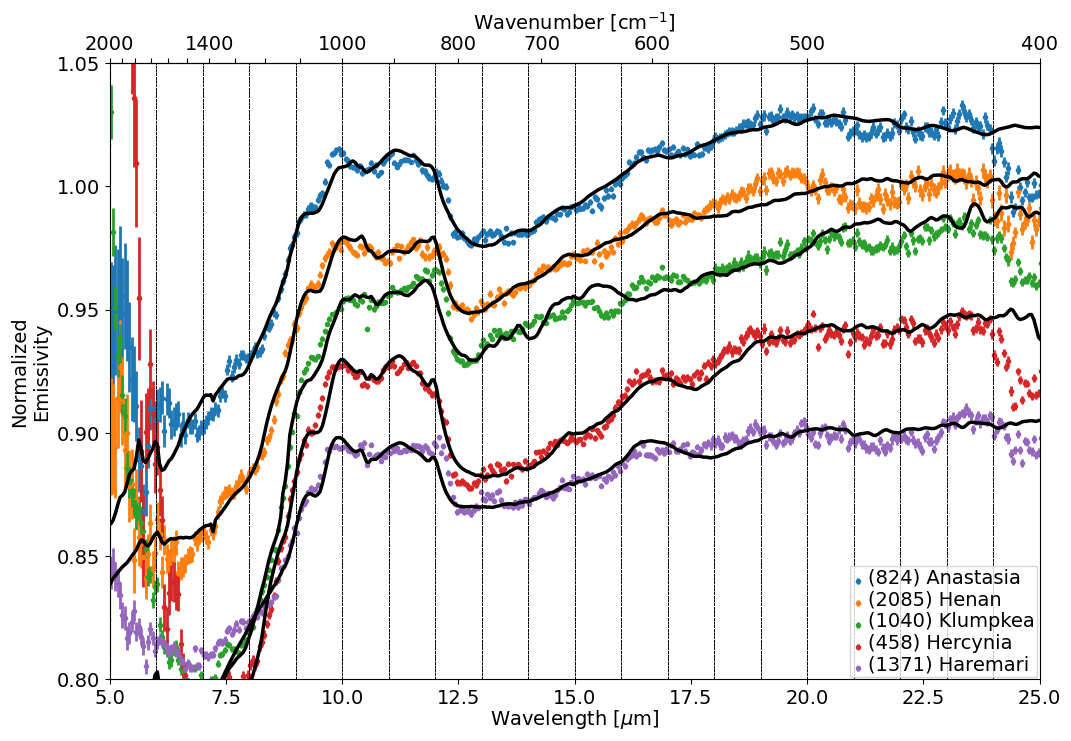
We present James Webb Space Telescope (JWST) spectra of 14 main belt asteroids observed over 5-25 microns with the MIRI/MRS instrument, complementing existing visible and near-infrared (near-IR; ~0.7-5 microns) spectra. Our targets include five members of the spinel-rich “Barbarian” L-type class (Figure 1) and nine members of the nominally metal-rich M-type asteroids. All objects show distinctive emissivity features in their spectra; these include the commonly studied ~8-12 micron emissivity “plateau”, but also include features across the 12-24 micron region that can be key to compositional determination, as well as features at 5-8 microns.

We investigate the composition of these objects using laboratory databases of minerals and meteorites across a range of particle sizes and regolith porosities. Mid-IR spectra reveal the presence of silicate minerals that are sometimes undetectable from near-IR spectra alone. For our targets, each wavelength regime is most sensitive to specific surface constituents, and combined data across the visible through thermal wavelengths is needed to provide a more comprehensive picture of the full surface composition. We will present the surface compositions and closest meteorite analogs to the objects that were observed with JWST, and discuss what our findings reveal about the asteroid origins.

Only laboratory spectra of very small particles (<30 microns) with high regolith porosities (>80%, and sometimes even >95%), as simulated with mixtures of IR-transparent potassium bromide (KBr), are able to match the general shape of the asteroid spectra. The spectral comparison therefore indicates that the surfaces of the asteroids in our study, which are tens of kilometers in size, are overlain with a very fine, porous regolith layer. This characteristic emphasizes the need for laboratory spectral databases of meteorites and minerals that include KBr to simulate regolith porosity, and/or the development of modeling approaches that can simulate these very high regolith porosities, which standard Mie theory + Hapke modeling approaches do not reproduce well.

Figure 1: JWST emissivity spectra of five L-type asteroids (colored points), with best-fit laboratory mixtures overlain (black curves). In all cases, the best-fit lab mixtures indicate surfaces composed predominantly of small-particle (<30 micron), porous (~85-97% porosity), crystalline Mg-rich (Fo80-100) olivine. In four out of five cases, the laboratory mixtures shown here are dominated by CV3 chondrite material, as measured in the lab by Izawa et al. (2021) and Dausend et al. (2025).

References

Dausend, M.D., Martin, A.C., Emery, J.P. 2025. PSJ, 6, 54.

Izawa, M.R.M., King, P.L. Vernazza, P., Berger, J.A., McCutcheon, W.A. 2021. Icarus 359, 114328.

How to cite: de Kleer, K., Ehlmann, B. L., Wong, I., Tissot, F. L. H., Martin, A., Lane, M. D., Jacobson, S. A., and King, O.: Surface texture and mineralogy of main belt asteroids from JWST mid-infrared spectroscopy, EPSC-DPS Joint Meeting 2025, Helsinki, Finland, 7–13 Sep 2025, EPSC-DPS2025-1159, https://doi.org/10.5194/epsc-dps2025-1159, 2025.

12:03–12:15
|
EPSC-DPS2025-1062
|
ECP
|
On-site presentation
Alicia Allen, David Trilling, John Stansberry, Bryan Hilbert, Ryder Strauss, Cristina Thomas, Bryan Holler, Michael Mueller, and Andrew Rivkin


1.    Introduction

Asteroids are remnants which provide insight into the chemical and dynamical history of the early solar system. The origin and evolution of water in our solar system is of interest in planetary science, exoplanetary studies, astrobiology, and cosmochemistry, as well as to the general public, as water on Earth allowed for evolution of life. When observing in the near-infrared (NIR), hydration is indicated by a feature around 3.0 𝜇m [1]. It is difficult to identify hydration on most Main-Belt asteroids (MBAs) from ground-based telescopes, as telluric atmospheric water makes this wavelength region nearly opaque.

Two asteroid types, primitive carbonaceous C-types, and siliceous S-types, comprise ~90% of all asteroid taxonomies. C- and S-type asteroids formed in distinct regions of the solar system, where S-types formed closer to the Sun and experienced more heating, and C-types formed farther out [2]. Due to these formation locations, if C-types accreted water, their locations beyond the frost line would have allowed them to retain water ice [3,4,5]. In this work, we use JWST to observe MBAs at 3.0 𝜇m, giving us a glimpse into the current distribution of water in the Main Asteroid Belt.     


2.    Methods

2.1    Data Acquisition

The data for this work was obtained in JWST Cycle 1 pure parallel program #2211 (PI: Trilling) that was designed to obtain NIRCam (Near-Infrared Camera) data alongside pointings from various other programs within 15° of the ecliptic. These serendipitously detected asteroids were observed in three filters (1.5, 2.0, and 2.7-𝜇m) over approximately 40 hours of observing time. The JWST calibration pipeline flags MBAs as spurious with respect to the primary target, removing them from the final science image. However, because the data are collected in a read-up-the-ramp (RUTR) method, we can detect asteroids in locations where there is a jump in detected flux. Pulling the pixels with a jump flag, we created a binary image (Figure 1), where the streaks across the image are the asteroids captured. This allows us to measure the asteroid brightness at the correct time for each pixel.


Figure 1  A portion of a binary image created using the jump detection flags. The yellow represents all the pixels with detected jumps in flux. The green ellipses highlight the asteroids caught in the image, appearing as streaks as they move across the FOV.


2.2    Photometry and Colors

We tested our asteroid detection methods using MIRAGE1 (Multi-Instrument RAmp GEnerator) simulated JWST data and implanted asteroids. We will also use MIRAGE data to determine how to best extract the asteroid photometric information. Several methods will be tested for estimating the asteroid fluxes, and the most accurate method(s) will be used on all MBAs captured. Determining the [F150W]–[F200W] color distinguishes between S-type and C-type asteroids, and the [F200W]–[F277W]  identifies if a 3.0 𝜇m hydration feature is present (Figure 2, 3).

Figure 2  A diagram of the color–color analysis. The x-axis is the [F150W]–[F200W] color, which identifies the asteroid type. The y-axis is the [F200W]–[F277W] color, which determines hydration. C-types are in blue and S-types in red. Small diamonds represent an asteroid with no 3.0 𝜇m feature and large diamonds represent an asteroid with a large 3.0 𝜇m feature. The yellow dot is the solar color.


Figure 3  The reflectance in the NIR for synthetic S-type (red) and C-type (blue) asteroids [6] extrapolated with meteorite spectra with (solid) and without (dashed) hydration features [7]. The shaded gray regions are the bandpasses for the 1.5, 2.0, and 2.7–𝜇m filters used. The cyan regions are the double-wide NIRCam filters, which are too wide to be used here. The orange curves show the thermal emission for objects at 250K (thick) and 200K (thin).  


3.    Expected Results

Our methods have been able to capture ~20 MBAs per pointing. We expect that >60% of the C-type asteroids will have hydration features [8], while a small percentage of S-type asteroids will have these features [9]. The spectral feature at 3.0 𝜇m is caused by a vibrational frequency of the hydrogen–oxygen bond, therefore it can be from water ice, hydrated minerals, OH from solar wind, or a combination. We make the assumption that hydration features identified on S-types are likely a result of solar wind implantation [9]. To determine the origin of hydration features on C-types, we will use detailed 3.0 𝜇m spectra of asteroids with known hydration features as a proxy for comparison. Performing a color–color analysis of these asteroids will allow us to determine which of our C-types contain water ice. 


4.    Scientific Implications 

JWST is successful at examining the 3.0 𝜇m region of MBAs. The limiting magnitude of JWST can observe MBAs of smaller sizes than ever before (d~100m), therefore many of the asteroids captured here will be new discoveries. This work will allow us to understand the distribution of water in the Main Belt, and the distribution of hydration among C-type and S-type asteroids. Since the Main Belt is the primary reservoir from which objects enter near-Earth space, the presence of water ice and hydrated minerals on MBAs supports that Earth’s water was delivered via an impact, subsequently giving rise to life.


References

[1] Baratta et al. 1991, Astronomy & Astrophysics, 252, 421

 [2] Gradie & Tedesco 1982, Science, 216, 1405

 [3] Takir & Emery 2012, Icarus, 219, 641

 [4] Rivkin et al. 2015, Asteroids IV

 [5] Rivkin et al. 2022, PSJ, 3, 153

 [6] DeMeo et al. 2009, Icarus, 202, 160

 [7] Takir et al. 2013, MPS, 48, 1618

 [8] Rivkin 2012, Icarus, 221, 744

 [9] McGraw et al. 2022, PSJ, 3, 243


   https://mirage-data-simulator.readthedocs.io/en/latest/index.html 


How to cite: Allen, A., Trilling, D., Stansberry, J., Hilbert, B., Strauss, R., Thomas, C., Holler, B., Mueller, M., and Rivkin, A.: Identifying Water Ice in the Asteroid Belt with JWST, EPSC-DPS Joint Meeting 2025, Helsinki, Finland, 7–13 Sep 2025, EPSC-DPS2025-1062, https://doi.org/10.5194/epsc-dps2025-1062, 2025.

12:15–12:27
|
EPSC-DPS2025-897
|
ECP
|
On-site presentation
John Noonan, Henry Hsieh, Michael S. P. Kelley, and Dennis Bodewits

The recent detection of water vapor sublimation from objects in the asteroid belt, a region that should be devoid of any natal ice, challenges existing models of thermal evolution in the inner solar system. Prior to the launch of JWST, the assessment of cometary activity for the main belt comets (MBCs) was driven by observations of the surrounding dust coma, where water production rates were estimated, but never directly detected, despite numerous attempts to do so using the world’s most powerful telescopes. The exceptional sensitivity of the JWST NIRSpec instrument has now made it possible to measure gas-phase volatiles from MBCs, providing the first definitive evidence of ongoing sublimation in this population. However, the sample size of MBCs with measured water production rates remains small, and each additional measurement (or constraint) on the production rates for additional objects will have a large effect on the interpretation of the uniformity of H2O as a source.

Following the water production rate measurements and CO,CO2, and CH3OH upper limits for 238P/Read (Kelley et al. 2023) and 358P/PANSTARRS (Hsieh et al. 2025) with JWST NIRCam and NIRSpec, we obtained observations of another MBC, 457P/Lemmon-PANSTARRS, on September 20, 2024. Unlike 238P and 358P, 457P is not associated with the Themis family of asteroids, but may have its own family (Xin et al. 2024), suggesting it could be compositionally different. Notably, we do not find evidence of H2O, or any other volatile emission, from 457P at the time of observation despite a clear sunward tail in the NIRCam images. We derive a 3σ H2O production rate upper limit well below that detected for 238P (<1025 molec./s), indicating a significant difference in activity state during the observations. In this talk we will discuss the hypotheses for the observed state: recent global shutoffs, shadowing of an active region, mass wasting, and continuous low global activity levels. We will analyze how each mechanism would shape the observed activity and evaluate how well the dust abundance and morphology and volatile upper limits are fit by each unique hypothesis. Finally,  we will place our results in context with the detections from 238P and 358P to discuss the diversity of activity drivers among MBCs. 

How to cite: Noonan, J., Hsieh, H., S. P. Kelley, M., and Bodewits, D.: Emerging Diversity Among the Main Belt Comets:  JWST Observations of 457P/Lemmon-PanSTARRS, EPSC-DPS Joint Meeting 2025, Helsinki, Finland, 7–13 Sep 2025, EPSC-DPS2025-897, https://doi.org/10.5194/epsc-dps2025-897, 2025.

Posters: Thu, 11 Sep, 18:00–19:30 | Finlandia Hall foyer

Display time: Thu, 11 Sep, 08:30–19:30
F107
|
EPSC-DPS2025-278
|
ECP
|
On-site presentation
Tom Seccull and Robert Siverd

We present preliminary results from an ongoing project to assess whether or not the sun shield on JWST may serve as a practical solar calibrator source for ground-based spectroscopic observations of solar system objects. Although this idea may seem wild at first, various aspects of JWST's construction, orbit, and operation conspire to provide an always-visible, high-fidelity solar spectrum at roughly 16th magnitude, which is readily accessible to spectrographs on larger telescopes. We have conducted a multi-epoch observing campaign with SpeX (Rayner et al. 2003) at the NASA Infrared Telescope Facility to obtain low-resolution 0.7-2.5 micron spectra of JWST for direct comparison to contemporary spectra of solar twin calibrator stars (e.g. Ramírez et al. 2014) and main belt asteroids with well characterised reflectance spectra in the SMASS/MITHNEOS catalog (Binzel et al. 2001; Burbine & Binzel 2002). By analysing detections of JWST in survey data from the Asteroid Terrestrial-impact Last Alert System (ATLAS; Tonry et al. 2018), and by imaging it with IO:O at the Liverpool Telescope (Steele et al. 2004; Barnsley et al. 2016), we also place constraints on the variation of its visible brightness. Alongside our up-to-date analysis of JWST’s brightness variation we present a preliminary assessment of our attempts to use its reflectance spectrum to obtain an accurate and useful solar calibration spectrum. Finally, we outline our future plans for this project.

References
Barnsley et al. 2016, JATIS, 2, 015002
Binzel et al. 2001, Icarus, 151, 139
Burbine & Binzel 2002, Icarus, 159, 468
Ramírez et al. 2014, A&A, 572, A48
Rayner et al. 2003, PASP, 115, 362
Steele et al. 2004, Proc. SPIE, 5489, 679
Tonry et al. 2018, PASP, 139, 478

How to cite: Seccull, T. and Siverd, R.: JWST: A Midnight Sun for Planetary Astronomers?, EPSC-DPS Joint Meeting 2025, Helsinki, Finland, 7–13 Sep 2025, EPSC-DPS2025-278, https://doi.org/10.5194/epsc-dps2025-278, 2025.

F108
|
EPSC-DPS2025-622
|
On-site presentation
Giorgia Confortini, Camille Delarue, Bruno Reynard, and Christophe Sotin

JWST observations of TNOs up to 800 km in diameter show surface ices that include carbon-bearing species such as CO₂, CO, CH₃OH, and complex organic molecules (Pinilla-Alonso et al., 2024). Although surface compositions vary, no systematic trend with object size suggests these variations are dominated by surface processes. The surface compositions of larger TNOs display strong methane bands in addition to H₂O ice and CO₂ (Brown, 2012), and recent hydrogen and carbon isotopic measurements of CH₄ on Eris and Makemake by JWST suggest an internal origin for these species (Grundy et al., 2024). The bulk densities of icy moons and dwarf planets support the idea that their refractory cores contain a mixture of CI chondrite and carbonaceous material, reinforcing the idea that carbon-bearing molecules at their surfaces may originate from internal activity. Oxygen fugacity (fO₂) plays a crucial role in controlling the stability of carbonates, graphite, and associated mineral phases, governing carbon speciation and fluid composition in planetary interiors.

We studied the impact of carbon on the mineralogy of trans-Neptunian object (TNO) interiors. We model phase relations in the MgO–SiO₂–Fe–C–H₂ and MgO–SiO₂–CaO–Fe–C–H₂ systems across the P–T range of TNOs (300–1300 K, 1–7000 bar), using thermodynamic modeling with Perple_X (Connolly, 2005) and assuming CI elemental composition. The results reveal that at high fO₂, carbonates (magnesite, dolomite), water, and CO₂ are stable, whereas at lower fO₂, carbon is progressively reduced to graphite, with methane and hydrogen as the dominant volatiles. The stability fields of major species (CO2, H2O, CH4) in COH fluids are bounded by different oxygen fugacity buffers defined by the stability of various carbon-bearing mineral assemblages. Conversely, if fluid composition is fixed, for example by degradation reactions of carbonaceous matter, it will determine the mineral assemblages. Pressure does not significantly influence these transitions, whereas changes in oxygen fugacity and temperature strongly affect the gas species released from the mineral assemblage into metamorphic fluids. Specifically, at high temperatures, reduced phases such as methane are stable, while at lower temperatures, oxidized species and CO₂ are favored. Thus, temperature and oxygen fugacity play a crucial role in controlling the nature of carbon-bearing phases in solids and in fluids that can reach the surface of TNOs.

The predicted metamorphic evolution of mineral assemblages shows that the internal composition is directly reflected in fluid composition, which may eventually reach the surface and atmosphere of TNOs. Small TNOs (typically <800 km in diameter) have cold cores and therefore high oxygen fugacity, supporting the idea of oxidized interiors where carbonates and CO₂ are stable. In contrast, large TNOs such as Eris, Makemake, and Pluto, with higher core temperatures and/or lower oxygen fugacity, likely host more reducing phases, leading to the release of reduced fluid species such as methane. Overall, these findings suggest that redox-driven transformations have significantly shaped the interiors and volatile emissions of icy, carbon-rich bodies in the outer solar system, influencing their potential habitability. These results are consistent with JWST and earlier spectroscopic observations suggesting that volatiles of internal origin contribute to present-day surface compositions. It is predicted that CH₄ should become increasingly dominant as TNO size increases, a hypothesis that will be tested further by upcoming JWST spectroscopic investigations of TNOs.

Acknowledgement

This work was supported by Institut National des Sciences de l'Univers through Programme National de Planétologie, by the Agence Nationale de la Recherche (ANR, project OSSO BUCO, ANR-23-CE49-0003) and by the European Union (ERC, PROMISES, project #101054470). Views and opinions expressed are, however, those of the authors only and do not necessarily reflect those of the European Union or the European Research Council. Neither the European Union nor the granting authority can be held responsible for them.

References:

Brown, M. E. (2012). The Compositions of Kuiper Belt Objects. Annual Review of Earth and Planetary Sciences, 40 (Volume 40, 2012), 467–494. https://doi.org/https://doi.org/10.1146/annurev-earth-042711-105352

Connolly, J. A. D. (2005). Computation of phase equilibria by linear programming: A tool for geodynamic modeling and its application to subduction zone decarbonation. Earth and Planetary Science Letters, 236(1–2), 524–541. https://doi.org/10.1016/j.epsl.2005.04.033

Grundy, W. M., Wong, I., Glein, C. R., Protopapa, S., Holler, B. J., Cook, J. C., Stansberry, J. A., Lunine, J. I., Parker, A. H., Hammel, H. B., Milam, S. N., Brunetto, R., Pinilla-Alonso, N., de Souza Feliciano, A. C., Emery, J. P., & Licandro, J. (2024). Measurement of D/H and 13C/12C ratios in methane ice on Eris and Makemake: Evidence for internal activity. Icarus, 411. https://doi.org/10.1016/j.icarus.2023.115923

Pinilla-Alonso, N., Brunetto, R., De Prá, M. N., Holler, B. J., Hénault, E., Feliciano, A. C. de S., Lorenzi, V., Pendleton, Y. J., Cruikshank, D. P., Müller, T. G., Stansberry, J. A., Emery, J. P., Schambeau, C. A., Licandro, J., Harvison, B., McClure, L., Guilbert-Lepoutre, A., Peixinho, N., Bannister, M. T., & Wong, I. (2024). A JWST/DiSCo-TNOs portrait of the primordial Solar System through its trans-Neptunian objects. Nature Astronomy. https://doi.org/10.1038/s41550-024-02433-2

How to cite: Confortini, G., Delarue, C., Reynard, B., and Sotin, C.: Thermodynamic modeling of metamorphic fluids supports internal source of carbon-bearing molecules at the surface of TNOs, EPSC-DPS Joint Meeting 2025, Helsinki, Finland, 7–13 Sep 2025, EPSC-DPS2025-622, https://doi.org/10.5194/epsc-dps2025-622, 2025.

F109
|
EPSC-DPS2025-651
|
On-site presentation
Leigh N. Fletcher, Luke Moore, Tom S. Stallard, Henrik Melin, Simon Toogood, Oliver R.T. King, Michael T. Roman, Jake Harkett, Heidi B. Hammel, Matthew Tiscareno, Stefanie Milam, and Mark Showalter

JWST’s infrared exploration of the Saturn system has been designed to extend the legacy of the Cassini-Huygens mission, using the exquisite sensitivity, spectral coverage, and spectral resolution of the integral field units (IFUs) to reveal new insights into the atmosphere, ionosphere, rings and moons.  Guaranteed-time programme GTO1247 used MIRI/MRS (4.9-28.5 µm) to explore Saturn’s seasonal circulation patterns during northern summer [1], and a combination of NIRSpec/IFU (1.8-5.3 µm) and MIRI/MRS to diagnose the icy composition of Saturn’s rings and small moons [2].  GTO1251 explored Titan’s atmosphere[3], GTO1250 revealed the extent of Enceladus’ watery plumes [4], while guest-observer programme GO3716 explored Saturn’s irregular satellites [5]. 

NIRCam Imaging (June 2023):  NIRCam observations of Saturn at 3.23 µm (GTO1247) reveal structures never-before-seen in Saturn’s upper atmosphere (Fig. 1). Observations in this strong methane absorption band, overlain by methane fluorescence, show diffuse patterns across the disc, with dark polar domains in the north and south in Fig. 2, a faint auroral oval in the north, and unexpected structure (patches of brightness and darkness) extending from the poles towards mid-latitudes suggesting high-altitude wave activity.  Conversely, images at 2.12 µm reveal bright reflection from polar hazes, with the northern hexagon (78oN) and ribbon wave (48oN) clearly visible, and small cyclones and anticyclones observed in both hemispheres.  Brightness gradients at 2.12 µm reveal the edges of Saturn’s bands (Fig. 2), coinciding with zonal jets measured by Cassini.  Intriguingly, zonally-averaged gradients at 3.23 µm also show peaks at the jet locations, suggesting that the winds provide zonal organisation to the 3.23 µm structure and that both stratospheric aerosols (sculpted by zonal winds) and CH4 fluorescence (likely independent of the winds) are contributing to the unusual appearance at 3.23 µm.

Figure 1 NIRCam images of Saturn at 3.23 µm (left, with rings saturated to show atmospheric detail) and 2.12 µm (right), acquired in GTO1247 in June 2023.


Figure 2 Polar projections of NIRCam data at 3.23 µm (top row) and 2.12 µm (bottom row), for northern and southern hemispheres.  The auroral oval is evident at 3.23 µm (top left); and small vortices, the hexagon and ribbon can be seen at 2.12 µm (bottom left).  Zonally-averaged brightnesses (and their poleward gradients) are shown on the right, compared to the locations of Saturn’s prograde jet peaks (vertical dashed lines).


NIRSpec Spectroscopy (November 2024):  Missing from the JWST Saturn observations of Cycles 1 and 2 was NIRSpec/IFU spectroscopy, without which it would be challenging to distinguish ionospheric emissions from H3+ or CH4 fluorescence from reflection from stratospheric hazes.  In Cycle 3, GO 5308 [6] acquired a full NIRSpec/IFU map of Saturn’s northern hemisphere poleward of 45oN, spanning 2.8-5.3 µm using the F290LP/G395H filter/grating.  Saturn was observed continuously between 04:00-13:58 UT on 29 November 2024 to observe all longitudes, resulting in 26 spectral cubes each constructed from four dithers.  Cubes were processed using a custom pipeline to reduce saturation and assign geometry [7], producing polar projections (Fig. 3) and zonally-averaged spectra (Fig. 4).


Results:  Combining the 2023 NIRCam observations with the 2024 NIRSpec observations, we observe the following:

  • Extratropical and Polar Belt/Zone structure: Zonal jets organise both reflectivity and thermal emission, even in the CH4 fluorescence band near 3.32 µm (sounding high altitude). Latitudinal banding at 5-µm is on a scale finer than the zonal jets, potentially due to different latitudinal distributions of at least two aerosol layers: an upper tropospheric haze p < 0.3 bars, and a deeper cloud layer at 1–2 bars.  Latitudinal gradients in aerosol opacity, phosphine, ammonia, and water, will be compared to the jet locations to search for evidence of vertical mixing on the scale of Saturn’s belts and zones. 
  • Polar Domain and Hexagon: As previously reported by MIRI/MRS in 2022 [1], NIRSpec shows that the north pole remains dark at 5 µm and surrounded by a cloud-free band of bright emission, consistent with its appearance in Cassini/VIMS observations in 2016 [8].  This latitudinal contrast prevents us from seeing Saturn’s hexagon (78oN) in thermal emission, but reflected sunlight near 2-3 µm clearly reveals the six vertices of the hexagon with a westward translation between 2023 and 2024.  These data are possibly our last view of the hexagon before it becomes hidden in autumn darkness after Saturn’s equinox (May 2025), and confirm that the hexagon has now existed for at least ~45 years (since discovery by Voyager).
  • Discrete Atmospheric Features: NIRCam (Fig. 2) reveals the presence of a long-lived cyclone-anticyclone pair (one dark, one bright) near 60-65oN that were also evident in Hubble observations in 2022-23.  The NIRSpec data at 3 µm (Fig. 3) reveal the same vortex pair near 60oN, 135oW in 2024.  In the southern hemisphere, NIRCam reveals reflective ovals near 44oS and 55oS that also appear to have persisted for several years (observed by Hubble as the south emerged from winter darkness).
  • Large-Scale Upper Atmospheric Structure: Both NIRCam and NIRSpec reveal significant longitudinal structure in the 3.2-3.3 µm range sensitive to high-altitude aerosols and CH4 fluorescence (Fig. 3-4). NIRSpec reveals at least four dark patches extending equatorward of the dark north polar domain, creating a wave-like appearance at mid-latitudes that has changed between 2023 and 2024.  NIRCam reveals hints of similar structure around the South Pole.  We will present spectral retrieval analyses to determine the likely origin (CH4 fluorescence, stratospheric hazes) for these unexpected structures.


Figure 3 Polar projections of NIRSpec data in November 2024, showing brightness (top row) and residual from the zonal mean (bottom row) at 5.1 µm (showing deep thermal emission), 3.0 µm (showing aerosol reflection), and 3.32 µm (a blend of CH4 fluorescence and aerosol reflection).


Figure 4 Zonally-averaged NIRSpec spectra at 55 and 75oN, with key gaseous absorptions (and fluorescent emission) labelled.


References

  • Fletcher et al., 2023, DOI: 10.1029/2023je007924.
  • Hedman et al., 2024, DOI: 10.1029/2023je008236.
  • Nixon et al., Nature Astronomy, 2025.
  • Villanueva et al., 2023, DOI: 10.1038/s41550-023-02009-6.
  • Belyakov and Brown, 2025, DOI: 10.48550/arXiv.2503.20046.
  • Moore et al., Hunting for the source of Saturn's atmospherically driven aurora. 2024. 5308.
  • King et al., 2023, DOI: 10.3847/2515-5172/ad045f.
  • Sromovsky et al., 2021, DOI: 10.1016/j.icarus.2021.114409.

How to cite: Fletcher, L. N., Moore, L., Stallard, T. S., Melin, H., Toogood, S., King, O. R. T., Roman, M. T., Harkett, J., Hammel, H. B., Tiscareno, M., Milam, S., and Showalter, M.: JWST NIRCam and NIRSpec Mapping of Bands, Waves, and Vortices in Saturn's Mid-Latitudes and Polar Domains, EPSC-DPS Joint Meeting 2025, Helsinki, Finland, 7–13 Sep 2025, EPSC-DPS2025-651, https://doi.org/10.5194/epsc-dps2025-651, 2025.

F110
|
EPSC-DPS2025-805
|
ECP
|
On-site presentation
Aidan O. Madden-Watson, Cristina A. Thomas, Christopher W. Haberle, Andrew S. Rivkin, Heidi B. Hammel, and Stefanie N. Milam

Asteroid (3200) Phaethon is a unique near-Earth asteroid with a perihelion of 0.14 AU. It experiences extreme temperatures exceeding 1000 °C during its close solar approaches. The asteroid follows a highly eccentric orbit (e ~ 0.89) and is notable as the parent body of the Geminid meteor shower (a rare case where its origins come from an asteroid rather than a comet [1]). Observations from the Solar Terrestrial Relations Observatory (STEREO) have shown sodium emissions from Phaethon at perihelion [2]. These emissions suggest that the asteroid’s surface undergoes active and potentially transformative processes under intense solar heating. Spectroscopic data from the NASA Infrared Telescope Facility (IRTF) and the James Webb Space Telescope (JWST) show no detectable 3-µm absorption feature, indicating that Phaethon’s surface is dehydrated [3][4]. Additionally, JWST GTO Program 1245 observed Phaethon with the Mid-Infrared Instrument (MIRI), providing insights into compositional properties in this wavelength region. This presentation will discuss in-depth research on Phaethon’s thermal history and surface evolution.

To model Spitzer IRS observations of (3200) Phaethon, Maclennan & Granvik (2024)[5] looked for meteorite analogs and corresponding minerals for the asteroid from the RELAB database[6]. Their work’s analysis suggests that CY carbonaceous chondrites are good meteorite analogs, with olivine samples of varying forsterite percentages as good mineral analogs. Starting materials for their linear mixing model were selected to represent primitive, aqueously altered compositions (carbonaceous chondrites) and minerals that are products of Phaethon’s thermal evolution (secondary olivine, enstatite). We build on this study with our higher resolution and signal-to-noise JWST MIRI data [4], starting with similar carbonaceous chondrites and olivine samples in our analysis.

The meteorite analog and olivine (fo40 to fo80) mid-infrared data from RELAB were compared to the collected asteroid spectrum to begin constraining the mineralogical signatures observed in the JWST MIRI data. Both qualitative and quantitative spectral matching techniques were applied, and the results indicate that CY carbonaceous chondrite Y-86720 [4] appears to be the best match to Phaethon’s mid-infrared spectrum (Fig. 1). In addition, fo68 was the best-fit match to the olivine present on the surface, which differs from the previously best-fit forsterite percentage found in the previously published work [5]. This is likely due to the SNR of our data allowing for viewing of specific features like those in the 17 micron region.

With these constraints, we used a linear mixing model to combine mineral spectra and compare to the MIRI spectrum. We use mineral spectra from the RELAB database, including minerals relevant to olivine hydration and thermal alteration pathways. Troilite (FeS) was included in the mixing model to account for potential sulfide phases, though its use was minimized in the fits as troilite is expected to become unstable and devolatilize at the temperatures that Phaethon reaches near perihelion [7]. A mean absolute error (MAE) calculation was performed across the wavelength range, providing a quantitative assessment of how effectively the model reproduced the mid-infrared spectra. This modeling approach was compared to previous efforts [5] that utilized the Spitzer spectrum. A diagnostic feature at 17.5 µm, corresponding to the Christensen feature associated with phyllosilicate vibrations, is notably flat in the JWST MIRI data. This behavior suggests a high degree of dehydration, as this diagnostic feature disappears with thermal alteration of the phyllosilicates. The updated JWST-based modeling (Fig. 2) provides a more refined view of Phaethon’s surface composition, indicating dehydration and thermal processing from experiencing the high temperatures with close passes to the Sun that was not fully captured by the Spitzer observations. The model analysis suggests that Phaethon’s surface likely includes enstatite and secondary olivine that would have formed alongside the enstatite during thermal processing.

We are also interested in how solar heating alters the asteroid’s surface and subsurface, as remote observations only give us surface-level data. To explore this, we employed a thermal conduction model (KRC) to simulate the diurnal and annual heating cycles. This allowed for examination of how deeply high temperatures penetrated into the asteroid’s subsurface. The takeaway from this work is that primitive and aqueously altered rock is likely not found too deep under the surface because such materials are less affected by the intense heat of perihelion. Our thermal models show a dropoff of temperature as two or three skin depths are passed.

We will present our in-depth research into Phaethon’s mid-infrared spectrum, linear mixing model, and thermal model. Our work, which uses new JWST data and expands on previous studies, will yield a better understanding of the composition of Phaethon and its thermal history. 


References:
[1] https://blogs.nasa.gov/parkersolarprobe/2023/06/14/scientists-shed-light-on-the-unusual-origin-of-a-familiar-meteor-shower/

[2] Qicheng Zhang et al 2023 Planet. Sci. J. 4 70

[3] Takir, D., Kareta, T., Emery, J.P. et al. Near-infrared observations of active asteroid (3200) Phaethon reveal no evidence for hydration. Nat Commun 11, 2050 (2020). https://doi.org/10.1038/s41467-020-15637-7

[4] https://doi.org/10.48550/arXiv.2505.00692

[5] MacLennan, E., Granvik, M. Thermal decomposition as the activity driver of near-Earth asteroid (3200) Phaethon. Nat Astron 8, 60–68 (2024). https://doi.org/10.1038/s41550-023-02091-w

[6] This research utilizes spectra acquired from Ralph E. Milliken, Tim Glotch, Don Lindsay, and others with the NASA RELAB facility at Brown University

[7] https://www.hou.usra.edu/meetings/metsoc2024/pdf/6409.pdf

How to cite: Madden-Watson, A. O., Thomas, C. A., Haberle, C. W., Rivkin, A. S., Hammel, H. B., and Milam, S. N.: A Scorched Story: JWST Reveals Phaethon's Dehydrated Surface Composition and Thermal History, EPSC-DPS Joint Meeting 2025, Helsinki, Finland, 7–13 Sep 2025, EPSC-DPS2025-805, https://doi.org/10.5194/epsc-dps2025-805, 2025.

F111
|
EPSC-DPS2025-820
|
ECP
|
On-site presentation
Simon Toogood, Leigh Fletcher, Oliver King, Jake Harkett, Michael Roman, Imke de Pater, Francesco Biagiotti, Henrik Melin, Thierry Fouchet, Mike Wong, and Pablo Rodriguez-Ovalle

We present observations of Jupiter’s south polar region using the JWST/NIRSpec IFU spectrometer, providing high resolution spectral imaging across the near-infrared that probes the vertical and latitudinal distribution of aerosols and gaseous species.  Near-infrared spectroscopic mapping is a powerful diagnostic for studying giant planet atmospheres, enabling constraints on cloud structure in the weather-forming lower troposphere, and haze in the radiatively-controlled lower stratosphere.  The 1.7-5.3 µm range sampled here provides access to reflected sunlight both inside and outside of strong methane absorption bands; ionospheric emission from CH4 and H3+; and deep thermal emission from the 5 µm window where gaseous absorption is relatively low; sensing the 1 – 10 bar region. Locating and constraining the aerosol layers of Jupiter’s atmosphere is of great importance for photochemical models, as these hazes are produced in high-altitude photochemistry [1], and affect the efficiency of radiative heating and cooling of the upper troposphere and stratosphere [2]. The highest latitudinal zonal jets entrain a cold polar vortex, with clear transitions in aerosol properties (and potentially gaseous abundances) across the polar vortex boundary. Reflective aerosols may also be created by auroral particle precipitation [3] which allows magnetospheric phenomena to be traced onto the Jovian clouds [4]. We will invert the JWST NIRSpec observations to explore how aerosol and gaseous properties differ between the south polar vortex and the mid-latitudes.

JWST/NIRSpec observed the south pole of Jupiter on 24 December 2022 as part of ERS-1373 (Co-PIs: de Pater & Fouchet), using the high-resolution, long-wavelength filter/grating combination F290LP/G395H (2.8 – 5.3 µm). This provides exceptional spectral resolution (R~2700, =0.7nm) over the latitude range 42 – 85oS at spatial resolutions between 74km at 42oS and 1100km at 85oS. Six tiles were taken using this grating, giving 100o of longitudinal coverage, and three tiles were taken with F170LP/G235H (1.7 – 3.2 µm) extending the wavelength range down to 1.7µm. This covers the full near-IR range, from short-wavelength reflected sunlight to long-wavelength thermal emission. Hubble and Juno also observed the region at a similar time (2022/11/12 and 2022/12/15) allowing comparison of features in visible light and tracking over time in the same wavelength range.
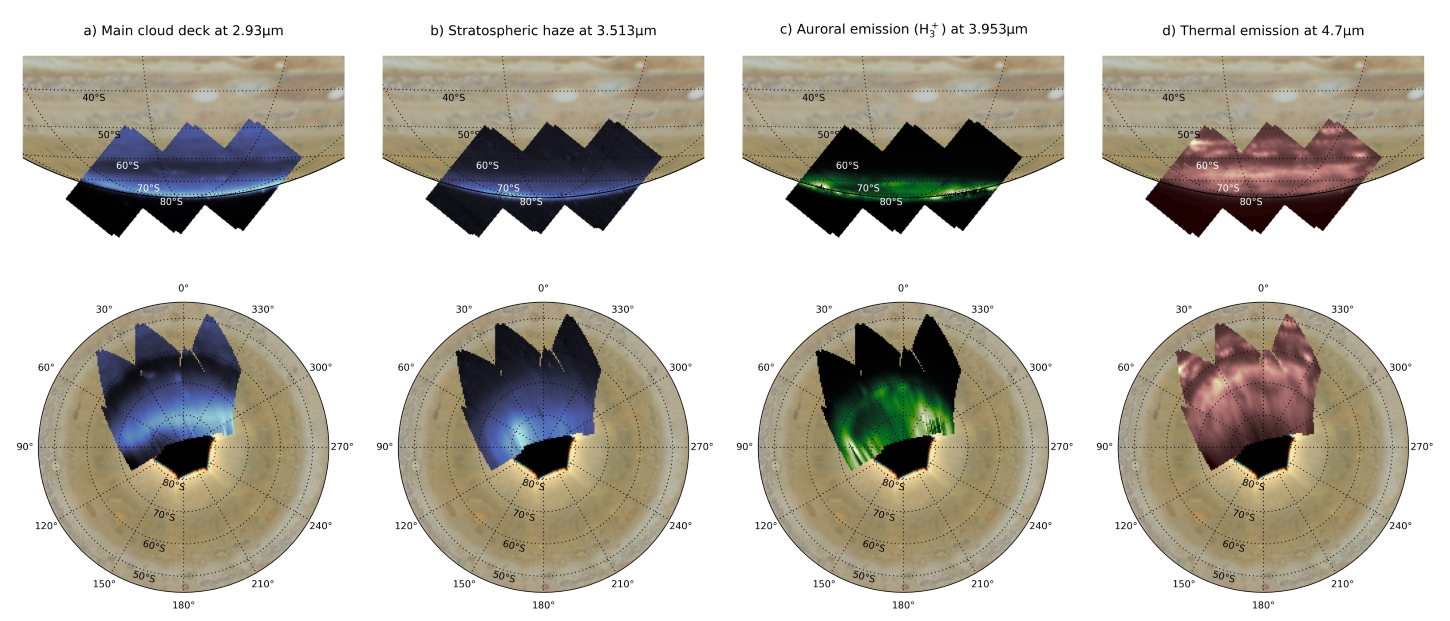
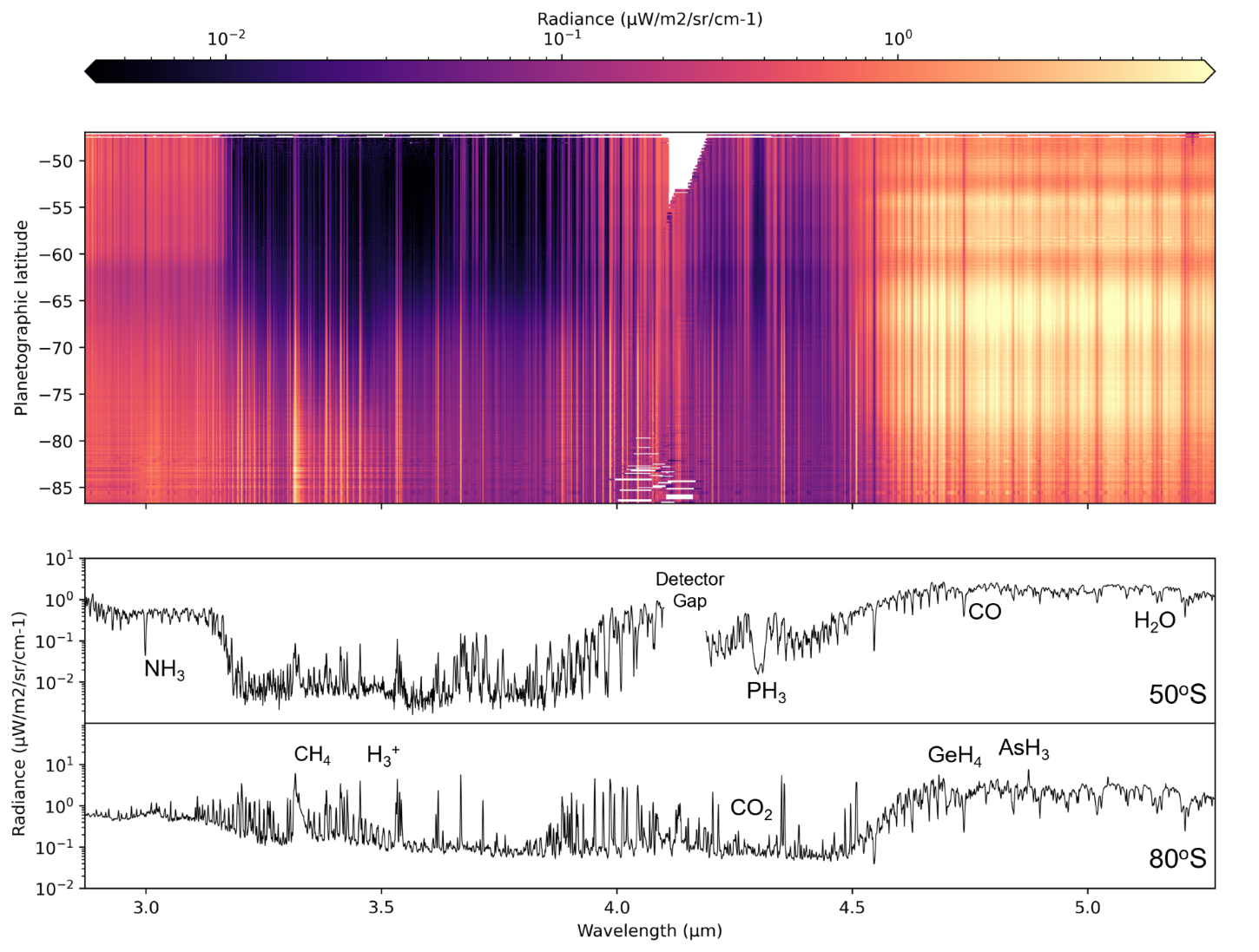
The vertical structure of aerosols and gases will be determined using spectral modelling and inversion package NEMESIS [5]. A key challenge is modelling and removing the ionospheric emissions from methane fluorescence and H3+, which is done outside NEMESIS, before performing the multiple-scattering retrievals to constrain aerosol properties. We vary the vertical profile of several gases including PH3 and NH3 and compare hazes in the upper troposphere and stratosphere atop a single extended cloud deck in the troposphere. We found that a stratospheric haze is required to replicate the broad shape of the region between 3.2 µm and 3.6 µm, where an upper tropospheric haze alone is not sufficiently reflective. Once these gas profiles and aerosols are tuned to provide a physical best-fit, model will be applied to zonally-averaged spectra across the full latitude range of the observations in order to study the changes in chemistry and aerosol properties that occur over the polar vortex boundary.

Figures:

Figure 1 The South Polar region observed by JWST/NIRSpec using G395H at 4 selected wavelengths. Top: Mosaic in the RA/Dec frame, rotated such that North is up. Bottom: reprojected onto an equidistant polar projection. 2.93µm (a) shows sunlight reflecting off the main cloud deck, 3.513µm (b) shows the highly reflective stratospheric haze layer, 3.953µm (c) is dominated by auroral emission from excited H3+ ions, and 4.7µm (d) shows thermal emission from deep within Jupiter (1 – 10bar). Context images are Hubble OPAL visible light images from Nov 2022.

Figure 2 Top: Observed radiance with JWST as a function of latitude and wavelength. Bottom: Two zonally averaged spectra at 50oS and 80oS, with some gas absorption/emission features labelled. The difference between the mid-latitude and high-latitude spectra are evident, with broadband methane and phosphine absorption disappearing at high latitude, and auroral emission from H3+ and CH4 becoming more dominant.

References:

[1]  Wong, A.-S., Y. L. Yung, and A. J. Friedson (2003), Benzene and Haze Formation in the Polar Atmosphere of Jupiter, Geophys. Res. Lett.

[2] Zhang X., West R. A., Banfield D., and Y.L. Yung (2013), Stratospheric aerosols on Jupiter from Cassini observations, Icarus

[3]: Sinclair J.A., Moses J.I., Hue V., Greathouse T.K., Orton G.S., Fletcher L.N., Irwin P.J.G (2019), Jupiter's auroral-related stratospheric heating and chemistry III: Abundances of C2H4, CH3C2H, C4H2 and C6H6 from Voyager-IRIS and Cassini-CIRS, Icarus

[4]: Tsubota, T.K., Wong, M.H., Stallard, T., Zhang X., Simon, A. (2025), UV-dark polar ovals on Jupiter as tracers of magnetosphere–atmosphere connections, Nature Astronomy

[5]: Irwin P.G.J., Teanby N.A., de Kok R., Fletcher L.N., Howett C.J.A., Tsang C.C.C., Wilson C.F., Calcutt S.B., Nixon C.A., Parrish P.D. (2008), The NEMESIS planetary atmosphere radiative transfer and retrieval tool, Journal of Quantitative Spectroscopy and Radiative Transfer

How to cite: Toogood, S., Fletcher, L., King, O., Harkett, J., Roman, M., de Pater, I., Biagiotti, F., Melin, H., Fouchet, T., Wong, M., and Rodriguez-Ovalle, P.: JWST/NIRSpec IFU Observations of Jupiter’s South Pole: Vertical and Latitudinal Structure of Aerosols in the Near-Infrared, EPSC-DPS Joint Meeting 2025, Helsinki, Finland, 7–13 Sep 2025, EPSC-DPS2025-820, https://doi.org/10.5194/epsc-dps2025-820, 2025.

F112
|
EPSC-DPS2025-938
|
ECP
|
On-site presentation
Anicia Arredondo, Tracy Becker, Maggie McAdam, Andrew Rivkin, Stephanie Jarmak, and Ian Wong

The new Polana collisional family is the hypothesized origin of the near-Earth asteroids (101955) Bennu, which was the target of the NASA OSIRIS-REx mission, and (162173) Ryugu, which was the target of the JAXA Hayabusa2 mission. We present JWST NIRSpec and MIRI spectroscopy of the parent body of the family, (142) Polana, and compare it with spacecraft and laboratory data of both near-Earth asteroids. We find that the near-infrared spectrum of Polana is similar to that of the returned sample from both Bennu and Ryugu, but has a slope that differs from that of the global average spectra taken by both spacecraft. The mid-infrared Polana spectrum differs in shape from the global average spectrum of Bennu, possibly because of porosity, space weathering, or grain size. Spectral features at similar wavelengths in the spectra of Polana and Bennu and Ryugu support the hypothesis that both asteroids originated in the Polana family. 

How to cite: Arredondo, A., Becker, T., McAdam, M., Rivkin, A., Jarmak, S., and Wong, I.: JWST spectroscopy of the parent body of the new Polana collisional family , EPSC-DPS Joint Meeting 2025, Helsinki, Finland, 7–13 Sep 2025, EPSC-DPS2025-938, https://doi.org/10.5194/epsc-dps2025-938, 2025.

F113
|
EPSC-DPS2025-416
|
On-site presentation
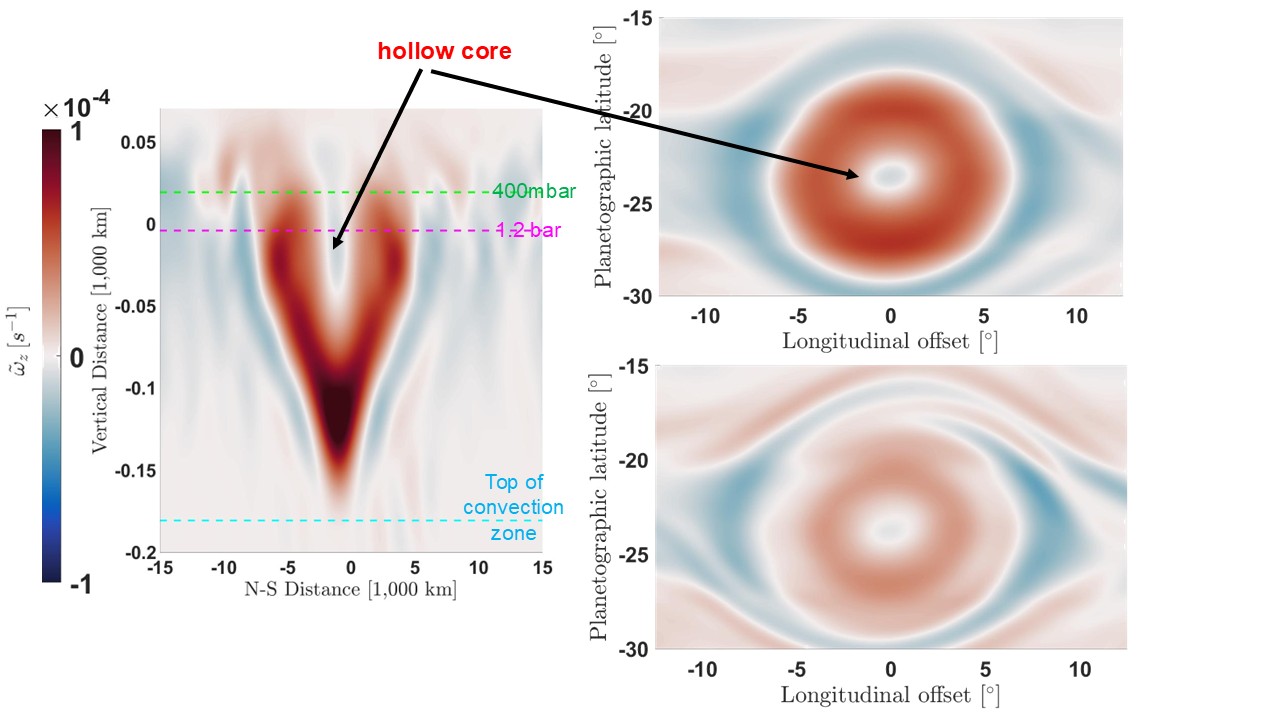
Philip Marcus, Sungkyu Kim, Michael Wong, Imke de Pater, and Amy Simon

In 2024, we published numerical simulations of Jovian anticyclones, including the Great Red Spot (GRS), that are solutions to the governing three-dimensional, compressible equations of motion. Our calculations depended on several unknown parameter values of the atmosphere that cannot be directly observed (e.g., the heights of the top of the convective zone, the heights of the top, middle,  and bottom of the GRS, and the temperatures of the atmosphere at heights from the convective zone up to 700mb). A wide range of parameter values produced stable vortices with velocities that matched the HST observations, including its hollowness (i.e., its quiet, and sometimes cyclonic center). However, it took a detailed search of the unknown parameter space to find the (apparently) one set of parameter values that produces an anticyclone that fits the GRS’s HST velocities and the JWST thermal observations of its anomalously cold top near 400mb. While exploring parameter space, we found that minor changes of the temperature profile and other parameters made large and qualitative changes to the vortex (e.g., changing it from hollow to unhollow, altering its vertical thickness, and/or adjusting its height in the atmosphere, vortical intensity and/or horizontal area, or making it unstable). Knowledge of how the vortices changed with respect to their parameter values not only provides us with an understanding of how hollowness occurs in vortices but also gives us guidance on the parameter values that are needed to simulate other Jovian vortices, especially the Red Oval, which we shall soon observe with the JWST and map its winds. The sensitivity of the GRS to subtle changes of the  parameter values provides us with a starting point as to understanding how subtle changes in the parameter values of the Jovian atmosphere might have caused the GRS to change since its Voyager observations - particularly, its shrinkage and its increase in its vertical vorticity.

Caption. The anomalous vertical vorticity of the GRS from our published simulation in the Journal of Fluid Mechanics 984 (2024): A61. https://doi.org/10.1017/jfm.2024.132.  The anticlonic vorticity is in red, and the cyclonic vorticity is blue. Left Panel shows the GRS in the vertical-north/south plane.  The origin of the vertical coordinate is aribtrary. The three dashed lines are the heights of the HST clouds  (purple), JWST clouds (green) , and the top of the convective zone (blue). The hollowness is only in the upper part of the GRS. The largest vorticities are below the visible clouds and have Rossy numbers of unity or greater, making the GRS ageostrophic. We find, in general, that the bottoms of our simulated vortices are unable to penetrate into the convective zone, and the GRS has no penetration. Note that the panel is stretched in the vertical direction and that the GRS is just greater than two hundred kilometers thick, while it is more than ten thousands kilometers wide. Right Panels: Top Panel shows the GRS in the east/west-north/south plane at 1.2 bar, approximately the height of the HST clouds, and the Bottom Panel shows the GRS in the same plane at 400mbar, approximately the height of the JWST clouds .

How to cite: Marcus, P., Kim, S., Wong, M., de Pater, I., and Simon, A.: 3D Solutions to the Equations of Motion of Jovian Vortices constrained by JWST Temperatures and Velocities Along with HST Velocities , EPSC-DPS Joint Meeting 2025, Helsinki, Finland, 7–13 Sep 2025, EPSC-DPS2025-416, https://doi.org/10.5194/epsc-dps2025-416, 2025.

F114
|
EPSC-DPS2025-117
|
On-site presentation
Nicholas Teanby, Conor Nixon, Manuel López-Puertas, Brandon Coy, Véronique Vuitton, Panayotis Lavvas, Lucy Wright, Joshua Ford, and Patrick Irwin

Saturn’s largest moon Titan has a nitrogen-methane atmosphere and a rich organic photochemistry. Dissociation of Titan’s molecular methane and nitrogen into N and methyl (CH3) radicals forms the basis of this photochemistry and results in a vast array of hydrocarbon and nitrile species. The abundance of CH3 is thus of critical importance to understanding Titan’s atmospheric chemistry. CH3 is predicted by photochemical models and must be present to explain Titan’s trace gas composition, but has never been directly observed. Cassini’s mass spectrometer was unable to make a detection as the extreme reactivity of radicals results in reactions on the instrument wall (e.g. recombination with H) before detection is possible. Emission features in the infra-red are also very weak, so detection from remote-sensing spectroscopy has previously not been possible. Here we use the very high sensitivity of the James Webb Space Telescope’s (JWST) Mid-InfraRed Instrument (MIRI) to detect emission from CH3 at 16.5 microns. We have used this to validate model predictions that underpin Titan’s rich atmospheric chemistry.

JWST/MIRI observations were taken in Medium Resolution Spectroscopy (MRS) mode on 11th July 2023 as part of Guaranteed Time Observation programme 1251 [Nixon et al., 2025]. Observations were reduced using the standard pipeline and combined to give a disc-averaged spectrum (Fig 1). The observed spectrum was compared to a forward model generated with a reference Titan atmosphere using the NEMESIS radiative transfer suite [Irwin et al., 2008]. The reference atmospheric temperature profile was based on observation from Cassini half a Titan year previous, augmented with ground-based measurements from ALMA and in-situ measurements from the Huygens probe (Fig 2a). A baseline atmospheric composition was compiled from Cassini/Huygens measurements [Teanby et al., 2019]. For the CH3 profile, in the absence of measurements, we used the predicted abundance from a photochemical model [Vuitton et al., 2019] (Fig 2a).

The abundance profile of CH3 is expected to be extremely steep with very high fractional abundances in the thermosphere (100 ppm at 1000km) and much lower abundances in the stratosphere and mesosphere (1 ppb at 300km). Peak emission under conditions of local thermodynamic equilibrium should originate from the mid-thermosphere at an altitude of ~800km (Fig 2b). However, our analysis shows that non-local thermodynamic equilibrium (non-LTE) emission is expected due to very low thermospheric pressures [Nixon et al., 2025]. This supresses emission below that expected from the Planck function and reduces infra-red emission from thermospheric CH3 to negligible levels. When non-LTE effects are considered, we find that the emission instead originates from the stratopause region (~300km) where CH3 abundances are predicted to be around 1 ppb (Fig 2c).

Agreement between forward modelled non-LTE emission using the photochemical model profile and the JWST/MIRI observation match very well (Fig 1) – confirming the model predicted abundances are consistent with conditions in Titan’s middle atmosphere. Our initial results were presented in Nixon et al., (2025). Here we present an updated analysis using improved pipeline processing, more in-depth treatment of the disc-averaged nature of the observation, and provide formal limits on the CH3 abundance profiles. The consistency of our results with predictions from photochemical models gives confidence to current chemical schemes for Titan’s low-order chemistry, which provides a sound basis for a deeper analysis of Titan’s more exotic species such as high-order hydrocarbons and poly-aromatic hydrocarbons.

References

Irwin, P.G.J., et al., 2008. The NEMESIS planetary atmosphere radiative transfer and retrieval tool. Journal of Quantitative Spectroscopy and Radiative Transfer 109, 1136–1150.

Nixon, C.A., et al., 2025., Titan’s Atmosphere in Late Northern Summer from JWST and Keck Observations. Nature Astronomy, in press.

Teanby, N.A., et al., 2019. Seasonal Evolution of Titan’s Stratosphere During the Cassini Mission. Geophysical Research Letters 46, 3079–3089.

Vuitton, V., et al., 2019. Simulating the density of organic species in the atmosphere of Titan with a coupled ion-neutral photochemical model. Icarus 324, 120–197.

Fig 1: JWST/MIRI disc-average spectrum compared with forward models with and without CH3. The model including CH3 provides a much better fit to the observations.

Fig 2: (a) Titan’s atmospheric temperature structure and uncertainty envelope from Nixon et al. (2025), along with photochemical model prediction of the CH3 profile from Vuitton et al. (2019). (b) Contribution functions for LTE case with nominal temperature profile (green), hot temperature limit (red) and cold temperature limit (blue). For LTE, peak emission would be from the thermosphere at ~800km, but this is not realistic. (c) Contribution functions for a more realistic non-LTE emission case peak at ~300km around the mesopause as non-LTE effects suppress emission at very low pressures. Our observations are thus most sensitive to abundances around the stratopause.


How to cite: Teanby, N., Nixon, C., López-Puertas, M., Coy, B., Vuitton, V., Lavvas, P., Wright, L., Ford, J., and Irwin, P.: Methyl Radical Detected on Titan with JWST/MIRI, EPSC-DPS Joint Meeting 2025, Helsinki, Finland, 7–13 Sep 2025, EPSC-DPS2025-117, https://doi.org/10.5194/epsc-dps2025-117, 2025.

F115
|
EPSC-DPS2025-1532
|
On-site presentation
Cesar Fuentes and Hemanth Bommireddy

The James Webb Space Telescope (JWST) offers, for the first time, routine mid-infrared imaging capable of detecting the thermal glow of kilometre- and sub-kilometre-scale asteroids that are invisible to ground-based optical surveys. We present the first systematic data-mining campaign targeting publicly released MIRI images acquired between March 2022 and October 2023. We analyzed data from 29 programmes that targeted pointings that fell within ±10° of the ecliptic, and grouped them into 171 fields that could be searched for moving objects, spanning a cumulative area of about 0.1 deg². A GPU-accelerated linear-motion pipeline, tuned to JWST’s dither strategy and resolution, recovered 17 moving sources consistent with main-belt orbits, 14 of which have no prior catalogue entry. Most objects were detected in several MIRI filters, spanning F770W–F2100W.

We considered a model spectrum using the Planetary Spectrum Generator (PSG) for a canonical asteroid at 2.9AU and pV=0.13, to obtain typical colors of an asteroid, and the expected visible magnitudes in the range g′ ≈ 24–29, and diameters of ~0.3–5 km assuming moderate albedos. When comparing with multi-filter photometry we obtain a systematically bluer F770W–F1500W slopes than those predicted for the comparison asteroid.

We estimate our detection efficiency by injecting synthetic PSFs, and recovering them in each field and filter in our dataset. These translated to visible g’ magnitudes, and combined with the surveyed area, and asteroid luminosity function predict an expected yield of 27_{-5}^{+70} serendipitous asteroids, only ∼2 σ above our observed yield. The faint-end turnover we detect is therefore genuine and, if confirmed, will tighten constraints on collisional models and the size–frequency distribution below D ≈ 1 km. Extrapolating our cadence to the ∼2 deg² of MIRI and NIRCam imaging already in the archive suggests JWST is on course to deliver ≥100 main-belt discoveries by Cycle 5 and >500 over a ten-year mission, probing down to D ≃ 0.2 km at 2–3 AU and to D ≃ 1 km in the outer belt.

Our pilot survey demonstrates that the JWST archive harbours a rich and largely untapped reservoir of small bodies. By exploiting this resource we will construct an infrared census of the main belt and transitional populations, refining models of planetesimal accretion, and collisional evolution.


How to cite: Fuentes, C. and Bommireddy, H.: Future of Mid-IR colors of sub-km asteroids from serendipitous JWST observations, EPSC-DPS Joint Meeting 2025, Helsinki, Finland, 7–13 Sep 2025, EPSC-DPS2025-1532, https://doi.org/10.5194/epsc-dps2025-1532, 2025.

F116
|
EPSC-DPS2025-773
|
ECP
|
On-site presentation
Paul Simon, Pierre Vernazza, Laurent Jorda, Marin Ferrais, Richard P. Binzel, Francesca DeMeo, Michaël Marsset, Pierre Beck, Sarah E. Anderson, and Miroslav Brož

Interplanetary dust particles (IDPs), the source materials of the zodiacal light, are supposed to originate from comets and some asteroids (Vernazza et al. 2015 [1]). So far, our comprehension of their composition relies primarily on the analysis of IDPs collected in the stratosphere (e.g. Sandford 1989 [2]).

The Mid-InfraRed Instrument (MIRI) of the James Webb Space Telescope (JWST) has the capability to provide spectra of the zodiacal light at an unprecedented spectral resolution and across a broad spectral range, assuming it has a good signal-to-noise ratio (SNR), and therefore a sufficiently long acquisition time. Rather than dedicating observation time to zodiacal dust, it is possible to exploit backgrounds with long exposures times, such as those in the Cycle 2 GO program GO  2820 (PI: Pierre Vernazza).

This program includes six background fields associated with observations of the small objects (1) Bienor, (2) Chariklo, (3) 2020 VF1, (4) 2013 LU28, (5) 2002 GG166 and (6) 1999 OX3.

The data are reduced through the JWST calibration pipeline last version, which significantly reduces the fringing effect, especially for channels 3 and 4. In order to remove the thermal contribution from JWST, a synthetic background is generated based on JWST Backgrounds Tool (Rigby et al. 2023 [3]), depending on the time and location of the observation, and is rescaled to match the total observed background flux. Through these steps, the average SNR between 7µm  and 25 µm is above 100 across all datasets, thus allowing the detection of relatively weak spectral features.

Olivine and pyroxene features between 8 µm and 12 µm are detected and consistent with prior measurements from AKARI/IRC (Takahashi et al. 2019 [4]) , thereby enhancing the reliability of the features observed in MIRI spectra. Several significant features not related to olivine and pyroxene are detected. Over these six backgrounds, close in latitude, variation of intensity and shape of features are observed. These spectral differences are being assessed in relation to the DIRBE zodiacal model (Kelsall et al.1998 [5]) modelised by the ZodiPy Python package (San et al. 2022 [6]). 

This investigation will involve a comparison of these spectra with those of various IDPs (anhydrous and hydrous ; e.g. Sandford and Bradley 1989 [2]) and an exploration of potential links with major dust bands produced by recent asteroid break-ups (Brož et al. 2024 [7]) and Marsset et al. 2024 [8]).

References

[1] Vernazza et al. 2015, Interplanetary Dust Particles as Samples of Icy Asteroids. The Astrophysical Journal, 806(2):204, June 2015.

[2] Sandford and Bradley 1998, Interplanetary dust particles collected in the stratosphere: Observations of atmospheric heating and constraints on their interrelationship and sources. Icarus, 82(1):146–166, 1989.

[3] J. Rigby et al. 2023, How Dark the Sky: The JWST Backgrounds. Publications of the Astronomical Society of the Pacific, 135(1046):048002, April 2023.

[4] Takahashi et al. 2019, Mid-infrared spectroscopy of zodiacal emission with AKARI/IRC. Publications of the Astronomical Society of Japan, 71(6):110, 11 2019.

[5] Kelsall et al.1998, The COBE Diffuse Infrared Background Experiment Search for the Cosmic Infrared Background. II. Model of the Interplanetary Dust Cloud. The Astrophysical Journal, 508(1):44, nov 1998.

[6] San et al. 2022, COSMOGLOBE: Simulating zodiacal emission with ZodiPy.  A & A, 666:A107, 2022.

[7] Brož et al. 2024, Young asteroid families as the primary source of meteorites. Nature, 634(8034):566–571, Oct 2024. 

[8] Marsset et al. 2024,  The Massalia asteroid family as the origin of ordinary L chondrites. Nature, 634(8034):561–565, Oct 2024.

How to cite: Simon, P., Vernazza, P., Jorda, L., Ferrais, M., Binzel, R. P., DeMeo, F., Marsset, M., Beck, P., Anderson, S. E., and Brož, M.: Zodiacal Light Spectroscopy with JWST/MIRI, EPSC-DPS Joint Meeting 2025, Helsinki, Finland, 7–13 Sep 2025, EPSC-DPS2025-773, https://doi.org/10.5194/epsc-dps2025-773, 2025.

F117
|
EPSC-DPS2025-1261
|
On-site presentation
Michael Roman, Leigh Fletcher, Heidi Hammel, Oliver King, Glenn Orton, Naomi Rowe-Gurney, Patrick Irwin, Julianne Moses, Imke de Pater, Henrik Melin, Jake Harkett, Simon Toogood, and Stefanie Milam

We present observations and analysis of Neptune’s atmosphere from JWST, providing new constraints on hydrocarbon abundances, cloud properties, and temperature structure across the planet’s disk.  

JWST observed Neptune in June 2023 (program1249) as part of the Solar System Guaranteed Time Observations (GTO). Integral field spectroscopy (IFS) with the Near-Infrared Spectrograph (NIRSpec) and the Mid-Infrared Instrument/Medium Resolution Spectrometer (MIRI/MRS) were combined to provide nearly simultaneous and continuous spatial and spectral data between 1.66 and 28.70 microns.

We show how wavelengths sensitive to the atmospheric temperatures reveal a structure consistent with Voyager [1] and ground-based imaging [2,3], with a sharply defined warm polar vortex. In contrast, wavelengths sensitive to stratospheric hydrocarbons (namely acetylene and ethane) show a marked enhancement in the northern winter hemisphere.

Finally, we examine the distribution and vertical structure of clouds in context of the temperature and chemical structure. Scattered light in NIRSpec observations indicate variable discrete clouds extend to pressures of roughly 50 mbar at the northernmost latitudes and south pole.


[1] Conrath, B. J., F. M. Flasar, and P. J. Gierasch. "Thermal structure and dynamics of Neptune's atmosphere from Voyager measurements." Journal of Geophysical Research: Space Physics 96, no. S01 (1991): 18931-18939.

[2] Fletcher, Leigh N., Imke de Pater, Glenn S. Orton, Heidi B. Hammel, Michael L. Sitko, and Patrick GJ Irwin. "Neptune at summer solstice: zonal mean temperatures from ground-based observations, 2003–2007." Icarus 231 (2014): 146-167.

[3] Roman, Michael T., Leigh N. Fletcher, Glenn S. Orton, Thomas K. Greathouse, Julianne I. Moses, Naomi Rowe-Gurney, Patrick GJ Irwin et al. "Subseasonal variation in Neptune’s mid-infrared emission." The Planetary Science Journal 3, no. 4 (2022): 78.

How to cite: Roman, M., Fletcher, L., Hammel, H., King, O., Orton, G., Rowe-Gurney, N., Irwin, P., Moses, J., de Pater, I., Melin, H., Harkett, J., Toogood, S., and Milam, S.: Temperature, Composition, and Cloud structure in Atmosphere of Neptune from MIRI-MRS and NIRSpec-IFU Observations, EPSC-DPS Joint Meeting 2025, Helsinki, Finland, 7–13 Sep 2025, EPSC-DPS2025-1261, https://doi.org/10.5194/epsc-dps2025-1261, 2025.

F118
|
EPSC-DPS2025-359
|
ECP
|
On-site presentation
Tania Le Pivert-Jolivet, Julia de León, Javier Licandro, Bryan Holler, Noemí Pinilla-Alonso, Mário De Prá, Joshua Emery, Brittany Harvison, Joseph Masiero, Lucas McClure, and Driss Takir

Primitive C-complex asteroids, primarily located in the main asteroid belt, are commonly associated with carbonaceous chondrites (CCs) due to their low geometric albedo (typically pv<10%) and similar spectral shape [e.g. 1]. The presence of hydrated minerals and organics in CCs attests to the accretion of volatiles by their parent body in the early solar system. These volatiles subsequently evolved through secondary processes, such as aqueous alteration. Thus, primitive asteroids are key witnesses for tracing the distribution and evolution of volatiles since solar system formation, as well as the role of primitive asteroids in Earth's water budget. Low-albedo collisional families of asteroids located in the inner main asteroid belt, between the ν6 secular resonance at 2.1 au and the 3:1 mean motion resonance with Jupiter at 2.5 au, are likely the sources of primitive near Earth asteroids (NEAs) and CCs [e.g. 2]. Recently, two space missions, Hayabusa2 (JAXA) and OSIRIS-REx (NASA), collected and returned to Earth samples from two primitive NEAs, Ryugu and Bennu. Laboratory analysis of the samples and their contextualization in relation to primitive asteroids will be key to understanding the evolution of the solar system.


The aim of James Webb Space Telescope (JWST) SAMBA3 (Spectral Analysis of Main Belt Asteroids in the 3-µm region) program (General Observer program #6384, Cycle 3) led by Driss Takir, is to observe and analyze spectra of nine asteroids from the seven low-albedo and low-inclination (i < 15°) inner main belt families (New Polana, Eulalia, Erigone, Sulamitis, Clarissa, Chaldaea and Klio) with the NIRSpec instrument (0.97 – 5.10 µm). Primitive asteroids typically present featureless spectra in the 0.5-2.5 µm, with the exception of a shallow absorption at 0.7 µm attributed to Fe-rich phyllosilicates in some asteroids [3]. On the contrary, several diagnostic spectral features can be observed at wavelengths > 2.5 µm in spectra of primitive bodies, such as bands associated also with phyllosilicates at 2.7-2.8 µm, water ice around 3.1 µm, organics around 3.4 µm and carbonates around 3.4 and 3.9 µm [e.g. 4, 5, 6]. The inaccessibility of certain wavelengths in the infrared from ground-based observations, due to the atmospheric opacity, makes JWST essential for constraining the composition of primitive asteroids. Here, we aim at analyzing the reflectance spectra of the primitive asteroid (84) Klio, the largest member of the Klio family, with NIRSpec.


The observation of Klio was conducted on July 6, 2024. The data were calibrated using the JWST pipeline. The solar analog P330E (JWST program #1538, led by Karl Gordon) was used to separate the reflected and emitted components of the spectrum. The thermal emission was fitted using the Near-Earth Asteroid Thermal Model (NEATM, [7]), allowing us to estimate Klio’s diameter to 78.1 km. We then analyzed the reflectance spectrum in the 2.8, 3.4 and 3.9 µm regions. Different Gaussian fits were used to estimate the peak position and the amplitude of the features. Those spectral parameters give valuable information on the composition, in particular when compared with primitive samples analyzed in the laboratory. We thus compared Klio with reflectance spectra of samples of carbonaceous chondrites from Takir et al. [6,8], Ryugu samples from Pilorget et al. [9] and Bennu samples from Lauretta et al. [10]. We will present the result of this analysis, as well as the interpretation of Klio’s composition and the evolution processes undergone by its parent body. In particular, this study revealed significant spectral differences between Klio and the Bennu/Ryugu samples, reinforcing the hypothesis that Klio is an unlikely parent body for the Hayabusa2 and OSIRIS-REx targets.


Acknowledgements: We’d like to acknowledge the support of the Space Telescope Science Institute (JWST-GO-06384.001-A). TPJ, JdL, and JL acknowledge support from the Agencia Estatal de Investigacion del Ministerio de Ciencia e Innovación (AEI-MCINN) under grant "Hydrated Minerals and Organic Compounds in Primitive Asteroids" with reference PID2020-120464GB-100.


References:

[1] Campins, H., et al. 2018, in Primitive Meteorites and Asteroids, ed. N. Abreu (Elsevier), 345–369, [2] Broz, M., et al. 2024, A&A 689, [3] Vilas, F. & Gaffey, M. J. 1989, Science, 246, 790, [4] Campins, H., et al. 2010, Nature, 464, 1320, [5] Takir, D. & Emery, J. P. 2012, Icarus, 219, 641, [6] Takir, D. et al. 2013, Meteor. Planet. Sci., 48, 1618, [7] Harris, A. W., 1998, Icarus, 131, 291, [8] Takir, D., et al. 2019, Icarus, 333, 243, [9] Pilorget, C. et al. 2021, Nature Astronomy, 6, 221, [10] Lauretta, D. S., et al. 2024, Meteor. Planet. Sci., 59, 2453

How to cite: Le Pivert-Jolivet, T., de León, J., Licandro, J., Holler, B., Pinilla-Alonso, N., De Prá, M., Emery, J., Harvison, B., Masiero, J., McClure, L., and Takir, D.: Composition of asteroid 84 Klio with NIRSpec/JWST, EPSC-DPS Joint Meeting 2025, Helsinki, Finland, 7–13 Sep 2025, EPSC-DPS2025-359, https://doi.org/10.5194/epsc-dps2025-359, 2025.

F119
|
EPSC-DPS2025-404
|
ECP
|
On-site presentation
Lucas McClure, Joshua Emery, Driss Takir, Noemi Pinilla-Alonso, Brittany Harvison, Mario De Prá, Bryan Holler, Tania Le Pivert, Julia de León, Javier Licandro, and Joseph Masiero

Determining the distribution of water throughout the main asteroid belt can inform us about the formation and evolution of the early Solar System. A powerful method for probing water abundance involves the observation and characterization of carbon-rich (C-complex) asteroids in the “3-μm region,” which contains the fundamental OH stretching mode associated with hydrated or hydroxylated  minerals (Rivkin et al. 2002). Carbonaceous chondrites, the meteorite analogs for C-complex primitive asteroids,  generally exhibit the OH-strech from Fe- or Mg-rich phyllosilicates, which affect the band shape and center differently (Johnson & Fanale 1973; Takir et al. 2013).  The range in band parameters, in turn, aligns with the degree of aqueous alteration (Takir et al. 2013). Though ground-based observations of the 3-μm region are obstructed by Earth’s atmospheric water features, the James Webb Space Telescope (JWST) provides unmatched access to this crucial wavelength range. Additionally, JWST can access features longward of the 3-μm region that could be associated with water-ice, organics,  carbonates, or ammoniated phyllosilicates (Campins et al. 2010a; Rivkin & Emery 2010; Clark et al. 2009; Rivkin et al. 2022). Thus, JWST observations of C-complex asteroids in this region allow for insight into the formation and evolution of these bodies and the Solar System at large.

The Polana-Eulalia Complex (PEC) is a low-inclination, carbon-rich (C-complex) asteroid population residing in the inner Main Belt (IMB) among numerous other families (Walsh et al. 2013). As shown in Figure 1, the PEC is composed of two dynamically overlapping families centered around (142) Polana and (495) Eulalia, the largest members of each one. The nearby ν6 secular resonance has likely caused some small PEC members to drift into near-Earth space. Notable examples of this dynamical evolution scenario include near-Earth asteroids Bennu and Ryugu, the targets of OSIRIS-REx and Hayabusa2 sample-return spacecraft missions, which are probabilistically traced back to the PEC region (Campins et al., 2010b, 2013; Bottke et al., 2015). Ground-based observational campaigns focused on near-ultraviolet (NUV; 0.35 – 0.46 μm), visible (VIS; 0.46 – 0.9 μm), and near-infrared (NIR; 0.9 – 2.2 μm) wavelengths found that members from both PEC families display featureless spectra (Tatsumi et al. 2022; de León et al. 2016, Pinilla-Alonso et al. 2016). Though PEC asteroids lack 0.7-μm features associated with Fe-bearing phyllosilicates, the presence of the fundamental OH-stretch from Mg-rich phyllosilicates in the 3-μm region cannot be ruled out (Rivkin et al. 2002; Takir et al. 2013). Spectral characterization in this wavelength region is particularly relevant to understanding the distribution of water throughout the Solar System as well as to disentangling the specific family of origin for Bennu and Ryugu.

Figure 1: The Yarkovsky Drift of the two families of the PEC, with asteroids Polana (red star) and Eulalia (blue star) at their relatively centralized orbital positions  (Vokrouhlický et al. 2006; Walsh et al. 2013).

In this work, we present a portion of JWST Cycle 3 spectra from Program #6384, led by Driss Takir. Entitled the “Spectral Analysis of Main Belt Asteroids in the 3-μm Region” (SAMBA3), this JWST program uses the NIRSpec instrument and has acquired spectra from (495) Eulalia and two ~10-km-sized Polana family asteroids: (6712) Hornstein & (2441) Hibbs. Upon calibrating the SAMBA3 spectra, we inspected/calculated spectral parameters for the observed features within and longward of the 3-μm region, including band shape and minimum. In addition to connecting the SAMBA3 spectra with VIS-NIR spectra of these objects, we compare PEC spectra to other relevant spectra, such as the spectrum of Bennu (remote & return-sample), of Ryugu (remote & return), and of (142) Polana (from Cycle 2 – Program #3760, PI A. Arredondo). We also contextualize the PEC spectra with the larger sample from this program, which also observed (84) Klio, (302) Clarissa, and (163) Erigone, largest members of the other carbon-rich, primitive-like families in the IMB.  Additionally, we link these PEC asteroid spectra to specific carbonaceous chondrite meteorite types.            

References:

Bottke, W. F., et al. (2015). Icarus, 247.

Campins, H., et al. (2010a). Nature, 464.

Campins, H., et al. (2010b). Astrophysical Journal Letters, 721.

Campins, H., et al. (2013). Astronomical Journal, 146(2).

Clark, R. N., et al. (2009). Journal of Geophysical Research: Planets, 114.

de León, J., et al. (2016). Icarus, 266.

Johnson, T. V. & Fanale, F. P., (1973). Journal of Geophysical Research, 78.

Pinilla-Alonso, N., et al (2016). Icarus, 274.

Rivkin, A. S., et al. (2002). Asteroids III.

Rivkin, A. S., & Emery, J. P., (2010). Nature,

Rivkin, A. S., et al. (2022). The Planetary Science Journal, 3, 153.

Takir, D., et al. (2013). Meteoritics and Planetary Science, 48(9).

Tatsumi, E., et al. (2022). Astronomy and Astrophysics, 664.

Vokrouhlický, D., et al. (2006). Icarus, 182(1).

Walsh, K. J., et al. (2013). Icarus, 225(1).

How to cite: McClure, L., Emery, J., Takir, D., Pinilla-Alonso, N., Harvison, B., De Prá, M., Holler, B., Le Pivert, T., de León, J., Licandro, J., and Masiero, J.: Compositional Characterization of the Polana-Eulalia Complex with JWST, EPSC-DPS Joint Meeting 2025, Helsinki, Finland, 7–13 Sep 2025, EPSC-DPS2025-404, https://doi.org/10.5194/epsc-dps2025-404, 2025.

F120
|
EPSC-DPS2025-488
|
Virtual presentation
Charles E. Woodward, Nathan X. Roth, Dominique Bockélee-Morvan, Diane H. Wooden, Michael S.P. Kelley, David E. Harker, and Stefanie N. Milam

Dynamically new Oort cloud comets, by their journeys into the inner solar system, deliver particulates and volatile gases into their comae that reveal records of the most primitive materials in the solar system. The abundances and spatial distribution of major gas species (H2O, CO2, CO), and organics yield insight into comet nucleus composition as well as sublimation or radiative dissociation of species in the coma. JWST spectroscopic observations of such comets provide a unique look into the physico-chemical properties of materials sublimed from the nucleus into the coma. Spectroscopy with MIRI MRS and NIRSpec integral-field-units (IFUs) deliver spectral-spatial cubes with wavelength access to key diagnostics of coma materials produced by comet nucleus sublimation activity, including molecular emission bands, organic signatures, and dust features in the spectral energy distribution (SEDs). Here, we highlight observations and modeling of a JWST study of the inner coma of the Oort cloud comet C/2017 K2 (PanSTARRS), a hyperactive (water ice active fraction ≥86%) comet at a heliocentric distance of 2.35 au. Our observations and analysis [1] reveals: (a) emission lines from H2O are detected in both NIRSpec and MRS spectra including faint H2O ro-vibrational lines from the ν32 and ν12 hot bands in the 4.5 to 5.2 μm range, and strong lines from the ν2 fundamental vibrational band; (b) a wealth of trace volatile species (molecular emission) is superimposed on the continuum including CN (band emission centered at 4.9 μm), H2CO, CH3OH, CH4, C2H6, HCN, NH2, and OH prompt emission (after UV photolysis of water); (c) a particle differential size distribution (n(a)da) and relative abundances of amorphous carbon, amorphous silicates, and crystalline silicates commensurate with those found in other comets[2]. In C/2017 K2 (PanSTARRS) the average (spatially averaged across the coma) amorphous carbon mass fraction has a value of the order 0.247 ± 0.010, the silicate-to-carbon ratio is  of the order 3.049 ± 0.163, and the crystalline mass fraction of the sub-micron grains, fcryst, is of the order 0.384 ± 0.065; (d) residual spectral emission features at 3.42 um and between 6.1 and 8.6 μm, with a prominent 6.9 um peak, in the JWST spectrum strongly support the contention that polycyclic aromatic hydrocarbons (PAHs) are present in the inner coma of this comet. We briefly discuss comparisons of the spectra of other comets observed with JWST early in the mission and explore the in-field and out-of-field impact of JWST comet surveys in the context of advancing our understanding of protoplanetary disk evolution and the formation of small bodies in the outer solar system. 

This work is based in part on observations made with the NASA/ESA/CSA James Webb Space Telescope Cycle 1 GO program 1556 whose analysis was supported via StSci grant JWST-GO-01566.001. 

References:[1] Woodward, C.E.  et al. 2025, “A JWST Study of the Remarkable Oort Cloud Comet C/2017 K2 (PanSTARRS)”, Planetary Sci. J. (in press) doi: 10.3847/PSJ/add1d5. [2] Harker, D.E. et al. 2024, “Dust Properties of Comets Observed by Spitzer”, Planetary Sci. J. 4, 242 doi: 10.3847/PSJ/ad0382.

How to cite: Woodward, C. E., Roth, N. X., Bockélee-Morvan, D., Wooden, D. H., Kelley, M. S. P., Harker, D. E., and Milam, S. N.: A JWST Spectroscopic Study of Comet C/2017 K2 (PanSTARRS), EPSC-DPS Joint Meeting 2025, Helsinki, Finland, 7–13 Sep 2025, EPSC-DPS2025-488, https://doi.org/10.5194/epsc-dps2025-488, 2025.

F121
|
EPSC-DPS2025-761
|
On-site presentation
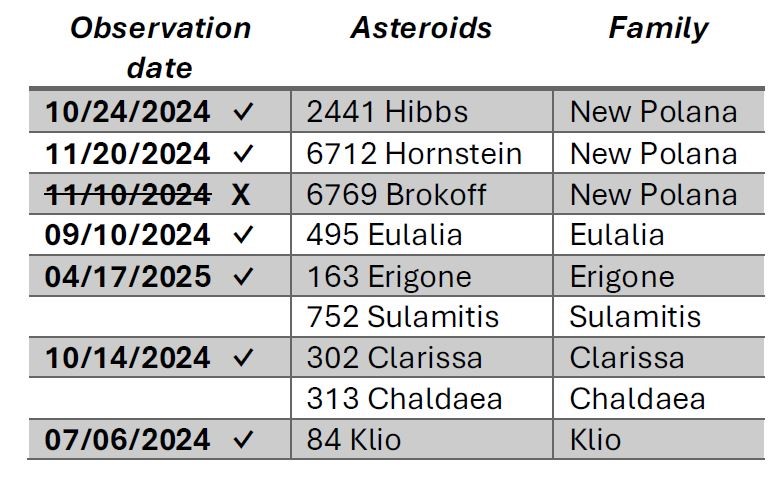
Driss Takir, Mario de Prá, Julia de León, Joshua Emery, Brittany Harvison, Bryan Holler, Tania Le Pivert-Jolivet, Javier Licandro, Joseph Masiero, Lucas McClure, and Noemi Pinilla-Alonso

Collisional impacts between asteroid-sized objects have been common throughout the history of our solar system and have significantly contributed to the formation of asteroid families (Nesvorný et al., 2015). Of particular interest are the low-albedo (geometric albedo < 0.10) and low-inclination (i ≤ 15°) asteroid families situated within the inner main belt (IMB), between the v6 secular resonance at ~ 2.15 au and the 3:1 mean-motion resonance with Jupiter at ~2.5 au. These families are proposed to be significant sources of carbonaceous near-Earth asteroids (NEAs) such as asteroids Ryugu and Bennu (Bottke et al. 2015; Granvik et al. 2016; Dykhuis and Greenberg, 2015). Carbonaceous NEAs contain abundant water- and carbon-rich materials, which are essential elements for understanding the origin of life on Earth and provide valuable historical records of the early solar system. Exploring the relationships between carbonaceous NEAs and these IMB families also enhances the scientific value of the sample return missions (see this meeting abstract # 678 by Takir et al.).  Studying the IMB also has broader implications for the formation of exoplanetary systems, such as PDS 70. The discovery of water vapor by JWST MIRI in the inner part of PDS 70’s protoplanetary disk (Perotti et al. 2023) suggests that water is playing a crucial role in the formation of this young exoplanetary system.

As part of the JWST SAMBA3 (Spectral Analysis of Main Belt Asteroids in the 3-µm region) program (Cycle 3 GO; #6384), we are conducting observations of asteroids from seven collisional low-albedo and low-inclination families located in the IMB. The studied families include New Polana, Eulalia, Erigone, Sulamitis, Clarissa, Chaldaea, and Klio. We have selected nine asteroids from these families to investigate potential links with carbonaceous NEAs (see Table 1). Our study focuses on the parent bodies of six asteroid families. For the New Polana family, we are observing three fragments. We will compare these fragments with one another and with the parent body asteroid (142) Polana (Arredondo et al. 2024) to determine whether the fragments from the same family exhibit similar or differing hydration states (e.g., Michel et al. 2020). For our observations, we are utilizing the NIRSpec instrument, which covers a spectral range of~ 0.6 to 5.2 µm. This range includes essential diagnostic absorption features characteristic of primitive and carbonaceous materials, such as H2O/hydroxyl (OH), carbonates, and organics.

Table 1. Current JWST observation status of the SAMBA3 program (Cycle 3 GO; #6384).

As of this writing, JWST has executed observations for seven asteroids. The observation of asteroid (6769) Brokoff faced an issue and was not fully executed; therefore, it has been rescheduled for the next cycle. Le Pivert-Jolivet et al. (this meeting abstract #359) will discuss the analysis and interpretation of asteroid (84) Klio. Harvison et al. (this meeting abstract #1004) will focus on asteroids (302) Clarissa and (163) Erigone. Additionally, McClure et al. (this meeting abstract #404) will examine asteroids (2441) Hibbs, (6712) Hornstein, and (495) Eulalia. We also expect to observe asteroids (752) Sulamitis and (313) Chladaea before the meeting.


Acknowledgements: We would like to acknowledge the support of the Space Telescope Science Institute (JWST-GO-06384.001-A). JdL, TPJ, and JL acknowledge support from the Agencia Estatal de Investigacion del Ministerio de Ciencia e Innovación (AEI-MCINN) under grant "Hydrated Minerals and Organic Compounds in Primitive Asteroids" with reference PID2020-120464GB-100.


References:

Arredondo, A. et al., 2024. AAS DPS, Abstract##411.02.

Bottke, W.F et al., 2015. Icarus 247, 191e217.

Dykhuis, M., Greenberg, R., 2015. Icarus 252, 199e211.

Granvik, M. et al., 2016. Icarus 312, 181-207.

Michel, P. et al., 2020. Nature Communications 11, 2655 (2020.

Nesvorný, D. et al., 2015.  Asteroids IV 297e321.

Perotti, G. et al., 2023 et al.  Nature 620, 516-520.

How to cite: Takir, D., de Prá, M., de León, J., Emery, J., Harvison, B., Holler, B., Le Pivert-Jolivet, T., Licandro, J., Masiero, J., McClure, L., and Pinilla-Alonso, N.: SAMBA3: A JWST Program to Study Low-albedo and Inclination Inner Main Belt Asteroid Families and their Connection to Carbonaceous Near-Earth Asteroids, EPSC-DPS Joint Meeting 2025, Helsinki, Finland, 7–13 Sep 2025, EPSC-DPS2025-761, https://doi.org/10.5194/epsc-dps2025-761, 2025.

F122
|
EPSC-DPS2025-1004
|
ECP
|
On-site presentation
Brittany Harvison, Mario De Prá, Noemí Pinilla-Alonso, Driss Takir, Tania Le Pivert-Jolivet, Javier Licandro, Julia de Leon, Bryan Holler, Joshua Emery, Lucas McClure, and Joseph Masiero

Primitive asteroids in the Main Belt possess one of the most pristine inventories of materials in the Solar System. Main Belt primitive asteroids are particularly interesting due to clear evidence of phyllosilicates, i.e., silicates that have encountered liquid water and undergone chemical alteration. Since asteroids are thought to be likely contributors to Earth's water content [1-3], mapping hydration across the primitive asteroid population is essential for understanding the compositional structure of the early Solar System and the introduction of water on Earth. Low-albedo (pv < 10%) and low-inclination (i < 10°) primitive asteroid families in the inner Main Belt are dynamically linked to the primitive NEAs Ryugu and Bennu [4,5], further supporting the importance of investigating their composition and the dynamics responsible for their delivery to near-Earth space. The Cycle 3 Program, “Low-Albedo and Inclination Asteroid Families as Tracers for Water and Organics in the Inner Solar System,” is currently conducting observations using the James Webb Space Telescope (JWST) to investigate this category of primitive bodies directly. Utilizing JWST’s NIRSpec Integral Field Unit (IFU), the program is acquiring near-infrared spectra (0.6 – 5.2 µm) from the largest bodies in the Clarissa, Erigone, and Sulamitis asteroid families. 

Initial investigations into the visible spectra of the Erigone, Sulamitis, and Clarissa families identified a specific trend regarding Fe-rich phyllosilicates: the Erigone and Sulamitis families exhibited similar, high percentages of members showing the 0.7 μm band, indicative of this mineral (60%). In contrast, an extremely low percentage of members expressed the feature in the Clarissa and Polana families [6]. While the absence of a 0.7 μm feature may initially suggest no hydration, it does not provide sufficient grounds to conclude that the body is not hydrated, as Mg-rich phyllosilicates do not show this feature. Studies have shown that although some asteroids lack the 0.7 μm feature, they may still exhibit the 3.0 μm region, whereas all asteroids with a 0.7 μm feature display the 3.0 μm band [7]. This region has been notoriously hard to observe from ground-based observatories due to the Earth’s water-rich atmosphere. JWST observations are required to adequately constrain these bodies' thermal and compositional histories. We will present the compiled preliminary investigations of JWST NIRSpec spectra of (163) Erigone, (302) Clarissa, and (752) Sulamitis. We will search for diagnostic features of hydrated minerals, complex organics, and carbonates. Each spectral feature will be characterized by band center, depth, and area, and compared to features identified in the spectra of carbonaceous chondrite meteorite analogs to investigate possible relationships. Finally, we will explore the compositional diversity of inner belt primitive families and how this connects to their formation and evolutionary history.

References: [1] Marty, B. (2012). Earth and Planetary Science Letters. [2] Piani, L. et al. (2020). Science. [3] Mezger, K. et al. (2021). Icarus. [4] Campins, H. et al. (2010). The Astrophysical Journal. [5] Campins, H. et al. (2013). The Astronomical Journal. [6] Morate, D. et al. (2018). Astronomy and Astrophysics. [7] Rivkin, A. et al. (2015). The Astronomical Journal.

How to cite: Harvison, B., De Prá, M., Pinilla-Alonso, N., Takir, D., Le Pivert-Jolivet, T., Licandro, J., de Leon, J., Holler, B., Emery, J., McClure, L., and Masiero, J.: (163) Erigone, (302) Clarissa, and (752) Sulamitis as seen with JWST’s NIRSpec, EPSC-DPS Joint Meeting 2025, Helsinki, Finland, 7–13 Sep 2025, EPSC-DPS2025-1004, https://doi.org/10.5194/epsc-dps2025-1004, 2025.

F123
|
EPSC-DPS2025-1109
|
Virtual presentation
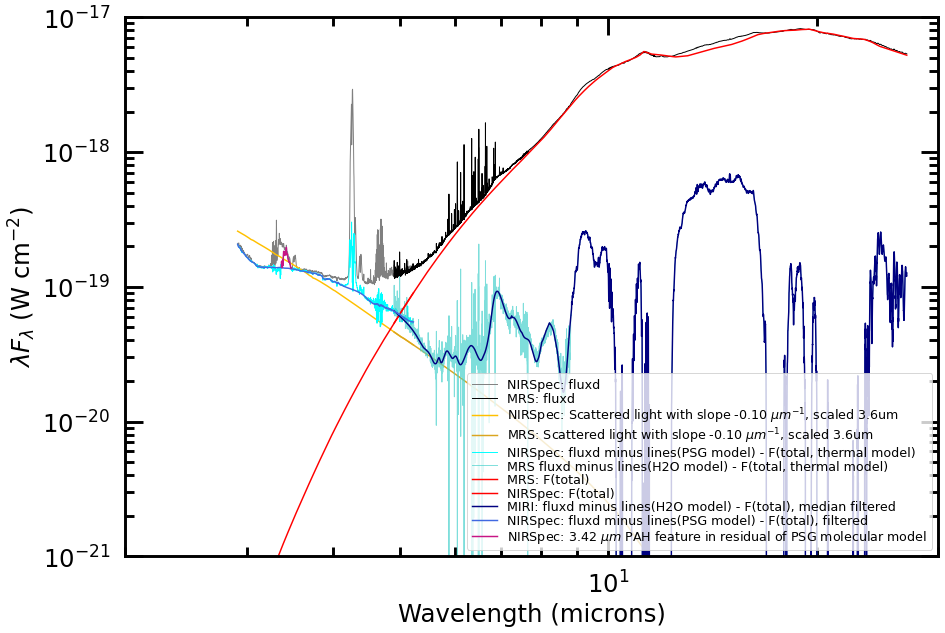
Diane Wooden, Charles Woodward, Dominique Bockelee-Morvan, David Harker, Nathan Roth, Michael Kelley, and Stefanie Milam

Comets are amongst the most primitive bodies in the solar system, containing volatile ices and dust particles from eras of protoplanet formation. Multiple perihelion passages of comets into the inner solar system cause a stratification of volatiles within their nuclei, with the most volatile ices preserved at greater depths. Comet nuclei also evolve from the redeposition of particles not lost from their gravity fields. On their first sojourns into the solar system, dynamically new Oort cloud comets offer important opportunities to study their comae volatiles and dust particles less encumbered by nuclei evolution.

Comet C/2017 K2 was one such dynamically new Oort cloud comet. Observations of comet K2 by the James Webb Space Telescope (JWST) at 2.35 au provided an ideal opportunity to search for polycyclic aromatic hydrocarbons (PAHs) in its coma [1]. High signal-to-noise ratio NIRSpec and MRS spectra were obtained. Emission bands centered at 3.42 µm, 6.9 µm, and 8.55 µm, and a plateau 6.3—8.6 µm, were identified and modeled with the Ames PAHdb Python Suite utilizing an excitation energy of 5770K appropriate for the Sun. PAHs with multiple hydrogens on their peripheral bonding sites were found to be very important in explaining the spectrum of comet K2 [1]. Such PAHs have been described as ‘aliphatic PAHs’ [2], PAHs with –CH2 side groups, and Hn-PAHs or ‘moderately hydrogenated’ PAHs [3]. PAHs embedded in water ice may have acquired additional H atoms, and PAHs in water ice irradiated with UV generate PAH cations, and these cations persist upon water ice sublimation [1].

The broad spectral coverage of NIRSpec and MRS was crucial for modeling thermal dust emission from coma particles [4, 5], necessary for determining the baseline beneath potential PAH bands [1]. Figure 1 shows the best-fit thermal model fitted to MRS 4.9—27 µm SED (Fλ  vs. λ) after subtraction of an extrapolated scattered light component fit derived from the NIRSpec spectrum. A notable 3.42 µm feature, not accounted for by the NASA Planetary Spectrum Generator (PSG) molecular emission line model, was considered in modeling PAH emissions. The ‘PAH extract’ residual spectrum was computed as the MRS flux minus the emission lines, scattered light, and thermal model ‘F(total)’, and then median filtered (shown in navy in Fig. 1).

Figure 1. Spectral decomposition of flux of comet K2: NIRSpec (gray); PSG-fitted molecular emission lines subtracted (cyan) and then filtered (blue, cf. [1]);  NIRSpec scattered light fit (yellow) extrapolated to MRS (gold); MRS best-fit thermal model fitted to the scattered-light-subtracted flux (‘F(total)’, red) and extrapolated to NIRSpec (red). The residual (violet-red) and median filtered residual (navy) contain  PAH emissions. Dust emissions from high-temperature oxides such as those from CAIs may explain the residual at 12.5-16.5 µm.  (Adapted from [1])


Figure 2 shows the best-fit PAHdb model for comet K2 using a 5770 K (blackbody) excitation cascade and restricted to PAHs with less than 101 carbon atoms (NC<=100). Heavily hydrogenated PAHs, characterized by  –CH2 side groups (NCH2 >0) [3], are present in the coma of comet K2. The Rosetta Mission ROSINA mass spectrometer detected aromatic molecules in comet 67P/Churymov-Gerasimenko (67P), although the fragmentation signatures were not sufficiently prominent to allow identification at >~35 atoms: ROSINA detected hydrogenated PAHs with NC=10 spanning normal hydrogenation to fully hydrogenated (C10H8 Naphthalene through C10H18 Decahydronaphthalene) [6]. ROSINA detected linear chain organic molecules, heterocycles, and PAHs in the ratios of 6:3:1 [6].

Figure 2. Model for PAH emissions in comet K2. Heavily hydrogenated PAHs, characterized by  –CH2 sidegroups (NCH2 >0) [3], are present in the coma of comet K2. (b) Small (NC≤40) neutral PAHs fit the isolated 3.42 µm feature. (c) Small cations and large (NC>40) neutrals primarily contribute to the 6.9 µm and 8.55 µm features, and the emission plateau. Large neutrals and cations contribute. The upcoming PAH database v4.0 will have more large PAHs. (Adapted from [1].)


Based on their comparison of the organics to those in the ISM using the diagram of Hydrogen Deficiency Index versus Natoms (for comet K2, see Fig. 24 in [1]) for comet 67P versus ISM sources, Hanni et al. [6] conclude that cometary organics have an ISM heritage with evolution. The PAHdb model for K2 extends to larger Natom than ROSINA.  Comet K2 has PAHs not as fully hydrogenated as comet 67P, yet supports the Hanni et al. view of potential inheritance from the ISM. The formation of PAH cations and hydrogenation of PAHs in water ice may provide a natural explanation of hydrogenated PAHs in cometary comae. High sensitivity JWST NIRSpec and MRS observations of more comets are needed to deepen our understanding of the evolution of aromatic molecules in the protoplanetary disk at the comet-forming epoch.

This work is based in part on observations made with the NASA/ESA/CSA James Webb Space Telescope Cycle 1 GO program 1556 whose analysis was supported via STSci grant JWST-GO-01566.003-A.

References:

[1] Woodward, C.E. et al. 2025, A JWST Study of the Remarkable Oort Cloud Comet C/2017 K2 (PanSTARRS), Planetary Sci. J. (in press) arXiv:2504.19849

[2] Yang, X. J., et al. 2016, On the aliphatic versus aromatic content of the carriers of the ‘unidentified’ infrared emission features, MNRAS 462, 1551 doi:10.1093/mnras/stw1740

[3] Sandford, S. A., et al. 2013, The Infrared Spectra of Polycyclic Aromatic Hydrocarbons with Excess Peripheral H Atoms (Hn-PAHs) and their Relation to the 3.4 and 6.9 µm PAH Emission Features, ApJS 205:8 doi:10.1088/0067-0049/205/1/8

[4] Harker, D.E. et al. 2024, Dust Properties of Comets Observed by Spitzer, Planetary Sci. J. 4, 242 doi:10.3847/PSJ/ad0382

[5] Bockelee-Morvan, D., et al. 2024, Chemical and Physical Properties of Cometary Dust, in Comets III, ed. K. J. Meech et al., Space Sci. Ser., U. AZ Press. doi:10.48550/arXiv.2305.03417

[6] Hänni, N. et al. 2022, Identification and characterization of a new ensemble of cometary organic molecules, Nature Comm. 13:3639 doi:10.1038/s41467-022-31346-9

How to cite: Wooden, D., Woodward, C., Bockelee-Morvan, D., Harker, D., Roth, N., Kelley, M., and Milam, S.: JWST Discovers Heavily Hydrogenated PAHs in the Coma of the Dynamically New Oort Cloud Comet C/2017 K2 (Pan-STARRS), EPSC-DPS Joint Meeting 2025, Helsinki, Finland, 7–13 Sep 2025, EPSC-DPS2025-1109, https://doi.org/10.5194/epsc-dps2025-1109, 2025.

F124
|
EPSC-DPS2025-1219
|
On-site presentation
Andrew Rivkin, Ian Wong, Alison Glatzberg, Cristina Thomas, Bryan Holler, Benjamin Pope, and Heidi Hammel

Motivation: Ceres, Pallas, and Hygiea are the three largest low-albedo objects in the main asteroid belt, and contain a little more than half of the belt’s mass. Ceres has been visited by the Dawn spacecraft, which has shown it to be a geologically varied relict “Ocean World” and dwarf planet, with cryovolcanism perhaps still occurring today [1,2]. Hygiea appears to be a spectral twin of Ceres, suggesting a similar composition (and perhaps a similar history?). Pallas, by contrast, is thought to be more consistent with the carbonaceous chondrite meteorites, and could plausibly be the largest undifferentiated object in the solar system.  The launch of JWST provided the opportunity to extend the wavelength coverage of these objects into spectral regions unobservable from Earth, and to use Dawn’s visit to Ceres to calibrate quantitative estimates of hydrogen content from these, and future, observations.

Observations: Two instruments were used for the observations: the Near-Infrared Spectrograph (NIRSpec) and the Mid-Infrared Instrument (MIRI).  In both cases an integral field unit (IFU) was used. The observations were made as part of GTO program 1244, part of a larger GTO effort spearheaded by Heidi Hammel. Observations took place on 1 August 2022 (Hygiea MIRI and NIRspec), 1 October 2022 (Pallas NIRSpec), 17 December 2022 (Pallas MIRI), and 18 January 2023 (Ceres MIRI and NIRSpec). 

NIRSpec: The NIRSpec data were downloaded from the Mikulski Archive for Space Telescopes (MAST) and processed using typical methods for IFU observations that are detailed in the literature [3-5, etc.]. Because all three targets are extended sources for the NIRSpec IFU (ranging from 2.3 pixels for Hygiea to 6.4 pixels for Ceres), boxes of 13 pixels for Ceres and 9 pixels for Pallas and Hygiea were used, encompassing ~98% of calibrated flux, though the final analyses were done on normalized spectra so the results are insensitive to the absolute flux calibration.  The spectra of Ceres and Pallas were saturated beyond roughly 3.7 and 3.2 µm, respectively, and those spectral sections were not analyzed. It is possible that some of the saturated wavelength regions can be recovered (see below), but the wavelength regions uniquely observable by JWST (2.5—2.85 µm) were unsaturated.  Following spectral extraction, the thermal flux contribution was calculated for each object and removed, resulting in a reflectance-only spectrum for analysis.  

All three objects have an absorption band near 2.72 µm, with Hygiea and Ceres showing band centers at identical wavelengths that only differ by 0.001 µm from Pallas’s band center. This is interpreted as due to Mg-OH indicating very Mg-rich phyllosilicates. Ceres and Hygiea additionally show features near 3.05 µm and 3.31 µm, with band centers that differ by < 0.01 µm. These are interpreted as due to NH4+ in minerals. In the 3-µm region, the two differ mainly in band depths, with Ceres showing a relatively deeper band due to NH4+than the OH band, suggesting Ceres has a more NH4+ -rich mineralogy than Hygiea. Ceres and Hygiea appear practically identical across all wavelengths that have been studied, not only in the JWST data but in other wavelengths by other workers. This similarity opens the intriguing possibility that Ceres and Hygiea had similar histories and processes, though modeling of Hygiea’s history will be necessary to demonstrate whether that was likely. 

The NIRSpec data were also used to estimate the hydrogen content in the regolith of Ceres, Pallas, and Hygiea, with results suggesting concentrations of roughly 0.5-1 weight percent, consistent with what is seen in CM chondrites.

MIRI: The sensitivity of JWST/MIRI and the brightness of Ceres, Pallas, and Hygiea at mid-infrared wavelengths combine to make it impossible to collect a completely unsaturated spectrum across all wavelengths with any setting. With this in mind, the observations were undertaken with an eye to analyzing those wavelength regions that were unsaturated and understanding the conditions where saturated data could be usefully recovered.

After exploring sophisticated recovery techniques, we determined that many such techniques that estimate the brightness of saturated pixels [6] were foiled by JWST’s very tight PSF. In this situation, the surrounding non-saturated pixels had low enough signal compared to the central pixel that extrapolating to the central pixel flux was not robust. As a result, our initial analyses focus on extracting the SED of the unsaturated pixels and scaling them to match unsaturated spectral segments where there is overlap.

We will discuss the NIRSpec results and the current state of the MIRI analysis. 

References: [1] Scully, Jennifer EC, et al. The Planetary Science Journal 2.3 (2021): 94. [2] Ruesch, O., et al. Science 353.6303 (2016): aaf4286. [3] Emery, J. P., et al. Icarus 414 (2024): 116017. [4] Wong, Ian, et al. The Planetary Science Journal5.4 (2024): 87. [5] Rivkin, Andrew S., et al. The Planetary Science Journal 6.1 (2025): 9. [6] Pope, B. J. S., et al. Monthly Notices of the Royal Astronomical Society: Letters 455.1 (2015): L36-L40.

How to cite: Rivkin, A., Wong, I., Glatzberg, A., Thomas, C., Holler, B., Pope, B., and Hammel, H.: JWST Measurements of the Three Largest Low-Albedo Asteroids, EPSC-DPS Joint Meeting 2025, Helsinki, Finland, 7–13 Sep 2025, EPSC-DPS2025-1219, https://doi.org/10.5194/epsc-dps2025-1219, 2025.